August 4, 2022
That’s not how I see it
I’ve been sort of obsessed with Katherine May lately, whose podcast archives I’ve not delved so deeply into (yet!), but every time I listen, I come away with a gorgeous revelation that’s blown my mind. I’ve included some of these amongst my “Gleanings” lately, including the following, from her conversation with Emma Dabiri: “We all end up using the same language over and over and the effect is just deadening. You just think, I’ve heard that, I know that already, and the brain gets over it. There’s nothing interesting there anymore because we’ve all said it.”
And I think about that all the time, the affect of everybody speaking from the same script with permissible takes, and how meaning gets stripped of all of it. For example, what does toxic even mean? Or gaslighting? Or narcissist. When you’re using buzzwords, it’s time to stop talking, and start thinking, and this is what galls me about everybody who thinks they’re so brave in critiquing the flaws in progressive politics, because they too all start speaking from their own reductive scripts (and subscribing to obligatory substacks) and it’s so boring. When, all the while, thinkers like Katherine May are applying their own rigorous analysis (and sense of curiosity and wonder) to these very same issues, and it’s actually deepening connection and thoughtfulness, which is everything we need right now.
I signed up for May’s Patreon at the conclusion of the podcast where she talks about how one need not increase one’s own suffering in order to meet the hardship in the world, and I so needed to hear that. (There was also something she wrote in an instagram post ages ago about how none of us are obligated to watch over the entire world. Yes, there is a part of the world for which we’re responsible, but there are limits to that responsibility, and I needed to hear that too.)
I also love this line from her recent announcement about her forthcoming book: ” My books always have their feet in uncertainty. They don’t come from a desire to hand down wisdom, but instead to acquire it.”
And, most essentially, this line, from her newsletter, delivered on June 30, in the wake of the overturning of Roe vs. Wade: If nothing else, keep making the world beautiful. Keep singing and dancing, drawing and planting gardens. This is no insignificant thing in the face of a movement that wants to make everything plain and ugly, cruel and sour. There is radicalism in refusing to judge. There is radicalism in listening. There is radicalism in saying, gently, ‘That’s not how I see it.’
There is radicalism in saying, gently, ‘That’s not how I see it.’
I’ve been thinking about that steadily ever since, as I continue to think about and evolve in the ways in which I want to be political. Because my former aspirations to be the witchy woman ever with the placard on a broomstick have been dampened by seeing neighbours* who are my political opponents taking up the very same tools to what I regard as most nefarious ends. I’ve seen masses take to the streets in the last few months, and the effect has been horrifying, and I don’t want to be part of anything to do with that, and I really am starting to think that it’s all—whatever your side, with the rage and contempt—feeding the same terrible, monstrous machine.
So, what to do?
There is radicalism in saying, gently, ‘That’s not how I see it.’
To live my life with integrity, according to my principles, gently, and honourably. My intention not to to beat anyone over the head with a placard, metaphorically or otherwise, not to try to convert everyone around me to my way of being and my way of thinking, because I don’t want to live in a world where everybody thinks the same—how uninteresting is that?—and, when I meet opposition, to say gently, “That’s not how I see it.” Not that I’m necessarily correct, even, in how I see it, but just to continue to complicate things, thoughtfully, generously.
There is radicalism in saying, gently, ‘That’s not how I see it.’
August 3, 2022
Happy Anniversary
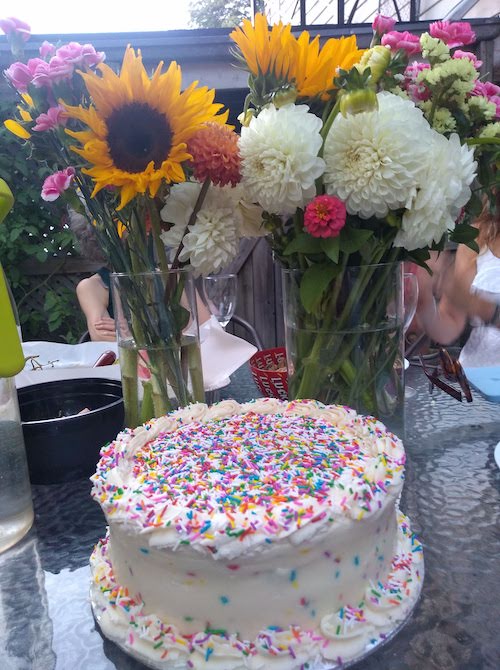
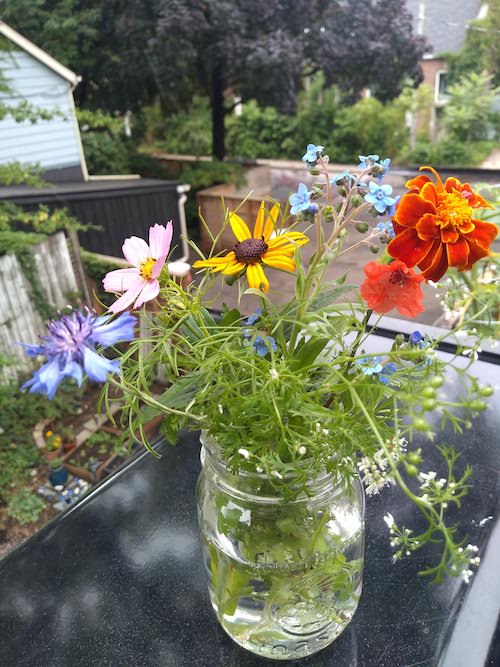
I’ve never observed my abortion anniversary before. I didn’t even know the date, had to look it up (20 years ago on August 1) but when the Supreme Court overthrows Roe Vs Wade on your birthday it’s not the time for business as usual. And so I’m so grateful for my woman friends who showed up in short notice on a holiday weekend to gather with me and commemorate the milestone of twenty years since this pivotal event that gave me my beautiful life. (I’m also grateful for the friends who would have been there and sent their love and support.) I asked my friends to come and bring flowers to add to a bouquet I’d started myself. Gorgeously, my vase overfloweth—and what a thing that my husband did the flower arranging. Twenty years ago, I was so lost and sad, but I am so grateful for the courage and conviction of that young woman who set me on the route to here, and what would I be without the friends who were there for me then and who are there for now (and my family too). What an extraordinary blessing, to get to own your own soul. I’ve said it before, abortion is unfathomable mercy. If that doesn’t resonate with you, I’d love you to get more curious. Happy anniversary to me.
July 29, 2022
Summer Reading
I would say that time’s gotten away with me since my week in Muskoka earlier this month, but that’s not strictly true. In fact, time has very much been on my side these last two weeks, which means that I’ve not been very busy, had enough time to do the things I need to do, and haven’t pushed myself to accomplish very much extra, such as recapping my holiday reads. But I’m finally going to get it done right now, because the reading was just so excellent.
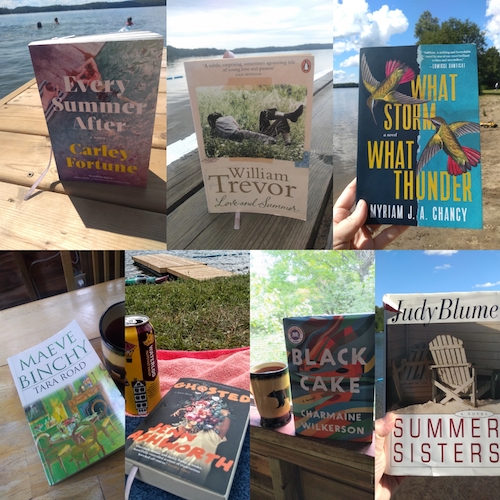
I started with a reread of Judy Blume’s Summer Sisters, which was published in 1998, and I don’t recall the circumstances under which I read it the first time, except that I think it was a book I enjoyed along with my mom and sister. And when I read it again, I was surprised to find out how much of it was still so familiar to me, even though I probably haven’t read it or even thought about it much in the last twenty years. Such a great summer book, rich and sweeping and just a little bit trashy. Holds up entirely, except for Vix’s reference to that Cherokee ancestor who’d gifted her those cheekbones, because we just don’t do that anymore. Lots of swimming in the pond on Martha’s Vineyard.
And next was Black Cake, by Charmaine Wilkerson, which I found absorbing, even if the storytelling style didn’t really work for me, skimming a (too) broad surface instead of plumbing depths. But it was still really fascinating, first with lots of ideas about food and colonialism and culinary history, and one of the characters is even an ocean scientist—there’s a whole lot going on. My favourite part, though, was the swimming, which I wasn’t expecting, because most Black characters in Caribbean-set books don’t get to swim so much, but swimming is a big part of the storyline here, as well as surfing, and I loved that.
And then I read Ghosted, by Jenn Ashworth, which I bought when we were in the UK because it was shortlisted for the Portico Prize for Northern English writing. I also bought her novel The Friday Gospels, and loved it, so expectations were high—and oh, she delivered. Ghosted is about a woman whose husband disappears, and she doesn’t tell anyone, which is kind of suspicious, plus she leads a pretty isolated life anyway and has a complicated relationship with her ailing father. There are secrets, but just like in Gospels, they’re not what you think they are, and Ashworth has such a gift for crafting suspense and writing sympathetic characters who are heartbreakingly human. No swimming, but scenes set in Morcambe and Brighton mean beaches definitely factor.
Following that, I read Tara Road, by Maeve Binchy, whose books I always dismissed with literary snobbishness, but I’ve come round, though hers is a curious kind of storytelling, very much telling. But what a wondrous tapestry of family and community Binchy weaves here, and I was utterly absorbed in this story which sweeps decades and continents, with women at the centre. Wasn’t expecting much swimming in this one, but there is a scene at the beach which inspired the opening scenes of James Joyce’s Ulysses!
Another Irish novel up next, Love and Summer, by William Trevor, the third novel I’ve read by him, and the least subversive, though it was in its own way, just more subtly so than the others (Miss Gomez and the Brethren and Death in Summer, both of which had evil lurking on its fringes and such wonderful dark humour). I think I love the works of William Trevor, and want to read them all. No swimming here, but there is a lake where Florian Kilderry walks his dog, and this is very much a novel about the pains of restraint and so nobody dives in.
I’ve already written about What Storm, What Thunder, by Myriam J.A. Chancy (SO GOOD!), which is definitely not a swimming novel. The one character who ventures into the sea ends up in a tsunami, so consider that a warning, but oh, what a book.
And finally, Every Summer After, by Carley Fortune, which is a much hyped book of the summer, perhaps too hyped for my liking, but I enjoyed it well enough, and its main character swims across the lake every summer, which is the kind of project I can get behind.
July 22, 2022
Freudenfreude
Freudenfreude (finding joy in other people’s pleasure) is truly one of the best habits that I’ve managed to get out of this pandemmick, and lest you think that I’m being repulsively sanctimonious right now, I can promise you that I am also well acquainted with freudenfreude’s much less salubrious evil twin (although I aspire to be better than that, and even sometimes succeed). But there was a time, when things were really rough and uncertain, that if I hadn’t figured out how to be happy for other people, I wouldn’t have been able to be happy at all, because there just wasn’t a whole lot of goodness going around.
This was about a year and a half ago, when the pandemic fatigue was real, and vaccines were only just beginning to happen. The very first person I knew who received a Covid vaccine was a friend who is a first responder, and we made him a card, delivered it to his house, because we weren’t going anywhere else, and had all the time in the world to do so. I wasn’t sure when I would get my own shot—predictions were for September 2021, perhaps?—but he needed immunity far more than I did, and I was happy for him, and for all the other people who love him who’d get to worry a little bit less. In a time that was rather bleak, this was a very good day.
And then friends in America started getting their vaccines, and I started saying, “I’m so happy for you!!” when they posted about it on social media. Partly because I was happy for them, but also because I’d come to realize that it didn’t really matter who was getting vaccines exactly (obviously it does, vaccine equity is a thing, and access is far from fair, especially on a global scale, but see, I was practising being magnanimous) because a shot for any of us is a shot for all of us. It helped too that those early glimpses of vaccine rollouts were a harbinger of similar goodness coming for us down the line. (I’ve felt the same seeing US kids under five getting their shots, knowing that so many families in my own community are going to be feeling the relief of having their own small children vaccinated very shortly!)
Possibly the root of my freudenfreude really is selfish after all, or maybe just not only altruistic, because I really do think we all win in a world in which good things happen and people get what they need. (I remember reading in Tara Henley’s Lean Out about how wealth inequity even made wealthy people less happy, because who wants the world surrounding them to be going to shit?)
Also being happy for other people was such a better feeling than what we’d all been through over the previous year, when you’d see someone on a playground swing, for example, and become enraged at the way they were putting lives in danger. When people were furious at twenty-somethings for sitting in the park. I was finished with the self-righteousness, with the shaming, and altogether tired of having the joy sucked right out of my life, and so every bit of goodness someone else experienced shone a little light upon my world. Family reunions, holidays, exquisite cakes, backyard pools, masked gatherings with friends six feet away in the garden—I was there for it. I was THRILLED for you.
It helped that I was finding my own small pleasures, going out of my way to care for myself and the people I loved. I knew what it meant, is what I mean, the hugeness of these small bits of normal, pleasure and connection. I felt it too.
When we FINALLY arrived in England in April, two days after our cancelled journey in March 2020, after such a long road, so much sadness, stress, and bother, a lot of people in my circles were feeling the freudenfreude, because they told me so. So many people were so happy for us, because they knew what that trip meant after what we’d all been through, how wonderful it was to connect with family again, to have any kind of a getaway after so much loss and anxiety.
It wasn’t just a trip. Nothing is “just a” anything anymore. A child’s birthday party in the park, dinner in a restaurant, being there when your grandfather blows out the candles on his birthday cake, a picnic with old friends, cousins playing together, sleepover parties, backyard bbqs, a trip to the movies, a day at the beach: I am so so happy for you.
And I am so so happy to be happy for you.
July 20, 2022
What Storm, What Thunder, by Myriam J.A. Chancy
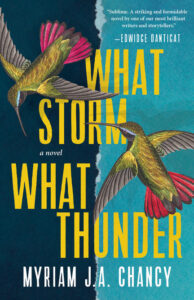
In June, I attended the second of a two-night spectacular in downtown Toronto celebrating the works of Toni Morrison and Black women writers (and had even contributed a short written piece about Morrison in anticipation of the event!) produced by Donna Bailey Nurse who, that night, was interviewing Myriam J.A. Chancy, Aminatta Forna, and Dawnie Walton, and I purchased Chancy’s latest novel, What Storm, What Thunder, which I read it on holiday last week, and it really is the very best book I’ve read in ages.
To read this novel, set in the aftermath of the 2010 earthquake in Haiti that killed 350,000 people, is to feel humbled. By the power of Chancy’s prose, first of all (I couldn’t help but read aloud an entire passage about leatherback turtles hatching on the beach: “They’d survived the Ice Age, continental drift, volcanoes erupting below and above ground, asteroids. They were the first superheroes. All that, and still, like most things, they began puny and fragile, scared and scrambling.” SO GOOD.) Humbled also by how puny and fragile are the lives we build in contrast to the destruction the earth might yield, as it did on January 12 2010, buildings collapsing, thousands of people trapped beneath the rubble. And finally humbled by how little I’ve thought about the Haitian earthquake in the years since it happened—how easy it has been to have the stories of lives lost fly beneath my radar.
Chancy, who is Haitian-Canadian, was not in Haiti when the earthquake struck, but in the months and years that followed, as she travelled and campaigned for organizations supporting Haiti and its recovery, she heard so many stories of people who had been. “Listening for years, I realized later,” she writes, “was a big part of the process of writing this novel.”
And so, fittingly, this is a novel constructed of a variety of voices—Ma Lou, the old woman who sells fruit at the market; a young boy makes money delivering her produce to the fancy hotel where Sonia, who works as an escort, runs into Leopold, a drug dealer, just moments before the hotel collapses. The boy’s mother is Sara, left traumatized by the loss of her three children, and her desperate existence in a camp after her home is destroyed. Ma Lou’s estranged son, Richard, a wealthy executive of a bottled water company, has returned to his home country from Paris in hopes of outrunning his own demons. Sonia’s younger sister Taffia tells her story of life in the camps, where rape is a common occurrence and resources are scarce, donations from other countries inappropriate and useless. Taffia’s older brother Didier is living in Boston, driving a taxi without a license, and he experiences his country’s tragedy from afar. Sara’s husband Olivier has left Port au Prince to follow rumours of factory work in other parts of the country. And Richard’s daughter, Anne, an architect who works with NGOs, leaves her placement in Rwanda to come home and volunteer in the camps.
Chancy writes in her acknowledgements, “In the end, what I wanted to capture was the way in which lives were disrupted, what those lives may have been life, before, what might have remained after.”
What Storm, What Thunder is vivid, brutal, gorgeous, devastating, its pieces so artfully woven, its storytelling invested with immense beauty and power. Haunting and mesmerizing, it’s the novel I’ve been trying to urge everybody to pick up since I read it, an extraordinary testament to what fiction can be and do.
July 19, 2022
Gleanings
- What does your weird little heart call you to do that makes you happy?
- Storms are welcome—alas, what else would carry the seeds far and wide? My plant, it turns out, is the sunflower—always looking only where the good can be found.
- If you want Summer to kiss you and make your heart beat faster, you have to slow down and enjoy each moment.
- The pools brought back a way of being in Toronto that hadn’t been available to me since the pandemic started.
- So, my prayer to the Universe is this: may I wake up each morning, remembering to do something fun.
- the FLAP friendship is hardy, healthy, has survived 40+ years and continues to blossom.
- Have you looked at flowers ever? I mean, if all things are logic, biology and scientific advantage, and survival, then what the hell is a snapdragon? Chamomile? Daisy? Hydrangea?
- How should the thought finish? As I walk through the valley of the shadow of Owen’s death, I have no sure path or comfort. All I know, or hope I know, is that at some point, in some way, I will emerge from it and he will not.
- We all end up using the same language over and over and the effect is just deadening. You just think, I’ve heard that, I know that already, and the brain gets over it. There’s nothing interesting there anymore because we’ve all said it.
- As Little As Nothing was a lovely read on a warm summer day, and it was also a reminder that women have been fighting for decades and will continue to fight, for agency and the right to make decisions about our bodies.
- Over lunch with my writing group the other day, there was much animated conversation over ‘Summer Reading’ and what did that mean exactly?
- What even is the soul? “Soul is not a thing, but a quality or a dimension of experiencing life and ourselves. It has to do with depth, value, relatedness, heart, and personal substance.”
- But while discussing the implications of your linguistic choices may be a good feminist practice (one that’s helped me clarify my thoughts on many occasions, and has sometimes changed my views more radically), ultimately I don’t think any feminist can claim the authority to tell other feminists what they’re ‘not allowed to say’.
- Fixing toasters alone won’t halt climate change, but there’s no doubt that changing our relationship to stuff is a part of the puzzle.
- Every morning I think as I swim. I think about the sky, its huge arc above me, the moon still wide awake some days. I watch the scribble of a jet trail appear and disappear.
- And so I return to this dance between me and thou.
July 5, 2022
Summer Read Supreme
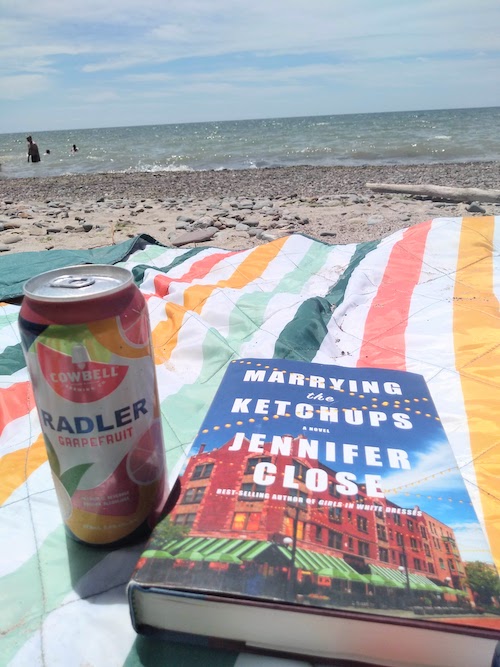
I’m happy to kick off my summer reading this weekend with Jennifer Close’s Marrying the Ketchups, which my friend Marissa recommended and which I loved so fully completely and devoured in a day. (Being able to read a novel in a day is my definition of a proper holiday, in addition to buttertarts.) I loved it so much, and it is the kind of book that, if a man had written, people would be heralding its emotional acuity and literary genius. Plus it was blurbed by Katherine Heiny and she was thanked in the acknowledgements, which is pretty much my literary catnip.
July 4, 2022
A Convergence of Solitudes, by Anita Anand

When I was on the radio last week talking about great books for REreading Canada, Anita Anand’s A Convergence of Solitudes was the one title I hadn’t yet finished reading, so I’m happy to report that I finished it this weekend and it lived up to my expectations and then some.
How do you tell a story that connections Quebec nationalism in the 1970s to the Partition of India in the 1940s, weaving in threads about Operation Babylift during the Vietnam War, colonialism in Ireland, and the experience of growing up as a person of colour in Montreal, creating a novel that’s not hitting its readers over the head with symbolism and parallels, but creating an organic and realized narrative that also remembers to run on its own steam?
Why, by structuring the novel as a double album, of course, this structure an homage to one of the story’s main characters, Serge Giglio, who headed a Quebec nationalism progressive rock band in the 1970s that never exploded like it might have because he refused to compromise and sing in English. So that the book becomes a sort of novel in pieces, but the pieces are drawn together compellingly and satisfyingly, moving between decades and characters and continents to culminate in what feels like an epic.
Rani grows up in 1970s’ Montreal, the daughter of immigrants, and finds herself drawn to Sensibilité, Serge Giglio’s band, to the point of obsession, though her relationship to its lyrics are complicated as a brown woman in Quebec who was barred from French schooling because she wasn’t baptized. When she meets Serge’s young daughter Mélanie, adopted from Vietnam, she’s drawn to the child because of her affinity for her father’s music, but perhaps it’s more than that. And when she connects with Mélanie again almost two decades later, this is affirmed for her, and she begins to wonder for the first time about her own parents’ experiences in Partition-era India and if she might be any more connected with these stories than she is the ideas Serge sings about in his songs.
While Rani serves as the main point of convergence between the various solitudes explored by Anand in her novel, the other characters—Sunil and Hima, her parents; Serge; his English wife Jane; Mélanie herself—are just as central to the text, the narrative portraying their various points of view and how these unfold over decades and between nations and continents, the connections between them (and also disruptions) serving to complicate notions of solidarity and independence and colonialism in a way that’s illuminating and fascinating, enlivening and unravelling ideas that might sound neat and tidy as political slogans but are more difficult to contend with in actual fact.
June 30, 2022
Gleanings
- Keep singing and dancing, drawing and planting gardens. This is no insignificant thing in the face of a movement that wants to make everything plain and ugly, cruel and sour. There is radicalism in refusing to judge. There is radicalism in listening. There is radicalism in saying, gently, ‘That’s not how I see it.’
- This doesn’t happen often. I am not a violent person. But right now, with broken families, broken hearts, beautiful cities torn apart by war, the consistent and constant gaslighting by politicians who could take measures but won’t, no authentic dialog, muddled truth, no compromise toward solutions, all leading to a sense of helplessness. it’s just time to break something. And cry.
- How on earth do we grow compassion, understanding, tolerance and acceptance on such stony ground? By welcoming one and all to the table.
- I remember rotary dial phones as a kid, which morphed into touchtones, then to call-display and the magic of voicemail. I remember when everything went through receptionists. If the person you wanted to speak with on the phone wasn’t there, the receptionist would write the message down on a special message paper, roll it up and pop it into a pigeon hole in a box that sat at the front of her desk (I say her, because back then they were never he).
- I think I want to write more about my life when I feel less sure about it. When things are a little dim or grimy or blurry and I turn to a Google Doc like it’s a magnifying glass or a flashlight.
- Minus our group’s cumulative, ongoing commentary and the special alchemy of our interactions and earned trust of each other’s opinions, adding words of criticism or praise here have no fair context. Does that make sense? And doesn’t that confirm that the secret sauce here is the book lists and information coupled with the chemistry of our fellow readers?
- For one, I’ve been highly reactive with the kids lately. My reaction time to kid-squabble-teen-bitchery is unbeatable. There is nothing faster, literally. My mouth and mother-hat are tilting wildly at windmills. At speed, mind you, which does not mesh well with health and wellness.
- I want to be open to the unexpected. Sometimes, opportunities fall into my lap; sometimes I pursue projects that don’t pan out but I’m glad I tried because why not.
- I want to stop worrying about ‘not enough’. My shaking doesn’t make me ‘disabled’ enough for instance, and there’s so many other things like that I feel. I’m fucking 46 years old and I’ve been though a lot. I think I need to stop being quiet and know we’re all enough, more than that. We just are. I might start going deeper, or at least trying to, and that’s kind of exciting.
- If I’m going to survive, I must make warm drinks. I must boil the water, select the mug, and also the tea – the latter two must align with the season and match the moon and whether I wish to feel free or safe.
- Recently a lovely internet friend and photographer wrote something on her blog that I one hundred percent relate to because what she said parallels how I use this space as well. Donna wrote, “This isn’t a portfolio of perfect images or a gallery of my best work. Instead, it is a record of my experiments and efforts.” When I read that, I couldn’t help but exclaim out loud, “Yes, that’s me too!”
- To follow my spirit, to say NO to societal pressures, is to go against the herd. It is to say once again, after fighting so hard my whole life to escape the pain of it—I am all alone.
- I’m more in love with trees every day now that I live with a forest. Am learning how they’re a community and speak to one another and how sometimes what we might call ‘crowding’ they call protection and comfort. Left to its own devices a forest pretty much knows how to be.
- Some days I think, Why bother? Why bother with writing books that get lost in the ebb and flow of the literary conversation, their voices a little quiet and timorous for these times? Or quilts, because honestly does anyone need another one in a world filled with stuff? But my hands need the work, my mind needs what happens when my hands find their way to loop and tie and dip and stitch. The way I find myself weeping when I see the cloth hanging on the clothesline, the books arriving in a courier’s van. See, you did this. It’s not quite what you meant to do (is it ever?) but you did this. On the cover of handiwork, a whole little flock of painted birds, ready to fly.
June 30, 2022
Canada Day Reads on the Radio
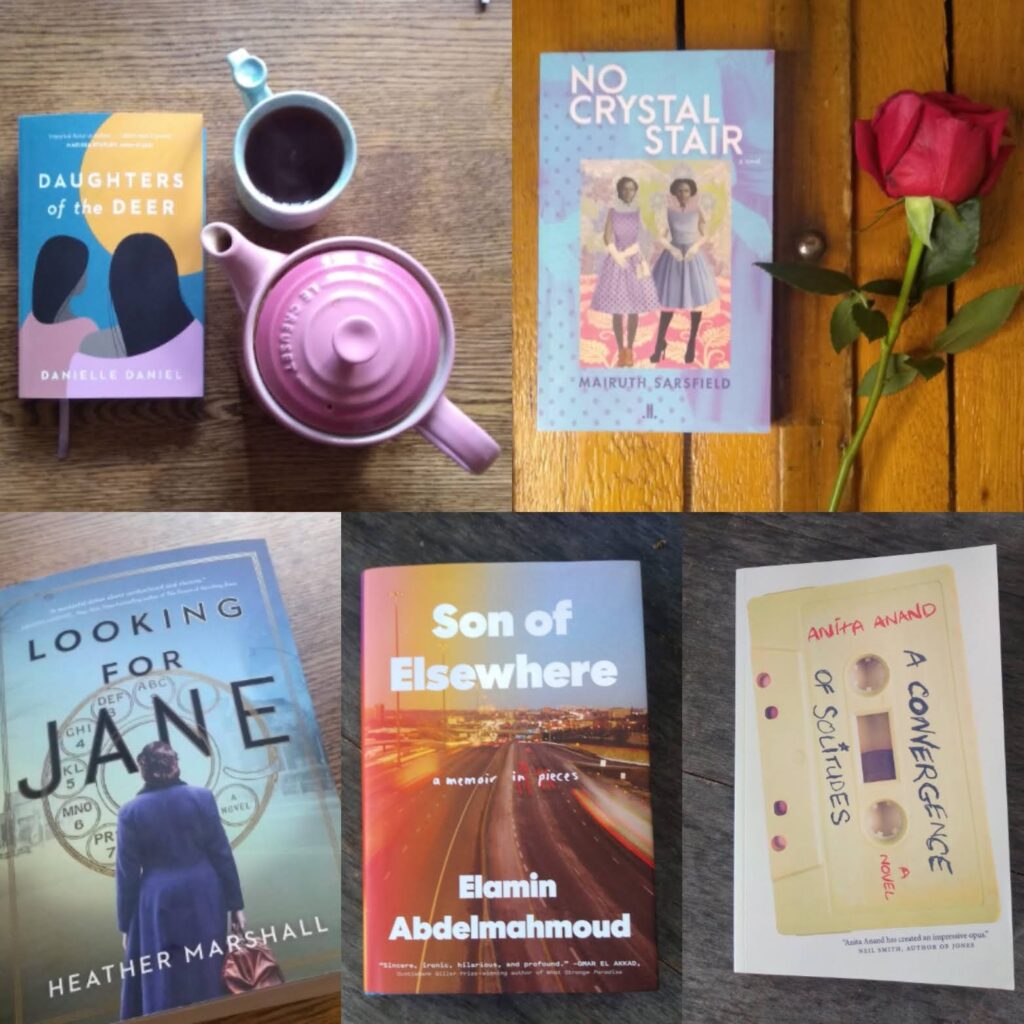
I was on CBC Ontario Morning yesterday recommending great reads for the Canada Day long weekend. You can listen again on their podcast.






