September 13, 2022
Big Flex
September is a new season, a new year, in many ways (and this September marks three years since I started Blog School!). For me, it’s always been a time for reflection and renewal, especially having come off such a restorative, restful summer with the goal of bringing that some of that softness with me as I go back to the “grind.” (I also would like to aim to not ground down to dust, less grind in my grind, please!)
“I think this fall,” I said to my husband, “I would like to have a kind of structure for my days, but one where you can move things around, everything not rigidly fixed in place.”
“You mean, like a calendar,” he said patiently.
“OMG, yes!” (Or maybe I finally need a bullet journal after all?)
But what I’m really saying is that I want a framework with a bit of slack, where my days have different shapes and things can be moved around to accommodate whatever else might be going on. My tendency is to be so unyielding in my approach to my days, partly because you have to be protective when you are self-employed and work from home, because everybody always things you’re just sitting around waiting to have coffee all the time, and also because I’m worried that if I’m not disciplined, the whole structure will fall apart.
But the thing is that sometimes I actually do want to go and have coffee, and also that often I actually can!
And I know that for some people, none of this is complicated, and also that adaptable calendars might not even be a revelation, but it’s too easy for me to become inflexible in my approach to my schedule, to do the same thing every Monday, Tuesday, Wednesday, etc, for one to be this day, and one to be another. I keep envisioning a structure that’s less a grid than a hammock, one of those knotted ones that are full of holes, but not so large that everything just falls through. Just that there’s give, and it’s easy, it stretches wide and low when it has to.
Is this the beginning of me FINALLY becoming laid back?
Don’t bet on it.
But maybe I can be me with more room to breathe.
September 13, 2022
The Long Road Home: On Blackness and Belonging, by Debra Thompson
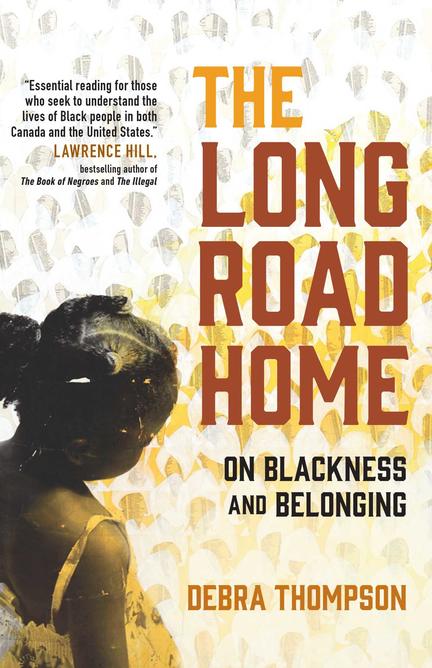
Debra Thompson’s The Long Road Home: On Blackness and Belonging is an excellent and bracing work of memoir and social science, providing a Canadian lens on topics explored in the works of Isabel Wilkerson and Ta-Nehisi Coates. Thompson writes about being a Black Canadian and her relationship to America, the land from which her once enslaved ancestors had escaped for Canada, which makes it a curious kind of homeland. And then about what kind of “escape” Canada offered after all, Canada’s own legacy of enslavement and racism seemingly muted in contrast to its southern neighbours, but that legacy lives. Growing up in Oshawa, ON, during the 1980s, Thompson was so often the only Black person, “[which] didn’t make me feel particularly unique or successful or special. It made me think that there was something inherently wrong with Black people and that I had to fight against it every day to defy what the fates had in store for us.”
After completing her doctorate (with experiences in academia rife with anti-Black racism), Thompson arrives at Harvard on a post-doctoral fellowship in 2010, just as the hopefulness of America’s first Black president was beginning to crest, and the story of her decade to follow traces a powerful trajectory in American history and politics, particularly in regards to race. She writes of her own ambivalence towards notions of American democracy, an ideal that has forever failed to live up to its potential and was imagined for the white men who have long been its beneficiaries, a process in which “African Americans are perpetual losers.” Her connection to American is further complicated as she moves on to teach in a town in rural Ohio, then in Chicago, and finally Oregon, as American moves from Obama to the election of Donald Trump, and then the “reckoning” of Black Lives Matter throughout the entire decade and public demonstrations following the murder of George Floyd in 2020. (She wonders if racial justice, for many white liberals, wasn’t just another Covid hobby to cut through the boredom, up there with Tiger King and sourdough.)
n 2020, Thompson moves—with her American partner and their children—back to Canada, to Montreal, which offers a whole additional layer of complexity to her lens, as she takes on notions of Blackness in the very specific context of Quebec. And throughout all of this she’s mindful of her place on Indigenous lands, with teachings by Indigenous scholars such as Eve Tuck and Leanne Betasamoske Simpson underlining her approaches to political science and being a human in the world.
The Long Road Home is a sparkling and engaging work, and also a demanding one, for white readers. Not that it’s difficult to read (see previous sentence on “sparkling and engaging”; I read it in two days) but that it’s literally demanding something of us, white readers—our discomfort, our willingness to see the white supremacy inherent in our systems, to wake up to the realities of racial injustice and begin to imagine a better, fairer world.
September 9, 2022
Blue Portugal, by Theresa Kishkan

To those of us who’ve been following Theresa Kishkan on her blog for many years, the preoccupations of her latest book, the collection Blue Portugal & Other Essays, will be familiar, the quilts, the homesteads, the memories, the blue. But it’s the stunning craftsmanship of the book, the fascinating threads that weave the pieces together and also recur throughout the text, that make this book such a pleasure to discover. How quilting squares are analogous to the rectangles from which, one by one, Kishkan and her husband literally constructed their home on BC’s Sechelt Peninsula, and the blueprints, and the blues of dye, and of veins, and of rivers, and of how one thing turns into another—how? How does a body get old? How do children grow? How does a family tree sprout so many new branches? And from where did it all begin, Kishkan going back to seek her parents’ nebulous roots in the Czech Republic and Ukraine, in a 1917 map of lots in Drumheller, AB, in everything that was lost in the Spanish Flu, and how we’re connected to everything our ancestors lived through.
Kishkan, as she tells us in her preface, came to writing via poetry, which she put aside when her children arrived, and when she picked up her pen again, she wasn’t a poet any longer: “I had the impulse to write, I had ideas to explore, material accumulating in my mind as my quilting basket accumulated scraps of cotton, but I didn’t have a shape for my thinking any longer. The lines I wrote continued past the point where a poet would consider the stanza, the lyric, complete. At first I tried to wrangle them, contain them, but one day I just let those lines continue, as prose maintaining a certain rhythm but given the freedom of the wide space on a page, One line led to another, then another. Their purpose was not to create fiction but instead to make a map of my own reflections, main roads and secondary roads, river systems, mountains, an beautiful circled stars for settlements. One line led to another, a threads leading me into the heart of meaning I hoped would be there, a little knot at the centre.”
And the meaning is there, but the poetry is too, still, (but not still!), this book a heartful, artful offering.
September 7, 2022
Pop This: Obvious Child

Guess what, there was one last place on earth where I hadn’t yet talked about abortion, and that’s the awesome Pop This Podcast with Andrea Warner and Andrea Gin, who had me on a few weeks ago to talk about OBVIOUS CHILD, the Jenny Slate “abortion rom-com” I saw in the cinema in 2014, where a post-Roe America was unfathomable. I rewatched it this month in the company of my 13yo, which was such a great experience. If there had been films like this when I was a teen, I likely would have spent less time saying things like, “I’m totally pro-choice, but that’s not a decision I’d ever make myself.” (Ha ha!) Since we recorded the episode, I’ve also been thinking about what a good job this movie does showing the messy reality of human bodies, bodies that fart, pee, (and even pee-fart), poop, leak, and get pregnant unintentionally. And abortion is just as ordinary as all the rest of that, as OBVIOUS CHILD shows, and I love that.
September 2, 2022
All of This, by Rebecca Woolf
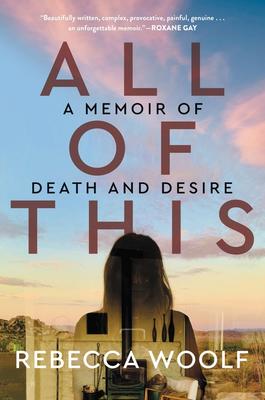
Rebecca Woolf (formerly of Girls Gone Child) is the only blogger on the planet whose sponsored posts I could actually stomach.
She once wrote a post sponsored by an almond company, and I still remember it.
So it’s not exactly shocking that her beautiful, gutting, raw, and awesome memoir, All of This, has proved to be unputdownable, a brave and visceral story of marriage, death, and widowhood from someone who has made a career out of making the unvarnished truth shine.
As a long-time reader of Woolf’s blog and instagram, I was wholly invested in her family life, in her marriage, and the story of her husband’s painful death from pancreatic cancer. And because part of that investment involved my admiration of her ability to hold two truths at once—that, say, her own decision to proceed with an accidental pregnancy at age 23, and her staunchly pro-abortion feminist politics are not incongruous—that the story of her family life, marriage and Hal’s death turned out to be far more complicated and tumultuous than it appeared from the outside only seems to be only adding texture to the story we’d been reading all along.
I remember the rats in the walls. I remember her commitment to telling the story until it came true. I know how hard she tried.
And I’m awed by her capacity for truth telling, and growth, and learning in public.
What does it mean when your husband dies and you feel relief? To be a widow who wants to fuck? To be a mother of four children who’ve just lost their father, and also a mother to one’s own self, one’s own soul? Beginnings and ends all at once. Everything is a circle.
Extraordinary writing, candour, courage and generosity is on display in this beautiful memoir, and also so much raw and bloody love.
September 1, 2022
Sweet Spot
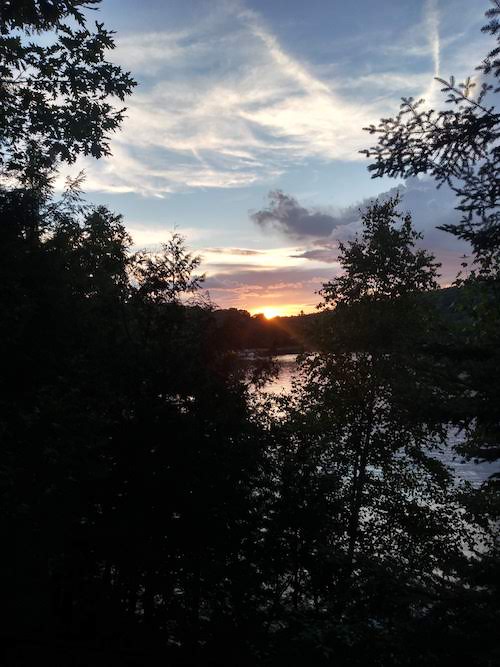
I’ve written before about the too-muchness of summer, and also about what the last two summers of less than optimal circumstances have taught me about “enough,”and somehow, miraculously, summer 2022 has found that sweet spot right in the middle, a perfect balance. Some of which I deserve credit for, because staying within my limits has been important for me this season (in June I didn’t, and it was not a great time), and so I’ve been seeking so much rest and moderation, healthy things to restore me after the first six months of this year during which I’d periodically compare my mental health to a fraying thread. I feel so much stronger now, and grateful for this reprieve from struggling, and grateful to summer for being such a gift, for being so soft and gentle when I needed it most.
I’m still not about to say goodbye to summer—we haven’t even been to the CNE yet. But I’m still afloat on the memories of our camping trips, days on the beach, drives up north, leaps into lakes, the card games and the board games, and the books I read, and the tarts we ate, and the friends we saw, and patio meals, and ice cream cones, Shakespeare in the park, tending my garden, farmers’ markets, bike rides, campfires, and the songs we sang, and the times I laughed until I cried.
Oh, how I’m satisfied. So very satisfied.
September 1, 2022
Gleanings
- What if we knew and trusted and embodied a felt feeling and awareness of even mere moments of being satisfied, content — of having and doing and being … enough. What might become possible?
- Don’t make the mistake of thinking that contemporary fiction is all there is. Older books need not be the traditional classics that you read at school, if those aren’t your thing. Seeking out books published in earlier decades can provide you with a plethora of new favourites…
- What happened to the Retro Frosted Cake Brownie, y’all? Is it out of fashion? This is criminal!
- While I swam, the last of the swallows were dipping over the surface of the water, two of them swooping right over my arms, windmilling me backwards from one grove of cedars to the other, my sentinels.
- It has been much more than a week of lasts — indeed many happened much earlier, without out us being cognisant or marking those occasions.
- First come the peonies, then the Dahlias –– and then come the sunflowers, summer’s last laugh.
- in the face of countless calls to health insurance companies, car troubles, worries about money, automation, depersonalization, there are roses, there are flower petals dropping to the ground while no one watches. the fans oscillate. the artwork falls cockeyed in the frame. there is a chill to the air today, reminding me that i’ve survived another summer. jazz plays while i am on hold and i enjoy it. lots of horn.
- Is the world, ever so slowly, righting itself again? Stabilizing? So, so slowly? And if not — or if this sense of balance, possibility, and normalcy is also only temporary — can I enjoy it for this moment? There’s the bigger question.
- When asked about books that have stayed with me forever, what comes to mind immediately is a childhood collection of stories…
- When I sit to do my daily meditation, I try not to look at my meditation streak.
- I still can’t give a particularly good reason for getting the very large tattoo, or even for the chosen image (an owl made of woven ribbons), other than I like it.
- So, my advice would be to celebrate every success like it was the end goal. Finished an entire draft? That’s a huge accomplishment! Stop and revel in that. Revel in every moment. By all means, keep climbing, but don’t forget to take in the view on your way up.
August 30, 2022
More Vacation Reads
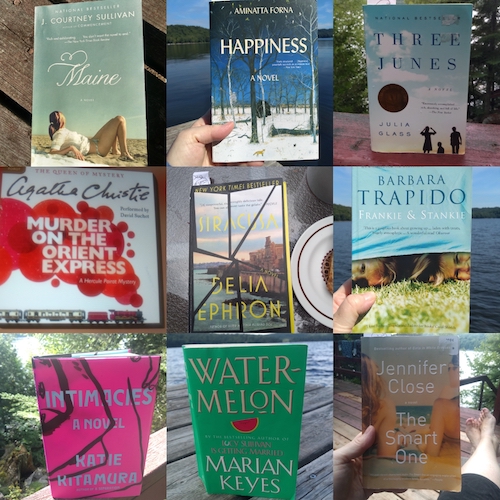
For the second summer in a row, we’ve gotten away for two one-week-holidays at a cottage, and I feel so lucky that this is possible for us and will go out of my way (if necessary) to continue to make it so because it’s just the very best thing, so relaxing and restorative, which has been the theme of my summer in general, and what a gift. And not just because I got nine whole books read!
The first was The Smart One, by Jennifer Close, which I stole from the resort library of the cottage we stayed at in July (though I left two books in its place, so that’s okay, right?). Since reading Marrying the Ketchups in July, I’ve been wanting to launch a Jennifer Close kick, because I enjoyed it so much. The Smart One, her second novel, is similarly a book about adult children coming home again after failures to launch, and it started out fine enough, very typical commercial fiction fare, I thought, but then I started to notice the thread of thoughtfulness that wound the different parts of this story together, and the questions the book asked about what it means to be “the smart one” or “the pretty one,” and the impossibility of any woman making the right choices. Surprise pregnancies, Catholic guilt, people called Cla(i)re and the ties that bind were introduced in this novel, themes that would appear in subsequent books I read.
In Watermelon, by Marian Keyes, the pregnancy is not, in fact, a surprise, but what is a surprise is that Clare’s husband announces he’s leaving her right after their child is born. (He didn’t want to mention it before, because it might have been a risk to her health then.) And so Clare decides to pack up her London life and head home to Dublin, to the house that she grew up in with her legion of sisters, and there she proceeds to drink away her pain and then plot her way toward a better life, so that when her husband finally appears to win her back he’s not really sure what’s happened. I will confess that this is not the best Marian Keyes book I’ve ever read—and I found it in a Little Free Library anyway, so no matter. It was entertaining enough but also utterly implausible—Clare’s newborn baby seems remarkably independent and leaves her mother with plenty of time and space to explore her own needs, which was certainly not my postpartum experience. I also found it very amusing when everyone in this book from 1996 worries that their bum looks big from the vantage point of the 2020s when big bums are all the rage and unflattering jeans are where it’s at. This book was something of a relic but also a perfect diversion for a summer’s day.
Next I read Intimacies, by Katie Kitamura, which was the odd man out of these books in many ways (such as, I didn’t find in a Little Free Library), but had more in common with Marian Keyes’ Watermelon than you might imagine (and intersected with Aminatta Forna’s Happiness in interesting ways). It’s true that this is not a novel about ties that bind, instead it’s about being free of those ties, which doesn’t always feel like freedom. Intimacies is a novel about exile, about belonging nowhere, and features a protagonist who’s dating a man whose wife has left their family, inviting some of the parallels to the Keyes. It’s a curious and alienating novel, one just a little too cold and precise for my liking, but that’s not a criticism, just taste.
After that I read Siracusa, by Delia Ephron, who I’ve never read before, and I think I found this book as a secondhand bookshop. It’s a novel, like Intimacies, with an atmosphere that feels oppressive, but far more revealing, and actually intimate. Could be described as a taut thriller, but it’s weirder than that, about two couples who travel to Italy together and whose lives seemingly unravel on the journey with players being played and too many secrets threatening to be revealed. Quick and eerie, I really liked it.
And remained by the Ionian Sea for my next book (or at least it’s beginning), Julia Glass’s Three Junes, which I knew nothing about, except that it won the National Book Award in 2002, and my friend Marissa recommended it to me (and she never steers me wrong). I loved this book, which comprises three distinct sections—the first of Scottish widower Paul on a Greek holiday months after the death of his wife; the second from the perspective of Paul’s son Fenno, a NYC bookseller coming home to Scotland after the death of his father five years later; and the third set five years after that when a character we glimpse in the first section meets Fenno on Long Island where she is accidentally pregnant (and there’s a pro-life activist; curiously, there is not an abortion in any of the books I read in this bunch, truly a holiday indeed) and waiting for her boyfriend to return home from Greece so she can tell him about the baby. This novel is a bit strange, and its connections aren’t always clear, but I found it utterly absorbing.
And then I read Frankie and Stankie, by Barbara Trapido, which blew my mind. I read Trapido’s reissued debut, Brother of the More Famous Jack, when we were in the UK in April, and while I enjoyed it, it was so unlike anything else I’ve read before that I had trouble placing it in my mind. This novel, written more than thirty years later, is helping me do so, however, because it’s brilliant. Ostensibly a coming of age novel set in South Africa during the 1950s and 1960s, it manages to be a fascinating (and hilarious) character study, story of a family, but also the most interesting history of South Africa I’ve ever read at once. (In her notes at the end of the book, Trapido explains that the forty years that she’s spent in the company of her husband, Stanley Trapido, a professor of South African history at Oxford, certainly informed her point of view.) I learned so much from this book, but it was also delightful, and now I am officially Barbara Trapido-obsessed.
All the while we were listening to Agatha Christie’s Murder on the Orient Express in the car on audiobook—it was so good!! We all kept coming up with reasons to go somewhere just so we could get in the car again and hear what happened next. Truly a delight for the whole family, even Stuart, who had watched the movie recently so had a good idea of what was coming.
And then I read Happiness, by Aminatta Forna, which I purchased at the Toni Morrison event I attended at Luminato in June, and like everything associated with that event, it was just so fantastic. As unfathomable as it seems, a novel about urban foxes in London, coyotes in the northeastern United States, and PTSD from war in Sierra Leone, amongst many other things, the novel becomes a study of wildness, of humanity, of love and goodness. Part of it also spoke directly about my own anxiety, my fear of hardship and suffering, a fear of trauma which is seemingly a condition of white, middle class, privileged people in the West, which might cause us to turn our backs on those for whom trauma is lived experience. And trauma also doesn’t have to be destiny—it changes one, but it doesn’t necessarily leave one damaged, as psychiatrist Attila explains. There’s so much to unpack here, but I’m looking forward to reading it again and getting to work.
And finally, Maine, by J. Courtney Sullivan, which I’d saved for the end, something light and easy, another seaside book with Catholics, accidental pregnancy and someone called Clare, though it was probably the most forgettable of the bunch, so I’ll leave it at that.
Hooray, hooray for holiday reading.
August 25, 2022
There are no edges.
I was reading Katherine May (again; I am nothing if not consistent), a post about how her people are “edge people,” about how she’s drawn to margins as a result of growing up far from the centre, and it made me think about how growing up smack dab in the middle of a continent (I didn’t see the sea until I was 10) might have informed my own tendency to adhere to the status quo, to centre my own experience instead of seeking a broader understanding (though I think a lot of people do that; though isn’t that just what somebody with such tendencies would think?!?), but also how it has truly left me hungry to know the edges of places sometimes, which is why—in my most pivotal moments—I find myself so drawn to the Great Lakes shores, to their infinite horizons.
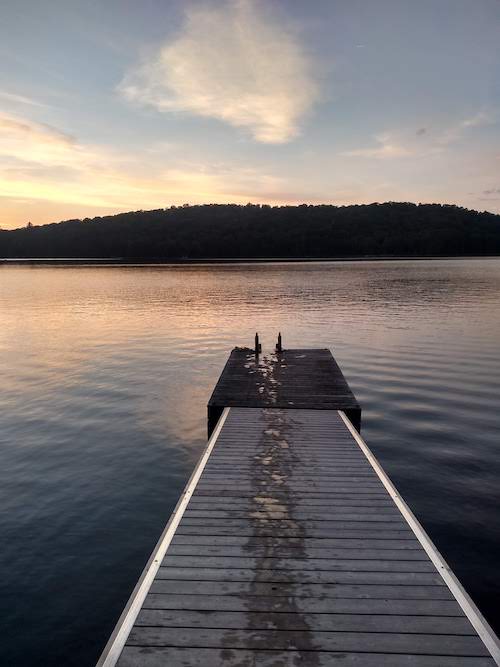
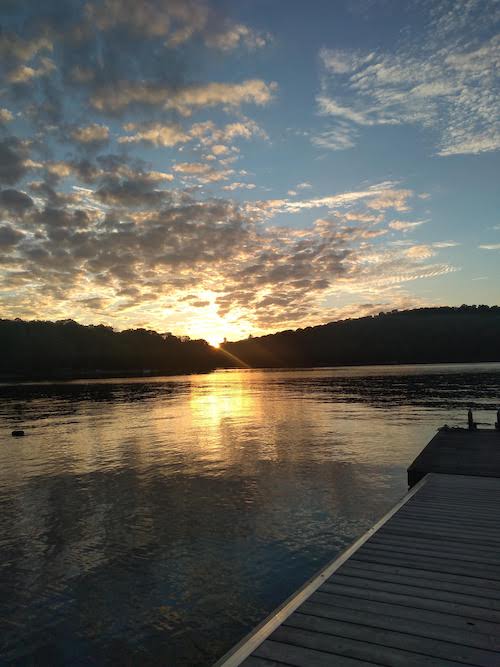
The lakes more familiar to me, however, provide a very different sense of being in the world, instead of edginess, immersion. (And maybe this is what you love when your people are middle people?) The lakes of Haliburton, ON, in particular, just north of the Kawartha Lakes I grew up with, and different too, more rugged with such rocky shores, self-contained instead of each lake merely a conduit to another place, water instead of a waterway. The cottage we’ve rented there for the past three summers does not have a beach, instead a dock with a ladder at the end, so you’re either in or out, there is no in-between, and when I’m in, I feel like I belong to the world in the most peaceful and meaningful fashion.
There are no edges, the lake a giant rocky basin that turns into trees that turns into sky that turns back into trees again as you trace the shape of the visible universe, everything a circle, leading back to the lake, leading back to me there, buoyant and held, connected to all of it, grateful to be one with these waters, clear, silky and cool.
August 9, 2022
Gleanings
- Instinctively, I started referring to the city of my birth by its Ukrainian name, Kharkiv, rather than Kharkov. The vowel change might seem insignificant, but it marked a shift in my thinking. I could no longer bring myself to say “Kharkov” aloud without confronting the stench of imperialism, violence, destruction and forced occupation. I have stopped telling people I am from Russia, because not only is it disingenuous, but it embraces an oversimplified understanding of history.
- As I orient myself, today, I hope to find new and continuing ways to conjure and appreciate experiences, both ordinary and extraordinary, that make possible profound connection with others. I want to be open, always, to that swirl and whirl of delight in what is, that grounds us in what’s happening with joy, trust, light, and lightness.
- How often life can feel this way, like there’s so much to do, could do, should do, could have, should have, could experience, should experience … that has us grasping at scarcity and urgency and fear and the elusive satisfaction that will be found somewhere out there.
- Last year we were away for two months traveling and I longed for this place of blue sky, and mountains, and wide open spaces. I dreamed about this place when we were gone.
- As I have learned more about grief and what helps people move through it, I have realized that the compulsion I felt starting very soon after Owen’s death to write about it was probably an intuitive reaching towards what in therapeutic jargon is sometimes called “meaning making.”
- It’s a reminder isn’t it? A reminder to find some balance between the sludge and the sparkle. A reminder to peek out of the (often unavoidably) muddy bits when and if you can. A reminder that there are beautiful bits tucked all around us, just waiting to be welcomed into each day, if we only take the time to notice them.
- A million years ago when I first left home and moved to Toronto I met a woman, a potter. She had her own studio. I wasn’t yet twenty and she might have been twenty-four, twenty-six, something ancient…. I remember she was ancient.
- books don’t go stale. Books can wait for you to (re)discover them, in your own right time.
- But my favorite kind of souvenir, no surprise, is the one that doesn’t get put on a shelf or forgotten about immediately upon its homecoming. The best souvenirs settle themselves right into the way of things—souvenir objects that transition themselves into everyday objects.
- A heat wave book if I ever read one. You Made a Fool of Death with Your Beauty by Akwaeke Emezi is a book that colourfully conjures sun, sweat, and that shimmer in the air on a hot, hot day. Oh, yes, and a little splash of blood, too.






