February 23, 2023
This is the House That Luke Built, by Violet Browne
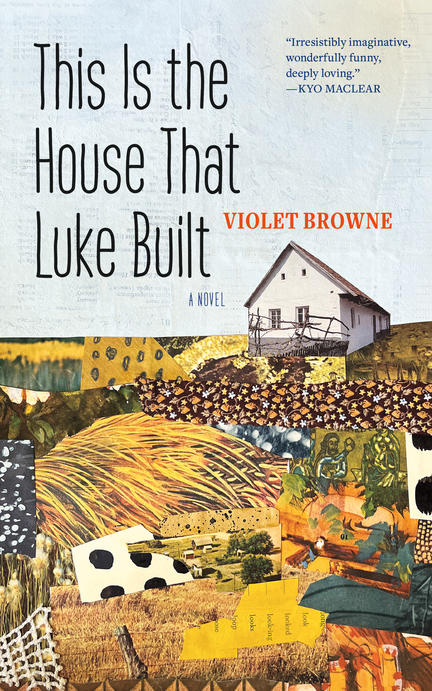
I don’t really know where to start with this book, this brutal, gorgeous, funny, strange and loving story of loss and living, though there is an obvious comparison in terms with subject matter with Lisa Moore’s February, but Violet Browne’s This is the House That Luke Built—fiction born of the author’s own experience—is something altogether its own. Something that, I must confess, I don’t *get* in its entirety, but I’m going to speculate that this is the point, that there are element of Rose’s experience of loss and widowhood that are unfathomable to me, the same way that, I suppose, I once read Rachel Cusk’s A Life’s Work before I’d had children and missed the point altogether.
The novel is told in a series of vignettes moving back and forth through time, showing Rose early in her relationship with Luke as, with her two children and his son, they come together and make a family, baby Emily arriving not long after. We see Emily in 2013: “Every since her father vanished when she was fifty-three days old, Emily’s body has been gripped by a vibration at the molecular level,” an urgency she tries to satiate with tattoos, piercings, as she tries to settle with what was lost to her. 1994, as Luke’s boat goes down in a storm. 1980 with Rose in her father’s boat as a child, in Plancentia, NL.
Mostly though, these vignettes tell the story of Rose trying (and often failing) to pick up the pieces of her family life after Luke’s death, how time marches on, how her parents and her sister keep her going, as do her children, with their own needs and particular wounds that become clearer over time. But she ends up eking out some kind of a deal with the fates, that every year on the anniversary of Luke’s death, Rose gets to walk through the wall of the house he’d built for their family and find him waiting there for her, though it’s a deal she must pay dearly for—in exchange, she’s aging faster, losing years of her life, her teeth decaying, her skin losing its definition. Until eventually she’s asked for too much…
I love this book, just as heartbreaking as it is hilarious, full of gorgeous prose, and gutsy women, and so much love, even in the face of so much loss, maybe especially. Rose’s struggles to raise her kids and make a better life for herself are harrowing and awesome, and the flame that continues to burn for the husband she lost is sustaining, transformative, unforgettable.
February 22, 2023
Gleanings
- I loved this book because it acknowledges the unfairness of the world and the privilege of those who fall back on a shallow understanding of faith. But where I can get mired in despair over these truths, Vanessa is out there beating a path through these weeds for all of us.
- The story was titled Wankus Interruptus, and when I first read those words, centred at the top of the page, I paused. (Do you know this feeling? A fleeting fuzz of nostalgia. A whiff of emotion. In this case, the top note was humour.) The phrase was familiar. Why? And in the next second I recalled.
- If you pay attention to the world, you will love it more than you realized was possible. This love will break you down and build you up.
- When we walked the route to church or our cousins’ house, we passed by the slum where our ayah lived. There was a big gate that separated the area where the servants lived in cramped poverty. Sometimes the gate was open and I would glance in as we walked by, curious about the squalor that lay beyond, where there were children like me but not like me. We were worlds apart.
- Like maybe, even if we aren’t friends (yet!), we are neighbours in a spiritual suburb full of women trying to parent and work and be full human beings and sleep through the night. It’s not a bad place to live.
- That there’s still a piece of me (oh how it works so hard to keep me safe) … that thinks that there is a right and wrong way to get to that place, that there’s a right and wrong way for me to be, to feel, to act, to travel, look, to parent, to human, to live.
- And by the time I’ve done all these things to my outer self, my inner being is nodding and rolling their eyes and going: Yeah, yeah, ok. We’re not such a dirt grub. We clean up nicely, we make cool things, we’re strong, we really do like ourselves and others. Sure. Whatever. Let’s do this.
- I sewed and John healed and then I wrote about how the two processes were intimately connected, the threads overlapping and entwined. (In an older time, his incisions would have been sewn up after the surgery but now most surgeons use staples!)
- You’d think a cylinder would be easy but it’s often the simplest forms that are most unforgiving. As I am not a thrower, I know that my forms will never be as tight as they would be on a wheel, and nor do I want them to be. But cracks won’t do. ‘Practice makes good,’ is my new motto.
February 21, 2023
Blackwater Falls, by Ausma Zehanat Khan
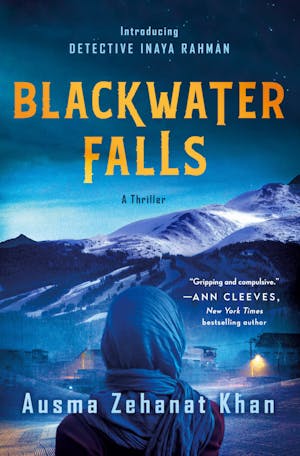
Blackwater Falls launches a new mystery series by Ausma Zehanat Khan, whose Esa Khattak/Rachel Getty books I enjoyed very much, this new series set in Colorado, where British-born Canadian Khan now makes her home, and with Detective Inaya Rahman at the helm. This is a novel very aware of itself as a police procedural post-2020, just as Rahman herself is aware of her complicity as part of a system that neither serves nor protects people of colour.
And it’s not just (B)lack and white, literally, or otherwise. Detective Rahman, a member of the police’s Community Response Team, is brought in after the body of a teenage girl, Razan, a Syrian refugee, is found murdered and bizarrely displayed at the entrance to her mosque in the rural town of Blackwater Falls, CO. A gang of menacing bikers linked to the local Evangelical church lend an aura of menace to the case, plus a local Black activist is furious that this one murdered teen is garnering so much attention, while two other cases of Muslim teens missing from the local Somali community have not even warranted an investigation, have been shrugged off as merely runaways.
Detective Rahman has to gain the trust of local Muslim communities, work toward finding Razan’s killer, tiptoe around the local Sheriff with white supremacist leanings, and also make sense of her superior, Detective Waqa Seif, who keeps obstructing her investigation in curious ways—is he working for the Sheriff, perhaps, or is there some other secret that he’s hiding?
Meanwhile, Detective Rahman is still dealing with PTSD from a violent assault by her police colleagues at her previous job in Chicago, a retaliation for her efforts to hold an officer to account for the killing of a Black man at a traffic stop. And Khan’s depiction of this assault, told through a flashback, was one of the most devastating, affecting bits of fiction I’ve encountered in a book lately—some readers may want to take care.
This novel by Khan—who holds a PhD in international human rights law—is very much a story of our time, from white supremacy, police brutality, Black Lives Matter, border policy, refugee struggles and more, right down to the inhumane working conditions in meatpacking plants that has resulted in so much death due to Covid-19 over the last three years. And yet this isn’t a book that gets bogged down in the issues, perhaps because Khan goes out of her way to have her story show the interconnectedness of all of these ideas and the way they affect people’s lives and communities. The stakes—both in the novel and in reality—are huge.
February 17, 2023
Do Good for a Chance to Win a #TodaysTeacup Teacup
It’s just ten days before the Coldest Night of the Year event where I’ll be walking in support of my local Fort York Food Bank to help them meet their goal of raising $100,000 in support of the vital services they provide to my neighbours.
(FYFB is a small but mighty food bank in downtown Toronto. They serve over 2,400 clients weekly with grocery hampers, hot takeaway meals on Sundays and a grocery delivery program for 160 seniors every Monday.)
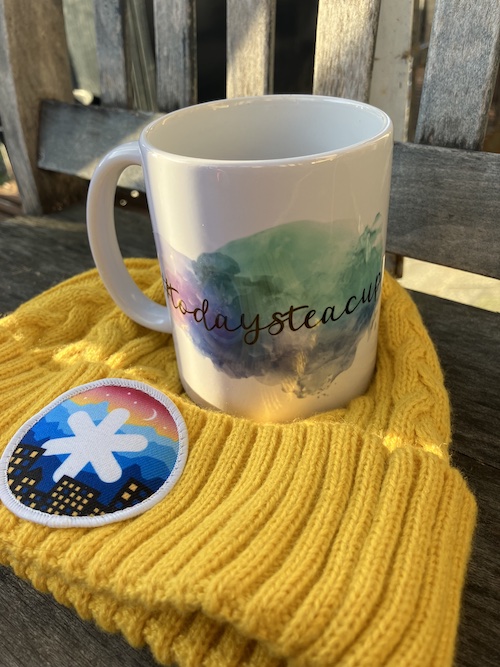
And now the stakes have been raised—when you donate to our campaign, you’ll be entered into a draw to win a most extraordinary, coveted object, the very FIRST Official #TodaysTeacup Teacup, perfect for your own personal tea times to add a bit of ceremony to your life.
Even better, the Official #TodaysTeacup Teacup is not just any old customized mug, oh no, this Official #TodaysTeacup Teacup was designed and created locally by my friend and neighbour, the multi-talented @esquared.designs—and it could be yours if you donate to our #CNOY2023 team today! Once the event is over, I’ll be making a draw and will personally mail this mug to YOU! (Canadian addresses only please.)
Do you want to win?? Donate at our team page and you’re automatically entered into the #todaysteacup giveaway while raising money for good in the process. Win, win! WIN!
February 15, 2023
Gleanings
- Misogyny may have been force-fed to us, but we still ate it up. Realizing later it was making us sick didn’t change that.
- When I’ve gone on solo trips, people have said the same thing to me, “How brave of you.” I have not considered it bravery, merely a curious and adventurous spirit, and, honestly, a bit self-indulgent. Because I can travel, I do.
- Have I mentioned that I do not like anyone touching my feet? This guy, he is going to touch my feet. I wish they could put me under general anesthesia for this but it sounds like no.
- I so believe what Dan Savage said, that a love story has to be written and re-written, over and over again if it is to survive. A couple is not just a commitment in terms of sexual fidelity and household labor, but a commitment to an evolving idea.
- How can I possibly fathom what I’m making of my life, while I’m living it? What a comical task to set for oneself.
- Here’s a way to blog: you take a few things that are currently of interest to you, and then you start to ramble and see if they make sense together. Sometimes they really do! Sometimes it’s kind of a stretch….
- Kindness is a choice, a decision. It’s a conscious intention towards thoughtfulness, amiability and goodwill. I was ready to give up on ever having a map of the creeks, but then a sweet moment of grace happened, the kind that caused gratitude to explode in my chest, and just like that, my world was – is – wonderfully rosy.
- I can have my spreadsheets and my 5-point book marketing strategy. I can do all that. But then I can also go out for a very quick ski and end up injured, off work and unable to type or do basic tasks for multiple weeks. Who knows how it will all go? NOT ME.
February 14, 2023
Swimming in Pee
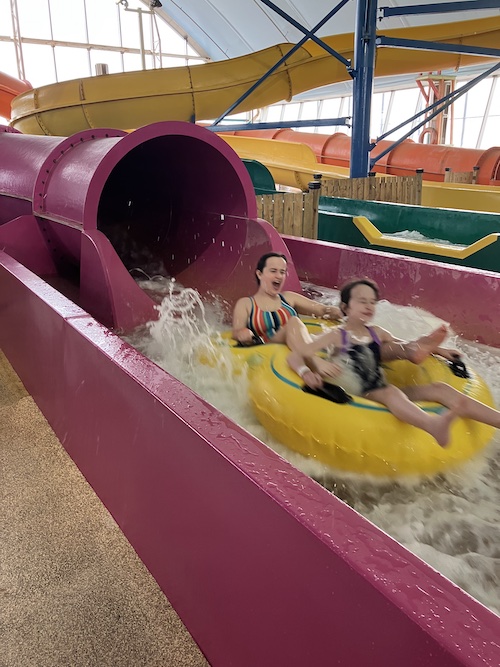
We had the kind of weekend this weekend that hasn’t been possible in such a long time, the kind of weekend that we were wondering if we’d ever have again, even just a year ago, and it felt really good, to be so full of joy, our time full of fun, everything carefree. And something I can write on my blog that I would be less comfortable posting to social media, which is so much more amplified and devoid of context, is that we thoroughly forgot about Covid this weekend. 24 hours in Niagara Falls, staying in a hotel, visiting an indoor water park, and eating in restaurants—the object was enjoying ourselves and beyond packing hand sanitizer, we were going to not worry so much, leave our masks in our pocket for once.
Which I know is something we’re very lucky to be able to experience, but anyone who reads here often also knows what a terrible time I’ve had with anxiety over the last few years and how Covid absolutely fucked with my brain, made me think that keeping our health system functioning was my personal responsibility, and that every single one of my actions was so gravely consequential that I eventually was unable to do anything except walk around weeping at the sadness of it all, crumbling under the weight of this imagined burden of personal responsibility and my own catastrophic thinking. It was really bad, and terribly debilitating, and also really freaking hard for my family, and no doubt my kids will be talking about this in therapy for decades to come.
(I really really hate the way that bad actors hijacked the conversation around the pandemic and mental health right out of the gate so that it became impossible to have good faith conversations about any of this, to acknowledge that Covid is real and threatening, but also that there are dire consequences of having an entire society living under a perpetual emergency for literally years.)
And so it was actually really important, and even healthy, to have this little holiday away from it all, a bit like tearing off a band aid, pushing myself out of a strange uncomfortable comfort zone. If we got sick this weekend, we reasoned, so be it. Which is the kind of gamble that’s always been necessary for a trip to an indoor water park anyway, right? We were pretending that there was no circulating respiratory viruses, just as we were pretending that the wave pool wasn’t populated by people (hopefully mostly just the small ones, which is somehow less disgusting!) who were freely urinating without compunction.
So naturally, my youngest child woke up this morning puking—an inevitable water park aftermath. (She has been well since mid-morning, however, and will likely be returning to school tomorrow.) And then I headed to the hospital for my annual thyroid check, where it was found that one of my nodules had grown larger and so I had to have a biopsy (which I have had fairly often, and they’ve always been benign, thankfully), cystic liquid being sucked out through a needle in my neck.
And in the lab where I was sent for routine bloodwork, the technician was dressed in red for Valentines Day, just like I was, and we remarked on how we matched my blood, which filled four small vials for testing, and it somehow seemed fitting on Valentines Day, it being about hearts and all, my heart and your heart doing the amazing work of keeping our remarkable blood pumping through our gross and awesome bodies, and how all of us are connected, for better or for worse, most irrevocably.
I took the subway to the hospital for my appointment this morning, the first time I can recall riding transit at rush hour in such a long time, and the subway cars were packed, and more people than not with masks on, including me, and far more people with masks on than I ever see at off-peak hours (which makes a lot of sense!), and the subway was also so audibly quiet, people possibly on alert and good behaviour due to recent acts of violence on transit, and maybe that calm and quiet was what made it a little extra easy to feel in love with everybody today. All these people who’d woken up and had their breakfast and gotten dressed, and maybe nursed sick kids, or walked their dogs, or watched the sunrise with a cup of coffee, and now they’re out in the world, surrounded by strangers, following the rules, going through the motions, minding the gap.
It isn’t necessarily how badly our society functions that is remarkable, all of its faults and flaws, as I’ve written many times before, but instead that it functions at all. That most days in this city hundreds of trains take people places, and those people make room for each other, and move over on the stairs to let others pass, and help somebody up who has stumbled and fallen. That lab techs who dress up in red to make someone’s day a little brighter, going to work to poke needles, drawing blood, performing work that just might mean the difference between life or death. The miracle of socialized medicine and that I get the care I need to stay healthy. The miracle of ultrasound. The mask I continue to wear, when it makes sense, in my day-to-day life, and the knowledge that all of us, always, are swimming in pee.
And somehow, this is love.
This is life.
Happy Valentines Day.
February 8, 2023
I’m Good At
This post is inspired by Kate’s, which made me think. Like Kate, I am also good self-deprecation, and I’m also good at getting irritated by inane social media posts with messages like, “You are good, and you have worth, you are beautiful, and I love you,” which just never means a lot coming from a complete stranger and directed toward the general public, you know? I always prefer to be admired in the specific, and so, to that end, and also because I could write a post about what I’m bad about that would go on and on all day and I’m much less practiced in the art of affirmation, I want to put my mind towards those things at which I am strong and capable.
I am good at managing my household purchasing and, without use of sort of spreadsheet or app, keeping us from ever running out of such essentials as toilet paper, tea and maple syrup. Butter and eggs I take no credit for, because these are delivered weekly, but there is a part of my brain that is tracking our current stock of jam, and it never ever fails me.
I am good at helping to hold my kids’ feelings when they’re sad.
I am good at driving, which is an extension of the fact that I am good at sharing space in general and negotiating my proximity to others (except when I am dancing, arms flailing, likely to strike somebody in the face). I am also good at sharing space in the swimming pool and letting faster swimmers go ahead of me
I am good reading, and staying focused on reading, and finding the pleasures of reading.
I am also good at understanding what a book is at its heart, which makes me good at reviewing books and interviewing authors.
I am good at going to bed on time.
I am good at ensuring there is always a tin of fresh baking in my kitchen for snacks and stocking lunches.
I am good at meal planning. I am good at making dinner for my family every evening. (I am also very good at eating whatever somebody else has prepared for me, in particular lunch by my husband, a near daily feature now that he’s been working from home for nearly 3 years.)
I am good at making bad times into something good and bearable. Sometimes I am good at this, literally, to a fault.
I am good at picnics. I am good at keeping the teapot full. I am good at getting the hard work out of the way so I can focus on the fun parts. I am good at delayed gratification. I am good at remembering to floss and actually flossing. I am good at doing big things in small pieces.
I am good at karaoke and knowing all the words to epic poems such as “Total Eclipse of the Heart” and “If I Could Turn Back Time.”
I am good at supporting local independent businesses. I am good at putting my money where my mouth is and actually doing the things I say. I am good at meaning what I say and avoiding falsehoods. I am good at not pretending. I am good at being the same person in person as who I am on the internet.
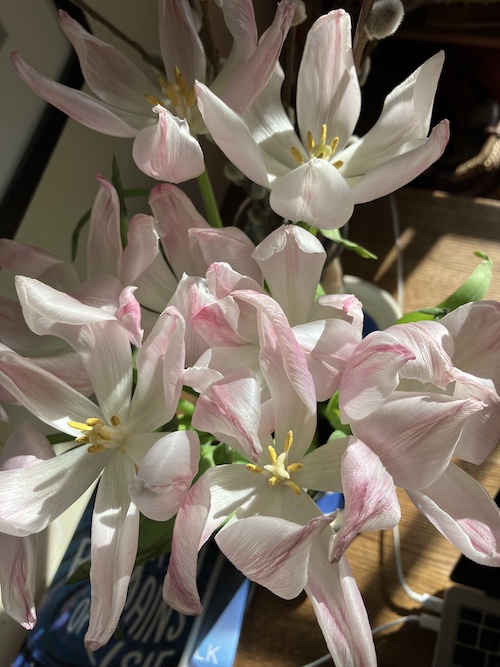
I am good at taking it easy. I am good at booking holidays. I am good at buying myself the flowers. I am good at making special breakfasts and turning part of an afternoon into an occasion. I am good at finding the joy in extraordinary things, like flowers and sunsets. I am good at noticing the light and watching where it falls, and where it’s going. I am good at sitting—if I have a book I can sit forever.
February 7, 2023
Gleanings
- I was lucky to travel to Ukraine in my 60s, lucky to meet far cousins, and to be greeted with bread and salt, with tiny glasses of moonshine flavoured with mountain herbs, and I am reading backwards to remember it all.
- With my next book, I want to strive bring down my expectations. This sounds like I’m joking, but I mean it. I think low expectations make for less disappointment. Also, it helps me to realize there are tons of writers feeling the same way about not making whatever list. It’s not just me.
- The only difference is experienced authors know the unconscious is also at work and, if we’re smart, we’ll lean into whatever gifts it might offer.
- Oh, and about that four-year-old friend, I strongly believe everyone should have one. I’d even go so far as to say, if I could give one gift to everyone in the Universe, it would be a four-year-old-friend. But know this, you will never get to be the teacher when you play school.
- No, we don’t solve the world’s problems in any of our conversations, nor do we solve our own, but we always come away with food for thought. Nothing is off the table.
- And this kind of reminded me why I’ve always loved good old fashioned blogging — the way you find things you wouldn’t have otherwise.
- For the flow will continue – you, her, these feelings, this moment, life … we’re already in the river we don’t need to swim against the current … release, allow, find yourself in the flow.
- I don’t actually have much to say about French Braid. I liked it a lot, because it’s the kind of thing I like.
- There really is a magic to playing with ideas and images and watching the piece transform itself from a collection of photos to a composite image. Something new and unexpected is created and if you work intuitively, eventually what you are thinking or trying to say emerges. I find writing that way as well. As long as you don’t try to force things, if you sit down to play with the words, then what you are trying to say eventually finds its way out.
- I’m way fantastic at self-deprecation, which needs work, surely.
Do you like reading good things online and want to make sure you don’t miss a “Gleanings” post? Then sign up to receive “Gleanings” delivered to your inbox each week(ish). And if you’ve read something excellent that you think we ought to check out, share the link in a comment below.
February 6, 2023
What Remains of Elsie Jane, by Chelsea Wakelyn
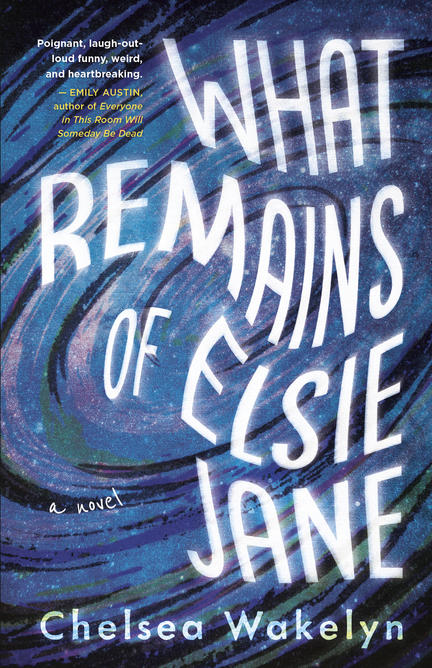
Chelsea Wakelyn’s debut novel WHAT REMAINS OF ELSIE-JANE reads a bit like Joan Didion’s THE YEAR OF MAGICAL THINKING, but narrated by someone who is not a cool customer, instead a human being wracked with pain and grief and lust and longing after the death of a partner from drug poisoning, a loss that has left Elsie Jane with a backyard full of weeds, an addiction to dating apps, and two small children who need feeding and caring day-after-day, and Elsie Jane is hanging on, just barely. Or not really at all…but then she decides to contact a space-time wizard via Craigslist who can help her return to the dimension where Sam lives and Elsie Jane’s life was still whole and functioning, and her biggest struggles were with Sam’s drinking and also the grief she carried from the deaths of her parents, back when she thought that constituted “the worst.”
This novel about death just pulses with life, with a force as compelling as the one that kept me turning the pages. It reminded me a lot of Rebecca Woolf’s memoir ALL OF THIS, about a complicated widowhood, brutally honest and beautifully human. I absolutely adored it.
February 2, 2023
Brotherless Night, by V.V. Ganeshanathan
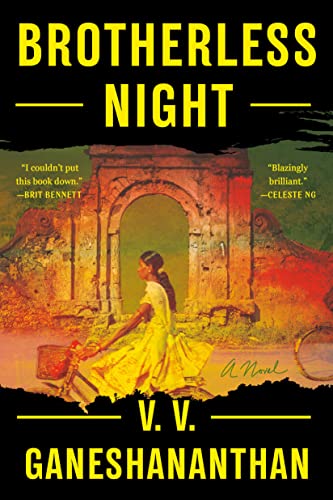
In her novel Brotherless Night, V.V. Ganeshananthan writes about the way that Tamil fighters would take over ordinary homes in 1980s’ Sri Lanka, during that country’s brutal, decades-long civil war, and how, when they were finished with these spaces, they’d leave them laden with traps and mines, which seems like an appropriate metaphor for what such tumult, violence and devastation from civil war does to the notion of home in general. Though I suspect Ganeshananthan’s protagonist, Sashi, would have something to say about my employment of metaphor at all, about my liberty to have one thing stand for another, war being, for me, an abstract concept, which is something Sashi doesn’t take for granted in her telling: “Imagine the places you grew up, the places you studied, places that belonged to your people, burned. But I should stop pretending that I know you. Perhaps you do not have to imagine. Perhaps your library, too, went up in smoke.”
I learned so much from Brotherless Night, a story whose title comes from Sashi’s loss of her revered elder brothers to violence and also from how even those with loyalty to the cause of Tamil freedom were used and made to suffer in its name. And while the specifics of the political events, between 1980 and 1989, were new to me, the overall narrative is a familiar one—of people yearning for liberation, about noble causes hijacked by ego and violence, and how women are always collateral damage in war, the ways in which their suffering, by some, is simply expected.
When the story begins, Sashi is dreaming of becoming a doctor, following her elder brother in this dream, and her greatest hardship is that her father has forbidden her and her brothers to ride their bicycles against the backdrop of political tension. And as the tension builds and violence and ensuing traumas begin to rob Sashi of her innocence and her youth, ordinary life proceeds as best it can—when most electricity is no longer functioning in Jaffna, Sashi and her medical school colleagues gather by the hospital with their school books to study under the outdoor lights there.
Eventually Sashi takes a job working in a Tigers field hospital, dismayed by what their cause has done to the boys she’s grown up with, including her own brothers, but also feeling obligated to offer care to any person who needs it. All the while, however, she works with her charismatic feminist professor to keep an apolitical record of atrocities committed by all sides in this complicated conflict, which means that eventually her protection by the Tigers is compromised.
As much as Sashi’s story itself was fascinating and illuminating for me, however, it’s the way she tells it that is the most compelling aspect of the narrative, instances of direct address (such as the passage about the burning library above), her evasions, her unwillingness to choose definitiveness, and also her acknowledge of how language and translation complicates and obscures—the nuances of Tamil that cannot be conveyed in English, all those parts of this story that those of us reading from a distance will never actually understand.
Beautiful, devastating, brutal and meticulous at once, Brotherless Night is a read that’s unforgettable.






