February 1, 2023
Gleanings
- For me, the puzzle represents an acceptance of the messiness of life. Sometimes a piece is missing. Sometimes you just have to give up. Sometimes the demon wins.
- Women hate in each other what we fear in ourselves. Perhaps men do, too, but for women — our hatred of each other keeps men safe. Because it keeps women quiet. Who’s gonna hate you if you keep your mouth shut, your legs closed, your ambition to yourself.…
- There are times when it is impossible to separate the disease from the person it is happening to, and we were in the thick of one of those times. The guilt that surrounds that feeling, the one of wanting to get away from the person you were so terrified of losing only weeks before, is confusing and consuming.
- Heck, the title of this blog is Living Plan B. I know planning is somewhat of a myth, and at this point, I’m fairly adept at the large pivots. Even still, in 2023, at the age of 66, I continue to be sorely disappointed when my plans fall through.
- I finished my 1000th book on Saturday. The Sleep of Apples by Ami Sands Brodoff. I enjoyed the book, a collections of linked stories, but I also got that frisson when I finished it of knowing I had hit 1000. Three diaries, almost 17 years, and 1000 books. I judge myself so harshly for this but also–just so excited for 1001. What is this impulse?
- If photography is fiction, then composition is the initial dishonesty. The lie begins to take shape the moment the photographer aims the camera, imposing his or her arbitrary, exclusionary, restrictive and preferential choices on anyone who later views the image. Vantage point, punctum**, exposure, and focal length (zoom), all combine to determine what is or is not in the shot.
- As most creative people know, when you’re just playing around, goofing about, that’s often when neat stuff happens. You’re open to it, it’s open to you. Who knows. In the next two frames, a couple of birds began to play. You could tell they were riffing off of each other, taking turns perching on the horse. Delightful, yes?
- And I wonder what if … what might become possible, if we see, if we allow those borders between us and within us, not to be impassable walls and boundaries, but simply flowing rivers permeable and unpredictable, constantly changing … sacred waters, inviting us to step in, to cross the threshold and unite what separates you from me, and me from me.
- I wish he had resisted the temptation to republish A Writer’s Diary as a conventional book. He could instead have accepted the ephemerality that is a blog’s most defining quality, letting the posts scroll away as they first appeared, one day at a time.
- I haven’t been feeling like doing very much at all over the past month. I can’t seem to get myself all zizzed up about a new writing project or a visual arts project. I don’t know what this means. Is it simply okay to float aimlessly for a while and produce nothing? It doesn’t feel okay to to me to just be. It’s not in my nature to not be making something or working towards some sort of goal or outcome.
- The train was LONG. Three locomotives to pull it. The conductor sometimes let us get off at stops or when we had to wait for freight trains to pass. There were also lots of stops for the smokers. I jumped around a bit, stretched my back and legs.
January 30, 2023
Keep Riding the Streetcar
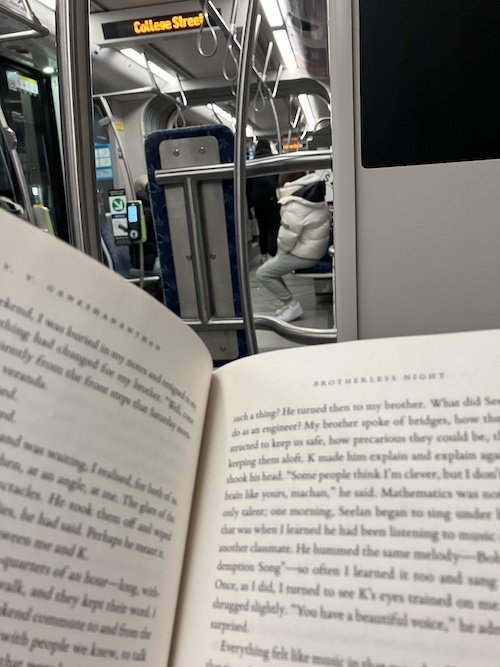
To live in a city at all is to sign up for a complicated project.
I think that living anywhere among others is a complicated project, but in a city there are no grounds to believe otherwise, no opportunity to bury one’s head in the sand about how difficult (and worth striving for) is a functioning society.
Bad things happen everywhere, they really do, and the only difference is that, in a city, when they happen, nobody says that they never thought a thing like that could happen in a place like this.
Which, of course, doesn’t make it any easier when bad things happen, except maybe a little bit, that I’ll never get quoted on a local newscast spouting that cliche.
But otherwise, it’s hard. It’s hard when scary and violent things occur in your little world, no matter where that little world is. My daughter takes public transit to school every day. I take transit almost everywhere that I don’t walk to. Transit is what makes a city work, it isn’t a city without it, and I’ve so had enough of Brenda from Whitby in the Comments explaining why she doesn’t take the TTC anymore because of escalating crime—but maybe it’s also because she lives an hour away and has no idea what she’s talking about?
The rest of us, however, don’t have a choice in the matter, and even if we did, we might take transit anyway, because if you take transit often you already know that most of the time it’s fine. That millions of people ride transit everyday without incident, and I’m not saying the system could not use improvements, but it certainly doesn’t need riders abandoning it in droves.
I keep thinking about those awful trucks one year ago that shut down our nation’s capital, the violence, the noise, the fury, the anger, and how, in some ways, the increased more explicit violence we’re seeing everywhere is part of that same spectrum, people empowered by rage and delusion, stoking fear and division.
I’ll keep riding the streetcar. Not just because I have to, but because it’s also the answer, the way it connects us all, to everywhere and everything, makes it impossible to imagine that answers to the challenges before us are ever easy or obvious.
January 27, 2023
Small World, by Laura Zigman
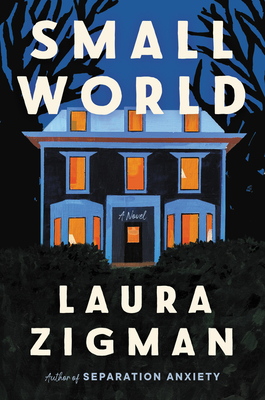
I’ve never read Laura Zigman before so I don’t really know what I was expecting with her new novel, Small World, which is weird, because I’d read her interview with Lauren LeBlanc, what turned me onto the novel in the first place, so I knew that this was a story of a divorcee on the cusp of 50 whose sister moves in with her after many years of a continent between them, and that their coming together again prompts a reevaluation of a childhood spent in the shadow of their sister Eleanor, who was born in between them and lived with disabilities until her death which led to the end of their parents’ marriage and their mother’s fervid mix of despair at this loss and years of activism in a fight for disability inclusion.
But I didn’t know how such a book could turn out to be so funny, how sisters Joyce and Lydia could turn out to be both be so difficult (with each other, and the world in general) in such different ways, and how this story that weaves back and forth between the sisters’ childhood and the present day could be so perfectly complemented by the inclusion of found prose poems Joyce has taken from posts on a Neighbourhood app called Small World, similar to Nextdoor:
INCONSIDERATE NOISE
I’ve lived on what used to be
a quiet street in
West Cambridge
I say “used to” because
recently
two families with young children
moved in
and destroyed the peacefulness of the street…
The tension between Joyce and Lydia remains unaddressed until the arrival of new upstairs neighbours operating a yoga studio/wellness centre above their living room forces things to a head, Joyce frustrated by the neighbours’ lack of adherence to rules and general decency, and by Lydia’s lack of support as she tries to resist their friendly overtures, and things between them get even weirder and uncomfortable, but their childhoods made for weird and uncomfortable, for them, a most familiar terrain, and it’s here where they finally begin to understand how much they lost and also never really realized they had during the years they had Eleanor and afterwards.
This is a novel about inclusion on all kinds of levels, about how both sisters felt removed from their mother’s connection to Eleanor, and from the family life that had Eleanor’s care at the centre, and about what community means and what family means and the impossible standards people (mothers in particular) are forced to live up to, and those miraculous people who see us, who save us.
January 26, 2023
Happening
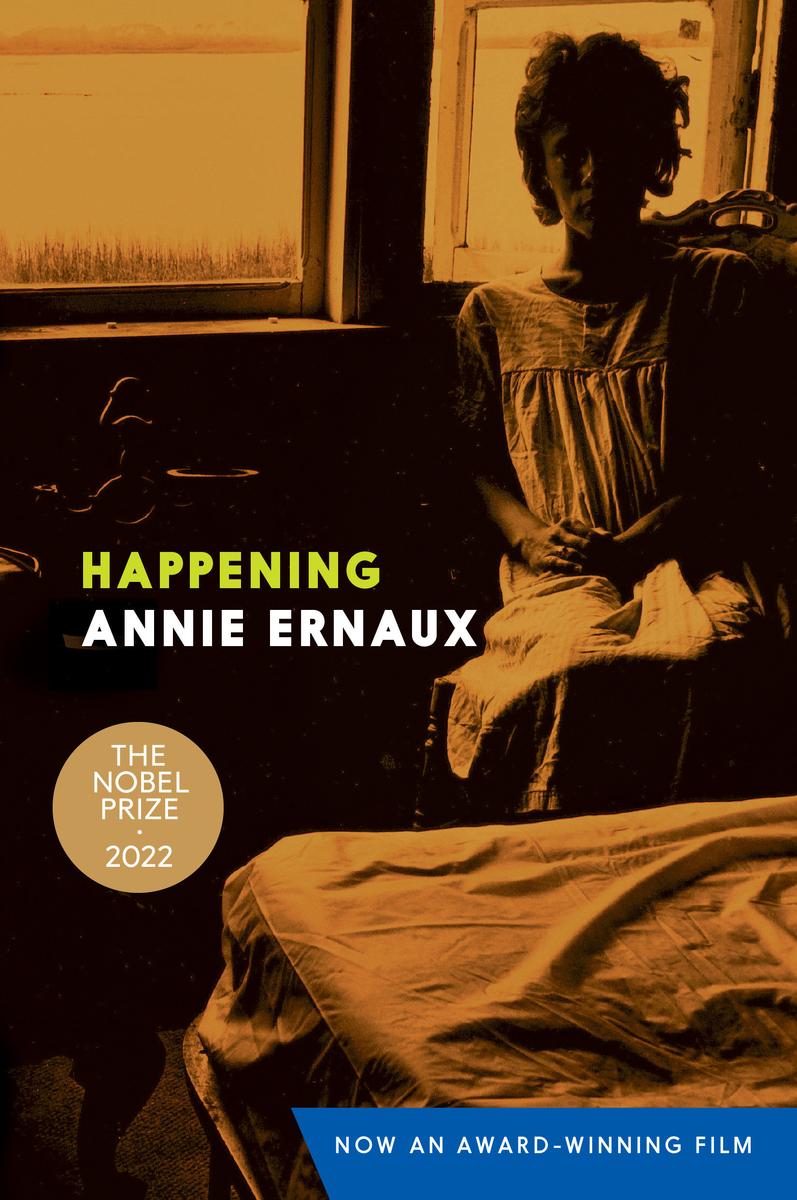
“Through this story, time has been jerked into action and it is dragging me along with it. Now I know that I am determined to go through with this, whatever the cost, in the same way I was determined to go through with my abortion after tearing up the pregnancy certificate, aged 23.
I want to become immersed in that part of my life once again and learn what can be found there. This investigation must be seen in the context of a narrative, the only genre able to transcribe an event that was nothing but time flowing inside and outside of me. The diary and engagement book I kept back then will provide the necessary dates and evidence to establish what happened. Above all I shall endeavour to revisit every single image until I feel that I have physically bonded with it, until a few words spring forth, of which I can say, “yes, that’s it.” I shall try to conjure up each of the sentences engraved in my memory which were either so unbearable or so comforting to me at the time that the mere thought of them today engulfs me in a wave of horror or sweetness.” —Happening, Annie Ernaux
January 26, 2023
Soft
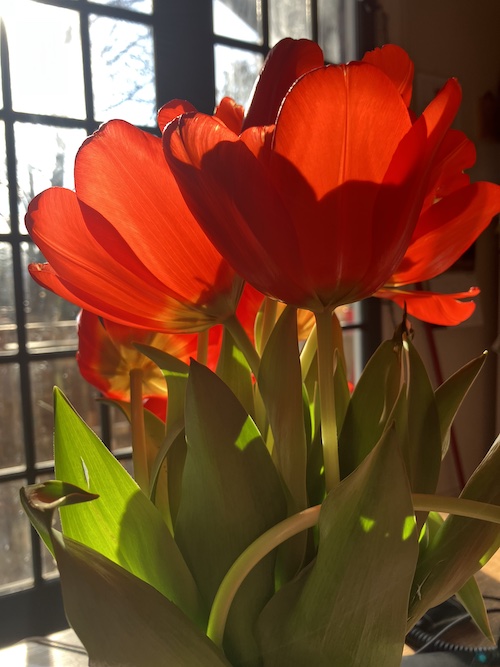
I used to drive myself crazy (literally!) trying to synthesize the world, to have the pieces fit together, to have it all make sense. I wanted to frame things to make the not-okay seem okay, somehow, like it fit into the scheme of things which, as I’ve learned in therapy, is a particular problem I’ve had for a very long time, this notion too that I have to hold it all. But I don’t have to—what a thing! Instead, I have to let it be, which in some ways is harder than trying to hold it all, but in other ways, so much easier.
I wrote the above with several random incidents of violence in my city in mind, such upsetting events which, it occurs to me, have same effect that terrorism does, the terror part. A sinister cabal really couldn’t have planned it any better than the perpetrators of these acts of violence. (I think about too the anti-social nature of protest against public health restrictions last winter, how these more violent actions are born of the same vibe. Sowing mistrust, uncertainty, and fear, and suspicion of our fellow human beings.)
I used to think that the bad thing would end and then there would be a period of calm. Perhaps this what a person is trained to think who came of age in the 1990s, didn’t read the newspaper very closely, and never imagined that anything that happened outside of a five mile radius have anything to do with them.
A thing I’ve said lately to a few people, in regards to parenting both toddler and teenagers, is this: It’s hard. And it’s hard because it’s hard, not because you’re doing it wrong. There are no hacks.
And I’m starting to realize that this is true about life itself, actually. It’s hard. And it’s hard because it’s hard, not because you’re doing it wrong. There are no hacks.
All of which is another way of saying (I’m sorry!) that “It is what it is.”
But it is!
I have become more cognizant of how I meet the moment, greeting hardness and anger with the same. Greeting violence with fury. And fearfulness, stoking division. No, I want to be constructive. I want to be brave.
“If you look back at history or you look at any place in the world where religious groups or ethnic groups or racial groups or political groups are killing each other, or families have been feuding for years and years, you can see…that there will never be peace until somebody softens what is rigid in their heart. So it’s necessary to take a big perspective on your righteousness and your own fundamentalism when it begins to kick in and you think your own aggression and prejudice are reasonable.” —Pema Chodran
I want to soften. I want to keep being soft.
January 24, 2023
Gleanings
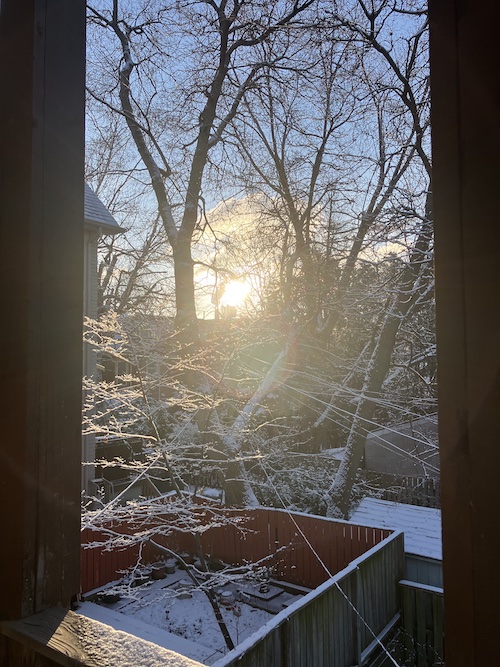
- I think I’m drawn, in most of the art I love, to the kind of ordinary darkness that everyone experiences: that every one of us, no matter what we might aspire to, is capable of failing to do what’s right, and that failure, no matter how we might explain it to ourselves, no matter how sorry we might be, could have catastrophic consequences anyway. This to me feels like the tragedy of the human condition, and it also feels like the source of some of the most beautiful, terrifying stories people have made.
- I’m going to be completely honest: If your girlfriend wrote into this column with this story, I would tell her she should break up with you. Not because you were “honest about your feelings,” but because gaining and losing weight, over and over and over, is part of nearly everyone’s life. It is so inconsequential in the vast tapestry of existence, and if getting fatter over the course of nine short months throws you into this kind of tailspin where you find yourself not only unattracted to her, but you feel honor-bound to tell her so, how are you going to handle it when the really hard stuff happens?
- What activities and actions and experiences and routines help me feel good, whole, content? What leaves me feeling empty, anxious, drained? As I explore what I FEEL (last year’s word), I gain clues to what I NEED.
- I would move into this book immediately if I could, or at least visit for a while. But of course, I already lived there once. Of course, this reading is wildly coloured by my life experience, as is anyone. Perhaps there will be a future school of criticism about the death of the reader, but I don’t know how that would be possible and also it would be too sad.
- It’s not a colour I like to wear because finding the right shade of orange in clothes is nearly impossible – but it’s everywhere in nature. Persimmons, apricots, clementines, strands of saffron in water. When I see it I swear I can feel my heart expand.
- Walking is not a form of exercise. It’s an act of contemplation, a ritual of communing with nature and self.
- “Equanimity,” says Salzburg, “can be described as the voice of wisdom, being open to everything, able to hold everything. Its essence is complete presence.”
- How, just how, in a world of 8 billion people floating amidst the vast cosmos, with layers and layers of histories and everyday moments and decisions, did the group of us from all over this world end up together in this very moment, in this very place … continues to mystify me with awe and wonder and gratitude.
- It’s not how many books or works you read (in whatever form) that counts. It’s that you read that counts – and it counts so very much.
- So I didn’t buy it and we went off to La Paz for five days. I thought I might see another bracelet I liked. I didn’t. But I saw that blue everywhere.
- Honesty is scary, and surprisingly freeing. It helps to try it out on people whom you trust, who’ve been honest with you, too. One honest conversations begets another. And so begins a chain reaction to something so liberating you wonder why it took you so long to blossom.
January 23, 2023
Digital for Good, by Richard Culatta
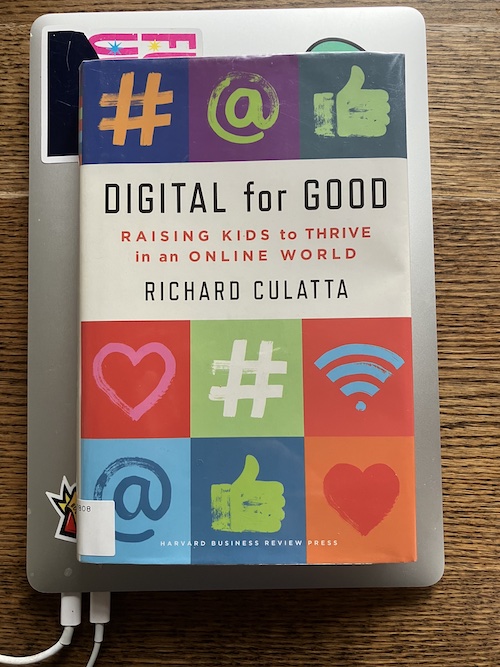
One of the best things I do is subscribe to Courtney R. Martin’s Substack, which is where I encountered her interview with Richard Culatta (headlined “‘Screen Time’ is Dumb”), introducing me to the ideas presented in Culatta’s 2021 book Digital for Good: Raising Kids to Thrive in an Online World, published by Harvard Business Review Press. Culatta is CEO of the International Society for Technology in Education, former Chief Innovation Officer for Rhode Island, and was appointed by President Obama to lead the US Department of Education’s Office of Educational Technology, and I found his book such an inspiring and exciting read, reframing so much of how I’d come to understand my role in helping to shape my children’s relationships to technology. Rather than foregrounding potential online dangers, Culatta argues, we should be giving our kids the tools to be good digital citizen who are able to contribute to conversations, use technology for problem solving, community and connection. Rather than telling our kids they spend too much time on their phones, to select one example, we should teach them to be thoughtful in HOW they use their phones. Culatta recommends researching apps that are educational and interesting and recommending these as we might a good book, a tactic I’ve already tried with my eldest with really interesting and positive results, along with all kinds of other accessible “next steps” that follow each of his book’s chapters, which I’m also really looking forward to putting into play.
January 20, 2023
Fifteen Minutes
I have fifteen minutes before I head to the pool, but I wanted to check in here and write something, to write something without even knowing what I’m going to write, which is the advice I give to anyone who wants to blog but doesn’t know where to start. Start where you are and see where it takes you, and so here I am at the end of a busy week, but not too busy, because I don’t do too busy anymore. I used to go swimming before breakfast so my workday would not be interrupted but now I interrupt my workday all the day (I don’t have a full time job! Let’s act like it!) and it’s the precious hours outside it that are untouchable, time for decompressing, for relaxing, for reading. I got a new phone in November, my first iPhone and I really like it but the way in which it’s most improved my quality of life is that it didn’t come with an electrical plug so I charge it through my computer downstairs, instead of at the plug in my bedroom where it was still accessible even though I mostly never looked at it after 9pm. Now I never look at my phone in the evening, and in the morning where I’d once spend the first twenty or thirty minutes of my day scrolling Instagram and checking my email (time that went by in a flash) I now pick up the book on my bedside and start reading, and I’ve been reading so much more since this shift. My mind is also in a better place, and I think that’s no coincidence.
Along those lines, I finished a big project today (actually the first quarter of an even bigger project) which I feel really good about because last spring’s edition came out so much later because I’d struggling so much from November 2021 onward. Getting it finally finished today is a sign of what a much better place I’m in that I was a year ago, a fact I’m still marvelling at, how much better something can be that once felt absolutely impossible. And I’m wondering about this, about gauging my well-being by my productivity, but I don’t think that’s actually it. My productivity is a symptom of my well-being, rather than the opposite. And it’s such a relief.
This week I also achieved a professional goal I’ve been working toward for a really long time, and I’m taking the time to really steep in this moment. As much as I’ve come to understand the way I’ve avoided feeling difficult feelings (an act from which my anxiety has stemmed), I think I’m also not very good at feeling good ones either. And so I’m trying to do that, which is harder than you’d think, but also really such a pleasure, and I’m looking forward to sharing my news with you as soon as I am able.
January 19, 2023
Cyclettes, by Tree Abraham
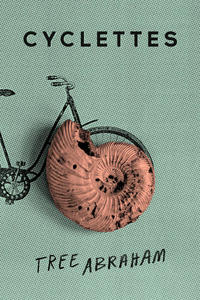
I don’t think I could write a memoir through bicycles, though I’d like to consider it—the ten year gap following the birth of my child would be conspicuous though, and there’ve been other holes. I’d have to write about leaving bikes in the driveaway that my parents would back over. (When’s the last time I just dropped a bike somewhere? From Cyclettes: “In suburb childhood when we were done with our bikes, we could smash them down on the front lawn or driveway or any old place we pleased…The bikes were not a thief’s commodity; they were ours like a worn pair of shoes shaped to our foot’s print.) I’d write about our bicycles in Japan which we rode around with in the company of our friends (I think I rode in a car not even five times during that time) like a pack of suburban kids, and the freedom of those days (and also the impossible feat of the obachans who managed to ride in the rain while holding umbrellas). About the metal basket on my bike today, a bike we only got tuned up in the midst of the pandemic when it seemed impossible to go anywhere any other way, and how wonderful the world feels when my basket is packed with things like donuts, potato chips, or library books. I’d think about all the bikes I’ve had throughout my life and where some of them might be now—the bike from my freewheeling fourth year in university lived in my shed until last summer when we finally put it out in the garbage because the tires were shots, and it only had one pedal, having long ago been pilfered for parts.
I loved Tree Abraham’s Cyclettes, a beautiful amalgam of text fragments and image that is to bicycles as Leanne Shapton’s Swimming Studies was to swimming. Abraham takes her reader from her Ottawa childhood (showing stills from a video of her very first bike ride) through childhood and adolescence, and across the world as she works in international development, living abroad and travelling extensively, riding bikes, observing bikes. Following her path, coming of age: “My heart beats so strong it resounds as gong. I am flying. Only the bike can keep up with the exhilarated acceleration of my spirit.”
Her impulse is to go, to ride, to render the world whole and wide…until she arrives in New York City and finally stops, her first big ride to the beach, to the sea, full page spread of her handlebars and the beach—what a TRIUMPH. (Pun kind of intended.)
January 16, 2023
Modern Fables, by Mikka Jacobsen
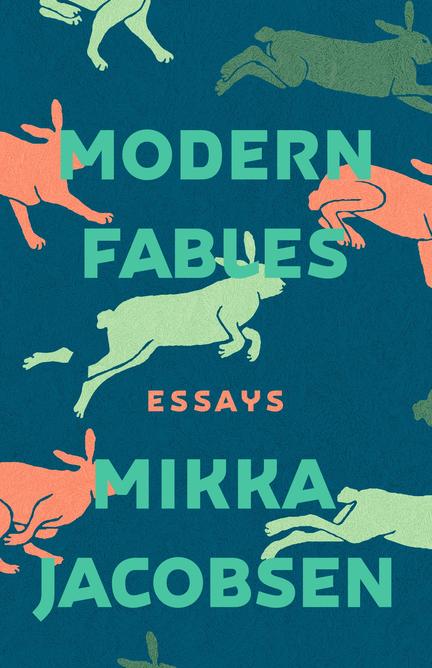
Modern Fables started out strong and never quit, a collection of personal essays that begin with a wake (with whisky, which leads to a brawl) and concludes with a wedding (with watermelon vodka-cocktails, which leads to Jacobsen fucking the best man, and the dissolution of her friendship with the bride). And in between, a wide of stories that take no sides, but instead examine every side—on sports and mascots (you can read an excerpt at 49thShelf); about a white Albertan’s relationship to the Indigenous peoples upon whose land she lives (complicated by her psychologist mother’s shamanism); such an artful revenge essay on a shitty ex-lover who turns out to be a plagiarist but which is also a treatise on women’s work and textile arts, and Mrs. Ramsay’s brown stocking.
In “Kurt Vonnegut Lives on Tinder,” Jacobsen notes how an affinity for the Slaughterhouse Five author is shorthand for something on the popular hook-up app, and resolves to figure out just what that means. “Modern Fables” tells the story of a relationship with a seeming pathological liar, and also catfishing, and cats, and rabbits, and other dead household pets. “Me vs. Brene Brown” is another story of a love story gone sour, in this case between Jacobsen and Brown’s ideas about been empathy and shame, which seem revolutionary at first, but Jacobsen soon realizes she’s read something like them else before (oh, yeah, right, in almost every work of literature ever, not least of all The Scarlet Letter), not to mention how Brown’s work seems to preclude the possibility of a fulfilling life outside of a nuclear family, and what Brown’s folksiness might suggest about what she thinks of the intelligence of her readership. And finally, “David Silver,” taking on the 90210 actor and other notable Davids (including he who battled Goliath) in a rich and provocative piece on mental illness, convening with the spirit world, and the possibility of cosmic order.
I loved this book, a collection that relit my flame of passion for the personal essay, a collection up there with Susan Olding’s two, which are some of the finest in CanLit—in Freehand Books, Jacobsen and Olding share a publisher. These essays are gorgeous, brutal, stunningly crafted, and pack a punch, like a one-two, WHAM, and then another, and then another, you’re sad when it’s all done.






