April 13, 2023
Diagnosing Minor Illness in Children, by Kerry Ryan
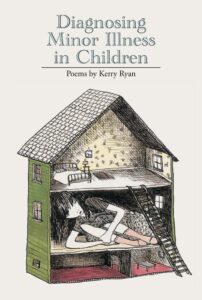
There is a line from Kerry Ryan’s first poetry collection THE SLEEPING LIFE that I’ve been thinking about for almost a decade and a half since I first read it, the line about the click of her partner’s glasses on the bedside table at the end of the day: “I wait for it all day.” And what remains just as true about Ryan’s vision all these years later as I picked up her latest DIAGNOSING MINOR ILLNESS IN CHILDREN (and read it in a single sitting) is the way she manages to capture those moments of every day existence so fleeting that most of us fail to notice until we see them articulated in a line of her poem, and declare, “Yes, THIS. The miracle of existence in a nutshell!”
Or, as I wrote in my blurb for the book: “Once again, Kerry Ryan’s singular vision and attention to perfect details works to render the ordinary absolutely extraordinary, the world shown anew through these poems about bodies, birth and motherhood, and the wildness of all of it.
Meeting Kerry Ryan at my husband’s colleague’s wedding fifteen years ago (he was marrying her sister!) was such a fortunate event for me, which I was not wholly expected when I was introduced to “another Kerry who likes books.” What are the odds that that other Kerry’s debut poetry collection would be so dazzling, speak so clearly to my soul? That she would end up contributing one of my favourite essays to the anthology The M Word: Conversations About Motherhood, “Confessions of a Dilly-Dallying Shilly-Shallier.” That she would introduce me to the wonderful Ariel Gordon! We’d also hang out in her home of Winnipeg in 2014 where lines from her second collection Vs. (about being a bookish non-sporty girl who takes up boxing) were displayed outside her gym.
So I’ve been waiting a long time for a new book by Kerry Ryan, and I’m thrilled that DIAGNOSING MINOR ILLNESS IN CHILDREN (with gorgeous cover art by Julie Morstad, who is my favourite!) is entirely worth the wait, Ryan turning her eye to parenthood and its excruciating wonderment, to losing a parent, to love and marriage in middle age, noticing everything, those perfect details. This is truly a book to savour.
April 12, 2023
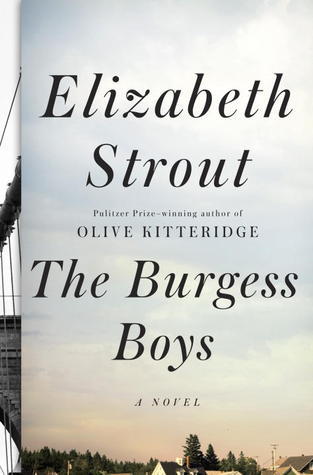
The Burgess Boys
Running away on my own personal reading projects is perhaps my favourite fascination, the time I spent rereading Madeleine L’Engle’s Austin series in 2019 a case in point. (I talk about it all the time, like some people’s version of where they were when JFK was shot. Where were you when I was reading A Ring of Endless Light? Omg, remember when I was reading A Severed Wasp in New York City? Somebody ought to put up a monument!) And the best thing about these sprees, like most things I do, is that they’re never planned, they just have to happen, and when they do the moment is so absolutely perfect, serendipitous, infusing my life with light and meaning, spiritual, an epiphany. I am not being facetious or hyperbolic in the slightest.
And lately, it’s been the Lucy Barton books, which I’ve been rereading these last few months and wrote about here. These books not blowing my mind quite like the L’Engles did (“every single one of them words rang true and glowed burning coal/ pouring off of every page like it was was written in my soul…”) but rearranging my thinking in a more subtle way, a quieter way. How I’d dismissed them at first, and then going back to see what I’d been (dis)missing, and how exploring Elizabeth Strout’s books is a bit like being handed a key to a literary universe where the reader is omniscient, making connections the characters themselves don’t understand—though it seems like the inverse when one encounters the Lucy Barton books, it’s true, where the connections are elusive, and it’s hard to understand just how she (both Lucy and her author) got from there to here.
But I think that Strout’s 2013 novel The Burgess Boys might just be the bridge.
I first encountered Bob Burgess as a secondary character in Lucy By the Sea, and had the same response to him that Lucy did, which was that I loved Bob Burgess. And so, when I realized that Bob Burgess had his own book (albeit one shared eponymously with his asshole brother Jim) I placed a library hold immediately. (The best thing about becoming obsessed with the Elizabeth Strout books in 2023 is that most of the library holds come in pretty quickly…)
And so Bob Burgess came away with me last weekend, and the coals were glowing again. Oh my gosh, I loved this novel.
The most remarkable thing I can say about it is that I knew its big twist, that Bob had revealed his story to Lucy during their time in Maine, and still the story was not spoiled in the slightest. The other thing I particularly loved was that I got to see Bob (Oh, Bobby!) meeting his second wife for the very first time, and neither of them had any idea!
The Burgess Boys is the first conventionally-structured Strout novel I’ve ever read (the Lucy Barton books are a study in interiority, while her Olive Kitteridge books are the same but with…exteriority [is that a thing?]). And The Burgess Boys really is the bridge between the two, all the scenes of the Lucy Barton books just planted in its soil. Parts of the novel are narrated by Bob’s ex-wife Pam (whom we’ve also met in the Lucy Barton books) and her feelings about her first husband are a quiet preview of what Lucy will feel for William. (There is also, indeed, a line from her perspective: “Oh, Bobby!”
And the scenes in which Bob is looking out the window in his New York City apartment, wondering at all those different lives going on, lighted windows offering just the smallest glimpses of other people’s private worlds—a preoccupation of the Olive and the Lucy books alike. The mystery of other people’s experiences and understandings.
The Burgess Boys is also deeply concerned with the fabric of American society, as the Lucy Barton books are against the backdrop of the 45th President, Covid lockdowns, and the George Floyd/Black Lives Matter protests in 2020. But so unbelievably presciently considering how much I hadn’t seen coming in 2013. The novel is set around 2007, the shadow of the Iraq War and torture in prison camps still very present, and a major part of the plot involves an act of violence on the property of a mosque in small town Maine, where the Burgess boys hail from, where the locals in this dying town are decrying the arrival of Somali immigrants whose culture seems to represent a threat to their way of life. As with the Lucy Barton books, as with, well, everything, the challenge: how do we learn to live with difference? How do we learn to live with each other? Strout refusing to look away from class, either, and how poverty can come to define one’s experience. The ways in which all of our experiences make us either harder or softer. How it’s never not complicated.
April 11, 2023
Gleanings
- I think about the moment I found out I was pregnant and how I counted the years until my pregnancy would turn eighteen which felt like a hundred years from then and now it’s here. That people talk about empty nesting but not about this weird transitional in-between existential crisis of WAIT IT’S OVER. HOLD ON… WAIT, WHAT!? Like… for example, no one really talks about the funeral procession that is college tours.
- I cannot tell you what a gift that little message has been to me. A touchstone of sorts. A simple gesture that serves to remind that someone crazy enough to ride his bicycle from San Diego to St. Augustine, loves me. Now, how cool is that? Pretty dang cool!
- Now there’s a word – unfiltered – that seems like it could be a good thing. It conjures up being unshackled or uncensored, freedoms we value in some contexts. However, our echo chambers of social media and curated streaming services lull us into a false sense of security that everyone is going to unfilter their messages the same we we would. At least I did. But, as I recently discovered, being unfiltered isn’t always desirable.
- Writing is my way of exploring and making sense of what I’m feeling in my heart. Once it’s all committed to words, I do a little editing and then post about one in ten to my blog. It is a privilege, being able to freely publish, but it is an absolute honour receiving all the feedback, the sweet (and snarly) comments and especially all the words of support and encouragement.
- I describe it like this to clients: You’re not just crossing unknown terrain, you’re creating the land as you go. And the first time across, the goal is to get to the end. Along the way you might drop flags in the ground, markers of places where you need to return and fine tune. Maybe add an oasis in this desert; get specific about the flora and fauna in this forest.
- And here I am, Sunday morning, ready to pull the covers over my head again. This time, not from a feeling of despair but rather a sense of deep contentment.
- I am the slowest moving tortoise, let’s call me a giant galápagos, but even the giant galápagos moves a couple of kilometers each day.
- Good writing has a lot to do with specific detail — it’s not just any blue cup that broke, it’s the blue pottery cup with the crooked handle that he found at the thrift shop and presented to her, down on one knee, when she was hoping for an engagement ring.
- When will I learn/ to trust what I see, what I feel/ what I know?
- My point is that the behavior is exactly the same! Assuming I am speaking to a fellow Old here: you did things for “likes” too! You brought the “right” book or stack of comics to be seen reading at lunch. You wore sunglasses when you didn’t need to, fished the band t-shirt out of the laundry, and went specifically to the graveyard with your sketchbook to smoke cigarettes.
April 6, 2023
AFAF Mood Board: Part One
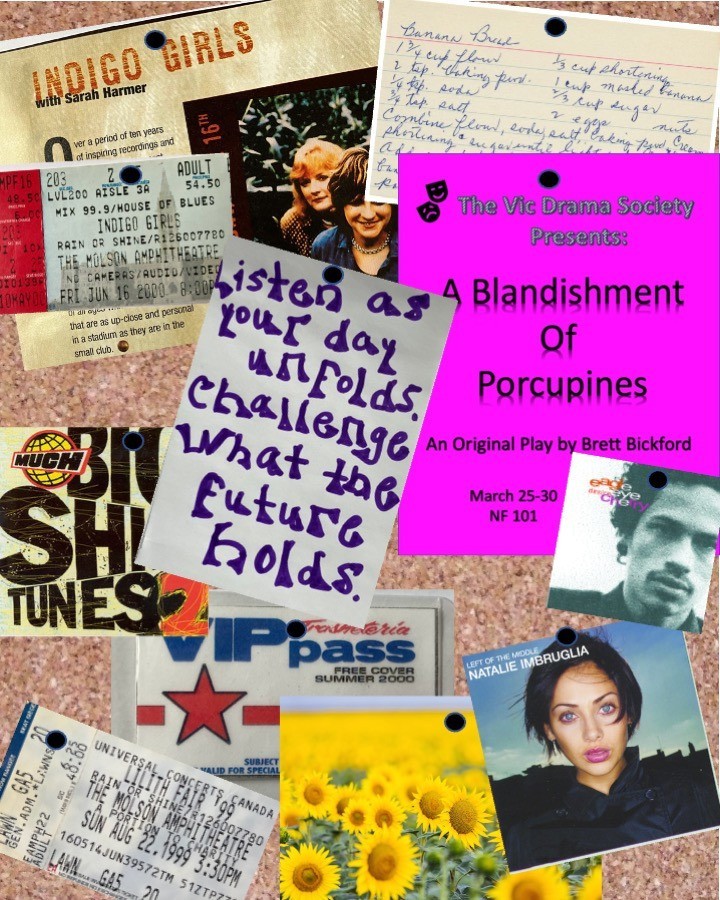
Yesterday marks five months before the release of my new novel, and to celebrate, I’m sharing a mood board for opening chapter, set from 1998-2000. So excited to share this book with you!
April 4, 2023
On Choosing Harriet
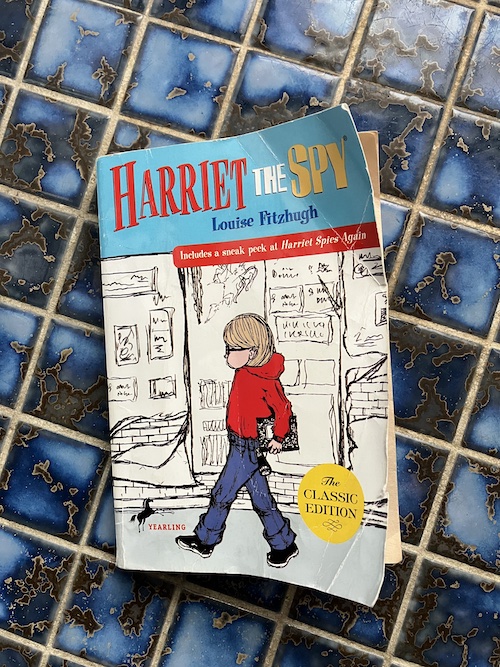
As I’ve talked about many times—it was a formative experience that would inspire both my first novel and the name of my firstborn child—I didn’t read HARRIET THE SPY until I was 27, which I’ve always known was a blessing. Although I’d been a fan of Louise Fitzhugh’s slightly less bizarre (but only slightly) sequel THE LONG SECRET, which I read regularly throughout my childhood, tracing my fingers along the lines on the map that opened its pages. It’s a weird book, but not as weird as the Fitzhugh O.G., whose charms would have washed right over me as a young reader too firmly wedded to conventionality.
It wasn’t until that I was almost 30 that I was ready to receive its message about telling the truth, and being unlikable, and being brave, and true to oneself. When I was 27 and finally coming of age in a way that was real to my bones, HARRIET THE SPY read like a revelation.
At almost 30, I wanted to be like Harriet—that courage, that gumption, no fucks to give. And I wanted the same for my child, my daughter, who was born two years later, whom I named Harriet, imagining—the same mistake I’ve made in parenthood over and over—that she could be fully hatched as such, that I might have learned all my lessons so that she wouldn’t have to.
Last night I finished reading Harriet the Spy again, aloud to my family, the second or third time I’ve read the novel with my children, but the first time since they were old enough to critique it—they’re weeks away from turning 10 and 14. And this is the closest I’ll ever come to reading it as a child myself, because I was reading it through their impressions of the novel, and—just as I would have done if I were 10 and 14—they found the whole thing unfathomably weird.
And I did too, which I don’t remember so much from when I was 27. The unevenness of its structure. The writing is kind of sloppy in places. Why does Pinky Whitehead have the same last name as the head teacher? Someone “gasps audibly,” which, as any editor will tell you, is the only way to gasp, right? Harriet M. Welsch, I can see now in a way I didn’t have the vocabulary for 15 years ago, clearly (and wonderfully!) exists on the autism spectrum. And oh my goodness, she struggles so much, which I see now as I read like as a mother. She’s not badass, she’s tortured. She’s hurt and confused and railing against a mold into which she doesn’t fit. At age 27, I admired her obstinacy, but now I read her and think, “Oh, man! That must be so hard!”
And what a complicated legacy that is to hand to your child—how I see that now. When our children are hypothetical, of course, we dream that they will be strong, and defiant, demand tomato sandwiches. Who’d want a child who was like everybody else, prissy and obnoxious like Marion Hawthorne or Rachel Hennessy? Fitting in to the point where one’s character gets lost, and they’re just part of the crowd. Who’d want a kid who never gets in trouble, or ruffles feathers, or who gets along with everyone? Who wouldn’t want a daughter like Harriet?
But now, nearly fourteen years into parenthood, I see that these questions—in practice—have answers far more complicated than I thought they were when I first asked them. I see how we imagine our children will be brave and bold—and they have to be!—but how difficult it is to be so. How we imagine our children will be strong individuals, and raise them not to follow the crowd, to be like everybody else, but how painful it feels when they don’t fit in. How we (okay, maybe I’m talking about ME) bring all our own painful childhood struggles and experiences to the table, projecting them onto whatever our kids are going through, so that we’re all just mired in emotions and projections (and sometimes it’s difficult to tell where they end and we begin). How we might name our child Harriet and then reread the book and realize that this is an awful lot to carry in a way we really didn’t get at the time.
My particular Harriet, at the moment, is in a pretty good place—though I’ve knocked wood just now, because I’m afraid that I’ll jinx it. (In parenthood, nothing ever stays the same for a moment, which is a blessing when things are hard, but can be a curse when things are otherwise.) But oh, there have been tough times as she’s been finding her way and growing into herself, and there were times I wished for the ease of a Rachel or Marion, for her to be a kid who knew the script and could recite it flawlessly.
I had no idea what I was signing up for all those years ago when I chose her name out of a book.
But I suppose that’s the case no matter what your child’s name is.
April 3, 2023
New Book Quiz!
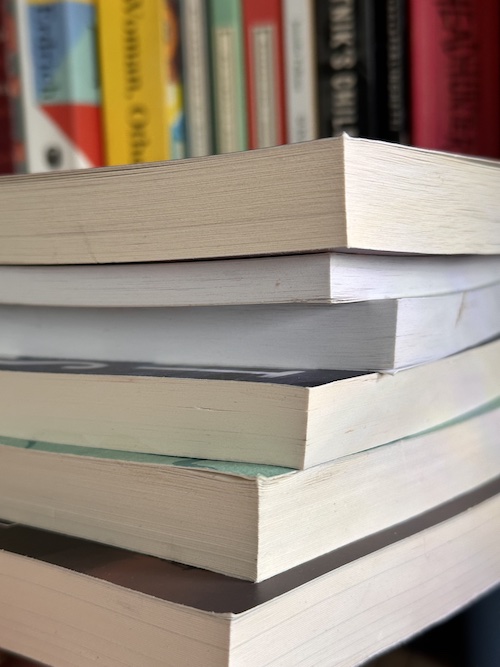
Which one of these fantastic books is your next favourite read?
Take my new quiz to find out!
Yep, I’m back with some literary matchmaking after far too long and I’m THRILLED to be setting readers up with some books I’ve loved lately…
March 29, 2023
Gleanings
- March… ah, March. It’s a month, a verb, a noun, … a promise.
- There are moments when one’s actual happening life feels fully integrated and aligned with one’s intentions and beliefs. This was that.
- If you know what “three on the tree” means, you’re no kid. And when you were one, there’s a good chance you lived on a farm.
- When we allow ourselves to be fed single narratives by others, by people in power in the mainstream, then we are in danger of stereotypes and preconceptions taking root in our minds.
- As to my fondness for poetry, Mrs. Nelson always said that my preference was twofold; because I was a lazy reader – I could quickly read a poem and get right onto analysing it for an assignment or essay, and because I loved music so much – the cadence of poetry dovetailed into that passion.
- That’s my dream—to one day have that conversation with my children about when the country’s grown-ups finally pierced the veil, understood that we would never understand one another completely, but we could still agree on wise limitations that would save lives and our very own American souls.
- ‘Whose needs are you meeting by visiting your husband?’ My therapist asks me./ Today I can speak the truth she has known for much longer than I have. Mine. My needs.
- Part of what I do when I lie awake at night* is fret about lying awake at night. (I’m fun like that.)
- The other morning I asked my husband, did you not sleep well last night? He had been so restless. He informed me that I had spent most of the night ‘manipulating’ the blankets, pulling them off him, twisting them around me, and leaving him naked to the cold air blowing in from our window. And, he added, my snoring had been off the charts! Why didn’t you wake me? No, he said, you were clearly having a good sleep.
- I love all the kids, all of them, with all of the learning they still have to do, and all they have to teach us as they do. (especial love today to trans kids and the kids without a box. holding them to the deepest depth of my ability. how incredibly brave they are to make something new.)
- I can now tell my neurologist that I doodle.
- I was remembering things more or less correctly but how easily I took for granted the actual fact that I was Greece. That I walked up the marble steps to look at the Erechtheion, the porch of the maidens, the wildflowers growing on the hill.
- I read that one of the most critical parts of any journey is the return home. That the journey asks, for us to gather up the medicine that we found along our way, and bring it back … not just for ourselves, but to our home, our community.
- Do you want to know what’s almost as magical as an animal friend that goes for a walk and comes home on her own? Plants that make little hard, dry seeds and then give them to you so you can collect them and make new plants from seemingly nothing the next year.
- I think what drew me back to thinking again about and wanting to re-watch RW is for what it teaches us about knowing. How things and information can move in and out of the light, how the way we know things is more fluid than we’d like, and how we’re continually trying to make sense out of what we see, and then act on that to the best of our ability (knowing that we don’t know everything).
March 27, 2023
My Boots Match My Book
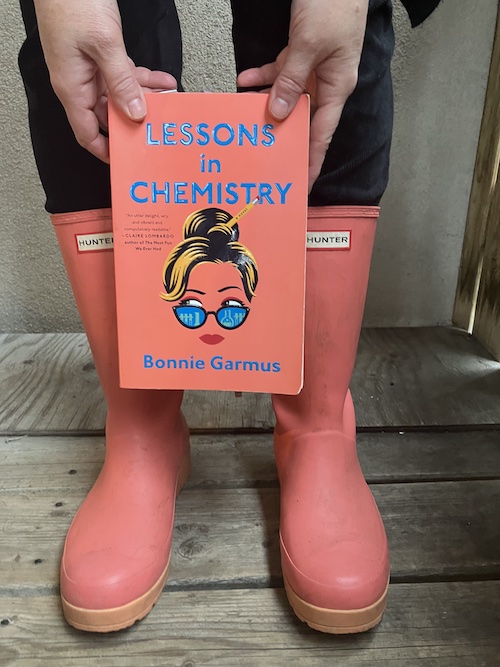
I made up a thing called International Match Your Book to Your Boots Day on the occasion of my wellies being broken out for spring at the same time I’m finally reading Bonnie Garmus’s Lessons in Chemistry, which I started reading yesterday evening and am already more than halfway through. It’s so good—it sparkles. This evening I am aiming to put dinner on the table as early as possible so that I can put on my pyjamas as soon as I can and retire to bed to read the rest of it.
March 23, 2023
Bleed, by Tracey L. Lindeman
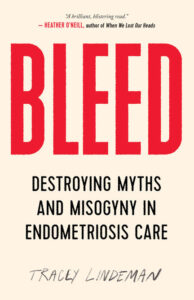
The first time I heard about this book was last fall while I was drinking tea in Jennifer Knoch’s garden and asked her about amazing books she’d edited that were coming down the pipeline, and she talked about BLEED so passionately and made clear that this was a book that everyone should read, not just people with experience suffering with endometriosis.
And then two more people I deeply admire—@aborshpod’s Rachel Cairns and @yellowmanteau (Julie L. Lalonde)—started posting about it on Instagram, weaving its threads into the stories they tell online about reproductive justice and feminism/violence against women respectively—and showing too that all these stories are connected, for worse (because such tangles makes everything so much more *complicated* and difficult to resolve) and also for better (improving healthcare for people with endometriosis means better outcomes for *everyone*).
In BLEED, Lindeman uses a mix of memoir and reporting to show how her brutal and painful experiences with endometriosis since age 11 is representative of the suffering of so many other people, and also how the lack of care endo patients receive highlights sexism, racism, classism, anti-fatness within the medical system. Most doctors aren’t aware of how to diagnose endometriosis, let alone how to treat it—thanks to the influence of pharmaceutical companies, patients are usually given pills before surgery, pills that are ineffectual at best, harmful at worst.
Those who ask for surgery receive push-back from doctors who wish to preserve patients’ fertility, even when patients are adamant that they do not want children. Patients are caught in a catch 22 where they’re able to mask their symptoms and remain high functioning, which comes to undermine their complaints, or else they’re overwhelmed by the physical and mental toll of endometriosis and dismissed as just hysterical.
It was interesting to read BLEED in the context of another book I’ve recently read, Felicia Kornbluh’s A WOMAN’S LIFE IS A HUMAN LIFE about the parallel battles for abortion access (by white middle class feminists) and against forced sterilization (by working class activists of colour). At first glance, these two through-lines seem entire separate, even opposed, from each other, let alone Lindeman’s narrative. In a politics of either/or, black and white, this is certainly the case—but life is not like that. And—as Kornbluh’s book made clear—insisting that it is undermines justice and progress for everybody.
Lindeman’s narrative overlaps with Kornbluh’s when she writes about how birth control drugs were tested on people in Puerto Rico…and then ultimately dispensed in huge amounts to the general public in what purported to be a kind of liberation, but perhaps at a cost that most people don’t like to talk about, mostly because the people who are talking already are religious zealots seeking to control women and also because who wants to be opposed to liberty?
This narrative is messy and demands attention to nuance, and it also challenges me as someone who has mostly been served by the medical establishment so far throughout my life, never meeting with the roadblocks and suffering that becomes standard for Lindeman and others with endometriosis (and PCOS, and a litany of other chronic illnesses, and also [the much feminized and therefore maligned] chronic pain). It’s also a narrative that doesn’t come with neat and tidy ending, for the patients themselves or the system at large. The end of BLEED is just the beginning, after all, of—hopefully—a powerful reset and reimagining of how our medical systems are structured, and what reproductive justice/’my body my choice’ really means.
March 22, 2023
Asking for a Friend: Cover Revealed!

I am beyond thrilled to finally be sharing with you the gorgeous cover for my new novel, ASKING FOR A FRIEND, coming September 5, 2023, from Doubleday Canada, designed by the talented Lisa Jager. It’s the cover of my wildest dreams, encompassing two of my favourite things, extravagant sunsets and SWIMMING, and it’s such a wonderful encapsulation of this story, which I’m so looking forward to sharing with the world.
You can preorder your copy now at the SHOP LOCAL link at my publisher’s homepage, or at your favourite bookseller. Stay tuned for preorder goodies and launch plans.





