May 2, 2023
The Light of Eternal Spring, by Angel Di Zhang
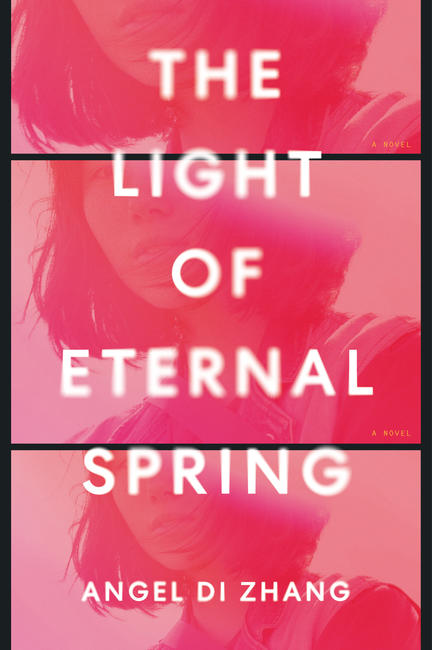
“My mother died of a broken heart, or so the letter said.”
And this is the spectacular opening line of Angel Di Zhang’s dazzlingly dreamy debut novel, The Light of Eternal Spring, a story of love and loss, a story of finding and belonging, about seeing and knowing, all the gaps between what we remember and what really happened, and the curious nature of space and time. How did we get from there to here?—a question that preoccupies Di Zhang’s protagonist, Aimee (pronounced Eye-Me), particularly after her mother dies and she travels with her American husband back to her hometown in China, the rural village of Eternal Spring, where she hasn’t been for so many years. It’s also the question the narrative sets out to answer.
Aimee, a photographer, is known as Amy in her new life in New York City, where she is now so established that she thinks in English, and her photos appear in ads on the subway, and she thinks her thoughts first in English instead of her native Mandarin. Though it’s Manchu that’s Aimee’s mother tongue—literally, her mother’s first language—and she’s forgotten it to the point when her sister’s letter arrives with news of her mother’s death, she has to have it translated by a woman in Manhattan’s Chinatown running a vegetable stall.
It’s 1999 and communication is not as instantaneous as it is today. When Aimee and her husband David set out for Eternal Spring in the hope of making it back in time for her mother’s funeral, she has no idea what to expect, and her family don’t even know to expect her. What she’ll find is a place and people who are radically different than they were when she last saw then, by virtue of the nature of memory, but also because the previous decade has been a time to radical change in the village, which has become busy and bustling, not a village at all. Because nothing ever stays fixed, both in life, and in our memories, and such understanding is a challenge for Aimee, whose photos aim to capture time, to hold it still.
How to grapple with the mutability of reality? And even more important, how to resolve her relationship with her mother now that her mother is gone? The last time mother and daughter were together led to a spectacular flame-out and they haven’t spoken since. Will there be any chance for Aimee to to reconcile with her mother’s memory? And what about reconciling the space between Aimee and Amy, between the place where she comes from and where she lives now, and possibility of belonging to both places, a kind of double exposure, not a photographic error but instead an accurate image of her psychic reality?
I loved this book, its freshness and sense of play, its curious placement outside of time, just beyond the limits of realism, about the all the possibilities of impossible things.
May 2, 2023
Gleanings
- It’s no picnic, that’s for sure: the unexamined life may not be worth living, but (as I have often thought myself in recent months) surely in many ways it is an easier way to live.
- Blue Portugal & Other Essays is a book I’ve been writing all my life, through all the years that have led to this one, stitched from scraps of beauty and difficulty and love.
- The year is now 2023. Books have been published. Regimes have changed. Children have entered and nearly completed middle school, gray hairs have sprung, betraying, and I believe — I mean, I’m absolutely utterly certain — that this is the final iteration of what I consider to be the perfect homemade hash brown patty….
- What is the relationship between nature and each of these walkers? Is there a melding of purpose and experience, a common recompense on some level? Have any of them met the soul walking upon the path? How aware is each walker, of just how interconnected they are to this woodland? In the simplest of terms, the trees give off the oxygen we breathe in, and absorb the carbon dioxide we exhale – a true symbiotic partnership that has spanned centuries.
- It is what my brain has been like this month. Just flayed, spread out and incapable. (looks like a flower, but carries a whole lot of teeth) while my body does all the things necessary: kids are mostly fed, laundry is done and even folded, sports are attended, jobs are attended, my brain has been uninvolved.
- I share my words with you. You provide me with your thoughts and wisdom. I sit with your words. And I am rewarded with more learning, insights, and additional pieces to the puzzle.
- Do I recommend it? Only if you enter into the experience of reading it with a sense of generosity and curiosity, as if you’re conducting an experiment. Which, come to think of it, isn’t a bad way to begin reading any book: with generosity and curiosity.
- For me, fourteen years ago when I was desperate to move on from the thing that had consumed my energy for almost a year, meeting an active, healthy person who had done the treatment and gone on to live a good life, inspired me. My hope is that my story in some way inspired them. They certainly inspired me. Out there playing pickleball when they’re still dealing with pulling gauze out of their chest. Now that’s impressive!
- I am sad to report that I have exhausted all of the available fiction by Iona Datt Sharma. But I am overjoyed to have found them in the first place.
- All day, it was like looking through a small microscope, a zoomed in experience of the world. Seeing just a piece, a small part of all of this, of all of us.
May 1, 2023
Harper Valley PTA
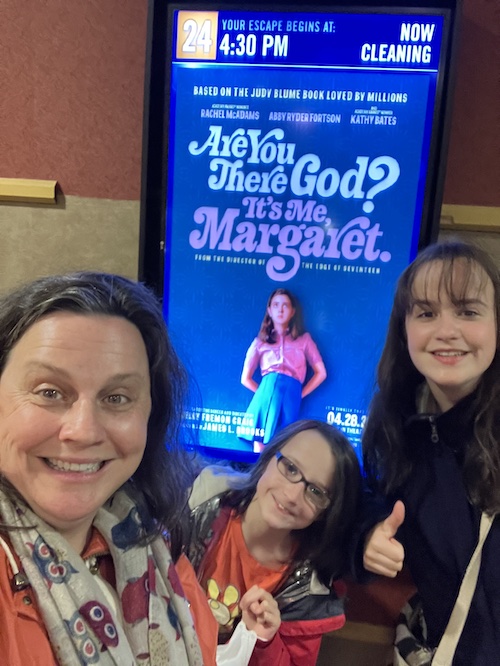
I had but a single reservation about the film version of Are You There God? It’s Me, Margaret, which I saw at the cinema yesterday with my daughters whose companionship for such an occasion was such a treat for me. They’ve both read (or reread) the book in the last few weeks, and were as enthusiastic about the movie as I was. We loved it, and to all be able to experience and love something together is a pleasure I appreciate so very much.
But. But. But.
And this is personal. I’ve spent the last few weeks overwhelmed by several things, not the least of which is a fundraiser for my child’s school that has ended up on my plate mostly because I was the only person who reluctantly failed to refuse it. Because I cannot bear to leave a silence or vacuum unfilled. Because while succeeding in leaving such a silence or vacuum unfilled is an act of liberation (which I’ve even managed to pull off once or twice) it only means that someone else is going to have to do it, and that’s not really liberating at all.
It’s a quandary, and I’ve come full circle, and then some. When my children started elementary school (ten years ago!), I swore off volunteering altogether…because I know myself, how it’s only ever all or nothing, and um, I think I was also still on the board of their playschool at the time. And I was also bowled over by the requests for volunteers and funds (and usually both) at my children’s school. It was too much, it was inequitable, they had galas to raise money for the galas! Okay, that last point is an exaggeration, but I put it in my first novel, Mitzi Bytes, whose protagonist was resolutely anti-school volunteering. She values her time too much to go in for any of that nonsense—and oh, I wish I was her with every fibre of my being. The way she really doesn’t care what anybody thinks or about what she should be doing. She’s not doing it, and it’s simple. What I would give for that kind of clarity.
But of course, I care what people think a lot, too much, and I overthink everything about how to be a good citizen, and a good community member (and how to be “good” in general, which my therapist and I will be continuing to unpack for the foreseeable future), and so when my book was coming out, I eagerly signed up for the school council just so now one would think that the book was autobiographical, and chaired that council for two years, taking on duties to such a ridiculous extent that I was sitting in for the secretary sometimes when I was chairing, taking my own minutes, which is nuts. I also thought a lot about the role of fundraising in public education, registering my discomfort, but by this point understanding how school staff count on these funds, which are raised entirely on the backs of moms whose labour is discounted by assholes like my protagonist and other like-minded folks (who were sometimes me).
I managed to step away from school volunteering eventually, which maybe is the way it should be—we do what we can, take a break, come back again (or not). These days I volunteer twice a month at pizza lunch, which I really like doing, and it’s nicely low key. I’m not on school council anymore, because I did my time. It’s other people’s turn—and that’s a wonderful thing to realize, by the way, when we’re feeling all disgruntled, put-upon, why do I have to do everything? When I stopped showing up, someone else took my place, which is also (sort of) to say that I gave someone else a chance to take my place (as opposed to taking my own minutes; all or nothing, remember?).
But then my elder daughter entered middle school, and it’s very small school, oh no, I saw it coming, really. This spring fundraiser that hadn’t been produced since 2019—who was going to do it. It was going to be me. It was always going to be me, even though I’m not really that good at producing events, and I do so always in the most corner-cutting, simple way possible because I’d rather get it done than do it well. Sigh.
And, truthfully, it’s not been so bad, and I’ve only cried about it once, and if the event manages to be a success (it’s the day after tomorrow), which is to say even approaches reaching our fundraising goal, I’ll be glad I did it. Even though I’ve been bothered that more people in our school community haven’t been pitching in, that such a small number of parents (moms!) are usually the ones who do everything, and so many others are content just to not be involved, to ignore my emails, to not respond to requests for help, content to let it all be somebody else’s burden, which is to say mine.
I think what bothers me so much about the situation is not just that people aren’t helping, but that their failures to help makes me feel embarrassed, ashamed. Sending out these annoying emails week after week, all peppy, and knowing such messages must be so obnoxious to receive, so I feel kind of pathetic, like a loser. And that it seems like I have nothing better to do with my time than this—what does that say about me? About who I am and what I do?
(Like I said, this is personal.)
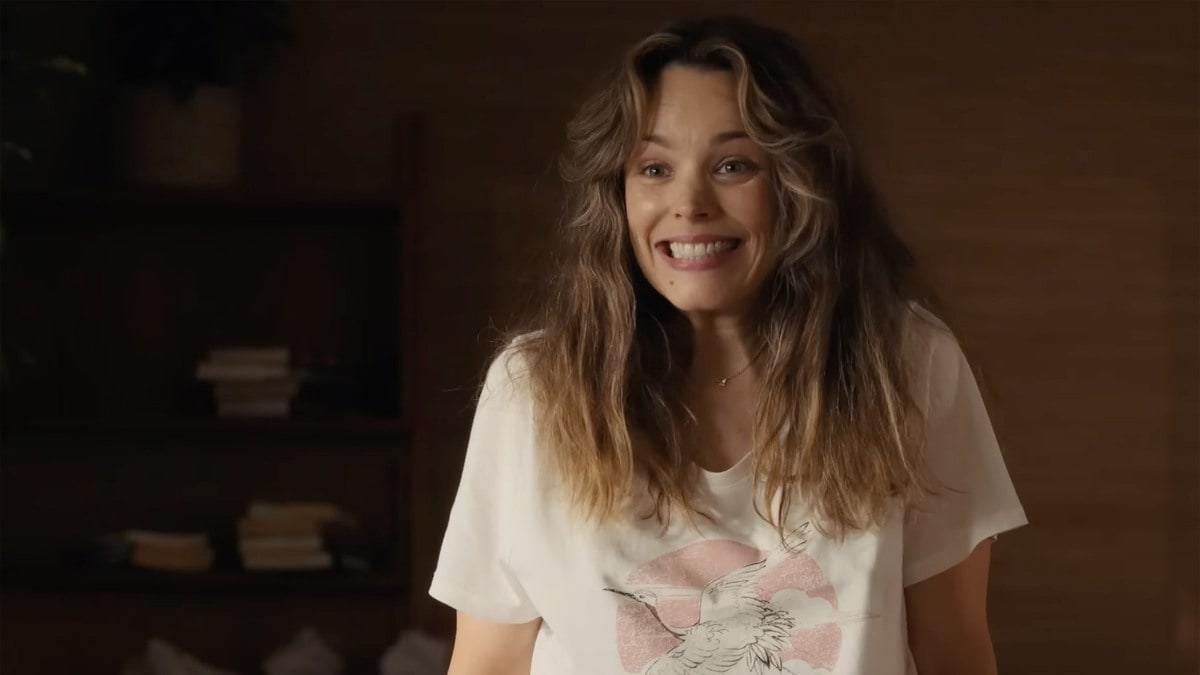
So yes, I was conflicted about the final arc of Rachel McAdams’ character in Are You There…, a bohemian mom who moves to the suburbs and leaps right into the school community because she wants to do the right thing and because for the first time in her life she has the time to, but of course her intelligence and talents are wasted there. The company is terrible, shallow, and the labour itself is totally pointless—she’s charged with cutting out thousands of thousands of felt stars that ultimately end up on the garbage. By the end of the film, she has found better and fulfilling things do with her time, and when she’s called on again to volunteer, she declines, declaring “Because I don’t want to,” and people in the cinema cheered, and I get that, but I also hate that.
In particular during this particular week, as I find myself (metaphorically) cutting out my own felt stars, as I send just one more cheery email urging families to please sign up for the bake sale.
What do we do with this? What do we do with the vital labour of mothers that’s necessity to make up for a public education system that has been hopelessly underfunded for nearly thirty years? What do we do with the fact that it’s often other mothers who are most derisive about this labour? And what do we do that none of this ever has anything to do with the dads at all? (And we can continue—this is about class, of course. About families with the time and resources to commit to school fundraising, which many school communities can’t count on at all.)
These are the circles I’ve been thinking in for almost a decade.
But today I came to some kind of answer, or the beginning of one—at least in my own mind. First, we need schools better funded. We need fathers to be as invested as mothers are in what happens at school, which means less work for everyone. And another part of the answer, which I’ve sort of been onto already, by virtue of being lazy, is my corner cutting approach to things all along. I’m not cutting out any fucking felt stars, is what I mean. This kind of labour is essential, so use it smartly, use it well. Value people’s time. Keep meetings within limits. Respect people’s boundaries. Appreciate people’s talents and skills. Don’t take any of this for granted. And if everyone does a little, that means no one has to do it all.
April 26, 2023
AFAF Mood Board: Part Two
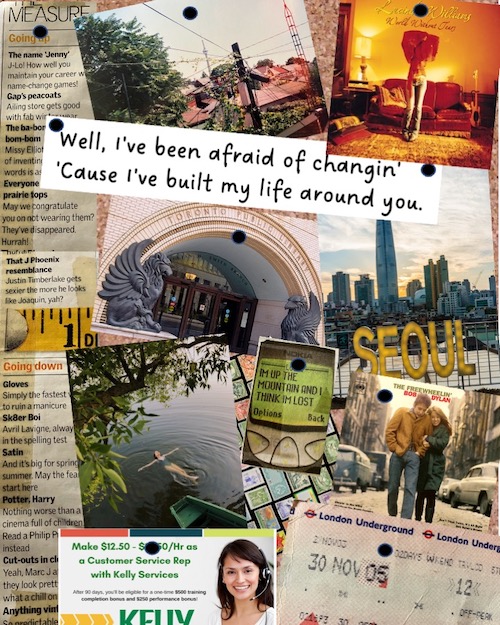
Mood Board 2 for Asking for a Friend, my new novel coming from Doubleday Canada on September 5! These images are inspired by the novel’s third and fourth chapters in which Jess and Clara begin to make their respective ways in the world after having lived a life entwined throughout their early 20s. How are they supposed to be themselves without each other?
Asking for a Friend is available for pre-order from your favourite bookseller!
April 25, 2023
Gleanings
- I’ve previously shared with you that grief is my roommate, inescapable even when I’d rather live alone. In that moment in my basement though, I realized that my emotional house-mate had, in recent months, quietly moved to the lower level.
- The largess of Andrew Carnegie allowed for the construction of five libraries here in Essex County, and the one in Windsor was the first Carnegie Public Library in Canada.
- But this book, and Sashi’s brothers and friends who kept disappearing from the village, brought back not only the memory of that young man who disappeared from our office, but also the realization how war is never just black and white, never just good versus evil, never only the one narrative we hear. Because we never truly know how the everyday lives of people are forever changed and often erased.
- From author Deryn Collier comes a smart, charming postwar historical novel based on the true story of an aspiring writer who dares to dream big.
- For me, I decided to make a deal with the world. The deal is that I agree to believe everyone is trying their best, and I hope that they will believe I’m trying my best. No conditions. That’s the deal.
- Burr falls squarely in the tradition of The Southern Ontario Gothic, mining the unsettling territory where our wilder, more honest selves rub up against the veneer of suburban respectability that blankets us. It reminds me of the novels I read as a teenager just beginning to discover what literature could do, books by Margaret Atwood and Alice Munro that offered me the radical notion that the boring, bright suburban world I inhabited was as full of ghosts and desire and grief and decay as any other time and place.
- 7. I wonder if she even liked the dishes? If they ever got used? If the dress felt good on her body?
- And now I am being careful about what I wish for. Warmer days, yes, but not too hot (the ability of bees to both pollinate and to reproduce decreases in extreme heat). Nights without frost. The third planting of tomato seeds (better late than never?) growing to full size, heavy with fruit, the pans of them roasting with garlic, rosemary, quarters of onions, the beautiful mutilated world somehow surviving, surviving us.
- After much reflection, I’m now learning that the confidence, daring and joie du vivre that I felt in my Mum throughout my childhood was in part the result of a woman who didn’t compare herself, and didn’t bother too much with what others thought. She was herself, not a version she aspired to.
- Last night as I turned off lights and tucked kids into bed, I caught a whiff of lilacs. A neighbor’s lilac bush was blowing its heady perfume three doors over and two stories up, right into our windows. The evening air had grown chilly and the sky was not quite dark, so I closed the windows and drew the shades and thanked goodness for the millionth time that winter is over and that tomorrow could bring more lilac huffing.
April 24, 2023
There Was a Good Man Named Paul Revere

On Friday evening, a raccoon got into my kitchen. (Not for the first time; also this was not the only raccoon intruder in the neighbourhood this weekend!). And whenever I told anyone about it, they’d ask how the raccoon got in, and I would reply, “It came in the door…” And then I’d have to resist the impulse to finish off the sentence with, “I said it before/ I think I’m over you, but I’m really not sure.” Which is a problem much more rare than Toronto raccoons are, which is that I am absolutely obsessed with the song “Summer Girls,” by LFO.
And the weird thing about this is that everyone else isn’t. I don’t get it. A few years ago, back when Twitter was not a terrible place, I shared my shocking discovery that two out of the three members of LFO (aka, “The Lyte Funky Ones,” whose “Summer Girls” was pretty much a one-hit-wonder in 1999, though they tried hard to follow it up) had died of cancer. Because what kind of a statistic is that? Cancer, robbing the world of 66% of the ones who were lyte and funky, and now there is just one. The Lyte Funky ONE, and I partook in such banter with exactly TWO people, and it seemed like nobody else on Twitter cared about LFO, or even remembered the song at all.
But the lyrics to that song are wired to my brain in a way that I just can’t kick, and I don’t even want to. Which is kind of ridiculous, because the lyrics are so random and weird, but unbelievably catchy, and I just can’t help walking around the house muttering lines like, “Call you up, but what’s the use?/ I like Kevin Bacon, but I hate Footloose.”
Part of the problem is that I have two amazing daughters, and so it comes up a lot, a line like, “You’re the best girl that I ever did see.” Multiple times a day, I’m not even kidding, to which my children reply, without missing a beat, “The great Larry Bird, Jersey 33!” And HOW can I not follow that up with, “When you take a sip, you buzz like a hornet, Billy Shakespeare wrote a whole lot of sonnets”? Not a single one of which I can recite, by the way, and yet I know all the words to this bizarre and remarkably song in which “hornet” and “sonnet” rhyme!
When I do online yoga classes, I’m sometimes instructed to “shake and wiggle,” which puts “Summer Girls” back in my head yet again...as if it even needed planting: “In the summertime, girls got it goin’ on/ Shake and wiggle to a hip hop song.”
And I don’t know a better expression of love than telling somebody, “There was a good man named Paul Revere/ I feel much better, baby, when you’re near.”
Stayed all summer, then went back home
Macaulay Culkin wasn’t home alone
Fell deep in love, but now we ain’t speakin’
Michael J. Fox was Alex P. Keaton
I honestly don’t understand why any other song has to exist!
I am not the only person who has thought quite extensively about this song, and Rob Harvilla “How ‘Summer Girls’ Explains a Bunch of Hits—and the Music of 1999” was such a joy to encounter, explaining a lot about just how this song has been running through my brain for almost 25 years. (The summer of 1999 was one of the most vivid and insane periods of my life, and I remember every song that was ever on the radio, which was this one, and “I Want it That Way,” by the Backstreet Boys, and “Living’ La Vida Loca,” and “If You Had My Love,” my Jennifer Lopez, and and and, and Harvilla does a formidable job summing up the absolutely bananas musical year that ’99 was.)
I had never heard of Abercrombie and Fitch until that song, whose video had a similar vibe to “Steal My Sunshine,” by Len, and we all watched videos then, and I put my hair in cute pigtails and wore tank tops and aspired to be admired by boys with frosted tips.
One day I’m going to be old and senile, and just repeating these lyrics on a loop.
Boogaloo Shrimp and pogo sticks
My mind takes me back there oh so quick..
April 19, 2023
The Story of My Garden
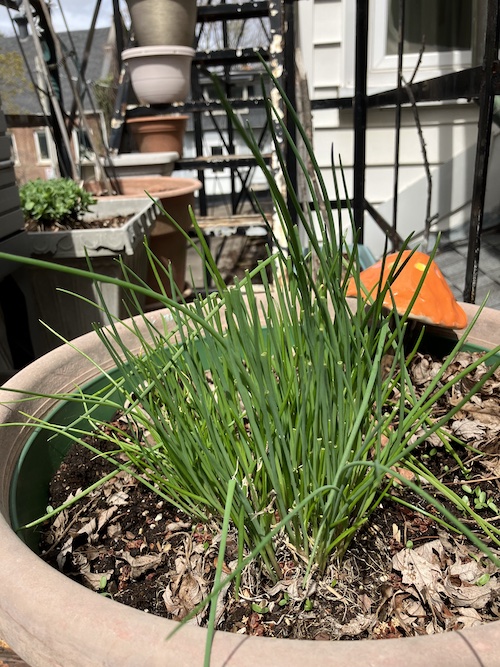
There were a few seasons during which I might have told you that I had a greenish thumb, more than fifteen years ago now, back when I was a newlywed and my husband and I lived in a second floor apartment near College and Ossington. I’d never had a garden before, but, with the help of our downstairs neighbour, we planted one in the backyard where tomatoes already grew, their vines winding around the cinderblocks and other construction debris that littered our yard.
The tomatoes should have been a sign, but I didn’t know enough to know that…
(Read the rest of my piece in the Harbord Village Gardeners e-newsletter!)
April 18, 2023
Gleanings
- And then, “I ask myself constantly….why do you return again and agin to Woolf? It is because the text made me!” And isn’t that a moment of joy for us all, to be in the presence of such a wonderful engagement with a text.
- The objective of the exercise is not to look for life balance, but to look for movement towards the things you love, those things that uniquely define and delight you, then tilt madly towards them.
- Oh, right. Duh. Public schools are basically the most complex kind of community there could possibly be–a crew of people from different racial, religious, and class backgrounds, who didn’t choose one another, coming together with pathetically limited resources to try to care for one of our most precious, insanity-inducing assets: our kids. Some eggs are going to get broken with that collective recipe.
- There are some things I just can’t enumerate, like the peanut butter and honey sandwiches, cheese sticks, and protein balls we ate on the road. Or the long stretches of beautiful or non-descript highways we traversed. The patches of wildflowers on the roadsides. The few scary traffic situations we endured, and frightening bridges we drove over. The laughs and the catching up about family and friends from way back. The discussions about childhood in which my sister and I just don’t remember things the same. The times I just wished we were there already.
- And I wondered to myself, when did my need for validation transition into a desire for affirmation? It was an aha moment; I felt like I had discovered something new.
- It’s probably ridiculous, how much I love an HB/2. It’s simple. And it’s forgiving. I can be most creative, and try and be wrong countless times- until something comes out right, when I’ve got this guy in my hand
- Okay, so there’s the obvious impracticality of spilling mouth wash all over your vintage Guatemalan textile, but really, who doesn’t love to floss over a bustle of fancy fabric?
- In summer we will swim in the bay that is hung with mist. Small boys love the shore for the starfish, the crabs under rocks, the anemones pulsing in the tidepools. Looking up from the water, I’ll remember the lilies in their damp moss, the decades of seeing them, how the sea rises and falls, rises, falls, generations of ravens in the trees, and the oyster shells on the side of the path.
- If you are a bird person, it’s hard to have a favourite bird, but if I was pressed, I would have to say that Dark-Eyed Juncos are among my favourites. See what I did there though? I didn’t commit to having a favourite, but I acknowledged that Juncos are one of my favourites. See? Hard.
- Despite the algorithm that can apparently now predict language — I couldn’t predict the way that my heart would leap when I heard a friend call his teen son sweetheart on the phone yesterday, or expect a machine to know the feel of her heart thumping against my palm while cuddling on the couch, Blake’s howling laughter in the background.
April 17, 2023
Birnam Wood, by Eleanor Catton
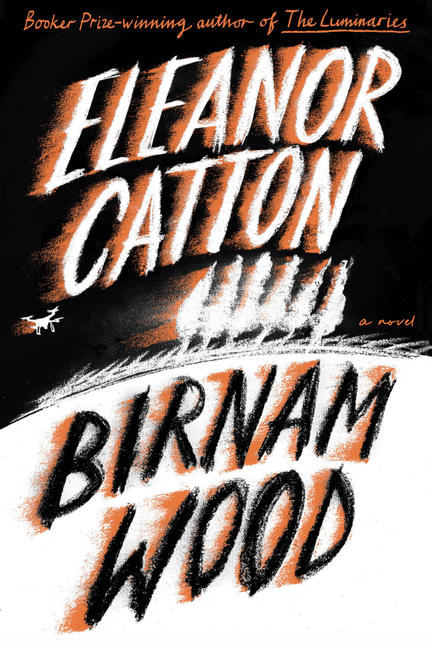
True confession time: I’ve never read Eleanor Catton’s Man Booker Prize-winning novel The Luminaries, and I likely never will. Reportedly, it’s very lengthy, set a long time ago, and all about a man staking his claim in a gold rush (yawn), and no doubt it’s extraordinary and brilliant, but each of these makes for three counts on my NOPE NOPE NOPE list, and there are so many other books in the world.
My interest in Catton’s latest Birnam Wood, however, was piqued by critic Lauren Leblanc’s enthusiasm for the project, which was also the reason I went to see Catton at the Toronto Public Library’s Bluma Salon event in early March, which was really fantastic, and I bought the book there. She kept talking about plot, and about how “character is action; we are what we do,” and I was intrigued, though I’ve got to say that even though this novel clocks in at only just over 400 pages, I picked it up thinking of a doorstop, and what have I gotten myself into? There was not a lot of white space. Will I be reading this novel for the next 900 years?
But reader, I sped through it in two days. This book! This book! Speaking of plot… Though it didn’t take off immediately. I was interested in the story and surprised to find that it was so much more intimate and immediate than I was expecting, deeply embedded in the experiences of characters ranging from the leader of the gardening collective, her loyal sidekick, a renegade citizen journalist, a pest-control mogul who has recently received a knighthood, his wife, and a reclusive American billionaire seeking refuge in middle of nowhere New Zealand for reasons that aren’t bound to be honourable. I thought this would be a more sprawling book, individual people at a distance, more a book in general than this one, which is so exactly, specific. Even though the paragraph-long sentences were hard to parse at first, so many clauses, and semi-colons. Like making one’s way through the weeds and the bramble, and then suddenly there I was at the heart of things and the novel was unputdownable.
“She was still looking for a villain. She was still trying, desperately—and uselessly—to find somebody more monstrous and despicable than her.”
Who is the villain of this story? Who is the hero? Such murky distinctions (if any are to be made) are what make Birnam Wood such a fascinating puzzle of a story. I loved it.
April 14, 2023
It’s All Happening
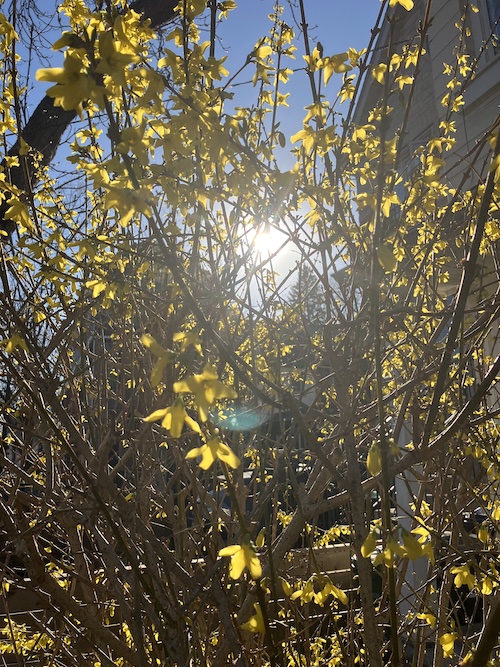
It’s all happening! Not just spring even (though spring is happening too—there is forsythia in bloom in my front garden!) but everything else, the weekends filling up like in old times. And I’m running two community events in the next three weeks, as well as supporting another one in June, and while I may have reached the “crying because I’m frustrated and no one will help me” and having periodical hissy fits stage in the organization process, in general I am doing okay, which is a big deal, because when I was having a really hard time with my mental health last year, I wasn’t sure I’d be able to take on these sorts of responsibilities again. I have a much harder time with stress these days, sometimes my anxiety turns on out of nowhere, and a year ago I was still was suffering so much, but since then I’ve rebuilt so much of my mental strength, and it feels really good. I’m proud of just how far I’ve come.
And something else good that happened to me last week was sitting down to write a little piece for our neighbourhood’s community gardeners e-newsletter. I’m at a moment in-between with my new novel nearly ready to go to print, and another novel that’s still in progress but I’m not stressing out too much about getting that next draft done, and I’ve taken a break from doing manuscript evaluations (though I’m returning to that delightful work next month!), which means that I’m temporarily between deadlines, as they say, and finally had a moment to devote to writing something for the Harbord Village Gardeners, which I’d been meaning to do for months now.
And it felt so great! To write and write and to get to the end, so richly satisfying. I’ve been writing my novel since 2015 and while getting it out there finally will be incredible, it’s still a long and complicated road to take, but this was different, and it had been so long since I sat down to write something like an essay (or a story). A creation I can (metaphorically) hold in my hand, and I was so pleased with myself, and pleased with the result. Looking forward to sharing it soon.






