November 6, 2011
My favourite day of the year
 It really is my favourite day of the year, this one with 25 hours in it. It meant that this morning we could get up and be lazy, and still be at the AGO for their 10:00 opening. And that it was ROM Members Day at the AGO meant that we got in free, which meant no fretting about getting one’s money’s worth, and that we could hang out in the gallery for an hour or so, and then retire to the cafe (and this, plus the lazy mornings, are exactly how we roll). Then this afternoon, I spent four hours working on tomorrow’s Giller Prize post for Canadian Bookshelf, and by the time I was finished, it was dark outside. And though I love summer madly and despair the winter days, I do love those dark evenings with my family tucked inside our house, the lights a golden glow. Particularly because we had wine leftover from last night’s dinner with friends, and it was delicious. (As had been the dinner itself, meat lasagna from Tessa Kiros’ Apples for Jam, the cookbook that never fails). The overall goodness of the day only underlined by the glorious weather, sunshine so warm that I didn’t even need to wear my new hat (but I did anyway, because I made it myself. I have the biggest head in the universe). And that tomorrow we’ll wake up at 7:00, and it finally won’ t be dark out.
- Check out my friend Nathalie’s time-change blog post, Got An Extra Hour? Read Books With Clocks.
November 6, 2011
Our Best Book from the Library Haul: In the Meadow by Hilde Heyduck-Huth
 There wasn’t an obvious candidate for our Best Book this week, and this aged book, which was translated from German by Patricia Crampton, did not seem like an obvious contender. But you never know with Best Books really, and it’s anybody’s guess how children will respond. Halfway through our first reading of In the Meadow, the story about a dung beetle navigating a forest of grass, Harriet was absolutely captivated.When the beetle encountered his ladybug relatives,
  Harriet insisted on digging her stuffed ladybug out of her toybox. “Ladybugs are a kind of beetle,” I explained to her, but she heard it differently, and has been telling us ever since how her ladybug is a “kind-of beetle”. The illustrations in this book are detailed and beautiful. Hilde Heyduck-Huth has a website (in German) and from the links on this page you get a sense of the fascinating things she’s been up to in her illustration career (inc. an edition of Kahil Gibran’s The Prophet).
November 3, 2011
What I found: Childcraft- The How & Why Library
 Blog fodder is something I’ve been thinking about as I finish up writing my lectures for SCS 2114, and I’ve been thinking about how often I stumble upon mine by the side of the road. On Tuesday, it was a stack of encyclopedias from the Childcraft- The How & Why Library, an edition published in 1987. There’s a volume of fairy tales and nursery rhymes, another of contemporary stories (Amelia Bedelia, Where the Wild Things Are, etc.), one of art projects, another about dates, festivals and celebrations, one about How Things Work, and Numbers and Math. We’ll have to edit Space and the Universe so Harriet understands that there is no such thing as Pluto, but so much of the content here will never go out of date, the books are in perfect condition (except for the page that Harriet ripped), are still attractive-looking, and (best of all) they don’t smell like a basement. (We might ignore the parenting guide in Volume 15 though, with its topical chapters of latchkey kids and working mothers.)
I’ve been longing for an encyclopedia in the same way I wish I knew how to use my sewing machine. I love its containment of the universe, the order of its numbered spines, its place of honour on the shelf, and that if anyone in our household ever wants to know what a cloud is and the internet’s down, it’s no problem. I love that you can open any volume to a random place, and discover something completely fascinating.
The downside to all this, however, I discovered after lugging the whole stack home (while pushing a stroller whose basket can no longer accommodate books after too many gluttonous trips to the library, though that I carried a stack of encyclopedias home really might be the most remarkable part of this story): two volumes are missing! Volume 3 Stories and Poems, and Volume 7 Story of the Sea might just have to tracked down and purchased online for the sake of completion.
November 2, 2011
The Vicious Circle Reads Saving Rome by Megan K. Williams
 I’m coming out of first-person plural here, because I loved Saving Rome by Megan K. Williams without reservation. I’m coming to the tail-end of the busiest month I’ve had in years, and the space I’d carved out to read this book– sitting on the couch during Harriet’s nap times, holding the book open with my feet while I furiously knit up this hat— was like a gift to myself every day last week. The reading was a pleasure, the stories so diverse in their approaches to their subject, so strong, convincing, so funny, and underlined a lot of experiences from my expat days. I don’t think I’d enjoyed any other book as much that we’ve read for our club, unless it was a book written by an English novelist in the 1950s. It’s one of the best books I’ve read lately, and I’d recommend it wholeheartedly.
What being in a book club has taught me, however, is that there’s no telling with taste. And that taste is so much what we’re talking about when we’re talking about books, no matter how much we couch our arguments in aesthetics. I also know that being in a book club has made me a better book reviewer (and it has made being a book reviewer that much harder. I second-guess myself more often now. Which, for a book reviewer, is a good thing.)
Anyway, reactions were mixed across the board as The Vicious Circle assembled in the St. Lawrence neighbourhood of Toronto last Saturday morning. We were also dressed as literary characters for Halloween (and one of us was dressed as a genre)– I was wearing a 99 cent 54DD bra from Honest Eds, stuffed with Harriet’s plush balls as Georgina Hogg from The Comforters, but not the sexy version. There was lots of delicious food, and plenty of gossip, and even a baby, then we got down to the book.
It was boring, said one of us, and another of us was aghast. One of us had struggled for a while with not liking the characters, which was disturbing because she’s a better reader than that, but then she realized that she just didn’t care about the characters. That they were boring. That they were living in Rome, but weren’t engaged with the setting at all. They could have been anywhere. “But that’s just the point!” said another one of us, pulling out the old “I’ve got personal experience of it” trump-card, which is a stupid trump-card actually, because a book isn’t good just because it reminds me of when I lived in Japan.
The point though, that one of us continued, is that living abroad and being engaged with a place is exhausting, and can unsustainable, and that Williams’ stories reflect the frustration, rage, ennui and struggle of one who is living where she doesn’t belong. Fair enough, says another of us, but the stories were all the same, the same kinds of people, the same kind of stasis, the non-endings. Even though the characters were married, single, gay, parents, variously? But they all sounded the same, was the problem. It was also noted that the gay characters didn’t get to have sex, that Williams shut the door on their encounter, when it was flung wide open for heterosexual couples.
There was no consensus on best stories, though “Pets” probably was closest to it, particularly the strange pet shop owner. It was noted that Williams’ Italian characters were more interesting than her expat characters who seemed more like stereotypes. Though we also liked the story “Saving Rome for Someone Special” about the perils of living abroad with friends-of-friends always showing up to sleep on your sofa, and what happens when a girl arrives who is certifiably insane. There was some debate as to whether Jonathan is pathetic as he’s presented, and why exactly he’s presented as pathetic. It was felt the ending petered out the same way they all did.
We liked the wit though, the dialogue. We liked that a hamster died of being squeezed to death. We liked the end of “Motion”: “But that day, when her eyes finally fell on it, on Frank’s arrow made of dried corn stalks pointing right, she felt a startling surge of gratitude for being linked this way to another human being, and she followed it.” We weren’t nuts about the two stories that weren’t set in Rome. Some of us liked the first story very much, its “acerbic wit” and others found it frustratingly “mommish”. But then no, exclaims another. The point was what was going on below the surface, how she kept laughing at inappropriate moments and was on the verge of a nervous breakdown.
And so it continued, volleys back and forth over coffee and apple cake, and cupcakes, and guacamole (because there is always guacamole), and always, as always, a splendid time was had.
November 1, 2011
Blue Nights by Joan Didion
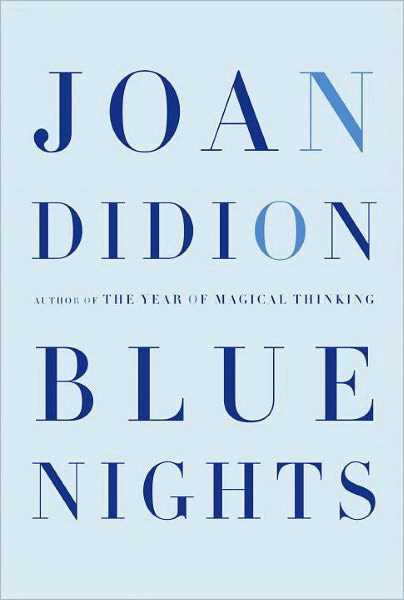 “When we talk about mortality, we are talking about our children,” writes Joan Didion in her new book Blue Nights. And in fact, when Didion is talking about any one thing in this book, she is usually talking about something else, a point which she spends much of the book considering– her struggles of late as a writer to be direct, to get to the point. In particularly in regards to her daughter Quintana, and when Joan Didion is talking about Quintana, she can’t avoid talking about mortality, about the “death of promise”; Quintana died in 2005 at the age of 39, not long after her father’s sudden death one evening at the dinner table (the year after which Didion chronicled in her previous memoir).
When Didion is talking about Quintana, she’s not only talking about her daughter’s mortality, but about her own. The years since her daughter’s death have brought about a general ill-health, a growing frailty that she has struggled to address with various health professionals with very little success. And then it occurs to her– she is 75 years old. Perhaps this alone is the problem, and there is no “fix”. And this has never occurred to her before, that she would eventually (or quite suddenly) get old. “Time passes… Could it be that I never believed it?”
This from a woman whose writing has always been drenched in nostalgia, who from the time she picked up a pen has been eulogizing the way we don’t live anymore and the “all that” she’d said good-bye to. That Joan Didion has never believed time to pass is impossible to consider, except that maybe she never considered herself passing along with it.
“The common denominator of all we see is always, transparently, shamelessly, the implacable ‘I,'” wrote Didion in “On Keeping a Notebook,” from her 1968 collection Slouching Towards Bethlehem, except now she’s 75 and that common denominator seems less a sure foundation. In the same essay, she’d also written, “Remember what it was to be me. That was always the point.” And now more than 40 years later, she doesn’t want to remember anymore.
She writes that well-meaning friends try to assure her through her loss: “You have your memories”. She writes that for many years, she fetishized these memories, saving everything– drawers and cupboards stuffed, mementos pinned to the walls– believing that they would help keep people “fully present”. And when she most important people in her life are lost, she’s left with “detritus of this misplaced belief.” She writes that remembering the past only reminds her of how much she failed to appreciate what she had in the first place.
And when she writes about failing to appreciate what she had, she’s writing about Quintana. She’s writing about her own relationship to her daughter (who happened to be adopted), which is similar to any mother’s relationships to her child, adopted or otherwise. Contemplating that newborn bundle: “What if I fail to take care of this baby? What if this baby fails to thrive, what if this baby fails to love me?… what if I fail to love this baby?”
Except that Quintana doesn’t just “happen to be adopted”, and Didion has realized that failing to acknowledge this was a significant failing of her own as a mother. That Quintana’s mental health problems (which are referred to obliquely; this is no expose) could have been rooted in her own fears of abandonment. That what the “choice narrative” so favoured towards 1960s adoptees left unsaid was the underside of adoptive parents’ choosing, why a child was up for choosing in the first place. And Didion notes that she could never treat this underside, that she chose to avoid it because to highlight her daughter’s origins would be to expose her own terrible fear– that this miraculous child who’d been placed in her arms would somehow be stolen away from her. To acknowledge Quintana’s fear of abandonment, to acknowledge the fact of Quintana herself, would have been to clarify her own feelings and fears about her daughter, which Didion could never bring herself to do.
Except that she’s lost her now, a worst fear realized, and her daughter’s death has served to bring her own death closer. And without her daughter to survive her, when she dies she will “Pass into nothingness,” a phrase from Keats’ she discovers in one of Quintana’s high school exercise books. A phrase that had resonated with the teenaged depressive Quintana, another side of her that Didion had never allowed herself to understand. A side that she’s coming to understand now as she contemplates the end of her own life, and how much her daughter’s sense of mortality and her actual mortality have illuminated her own.
She finds it hard to be direct now. She offers a passage from her novel The Last Thing He Wanted to show the way her prose used to come so easily, that she wrote it like the rhythm it was. But she can’t do that now. She can’t find the right words, she can’t get to the point, she keeps falling, and forgetting, and getting frailer all the time. The point is slipping farther away. But it’s not that she is afraid to die. She writes that she’s getting so she’s afraid not to die, but it’s not that, and it’s not the writing either.
She writes, “The fear is for what is still to be lost,” and she’s writing about her memories of her daughter. “How could I not still need that child with me?” She writes, “there is no day in her life on which I do not see her.”
October 31, 2011
Tricks and Treats
 Harriet was Tilly Witch for Halloween this year, which was a grand success, except for the blip around 4:30 when she decided that she going to wear her Easter Bunny ears instead of the witch hat, and I had to go upstairs and have a moment to myself in order to avoid murdering her. By the time I’d calmed down, the bunny ears were abandoned, and the rest of the evening was splendid, resulting in a bucketful of treats.
Over at Canadian Bookshelf, I’ve written “I am Not At Peace: Ghosts and Haunting in Canadian Fiction”, exploring the spookier side of CanLit. And if you’re not subscribing to the blog, you should. There’s great new stuff up three days a week.
October 29, 2011
Author Interviews at Pickle Me This: Johanna Skibsrud
 I was disappointed to have to decline the opportunity to have an interview in person with Johanna Skibsrud as part of her IFOA appearances in Toronto, and grateful when Skibsrud and her publishers agreed to an email interview instead. Though upon rereading her latest book This Will Be Difficult and Other Stories in preparation, I found myself discovering new depths to the stories that I hadn’t even glimpsed, which made me think that an interview might not even be necessary, that the answers to all my questions would be found within these stories themselves if I just looked hard enough…
Johanna Skibsrud was born in Nova Scotia, and is currently completing her PhD in English Literature at the Université de Montréal, with a focus on the poetry of Wallace Stevens. Her first book of poetry, Late Nights With Wild Cowboys, was published in 2008 and shortlisted for the Gerald Lampert Award for the best first book of poetry by a Canadian poet. A second book of poetry, I Do Not Think That I Could Love a Human Being, was published in April, 2010 and was short-listed for the Atlantic Poetry Prize. Her debut novel, The Sentimentalists, was awarded the 2010 Scotiabank Giller Prize, making her the youngest writer to ever win Canada’s most prestigious literary prize. You can read my review of her latest book This Will Be Difficult to Explain and Other Stories here.
I: So many of your stories are constructed around questions of theoretical concerns, around ideas of aesthetics, epistemology, language, time and place. When you sit down to a blank page, do you begin with these questions or with narrative? And how does fiction prove useful in generating answers?
JS: All my stories start from some small narrative kernel – an interesting anecdote (told to me or overheard), an image that begs a story, a memory. The ideas the stories encounter and engage with grow from that starting point. I am concerned with ideas, aesthetics, epistemology, language, time and place—very much so–but only because I am interested in people, and history; of the reality and intricacies of our relationships and every-day lives. I think it is impossible to separate philosophy and epistemology from the everyday—even though we often try. On a social, political and environmental level this impulse can be very dangerous.
I: Your prose style has divided your critics, and much attention has been paid to the construction of your sentences. Does this surprise you? How would you advise that a sentence be constructed? And echoing the words of Annie Dillard, do you like sentences? Does being a poet shape the way your make yours?
JS: I am flattered that so much attention has been paid to my language construction, but I often think too much is made of it. My writing style—especially in the stories—is not particularly complex, and hardly avant-garde. It is certainly meant to be read slowly and carefully, however, and according to a rhythm that reflects the difficulties and necessities of articulating the writing’s content. My ambition is not to offer the fact of the writing or of language itself, but it is certainly to pay attention to the implications of rhythm, style and language.
My advice regarding the writing of sentences would always be for the writer to follow their own inner sense of logic and rhythm while at the same time never failing to convey their meaning in the most direct possible way. Sometimes meaning is difficult—this takes more difficult sentences. I don’t mind it when sentences are complicated or difficult if they need to be, but I certainly don’t set out to make them that way. Just the opposite. A lot of (what I see as) the misunderstanding regarding the “difficulty” of my sentences stems from an unhealthy misconception as to the supposed “autonomy” of what people think of as “straight prose.” Prose is always as constructed as poetry is and often even more so because of how deeply invested it is in recreating the biases and blindnesses of everyday culture and language-use.
The idea that “poetry” is something that can be isolated, and stuck on the back shelf of the bookstore or library is disturbing to me. That said, the last thing that I would aspire to is what in Canada often gets called “poetic fiction”—the term is often synonymous with loose, floppy, or decorative language. Good poetry is the farthest thing from this: it is devastatingly crisp and succinct. It can say (what feels sometimes like) everything in just a single brief image, a single well-placed word. I think that all literature should be poetic in this sense. It should pay attention not only to the limitations but also to the inherent possibilities of its form.
I: What’s the genesis of the stories in This Will be Difficult to Explain and Other Stories? Were they written with an eye toward collection? Have some of these been published elsewhere, and where?
JS: The stories were all written between 2004 and 2007. I revised them after that incessantly. I tried to tighten them and bring out what I thought was most important to each. In 2008 I put them together as a collection and began to think of them more consciously in that way. The characters in all nine stories are united by the desire to push past—and overcome, when possible—the “limits” of perception, communication and understanding. The stories “belong together” in this way—each confronting what is “difficult to explain” in its different way. But the stories are certainly not intended to come together seamlessly in a comprehensive whole. Although some of the stories are explicitly connected and share a cast of characters (a network of American ex-patriates living in Paris), many are not. There are questions that get asked, or ideas that get introduced that remain—for the characters, just as they do for me—unanswered, unresolved.
Four of the stories were published previously. The first to be published was “The Electric Man.” It was brought out as a limited edition chapbook by Montreal’s Delirium Press, edited by Heather Jessup and Kate Hall. “The Limit” won The Stickman Review short story contest in 2005, and was published in their on-line journal. “This will be difficult to explain” (originally titled “This will be difficult to explain, and other stories”) was runner-up in a Glimmertrain Magazine contest and published in 2009. Finally, “French Lessons” appeared in Zoetrope: All Story in 2011. All of the stories that were previously published (except “French Lessons”) went through extensive overhauls before appearing in the book.
I: What do the stories in this book tell us about your preoccupations as a writer?
JS: Like me, the stories are preoccupied with the relationship between the abstract and concrete, the personal and the collective, the infinite and the everyday. Also, with limitations—both personal and historical. There is a desire to move past them in the stories, but also an awareness of the inevitable adherence, or return, to the limiting structures of culture and language.
 I: In both “Angus’s Bull” and “Cleats”, there are moments in which mothers become disturbingly aware of their own children’s disturbing awareness of what’s going on in the world around them, to their openness to experience. The mothers seem to fear both their power and powerlessness at once. Which one do you imagine is most real and most terrifying?
JS: I think the two things cannot actually be separated. Just like with language. The moment you say something—the moment you settle on a single word to stand in for something that the word is not—you assert power over that named thing, but you also open it up to a (far greater) powerlessness: what it cannot say. It becomes instantly impossible for the named thing to speak for, or even directly to, what exceeds it, but at the same time that which exceeds it is afforded (against the newly circumscribed space of the word) a certain definition and form. It is possible that, at this point, genuine contact becomes more, rather than less possible. I think this must be true for parenting—and for politics, too, though I don’t have any personal experience practising either. We are constantly, in so many areas of life, forced to confront the limitations that arise due to our concentrated efforts to avoid, or move past, them. What is most terrifying is when powerlessness is not acknowledged; when power is asserted without recognition of its blind-spots, prejudices and limitations.
I: How does geography and topography influence how your characters think of place and themselves within that place? Is it like Daniel in “The Limit” who thinks that living in a place where the limits are clearly demarked enables you to better situate yourself, or like Martha in “Signac’s Boats” who is disappointed to find that limited perspectives are decidedly portable, and that she’d brought hers halfway across the world to Paris? Are limitations real or imposed/imagined?
JS: Again, both. Limitations are real because we imagine them that way. Reality and the imagination (just as Wallace Stevens spent his twin careers—as both poet and as insurance salesman—investigating) are inextricably intertwined. Art and literature can expand our personal, as well as our collective, imaginations. It can open up a space of empathy, and from this space can open the possibility of genuine action and change.
I: Setting is so essential to your work. Is it necessary for you to have experienced a place in order to set a story there?
JS: Not necessarily—though I do like to have some sense of the territory familiar to my characters. I haven’t been to Red Deer, Alberta, but I have been nearby. I think I have been almost everywhere else that I mention in the collection. I think that a writer can’t possibly avoid writing “from life” but should never feel, or be, limited by that. The material that any one of us draws from can be almost infinitely expanded, reinvented and reimagined, by combining our “real life” experiences in different ways.
I: For me, the definition of growing up lies in Martha’s revelation of love as a simplifying force, “when she’d thought it would have made her at the same time more integral, and more complex.” Do you think this is maturity? Is it a compromise?
JS: I do think that Martha’s revelation indicates the process of maturation that takes place over the story–and I don’t think it’s a compromise. So much of learning to live in the world is, I think, about learning to appreciate relationships and experience in “simple form.” To not will them into being something else, or a preparation for something else. Art helps us look at things in this way, I think—helps us learn how to look. It can help teach us how to appreciate things from a little distance, by thinking of them in relation to a wider frame of reference. The trick—and this is what Martha struggles with—is to not let this “simplicity” depreciate the value of the thing. To, instead, like a good poem or a painting (think of Frank O’Hara, or Georgia O’Keefe), allow that achieved simplicity to open the experience up—to reveal its inner richness, and complexity.
I: What books have been most formative in your experiences both as reader and as writer?
JS: The books that made me re-think what writing was capable of were (in order of their appearance in my life): Virginia Woolf’s The Waves, Knut Hamsun’s Hunger, Marcel Proust’s Remembrance of Things Past, and Vladimir Nabokov’s Pale Fire. Also, the work of the poets Wallace Stevens, John Ashbery and Lyn Hejinian. And you brought up Annie Dillard—I should mention also, Pilgrim at Tinker Creek and For the Time Being.
I: What are you reading right now?
JS: Gulag: A History, by Anne Applebaum and David Foster Wallace’s Consider the Lobster.
October 27, 2011
Our Best Book from the library haul: Once Upon A Golden Apple
 It was meant to be, really. A team of Canadian kid-lit legends Jean Little and Phoebe Gilman could only ever have been a success. Co-Author Maggie de Vries too– I’d read her memoir Missing Sarah years ago, and she’s had a successful career writing for children as well. But I am really baffled as to how it’s taken me so long to discover Once Upon a Golden Apple.
The very best book from the library in a bumper week of very good books from the library, and as soon as we began to read it, we just knew. It begins with a father telling his children a story, deviating from the familiar tropes much to their chagrin. “Once upon a golden apple?” “No!” the children shout. “Once upon a singing fiddle?” “No, no, no, no, no!” With each preposterous suggestion, the children become more and more agitated, and just when they think they’ve got their dad back on track, he breaks off again: there lived Goldilocks and the Seven Dwarfs? The princess kissed Humpty Dumpty? Who turned into a gingerbread boy? “No, no, no, no, no!”
Gilman’s children are adorable and Jillian Jiggs-ish, and we like the sausage-stealing dog that the storytellers are too en-rapt to notice. de Vries and Little finally manage to get the tale told, though not before making ridiculous suggestions that Harriet finds hilarious, and loves most of all because it’s always fun to be in on the joke, especially when you’re aged two.
October 26, 2011
The Submission by Amy Waldman
 Amy Waldman’s The Submission begins with a jury making their final deliberations on how site of the September 11th terrorist attacks are to memorialized. Two years on from that fateful day, the nation is still raw, and anxious for healing to begin. No juror feels this more acutely than Claire Burwell, who lost her husband in the attacks, and who has been selected to serve representing the interests of the victim’s families. She rallies support around a design called The Garden, where she can imagine her children playing and which serves to honour the kind of man her husband was, as opposed to the more brutalist designs championed by other jury members. The Garden wins, the identity of its designer revealed, and he turns out to be a man called Mohammed Khan.
That the outrage sparked by this revelation seemed implausible to me mostly means that I don’t live properly in the world. A world in which the idea of a Ground Zero Mosque (which is neither a mosque nor at Ground Zero) sends people to the streets spouting hatred and threats of violence, which no doubt inspired some of what transpires in The Submission. The story shifts from Claire Burwell to Mohammed Khan himself, an architect American born-and-raised who is stunned to find himself in the spotlight, discussed on late night TV by right-wing windbags who speculate upon his motivations and foster rumours that this secular Muslim has extremist ties.
The story moves back and forth between these two characters and others, including a reporter who sees the story as an opportunity to further her own career, a Bangladeshi illegal alien who also lost her husband in the towers, the brother of a deceased firefighter who sees his newfound 9/11 status as a chance to finally make something of his life, the jury chair who’s caught between the jury and a state governor with elections on her mind.
Waldman is the former co-chief of the New York Times’ South Asia Bureau, and has the journalistic chops to tackle a story with such breadth, and also understands the spiral effect of story and the role the media plays in this process. It was on the side of fiction, however, where the story fell down for me, and in characterization more specifically. Claire Burwell herself is little more than a type, and she loses substance as the story progresses. Her supposed downfall is an ability to see the issue from all sides, but I failed to see her at all. Waldman tries to complicate her character by suggesting that all was not as well in her marriage as she presents to the outside world, but this significant storyline is never picked up again, and Claire herself ends up virtually disappearing from the novel about two thirds of the way through.
Another character weakly drawn was the firefighter’s brother, who turns out to have stupidity and alcoholism underlining his vitriol. It would have been more interesting to find a bigoted jingoist as intelligent and sure of himself as the characters on the other side. And not for the sake of fairness and balance, but rather because I think we’d be fooling ourselves if we explained away all the idiots as people who know they’re idiots deep down. In reality, there is a fiercer opposition to contend with.
But The Submission turns out to be a better book than it seems, and it turns out that what Waldman is writing about is not opposition at all. Khan digs in his heels and refuses to submit to the demands being put upon him from all sides– does he deny his background, assert himself as an American? But what of his understanding that being American means one has no need to deny his background? But who is he serving here? His country? His some-time faith? Himself? Claire Burwell is asking herself similar questions in her role as juror, and doubt is cast in her mind as to Khan’s intentions. Doubt he refuses to assuage because he’s never given her reason to mistrust him, so he holds back on principle, her mistrust doubly undermined. They’re turning in circles, and so is the whole world around them, violence and intensity escalating with each revolution, which culminates in a life that is tragically lost.
Waldman’s language doesn’t call attention to itself, though hers is a working prose that is doing things, so you’ll notice when you take your mind off the plot enough to pay attention. And similarly with the literary-ness of the novel, which creeps in and eventually outshines the plot. In the end, The Submission is a story both more universal and more specific than what the plot suggests, challenging, provocative and rich.
October 26, 2011
On re-watching Reality Bites
 I was a deeply impressionable 14 years old when I first saw Reality Bites, and it came to define “cool” for the remainder of my teenage years and beyond: smoking, vintage dresses, ’70s nostalgia, passionate friendship, complicated relationships, the attractiveness of moody boys, and an obsession with self-obsession (“I’m making a documentary about my friends”). It taught us all to define irony so we wouldn’t be caught on the spot, it was David Spade at his finest (“Have a ‘tude weiner dude, all right.”), and it made angst so attractive, so important, essential. It made me pretend to like “My Sharona” (“Turn it up. You won’t be sorry”), had Crowded House on the soundtrack, sold torturous angst straight-up with U2’s “All I Want is You”, and it brought “Stay, I Missed You” into the world, which was the song that was playing when I was asked to dance by the coolest boy at summer camp (and, sadly, this was to be the peak of my romantic life for years and years and years).
Because I couldn’t find Reality Bites at my local video store and the Toronto Public Library had not seen fit to update its VHS copy, it seemed like all my wishful thinking had conjured the Tenth Anniversary DVD I bought a few weeks ago at a yard sale for a dollar. I sat down to watch it last Friday night with an aim to craft a blog post about literary references in the film. Except that there weren’t any. Nobody reads in Reality Bites, not even Lelaina Pierce, college valedictorian, or Troy Dyer/Ethan Hawke, the greasy-haired philosophy drop-out. Who says things like, “I might do mean things, and I might hurt you. and I might run away without your permission… and you might hate me forever. And I know that that scares the shit out of you because I’m the only real thing that you have.” And what scares the shit out me is that fifteen years ago, I would have considered these lines incredibly romantic.
It’s true, all the movies I spent my teens and twenties thinking were romantic actually turned out to be fucked up stories about people who were emotionally crippled or mentally ill. Perhaps both forces were at work in Reality Bites (and really, we all know how things turned out for Winona). Reality Bites, the land where nobody reads, but people quote 1970s sitcom trivia at parties and Melrose Place is a cultural reference point. “Melrose Place is a really good show,” said Winona, and I’m not sure that I really agree, but I do think that Reality Bites is a really good movie. Still.
It’s an old, old story, contrary to what the newspapers would have you believe. It’s hard be out just of school, to be transitioning to adulthood, to be unemployed or underemployed, to not know where you want to go, and to have your actual options be even more limiting. To have goals but no idea how to make them realities. It’s hard to have ideals in the real world, to make things that matter, to settle down without settling, to decide who to fall in love, and when not to dress like a doily. It’s terrible to spend four years working towards adulthood, and then emerge into the world to find it utterly unwelcoming. To think that you’re not going to be able to have the kind of life your parents did, even if you’re not sure you want that life in the first place. To not get what you’ve been raised to think was your entitlement. To step out into the air and discover that you can’t fly.
We all know that each generation imagines that it discovered sex, but it’s true also that each imagines that disillusionment is something new. Reality Bites says otherwise: being 23 has always, always been terrible, but thankfully being 23 manages to not be the end of the world. It’s only the very beginning, and you learn.