October 23, 2011
New Kids Books We've Been Enjoying
 Hooray for Amanda and her Alligator by Mo Willems: Willems is the best part of parenthood, his stories of Elephant & Piggie, Knuffle-Bunny and that notorious Pigeon never failing to delight, but I think that Amanda and her Alligator is my favourite yet. Amanda arrives home from the library with a stack of books, and her toy alligator has been waiting to play with her. Over 6 1/2 chapters, Amanda reads though her library stack (mostly nonfiction– my favourite is Climbing Things for Fun and Profit, or maybe Build It Yourself: Jet Packs!), and sets upon adventures with Alligator without ever leaving her room. The drawings are clear and simple, the stories too, and they’re heartwarming (though not ickily so) as they are funny.
A Few Blocks by Cybele Young: There is nothing simple about the illustrations of Cybele Young’s book A Few Blocks, in which imagination transforms the few blocks it takes to walk to school into a rich fantasy world. Ferdie doesn’t want to go school, but his sister Viola coaxes him along the way by creating adventure out of the ordinary, just as Young herself does through collage of her drawings which transform ordinary bits of neighbourhood into a giant sailing ship, a knight’s battleground, a superhero’s stomping ground.
 A Daisy is a Daisy is a Daisy (except when it’s a girl’s name) by Linda Wolfsgruber: A Daisy… is a strange book that will probably appeal most to anyone with a flower name, or those of us who read baby name books as a pasttime. Gorgeously illustrated, Wolfsgruber shows that girls all over the world are named after flowers, and in all kinds of different languages. In Greek, Ianthe means violet, and she is Jolan in Hungarian, and Yolanda in Spanish. In Dutch, Mirte means Myrtle, she’s Hadassah in Hebrew, and Mirta in Spanish and Greek. “And Chloe is a very young sprout…”
Caramba and Henry by Marie-Louise Gay: “Stella and Sam?” said Harriet the first time she saw this book, and it doesn’t even matter that it’s not, because Marie-Louise Gay is always good. Though I don’t get him, Caramba, the cat who can’t fly. “But cats can’t fly!” I keep protesting, and people shout back at me, “That’s the point. Isn’t it awesome?” I’m not sure, but Harriet has never batted an eye, the story is great, the full page spreads absolutely breathtaking in their scope. Marie-Louise Gay is a treasure.
 Molito by Rosemary Sullivan and Juan Optiz, illustration by Colleen Sullivan: Rosemary Sullivan is a friend of mine, and Harriet loves drums, so we were set to love this book from the get-go. The story of a little mole who dares to climb up from the underworld and discovers a whole other world out there of music, dancing and light. But losing himself to this world would require losing the friends and music he made in his life underground, so Molito seeks a way to make a connection between the two. “Above and below/ In the dark and the light/ Upside down and upside right/ Below your feet and above your head/ There’s just one world./ There’s just one world.” Colleen Sullivan’s illustrations are delightful in their detail, and the book also comes with a CD of Molito’s music.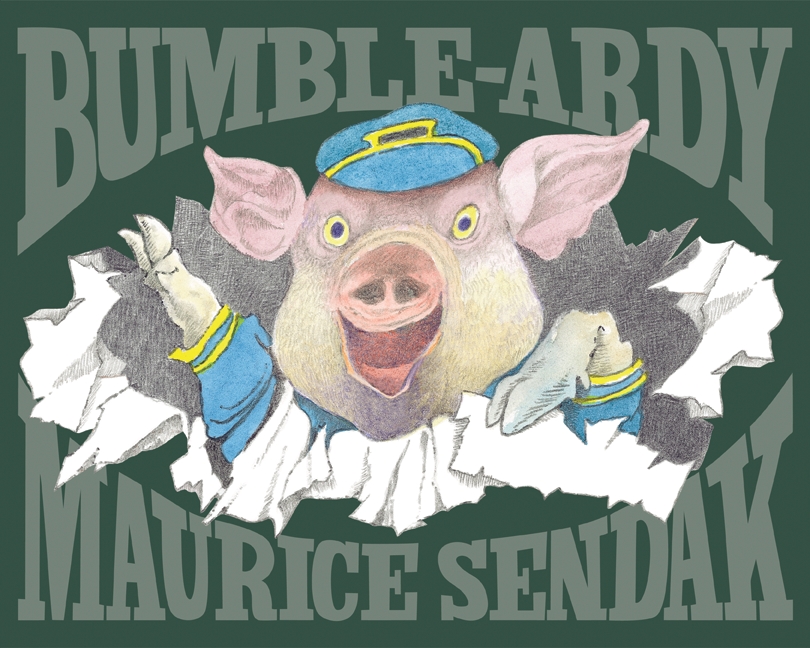
Bumble-Ardy by Maurice Sendak: I’m more confused by Maurice Sendak than I am by Caramba, actually, but my appreciation for Sendak’s new book Bumble-Ardy was underlined when I read his interview in The Paris Review. Harriet just likes the pigs, the birthday party and the pictures. The rhyme is a bit ripped off from Ludwig Bemelmans, reminding us of a someone we once knew who left the house at half-past nine in rain or shine, but I’m less confused than I was with Outside Over There, and there is depth here that reader young and old can tumble into and wander around in. Every time I read it, I appreciate it more.
October 21, 2011
Not believing the hype
 One if my favourite books ever is Lionel Shriver’s We Need to Talk About Kevin, and I’d be a rich woman if I had a nickel for every person I’ve ever encountered who’s refused to read it because it’s story of a teenage murderer. (And oh, by the way, it isn’t. We Need to Talk About Kevin is the story of a marriage. But you have to read the book three times to figure that out). For some reason, however, I feel free to cast disdain on these non-readers, on their deliberate steps away from the difficult, uncomfortable questions put forth by provocative literature, while I continue to oblige my own prejudices. Perhaps because my own prejudices are not quite so vague, so open-ended. Give me a well-written teenage murderer any day, but force me to read a book about a dog and I’ll pull my eyes out.
Note, however, that here I insist on being as inconsistent as I ever was– a look through my recentish reading confirms that I liked Andrew O’Hagan’s Maf the Dog book, and both Our Spoons Came From Woolworths and Quickening, both of which had dogs on their cover, plus I even attended a literary dog exhibition.

This is actually not a panda.
But dogs are really only the tip of the iceberg, and somehow the fates have conspired to make the rest of the iceberg the most hyped books of the season. Because do you know what I hate more than I hate books about dogs? That would be books about circuses, of course, and I don’t like books about cowboys, and not even “books about”, but there might be nothing I hate more in the whole wide world more than I hate jazz. Which has pretty much left me nothing in the whole world to read… except for the 73 books I have before me on my TBR shelf. So maybe you can see why I’m not too bothered.
So dare I cave to the pressure of the hype? Is the hype any less ridiculous than my own stupid literary prejudices? Though I do pay attention to awards lists (and go Zsuzsi Gartner and Lynn Coady, by the way. Your books rocked my soul), and I’m grateful to the books they point me to, I’m certainly not going to read all lauded books for the sake of the act. This is a lesson I perhaps learned the time I read Vernon God Little.
There are books I should read, no doubt. This is the reason I read The Wings of the Dove and Great Expectations this year, and why my slow trip through The Collected John Cheever is ongoing. But I refused to be obliged to read a book until at least ten years has determined it’s still worth my while. And depending on how posterity has treated it, I might pick it up, dog or no dog, cowboy or no cowboy. Unless it’s a book about a circus.
October 20, 2011
Our Best Book from the library haul: Ira Sleeps Over by Bernard Waber
 We’re having a bit of an affair with Bernard Waber’s Lyle the Crocodile books, which are so good, and Harriet loves them. Though they’re a bit long, and I’m not sure every toddler would have the patience, so I was delighted when we took out a new book by Waber, Ira Sleeps Over, and discovered that here was a less text-laden book that I could heartily recommend.
I love these ’60s/70s’ children’s books (Waber reminds me of Louise Fitzhugh and Judith Viorst), their sharpness, and their irreverance. Plus, Waber is an author/illustrator, and the best of these people can elevate the picture book to a whole other level. Must confess up front though that I am disproportionately amused that this book contains the line, “That night, Reggie showed me his junk.” But that’s only because you’re the one with the sick mind.
Ira has been invited to a sleepover at his friend Reggie’s house. He’s excited, but a little nervous, and he goes back and forth between these emotions in passages with his parents and meddlesome sister– the repetitive language will especially appeal to young readers. When Ira wonders if he should bring his teddy bear with him? Would Reggie laugh?: “”He won’t laugh,” said my mother. “He won’t laugh,” said my father. “He’ll laugh,” said my sister.”” I particularly love the family dynamics, very Free to Be You and Me with Mom and Dad making dinner together, both parents pursuing interests beyond their parental roles as Dad practicising the cello in the evening, and Mom hides behind the newspaper.
Eventually the sleepover arrives, and Reggie and Ira have fun together. Reggie shows Ira his junk collection in a fabulous two page spread that might have inspired a young Marthe Jocelyn to go on to write Hannah’s Collections. The boys start to tell ghost stories, and the moral of the book turns out to be that a need for comfort is universal, that teddy bears are much less controversial than a small boy might think.
October 19, 2011
Once You Break a Knuckle by D.W. Wilson
 On Monday, I compared D.W. Wilson to Alice Munro in a Twitter post, and got called out by a few people for being off the mark. Upon rereading my post, I could see how it my point was misconstrued– I forgot that Alice Munro comparisons must necessarily denote Greatness, and I didn’t mean to do that. D.W. Wilson’s short story collection Once You Break a Knuckle reads very much like a first book, lacking in precision and assurance, but there is promise here, evidence of a good writer whose best work is still before him. Which really, in a first book, sometimes, is all that a reader can ask for.
But I stand by my Munro comparison, though I know I should be comparing Wilson to Raymond Carver and commenting on the raw, violent masculinity afoot. What I couldn’t stop thinking of, however, as I read the stories about Will Crease sparring with police constable father John was Flo & Rose, and the Royal Beatings,that violent dynamic of family life with love at its root. About class and how both families are of and apart from their communities, and about the communities themselves, Wilson’ s real-life town of Invermere evoked similarly to Munro’s Hanratty (or Jubilee). And how Wilson seems preoccupied with certain ideas, characters and story lines, returning to them again and again to examine them from various angles, as Munro has also done throughout her story collections and throughout her entire career.
I agree with Steven Beattie’s comment that the Will Crease stories in this book have the feel of ” chapters in a novel searching for a through-line”. My favourite story in the collection was a Will Crease story, but the one that seemed most discrete from the rest, “Don’t Touch The Ground,” about a young person’s act of vengeance with tragic consequences. The collection’s longest story “Valley Echo” was also strong, and its structure reminded me of Munro’s ability to telescope time.
There is a class division throughout the collection between “the hicks” so feared by Will and his friends, and the down-and-outs themselves– I found myself longing for a connection as in a story like Alexander MacLeod’s “Light Lifting”, which would have shed considerable light on both sides. Though there were other kinds of links, most particularly the Oldsmobile 1955 Rocket 88, which turns up with a few different drivers at its wheel, recurring characters, and repeated expressions about broken knuckles and picking fights, and kicking cows as well.
I got hung up on some of the metaphors– no matter how many times I read the line, “I’ve got fibrous red hair and a jaw tapered like a rugby ball,” I still can’t see what he’s saying. Then there was the line about “wineglass-sized breasts”, and I just don’t really think people should compare breasts to anything. But I underlined good parts too– my favourite passage was, “And she was attracted to him– if he didn’t, for instance, need someone to pull his head from the clouds– then Ray knew why: broken people are drawn to broken people. That’s the love life he had to look forward to with Kelly: a three-legged race.”
There is a bleakness to these stories, a sense of inevitability that Wilson goes to such pains to make clear that he takes us decades into the future, and the future is a lot like now is. In a town like Invermere, nothing ever changes, but Wilson that shows story happens all the same.
October 17, 2011
Our visit to Little Island Comics
 By pure coincidence, this is my third post in a row dealing with islands and oceans. And this is an especially joyful post because the gist of it is that a new children’s bookstore has just opened up around the corner from my house. Little Island Comics is brought to you by the people behind The Beguiling, and is the first comic book store in North America catering exclusively to children. They cater not just with comics either, but also with a wide variety of beautiful books that seem to mostly just have gorgeous illustrations in common. We stopped by on Saturday and the store was full to bursting with children of all ages (and their parents). Though the big kids in the store seemed enthralled by the wares, we also found much to choose from for the Harriet set, and settled on a Tiny Titans comic, and Maurice Sendak’s new book Bumble-Ardy. Staff were approachable, knowledgeable, and thrilled with all the activity going on in the store. And there’s bound to be more of it– Little Island Comics has a space in the back where comic workshops and other events will be conducted. Check their blog to stay abreast of happenings. We’re looking forward to our next visit!
*Check out their profile from last weekend’s Globe and Mail.
October 16, 2011
Not Being on a Boat by Esme Claire Keith
 There was so much right about Esme Claire Keith’s novel Not Being on a Boat that I was planning to review it here anyway, even though there was one thing quite wrong. The one thing being its length, of course, and that being trapped in the mind of her Mr. Rutledge for 350 pages was just too much, but that it was so thoroughly too much was because her Mr. Rutledge was so spotlessly executed. A divorced retiree jacked up on the force of his own consumer power, he has bid farewell to the world and boarded the good ship Mariola to sail off into the sunset. Equipped with two tuxedos and a taste for the finer things in life, he’s expecting good value for his money and some fine conversation with the other passengers in the Captain’s Mess.
 The devil is in the details, however, all of which Rutledge notices, astute businessman (and borderline autistic) that he is, forever on the lookout for number one. But such details and this perspective doesn’t make for great reading, not 350 pages of it, as we learn about the ship’s laundry procedures, and what’s available on the menu, and the historical facts even Rutledge fast tires of as delivered by guides giving tours at the ship’s ports of call. The flawlessness of Keith’s narrative makes reading really hard-going, though things outside Rutledge’s head are certainly interesting: we receive glimpses of the distopian civilization that Rutledge has left behind him, and the problems come aboard the Mariola when one day a group of passengers and some crew fail to return from a port of call. Suddenly, the ship’s standards begin slipping, supplies are getting low, communications are shut down from the outside world, and the problems of the outside world are creeping in through the portholes.
The novel concludes with an end-of-days scenario that had me furious: 350 pages for this? But as the fury wore off, I decided to write about the book anyway because Keith’s control of her project was so impeccable, and also because I’m not sure there was any other way she could have ended it. Not Being on a Boat is a marvelous satire of consumer culture and luxury tourism, so smart and funny, deadpan and sharp. (It is also beautifully designed by kisscut book design, including the map of the boat I discovered under the back flap). And sometimes a flawed book really can still portend the debut of a really great writer, so though “less is more” would really go a long way here, I’d say Keith is one to keep an eye on, and I’d check out what she comes up with next.
October 16, 2011
Book I'm longing for: Atlas of Remote Islands by Judith Schalansky
 What I know is a mountain
What I know is a mountain, high as a coin.
My liquid wisdom would not fill a cup.
This vastity, that unshrinking cupity-
sit back and watch it grow.
Sunk far-off lands’ topography.
Magic words forgot by history.
Ursa Major, Asia Minor-
a thousand stations I’ll not go.
Fossils, bugs and dragon wings.
Burnt, lost or abandon’d things.
Mud or flood or lava lost-
mislaid worlds I cannot know.
A show that’s shown, curtain down.
Unsung songs and pin drop sounds.
Hot air balloons and sailing ships-
an old wind’s worn out blow.
Untold truths and uncaught looks.
Oral myths and dirty books.
Wombs and tombs and pyramids-
and a mountain’s all I know.
I wrote this poem (which, incidentally, does not contain one e) some years ago, and I post it now because it says everything I want to say about why I’m already in love with Judith Schalansky’s Atlas of Remote Islands. I stumbled upon it this morning whilst browsing (by myself!–speaking of islands) at Good Egg in Kensington Market after an early brunch (by myself!) with my friend Jennie, and immediately added it to the front of list of books for Christmas. Upon arriving home to the interet, I found that this writer was as besotted with the book as I was, and her piece clinched it. Looking forward to unwrapping this one somewhere one of these days not far from soon.
October 13, 2011
Our Best Books from the library haul: Sunny et. al. Robin Mitchell and Judith Steedman
 Once again we’re cheating: these aren’t books I stumbled upon, but rather sought out after a recommendation from Sara O’Leary (whose new book When I Was Small is out next month, and whose Picture Books We Know and Love list is brilliant). Sunny (and his companions Windy, Snowy & Chinook and Foggy) are all written and illustrated by Robin Mitchell and Judith Steedman, and published by the wonderful Simply Read Books. I’ve not read Foggy yet, but the other three have been read and re-read with much delight since we borrowed them from the library last week.
The stories are pretty simple– Sunny begins to listen to the sounds in the city, realizes that city sounds are beautiful and celebrates them with a hootenanny. Poor Windy loses her beloved blue kite, but discovers it at the end of the story much closer to home than you might have imagined. And then Snowy and Chinook, an arctic adventure of two friends looking for a birthday gift for Tulip the Buffalo (and there is bunting!).
 These plots are perfectly complemented by simple illustrations which are not so simple when one discerns how the contents of each scene have been fashioned from ordinary objects. On top of being visually appealing, they are also pretty inspiring craft-wise, and constructed with a fabulous dose of whimsy. Also remarkable are the double page spreads in each book with simple line drawings reconstructing a map of the story so-far– little fingers will delight in tracing the dotted line and revisiting each point along the journey.
Oh, it’s true– these are books that revel in brilliant design. The endpapers are marvelously decked with the simple line drawings from the map pages, and the underside of each dust jacket contains a hidden surprise– a recipe for pancakes, directions of kite building, instructions for homemade musical instruments. They’re absolutely lovely, and beloved by both Harriet and I . Such a fantastic discovery, so I want to pass it on to you.
October 12, 2011
The Big Dream by Rebecca Rosenblum
 Though I am far too close to Rebeccca Rosenblum to be able to give an unbiased assessment of her new short story collection The Big Dream, I’m going to let my bias fly and tell you that this is a wonderful book. A collection of linked stories about employees at the struggling publishing company Dream Inc., The Big Dream begins with tech support staff scurrying underfoot like rodents and then moves up the corporate food chain– call centre staff anticipating lay-offs, a cafeteria worker who can’t get it together, a new-hire who casts the jadedness of the design staff in terrible perspective, the retired CEO who can’t accept that it’s over, a lusty encounter between the CFO and Senior Marketing Manager, tension between the top execs, and the final story, “This Weather I’m Under” about a VP charged with firing an entire department as her mother lays dying in the hospital.
The entire collection reminded me of a line from Rona Jaffe’s The Best of Everything: “It’s funny, she thought, that before she had ever had a job she had always thought of an office as a place where people came to work, but now it seemed as if it was a place where they also brought their private lives for everyone else to look at, paw over, comment on and enjoy.” Though there’s not a lot of enjoyment going on in The Big Dream, but certainly, Rosenblum shows that our lives are what we bring to work every day. It’s the personal calls we take at our desks, the way decorate our cubes, what’s in our lunch bags, and hidden in our drawers, and in our coats, and tights, shoes that pinch, and our dental emergencies too. It’s in the camaraderie between office-mates, the shared language, inside jokes, and institutions.

Me interviewing Rebecca at her book launch last month.
My favourite story is “Research”, a story of libreation about a woman who shows up to work one day to discover her entire department has been laid-off and is suddenly left to her own devices. She devotes her research to discovering her office building– its incredibly topography (which is always changing– cubes go up, cubes come down), and the floors above and below her own that she’s never seen before– the modern office has never been seen through such eyes before, and with such reverence. I love the sex scenes in “Loneliness”, which are so perfect. I’m uncomfortable with the Russian boy who masturbates into a sock in “Complimentary Yoga”, but only because I’m a prude, and I’m amazed by how thoroughly he’s been created. “How to Keep Your Day Job” is a wonderful story in second person, the exhausting tale of a fall down a flight of stairs. I love the ending of “After the Meeting”, in which a group of co-workers assemble after their entire department has been dismissed, and they have to consider what they really have in common anymore. I know the predicament of the tech support guy with an abscessed tooth who dreams of dental coverage and is even entitled to it, except that he’s not been given his three-month review and the company really has no intention of making him permanent staff.
The backdrop is bleak, but the conversation is funny. In this fascinating look at the cogs that really run the corporate machine, Rebecca has written a book that’s even better than her much-praised first collection Once. A must to check out for any cubicle dweller, and also for any reader who likes to marvel at the amazing things the short story can do.
October 10, 2011
What Sally Draper must have been reading: Virginia Lee Burton and Mad Men
 Virginia Lee Burton’s father was an engineer, and her mother was an artist, which is probably a surprise to nobody familiar with her work. Burton’s early books (Choo Choo, Mike Mulligan and His Steam Shovel, Katy and the Big Snow) are celebrations of man’s power to harness his environment with the use of technology, Burton’s vivid illustrations investing her fascinating machines with life and personality. Even 80 years after the publication of Mike Mulligan and His Steam Shovel, that steam shovel Mary-Anne appeals to young readers, and part of that timelessness is that Mary-Anne’s story of technological prowess (she could dig as much in a day as a hundred men in a week) was already about nostalgia even when the book was new. Burton’s work does not become dated, because within it she has acknowledged the passage of time. Mary-Anne was already the relic of a dying age, steam shovels being replaced by diesel-powered diggers, and Burton showed even as she glorified technology that progress did not necessarily lead to better.
But the pastoral age that Mike Mulligan… hearkens back to is a pretty curious one. Children have always loved this book because children are fascinated by machinery and learning how things work (Burton: “Children have an avid appetite for knowledge. They like to learn, provided that the subject matter is presented to them in an interesting way”), but for an adult-reader to understand Mary-Anne as the story’s heroine represents a significant departure from how we in the 21st century have come to understand our relationship to the environment. Mary-Anne who can level hills to make roads for automobiles to drive on, and dig holes to turn grassland into skyscrapers, and is powered by filthy coal– that Burton’s steam shovel continues to be a lovable storybook character is a testament to the enduring qualities of her book as a whole.
Mike Mulligan was published in 1939, and in 1942, Burton published her most celebrated book, The Little House, which won the  Caldecott Award that year (whose ceremony, it is noted in Barbara Elleman’s fascinating biography Virginia Lee Burton: A Life in Art, was attended by Lillian Smith, president of the Children’s Library Association and head of children’s services at the Toronto Public Library). And from these dates and these books’ acclaim, we can only assume that both found a place within the personal library of Sally Draper, who was born in 1955. Unlike her parents, Sally is rarely seen reading (until Season 4 when she’s spotted with a Nancy Drew), so the contents of her early library can only be inferred, but if the connections between Burton’s world and the Man Men universe are any indication, these books should be an essential part of any Mad Men reading list.
Part of the appeal of both Mike Mulligan and Mad Men is our own nostalgia, but the nostalgia already implicit within these works’ conception of modernity makes our own present ring doubly hollow. In both works, the Future is now, and the present is shining, but something essential has been irrevocably lost, and it has been too late to turn back forever now.
 Modernity is symbolized by the city in Mad Men, and also in Burton’s work, no more so than in The Little House. In both works, the city is to be escaped from, its edges a pastoral idyll, though in both works, the city is creeping. In Mad Men, this is shown by suburban life’s failure to be protection enough from the vices and sordidness the city entails. Even in Arcadia (ie Ossining NY), there is infidelity, family violence, divorce, and women lock themselves in the house all day, drinking too much and smashing chairs up. The outside world is brought in every night by the dad in his hat coming home on the train, and by the television’s incessant blare.
The creeping is literalised in Burton’s The Little House, which sits contentedly on its hill as the sun goes up and down, and as the seasons change. And then the lights of the city began to seem closer, and roads appear (courtesy of that same steam shovel we know so well from Mike Mulligan, as Harriet is always delighted to point out). There are new houses, and then the buildings around the house grow higher, and a subway is dug underneath, and trams run back and forth, and eventually the house is left abandoned and unloved in the middle of an urban wasteland. (And in this book, indeed, Burton has presaged and synthesized the ideas of Rachel Carson and Jane Jacobs).
But the book’s conclusion is as curious as is Mary-Anne’s status as hero instead of villain. The story of The Little House is resolved when a great-great grandaughter of the man who’d built the house discovers the place in its derelict state, and decides to move it back out to the countryside. Traffic is halted as the house is lifted up from its foundations and placed on a truck, then driven down a big road, then a small road, and eventually the house is settled down on a little hill much like the one it once called home (before that first hill was levelled by a steam shovel). Same apple trees and flowers, and the house can see the sky again, the sunrise in the morning, the moon shining high at night. “The stars twinkled all around her…/ A new moon was coming up…/ It was Spring…/ and all was quiet and peaceful in the country.”
The first few times I read this book as an adult, I figured the moral had something to do with white flight, and the death and death of the  American city. Until I realized that Burton hadn’t presaged Carson/Jacobs so much, and then I thought about the book in the context of its own time, and Mad Men’s. The story’s point, according to Elleman’s book, is that “the further away we get from nature and the simple way of life the less happy we are.” It is a story of the environment with man still at its centre, and with this notion of the city as a place to move away from is an understanding that the space “away out there” is infinite, inexhaustible. (See Kathryn Davis’s Hell and the spaces at the back of medicine cabinets for razor blade disposal in the mid 20th century house– that throwing something “away” was to make it disappear.)
In “The Gold Violin” (Mad Men, Season 2), the Drapers retreat further from urban/suburban life by partaking in a rare family outing, a picnic (although they get there in a brand new Cadillac, so modernity has certainly not been left behind). At the end of the picnic (which has involved smoking while horizontal and peeing behind trees), Betty Draper picks up the picnic blanket and shakes away accumulated rubbish, letting it fall down onto the grass where she’ll leave it.
As in Burton’s The Little House, the world away out there is still ours for the taking, to be used and made noble by our relationship to it.