November 17, 2011
Of Eatons and Avenues
 Last night I finished Rod McQueen’s The Eaton’s: The Rise and Fall of Canada’s Royal Family, which I was reading because Jonathan Bennett had included in his Power & Politics Book List, and then I found a copy in a cardboard box outside a house on Borden Street last summer. And to be reading this book right after Heather Jessup’s The Lightning Field is to be steeped in old Toronto now, to be rumbling up and down its avenues like the old cream coloured streetcars of my childhood. And to be so steeped is to be led down strange avenues online, pursuing the odd history of Dundas Street, or even leaving town to find this fascinating 1958 article in Macleans by Peter C. Newman about Deep River ON: “The Utopian town where our atomic scientists live and play has no crime, no slums, no unemployment and few mothers-in-law. But maybe you wouldn’t like it after all. Here’s why.”
McQueen’s story of the Eaton family was readably rife with scandal and gossip, and good old fashioned story. Art heists, a foiled kidnapping, cuckolds, Fascists, terrorists, Rolls Royces, idiots, feuding siblings, and fallen empires– you wouldn’t know this was Canada. How the Eatons myth was divorced from its reality, and the public was so determined to keep the myth perpetuated. The book ends in 1997, when how far the Eatons would fall was still not entirely clear, and that they only fell further doesn’t undermine the story’s importance. That this book is out of print, however, to be found in curbside cardboard boxes only (though thank heaven for such distribution really) is totally ridiculous.
November 16, 2011
I am in a book!
 Today I had the remarkable experience of walking into a bookstore and finding a book with my name on it. The Best Canadian Essays 2011 is out now, featuring my essay “Love is a Let-Down”, along with other essays by writers including Caroline Adderson, Mark Kingwell, Stephen Marche, David Mason and Barbara Stewart*. The Best Canadian Essays series editor is Christopher Doda, issue editor is Ibi Kaslik, and I’m so honoured that they’ve included my work in this collection. Though I must admit that part of the thrill is the idea of being in a book at all. Me! In a book! Which is more than kind of a dream come true.
*We published a great essay “The God Edit” by Barbara Stewart on Canadian Bookshelf this week. See also Caroline Adderson’s book list Imperfect People. And check out Susan Olding’s wonderful article on the essay form, “That Trying Genre”.
November 14, 2011
This is where we used to live.
 2001/2002 was my final year at university, the year I had a back page column in the school newspaper and therefore had a platform from which to address the question of what it meant to live on a “grimy, yet potentially hip strip of Dundas St. West”, as my block had been described by the Toronto Star in a restaurant review of Musa. To live on such a strip meant kisses in doorways, I wrote, because no boy would ever let you walk home alone, it meant watching from your bedroom window as a dog devoured a skunk, and having to call the police when people started smashing car windows with implements from the community garden. I can’t remember what else I wrote in that piece, and Musa burned down two summers ago, but neither point means that year is lost. I have never gotten over it.
Everything felt monumental that year, not because of anything specific, although it was our final year of school, and 9/11 occurred days into it, serving to make us think a lot about things we’d always before taken for granted. “That was a year,” wrote my friend Kate in a recent email, “we all made enormous leaps into adulthood even if many days it felt like we were just playing.” And of course, everybody has had those years, monumental if only for how they delivered us to here. A threshold to something finally real, but we were aware of it happening all the time, and so amazed to watch the world opening up before our eyes.
And so it felt entirely appropriate when I discovered last week that they’d turned our entire apartment into an art exhibition. (It all feels a bit Tracey Emin.) “They” being the people at Made Toronto, which now lives downstairs from where we used to live, though that storefront was a Chinese herb shop when it was ours. (It was a different time. We’d never heard of hipsters, and Musa was the only place to get brunch for blocks and blocks. David Miller wasn’t even the mayor then, and Spacing Magazine had yet to be invented.) The exhibition took place last year, designer furniture and housewares on display in a “typical Toronto apartment,” which is funny because there was nothing typical about it– for about nine months that I know of, that apartment was the centre of the universe. It’s also funny because it’s the ugliest apartment I have ever, ever seen. Aesthetically speaking (although “aesthetic” was not, in fact, a word I was aware of when I lived there), that apartment’s sole redeeming feature was the patio where I used to go to pretend to smoke cigarettes, and watch the city skyline.
Part of the reason I love my husband is because I brought him home for a visit from England in 2003 when the apartment was still inhabited by friends of mine. And they had a party to welcome me back, and so for two days, he got to know almost exactly what I was talking about when I talked about that place, about that time. I love that he was there, that brief intersection between my new life and my old one. I love that my roommates are still such dear friends, no matter that we live so far apart now. And I love that the hideous pink linoleum floors are just the same, and that we’ve come so far, they’re considered art now.
November 13, 2011
The Lightning Field by Heather Jessup
 Knowing what I know now of Heather Jessup, it’s not altogether surprising that we had more than a few mutual friends. Heather Jessup is the sort who’s beloved by a lot of people, and the reason why was underlined to me the day she showed up at my door bearing a jar of pickles. Which was, sadly, only a few days before Halifax stole her away from Toronto, and though I was only just beginning to know her, I knew enough to be sorry to see her go. But it was consoling to know I had her first novel The Lightning Field to look forward to, and it’s doubly nice now that the book is read to know it forever has a place in my library.
Partly because it’s a Gaspereau Book. Oh, just to hold one of these! And this one in particular, the dust jacket illustrated with diagrams of the Avro Arrow. Remove the dust jacket itself, and the book itself is patterned with the planes, triangles fashioned together into lines. The book’s typeface is a brand new one called Goluska (“used in advance of… commercial release”), and the note goes on to explain, “Also making brief appearances are Courier New and Adobe’s Garamond Premier Pro.” Beautiful thick paper, such considered design– a Gaspereau book is always something wonderful to behold. And to hold. Except that I always feel like I should wash my hands before I touch one, which makes picking up the books a little difficult.
But I managed to cast aside thoughts of my mucky mitts, and start reading The Lightning Field late last week, and it read as something apart, like nothing I could directly compare it to. It’s the story of a couple, Lucy and Peter Jacobs who meet at the end of WWII, and get married, because it’s what you do. And because they love each other, and because they’ve got dreams. Peter is working as an engineer with the A.V. Roe Company, working on the Avro Arrow’s wing’s, and they’ve built a brand new house on Maple Street in Malton. The children arrive, the years go by, Lucy looks around the cul-du-sac of her life, and imagines, “Is this it?”
And then one day– on the day the Arrow is revealed to the world for the very first time– on her way to the bakery to pick up a cake, Lucy is found unconscious in a field, struck by lightning, burned and comatose. The space between the couple becomes broader through the struggles of her recovery, and the damage become irrevocable when Peter’s dreams are smashed with the cancelling of the Arrow project. The years that follow fail to realign their lives, so spun out by loss of promise.
The Years is the book that this book put me in mind of, structurally speaking. Though The Lightning Field spans more than forty years, nothing is epic in its presentation. As Woolf did, rather than years, Jessup hones in on the moments, and the culimination of these moments into something that is life. And it is very much like life, the novel that she makes. The way the people talk in particular, and the moments themselves with their details– it’s as if Jessup has infused her novel with the essence of the short story in this way. And I’ve never read a historical novel that felt so contemporary, which is all in the prose, of course– Jessup’s writing is charged with energy, and vision, the whole way though.
The whole way through is not a journey without its bumps, of course, though the problems are less remarkable than its strengths. At times it felt as though these characters were so contained in themselves that it was difficult to understand who they were, which was certainly the case in their relations with one another, but as a reader, I wanted more privileged access. And the other problem, which I try to forget because the spell wasn’t otherwise broken, but I can’t– there would have been no CN Tower to see from Andy’s window as his plane departed from the city in 1971 (but then maybe I’d fixate more on this than the average person due to my background in CN Tower fiction).
However, The Lightning Field is not one of those books in which such detail makes or breaks, because the novel is constructed upon something more abstract and true than historical fact. And in this, the book succeeds, and also mesmerizes. Yes, with the detail, even (or especially?) removed from its context– all the bits about flight, and the engineering of a plane’s wing, and Toronto geography, and the music, and the orange colour of a suburban living room wall– so much that Jessup gets totally right. But truly, the effect comes of nothing of what this book is really about having to do with plot exactly, or with character. Context was never the point anyway, and not so simple in this way, the novel is almost a poem. A story of love, and family, and broken dreams, but it transcends that, and becomes about more and less at once, universal and specific, and absolutely transporting.
November 13, 2011
Our Best Book from the Library Haul: Argus by Knudsen/Wesson
 So Argus, which was written by Michelle Knudsen and illustrated by Andrea Wesson, is another story of a misidentified egg, along the lines of The Odd Egg by Emily Gravett or Duck and Goose by Tad Hills. When it comes time to hatch chicks at school, poor Sally ends up with the odd one out. The egg hatches into what appears to be a dragon, and no one takes much notice, as poor Sally struggles to care for her most unruly “chick.” In the end, she learns that it’s not so bad to stand out from the crowd, but for me, the story’s chief appeal lies the narrative involving Sally’s teacher Mrs. Henshaw, who never bats an eye at the dragon in her room, even when she’s forced to leap atop desks to prevent it from eating her students. And anyone who dares to cross her is stopped with the teacher’s signature phrase, “Don’t be difficult.” And really, who can argue with that?
November 12, 2011
Time passes for the curators
“As a scholar of a historical science I was accustomed to seeing the events of the past unfold before me like a parade. But I had thought of myself as a bystander, timeless. How ironic for me, the time traveller, to suddenly realize at the edge of a contemporary archeological exacavation that I was simply another event in the parade. And that time passes for curators, as well as for the things they study”. Dr. Peter L. Storck, “Passing into History”, ROM Magazine, Fall 2011 cc. Joan Didion, Blue Nights
November 10, 2011
"I wrote two books watching her clothes blow on those lines."
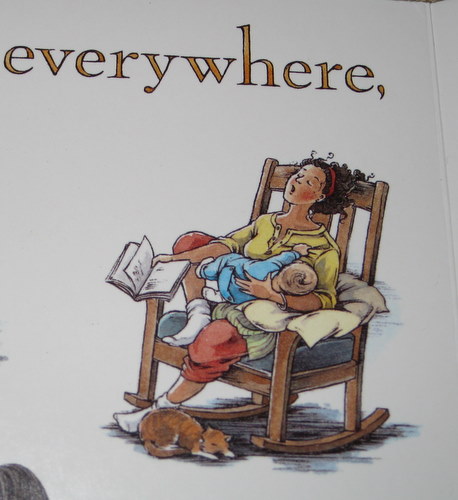 Before I had a baby, somebody told me how she wished she’d played with her children more. That she’d spent their childhoods rushing from one thing to another, and never took the time get down on the floor and engage with what they do on their own level. So I decided that her experience would be a lesson for me, just like I’d decided that any sleepless nights with my new baby be an opportunity for me to revel in her nearness. And then my baby was born, an occasion I came to define as “the day I discovered all my limits within arms’ length”. The sleepless nights were an opportunity for me to imagine murdering my husband, more than anything else. And it would turn out that when it came to play, I wouldn’t do much better.
Now just being with my daughter, I can do. Ours is not a particularly harried pace. We spent a lot of timing talking over pancakes, and lying sprawled on the floor staring at the ceiling. I like our conversations, I love brushing her hair, I think that holding her hand as we walk down the street is perhaps the great privilege of my existence. I really do like to be with my daughter, but I find playing insufferably dull most of the time. It’s boring, and after about five rounds of “playing farm”, “making a cake” (which involves piles of crayons), or “playing doctor” (whose stethoscope is actually a USB cable), I tend to drop out. I find her play absolutely fascinating to watch, but not to engage with it. Which is a huge reason why I appreciate picture books and stories, actually, and why we read so many of them– it’s the one activity of which neither of us ever tires.
 In a recent interview promoting her new book Blue Nights, Joan Didion notes that as a mother of a young child, she had been “totally wrapped up in keeping some time free for myself.” And I read that and thought, yes, that is precisely what motherhood is. Because once the baby’s arrived, she’s there, and there’s no fighting it– there’s no need to be wrapped up in that. How much I am enjoying the experience of motherhood has always been directly proportionate to the time I have to spend away from it. And to be totally wrapped in keeping this time free is not the same as being a bad or neglectful mother. To be so wrapped up is to be going against the flow, of course, swimming upstream, yes, but you’re still in the water. You’re always and forever in the water, which is precisely the point.
(I always think of the son in JM Coetzee’s Elizabeth Costello, whining at the bare silence of his mother’s office door. And I’ve always thought that the son was a bit of an asshole, since I read the book, which was long before I had a child of my own. I’ve always thought that learning from an early age that one is not the centre of any universe, let alone his mother’s, is probably a healthy thing for anybody.) 
Love pours out from the pages of Blue Nights, for the difficult Quintana Roo from her even more difficult mother. Life is like this. Motherhood is also like this, as Didion examines old photographs of her daughter growing up in Malibu: “The clothes of course are familiar./ I had for a while seen them every day, washed them, hung them to blow in the wind on the clotheslines outside my office window./ I wrote two books watching her clothes blow on those lines./ Brush your teeth, brush your hair, shush I’m working.”
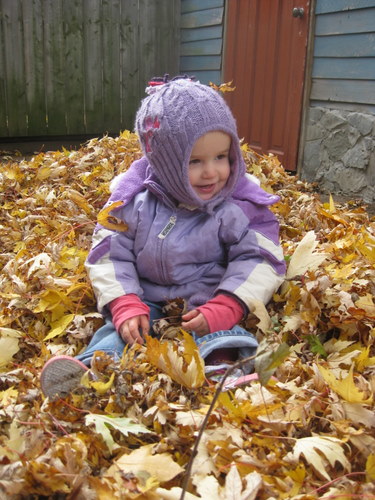 We had a wonderful morning at our house today, a backyard buried in leaves presenting the greatest opportunity. To be outside together working on a project we would both equally enjoy, the best mix of practical and whimsical, and neither of us would be bored. We filled two big bags with leaves, and there will be much more of this in the days to come, as the tree appears as fully dressed as ever. And then we walked to the grocery store to pick up some milk, which is rare because we usually stroller-it everywhere. I am usually in too much of a hurry, but not this morning, this lovely, leafy, golden morning. And just when the walk home appeared to be taking forever and the end of my patience was in sight, Harriet demanded to be scooped up and carried, which was fine with me, however awkward in coordination with 4 litres of milk, but these are the things we manage. We got home, and made a batch of Carrie Snyder’s granola bars, which are delicious. The whole arrangement sort of glorious, because it felt like we were two people rather than parent and child, relating on a somewhat-even keel, in spite of the disparity in our heights.
But see, she’s sleeping now, and I’ve got a cup of tea, and the time and space to write it all down, and therein lies the key to my happiness.
November 9, 2011
Still Reading Through the Alphabet: Under Covers
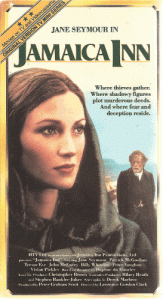 Though I’m drowning in new releases, I am still making my way through the TBR alphabet, currently mired in the unending Ms. And finally got to Jamaica Inn by Daphne Du Maurier (who probably doesn’t belong in the Ms, but who’s to say?). I do love that I have a hideous old paperback with Jane Seymour on its cover– Dr. Quinn Medicine Woman! And that my paperback is a TV mini-series tie-in– how often does that happen these days? Who could ever have imagined that the cover would ever be dated too, hmm? Though I supposed that datedness is the object of a trade paperback, to be read to shreds, battered, and relegated to the dustbin. Except that mine overcame the odds and I scooped it up at a used book sale once upon a time. Must say that it’s my least favourite of the DuMaurier’s I’ve read so far– though the ending surprised me, the main character and the backstory had much less substance than Rebecca or My Cousin Rachel. The plot was less compelling, but there were good bits.
I also read Joyce Maynard’s Labor Day, which everyone is except me has read already. And which everyone has told me is so very, very good, but I didn’t believe them. Partly it was the gross peaches cover (and those hands are all wrong!), the Jodi Picoult blurb (I am not only a snob, but one who once read a book by Jodi Picoult, so I’ve got cred), and the title, which made think that this was a book all about birthing. But it turned out to be completely different than I expected, including really, really good. And perhaps it’s the New England thing, but it read like a book a less-weird John Irving might have written, and someone would have slapped an altogether different cover on that one, don’t you think? Does this look like a book that’s narrated by a teenage boy? But it is, and it’s great, and I’m glad I finally read it, and I’m just sorry that so many other people as prejudiced as I am never will.
November 9, 2011
Discovered: Brain, Child Magazine
 I’ve been living under a rock, it seems, and so it was only on Monday that a copy of Brain, Child Magazine first appeared in my mailbox. And it’s like I’m right back there years ago discovering MS, Bust, and Bitch for the very first time. All those magazines that changed the way I see myself and the world, that were the turning point when I became a feminist. But after a while, I didn’t need them anymore, and it’s been a really long time since I read indie magazines (um, apart from the five literary magazines that turn up in my mailbox quarterly or more. I do my part, no fear).
But in terms of reading about parenting, it’s been all mainstream over here, and I tired of it much faster than I tired of the others. And not until I finally got my mitts on Brain, Child did I discover that I’ve been parched, starved for story. For essays that run off the page, and are written so well, which challenge and move me (but not too much for the former. Brain, Child seems infinitely readable, even for the bleary-minded. I read the whole thing cover to cover in 36 hours, part of it in the bathtub. It’s like that).
The magazine appeared on my limited radar when the wonderful Stephany Aulenback mentioned her essay published within about her adventures on Ancestry.com– a hilarious piece about her discovery of her children’s alleged royal lineage. And then I read “Glass Half Full”: has telling the “truth” about motherhood been taken to the point of dishonesty? And this was when I decided to buy a subscription, because I wanted a parenting magazine that had Rachel Cusk as a touchstone (and which doesn’t advertise boatloads of unnecessary crap, like that ridiculous stroller that turns into a tricycle, or denim diapers).
I loved the essay about the woman with chicken pox in her third trimester, and the scene where her two-year-old is finally allowed to see her after weeks of separation– the primal way in which the little girl reclaims her mother. In another essay, a mother accompanies her small daughter to her birth mother’s sister’s wedding– and contemplates the ways in which the birth mother will always be disappointing. Or another in which a woman thinks about the meaning of “inappropriate” and links it to her daughters’ discomfort with her body after her mastectomy.
I love that there is fiction here, and loooong book reviews, and that the magazine ends with a poem that is funny. I love the mothercentricity of the magazine’s approach, the literary quality of the writing, that the essays offer more questions than answers, and also that I subscribed for my Fall issue so late that it won’t be long until the Winter one arrives.
November 7, 2011
Dadolescence by Bob Armstrong
 Dadolescence is one of a few books I’ve read this year– along with Kate Christensen’s The Astral, Shari LaPena’s Happiness Economics and even the story “Summer of the Flesh Eaters” from Zsuzsi Gartner’s Better Living Through Plastic Explosives— that considers what it is to be a man apart from traditional institutions of masculinity. Is a man still a man when his wife is his family’s main breadwinner, when he’s spent his career chasing after artistic dreams that haven’t come true, when he’s become decidedly middle-aged and no longer attracts admiring glances from women (if he even ever did)? As outliers on the spectrum of masculinity, the men in the novels I’ve mentioned are dumped into a catch-all house-husband/stay-at-home dad catagory, but they fit in here as awkwardly as they do everywhere.
Though Bob Armstrong’s Bill Angus is a stay-at-home-dad, his son is old enough and independent enough that the novel doesn’t fully examine that experience. Rather, Dadolescence considers what happens to every stay-at-home parent when they begin to realize that their role is becoming obsolete. They’ve stayed home for the kids all these years: now what? Though Bill avoids addressing this question throughout the novel, deluding himself into thinking instead that the PhD thesis in anthropology he’s been not writing for years is ever going to be finished.
His stay-at-home dad neighbour/colleagues have similar diversions. Dave has become obsessed with remodeling his house in order to add resale value, digging up floors and knocking down walls (sometimes load-bearing). The tipping point arrives when he decides to built a turret on his 1950s’ bungalow. Meanwhile, Mark tells implausible stories of his work on a cattle-ranch, as a police officer, influencing Bono, and now he’s gunning for an astrophysics contract with NASA. And Bill is taking this all in, imagining himself turning his neighbours’ experiences into an anthropological study of modern masculinity, supposing himself to be removed from what he is observing, though also terrified that he isn’t.
Meanwhile in his preoccupation with his neighbours, Bill finds himself neglecting his household duties, disappointing his twelve-year old son, and (almost) failing to notice that his wife is drifting away from him.
Dadolescence was written from Armstrong’s play Tits on a Bull, which was performed at the 2007 Winnipeg Fringe Festival. Which means that the voice of the hapless Bill comes through with enormous humour, though it overwhelms the novel itself at times and tells much more than it shows. Bill himself is also such a passive character that the plot lags with him at the helm, and in order to be resolved resorts to some screwballish hinjinx. Nothing is subtle here, everything a little bit over the top, but it’s as funny as it’s meant to be, and more than once, I laughed out loud.
In Dadolescence, Armstrong has captured that difficult period in the life of every Gen-Xer, when it becomes time to unload the vinyl evidence of one’s “youthful audio anglophilia” at a garage sale, and finally begin to grow up.






