June 6, 2014
Market Wine
 I’ve had no blogging mojo this week—sometimes this happens. I have also been incredibly tired, a condition that will not be ameliorated by my attendance on Harriet’s school trip to the High Park Nature Centre this afternoon. With the baby in tow. In my experience, shepherding 20 kids on the subway is one of the more crazy-making circumstances of one’s life. But the weather is beautiful, and I think we’re going to have a great afternoon. Tonight’s plan is wine on the porch, followed by Top of the Lake. The wine is from the Farmers’ Market, which means that the Farmer’s Market (and summer) have returned to us, and also that wine is now permitted to be sold at local markets, and both of these points are incredibly pleasing. So I am looking forward to tonight, though not so much, because I find that evenings that are too anticipated usually result in my cleaning up one of my children’s vomit. Somehow, they just know.
Also pleasing, I wrote a review of the memoir, Birding With Yeats, by Lynn Thomson in the National Post. It’s a curious book which only became weirder the more I thought about it, which I mean as an endorsement, actually. The fact that I thought about it so much, mostly. I was also reading it at the same time I was reading A Siege of Bitterns and Pluck. So many birds. It inspired me to create a list of these books and more–as ever, putting a bird on it is popular.
And I was thrilled by this review of The M Word in The Winnipeg Review this weekend by Angeline Schellenberg. She got the book exactly, and wrote about it so well. I loved, “Some moms decorate Barbie cakes in their sleep. The M Word is a kind of What to Expect When You’re the Rest of Us” and “A book about motherhood that includes those who never gave birth? Those who’ve been pregnant but never held a child? Halleluiah! Finally: a conversation with no “us versus them.” Here is only “us,” those who desire to “be connected by this understanding of what it is to love and celebrate your children.” The M Word offers what mothers (new and old) need most: to know we’re not alone.” So proud of this, and pleased that this book continues to find its way into the world.
June 5, 2014
A Year of Iris
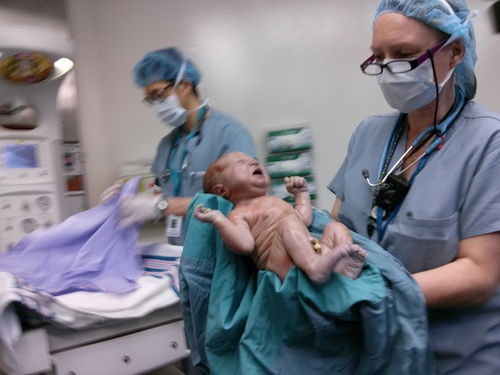
This whole week has been rife with “one year ago” nostalgia, the disbelief that so much time has passed, that it’s all gone so fast, and that there ever was a time when we didn’t have an Iris. And it is astounding to have a record of my first glimpse of her, a baby who looked nothing like anyone I’d ever seen, certainly not like her sister, who I’d sort of assumed was a baby template. But no, because here was someone else, someone entirely different, utterly herself. I was able to love her immediately, even as I understood that I didn’t know her at all.
While I feel as though I’ve always had an understanding of Harriet, that if I could have dreamed up a daughter she would have been just the one, Iris has been a mystery to me. She’s kept us guessing–she was born with a tooth, and then another by 3 months, and has yet to have any more. She’s had weird ailments that made us regular visitors at the Emergency Room this winter, and none of them have been either serious or straightforward. She’s very small, her weight in the low percentiles since 3 months of age, and while her weight went up at her 9 month visit, her height was down and she was in the third percentile. “Third?” I asked for clarification, thinking this put her in the bottom 30%, but no, it was the bottom 3. We track our girls’ heights on a doorframe in our house, and Iris is so much smaller than Harriet was at this age. And it’s all so different from my first baby, who was big and bruising and never got sick. And yet…
Iris can walk! Only single steps for now, but she has pretty much mastered pulling herself up to standing without support. She has been crawling for months, speeding across the floor, up flights of stairs, and across the sandbox, and the playground, and Harriet’s classroom, and pretty much anywhere. Iris is at home in the world. She can be jolly and happy, and she laughs and laughs, but has a scream that’s the definition of bloodcurdling. She will rarely consent to have anyone hold her, except her parents, but if you give her time and space, she’ll warm to you. She likes to play with balls and flips through books and if you put on music, she will do the shaky bum bum dance. She has learned to safely get down from furniture and the step in our hallway, and has never fallen. Somewhat recklessly, she has the ability to turn anything into a potential noose. Her favourite joke is blowing raspberries on people’s bare skin. She is an expert at blowing kissing too, and waving, and clapping, and in the last day or so, we’ve begun to suspect that Iris can talk. She can say, “Bye bye”, and “dog” and “Daddy” and sing, “Happy Birthday” (which sounds a bit like, “Apa buh”). She is absolutely in love with her sister, and the two of them now get up to all kinds of tricks, and they make one and other laugh and laugh, and their relationship makes me happy. I am also fascinated by the fact that it has nothing to do with me.
Iris has been up to all kinds of adventures this year. She’s taken two journeys on a plane, another on a train, and plenty of road trips. She has loved our co-op shifts at playschool and has been so welcomed there that she thinks it’s her school too. She’s had afternoon tea at the Windsor Arms, and been out for all kinds of brunches, lunches and dinners. Last Friday, she tried sushi for the first time, and discovered an affinity for edamame. On Sunday, we had our first experience of going out for ice cream and ordering four cones. She likes to hang out at the park and eat sand, and if you try to take her out of the swing, she will scream at you. She likes the slide. She likes looking out the window. She likes to open cupboard doors, get her fingers stuck in drawers, and often won’t eat her dinner until you take her out of her high chair and then she’ll eat what she’s just thrown on the floor. She’s big into eating paper and I once found a googly eye in her diaper. She is still really enthusiastic about pushing the button to change the traffic signals before we cross the street. And once we’ve crossed the street too. And if we just happen to be walking by one. And she loves climbing, her latest trick involving standing up on her rocking chair and then rocking it perilously. Her favourite book is Little You by Richard Van Camp and her Wonder Woman Board Book. She likes turning pages more than she likes listening to stories. She likes it when I play guitar, but mostly because she wants to put things in the hole. She is always game for a round of “Row Row Row Your Boat.”
She’s terrible at sleeping, and only naps on people, which has its benefits and drawbacks. Ever since I met her, I’ve been ridiculously tired, but I’ve also been ridiculously happy, so pleased and grateful to have the family I want to have. (To be finished having babies too.) I am grateful too for the gift of having learned to appreciate babies, an ability that was lost on me when Harriet was small. I am grateful that this really has been something of a do-over and that I had a chance to appreciate what they mean when they all tell us to enjoy every minute. I would never have believed it, but for the most part, enjoy it I really really did.
Happy Birthday to our beautiful girl! How wonderful life is now you’re in the world.

June 3, 2014
A Conversation About Mothers in Children’s Books

I’m really excited about the event we have scheduled for 7pm on Thursday June 19 at Parentbooks in Toronto (121 Harbord Street, just west of Spadina). I will be there, alone with Heather Birrell, Heidi Reimer, Amy Lavender Harris and Patricia Storms, and we’ll be talking about representations of motherhood in children’s books. Having chosen some of our favourite examples, we’ll be doing readings from the books and discussing why these stories are important to us, and also tying their themes to the broader themes from The M Word anthology. It’s going to be an intimate gathering, and I do hope that audience members will arrive with their own ideas for discussion.
Space is limited, so you are asked to RSVP at Parentbooks (416-537-8334).
The M Word will be for sale, along with some of the other books under discussion
I hope you can make it!
June 2, 2014
An Untamed State by Roxane Gay
 For about two-thirds of An Untamed State by Roxane Gay, I wasn’t sure what to think. The book begins with the most majestically-crafted sentence (“Once upon a time, in a far-off land, I was kidnapped by a gang of fearless yet terrified young men with so much impossible hope beating inside their bodies it burned their very skin and strengthened their will right through their bones.”) but then that huge and generous perspective disappears and we’re left with a narrative that moves narrowly between the Before-and-After lives of Mireille Duval Jameson.
Before, ensconced in a fairy tale, confident of her wit and wiles, American born and raised but returned to Haiti, the land of her parents’ birth, her family’s opulent lifestyle conspicuous against the nation’s wider poverty, but this was the only life she knew. And then After, ripped away from her husband and child to be held captive for 14 days and subjected to rape and sadistic violence. From a bubble to a prison then, and while the novel was compelling, there was a flatness to the narrative, its dialogue, and I wanted more in exchange for the violence to which this book’s reader must bear witness—though I will note that the violence is described sparingly, more gestured toward than elaborated upon. Disturbing, yes, but not gratuitous. But still.
And then Mireille is freed (which is not a spoiler) and suddenly, the whole project comes together in the most mesmerizing way and the book became difficult to stop reading. In An Untamed State, the plot is not the point, but rather the point is psychology. First, the psychology of one who is suffering from post-traumatic stress and trauma, as well as the brutal revelation that there is so such thing as safety in the world, not truly. She leaves captivity disconnected from herself—she had to make herself into nothing in order to survive what was inflicted upon her, so how can she get back to the woman was, a wife and mother? Gay’s narrative enacts the processes that Karyn L. Freedman (necessarily, this being non-fiction) more cooly explains in her stunning memoir, One Hour in Paris: A True Story of Rape and Recovery. Both books show that trauma is not something one can move on from, but rather that it must be managed and treated on an ongoing basis, like a chronic condition. Which is both heartbreaking, that one never gets over this, but also hopeful—that there is a process at all, and life in the aftermath.
What is most compelling about An Untamed State are the family dynamics that run like fault lines through the entire text. When Mireille is kidnapped, her father refuses to negotiate with them, sacrificing his daughter with his unwillingness to abandon his principles. When she is freed, Mireille has to account for her father’s role in what happened to her, and Gay does a terrific job in making her father a fully-developed, complicated character whose actions are (almost?) understandable, instead of the far more convenient tyrant he could have been. Similarly, her mother’s compliance with her father’s point of view is troubling for her, and even the dynamic she has created with her own husband—she’s hardheaded and hotheaded, prone to running away in hopes of being found, and this time when her husband is unable to find her, the balance between them is upset, perhaps forever. It is remarkable how consistent the characters’ behaviour and actions are throughout the entire novel, and how these actions resonate so very differently in the context of Before and After.
Gay’s allusions to myth and fairy tale add marvellous texture to the novel, and perhaps go some way toward explaining the flatness I was initially confronted with as I read it. There is a deceptive simplicity to the novel that belies its remarkable originality, as does the fact that it’s a really good read. It’s that rare thing—a page-turner whose pages you’ll still be turning in your head long after the book is done.
May 30, 2014
4 Mothers 1 M Word
 I’ve been so happy to follow along as the writers at 4 Mothers 1 Blog have been responding to The M Word all week. Nathalie Foy wrote about reading the book as an exercise in empathy, noting: “It was glorious to look into that kaleidoscope and feel as much myself as ever; it was wonderful to look at difference without feeling the need to be different.” Carole Chandran read the book and felt relief at how far she’s come with carrying her own motherly burdens, which don’t seem so burdensome these days. And Beth-Anne Jones wrote about ambivalence, of which in the book there is plenty expressed. She writes, “Parenting isn’t about attachment or a helicopter, a tiger or a presence of mind; it’s a harrowing see-saw ride with such soaring highs that it can shock the breath right out of you and thud-to-the-ground lows that will diminish you, gut you, scare-the-shit-out-of -you.” I love that.
And today, I get to add my voice to the mix, expanding on my “non-fiction anthology is a revolutionary act” idea to show that women’s stories together are a powerful force and also the stuff that ordinary days are made of.
Thanks to Nathalie, Carole and Beth-Anne for having me, and for their wonderful support for The M Word.
May 29, 2014
Kids Books We’ve Been Enjoying
 Chaucer’s Canterbury Tales by Marcia Williams: We received this book after Harriet’s classmate’s Knights and Castles birthday party. (This classmate happens to have a notoriously bookish Mum who seems to be making a serious return to book-blogging–yay!). Harriet is comics-mad, loves a good story about knights, plus she’d been told that there was lots of farting in these stories. With her richly illustrated panels, Marcia Williams has made the Canterbury Tales fun and accessible to modern readers, and they were as bawdy as promised. These adaptations serve as an excellent introduction to the original tales, and keep these timeless stories in our collective consciousness.
 Underworld: Exploring the Secret World Beneath Your Feet by Jane Price and James Gulliver Hancock: One day, Harriet and I spent ages lying on the carpet reading this book, whose every new page revealed something else to fascinate us. Egyptian tombs, Paris catacombs. the Tokyo subway, volcanoes, buried treasure, WW1 trenches, bomb shelters in the London Blitz, and underground cities in Turkey. Has a book ever so contained everything? It was pleasure to read a book from which both of us learned so much, and the design and illustrations of this one are really well done.
 When Emily Carr Met Woo by Monica Kulling and Dean Griffiths: The creative team behind Lumpito (a picture book about Pablo Picasso) gets together again for this story about the eccentric Canadian painter Carr and her messy, extraordinary life, a part of which was the monkey, Woo. There is a bit of peril when said monkey devours a tube of yellow paint, but (spoilers!) disasters are averted. This is a fun take on an unconventional and important life.
 Charlie Cook’s Favourite Book by Julia Donaldson and Axel Scheffler: On Monday when we were all sick on Harriet’s birthday, this gift arrived from Harriet’s great-aunt and it was such a bright spot in a difficult day. This book thrilled us first because no one ever gives us books–we are an intimidating prospect owning so many books already. But we’d never heard of this one, and we love Julia Donaldson, and this one is so so good–a story of a book reading a book about a boy who’s reading a book about a book who’s reading about a book about a… A book within a book within a book! So great! So it’s a bit like that, but even better.
 Today We Have No Plans by Jane Godwin and Anna Walker: I sometimes am so grateful that we don’t have a lot of extra money and no car because it means we’re ineligible for the hyper-scheduling that some families happily choose for themselves but which would never ever work for me. The one thing I’m glad to be rich in is time, and this book (which I bought at our playschool book sale for a dollar) celebrates such wealth, what it means after a busy week on the hamster wheel of piano lessons, carpooling, soccer practice, hurried breakfasts, rinse, repeat, etc, to be able to have a day with nothing in it (yet). To linger in your pjs over pancakes (and the paper). The very best days, plus it rhymes, so this book and I were always going to get along.
 The Goldilocks Variations by Allen Ahlberg and Jessica Ahlberg: This book is weird and wonderful and full of pop-ups and silly jokes–is there anything better? Ahlberg (with his daughter doing the illustrations) riffs on the familiar Goldilocks tale in true Ahlbergian style–plus, there’s a book within a book. Of course! See Goldlilocks as she steals into the 3 bears’ house, and then the 33 bears’ (really tall) house, and then into an alien spaceship, and the one where she is thwarted by the furniture and a sheet called James. (Why don’t more sheets have names?) Stuff and nonsense. We love it.
 There Was An Old Sailor by Claire Saxby and Cassandra Allen: Forget the old woman who swallowed a fly! This sailor ends up swallowing a whale, but not before a jellyfish, a squid, a krill. It’s a delightful twist on a familiar song, and perfectly complemented with vivid, striking illustrations that please the eye and give a modern twist to traditional maritime images. It ends with a belch, which will never not prove amusing, and then the reader will encounter some fun facts about the sea creatures in this book (like a squid has a beak–who knew?).
 Jack and the Box by Art Spiegelman: After reading Michael Barclay’s piece on Toon Books, I was inspired to read Jeet Heer’s biography of their founder and editor Francoise Mouly, and also to buy a copy of Jack and the Box. Mostly because I loved this panel. It’s a wacky, startling and funny story of a boy and his unconventional Jack in the Box. The silliness is the best part. There is also a physicality necessary to the story which the comic form so perfectly expresses.
 101 Things to Do With Baby by Jan Ormerod: Seriously, is there anything that can’t be expressed in a series of illustrated panels? Lately in our house, we think: no. Clearly, the folks at Groundwood Books agree, which is why they’ve reissued Ormerod’s classic after 30 years. And I love this book, whose first image of a mom reading to her small daughter while breastfeeding a new baby was pretty much how I spent my whole last summer. Showing the moments–funny, tender and mundane–which make up a day, Ormerod shows the trials and joys of being a big sister, and gives a wonderful child’s-eye view of the world.
May 27, 2014
The M Word keeps going…
 The Great Sheree Fitch wrote a beautiful review of The M Word for the Telegraph-Journal in New Brunswick on May 10. The review is not online, but I received a clipping in the post yesterday, and it’s so wonderful. She writes, “The M Word felt like a kind of emotional labour for the three days I was reading. This is a motherlode of deeply personal truths, generous and courageous souls, bearing witness to lives shaped, if not defined, by, well, “life with a uterus,” as the foreword suggests.” I am honoured and thrilled by this review.
I was also very pleased by poet and critic Sina Queyras’s review of the book at Lemon Hound. I found the review interesting, provocative, and totally right in a lot of ways. She asked great questions (about the book itself and her own reactions to it), opening the book itself up wider. Mostly though, I like the part where she writes, “Would I recommend this book? I think so…” and I’l leave it at that. She’s right—The M Word is a start, and I never intended it to be an end. And that, I think, is part of the book’s power.
Finally, I am so pleased that this week, the excellent blog 4 Mothers will be focussing on The M Word all week long. Today, my friend Nathalie Foy writes about The M Word as an exercise in empathy. I’m looking forward to the other posts, and to having my own guest post on the site on Friday. The M Word is a start indeed. It’s really nice to see the conversations continue.
And they’ll continue at a really fun event we have coming up at Parent Books in Toronto on June 19, at which we’ll be discussing representations of motherhood in children’s books. I’m looking forward to this one. Stay tuned for details…
May 26, 2014
Harriet turns five
 Harriet turned five today (I know! Crazy) and to celebrate, we all came down with a stomach bug. It was brutal, and poor Iris had it the worst of all of us. I do wonder if fate wasn’t hoping to counter any nostalgia I might have for baby days, now that my first baby is impossibly grown (5!) and my little baby is just days away from turning one. Waking the baby to feed, having to sit up to do so–ugh. And then walking around like a zombie this morning, all of us taken down by illness, sleeping lying sideways on my bed beside the baby while the strains of Frozen made their way up the stairs. I am so glad this isn’t my life anymore. Iris doesn’t sleep much, but she sleeps more than she did last night, and I’ll appreciate it now. We’re all feeling much better, and looking forward to a final day of convalescing tomorrow in which we’re feeling well enough to go to the park or even out to lunch.
 So Harriet had the most disappointing 5th birthday ever, but it wasn’t so bad because we managed to throw her a party on Saturday, a little fete for five friends from playschool. The theme was Beetles Bugs and Butterflies, and we pulled it off beautifully, stringing up extra bunting for the occasion. Things were very simple–drawing bug pictures, hunting for plastic bugs, making antennae and dancing to The Beatles. Dessert was served in flower pots with gummy worms, and everybody got a copy of this fun book to take home. Nobody cried, which was pretty much our goal, and it was totally nice and un-overwhelming and would all have been so perfect had most of the guests not also come down with a stomach bug the next day (but so did many children in Harriet’s class who were not at the party so it’s not all my fault.)
 So Harriet at five–what can I tell you? She never stops talking, she loves Wonder Woman (dressing up like her, reading her comic books, pretending to be her), is learning to read, still loves H best of all the letters but can write them all now (though she doesn’t see the point of lower-case). She does a terrific job of taking care of her sister, and the two of them have a really excellent time together, making one another laugh. She gets along well with friends at school and even tries sometimes to rise above the pre-pre-adolescent girl drama squabbles. She can be really helpful, empathetic and kind. When my book arrived in the mail and I showed it to her, she said, “Oh, Mommy…” and gave me a big hug. We have reached a comfortable arrangement in which she can tell me she hates me and I’m not bothered. She thinks that all families eat ice cream daily and sometimes twice. She is excited to get a scooter and ride it to school. She loves school and has learned so much this year. She is obsessed with Riders of Berk, and idolizes Violet from The Incredibles. She likes Ramona and Laura Ingalls, and loves to be read to. She is clumsy and uncoordinated but we’ve enrolled her in emergency dance and soccer classes and she’s happy to be learning and having fun. Her powers of observation are formidable. She is tone-deaf but we’ll never tell her. She is funny and smart, so aware of the richness of language. She finds the world interesting. Sometimes it is too much with her. I can’t believe she is that tiny bundle of baby I first encountered five years ago. It seems impossible now, and also like yesterday, and it seems like I’ve known Harriet all my life. And I think I really have.
May 23, 2014
Pluck by Laisha Rosnau, and a giveaway!
 Having finally learned to read poetry has been the greatest revelation. And so I’ve been reading Laisha Rosnau’s Pluck for the last six weeks or so, living with the book, dipping in and out of it, carrying it in my bag. One day after reading it in the sandbox at the park (as you do), I opened it again while in bed and sand poured out of the pages, all over my duvet, which was definitely inconvenient but perfectly fitting too. Because Pluck is gritty, about nature and domesticity, about the spaces where they overlap, sometimes comfortably and sometimes otherwise. It’s about the spaces where our selves overlap too, the people we are and who we used to be, and who we hope to be, and what we might become.
The first poem I read aloud at the table was “Accumulation,” a poem that plays with language to illustrate the way that stuff builds up around us, particularly when you add children to the mix: laundry and plastic. And the heartbreaking, wonderful, so perfect ending, “Please me, you please, what pleases us, pleases them, again and again–yet/ how can we please each other, do each other justice, just us/ we and us and you and me and all we’ve collected, accumulated/ amassed, a mess, amen–”
These are poems about the chaos of family life, about what we have to prove to ourselves and each other. And this chaos is juxtaposed against a more natural order, a world outside where birds fly into windows and injured fawns show up on the lawn (and even inside the house, above the marriage bed, paintings of great horned owls hang on the wall). There are secrets and compromises in these tidy lives we have made, most strongly expressed in “The Music Class”, formally a variation on the villanelle (I think, though this variation may be its own form) in which a woman takes her child to a music class to discover the child and wife of a man who’d raped her years before: “Out children go to music class/ at the same school I went to as a girl./ We make up a life… then, he kept the radio on and I caught notes/ in my throat when he forced himself in my mouth./ We make up a life,/ Sometimes on instinct. I kicked open the door/ instead of biting down though, if I had, perhaps/ our children wouldn’t go to music class…”
The poems in Pluck are about the desire to create–our own lives, new lives, poetry–and about the way these desires are complementary and otherwise. I loved “Late” about a woman perusing obituaries critically (and I’ve been there–so fascinating): “The women, their lives canned and quilted, baked/ into the memories of their children, and I wonder;/ Really? Is that all that those left behind chose to record?/ I love a canned peach but, good Lord, if anyone mentions/ mine when I am dead, my time was not well spent.”
Pluck is a curious, surprising and absorbing collection, rife with familiar points and then shifts to keep one from getting too comfortable within. It’s a book that interrogates language just as it asks questions of the world, nudges into dark and dusty corners, and illuminates the complicated many-sidedness of love and life.
I was looking forward to this book, and it definitely lived up to my expectations. And so it is to my great joy that I can share the goodness. The publisher was kind enough to send me a review copy of Pluck, but I’d already bought a copy in the store (of course!) so I have an extra copy to giveaway. If you’d like a chance to win it, leave a comment below and I’ll make the draw on June 1st.
May 21, 2014
A Siege of Bitterns by Steve Burrows
 From the start, I liked the premise: a birder murder. Though I am not a birder myself, I am fascinated with the species (the hobbyists, I mean), and take a great deal of comfort from the fact that they exist in the world. I also like a murder mystery, particularly those set in the English countryside, so when I stumbled across Steve Burrows’ book launch for A Siege of Bitterns at Blue Heron Books in Uxbridge not long ago, I was more than happy to buy the book. But would the book itself live up to the promise? Well, after a delicious weekend devouring it, I am happy to tell you: yes.
For some reason, television comparisons spring to mind. My beloved Midsomer Murders for one, with its semi-satirical and slightly absurd look at English society, and then also Broadchurch, in which the damaged, alluring, flawed detective genius rolls into town with a whole lot of baggage, and a high profile case is not the introduction to the job that he had in mind. The genius here is Domenic Jejeune, Canadian ex-pat and apparently a media darling, though we’re told very little about either why he’s admired or the past that he is fleeing from. He’s just as much an enigma to his readers as he is to his new colleagues in the Norfolk town of Saltmarsh.
From the television references, however, one is not to think that part of A Siege of Bitterns’ appeal is not its language. It’s a book that will appeal to those of us who covet collective nouns, and apparently it’s meant to be the start of a whole series (A Murder of Crows, A Charm of Goldfinches, etc). One of the book’s greatest charms is Domenic Jejeaune’s girlfriend, Lindy, a journalist, for whom grammar and editorial style is a preoccupation, which proves convenient to Jejeune as these semantical details turn out to be upon which the whole case rests. Birds and words: this is such a book for nerds! And I absolutely loved it.
The case is the murder of celebrity ecologist Cameron Brae, and the suspects begin lining up not long after his body is discovered hanging from a willow bough. Is it his unlikely second wife, a former Spice Girl-esque rockstar with a penchant for Motown music and a yearning to be her husband’s intellectual equal? Or was it Brae’s son whose cravings for his father’s attention lead to involvement with a radical environmental group? Is this about wind turbines, the fragile climate of the salt marshes, landowners with no regard for conservation, or does it all come down to a fierce rivalry among birders to get to 400 species sightings, which Brae was unbelievably close to? What of the note Jejeune finds scrawled in Brae’s study referencing the American Bittern? Could a man be murdered because of a bird?
Burrows’ background includes extensive birdwatching experience around the world, and editorships at the Hong Kong Bird Watching Society Magazine and Asian Geographic, which I assume have led to the deftness with which he writes about ecology and ornithology, applying these ideas to the mystery genre in a way that doesn’t feel like a stretch. I was a bit concerned in the book’s opening when Jejeune’s own background as a birder gives him special insight into a suspect’s false alibi–it was a bit to convenient. But after that, the birding didn’t seem conspicuous in the novel, and it was the mystery itself that had me so absorbed, as well as the complex and interesting characters that Burrows has created–Jejeune and Lindy, and Jejeune’s Sergeant Maik.
It’s obvious we’re being set up for a series here–Burrows has deliberately left so many ends wide open, and I can’t wait to find out where they lead. A Siege of Bitterns signals an original, well-crafted, clever and exciting new series on the scene, and it’s a really terrific read.