May 21, 2014
“Helter Skelter”
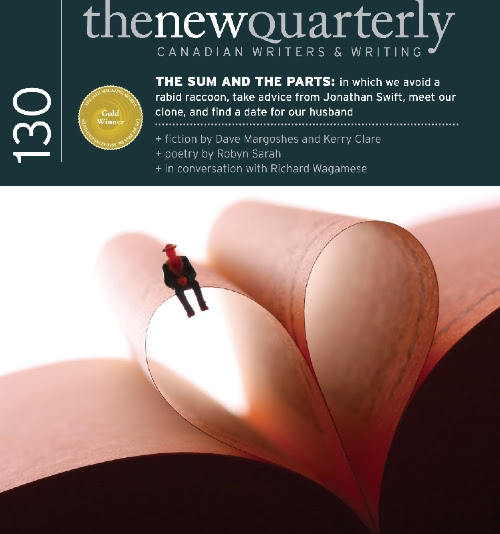
I am thrilled beyond measure to have a new published short story in the world, “Helter-Skelter” appears in The New Quarterly 130, and my name is on the cover, which means that you can sing this song about me now. It’s a great issue of a magazine that has done so much to support my work and which I credit for most of my career–both The M Word and my job at 49thShelf were spun out of their publication of my essay “Love is a Let-Down” a few years ago. I’m so pleased to return to their pages, and in fiction to boot. And it’s pretty wonderful that this story has finally found a home.
You can buy a digital or print edition of the magazine at the TNQ website, or wherever good magazines are sold.
May 20, 2014
On Visiting Winnipeg
I only knew Winnipeg through books, by Miriam Toews and Carol Shields and others, and so I had literary expectations of the city and it didn’t disappoint me. And the Winnipeg books I know were newly imagined in my mind as we drove along Winnipeg’s streets, streets whose winter had removed all road markings, as we visited so many of the city’s neighbourhoods, a literary map come to life. I’d been checking out the official site of Tourism Winnpeg too, and they really do a terrific job of selling the city and I began to be sorry we weren’t staying for a week. We were only staying for two nights, a day and a half. We decided to pack our schedule quite full.
We had the best flight ever (the baby slept, I read a book, and sipped a [terrible, but I won’t quibble] cup of tea). Some people might have supposed that flying with two children was something to be worried about, but those people evidently didn’t remember our disastrous flight to England last fall. This time, no one threw up, I didn’t lose our passports in Amsterdam, and we landed it two hours. In comparison, our journey to Winnipeg was like a week at a luxury resort.

In Winnpeg, nothing is located very far away from anything else. This means that we were able to get off the plane and be playing at the Nature Playground at Assiniboine Park within the hour.


And already, we were awash in literary references as we encountered the Winnie the Pooh Statue (the bear having been named for the city, naturally.)

The next morning, we visited the Carol Shields Memorial Labyrinth at Kings Park. I wasn’t sure it would be all that impressive without foliage, but turns out I don’t really know labyrinths. Tracing its paths was twisty, wonderful and full of surprises. It felt very emotional being there and being able to connect with the spirit of a writer whose work means so much to me (and whose words are the epigraph to the essay in the book I was visiting the city in promotion of).


Here is a photo of Harriet, Iris and I at the centre of the labyrinth. I was also moved by Shields’ own words which are etched into granite gates nearby, the granite in reference to her The Stone Diaries.

I was also excited to visit the Carol Shields Project Bookmark Plaque in Osborne Village, which makes reference to her novel, The Republic of Love.

And then later that afternoon, we encountered another literary landmark when we saw Kerry Ryan’s poems installed outside her boxing club in The Exchange neighbourhood. The poems are from her extraordinary collection, Vs. And the neighbourhood looked more liked New York City than anywhere else I’ve ever been.


We took care to visit Portage and Main, which was famous for something, but we couldn’t remember what.

Then we encountered a horse.

A highlight was the whole family hanging out in CBC Green Room as we waited for my radio interview. It was a pretty cool experience.

And then our wonderful launch that night at the extraordinary McNally Robinson Bookstore, where we were so welcomed and enjoyed a delicious dinner before the reading. And a quick shopping spree too. For it is impossible to visit a literary city like Winnipeg without coming away with a book or two. Or three.

We had such a wonderful time.
May 19, 2014
This One Summer by Mariko Tamaki and Jillian Tamaki
 It’s a toss-up, the question of my favourite line from This One Summer by Mariko Tamaki and Jillian Tamaki. It’s either, “That’s the problem with being adopted. I have no idea how big my boobs are going to be.” or, “You can’t get herpes from a flip-flop.” And it’s remarkable that the lines stand out in a graphic novel, a books whose visuals are so overwhelming. A book whose graphics’ simple blue only emphasizes the detail of the drawings, the clutter in the corners. There are some graphic novels you are breeze through in one sitting, but this isn’t one of them. The illustrations are a marvellous mix of old-school comic style, complete with text to imply sound and movement, and images inspired by scientific drawings of birds, plants and stars. And then full-page spreads with surprising perspectives and you could read this book over and over and discover something new each time.
Summer is fitting for comics, the season allowing plenty of time for pleasure reading, summer cottages perhaps having stacks of old comics on hand. And also for the way that summer is so fleeting–just a few panels in the book of a year. So much of life goes on outside it, and yet these summer memories, these ephemeral experiences of jumping off docks and sitting in sand, are what our minds return to over and over again. Summer brings us to the same old places but we’re a different person each time that we come, as Rose is beginning to discover in the Tamaki cousins’ tale.
And they get the details just right–cottage-country traffic, the winding roads and the posts mounted with family names pointing in their cottages’ directions. When Rose’s family arrives, she goes to find her friend Windy, her cottage friend since age 5. They visit the general store to buy candy, ride their bikes, lounge on the beach, wonder about the local kids and their teenage dramas, contemplate the summer romances they’re still too young for, get bored, get into trouble, wait out the rain.
Outside this chronology of hours, how summer days can stretch so long, there is much more happening, so much that cannot be articulated, which is why this story is such a great fit for a graphic novel. Rose’s parents’ relationship has fractured, her mother seems to be suffering from depression, their family going through their familiar routines but not meaning much of it. The reader also infers that in subsequent summers the differences in Rose and Windy’s ages will start to matter more, that the friends will grow apart, which will be heartbreaking and complicated. But that is a summer still to come.
In the meantime, the girls are on a threshold, having not put away childish things, but beginning to glimpse an adult world before them whose puzzles they just can’t decipher. They still think the puzzles are decipherable, however, so they’re still young yet, looking on in fascination and fear at the possibilities before them, feelings best expressed in an awe-filled silence. And to fill that silence in the meantime, they talk, Mariko Tamaki’s dialogue ringing true. Riding bikes, slouched on porches and bobbing in inner-tubes, doing and talking about everything, and nothing at all.

May 15, 2014
The M Word: What Motherhood Taught Me About My Abortion

And here it is! My essay from The M Word appears on The Huffington Post Canada, and I’m so relieved and bolstered by the feedback I’m receiving. Hope you will enjoy reading it.
May 12, 2014
This Week with The M Word
 I am going to be honest: launching a book has been as draining as its been exhilarating. We have been extraordinarily lucky with this book to have copies selling, to be connecting with readers, and to be receiving attention from the media. And yet: staging an event last week with three (three!) attendees has left me with a mild case of PTSD and now I’m basically petrified of leaving the house, plus various factions conspiring to drive me insane. I need to take a deep breath, aaaand….
Here’s hoping for better numbers at our event at Another Story Bookshop on Roncesvalles this week. I’m going to be participating in a panel discussion with Jasjit Sangha, co-editor South Asian Mothering: Negotiating Culture, Family and Selfhood (Demeter Press) and Melinda Vandenbeld Giles, editor Mothering in the Age of Neoliberalism (Demeter Press), hosted by Sadia Zaman. The event starts at 7pm and I’m looking forward to it.
Elsewhere, the biggest news: The M Word is a bestseller in Winnipeg! I love this. We also continue to be Goose Lane’s top-selling title, which I’m pleased about.
Last week, Sarah Hampson mentioned The M Word in her Mother’s Day column in the Globe and Mail, which ends with the wonderful lines: “Sure, there were hard rules – manners, respect, loyalty, work – but much of the experience of being a parent was to be open to the wonder of what each would become. What was right for one wasn’t necessarily right for the other. There is no perfect way. It’s about listening to them and to your own voice, your own instinct of love. Which is so very simple and fun.”
Lesley Kenny reviewed the book at the Descant blog. An excerpt from Fiona Tinwei Lam’s essay on single motherhood was reprinted in The Tyee. And in her review in The Kitchener Waterloo Record, Susan Fish writes “Rather than attempting to resolve issues once and for all, or to glorify and idealize a madonna-like figure, [The M Word] presents in alphabetical order a wide variety of the experiences of women who have embraced, eschewed or endured the experiences of motherhood in its many, different realities.”
May 11, 2014
Pat Barker’s Union Street and Just Pretending by Lisa Bird-Wilson
 Books are another thing that happen when you’re making other plans. My friend, Maria Meindl, recently recommended I read Union Street, Pat Barker’s first novel. On Maria’s blog, she writes, “When I read The M Word, I thought of the at-times agonizing intimacy of Barker’s book. She portrays the women in a working class neighbourhood in northern England. At first read, I pegged it as taking place just after World War Two, a grittier version of Call the Midwife; then it became disturbingly clear that this was the 1970s. The women’s choices are severely limited, and not surprisingly, the key moments, the defining dramas of their lives are played out on the stage of motherhood.”
So I tracked down a copy, even though it was the worst edition ever, and read it last week while were in Winnipeg. And I’m so grateful to Maria for recommending this book, which is a collection of linked short stories whose different characters (ranging from an 11 year old girl to a Hagar Shipley-ish character not far from death) mark the progression of a woman’s life. The book is gritty, effortlessly daring, disturbing, and ever-surprising. Barker’s women feature levels of complexity not often seen in fiction, and while “the key moments [of] the defining dramas of their lives” are events that we have encountered before, we’ve never encountered them from Barker’s particular angle in which these characters with so little agency are allotted a complicated breadth. These women are not just victims, but they are whole, complicated, flawed and brilliant beings. Their lives are depicted in agonizing detail, what it is to inhabit these bodies which birth, miscarry, are beaten, stand for hours on a factory line (and its a cake factory–the most magnificent detail), which are raped, fucked, rarely loved (but sometimes), tired and weary. But not just bodies–these are people. It’s a truly extraordinary book.
 The book I turned to next, presuming no connection, was Just Pretending, a short story by Lisa Bird-Wilson, who is a Metis writer from Saskatchewan whose stories have been widely published in prominent Canadian literary journals. Just Pretending had been on my radar for a while, but I took special notice when it recently took multiple prizes at the Saskatchewan Book Awards, including University of Regina Book of the Year. And it soon became clear to me as I started to read that Barker and Bird-Wilson’s books are similar projects, portraying the wholeness of marginalized women’s experiences, experiences which hinge on maternity, on motherhood and daughterhood, and on what happens when these connections are broken.
Many of these stories centre on characters who have been divorced from their heritage. In the first story, “blood memory”, a woman about to give birth to her first child imagines what her birth mother must have experienced at her own birth, and anticipates the awesome, surreal experience of meeting a blood relation for the first time in her life. In “the nirvana principle”, a young girl whose trauma from abandonment is compounded after a difficult experience attempts to outsmart-aleck her psychiatrist. A father in “deedee” visits a bar in a strip-mall, anticipating a reunion with the daughter he hasn’t seen for years, but she never shows and he gets lost to his old demons. In “Julia and Joe”, a young woman is about to give birth to her first child and and navigating complicated terrain as she lives with the father of the boyfriend who has taken off and left her. A woman’s dream of a happy blended family in “oldest sons” is tainted by the disappearance of her stepson. In “Just Pretending”, a teenage girl who is adopted contemplates her “real family”, which hangs her entire present situation in a state of “pretend”, enabling her to take risks with a charismatic older boy which leads to tragic consequences.
In so many of these stories, pregnancies are miscarried, babies stillborn, symbolizing the perpetuation of the disconnection between the future and the past, and also characters’ lack of agency in their own circumstances. Not to mention reflecting reality. Characters also struggle with addiction–a particularly strong story is “drinking wine spo dee o dee”, in which a down-and-out character drinks in a bus station parking lot in Winnipeg. His girlfriend has taken off to Toronto to find the child she gave up for adoption years ago, and he tells his story as testament to her: “Sadie liked me telling stories. ‘It’s how we know who we are,’ she was always saying,” but he points out that his stories were different from hers, which were “ancestors and shit like that. Mine are just life stories. Jokes and life stories.” Just as powerful though.
This story is followed by “hungry”, about a young girl whose abused and deprived experiences in the care of her mother lead to uprootings and trouble in foster care. Desperate for love, for something to call her own, she puts up with the attention of male classmates who end up raping her, and she becomes pregnant. It’s a harrowing but illuminating story, how one thing leads to another, how there is a light inside Bird-Wilson’s Lucy Wingfeather that no amount of trauma can extinguish. It is a story of perpetuating cycles, and then there is a powerful conclusion of connection finally, in which the mother/daughter connection is finally completed, which parallels a similar conclusion in Pat Barker’s story of a woman whose painful existence as an abused wife leaves her despairing at having brought a daughter (another woman) into the world to continue the struggle, and then finally, she recognizes her daughter and there is some kind of catharsis (we hope).
And we do hope. We cling to the moments of light in these stories, the powerful longing and love to cancel out all that gets lost. There is also humour here, both situational and also in the voices which Bird-Wilson evokes to bring her characters to life. There is a real mix of stories in the collection, and my only criticism of the book is that I’d have preferred more careful creation, perhaps fewer stories with the connections between them made implicit. While Bird-Wilson’s considerable talent is clear here, it would have been better highlighted with more selectivity, a nod to the book itself in addition to its stories.
But the stories are strong. It’s true that our stories are how we know who we are, but they’re also how others can know us, how the experiences of other people can be known. So I am glad that Lisa Bird-Wilson and Just Pretending are receiving such deserved attention. These are life stories, and there is is nothing “just” about it. Pun intended.
May 10, 2014
Destination Bookshop: Blue Heron Books
 Destination Bookshop is part travel-guide, and part bookshop discovery. Having recently lost my local bookshop, Destination Bookshops now seem more important than ever, first because I have to buy my books somewhere, and second to support great shops in order to ensure that we’ve always got somewhere to go.
I’ve been hearing buzz about Blue Heron Books in Uxbridge (about 1 hour from Toronto) for years, but it was the lovely Matilda Magtree who really got me interested in the shop, particularly when she explained that it was her local indie, even though she had to drive for 45 minutes to get there. And so this year I asked that my Mother’s Day gift be a family road trip to Uxbridge so that I could see Blue Heron for myself, and it was just a coincidence that Uxbridge is halfway between my mom’s house and mine so that she could meet us there too and Mother’s Day could be observed in proper fashion.
 We arrived to find that we’d come on the right day because Steve Burrows was there launching his birding detective book, A Siege of Bitterns, and they even had a cake! The cake was good, and I’ve been wanting to check out A Siege of Bitterns ever since I put Burrows’ Inspector Dominic Jejeune on my Canadian Sleuth list in December. So I was pleased to get a signed copy and enjoy my slice of cake while my children wreaked havoc in the store’s huge gallery/meeting space in the back.
 My mom’s Mother’s Day gift to me was reading to Harriet from DC Comics Superhero I Can Read Books so that I could spend ages wondering around and perusing Blue Heron’s shelves. Their children’s book selection was huge, and I ended up buying The Goldilocks Variations by Allan Ahlberg and his daughter Jessica Ahlberg, which I’ve never heard of, but which we read tonight and had the grown-ups among us in hysterics.
 Books. Books. Books! This was a monumental trip for our family as we haven’t visited a bookshop since, well, Tuesday, and there was the shop I visited alone on Wednesday, but. Moving on. The staff at Blue Heron Books knew we were coming (because of Twitter, of course) and they’d put out The M Word in anticipation, and were kind enough to have me sign some copies. We were immediately taken in by the friendliness of the shop staff, and it was clear that Blue Heron is the Uxbridge town centre, as people for stopping in to visit the whole time we were there, and also to pick up Nora Roberts novels as presents to wrap up for tomorrow. Plus, Blue Heron runs all kinds of events, as demonstrated by Steve Burrows in the house. Clearly there had been something to all the buzzing.
 Though the shop itself was buzzing today for a very special reason. I already knew that so much of what Blue Heron was getting so right was thanks to genius of its owner, Shelley Macbeth (who won the 2012 CBA Libris Award for Bookseller of the Year). Shelley was badly injured in a car accident a few months back, and after months of hospitalization has returned home and made huge strides on the long and difficult road to recovery. Today she came into the store to meet us after a long time away, and it was an honour to meet such an esteemed book selling hero, but also she was lovely, and we bonded over a mutual love of Margaret Drabble. And I was only one of many many people happy to see Shelley back behind the counter at Blue Heron Books today.
 I picked up a copy of Boy Snow Bird by Helen Oyeyemi, which I’ve been looking forward to reading for a while now. And then both Stuart and I became entranced by Blue Heron’s “Blind Date” bookshelf. It is an ingenious concept, not just because of the aesthetics of brown paper (but really, that’s a huge part of the appeal). These anonymous book packages are marked by a description of their contents, and I was intrigued by the sound of, “A European Gone Girl…” I can’t think of any other case in which I’d buy a book I’d never heard of, or at least I was hoping I’d never heard of it (and I know a lot about books. There aren’t so many that I’d never heard of). This was perhaps our most exciting purchase of the day.
 Finally it was time to go, and we went around the corner for dinner at Urban Pantry, as recommended by Ms. Magtree. The food was delicious, and I got to have first fiddleheads of the season! We were all entranced by the cake pops, which were new to us as we don’t spend so much time on Pinterest. The children were only moderately bonkers, and a good time was had by all.
 So that is how it all stacked up, another marvellous installation of Destination Bookshop. Our Blind Date book turned out to be The Dinner by Herman Koch, which indeed I’ve never heard of and cannot wait to read. It seems that Blue Heron Books never disappoints, so everyone wasn’t wrong when they told me that.
I suspect we’ll be back again.
May 8, 2014
Unexpected Mad Men read: Tales of a Fourth Grade Nothing
 I wasn’t expecting a Mad Men read when we started Tales of Fourth Grade Nothing a couple of weeks ago (which is significant for being Harriet’s first Judy Blume). I remembered the stories in the book so well, but I’d forgotten the details, or maybe I just hadn’t noticed at the time. Like how its backdrop was 1970s’ New York City, and how Peter is allowed to walk to Central Park alone to play with his friends when the weather is good, but he’s wary of muggers. “I’ve never been mugged. But sooner or later, I probably will be. My father’s told me what to do. Give the muggers what they want and try not to get hit on the head.” His parents are concerned about dope-smokers who hang out in the park. “But taking dope is even dumber than smoking, so nobody’s going to hook me!”
 Warren Hatcher is totally Don Draper, though I suspect not as dashing and probably not so lucky with the ladies. He works for an advertising agency and, like Don in his more domestic days, is expected to use his status as family man to further himself professionally and win accounts. Because of the antics of his youngest son, he ends up losing the Juicy-O account. When his wife goes out of town for a few days, he brings the kids to the office and leaves them in the care of his secretary, Janet, who seems fine with the amusement of small children being part of her job description. While at the office, Peter and Fudge stumble onto auditions for the Toddle Bike commercial, and Fudge captures the heart of the company’s president. As ever, disaster ensues, but Fudge gets to be on TV. The next day, Warren/Don takes the kids to the movies, even though Fudge is only just three, and he sits Fudge on the end of the row. Unsurprisingly, he goes missing. And even without the disaster, it would have been a very Don Draper parenting move.
He even makes omelettes, which I remember as a Don Draper speciality! His children can’t believe he knows how to cook at all, and he actually doesn’t, because the omelettes are inedible. We finished the book amused by the Don Draper-ness, but a bit disappointed in the gender roles reinforced in the book. But then it was first published in 1972, so what do you expect?
Except that we started reading Superfudge, and it seems that Don Draper is evolving. He’s taking a year’s leave from the agency to try writing a book about the history of advertising and its effect on the American people. The idea is especially appealing to him because he’s looking forward to staying home with his family, to experiencing his daughter’s babyhood when he’d been absent for the other two. He’s even started changing diapers! No word if he’s cut down on the smoking or the drinking though, or of what Roger Sterling thinks of the sea change.
May 8, 2014
In which we eat baby heads
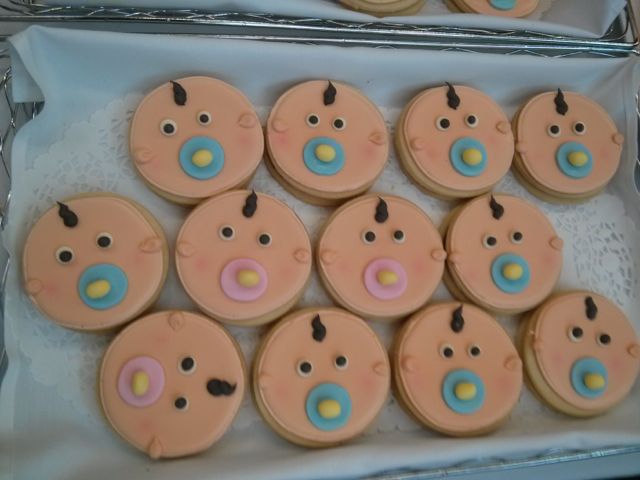 Last night was Hamilton, the night before Winnipeg, tonight is Victoria, and I’ve heard tell that Sunday’s event in Calgary was pretty terrific. I have lots to say and share about all these events, and about our mini-break to Winnipeg en-famille, which was so wonderful, but here is the lowdown on The M Word in Winnipeg and Hamilton to start with. Such as the cookies. The cookies. Don’t they in themselves make the entire project worthwhile?
 In Winnipeg, I read with Kerry Ryan and Ariel Gordon, and was pleased that Winnipeg photographer Lindsey Bond also took part in the event. Her portraits of new mothers were projected on a screen behind us as we read, and she talked to us about her fascinating In Conversation With Motherhood project. It was a good night, and I was blown away by the fabulousness of the McNally Robinson bookstore. (I also got to buy a copy of Ariel’s new book!)
In addition to many other excellent Winnipeg things (which I can’t wait to tell you all about), a highlight of our visit was a trip to the CBC studios. Sandra Thacker put together a wonderful feature on The M Word for the CBC Manitoba arts website “The Scene“, with contributions from Kerry and Ariel. And I did an interview on their radio drive-time show, “Up to Speed”, with guest-host Sarah Penton.
You can listen to the interview here:
Kerry Clare on CBC Manitoba’s Up to Speed with host Sarah Penton on Tuesday May 6:
 And then yesterday evening, I filled a carload of terrific hilarious women and we all drove to Hamilton to Bryan Prince Booksellers, which is in the part of Hamilton, I realize, that makes people want to move to Hamilton. Though for me that would be just to live in close proximity to Bryan Prince Booksellers, which was a great store, the kind with high shelves and ladders. In the photo at left, you’ll see Julie Booker, me, Diana Fitzgerald Bryden, Maria Meindl and Heidi Reimer. Carrie Snyder arrived not long after, and the really great news is that everyone in attendance was able to find a seat. (!)
 It was really great to listen to the readings, especially because this time I wasn’t holed up in a corner trying to breastfeed a recalcitrant Iris whilst wearing a dress completely unsuited to such things, all of which made listening a bit difficult when we launched in Toronto last month. Such a pleasure to hear these stories I know so well, and in the voices of the people they belong to. I was particularly struck by Heidi’s reading, which was extremely emotional and which she pulled off with poise and grace. It was a line from her essay, about a realization after the birth of her second daughter, “This is the most important thing I will ever do.”
In my prologue to The M Word, I write about how these essays don’t always agree with one another, how they can rub up against each other uncomfortably. And Heidi’s line is indicative of that, and what I want these essays to do together. That with this book we are making space for a woman to acknowledge that creating and birthing a child is the most important thing she’ll ever do, and yet for the book as a whole to acknowledge also that this is singular and personal, not a general statement on womanhood. That some women may mourn not having had this, others not at all, or still others having experienced childbirth in a completely different way (and let me tell you, having a child surgically removed from my body did not seem to me like the “most important thing” I’d ever do, lying there passive and immobile as I was.) That there are other most important things, and maybe even to Heidi, there are other most important things that she will do. That what she said is just as true as the line from the poem “Late” by Laisha Rosnau, whose new collection I have been reading this past while: “I loved a canned peach but, good Lord, if anyone mentions/ mine when I am dead, my time was not well spent.” As I write in my own essay from The M Word, “A single thing can have two realities.” Or 25 realities, as the anthology suggests, and so many more, to the point where it’s almost a parlour game, coming up with all the stories that should have been in this book.
Women’s lives are rarely boring, is something that’s become quite clear.






