December 2, 2019
Gleanings
- No one gets anywhere by scrolling, they get there by doing.
- Lake Superior just happens to be Linnea’s blank page.
- Community doesn’t just happen—we have to make it happen
- When women are killed because they are women, we have to acknowledge that, and not retreat in silence. Silence doesn’t honour the dead, and it doesn’t protect the living.
- Ten years into motherhood, and my children hang off my boughs much less than they used to.
- It has taken me no less than ten years to make the acquaintance of Olive Kitteridge.
- How ordinary we all really are. How meaningful it is, to be just that: ordinary.
- A book, especially one received as a present, is a thought made tangible–a gift from the past, a gift for the future, a way to touch those who have gone before and, if we’re lucky, those to come.
- This year marks the fifth anniversary of the Short Story Advent Calendar, one of the Christmas season’s most dependably enjoyable traditions.
Do you like reading good things online and want to make sure you don’t miss a “Gleanings” post? Then sign up to receive “Gleanings” delivered to your inbox each week(ish). And if you’ve read something excellent that you think we ought to check out, share the link in a comment below.
November 28, 2019
Five Wives, by Joan Thomas
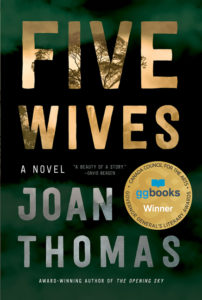
There’s a possibility I might have let the year pass me by without picking up Joan Thomas’s latest, Five Wives, winner of the 2019 Governor General’s Award for Fiction. And what a disaster that would have been, my reading year without one of the best books of the year included. But disaster was averted because I finally picked up the novel last week, and it was one of those experiences like I mentioned while I was writing about The Dutch House. As in, I was instantly enveloped and not remotley moved to clean my bathroom . (Full disclosure: this novel was actually one of those books I read in the bath until the water got so cold…)
Based on the true story of a group of American evangelical missionaries murdered in the Ecuador jungle in 1956 after making contact with an isolated Indigenous group, Thomas blurs fact and fiction fascinatingly in Five Wives—as she did with her earlier novel, Curiosity, which imaged the life of nineteenth century fossil hunter Mary Anne Anning. Billed as “in the tradition of The Poisonwood Bible,” I actually found the novel more in conversation with Miriam Toews’ Women Talking (with shades of Irma Voth!) in its consideration of the role of women in religious communities, in religion in general, and also with the fraught question of female solidarity. Because as with the women of Women Talking, and women anywhere, actually, and with people in general, the women of Five Wives do not speak with a single voice and view their shared story through very different lenses.
Although when the novel begins, theirs is a collective voice, “the wives,” in the immediate aftermath of the deaths of their husbands. The narrator does not distinguish these women, who themselves are “putting the story together”of what had befallen the men. A story that would become legend in evangelical circles, a story Thomas herself grew up hearing told, as she explains in her interview at 49thShelf. But in her novel, she complicates this mythology and explores the way in which story and narrative is constructed from the raw material of facts.
The novel’s present day story line concerns a young woman called Abby, whose mother and father had each lost their own fathers in the massacre, and had grown up steeped in the story, as her father, David, a pastor, also had. This part of the novel begins at the funeral of Abby’s maternal grandmother, Elizabeth Elliot (a real life figure whose own writings have been instrumental in spreading the story of what happened in the Ecuadorian jungle, and how the Waorani people eventually did convert to Christianity, thereby ensuring that this story of martyrdom ended in triumph and glory). And now Abby has lost her faith, much to the chagrin of her father, and we see the tension between them as she tries to find her own way, which challenges David’s own faith, in many things, including the truth of what he knows about what happened to his father and the story his family continues to tell about it to the world.
More central to the plot are the stories of the wives themselves, however, and their own struggles and challenges, those things they are sure of and that which they doubt. Abby’s grandmother, Betty, for whom missionary work was a vocation, and then Olive, who has followed her husband to Ecuador (and we meet her in the years before her marriage, when she’s attending university and developing independence from her religious family), and Marj, David’s mother, who ran the guesthouse where so many of the missionaries stayed, and her relationship with her sister-in-law, Rachel, the one woman in the group who is nobody’s wife. (“Goodness is more complicated that Marj ever imagined.”
And then Cornell Capa, the photographer from Life Magazine, who took the photographs that showed what happened in the jungle to the world—also a real-life character to whom Thomas grants a fictional inner life. And in the contemporary timeline, a film is being made about the massacre, and so there are lots of opportunities for Thomas to play with and complicate the idea of truth and myth and how stories get told.
The novel is a puzzle, pieces fitting together in surprising ways. The women’s own stories are not told chronologically, and overlap in some aspects and there are gaps in others, and not all the women are as central to the story. There is cultural appeal in this novel about mid-20th century womanhood and wifehood, which Thomas complicates interestingly, in addition to the layer of faith, religion and colonialism which complicates everything even more.
November 26, 2019
Slow News
It was the Amber Alerts that started it.
But no, lets back up. I’ve been on Twitter for almost a decade, and once upon a time it was a platform that served me well—I made friends, was referred to wonderful things to read, participated in in-jokes, pondered pop-culture trivia, was able to tell people I admired just how much I liked their work. Twitter was a bubble, but the best kind. When Rob Ford was elected Mayor of Toronto in 2010, the breaking news was a devastating collective experience. Not a peep in the Twitterverse (or mine, at least) had indicated that such a thing was possible. We were talking about echo chambers. I would consider how disappointing it was that Twitter wasn’t the world.
But then came Gamergate, which changed everything, although I didn’t know it at the time. And suddenly Twitter was the place I went to argue with Pro-lifers and have men with terrible beards call me a cunt. And then eventually even those people ceased to be actual people with names and faces (and beards) and became cartoon avatars with strings of numbers after their names and the Trudeau Must Go hashtag in their bio. And now the fact that Twitter is not the world seems like an actual blessing—which is not to say that Twitter has not changed the world somewhat in its despicable likeness. But still, that the world is not Twitter is an idea I now cling to for hope.
I am so glad that I’ve gone Back to the Blog this year, for more thoughtful and meaningful connection and engagement. Because I think that Twitter and I might be totally done. We’re long past the point where I am compulsively refreshing my screen and scrolling in a vain attempt to have the world come together in some kind of narrative sense, to find the answer. (Olivia Laing’s piece on her Twitter addiction really resonated with my own experience.) I took Twitter off my phone years ago, because it really didn’t need to be my constant companion.
There is no suggestion of an answer at all anymore, no complexity. Instead, there are people who are angry about being woken up in the night by Amber Alerts, and people who are angry about people who are angry about being woken up in the night by Amber Alerts. And here I am with my phone alerts on mute, and I just have no fucks to give about any of it.
Once upon a time, I liked Twitter, because even amidst the men who called me a cunt or the Christians who called me a baby murderer, I appreciated learning about other people’s points of view (not those people, obviously) and it was really how I got my news. But I’ve since found another way.
‘But not reading the paper only kept me from not knowing things; it didn’t keep them from happening.’
‘Maybe instant information isn’t good for us. We can’t absorb it.’
—Madeleine L’Engle, A Ring of Endless Light
I still get a newspaper on the weekends, as I have for years, but in the last year, I started buying and then ordered a subscription for The Guardian Weekly. And because it’s a magazine instead of a newspaper (which always feels stale after a day), it hangs around all week, and everybody in our house reads it. There are book reviews, and culture pieces, and news from all over the world, and long-form pieces, and summaries of breaking events. It’s great, but even better? It always arrives in the mail about a week after the fact. Sometimes even longer. So that much of the “breaking news” by then has been put back together and healed over again.
And I love it.
There is context. There are facts. Instead of compulsively refreshing for it all to make sense, I have waited—and then sometimes it even does make sense by then. The news is also finite, which is splendid, and there aren’t Nazis (except in stories on the rise of white nationalism).
What would happen if you had an unpopular opinion and kept it to yourself? What would happen if your consciousness wasn’t displayed upon a ticker-tape for everyone to see? What would happen if people stopped beginning sentences with, “Am I the only one who…” or sharing unpopular opinions about food, or even having opinions at all about food.
What if you just ate your lunch?*
*After photographing it and posting it on Instagram, of course, because not all social media platforms are dead to me yet.
November 25, 2019
Local, Sustainable and World-bettering: Great Holiday Gifts

My newsletter went out this morning with a special holiday gift list, including goods and services I’ve got on offer (a special holiday deal for Blog School!), and a whole bunch more that are things I love and which might prove inspirational as you make your own lists and check them twice. Local, sustainable and world-bettering were my priorities. Check it out!
PS It’s not too late to get a 2019 Short Story Advent Calendar!
November 24, 2019
Gleanings
- We are made to believe that there is never enough safety, enough space, enough resources for us all to exist at once. This is a lie.
- What I really love about prizelists are the longlists.
- Let’s talk inner demons, unhappy marriages, and maternal mental health. Halloween might be over, but the haunting continues.
- I have never been good with authority. If I had a more compliant personality I would have lived a less useful life, I think.
- Such as coming from Edmonton as children to race down to the Winged Victory of Samothrace. What is time?
- 50 Holiday Gift Ideas for 2019
- Be kind to your work, even if it’s shit, because all new work is shit, and we all deserve kindness.
- I am too old to drink a damn morning coffee and too old to stretch on a whim, and the best part? Is that it only gets worse!
- When you grow up in a counterculture that explains the world without reference to science and logic, you spend the rest of your life deconstructing things you once believed.
Do you like reading good things online and want to make sure you don’t miss a “Gleanings” post? Then sign up to receive “Gleanings” delivered to your inbox each week(ish). And if you’ve read something excellent that you think we ought to check out, share the link in a comment below.
November 20, 2019
Bits and Pieces
I want to blog, but I don’t know where to start, where to end, where to focus. Which is not only a blogging problem specifically, but also a broader statement about my current state of mind, which is scattered and anxious, as well as mostly fine. But the anxious part is weird, and I’m annoyed because I’ve spent the last while piggy-backing on my husband’s mindfulness, for the sake of efficiency. He’s gotten really into meditation and it’s helped him a lot, and it’s helped me too, because whenever I’m starting to lose it, I call on his knowledge and wisdom, and it’s hugely restorative. But maybe mindfulness-by-proxy is not a great long-term plan, and I might have to start meditating too, but how? There are not enough hours in the day, and of course, I’d rather be reading.
It’s the flip-side though of something I believe fundamentally, which is that the little things we do make a difference, that they matter. But this can also start to feel like an overwhelming kind of pressure. I was talking to a friend of mine who is a paramedic the other day, about CPR, and how I could never remember anything I was ever taught in a first aid class, but how he has restarted hearts and there are people walking around who are only alive because of him. But as I said these words, it occurred to me that if you get credit for all that, you’ve also got to take on all the people who you couldn’t save. The same as how you can’t believe your good reviews, or else you have to believe the bad ones too, except book reviews are less involved with literal peril.
Of course, because we’re talking about me, who never saved anyone, the stakes are very different. I honestly had a crisis sometime earlier this fall because I read an article about a cheese company that was going out of business, and the weight of having insufficiently supported the local cheese industry was weighing heavy on my shoulders. Does it officially count as a first world problem if you’re feeling anxious about your failure to support the cheese industry? I use this example to show that a) I am ridiculous and also b) the idea that one person can make a difference comes up short, is a scam, and diverts from the necessity of all of us working together, but then working together is hard.
Last fall was a difficult time. All our friends moved away, and my novel was rejected (this is when I wrote a post called Publishing a Book is Not a Catapult), and my husband tends to struggle in the fall in general due to cyclical things involving the seasons and his workload, so it all was not the best. This fall, however, even with some of our friends having moved back and new friends, and my book deal—it was still hard. Maybe fall is just hard? And I forget about it over and over with the promise of September and the glorious beauty of trees on display against a sky that tends to be impossible blue.
Last Friday I took my children to a play that turned out to be in December, but I’d thought we were late and the theatre turned out to be three blocks east of where I’d thought it was, so we were running to get there, but instead we were a month early. And then we went to get something to eat, and a crowd of teenage girls at a nearby table were staring at us and then laughing at us, and I still don’t really know why. (No doubt it was for a very complex and interesting reason, right?) They got up from their table and left, but didn’t leave altogether, instead lingering around a corner peering around to look at us and make faces at us, and why was I so upset and intimidated by a group of actual children? And I felt so powerless, and sad, which is never a great way to feel around your own children, and I wish I didn’t crumble under the scrutiny of a bunch of stupid kids, that those girls didn’t take me right back to when I was their age and intimidated by the power of girls like that. I grew up, but they still have that power. Why do I give it to them? Where is my spine?
Although nothing has taken me back to childhood social dynamics like watching my own child navigate those waters. I feel as though I haven’t fundamentally grown or learned anything since I was that age, because her struggles take me right back there. There is no perspective that I have to offer, except that the life I made (my friends, my people, this family that my husband and I have made together) is like a raft that I cling to on the turgid waters of life itself, and all I can hope for my children is that they get one like it.
And for the success of the local cheese industry, obviously.
Just once, I would like to be cool and laid-back. I would like to forget to bring that letter I need to mail, and instead of getting heart palpitations and reorienting my entire day to go back and get it, accept that it would fine if I just mailed it tomorrow. I would like to buy a block of cheese with no regard whatsoever for its origins (am actually quite good at this) and not even feel bad about it. I would like to genuinely not care if someone doesn’t like me. I would like to not be intimidated by teenagers. I would like to stop feeling guilty about decisions made months ago out of my own volition. I would like there to be be somewhere between my entire life being constructed of mundane to-do-list items, and everything going to shit because I didn’t bother to get it all done. I need to catch up on my emails.
I was sick for the last two weeks, a rather brutal cold that slowed me right down, depleting the energy stocks I count on, and they’re still not all back yet. I am really tired. I also was unable to swim the last two weeks, and I have come to count on swimming too as a kind of meditation and energy-release that keeps anxiety in check. I’ve also not done any creative work since I submitted my novel about a month ago, and I think I’m suffering from a dearth of that. So maybe it’s time to write a short story.
But in the meantime, I’ve managed to write this post, to process something of what has been on my mind. And as always, it’s cathartic.
November 18, 2019
Gleanings
- …a reminder that anything is possible, and that sometimes, surrendering to the surreal is all we can do.
- The process of creating an alternative canon cannot be easy, especially in these days when the very concept of canon-building is viewed with suspicion…
- Can My Blog be the Good Place?
- Maybe we don’t make it through this world whole. But there are moments of clarity, amidst the confusion.
- All I know is that often, what you go looking for is already there.
- …making this the winter I walk in any weather.
- It’s just such meetings…that I know are going to get us through the cold and snow ahead.
- a small dark presence
- Bea’s Favourite Snickerdoodles
Wondering what to read next? Take my quiz to find your PERFECT LITERARY MATCH.
November 14, 2019
Briny Books is Back!

So excited to finally be able to spread the news that Briny Books is back with three gorgeous autumn selections. The first one is Nancy-Jo Cullen’s The Western Alienation Merit Badge, which I had the pleasure of praising already last spring. Next up is All That Belongs, by Dora Dueck, whose work I’ve read online and in literary journals for some time, and I finally read her story collection What You Get at Home last winter and loved it. And then her latest novel blew me away. It’s a gorgeous story about family, memory, history and how we carry these things into the future. And finally, The Lost Sister, by Andrea Gunraj, a story of solidarity and resilience about a girl growing up in Toronto whose sister is murdered and who finds strength and solace through a friendship with a woman who’d survived Nova Scotia’s Home for Coloured Children (and this part of the book was inspired by the author’s friendship with an actual survivor). I’m so proud to be championing all these books, and especially excited to remind you that SHIPPING IS FREE (for a limited time) so do some shopping, and some holiday shopping, and be the bookshop customer you wish to see in the world.
November 13, 2019
Agnes, Murderess, by Sarah Leavitt

“When Did Everybody Become a Witch” was the title of an article a friend sent me a few weeks ago, a friend from my coven, no less, and I was still thinking about the article on Halloween night (of course) when I settled down to read Agnes, Murderess. The second book by Sarah Leavitt, whose first was the acclaimed graphic memoir Tangles: A Story About Alzheimers, My Mother and Me, this one tells the story of Agnes McVee, a legendary 19th century serial killer who ran a roadhouse in 108 Mile House, BC. A woman of whose actual existence there is no evidence, except for a self-published pamphlet by an amateur historian from 1973.
“I have thus felt free to reimagine Agnes’s story from her childhood to her death,” Leavitt writes in her book’s afterward, and the whole book becomes an exploration of storytelling and myth making. It begins on an island in the Scottish Hebrides, where young Agnes lives with her grandmother, who really does seem to be a witch, and her mother, who was stolen away from a genteel life in London by a seafaring man who brought her to his home and then disappeared forever. For reasons that might be familiar if you’ve ever read stories about witches, Agnes and her grandmother are not too popular with the local townsfolk, though she finds an affinity with a young man from the village, and together (desperate times call for desperate measures) Agnes and Seamus find a way for her to escape her grandmother’s yoke and head off to London together. But it turns out that her grandmother wasn’t Agnes’s whole problem after all, or maybe she was because Agnes senses the woman’s presence still haunting her, stirring her, pulling away from the kind of life she is striving for. A life which she glimpses further through a friendship with an upper-class woman who gives her books to read and the companionship she’s looking for—and then a humiliating betrayal changes everything, cementing Agnes’s trajectory toward a life in Canada and, yes, punctuated by acts of murder.
It’s a complicated story, with everything queered—not least of which is the line between truth and fiction. Is Agnes a villain? And if she is, what does it mean that she might have our sympathy? Are we, too, bewitched? And what does it mean that these stories of transgressive women at our particular moment in time? Most interestingly, Leavitt leaves these questions unresolved. As her drawings are simply sketched, so too is the story, providing plenty of room in which the reader can sit uneasily.
November 11, 2019
Gleanings
- Does a rainbow trout, like human beings, have to develop coping mechanisms to deal with the life’s great challenges?
- And thus Raphael became like my first boyfriend, someone I thought of fondly from time to time over the years, holding a special place in my heart although I had long moved on.
- Confessions of a Failed Self-Help Guru
- …it’s time we stop, as parents, crediting ourselves for our fortunate accidents
- The guiding principle of the bookstore, located in Toronto’s Roncesvalles Village neighborhood, is social justice, and it makes itself known right away.
- The university, I said, is not (despite what its denizens too often seem to believe) the only place you can have an intellectually stimulating life.
- The issue is women’s rights, pure and simple. Any campaign to reverse abortion rights is an attack on you — regardless of your personal beliefs.
- Almost without fail, the more bafflingly short an ingredient list and the more stunningly delicious the outcome, the more likely it is to rivet me.
- Which is a roundabout way of saying that time has passed, but yes, a month ago we were by the sea.
- How in the name of squatty pink-frilled alarm clocks?
- I’ve read other translations but this one has always felt like Homer to me.
- Because it feels weirdly lovely to be blogging from Rome and just sharing these things that I’m basically almost crying about when I see them. Rain on a windshield.
- “The book didn’t help my confusion at all, but I kind of think that’s okay,” she says.
- Life is too short for tepid colour combinations like greiges and taupes.