November 6, 2019
Awards Season Recommendations
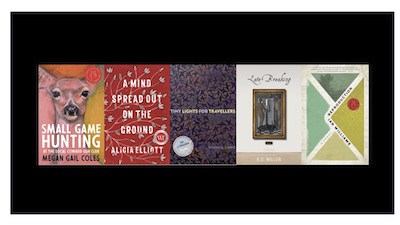
I had a very croaky voice, but still go to talk about books on the radio today, spotlighting some of my favourites that have been celebrated during literary awards season. I hope readers continue to read widely (and often), and don’t necessarily let awards and awards lists dictate their entire reading lives, but awards and their shortlists in particular can also offer some incredible reading suggestions. Listen here to hear my picks—I come in at 30.00.
November 5, 2019
The Dutch House
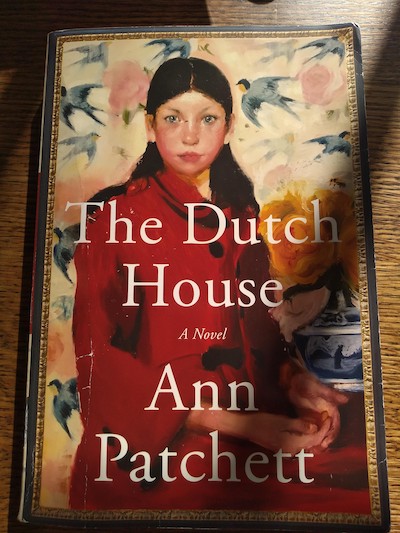
I knew I was in trouble the night I was reading in the tub, and then called for my husband to bring in a box of baking soda and a cloth so I could scrub the grout between the wall tiles. My grout is dodgy at the best of times, but it really does take a special level of “not into a book” to drive me to clean my bathroom instead. Which was not the case with Ann Patchett’s latest novel The Dutch House, which I finished reading last night in a two hour whirlwind. Patchett’s books are a bit hit-and-miss with me—truth be told, I didn’t love Commonwealth. I liked it. It didn’t drive me to scrub the tiles, I mean, but it didn’t live up to my high expectations. Oh, but The Dutch House swept me away, and the twists and turns were never what I’d expected them to be. I have no idea how you’d dream up a narrative like this, the form and shape of it, I mean. I’ve been thinking about the specificity of the narrative of Ian Williams’ Reproduction, and this book is similar, the curious shape of family and of life and how few books actually manage to properly express that.
November 4, 2019
Gleanings
- I kept making notes. Why do some road trips lead to essays and some don’t? I have no idea.
- If you’ve never had a look under the structures that support what we take for granted, give it a try. That applies to more than bridges.
- Oh, dear readers, there was an abundance of ethereal moments…
- CERTAIN THRILLS AND CHILLS OF THE PREVIOUS MONTH STUCK WITH ME. AND, I WANT TO KEEP REMEMBERING THEM AS I MOVE AHEAD.
- I want for everything to make sense; but it doesn’t.
- And we create things, truly, to transform our own lives.
- These amazing women and their epic to-do lists make me feel as if I’ve found my tribe.
Do you like reading good things online and want to make sure you don’t miss a “Gleanings” post? Then sign up to receive “Gleanings” delivered to your inbox each week(ish). And if you’ve read something excellent that you think we ought to check out, share the link in a comment below.
November 3, 2019
Neither Useful, Nor Interesting

Oh, yet another blog post that begins with me talking about something I heard when I was listening to a podcast. The Mom Rage Podcast, no less—am I predictable yet? This one was about vaccines (it was so good!), featuring a conversation with medical anthropologist Samantha Gottlieb about the HPV vaccine and “vaccine-hesitant communities.” She spoke about how many people are put off by doctors’ refusal to entertain questions about vaccines at all, which only serves to underline skepticism. When the facts are that vaccines can cause risks, that vaccine injuries and reactions do happen. They happen on a disproportionately tiny scale, with risks minute. It’s more dangerous to get in the car and drive down the road, and we all do that all the time, but still. Doctors don’t want to admit it. It complicates the narrative, and complicating the narrative of vaccination is perilous, literally life and death.
Of course, I like complicated narratives. To complicate the narrative is to get as close as we can to something called truth. I don’t want to live in an echo chamber, a bubble. I relish conversations with my economist friend about the virtues of capitalism; I appreciate the activists who’ve open my eyes to the violent reality of racism; my morning routine is basically putting on shoes, but I’ve got big respect for people for whom make-up is a form of personal expression. On Twitter, I used to actually follow the person whose booking at the Toronto Public Library has created such controversy over the last few weeks, because her take on sex-work complicated what so many of the other feminists in my feed were talking about, and I found that complicatedness useful and interesting… until it wasn’t. I unfollowed this person when she started writing online attacks on the grieving father of a dead teenaged girl. When I realized this “journalist” (whose platform is her own website, which she likes to call “Canada’s leading feminist website” [according to whom?]) relishes attention more than any kind of truth, and had figured out that courting controversy was the fastest way to get there (and solicit donations). When I realized she was more invested in dogma and ideology than the feminists whose thinking (and actual lived experiences) she purports to oppose and complicate. This person is neither useful, nor interesting. She is sensationalist, and purely disingenuous. She is the anti-vaxxer of gender politics. She is not “just asking questions.”
I think there is room for questions and nuance in conversations about gender. Unlike the speaker who was provided space at the Toronto Library, I think that none of this is simple. I wish that the City Librarian had listened to so many smart and respected voices calling on her to cancel the speaker’s booking—the milquetoast mayor called her on it, for heaven’s sake. And no, these people weren’t “bullying the library.” You can’t bully a library. This is nonsense. But I also know that people too are complicated like their issues are, and there are many of them (myself among them) who don’t like being told what to do, to have demands made of them, who double down instead of considering the opposite. We put a lot of truck in unapologeticness in feminism, for better and for worse. I don’t think that we should be boycotting the library, because for so many people, especially marginalized ones, the library is their most accessible cultural institution. Because the library belongs to all of us. Because the people who have the least are the people that lose the most, and I don’t really know what the end-game is of a library boycott, especially now that the event is done and dusted. Though I commend all the people who’ve taken a stance and I do think it’s been hugely worthwhile—the turnout to the protest on Tuesday evening was an incredibly show of solidarity, and the issue has led to all kinds of conversations, which are necessary as we ask questions in generous and thoughtful ways, and figure things out as a society—a process that is far more useful and interesting than anything the speaker might have said on any platform. (This is the work, people. We’re doing it. Even if, or maybe especially if, you’ll only doing it all in your head.)
I do know what it’s like to have my body be the site of a debate. I’ve stood on the sidewalk holding a sign listening to men argue over the semantics of abortion, as to the precise point where the procedure should or should not be permitted, and I can tell you that it’s dehumanizing, insulting, ridiculous, and neither useful nor interesting. And so I have an understanding of where trans people are coming from when they refuse to entertain questions, conversations or debate about their bodies and their identities. When the field of debate is your lived reality, listening to people arguing in abstract terms and citing outlying circumstances as emblematic of the issue at hand—for anti-choicers, it’s all about the case of a particular doctor and abortion provider who was convicted of murdering infants, same as how the anti-trans crew is always going on about aestheticians and waxing, as though these are the actual goal posts and such things are happening every day—is exasperating, traumatic, and a gigantic waste of everyone’s time.
I think there is room for questions and nuance in conversations about gender, because we live in a world where there are no absolutes, but I am sure that insisting on those conversations at this precise moment is not the most pressing thing we’ve got on the go. That democracy and freedom hang in the balance, as so many others might put it in their letters to the editor. I think back to the vaccine analogy, and the distrust and violent suspicion at the heart of the anti-vaccine movement, which is not so far apart from that of anti-trans activists, really. In both cases, there is an over-estimation of vulnerability, and a convenient disregard for those who are actually vulnerable after all.
Of course, there are conversations that need to be had, questions that need to be answered, but not like this, not by this person. As with the vaccine conversation, the harms—here, it’s increased violence against and vilification of an already vulnerable population—really do outweigh the benefit, which is mainly the privileged and smug self-assurance of living in a society where any idiot gets to spout her rubbish in a public building. And if such self-assurance is our guiding principle, instead of listening to, learning from, and taking care of each other, then what does it say about us?
October 31, 2019
How to Organize a Literary Event in 48 Hours
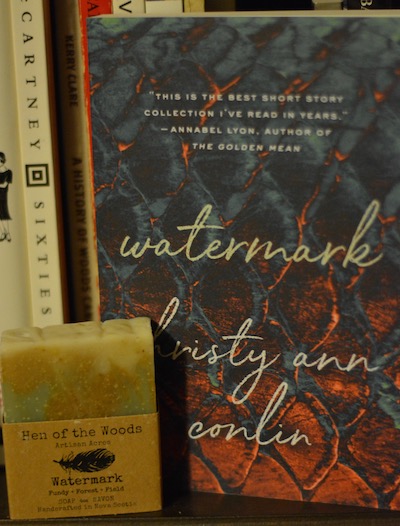
More than a month ago, I emailed my friend Nathalie and asked her if she’d attend the Toronto Public Library event with Christy Ann Conlin, Megan Gail Coles and Elisabeth de Mariaffi, and she replied with an enthusiastic YES, as you would, with a lineup like that. But then the event was cancelled after the Toronto Library was called on to cancel its provision of space to a speaker whose hate-speech about trans people is just one of the many awful things about her, and they refused. And so many authors and artists have cancelled their Toronto Library event in solidarity with the trans community, which is important and the right thing to do—but it also means that Christy Ann Conlin was coming to Toronto all the way from Nova Scotia for her very first reading in the city, and she had no event booked. So what to do?
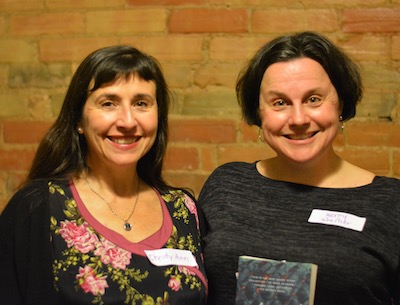
I hadn’t properly understood the situation until Monday, or else I would have stepped up sooner, but once I’d figured it out, it wasn’t long before I had my inspiration. Right in the middle of dinner, in fact. “What would you think” I asked my husband, “about us having twenty people over for a literary event in our living room?” And my husband was so excited about me having a wild inspiration for which he would not be obligated to build a website that he agreed without hesitation. And so I sent an email to Christy Ann in Nova Scotia, and once she said she was in, there was just one more email to set the wheels in motion.
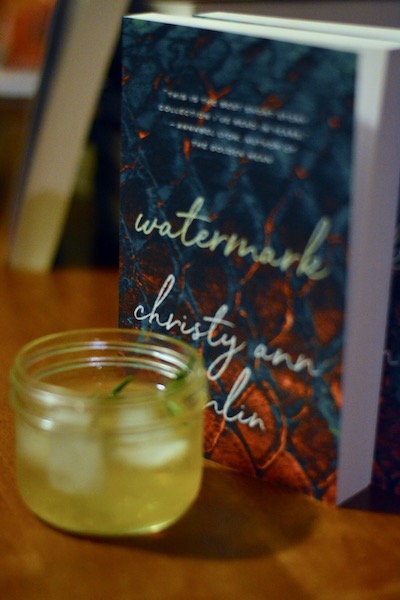
I had to email Nathalie and ask if she would be up for some custom mixology—and she agreed. Thank heavens, because everybody knows you can’t have a party without an official cocktail… (Nathalie invented three different cocktails, all with Nova Scotia spirits: “Minas Basin,” “It All Went Pear-Shaped,” and “Juniper and Apple Shrub.”)
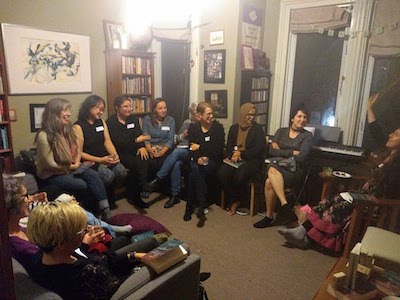
And next, we needed people to fill my living room in 48 hours notice, but they came, a wonderful collection of generous, book loving people who were happy to welcome Christy Ann to Toronto. They filled my home with the most wonderful bookish spirit (and all got to take home custom Watermark soap from Hen of the Woods—what a treat!).

It was wonderful! Friends and neighbours came, a literary community of amazing readers and writers, including Christy Ann fans who I got to meet for the first time, plus a very exciting guest—Amy Spurway, of Crow fame, who was in town for the author’s festival. We ate food, sipped delicious drinks, made great conversation, listened to Christy Ann read from Watermark, and I got to ask her questions about her career and her book, and she was just so kind, and gracious and terrific. Throughly entertaining and delightful, and we were all so lucky to be part of it together, but me most of all, because I got to experience it without leaving the house.
October 30, 2019
It’s Not About the Vision Board

I want to go back to Jia Tolentino’s Trick Mirror, the parts about scams and delusions. That we exist in a moment where people are trying to sell us their 5 simple steps to becoming millionaires, or having body confidence, or achieving career success. That the only difference between you and that superstar you emulate is something corny like, “She dared to dream, and then she did it.” I have to confess to a mighty aversion to vision boards, especially since the images are usually cut out from magazine advertisements. Do I really want my vision to be borrowed from an ad for Hyundai? What are the limits to empowerment by hashtag?
And yet. A thing I’ve learned in the last few years, during this year in particular, is that we have more power than we realize. The point, of course, is just to use it, and certainly confidence is a factor. I turned 40 this year and what this new decade has delivered me is the confidence to realize I really do have something—skills, knowledge, experience and insight—to bring to the table. After a decade and more of not taking myself too seriously (because people who do can be insufferable) I’ve learned the value of doing so—while not being insufferable, I hope.
But it’s not about the vision board. It’s not even about “daring to dream big.” Instead, it’s about looking at the world head on and figuring out what needs doing. Asking “What if?” and daring to follow through. It’s about the doing, not the dreaming.
I note this example all the time, but it’s emblematic of many other things I’ve achieved on a larger scale: when my neighbours had a baby, I brought them a loaf of banana bread. And in doing so, I made our street, this world, a place where things like that can happen. A small thing, but I don’t discount the value of small things. I think they’re everything.
Anyone who attends a protest makes a world where people care about things. Anyone who reaches out to someone in need makes a world where people care about people.
The foundation is an understanding that you matter, and therefore the things you do will matter. And then you’ve got to do the things, which is where, of course, the work comes in.
October 28, 2019
Gleanings
- He encouraged us to think less in terms of tying the word “professional” to the idea of making money and more toward the idea of what we are doing as an integral part of ourselves.
- Can I make Saskatoon pie with dodgy Toronto berries?
- It’s inspiring to me how women, throughout time, have continued to create art.
- It was page 236 before I finally caved and looked up a picture of The Dress
- The thing is, I’ve been all over the place, and can’t really settle on any one topic…
- The monarchy is a helluva drug, you guys.
- I’ve been on page 9 of Ducks, Newburyport for some days now.
- Here’s the foolproof way to write your story faster: identify the scenes you are avoiding and get them over with.
- If I’m feeling tired, I open the file and aim to do just one thing.
- Happy second anniversary to our east end Toronto silent book club!
Do you like reading good things online and want to make sure you don’t miss a “Gleanings” post? Then sign up to receive “Gleanings” delivered to your inbox each week(ish). And if you’ve read something excellent that you think we ought to check out, share the link in a comment below.
October 25, 2019
The Boy Who Invented the Popsicle, by Anne Renaud and Milan Pavlovic
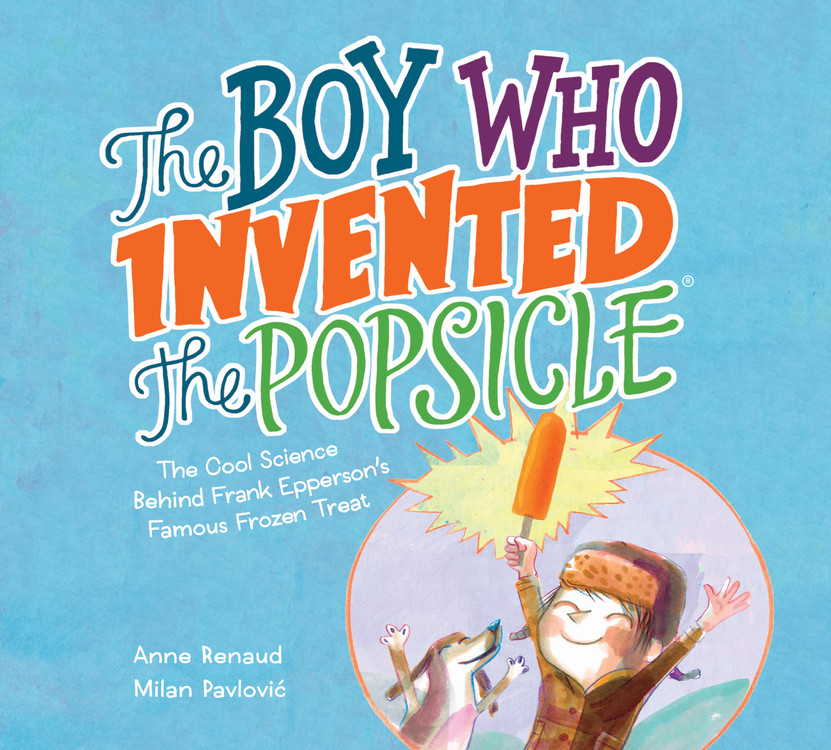
For some reason, unless they happen to encyclopedic catalogues fun to flip through but with no overarching narrative, non-fiction gets short shrift with the young readers in my house. We’ve got a whole stack of titles about history and animals, dinosaurs, guides to crafting and science experiments, none of them appreciated as well as they should be, and my children read Archie comics to tatters instead.
But The Boy Who Invented the Popsicle, by Anne Renaud and Milan Pavlovic, is the exception to that rule, primarily because it’s a fabulous hybrid of a book—a great story that’s fun to read aloud; a biography based on Frank Epperson who really did invent the Popsicle; a gorgeous book with great design (endpapers to die for!); and it’s got science experiments—on mixing oil and water, how to make fizzy drinks, how to lower the freezing point of water—each one connected to the narrative, which is not only engaging, but also demonstrates the experiments’ real-world implications.
One of my favourite picture book biographies ever is Monica Kulling’s Spic-and-Span!: Lillian Gilbreth’s Wonder Kitchen, and The Boy Who Invented the Popsicle is kind of a companion, a story that blends the scientific and domestic realms, that shows how having children can inspire an inventor’s ideas, a story that makes the familiar extraordinary by taking an every day item (the popsicle!) back to its origins. It also shows how childhood dreams can transform into reality, and how curiosity and an insistence on asking questions can serve a person throughout his life.
October 24, 2019
Empire of Wild, by Cherie Dimaline
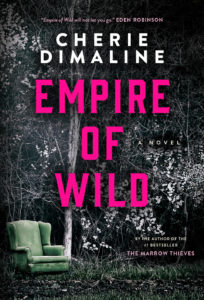
How does an author follow up a success like The Marrow Thieves, Cherie Dimaline’s bestselling novel that won so many awards and prizes that they ran out of room on the cover? The most straightforward answer I can think of was also Dimaline’s herself, which was to publish Empire of Wild, a book that’s unabashedly excellent, gripping, funny, gorgeous, and dark. I read this book when I was taking part of in a read-a-thon last weekend. No, not that one that is my life, but the other one, raising money for metastatic breast cancer research. And Empire of Wild was the perfect novel for this experience—I couldn’t put it down, even if I’d wanted to.
It’s a book that reminded me a bit of Bad Ideas, another one of my favourite novels this year, about impossible love and what it means to believe in it. Empire of Wild begins with Joan, whose husband Victor has been missing for almost a year. He’d left the house after an argument they’d had about selling her family’s land. Hasn’t been seen since, though Joan’s not given up hope of his return just yet. And then one early morning, nursing a hangover, Joan walks into a revival tent in a Wal-Mart parking lot and discovers a man she knows is Victor, but he’s also a preacher whose name is Eugene Wolff. So who is he anyway? And what’s up with these holy rollers who seem to turn up in Indigenous communities who are making deals with big mining companies? Add to the mix a Rogarou, a werewolf-like creature from Metis stories, and you’ve got a plot-driven thriller on your hands.
Will Joan succeed in finding her husband again? Is Victor even still alive? With her Johnny Cash-obsessed nephew riding shotgun, Joan sets out to discover the answer to these questions, risking her own life in the process, and the result is an absolute terrific read, as powerful as it’s propulsive, plus the humour even in the darkness, savvy and self-aware lines like, “Sure hope those jackasses haven’t built over the spot. If they have, I hope those scary movies having it right and building over old Indian stuff makes your kids disappear into televisions.”
October 23, 2019
We are stardust, we are golden

One single quotation that bugs me in its vacuity even more than Madeleine Albright and her special place in hell for women who don’t help other women is that excerpt from a poem by Rumi that goes, “Out beyond ideas of wrongdoing and rightdoing, there is a field. I’ll meet you there.”
A line that maybe isn’t so offensive on its own, and I think that Rumi was talking about the spiritual realm, but I’m not sure it really applies here on Earth in the meantime, where people who insist on hanging out in that proverbial field are likely to come home at the end of the day with black eyes and bruises (because they’ve been cavorting with neo-Nazis), and possibly they’ll also have measles.
So, yes, Rumi, I will meet you there, but in the meantime, there’s the land right here before the field beyond wrongdoing and rightdoing, where we’re all trying to puzzle out this thing called existence and how to get along with each other, to do better than emblematic opposition, us and them, love is a battlefield. Where we need better metaphors, which is the central thesis of Eula Biss’s On Immunity, in which she uses the issue of vaccination to explore ideas of societal (dis)trust and polarization (and also the history of public health, and motherhood, and everything).
It’s not quite as simple as shrugging off right and wrong, heading out to the field. Different strokes for different strokes. Because of course, in innumerable ways, our lives and our choices all intersect. There is indeed such thing as society, and a public of which each of us are a part. Eula Biss calls on the work of Rachel Carson, who writes, “For each of us, as for the robin in Michigan or the salmon in the Miramichi, this is a problem of ecology, of interrelationships, of interdependence.”
Biss writes, “We are…continuous with everything here on Earth. Including, and especially, each other.”
My favourite part of On Immunity is in the endnotes, when Biss credits the women in her personal circles “who complicated the subject of immunization for me.” (Emphasis mine.) This same idea is repeated in the book’s acknowledgements: “I am grateful to the community…who complicated my thinking, argued generously, and pointed me in new directions.”
(In the endnotes, she goes on to explain her use of “mothers” when she might have used “parents” throughout the text. “This does not mean that I believe immunization is exclusively of concern to women, but only that I want to address other mothers directly. In a culture that relishes pitting women against each other in ‘mommy wars,’ I feel compelled to leave some traces on the page of another kind of argument…that does not reduce us, as the diminutive mommy implies, and that does not resemble war.”)
I first read On Immunity in 2015, which seemed like a polarized period at the time, but appears somewhat utopian when one looks back from our post-November 2016 world. And in the years since I read the book, I’ve continually returned to that idea of complication as a kind of service, a gift, something to be grateful for. Not always succeeding in my understanding, of course, failing more often than not, because it’s no small thing, to be grateful to the people who complicate your vision, your understanding. An astounding and rare feat of generosity, in fact, to be grateful to the people who keep the world from being simple…but this is the kind of achievement that I’m aspiring to, a way one might make it here in this place entrenched by ideas of wrongdoing and rightdoing. This is how one might get beyond this place and manage to still have a soul.
“…it isn’t the clinging to answers but the embracing of ignorance that drives science,” Biss writes, but not just science—it drives everything. And to embrace ignorance is another way of asking to make it complicated. Tell me how the medical establishment has a centuries-old habit of undermining women’s knowledge, and that some of the first public health initiatives had people vaccinated at gunpoint. Tell me (as Biss does) how “a refusal to vaccinate falls under a broader resistance to capitalism,” but then complicate that. She writes, “But refusing immunity as a form of civil disobedience bears an unsettling resemblance to the very structure the Occupy movement seeks to disrupt—a privileged 1 percent are sheltered from risk while they draw resources from the other 99 percent.”
Or tell me how Rachel Carson’s Silent Spring alerted the world to the dangers of DDT, but also inspired a line of thinking that is not disconnected from the fact that one African child in twenty now dies from malaria as DDT is now discouraged for use against mosquitos. “For each of us,” as Carson herself said, “this is a problem of ecology, of interrelationships, of interdependence.”
It’s complicated. As they say.
Biss rejects the possibility of a middle-ground on vaccinations as facile, a middle-ground simply reinforcing the binary or this or that, and a divide instead of a connection, when the reality of most things is not so neat and simple. Bad guys and good guys? “[M]ost people are both,” writes Biss, and then quotes Naomi King, who knows something about monsters, because her father is an author called Stephen. She says, “If we demonize other people and create monsters out of each other and act monstrous—and we all have that capacity—then how do we not become monsters ourselves?”
On Immunity is preoccupied with the metaphor of vampires, and Dracula, but this passage had me thinking of Frankenstein, or rather Dr. Frankenstein, who, in creating a monster, has himself been transformed in into a monster, at least in the public consciousness.
However, now we’re back here with Rumi and the field beyond, basically, imagining that monstrosity is relative, but here’s the thing: I do think some monsters are real. And there is a distinction between the people who complicate things, and the people who set those things on fire. There is arguing generously, and there is arguing disingenuously, dangerously. Dog whistles. (That point where you start asking: am I being paranoid? Akin to someone who regards the polio vaccine as an global conspiracy?)
Possibly one benefit to restricting the bounds of your argument to apply to mothers, when certainly lessens the likelihood that you’re having your ideas complicated by someone who keeps body parts in the freezer, though no doubt (it’s complicated) there are even exceptions to that rule.
But now I’m back to Dr. Frankenstein again, and I don’t know what to do, but maybe complicatedness is the point. Complicatedness is reality. And the point is not untwining, but the twine, like ivy, and now I’m thinking of Biss’s final metaphor—for the body, for society. A better one than war, instead, the garden.
“The garden is unbounded and unkempt, bearing both fruit and thorns. Perhaps we should call it a wilderness. Or perhapscommunity is sufficient.”
A wild tangle. An exasperating mind-fuck. Sustaining, and but exhausting. Maybe that’s exactly what it’s supposed to be.
I reread On Immunity because it’s a Book Club Pick for the Mom Rage Podcast, a podcast which I’m embarrassingly enthusiastic about. I think they’re going to be talking about it on next week’s episode, but if you haven’t yet, you might as well just listen to all of them.






