August 23, 2016
The Best Kind of People, by Zoe Whittall
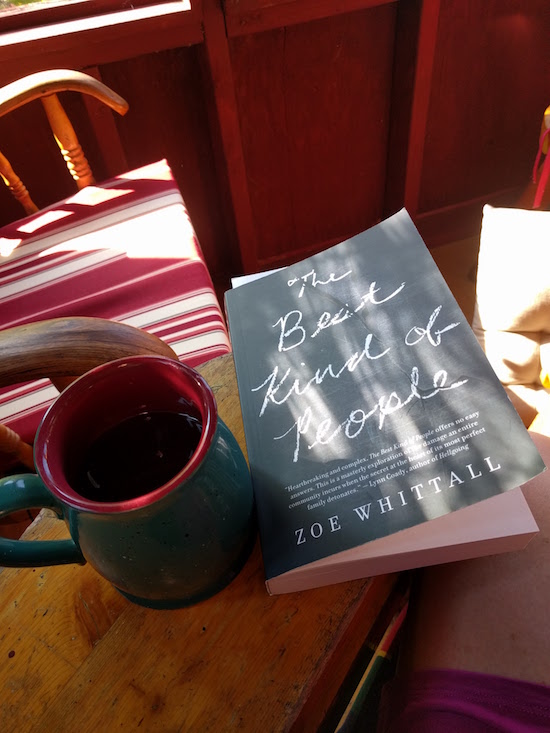
While Zoe Whittall has made a career of writing about misfits and outlaws (which is part of the title of an anthology she edited in the early 2000’s), she turns the tables in her latest novel by writing about a family of unremarkable (were it not for their resolute upstandingness) middle class people who suddenly become misfits and outlaws in their very own lives. The book is The Best Kind of People, which I read on my summer vacation and handed directly to my husband when he asked me what book he should read next. And the family is the Woodburys, the patriarch of whom shocks his wife and children and entire community when he’s accused of sexual assaulting girls at the high school where he teaches.
“How could a person do such a thing?” is the kind of question that tends to be raised after the fact, although Whittall is more interested in another question with wider ramifications, which is, “How can the people around that person, the people who love that person, who did it make sense of their lives and the world once he has?” Joan Woodbury tries to make sense of her past and her future—what was her marriage all of these years, and who is she going to become outside of the relationship that has so long defined her? She deals with threats and violence against her home and family, hears the whispers and the rumours, and knows that many people implicate her along with her husband, because as his wife, how could she not have known?
Her daughter carries many of the same burdens with her at school, and is forced to reconcile her own burgeoning sexuality with her father’s egregious crimes, not to mention falls in with a group of Men’s Rights Activists who try to use her and her father as a pawn for their cause. And when the Woodbury’s son returns home from his life in New York to take care of his family and support his father, he’s forced to confront his own difficult past as a gay boy coming of age in a small conservative town.
Similar to Joan Thomas’s novel, The Opening Sky, The Best Kind of People ponders how the politics and morality of well-meaning, liberal-minded people are tested when they find themselves in situations they never expected. In Whittall’s book, the result is a complicated range of emotions and reactions, and while she puts her characters through test after test, the result every time in believable, entirely (and sometimes unbearably) human. There is so much nuance here, but the book is also devourable, utterly gripping, unfolding with the pace of a thriller and also that hard to put down, as the case unfolds day by day and then week by week, right up until the trial.
While the entire book is fantastic, Whittall gets full points for her spectacular ending, however, which turns the story inside out and disturbingly rips us away from the singular perspectives of characters to reflect the wider culture of rape and sexual violence against whose context the entire novel has been taking place. Which is to say that this is not just a story about a family.
And then the final sentence, which will haunt you long after you’ve finally finished reading, quiet, subtle, devastating and terrible, just like the injustice that is Justice, which isn’t anything like justice at all.
July 26, 2016
Five Roses, by Alice Zorn
 I loved Alice Zorn’s Five Roses, a novel that’s a love letter to Montreal, its neighbourhoods, and to the magic and serendipity of city life that is inevitably born from the fact of so many characters living in close proximity. It’s a bit of a mess, it is, city life, what with different cultures, and types of people, and old traditions and new traditions, and money and poverty, home and commercial enterprise, and history and the moment, which is now, and impossible to capture anyway…because the only thing that ever stands still in the city is the force of change. Zorn’s novel, however, manages to convey all this and not be a mess, disparate narratives woven together in a way that sparks magic but is left just untidy enough to still ring true.
To still be authentic. This is the kind of thing that matters not only in a novel, but also in the city, and when Fara and her husband embark to buy their first home, authenticity is what they’re seeking. Something real and solid, not a poorly constructed condo where walls are thin and the rain gets in. Unfortunately, the kind of thing they have in mind lies far outside their price range…except for a house in the Pointe St.-Charles neighbourhood of Montreal. It’s a working class neighbourhood, although most of the industry is gone. The signs are still there though, quite literally in the case of the iconic Farine Five Roses sign, from where Zorn’s novel gets its name. The first time Fara walks through the neighbourhood, she hears the sound of old men playing horseshoes, not a sound one hears very often anymore. The houses in Pointe St. Charles are only just starting to be unaffordable, the neighbourhood becoming gentrified. The biker gangs are history. Many of the houses still have their original features, woodwork, which is another way of saying that the people who live there have never had the privilege of moving up in the world, even via renovation. There is poverty, local residents being classed out of their neighbourhood by newcomers like Fara and her husband…although the only reason they were able to afford the house they got is because the son of the previous resident committed suicide. A story like that is bound to bring down the value.
Five Roses is very much about real estate, about owning a house, which is also to say that it’s about making a home. Fara herself is not put off by her new home’s unsavoury history, or at least she imagines she won’t be. She doesn’t find suicide shocking, her sister having killed herself years before. But it turns out that her new home awakens fears and anxieties Fara had thought she would have put away by now. She cannot help but feel the uncanny presence of something in her house…although that presence will prove less otherworldly than she’s imagining. Her next-door neighbour, Maddy, could have filled her in, because she’s seen who’s been watching the place from her view on her back patio. But she keeps her mouth shut. Maddy, who’s lived in her home in Pointe-St Charles ever since the place was a hippie commune, and she’s got her own sad story about the baby she lost decades ago. Which brings us to the final point of this trinity, Rose, a strange young woman adjusting to the city after an isolated childhood in a cabin with her mother in a small town up north. Rose works in the same hospital as Fara, and her roommate is a work colleague of Maddy at a bakery at the Atwater Market, just across the river from Pointe St. Charles (and oh, the food references in this novel are wonderful and hunger-inducing). Which are the kind of connections that happen in a city, how one life brushes up against another. The subtle, often known and yet profound ways in which we touch each other and change each other’s lives. It is in the nature of the city that story happens—and a testament to Zorn’s talent that in her book she makes it all seem to happen so naturally.
The stories don’t all intersect in the ways one might expect, which makes this character-driven novel more gripping than you might think of about a book without a whole lot of plot. Both Maddy and Fara begin come to terms with their painful histories, and begin to settle the ghosts in their respective homes—both literally and figuratively. And the younger Rose begins the process of making her own place in the city, finding a place to make art in a converted industrial building, and falling in love for the first time with a man who squats in an abandon factory who is perhaps even more of a misfit than she is. It’s not perfect, but it’s all possible, possibility being the most valuable thing that a city can offer.
Well, that, of course, and also the wonders of a terrific baguette.
July 21, 2016
The Dancehall Years, by Joan Haggerty
 Joan Haggerty’s The Dancehall Years is a perfect summer book, rich and sweeping, the kind of book you’d like to give a week to, on a dock perhaps, or a comfortable deck chair beside the water. It begins in 1939 on Bowen Island, which is home to a fancy hotel whose custom comes courtesy of the steamship lines, and whose grounds are meticulously maintained by Shinsuke Yoshito, the Japanese gardener. His son is Takumi, the lifeguard, who is romantically involved with Isabelle, the youngest Gallagher daughter, much to the consternation of her father. The Gallaghers have a summer rental on Bowen Island, and make use of the hotel facilities, the dancehall. All this action observed by Isabelle’s niece, Gwen, who is the novel’s heart, six years old when the novel opens, her point of view gloriously unfiltered.
Of course, everything is going to change. The summer of 1939 would be the last one before the outbreak of war in Europe, everything changing even further after the Pearl Harbour attack in 1941. Japanese-Canadians along the coast would be taken to internment camps, their properties confiscated by authorities. Not to mention the end of the steamship lines, and cultural changes that would make Bowen Island a very different place by the time the 1960s roll around, when Gwen is a young mother, having left an unhappy marriage and trying to make a life for herself and her two daughters, all the while trying to reconcile unanswered questions from her family’s history.
Like, where did the Yoshitos go? What happened to Takumi? Not to mention Isabelle, once Gwen’s gay young aunt who is now semi-estranged from the family, taking care of her husband who’d come back damaged from the war. There had been a child, we know, although Gwen doesn’t, and was she given up for adoption, or did she die, as Isabelle had been told she did, a heartache she carries with her down through the decades. There are also questions about Gwen’s parents own marriage, her mother’s unhappiness, the question of her family’s inheritance and where it came from, and what do we do with all this history, this stuff we carry down with us, this freight.
Joan Haggerty is an extraordinary writer, her prose Woolfian in its stream of consciousness, its immediacy. This is a saga sweeping four decades written in the present tense. And it’s true that when we talk about summer books, we sometimes mean that they’re a bit light in substance, but this is a different kind of summer book. It’s not difficult, and it’s got its own kind of lightness (strung together by summers as it is), but it’s not a “beach read.” Which isn’t to say it would be wonderful to read it at a beach, but still, it’s not the kind of novel that would blow away in the breeze.
And it’s so good. Two decades in the making. Haggerty is in her seventies, and her last book was The Invitation in 1994, which was nominated for a Governor General’s Award. The Dancehall Years is published by the small but mighty Mother Tongue Publishing, based on Salt Spring Island, BC, and I’m disappointed it’s not available in-store at large Canadian book retailers because it would make a perfect addition to a summer books display—that cover is so perfect. But fear not, determined reader, for you can track this fine novel down, via an online bookseller or direct from the publisher.
And I really do urge to you to do so, for your own sake. For perfect summer book reasons.
Prepare to be swept away.
July 19, 2016
All the time you need

The above colouring sheet has been staring at me from the fridge for the last month or so, as I absently read its words while washing the dishes. I actually coloured it yesterday, just to prove its point, I think. That indeed, we have all the time we need. Which has been my mantra as I’ve sailed through the summer so far, a season which is somehow both endless and fleeting. The children home from school and the days are long. But my hours to myself for my work are far fewer, and I’ve once again decided to embark on a marathon sprint toward completing a draft of a new novel. There are not enough hours to read in. And not enough weekends either, for ferry rides to the island, and road trips, and camping trips, and sunny afternoons lying under trees in the park. And isn’t parenthood and life entire a little bit like this summer paradox? Isn’t everything? Endless and fleeting, so much, and also never enough,
And yet…
You have all the time you need.
Which is true. And it’s also true that you need all the time you have. And also that, admittedly, you only have the time you have, so time is precious. But it’s also everywhere. I remember Carol Shields wrote something like this somewhere: “Tempus doesn’t fugit.” Which is a difficult line to ponder considering that Shields died far too soon from cancer, but I’m not sure that fact changes anything at all.
 The colouring sheet is by Teva Harrison, whose Joyful Living Colouring Book is forthcoming from House of Anansi in November. She is also the author of In Between Days, a graphic novel published this spring. I read it at the beginning of May, and have wanted to write about it here, but wasn’t sure how to. I’ve followed Harrison on Twitter for years, and in the hundreds and thousands of people I’ve encountered there, she’s always made an impression. I’ve been inspired by her sense of wonder at the universe, and by the deep love she shares with her husband, and by the richness of her everyday life. It’s the kind of thing I turn to the internet for. Which made the news that she’d been diagnosed with metastatic breast cancer all the more incongruous when I read about it one winter day in the newspaper in late 2014.
While Harrison writes about the depression she suffered from in the wake of her diagnosis, by the time I learned of it, she’d actually just climbed a mountain. Which is kind of a metaphor for her experience, and in the year and a bit since then she hasn’t stopped climbing and going. She’s created two books; been overwhelmingly generous with her experiences in both of these and also on social media; she’s gone to great lengths to bring attention to metastatic breast cancer and to educate people about this disease, its incurability, and what it’s like to live with cancer. She’s also given talks and addresses about her story, one of them I listened to online last December. It was there that I first heard the line, “You have all the time you need.”
She spoke about her changing relationship with time since being diagnosed with cancer—about the endlessness of hours spent watching TV in her depression, about art and all of the things that she’d never made time for before she got sick, about the busy-ness of her professional life pre-diagnosis, and about how she intends to spend the time she has left (which she has ever intention of being years and years). That kaleidoscopic nature of time, fleeting and endless. You have all the time you need. To fill, of course, not to wait for—this is key. All the time you need is right now. (And even if you don’t have all the time you need, that proverbial bus in the street coming to mind, doesn’t it make the most sense to live like you do?)
While I value Harrison’s work so much for her willingness to share what it is to live with cancer—how this broadens our understanding of the human experience and helps us be better friends to other people who live with disease—cancer is only part of what her story is. As her memoir shows, her life has always been a little bit remarkable, from her childhood growing up in Oregon with hippie parents, to the incredible story of how she met her husband while stuck in Toronto after 9/11. Remarkableness seems to be a genetic trait, she shows us, as she traces the stories of the women in her family, “what everyone has done to find peace and a place in this world.” She writes about her aunts, her niece, about her socialist lawyer great-grandfather, about her grandmother who was a Stanford economist. Whose legacy is so much more than cancer and reminds Harrison that she herself is “so much more than my cancer too.”
She writes about the facts of life with cancer, the surreal bits and the terrible ones. About the practical facts of early menopause, brought on by her treatment. She writes about the hope implicit in living with disease, and about fears, anxiety, silver linings and wishes. About “the excruciating act of scaling back [her] dreams.” She writes about her husband: “I hold onto him for dear life, both of which are all I ever wanted, anyhow.”
“When I was a kid, summer stretched out forever,” she writes in “The Mermaid Pool.” “Two months away from school felt like an eternity. Absolutely anything could happen.” She used to swim and swim, and had a dream of staying overnight in the pool (which was actually an oversized horse trough), convinced that she could be a mermaid by morning. And her dream would actually come true, she tells us, albeit not by her original method, but instead, she and a friend would walk in the famous Coney Island Mermaid Parade, which was not quite as glamorous as it sounds but still, “it was something else, floating down that Coney Island street, nothing but a pretty, pretty mermaid for a few hours.
“Dreams come true, if we’ll only make them.”
Yes, and we have all the time we need.
July 10, 2016
Congratulations on Everything, by Nathan Whitlock
 While my career in the service industry wasn’t so long, it was longer than it should have been. I worked at McDonalds throughout high school, regularly screwing up my orders, serving Bacon and Egg McMuffins to people who didn’t eat pork, and finally receiving an Employee of the Month award after three years because everyone felt bad for me that it had been so long. I used to hide in the walk-in fridge and scarf down McNuggets and contraband filet-o-fish. I don’t know why I thought that waitressing would be any better than that, but it really wasn’t. At that job, I used to hide in a closet and eat beer-nuts. My career highlight was the night I received a bill and under TIP the customer had written, “No Way!” After that summer I got a job in a library, and never had to carry another tray ever again.
I kind of loved it though. I was a terrible waitress, but I loved the atmosphere. There was a guy who played guitar on our patio, and I used to play songs in between his sets. One night I was tasked with serving a Z-list (ridiculous) Canadian rock band and their lead singer was dressed head-to-toe in leather even though it was 35 degrees. The other girls I worked with were ridiculously fun, and we used to go out after our bar had closed to come home at 4 in the morning. And between them and the customers, there were so many people, so many stories, conversations that verged in hysteria even if some of them were only in the recounting. Even when things were boring, we were all thoroughly entertained.
Nathan Whitlock’s second novel, Congratulations on Everything, taps into that spirit, and also the soundtrack, which essentially includes Kim Mitchell’s “Go For a Soda.” The scene is The Ice Shack, a local bar in a strip mall with a patio overlooking a ravine—and that its proprietor, Jeremy, is out hacking away at the shrubbery with a machete early in the novel is a suggestion that things at this feel-good local joint (where everybody knows your name) are going to take a violent turn for the worse. In fact we’re told as much, that this novel will be the story of Jeremy’s downfall, and of the Ice Shack’s too. This is the story of a downward spiral.
Jeremy is a good guy with good intentions, and he tries to do the right thing. He tries to play the game. The point of the book though is that the game is rigged and the stakes for business owners are high and terrible. Things aren’t always so bad—the bar is doing okay, Jeremy’s got a solid staff, and the place is something he’s proud of. He’s close to the edge though, and in order to sustain the business, he’s got to get investors on board, and these turn out to be his parents. But then his brother-in-law comes into money, and Jeremy figures he might be interested in supporting his venture. Which is where things get a little slippery, and it’s at this point when he makes a tactical error and sleeps with his waitress, Charlene, who has her own complicated story of an unhappy marriage and general dissatisfaction. And things are only going to go from worse to worse.
As with any establishment, it’s the characters who make Congratulations on Everything a place worth visiting. Whitlock makes Jeremy and Charlene sympathetic even when they’re at their worst, and their stories are supported by a chorus of memorable and hilarious co-workers, customers, and family members. This is a smart, funny, and thoroughly entertaining read. What Whitlock and Jeremy both seem to recognize is that the point of a bar is that it’s a place in which make things happen, and where poor Jeremy fails at his enterprise, his author succeeds with aplomb.
July 5, 2016
Rich and Pretty, by Rumaan Alam
 Being white, I have the luxury of not having to think about race very often, and so when I first heard about Rich and Pretty, by Rumaan Alam, what occurred to me was not that this was a brown skinned person writing about white people, but that this was a man who was bothering to write about women. I mean, I know women who are nervous to write about women out of fear of what men might think of them, so it was this that seemed like a tremendous risk to me. But it wasn’t just the novelty—the very first time I read Rumaan Alam at all was in his article in Elle, “Raising Two Boys As Feminists Without a Mother.” Which made clear to me that I wanted to read more of what he’d written, and about women in particular because of the singularity of his viewpoint and its insight. Although Rich and Pretty is the kind of book I’d want to read no matter who had written it, being as fond as I am of well written novels about people making lives in New York during those pivotal moments when futures are still laid out before them.
It’s Elena Ferrante but light, a novel about female friendship that, just as Ferrante does, acknowledges the spectrum between love and hate that embodies a decades-long relationship between two women. It’s a novel that puts marriage on the sidelines and make friendship its love story, and like any love story, things are complicated. The book begins with Sarah, the rich friend, announcing her engagement, to Dan, who Lauren (“pretty”) thinks is boring, just one of the many things unspoken between them. Sarah, who’s always initiating the get-togethers with Lauren, even though she’s the one who’s so busy. The two friends about thirty, settling into their lives after growing up together, high school and university. Sarah’s career aspirations are vague, but she doesn’t need to bother with that end of things so much, and now she’s getting married. She wishes similar things for her friend, who seems much less interested in being “matched” than Sarah thinks she should be. At one point their lives were very much the same (even with the rich and pretty distinctions) but at some inevitable point their paths diverged, and how does a friendship (a relationship that’s meant to be as peripheral to life itself as it is to the literary canon) navigate the journey of a lifetime? In particular those turbulent, essential years between 20 and 40 when when seems to live at least six lifetimes in a decade or two.
I really loved this book. I loved its humour, its prose, its quietness and detail. I loved its subtle subversions—second abortions and pregnant women with a drink. I loved the difference between the two characters’ voices, how richly the two were delineated, and that the title is tongue-in-cheek—in a Mad Men fashion, Alam’s novel takes the idea of “types” of women and a binary approach to womanhood and complicates the idea entirely to show that women can be whole, flawed, inexplicable and fully realized people whose lives and experiences are worth writing about, thinking about. Which really shouldn’t be such a revelation, and this is still a completely excellent book for those of us who already know.
June 28, 2016
White Elephant, by Catherine Cooper
 There is a way to get around the problem of writing about white people in Africa, which is by making them abjectly horrible. White people who are coming to Africa in order to “help,” no less, the latest chapter in centuries of colonialism. In Catherine Cooper’s debut novel, White Elephant, the African country is Sierra Leone in the early 1990s, on the cusp of its brutal decade long civil war. Dr. Richard Berringer has arrived to fulfil a long sought dream of working in Africa, helping and healing, along with his wife, Ann, and their son, Torquil. Except that Ann is wretchedly ill, their son is miserable, and Richard is failing to connect with his patients in the way he desires. His attempts to educate them about female genital mutilation and treating illnesses with the local herbalist fall go unregarded, and his views invite hostility from his colleagues who protest that he doesn’t understand the implications of his words and actions. And we see that a failure to work well with others has troubled Richard before, in fact it’s partly what drove him to Sierra Leone, after falling out with another doctor with whom he shared a practice. Not to mention the affair which made him a target of gossip back home in their Nova Scotia community, where he and Ann had been subject to too much attention already thanks to the ostentatious house she’d had built for them and spent so much time and money decorating. Except that once they’d finally moved it, it had been here where her illness had started, something growing in the walls, she thought—mould? The problem driving her mad to the point where she was closing off rooms and/or hacking through the walls, and then news of her husband’s affair had thrown things into a further state of disarray, and it was around this point where they made the move to Sierra Leone—isn’t it amazing that these people would think they’re in a position to help anybody?
The story is told in chapters moving between the three members of the Berringer family, each of whom is perfectly terrible in his or her own way, eternally casting themselves as victims of their tale. Each of these people is also very hard to like, to sympathize with, Cooper making clear that these aren’t meant to stand for ordinary people but are each their own personal brand of awful. Solipsistic, oblivious to how they are perceived by others and of their effect on the world around them, short-sighted, cruel and mean. On one hand, all of this can get to be a bit much—Ann and Richard are so loathsome it’s a bit hard to fathom how they ever even liked each other once upon a time. But on a symbolic level, it’s perfectly apt, and attests to the inherent self-interest of white people turning up in Africa ever since white people started turning up anywhere.
The story is a little bit too long—there is so much action in the present day as the story moves toward its climax, and then all the details of the past are all drawn out in flashbacks, and it takes a little while for momentum to build. But once it begins, the story is quite gripping, these terrible people hurtling toward their inevitable disaster. The consequences of Torquil’s usual troublemaking have higher stakes in an area that is slowly becoming a war zone, soldiers patrolling checkpoints nearby, plus Ann finds her place about zealous missionaries and decides adopting an orphan would make her into the kind of person she wants to be, and Richard’s determination to provide medical care to a girl who’s been accused to witchcraft has results far beyond what he’s expected. Against all this drama, the three are grappling with more ordinary questions about love and family and marriage and home—and then there’s those threatening letters from Canadian Revenue. The only thing sure (although none of them see it) is that the end isn’t going to be pretty.
June 19, 2016
We’re All In This Together, by Amy Jones
 I’ve been having trouble focussing lately on the books I’ve been reading, and I’ve not been sure if the problem has been the books or my lack of focus…or a combination of both? I was hoping for a diversion, however, when I picked up Amy Jones’ debut novel, We’re All In This Together, which became a bestseller when it was published last week. You might remember Jones from her first book, the short story collection What Boys Like—and my interview with her from around that time is really wonderful to read again all these years later. (I recall spending ages transcribing it and then I pretty much never did an actual spoken-word interview ever again. Which is definitely too bad, but not entirely for my mental health.) The novel has received fantastic reviews and I’ve been looking forward to it, although when I first started reading I wasn’t convinced it was going to take. It’s a set-up similar, I thought, to books I’ve read before, books like The Corrections and even Angela Flournoy’s recent The Turner House. A dysfunctional family saga, a prodigal child returning home at a point of crisis. In this case it’s Finn Parker who’s been called back to her hometown of Thunder Bay because her mother’s just ended up in a coma after going over Kakabeka Falls in a barrel—a barrel pilfered from Finn’s brother-in-law’s bootlegging business, no less. So yes, this is not just like another book I’ve read before, but still, it took a bit of reading for the narrative to be properly distinguished.
As I’ve said, part of this is my problem. I haven’t had time to sit down with any book lately and give it the full attention it deserves, entire afternoons to curl up in. Part of the problem also is that the novel begins with characters who are painfully alienated from the worlds around them—Finn has run away from home and has nothing to show for it, living in a boring house in a boring suburb with no friends or other relationships. Her only real companion is a dog she has to borrow from a neighbour. And then we meet Katriina, who is married to Finn’s adopted brother Shawn, but similar to Finn is emotionally estranged from her surroundings. Both these characters are in contrast to Finn’s twin sister Nicki, who is wholly enmeshed in the world, living as she does with her parents (along with her four children from three different fathers, the last of whom happened to be Finn’s boyfriend at the time). The chapters in the book alternate between various characters’ points of view, highlighting the way that even the closest of families can be fundamentally unknown to each other—and these narratives overlap in a really intriguing manner so that we get to see the same moment from a different perspective more than a few times, to really powerful effect.
The novel is conscious of itself as the kind of story we’re familiar with. Nearly every character at least once or twice thinks, “If this was a movie I’d…” and then proceeds to do the opposite, which starts to get a bit overdone…and yet. There comes a point—and for me this was when we finally get a sense of the story from the Parker matriarch, Kate, whose waterfall plunge has gone viral online and has been declared “The Conquerer of Kakabeka,” when we finally get the story from her point of view—when all these familiar pieces begin to be assembled into something unexpected, deeper and more substantial than the novel’s initial lightness and formula may have suggested. Which is entirely fitting actually because there is something very wrong with Kate, something that drove to ride over the falls in a barrel, and in the midst of her decline over the years, the family has been falling apart all around her. She is her family’s lynchpin as she is too the lynchpin to the book, and with her story, finally the threads—Finn, Katriina, Shawn, Nicki, Nicki’s daughter London (who’s determined to run away to Duluth, Minnesota, to meet a celebrity marine biologist she’s fallen in love in on the internet), and Finn and Nicki’s distant father Walter—all come together to create a richly detailed tapestry, a story that proves the line about no two unhappy families being alike, because while we may have encountered dysfunctional families in books, we’ve never met the Parkers.
It wasn’t too long before I was so totally hooked, and grateful to be reading again, to be fully immersed in a story. There is everything here—sharks, Guns and Roses, a bar brawl, geology, Scrabble, Lake Superior, Paris, pancakes, raw beef, boats, betrayal, sex and destiny. And what is most remarkable about these characters, in addition to their depth, was how they surprised me, and also how Jones does a fantastic job of showing each one at his or her worst and yet invoking our sympathy at the very same time. Nicki in particular is a force of nature, and Jones does a stunning job with this complex, erratic and absolutely, painfully understandable character. I wish Finn had been able to have some similar agency in her own experience, although her own revelation at the end of the novel was that she may have a boring life, but it’s her boring life—no small achievement. Even the more minor characters are just as richly realized, even those who aren’t accorded their own chapters (oh, and every character with a chapter comes with his or her own hazard sign to head it. It’s wonderful.)
By the end of this 400+ page novel, I was only sorry that it wasn’t longer. Which is not to say that the ending, of course, wasn’t exactly right.
June 9, 2016
A Pile of Poetry

I attended the Griffin Poetry Prize readings last week, which was so much huger and more excellent and enjoyable than anything I’d ever expected. Afterwards, I couldn’t help but buy books because each of the readers had been so compelling, the poetry itself so arresting, though I congratulated myself on not buying all the books. And then in the morning I couldn’t help but go online and order just one more… Adding to the huge stack of poetry that I’ve been reading this spring, books that have been occupying my senses for a few months now. Most I’ve not motored through, but have have been making my way through slowly, not even in order sometimes. It was been such a pleasure exploring these books, their stories and their language, and while I find it difficult to write about poetry sometimes (and I actually find it difficult to *everything* about poetry sometimes) I wanted to write some of my thoughts down here.
 Sharon McCartney, Metanoia: I loved McCartney’s The Love Songs of Laura Ingalls Wilder, and this new collection is something entirely different, while I loved it too. I heard McCartney read from it in March at the Biblioasis launch, and this experience brought the disparate pieces of the project together for me. This long poem connects with a trend with many books I’ve read toward fragmented pieces that blur the lines between fiction and autobiography, this one concerned with the end of a marriage and the end of a love affair, as well as various other concerns.
 Suzanne Scanlon, Her 37th Year: An Index: I’m so grateful to Sarah’s beautiful blog post which not only introduced me to this book and inspired me to buy it, but also showed me how to read it. I’m currently midway through the alphabet, but enjoying piecing together the narratives contained within and also delighting in the sentences.
 Susan Holbrook, Throaty Wipes: Speaking of delight. I loved Holbrook’s previous collection so much (with its long poem about breastfeeding in particular) and have been looking forward to this one. It’s proven to be just as fun, playful, weird and enjoyable as the other. I especially loved her poem “8 ate…” with its lines (as my eldest daughter turned seven and my own 37th birthday approaches): “Who/ can remember if/ we’ve turned thirty-seven,/ maybe forty-nine already./ But she who still counts/ her age on her fingers/ curls them to individual/ numbers as to singular/ monkey bars. For a year/ she stand at the prow/ of seven, lead sharpened/ by the Swiss Army. shark fin,/ bared tooth, even as hers/ hail down.”

Soraya Peerbaye, Tell: Poems for Girlhood: was the collection I bought the day after The Griffin Readings, after listening to Peerbaye had brought tears to my eyes, with a reference to “Forever Young”, by Alphaville, no less. Read Sonnet L’Abbe’s excellent piece on Peerbaye’s collection and how it was inspired by the murder of teenager Reena Virk, and how Peerbaye underlines the racial aspects of this crime as other writers haven’t done. The book arrived in the mail on Tuesday afternoon, and that night I sat down and read it all in one go. It was amazing.
 Louise Bernice Halfe, Burning in this Midnight Dream: I think I first learned of Halfe’s work when Lee Maracle spoke about her on The Current on First Nations writers, and women First Nations writers in particular and how so many of these are under-appreciated. Halfe’s first collection was nominated for most of the top poetry prizes in the country when it was published in 1998. This new collection is about her own experiences of Truth and Reconciliation as she writes of her experiences at residential schools and also of her own painful family history. As Paulette Regan writes in the book’s introduction: “There are many pathways to reconciliation. Poetry is one.”
 I’ve been looking forward to Alexandra Oliver’s new collection, Let the Empire Down, following up her award-winner Meeting the Tormenters in Safeway, which I loved. The new book doesn’t disappoint, another collection of biting, sometimes funny and usually brutal poems about modern life and its horrors and absurdity, about motherhood and daughterhood, and all the things that once were that will never be again.
 I have loved making my way through Carolyn Smart’s collection, Careen, which reimagines the story of Bonnie and Clyde via primary sources that tell it so much less cinematic. I love the way that language can so perfectly convey the momentum of the story, its speed and all the getaways, and also all the different voices. (You can read the poem, “Proud Flesh,” here.
 We’re reading Never Mind, by Katherine Lawrence, for my book club next week. Truthfully, it’s the collection I’ve struggled with the most out of all of these, so much of the meaning rooted in language instead of story, which is how I find my way into most books. I also have an aversion to nineteenth century settler tales. Further I keep picking it up when I am tired and it makes my eyelids start to droop. It’s demanding more than I feel like giving any book at the moment—but there is goodness here too. There is humour and subversion and a powerful female voice. Look forward to delving deeper via next week’s conversation.
 I loved Lisa Bird-Wilson’s award-winning short story collection, Just Pretending, and so have been looking forward to her debut poetry collection, The Red Files. I’m partway through it now and enjoying it so much, although enjoying isn’t quite the right word for work that’s so harrowing. In these poems, Bird-Wilson takes photographs and other records of residential schools and beautifully imagines narratives, the people behind the official history, their names and stories. She also includes notes from official records and recontextualizes these pieces in a way that’s similar to Peerbaye’s use of transcripts from criminal trials.
 I bought 40 Sonnets, by Don Paterson, right after the Griffin Readings, because he was brilliantly funny and read the poem, “Power Cut,” about being stuck in an elevator, and it was powerful and glorious—and contained a reference to a dumbwaiter. This collection also won the 2016 Costa Poetry Award. I know Peterson is more established than she is, but reading this book finally gave me context as to what Alexandra Oliver is up to—I don’t read many poets like this who utilize traditional forms and metre and rhyme. I really, really like it.
 Conflict Resolution for Holy Beings, by Joy Harjo, was another Griffin Prize nominee, and I too bought this book after her incredible reading. Poems like “Indian Night School Blues” and “We Were There The Night Jazz was Invented.” I’m not far into this collection, but I like it a lot. You can read “Talking With the Sun” here—it’s beautiful.
 Excerpts from all the Griffin-nominated collections are contained within The 2016 Griffin Poetry Prize Anthology—a most excellent keepsake. Not wholly redundant, even if I end up buying every single one of the nominated books themselves.
June 6, 2016
Globe Review: Kay’s Lucky Coin Variety
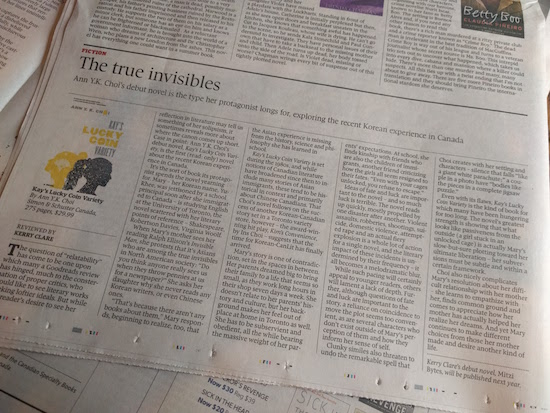
So grateful to the folks at Globe Books for the chance to review Kay’s Lucky Coin Variety, the debut novel by Ann Y.K. Choi, which appeared in the Globe and Mail on Saturday.
‘The question of “relatability” has come to be one upon which many a Goodreads review has hinged, much to the consternation of proper critics, who would like to see literary works seeking loftier ideals.
But while the reader’s desire to see her reflection in literature may tell us something of her solipsism, it sometimes reveals more about where the canon comes up short….’






