June 1, 2016
Listen to me on the radio!
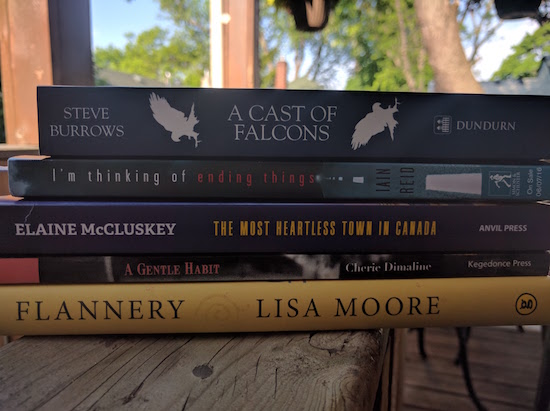
If you didn’t hear my book recommendations today on CBC Ontario Morning, you can listen to them here (at around 41 minutes). I love each of these books so thoroughly, and was so pleased to be able to talk about them. Although I am very sorry for getting Cherie Dimaline’s last name wrong and for confusing her First Nation. She is in fact from a Metis community on Georgian Bay. And you should definitely read her book, A Gentle Habit—it’s terrific. The other books were A Cast of Falcons, by Steve Burrows; I’m Thinking of Ending Things, by Iain Reid; The Most Heartless Town in Canada, by Elaine McCluskey; and Flannery, by Lisa Moore.
May 25, 2016
Double Teenage, by Joni Murphy
 Okay, I promise you this is the last one, the last time I write a post this week imploring you to pick up a certain book because it’s really fantastic. A list of books to be read can only be so long, I know, but here’s just one more. And I promise you that I actually should be going to bed right now, because it’s eleven o’clock and I’m tired, but first I want to tell you about Double Teenage, by Joni Murphy. A book that I had plenty of reasons to be initially deterred from—my own fatigue/discomfort with books about girls who do drugs and self-harm, a notion that perhaps the book was far too cool for me (as are girls who do drugs and self-harm), and I know nothing about French cinema, plus also its engagement with critical theory. I once made the mistake of embarking upon a Masters degree with no knowledge theoretical frameworks (somehow I missed these during my undergrad, which was mainly survey courses on The Faerie Queen), and it was a terrible disaster, and so a novel that engages with these ideas would normally make me run like the wind…but I didn’t. Because I wanted to read a novel about female friendship. Because the first section of the book is called, “No Country For Young Girls.” Because of the line, “In this world/ there were two kinds of girls,/ Celine and Julie were neither.”
Celine and Julie are growing up in New Mexico, a border town. They meet as part of a community theatre production, and Murphy plays with notions of girlhood as a stage/stage. We see both characters performing girlhood, growing up and away from their parents, because witness and victims of violence. They watch television shows (Law and Order and Twin Peaks) and listen to news reports, these ideas along with their own sexual experiences informing their understandings of women’s bodies and who they belong to and what they are to be used for. After high school gradation and a few years at a local college, both women depart for further afield, Julie to Vancouver to Celine to Chicago. And here they fall out of touch, and yet their stories remain connected, however obliquely. The narrative engages with missing and murdered women along the border in Mexico, and with the Robert Pickton case in Vancouver:
“What are the chances that the girls would live so close to two sites of the slow-motion mass murder of girls? / What are the chances?/ Good I guess.”
The last line of the book: “This is a spell for getting out of girlhood alive.” Murphy showing that the threat is from without just as much as it’s from within, just as much as society conspires toward the latter, how many people profit by it, when a girl’s body is turned into something to be consumed. That perhaps there’s really no distinction between the two.
“This is a world with syringes filled with blue liquid and faux fur-lined handcuffs, night-vision goggles and Spanish fly aphrodisiac, wallet photos of children in pink ruffles and velvet paintings of moonlit mountains. This is a world with things we have made.”
I’m nearly an exact contemporary of Celine and Julie, of Murphy even, and so I related to this story on a very personal, visceral level. (The part about Julie and her mother driving from Washington to New Mexico listening to Graceland: “They would be able to sing along with Graceland for the rest of their lives.” Later Celine contemplates heartbreak: “Everyone can see you’re blown apart.”)
Columbine, the protests in Quebec City in 2001, the day Saddam Hussein was hanged: our sorry cultural touchstones.
It’s heavy, but it’s not. I read this book all day on Sunday, a few hours in the afternoon in my hammock. I devoured it, and loved the shape of the project—that this is a novel gesturing outwards, pointing to the world, using the world and its threads to build something new, offering structure, frameworks, where we hadn’t seen such a thing before. Daring to state that girlhood is significant, even if it’s a stage, and even if it’s a stage. I loved the poetry of Murphy’s prose, the power of her language. The power of the book full stop—it’s both the story of my life and also unlike anything I’ve ever read before.
May 24, 2016
The Turner House, by Angela Flournoy
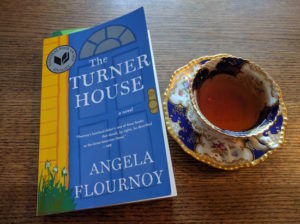 Would you agree that the very best worst problem in the world to have is the one where you keep reading stunning book after stunning book, but absolutely don’t have the time to write about them? Or especially to write about them with the care and attention each individual book deserves? Or when you read a book with the explicit intention of not actually writing about it, that’s going to be all for pleasure, because this book came out a year ago anyway and was a finalist for a National Book Award and so surely doesn’t need you to blow its horn. And yet you have to? Because to love a book is to talk about a book, and I want everybody to know about this one.
The Turner House, by Angela Flournoy, which I bought after reading Doree Shafrir’s piece at Buzzfeed, Why America is Ready for Novelist Angela Flournoy. And I had a feeling that I was, ready that is. The piece begins: ‘I’m driving through Detroit in a rented Ford sedan with the author Angela Flournoy, and it’s hard not to think that Google Maps is deliberately trying to get us to avoid the city’s ghosts. “It keeps wanting to — I’m just going to say, avoid things. Because this is a city that always wants to put you on a freeway.” ‘ And it was such a fantastic premise for an article, the disembodied GPS voice always threatening to throw the piece off-route, and Detroit to me is such a compelling setting for a story. I have this habit while reading books set in Detroit of doing Google street view searches for places mentioned in the text, and what I find on those streets is always stranger than my imagination—blocks of empty lots, overgrown sidewalks, here and there scattered a house, sometimes upkept, but often abandoned. Burned out shells. It seems strange that this place is real, streets on which actual people live.
Although Yarrow Street, portrayed in Flournoy’s novel, is fictional. And the world that she creates in her novel is one that seems familiar to me. In the Buzzfeed profile, she explains that she consciously didn’t draw attention to the blight in her book, to the things that would seem familiar and unremarkable to anybody who lives in the neighbourhood she writes about. “So imagine if you lived here every day of your life—it becomes part of the landscape. So I try to just be accurate in characterization. And that’s where the challenge is. Because I want other people to see this place like they’ve never seen it. I’m gonna point out the things that are interesting, but I also don’t want to focus too long on things that are not the things that you focus on if you live here.”
Yarrow Street is on the decline. Most of the old neighbours have died and departed, and the Viola Turner, the family matriarch, has gone to stay with in the suburbs with her son Cha-Cha, the eldest of thirteen. And it’s not supposed that she’ll be returning home, although nobody wants to admit it, and in grappling with this idea and the controversial question of just what to do with the family home once their mother goes—the bank has disclosed that it’s worth about four thousand dollars—all the while recovering from an accident that has left him weakened physically as well as psychologically, Cha-Cha is brought close to a breakdown regarding an experience from decades before, a curious encounter with an apparent ghost who tried to kill him. An experience that has haunted him ever since, but in raising the matter with his church-going wife, his dying mother, and his ever-feuding brothers and sisters, Cha-Cha seems to only make things worse. Meanwhile, unbeknownst to all of them, the youngest sister is a gambling addict who’s become homeless, and squatting in the house on Yarrow Street, meanwhile their brother Troy is hatching a plan to shortsell and buy the place out from all of them. And all the time, there’s an undercurrent, the story of their parents at the very beginning, a story none of the children knew, but has which has haunted all of them in ways they only just perceive. How much is legacy? How much is destiny? And how hard is it to disentangle from all of that and build an actual life for one’s self?
The Turner House deserves all its critical acclaim, and then some. Like Google street view, it’s the kind of world that you can lose yourself in, and well forget about the other one. If you’re on the lookout for a Great American Novel, I can’t think you’d do any better than starting right here.
May 23, 2016
The Most Heartless Town in Canada, by Elaine McCluskey
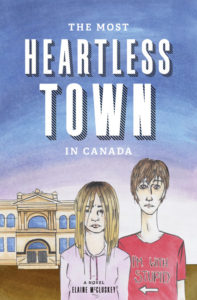 I’ve been a huge fan of Elaine McCluskey since her short story collection, Valery The Great. I love her merciless humour, the way she packs a sentence, her singular point of view which casts the ordinary in such an extraordinary light, and I love that her unsparing perspective is thoroughly laced with hope and kindness. All these things are on show in her latest novel, The Most Heartless Town in Canada, which begins with a Diane Arbus-inspired image and eight bald eagle carcasses. The town of Myrtle, Nova Scotia, has never been in the national press until this photo which goes out over the wires, and suddenly the boy and girl depicted find themselves as infamous as their town is. The story of the town involves its poultry plant and the bald eagles who’d started feasting on entrails left by plant workers, gathering a popular following of their own before all being brutally slaughtered. The story of the boy and girl is even more complicated that that, and involves a pitiful swim team with big dreams, their overenthusiastic coach, her dodgy boyfriend, and a get-rich-quick scheme. The girl is the photo is Rita Van Loon, an unremarkable swimmer, middling member of the Myrtle Otters. The boy is Hubert Hansen, who has just moved to Myrtle with his mother after the death of his father, and who wanders to the streets of town with his dog and perhaps sees more than anybody. Together, Hubert and Rita tell the real story behind the headlines and think-pieces, disturbing the reader’s notion of small-town stereotypes and the urban/rural divide. The most wonderful thing about McCluskey (and what makes her so funny) are the people she creates, characters who conform to type enough to be familiar but then surprise you just like real people do. Although the problem with this is that sometimes these people forget they’re in a novel and start doing their own thing, which is to say that The Most Heartless Town in Canada can lack cohesion. But that doesn’t undermine the goodness of this book, the delight I took in it. McCluskey’s writing is so good, her characters so richly drawn, and the payoff so great—in heart and humour both—that you’ll be happy to follow these sentences down any avenue, and all over town.
May 18, 2016
Mini Reviews: He Wants and Middenrammers
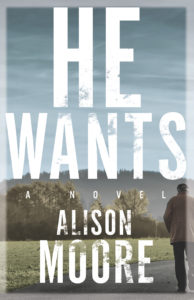 Alison Moore follows up her Booker-shortlisted The Lighthouse with He Wants, a novel that is an exercise in withholding and revelation. As the title suggests, this is a book about yearning. Lewis Sullivan has lived a quiet life and cannot articulate just what he longs for to either himself or to his reader, although the reader going back through the seemingly quiet text will notice that all the signs are there, in previously invisible flashing lights, even, and it’s quite remarkable that a “quiet” text can be such a minefield upon rereading. The narrative follows Lewis over the course of a single day whose pattern is disturbed by the arrival of a stranger in town…except that he’s not a stranger at all, but Lewis’s former schoolmate. And while the novel’s web became too tangled by the end—story threads about Lewis’s daughter and also a local thug distracted from the central story, too much coincidence—the climax is perfectly, subtly performed, and beautifully written. DH Lawrence fans in particular should take note. Plus, Rachel Cusk loved it.
**
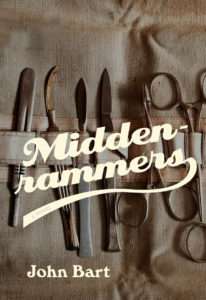 John Bart’s debut novel, The Middenrammers, suffers from being a novel with a political agenda, which works in places to undermine the impact of the characters on the page who are not necessarily enlivened by their own will. It’s the story of a young doctor who arrives in a Yorkshire town to practice at the town’s maternity hospital in 1970, and finds himself up against forces working to restrict women’s access to contraception and abortion. Things are a little too black and white—the evil-doers in this book are so totally evil but—as Chimamanda Ngozi Adichie wrote in her novel, Americanah—“like life is always fucking subtle.” And whenever I was feeling frustrated by the lack of subtlety, Bart would go and blow me away with a stunning scene, like the one in which the doctor has his arm stuck inside a woman’s vagina to keep the cord from prolapsing, and must move through the entire hospital in this awkward manner to get her to surgery. And he portrays the devastating impact of restricting women’s reproductive freedom, and shows too how such restrictions are part of systemic project of oppression of women and the poor. Despite my few reservations, I really enjoyed this fast paced novel, read it in a day, and think it would appeal to anyone who’s been a fan of Call The Midwife.
May 15, 2016
A Pillow Book, by Suzanne Buffam
 In the notes for Eula Biss’s On Immunity: An Inoculation, the author writes about the other mothers with whom she found herself “in constant conversation” after she became a mother herself, “and the subject of our conversation was often motherhood itself.” (My experience of these same conversations inspired a book, as I wrote about in my foreword here.) Biss writes, “These mothers helped me understand how expansive the questions raised by mothering really are.” And so it meant something to me that Eula Biss is one of the people acknowledged in A Pillow Book, by Suzanne Buffam (whose first book won the Gerald Lampert Prize and whose second was a finalist for the Griffin Prize), that Biss included Buffum in her own acknowledgements as one of the friends by whose conversations her own writing was fed, to consider that A Pillow Book was born of those conversations from the other side.
Although Buffam’s book is not obviously a companion to On Immunity. At first glance, it has more in common with Jenny Offill’s novel, Dept. of Speculation, a novel in fragments whose form suits the disintegration of the protagonist’s marriage, career and sense of self after she becomes a mother. The novel has been celebrated for its frankness in addressing that kind of disintegration, although my struggle with the book was with its failure to really be a novel. Whereas Buffam’s book is catalogued as poetry, and we’re told within the book itself (as well as on its back cover): “Not a memoir. Not an epic. Not an essay. Not a spell. Not a shopping list. Not a field report. Not a prayer. Not a dream book. Not a novel…” A far more interesting book for its lack of imposition of structural constraint.
While On Immunity is certainly apart from these, a volume of rigorous non-fiction, I think the three books form a fascinating trinity. When I am trying to persuade a reader to pick up Biss’s book (because not everyone is always up for rigorous non-fiction), I tell them that this is the kind of rigorous non-fiction a woman writes when she has a small child. It’s a short book, created of manageable pieces. You could pick up the book and read a section every time you feed your baby, is what I mean. So in a way while it’s decidedly coherent, On Immunity is structurally as fragmented as the others. Furthermore the whole premise is that Biss is trying to make sense of a world that has been exploded to pieces, to reconcile polarities and complexities, to put the pieces back together. Which is what Offill and Buffam are doing as well, and I wonder if together these books suggest a new genre of mother-lit, books that use structure and content to interrogate and complicate the narratives we’re handed about what motherhood is supposed to be and who mothers are and what we’re supposed to preoccupied with. All three books also blend autobiographical elements with fiction (or non-fiction in the case of Biss) in ways that further complicate the narrative and allow the author a necessary expansion of literary possibility.
(Sarah at Edge of Evening wrote this week about Her 37th Year: An Index, by Suzanne Scanlon, and after I read her post, I immediately ordered the book from the publisher. I have a suspicion that this book too might fit [but not comfortably; there are is nothing comfortable about these books] into the genre I’m talking about.)
Buffam’s collection has been born of a certain panic. The first: she’s unable to sleep. In lieu of counting sheep, she’s making lists, strange connections, pursuing fascinations, and becoming preoccupied with sleep hygiene. Plus pillows. “Among the oldest living pillows in the world today is a smooth block of unpainted wood with a wide crack running through its middle and a shallow indentation on the top,” the book begins. The next fragment of text starts, “F. Scott Fitzgerald wrote lists. Abraham Lincoln took midnight walks…. I put a piece of paper under my pillow at night, and when I could not sleep, I wrote in the dark, wrote Henry David Thoreau, who once spent a fortnight in a roofless cabin with his head on a pillow of bricks.”
Lists such as, “Books I’d Like to Read Someday,” “Dream Jobs” (the fragment above which is a piece beginning, “Later that fall in West Orange, New Jersey, Thomas Edison staged the first pillow fight ever recorded on film.”), “Unendurable” (“Dinner with donors./ Dreadlocks on a WASP.”), and “Dubious Doctors” (“Dr. Feelgood/ Dr. Doolittle/ Dr. Spock../Dr. Pepper./ Dr. Dre.”), “Moustaches A to Z” (Anwar Sedat and Burt Reynolds to Yosemite Sam and Zorba the Greek).
The fragments are divided by small circles whose shadings progress in the way of the lunar cycle (as in the cover of the book). And amidst all these other curiosities are dispatches (though “not a dispatch” is probably also true) from the field of motherhood, the narrator’s young daughter referred to as “Her Majesty:
“No luck with the potty today I record in my little blue pillow book. No interest, either, in wearing the new Hello Kitty underwear I bought last week at Target, though Her Majesty did kiss each pair as we removed them from the shiny plastic packaging.”
“Was Shonagon bored? Was she lonely?” Buffum’s narrator wonders of the Japanese author of the first Pillow Book, another object of fascination. We see her husband meeting with a student to discuss her paper on Spinoza: “From the hovering basket of a hot-air balloon in our front yard…the lift off into a swirling swarm of downy flakes, leaving me behind with Her Majesty in the kitchen…” Early in the book, moons before, she recalls sharing sushi “with a famous aging editor in New York.” When he learns she has no children (yet), he tells her, “Good…You’ll be finished as a writer if you do.”
As I said, this is a book that is born of panic.
And it’s fascinating, so readable. It got to the point where I had to put my bookmark onto the following page without turning it over because if I hadn’t, I would have read the page, devouring the whole book in a sitting, when it felt so good just to eke it out, a few pages before bedtime. A book truly to savour. Because the contents are so strange and interesting, ever surprising, and the language is beautiful. I kept reading parts out loud to my husband, and it was then that the poetry of the prose, Buffam’s attention to language was most clear, with subtle rhymes, alliteration. A sense of rhythm. A sense of humour most of all.
May 11, 2016
13 Ways of Looking at a Fat Girl, by Mona Awad
 I wasn’t expecting to struggle with Mona Awad’s debut, 13 Ways of Looking at a Fat Girl. The day I bought it, I met up with two friends who both happened to be in the middle of the book and they said it was great. It’s been receiving rave reviews. But as I began to read it, I couldn’t help but find it unsettling, and not just in the ways it was intended to unsettle. Part of the problem is entirely my own—I’ve had a hard time reading most of the books I’ve picked up in the last couple of weeks. Part of the problem too was with the book’s design, the unfinishedness of its stark design and its lack of heft. Was lack of heft the problem? Ironic. I did keep thinking that I’d read a version of this book a long time ago, and it had been called A Girls Guide to Hunting and Fishing. Was I being chick-lit-ist? But then Awad’s Elizabeth is definitely no “chick.” There’s nothing pink about this book. The only shoe you’d put on this cover would be an army boot, but maybe that was the trouble—Elizabeth the teen goth all in black, maudlin and sad. A bit like the actual cover then, rough outlines, scrawled. Maybe that was the problem too.
My problem with 13 Ways of Looking Like a Fat Girl was one that interested me, which is vastly different from most books I have a problem with. The problem I have with most books is that they don’t interest me at all, but this wasn’t the case here. It was totally bizarre. Here I was getting hung about a book because its protagonist was so unlikeable—which says way more about me than that protagonist. What kind of a reader am I? Only the kind of reader who usually considers herself above such critical assessments. Unlikeable, piffle. But I couldn’t shake it here. Elizabeth, I wanted to say to the girl, cheer the fuck up. It can’t all be that bad. Wash off all that unfortunate eye makeup and go out into the sunshine.
Part of my problem with 13 Ways of Looking Like a Fat Girl was personal. In general terms, to be a woman is to be afflicted with a mild case of body dysmorphia, and this inability to grasp one’s own bodily reality for me hasn’t been aided by the three times I’ve lost about 30 pounds in the last 20 years (only once through trying really hard; there was also the time I moved to Japan and the other when I stopped breastfeeding) or the two times I’ve gained 30 pounds in pregnancy, not to mention the other times I’ve gained 30 pounds without any real explanation (except for that one time, which was all down to moving to England, eating a lot of sausage [not a metaphor, you sick dog] and being in love). So you see, I know what it is not to know one’s own body. And so the stories that were fixed in Elizabeth’s perspective unnerved me then. Was she really fat? How fat? And did it even matter? Of course it did. But it doesn’t too. So my unsettlement here is a testament to Awad’s achievement of giving her reader such a feeling of the claustrophobia one can experience living inside a body. Some of it was just all too familiar.
Some of it really was that Elizabeth was also kind of annoying though. Which would be fine, except I think that what I mean by complaining that the character is unlikeable is actually that her lack of evolution is just not very interesting, from a literary point of view. Although it is interesting that so much remains stable for her even as she loses weight—this is quite deliberate on Awad’s part. The novel’s epigraph is from Margaret Atwood, Lady Oracle (I think?): “There was always that shadowy twin, thin when I was fat, fat when I was thin.” At any size, really, the song remains the same.
But it doesn’t have to be that way. And while it is also to Awad’s credit that this is not a heartwarming story about a woman’s struggle overcome adversity and finally accept herself (blech), I wanted something more for the character than what was written. As a kind of stand-in for actual evolution, Awad has Elizabeth changing her name as the book progresses, employing the various possibilities inherent in a name like that. But that literary strategy seemed kind of facile, because I didn’t know Elizabeth well enough to understand what it was she was striving for with her new names, what each one meant.
There is a dawning awareness though. The reader sees this in the story “Caribbean Therapy,” in which Elizabeth goes to a really terrible nail technician, incredulous of the woman’s reality—that here is a fat woman who loves and is loved and is happy. And then in the story “Additionelle,” with its stunning, awful, claustrophobic ending. That she’s trying and trying but not getting any closer to the person she is trying to be, to become. And finally in the last story, “Beyond the Sea,” in which she’s coming to realize the futility of her struggle, that we get one life and why should it be such a struggle, unless you’re Karl Ove Knausgård of course. (I think about this a lot, actually. Not about not being Karl Ove Knausgård, I mean, but that I am 36 years old and I refuse to to spend the next forty years of my life fighting, trying to be less, losing, and then losing again. I refuse to be 70 years old and hating myself because I’m fat. For that matter, I refuse to be 36 years old and hating myself for being fat. And am I fat? How fat? No. I refuse to engage. I’d rather eat a croissant. I’d rather take a walk.)
And then the ending of this story, the final line of the book: “As I watch her [a woman peddling on a stationary exercise machine]… I feel dangerously close to a knowledge that is probably ours for the taking, a knowledge that I know could change everything.” And it was here that I wanted to cheer: Yes, yes, take it, Elizabeth. Because that knowledge is right there. Everything I wanted from this book, for this character, summed up in a line. And it’s a credit to Awad too that all possibilities are wide open right here.
Being happy and fat (and what is fat? how fat? etc. etc.) is not a given, but that knowledge that is ours for the taking seems very much of this moment. Just this morning I read Kaye Toal’s article, “I Promise You Don’t Have to Lose Weight to Be Happy” AND Dr. Yoni Friedoff on how liking the life you’re living is the best way to have a heathy weight, AND just yesterday, Lindy West on how to be a happy fat woman. There are very few ways in which I can say that right now is a glorious time to be living as a woman inside a body, but with such zeitgeist this may be one of them. And it feels good.
I hope that Mona Awad’s character gets the memo too.
May 4, 2016
Flannery, by Lisa Moore
 There was little doubt in my mind that Lisa Moore could pull off a YA novel. I remember her teen character in Alligator, which was a book that just delighted me when I read it first, and the vividness of her point of view. And as a writer who so skillfully employs word as tools to create meaning, I was sure she had the deftness to tune her work to a different kind of reader. Which, of course, didn’t preclude me from reading it too. If she wrote One Direction fan fiction, I’d probably read that as well. Lisa Moore’s name is a literary hallmark.
So it’s no surprised that I really enjoyed Flannery, her latest book. The title character is a sixteen-year-old girl whose best friend has started ditching her for her cool musician (and slightly dangerous) boyfriend. Meanwhile, Flannery has got to complete an entrepreneurship project with her partner Tyrone, who she’s known since they were babies and is quite possibly in love with, but he’s not showing up to do any work, plus her free-spirited artist mother can’t afford to buy Flannery the new biology textbook she’s required to have, and keeps writing about Flannery on her parenting blog, which other kids at school are actually reading.
Flannery’s voice and point of view represents a stable force in a crazy world, and she’s an amazing mix of confusion, steadfastness and yearning. And naturally, I was very interested in her mother’s character, which Moore renders with just as much nuance. I think a lot about a mother’s right to tell her own story, even when her child is part of that story, because suggesting otherwise is another way of telling a woman to shut up. I do think that when a mother writes about her child with a great deal of thought, she can do this successfully, although Moore shows that Flannery’s mother Miranda is not too thoughtful about her blog (which disappointed me a bit—I would have loved some substance here), or anything, for that matter. Except her love for her children, of course, which is demonstrated in lovely, pointed ways—Miranda swooping in to exalt Flannery’s entrepreneurship project, her intuition regarding the well-being of her son, which her smartass daughter doesn’t give her credit for. Moore shows the the imperfect mother is the only kind of mother, and sometimes that all a child needs.
But of course none of this would be of much concern to the novel’s target readers, for whom Miranda would only be peripheral, I think. Those readers will be just as wrapt as I was by the story though, by Flannery’s incredible outlook on the world, but menacing shadows at its edges. And yes, there is edge here, real significant danger, and Moore so successful melds these points into a true, believable life, rather than using them for more sensational purposes (as bad YA novels might do, and even as a very good one like Raziel Reid’s When Everything Feels Like the Movies did quite deliberately). As the world’s is, the emotional spectrum of Flannery is wide. There is a scene in a mall food court where Flannery is betrayed by Tyrone that will break your heart as profoundly as that scene did in Moore’s February when her character waits in a bar for a date who never arrives.
Moore doesn’t push syntax and narrative structure quite as hard in Flannery as she does in her other books, which is the one significant way that the book is a break from her oeuvre. But here and there in her prose sparkles in just the same way her readers have come to expect: “The sun was so low that its reflection was a perfect bright red circle on the water’s surface and as the boat swing around, the circle was smashed into a thousand pieces that skittered away from each other and then floated back together, making the perfect circle again.” Such an extraordinary sentence! And what a gift to any reader, regardless of their age.
April 28, 2016
The Name Therapist, by Duana Taha
 Often the most remarkable story about names is the fact that sometimes there isn’t a story at all. For example: I somehow managed to be named after two Irish counties entirely by accident. “What where your parents thinking?” people have asked me, imagining me as the offspring of two Munster enthusiasts, but I don’t think they were thinking of much beyond euphony. Although my maternal grandmother had a difference of opinion about that, and suggested “Lea” as a middle name to soften the sound, which was how I came to be called Kerry Lea by everybody on my mother’s side of the family. But I think my father’s family found the double names a bit pretentious (and really, their tendency was to truncate single names to a syllable, so that’s not shocking), so they called me Kerry, and in my mind it was a bit like having two selves, Kerry and Kerry Lea being people entire distinct from each other. (Further: carrying around an extra name is very cumbersome, and I ditched the “Lea” altogether at the beginning of grade one at a very singular moment in which my teacher asked me what I wished to be called, and I proclaimed myself a Kerry and so have been ever since.)
So what I mean about names, and what Duana Taha means too in her wonderful new book, The Name Therapist, is that even the names without a story turn out to be stories, and for some of us, those stories are inherently interesting. Name nerds, she calls us. In high school, I owned an A-Z of baby names, just because it made for good reading. I used to collect weird and wonderful names I encountered in books—Beezie from A Swiftly Tilting Planet and Zeeney from Louise Fitzhugh’s The Long Secret were two very bizarre ones I fancied once (and while I didn’t end up naming anybody Zeeney, I named my firstborn after another character in the same book). More often than I ever wrote actual stories as a child, I invented fictional class lists, the names telling me everything about the plots inherent, multiple Melissas, and everything. I made up families too, ones with kids a bit older than me, sisters called Robin, Tracey and Karen—don’t you know exactly who these people are? There was a time in which I wanted to a name my child Ariadne, and about a decade ago, my husband and I had a fictional daughter called Sadie Rose who was very well behaved, and then when I gave birth to actual children, I called them Harriet Joy and Iris Malala, who were not named accidentally at all.
And so for me, reading The Name Therapist was a bit like going to church. Over the years, Duana Taha has established some serious name cred through her column on the blog Lainey Gossip, writing about names, helping expectant parents sort through Ellas and Bellas, and marvelling at phenomena like Jayden, Cayden and Brayden. She continues to explore these ideas in her book, as well as sharing her own experiences growing up with an unusual name, and how her Irish and Egyptian parents’ experiences with their names informed the selection of her name. (Her mother, Mary Veronica, who was only ever, inexplicably, called Maureen.)
The book is a delicious mix of memoir and social science, even better reading than the Baby Name A-Z (which was very good, actually, because it was from there that I first discovered that Zoe meant life, and that Elaine was a variant of Helen). Taha writes about naming trends, sibling matches, “Utah names,” Starbucks names, same-sex couples with the same name, and just what it feels like to be a Jennifer. Taha’s thesis is that a difficult name builds great character, and that learning to be a Myfanwy will make Myfanwy an awesome girl. She’s got a thing against Gords, but don’t take it personally if you are one. She delves into stripper names, African-American names, and why the Baby Name A-Z’s are so ridiculously Anglo-centric. Names and class. Also, what it felt like to be the parent of a child called Atticus during the summer of 2015.
Name therapy is not an exact science, and Taha’s thesis (name as character builder) was disproved more than once throughout her research, but I think that this was never meant to be a controlled experiment. Instead, it’s a book that will be delighted in by most people who’ve ever thought hard about how they were named and why, and what it means to name somebody else. It’s rich with stories, connections, and fascinations. And that I couldn’t write about it without sharing name stories of my own proves Taha’s overarching premise: that names are something it’s hard to shut up about.
April 20, 2016
On the Shores of Darkness, There is Light, by Cordelia Strube
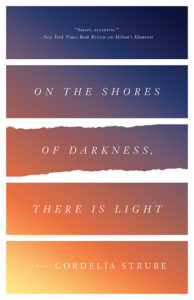 Ever since 1964, writers whose protagonists are eleven-year-old girls called Harriet have been taking a serious chance on things. How can one actually pull that off that kind of literary homage? But Cordelia Strube, whose many books include the 2010 Giller-nominated novel Lemon (which was one of my favourite books that year) has absolutely pulled it off. Her Harriet, in On the Shores of Darkness There is Light, is a many-splendored, singular creation, and the novel goes and goes and never falters.
Harriet lives in an apartment building called the Shangrila, once a luxury high-rise but now a place housing mostly downtrodden seniors and her family since they lost their home in the 2008 economic downturn. Her mother is trying to keep them afloat through under-the-table bookkeeping, with no help from Gennady, her broke criminal lawyer boyfriend in Crocs, or Harriet’s father Trent, avid cyclist who lives with Uma who he met at the farmer’s market and who is currently in the middle of an IVF cycle. And then there is Irwin, Harriet’s five-year-old brother who has hydrocephalous and whose traumatic entrance to the world brought forth the end of Harriet’s parents’ marriage and all semblances of stability in her life. His health remains perilous, with frequent seizures and hospital visits, ever a source of anxiety and preoccupation for their mother, leaving Harriet with a preponderance of freedom that she exploits for her own devices.
Dumpster-diving for materials for her found art projects, charging her elderly neighbours for runs to the convenience store, and hanging out with her teenage neighbour, Darcy, and losing her scattered grandmother at the Scarborough Town Centre, Harriet has her own agenda, which ultimately involves her dream of escaping it all and getting away to a rural retreat far away in Algonquin Park, living alone by a lake and painting much like Tom Thomson did. A playwright, Strube has an ear for dialogue, and the novel is enlivened by conversation by the people all around Harriet, from confused senior citizens to forthright angry teens, and we see all the information contained within these throwaway lines being filtered through Harriet’s precocious but still eleven-year-old brain and how they come to inform her view of the world. The connections she makes between her father’s obsession with cycling and her stepmother’s IVF cycle, for example, or how a diatribe from the malicious Gennady becomes the title of a sculpture she creates called “The Leopard Who Changed Her Spots.” In a subtle fashion, this is very much a novel that is preoccupied with language, by words, and the puzzles of what things really mean.
As in her previous work, Strube is unafraid to portray adults as a ragtag collection of lost souls and idiots. (This is another feature this novel shares with the collected works of Louise Fitzhugh.) That such folks are responsible for the care of vulnerable people is always a terrifying thing for those people to discover, and On the Shores of Darkness… is about that loss of innocence, the realization that none of us are really ever safe, and that our parents are as vulnerable as we are. “I want you to get better, but I don’t want to be blamed,” admits Harriet’s mother at one point regarding her son’s unhappiness, which is indicative of every adult’s failure in this book to take responsibility for his or her own actions, for their own life. “All of this has been very hard on me,” so say the grown-ups in relation to their children’s hardships, over and over again.
At nearly 400 pages, the novel is long, but swiftly paced and never dull. The bleakness of its considerations are broken up with incredible humour, from the cacophony of the voices in its background to the sheer audacity of Harriet herself, her nerve, all the things she is willing to do and say. There is a humour too in the contrast between the child’s point of view and the world around her, and—in the case of Harriet’s friend, Darcy, in particular—the person she is trying to to be. The sheer naïveté of these would-be old souls. Darcy likes to go on about, “that Caitlin whore,” a friend from her old neighbourhood, and we learn about what Caitlin did to her at Guides: “I was a Sprite and she was a Pixie. That ho bag made like all the cool girls were Pixies….Then the skank fucked up my puppetry badge.”
There is a twist two thirds of the way into the novel that is absolutely devastating and potentially crazy-making, but Strube manages to make the final section work with the introduction of a new character, a young girl who underlines the novel’s Fitzhugh ties by her determination to be a detective, carrying a magnifying glass and clues jotted in a notebook even. And while the novel veers dangerously toward sentimentality as it heads to its conclusion, Strube shows just enough restraint, and manages an impeccable ending, one that brings its pieces together, steady as the beat of a heart.