October 25, 2016
The Little Communist Who Never Smiled, by Lola Lafon

On the surface, Lola Lafon’s novel The Little Communist Who Never Smiled (translated from French by Nick Caistor) is a fictionalization of the life of Nadia Comaneci, but that (of course) is just a cover. What the book is really about is messaged in between the lines (or, quite literally, between the words). The Little Communist… is a book about the Cold War, the politicization of sport and womanhood, about deciphering codes and, fundamentally, this is a novel about punctuation.
 The book begins with Nadia’s performance on the uneven bars at the Montreal Olympics in 1976. (I call her Nadia. Everybody did. I wasn’t born until 1979, but I came into a world where girls were still gymnastics-mad and it occurs to me that gymnasts from that time are the only Olympic athletes I’m familiar with who aren’t from my country. From a very young age, I knew who Nadia Comaneci was.)
Her victory hung on point of punctuation, kind of—a decimal. Her score of 10.0 had never been achieved in gymnastics before and therefore the display screen didn’t have the capacity to show it. Lafon shows the confusion and crisis and judges and administrators realized what had happened and the scoreboard read 1.0, and the implications of this—this was an athlete from whom an entirely different system of success would be designed. “New numbers need to be invented. Or just abandon numbers altogether.”
On page 18, Lafon describes Comaneci: “Her arched back is a comma.” Which is significant because of how conspicuous commas are in the text. Comma splices are scattered throughout the novel, and I had to consider their implication, what they do to sentences. How in English they join unlike ideas in slightly jarring ways that makes the reader think twice, and it made me think about Romania in the 1970s and 1980s, a point in between the Cold War divides of East and West. Later in the book, Lafon shows Comaneci delivering an address in 1984 to announce her retirement from competition, an address that was written for her by the writer who composes all her official speeches: “He writes them out in short lines with commas so that she can pause for breath between them.” But in this address there are no commas. “She had not planned to be silent for so long she is simply searching for the comma, she thought she saw it but there wasn’t one, her words are chosen for her one last time, the comma jumps from one word to the next, like the decimal point: one point nought nought, she raises her eyes to those who have no words…”
The echo of the uneven bars creaking at the Montreal Olympics is “an uneven punctuation for her body as it folds itself around them.” Periods are replaced in between the letters of rival Olga Korbut’s first name in a Man From U.N.C.L.E.-like Cold War allusion (O.L.G.A). In her imagined exchanges with Comaneci, Lafon considers the punctuation used in newspaper coverage about Comaneci, “exclamation marks that compete with the ellipses.” There are references to the story of Nadia being written, rewritten (and indeed they are in Lafon’s imagined exchanges, which cast doubt on everything represented by facts. Truth is nowhere. Everything is suspicious.) and defying translation.
And then there is the period, the decimal point in another form. Full stop. Also menstruation (which I don’t think shares its name with a punctuation mark in the novel’s original French, interestingly, although apparently the French term for menstruation means “rules,” so it’s equally firm), which is hugely significant in this text. The arrival of the period signals the beginning of the end of Comaneci’s career, no matter her coach’s and manager’s efforts to stymy the effects of puberty through training and pharmaceuticals. But in the context of Romanian history, it has wider and more disturbing ramifications regarding forced pregnancy tests women were submitted to to eliminate instances of abortion, the way that not only Nadia had her body regarded as property of the state. And really, this sense of ownership over women’s bodies is a universal thing—anyone else who’s not an Olympic gymnast ever been chastised for not smiling?
And yet Lafon avoids obvious and facile comparisons with East and West with her imagined dialogue with Comaneci, who questions the ways in which women and athletes in the West are necessarily more free. While never minimizing the negative effects of life under the Ceaușescu regime, Lafon complicates notions that here and now is necessarily better than then and there. While Romanian people had nothing during the 1980s, Lafon is reminded in imagined conversations that sometimes nothing is better than insatiable materialist desires. All this so that we’re left with a notion of history and truth that is as elusive as Nadia herself, always just slipping out of one’s grasp.
“You quietly airbrushed your mistakes…could we say that?”
“Yes, exactly. I rewrite everything! But….discreetly.”
Thank you for the International Festival of Authors for inviting me to be a part of your blog tour and giving me the opportunity to read this truly excellent book.
Lola Lafon’s appearances at Toronto’s 2016 International Festival of Authors
(Supported by the Consulate General of France):
Monday October 24 8pm “Interpreting the Past” (Reading/Round Table)
Wednesday October 26 6pm “EUNIC: Writing History Telling Stories” (Reading/Round Table)
October 18, 2016
The Party Wall, by Catherine Leroux

It’s always a good sign when the blank pages inside a book become riddled with notes and diagrams, as has been the case with my copy of the Governor-General’s Award/ Giller-nominated The Party Wall, by Catherine Laroux, prize-winner in its original French, translated into English by Lazer Lederhendler (Nikolski!). Not because the stories themselves in the novel are so difficult to figure out—in fact, they read beautifully with luminous prose (“Fall is approaching and the warmth of the South throbs on the horizon like a sack of gold at the foot of a rainbow”)—but because the challenge and the pleasure is discovering how all of it fits together. While the shape of most narratives is a horizontal line (with the inevitable bump for a climax), the shape of The Party Wall is multi-dimensional, arrows pointed in all four directions and connections that hold the whole thing fast.
The Party Wall is several stories, and while one might argue it’s more a story collection than a novel, I have more fun considering it as the latter. These stories could probably all each stand on their own but the whole is much more than the sum of its parts, which come together in the beginning as a series of curiosities: a woman in Bathurst, New Brunswick, discovers she is not the biological mother of the son she gave birth to; a married couple with a cosmic connection (and he actually the Prime Minister of a future, post-apocalyptic Canada) discover they are twins who were long ago given up for adoption; and a brother and sister (a police officer and an Olympic runner) in San Francisco sit by the bedside of their difficult mother who is dying, and each try to come to terms with the fact that they may now never discover the identity of their father. These descriptions might give the impression that these aren’t stories that are steeped in realism, that they belong to a nether or even an ether world, but that’s not the case. There is magic and there is wonder, and while these situations are indeed highly unlikely, look around you and consider what isn’t.
If these stories are rooms in a house, the walls of the house (that connect them and divide them) are a story on another scale, one that takes place over the course of a single morning in Savannah, Georgia, two sisters wandering the rough and familiar edges of their neighbourhood. From details in the larger-canvassed stories, the reader understands premonitions of danger, this offering the book in parts the momentum of a novel—and where the danger is actually found is probably not where the reader expected. Anticipation of narrative links also urge the reader through the book, and the revelations are never cheap or disappointing, instead adding texture to the richness of the narrative.
In addition to the narrative links, the stories are joined by references to unfortunate cats (whose names include Bastard, Wretch and Shabby), a fixation on horizons (“the boundary between the two worlds, and what manages, unbeknownst to scientists and the gods, to travel from one to the other”) and walls that get knocked on, punched in, listened though and lived in. And yes, the splendid writing, twists that bend your mind, and a story that stretches across a continent, across years and lives, and binds them all together.
October 17, 2016
Today Will Be Different, by Maria Semple
 The first time I read Where’d You Go, Bernadette?, by Maria Semple, was the night after Iris was born via c-section, when I was immobile and yet expected to breastfeed my squalling baby off and on throughout the night (and many nights after…). Not exactly the best of times but it turned out to be the best of books, so much so that every time the baby woke, I was excited to pick up the novel again. It made for splendid reading. Bernadette was smart, funny, clever, breezy, dark, light, and I have always been a little sorry it ended. I’ve never completely gotten over this book.
I read Semple’s first novel, This One is Mine, not longer after, hungry for more of the goodness. It was not as good as Bernadette but had the same something. The same understanding that smart books need not be serious, and humour and situations surely born from their author’s experience writing for television. The same slightly neurotic, irresistible (if you’re a certain kind of reader) point of view. Awhile after that, I read Where’d You Go, Bernadette? again, because I wanted to and also because I wanted to see if it was as wonderful as I remembered/if perhaps I’d been influenced by being on drugs in my adoration of it. It was/I wasn’t.
And so I’ve been waiting more than three years to read Maria Semple again, a situation that brings with it enormous expectations, and I am very pleased to say that Today Will Be Different didn’t disappoint. And nor was it like anything I’d expected. I did a Q&A with Marissa Stapley last week at 49thShelf.com, and she noted that readers and critics of commercial fiction need to take notice of when its writers are taking risks with their work, and celebrate those risks. Here is a book that defies categorization, that pushes the limits of fiction and its tools (and how—the novel contains a mini graphic memoir, among other paraphernalia). Structurally, it’s a fascinating book…why is why I was totally annoyed last week when I listened to an interview with Semple and the interviewer refused to talk about the book outside the realms of autobiography.
It’s true that writers like Semple do make it easy for critics to fall into the trap of conflating author and narrator. It’s true too that very often the two are properly conflated. But when we view our fiction (and our fiction by women in particular) through such a narrow lens, we limit ourselves as to what fiction is all about and missing the chance to talk about women as artists and creators instead of giant sacks of feelings and experience (and after all, what then is memoir for?).
The way that Semple mines her experience and the world around her is interesting. There. There’s a start. Also the way she blurs fact and fiction even in her form, by including extra textual documentation and creating cultural reference points in vivid detail. Today We Will Be Different differs remarkably from Bernadette in its first person narration—while Bernadette was an enigma, we know exactly where Eleanor Flood is, and the reader is stuck right inside her head. Which is a little hard to take at times, and why this is the case is a worthwhile question and makes me thing of demonstrable evidence that people prefer the sound of a male voice to a female one. It’s also a matter of Eleanor’s idiosyncrasies, her digressions and preoccupations, and bluntness—she actively maintains a list of subjects she proactively chooses not to care about, diversity among them. Eleanor Flood is not dying for you to like her. And yet like her, you probably will. She even knows you will.
The book begins with the prospect of a new day, a day which (no surprise here) our protagonist becomes determined will represent a turning point away from the rut in which she has found herself stuck. “Today I’ll play a board game with Timby. I’ll initiate sex with Joe. Today I will take pride in my appearance. I’ll shower, get dressed in proper clothes and change into yoga clothes only for yoga, which today I will actually attend.” An ordinary day that might make all the difference, and it does, but not for the reasons that Eleanor imagines it will. Her plans soon go off the rails: her son’s school calls requesting she pick him up as he’s suffering from a fictional stomach bug; her lunch plans (with the friend she’s spent a decade being unable to shake) are not what she bargained for; and when she shows up at her husband’s office to foist their son upon him, it turns out he’s told his staff that he’s on vacation for a week and they’re surprised that Eleanor and Timby aren’t with him. Where is he?
There are writers who sit down and painstakingly plan their books before they start writing, a mess of post-it notes and index cards, and one gets the feeling that Maria Semple is not one of them. The plots of her books resemble those dotted lines on maps in Saturday morning cartoons in which small children navigate space with curious and often dangerous diversions. Which is kind of a funny way to plot a book, but think of the joy you once got in running your finger along that line, and also of the momentum inherent in this kind of narrative, the briskness with which the reader is brought along for the ride. It also turns out that plot isn’t really the point is, but voice is, and Eleanor Flood’s is the kind of voice that’s hard to get out of your head.
While parts of the narrative seem too brisk, a careful reader will discern clues hearkening to a deeper story, a complicated one of family and Eleanor’s sister, who is only alluded to briefly and mysterious in the novel’s first section. Why the elusiveness? Follow the urgent dotted line, and you will discover the answer, and while the novel ends in a story line that is as ridiculous as the end of Bernadette, you will just be so devastated that it’s over.
October 13, 2016
Commonwealth, by Ann Patchett
 I have never read Bel Canto. I don’t particularly want to read it. Your emphatic declaration of love for that book is unlikely to change my mind, but thank you for trying. I came to my admiration of Ann Patchett through the back door, via her essay collection, This is the Story of a Happy Marriage (which I reviewed in the Globe and Mail a few years back) and her novel State of Wonder, which I loved. The first thing by her I ever read was Truth and Beauty years ago, and it meant a lot to me. I sincerely appreciate her multifacetedness, that one reader’s Ann Patchett is probably not another’s (and then she goes and becomes an indie bookseller on top of it all.)
Her latest novel, unsurprisingly, represents a departure from her previous work, although having read her essay collection, I was able to note the autobiographical connections. The title “Commonwealth,” as in the state of Virginia, whose own title refers to the welfare (wealth) of the people (common) who live there. Some of the book is set in Virginia, although more is set in California, and also Chicago, New York, and Amagansett. Geography offering no hindrance to the connections between six people whose lives become irrevocably connected due to circumstances set off at a christening party when Bert Cousins arrives with gin, and ends up kissing Fix Keating’s wife, the baby (Franny)’s mother, Beverly.
The first scene of this book is remarkably choreographed, truly a dance between characters, in and out of corners, conversations overheard. Momentum is swift and the writing is terrific, and we think we know what we’re being set up for. And then we’re dropped into the second chapter, near present day, Franny with her ailing father, accompanying him to his chemotherapy. So this will be a novel ducking in and out of time, whose story becomes history with the turn of a page, and the events of the first chapter are recalled with decades of perspective. We learn that Beverly left Fix for Albert, but that their own marriage didn’t pan out, and there have been subsequent spouses. We learn that the babies and the unborn babies of the first chapter have come into adulthood, for better or for worse. It’s a different tone entirely.
Chapter 3 is back to the sepia tones, and we see the two families coming together, the shaky alliances and firm divides. The marriage is never on great terms, but for better or for worse, the Keating and Cousins children are bound together but also subject to the rifts between their respective divorced parents. It’s a curious dynamic, and all the parents are too busy dealing with their own tragedies (and philandering) to pay the children the attention they properly require. Things go amok. Pills are ingested, there’s a fatal bee-sting, and a most inexplicable gun.
And then we find Franny in her early twenties, dropped out of law school and working as a cocktail waitress. She hooks up with a famous writer who we learn discovers that her family history is his muse, later writing the story into a novel (his last, a brief interruption to decades of writers’ block) called Commonwealth. Years later the novel becomes a movie that Franny and her sister take their father to at his insistence, and they all end up walking out at the unbearableness of seeing their history (however fictionalized) presented there.
My experience of the novel was initially stilted—I’d just be getting into it, and then I’d be pulled away by a shift in time, character, setting, tone and everything. Around the time Franny was working as a cocktail waitress, I wasn’t sure that the sum of the parts made sense as a whole…but eventually it started to, and soon no one was pulling the strings, it was just all working, the pieces together doing what the best novels do: showing how one thing leads to another, and that there is no better plot in all of literature than the plot of family life.
October 3, 2016
The Break, by Katherena Vermette
 Katherena Vermette, who won the Governor General’s Award for Poetry in 2012 for her collection North End Love Songs, is demonstrating that winning writing need not be constricted by form—her debut novel, The Break, which has all the suspense and plot of of a thriller while not sacrificing literary richness, is a finalist for this year’s Rogers Writers’ Trust Fiction Prize. It’s a novel whose pieces are disassembled in the beginning, and a most ambitious project—a story told from so many points of view. A woman sees a crime being committed from her window one cold dark night; we see young girls getting ready for a party; another teenager has walked out of her juvenile detention centre; two sisters negotiating rich but complicated adult lives; their mother whose own sister died years before, another Native woman who became a statistic. And then their mother, growing old and frail, at the back of her children and grandchildren’s minds, but a constant. The dead woman too has a voice in this story, and it is her daughter who sees the disturbing scene out her window, blood in the snow that will be covered by morning.
The family tree at the beginning of the book is useful, but the reader soon becomes acquainted with the women of this family, so it won’t be referred to throughout. Momentum is strictly forward as the pieces begin to come together, Vermette deftly moving in and out of time to create a three-dimensional feel to the narrative—we come to feel we know this story from all sides. Four generations of a family, and how tragedy trickles down with all the goodness, the former not negating the latter though. As Vermette has made clear, this is a novel about women and about survival, a story that complements but also takes issue with stories and statistics about First Nations and Metis women as victims before they’re even people proper. But her characters are people here, people with flaws and foibles, strengths and weaknesses, and it’s the strength that endures: “‘It’s okay, my girl. It’s okay.’ Her answer to everything.”
Though that strength too—that will to survive—is a power that Vermette shows can be used for better as well as worse; women indeed contain multitudes both within themselves and amongst each other. The great power of this book is that it shows that.
The Break is a compelling, gripping and wholly necessary novel. I’m glad it’s receiving the praise and attention it deserves.
September 28, 2016
American Housewife, by Helen Ellis
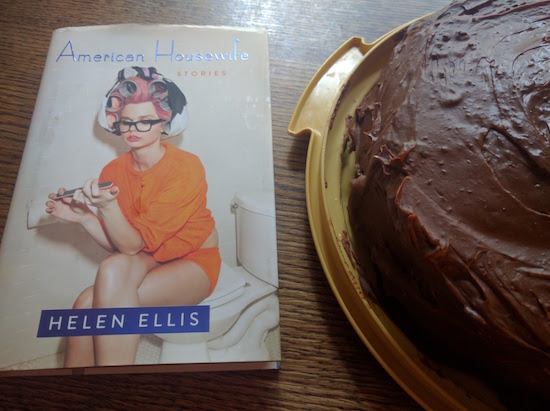
I bought Helen Ellis’s American Housewife after reading about it plenty, and then reading more in Laura Miller’s article on Housewife Fiction (which led me to Diary of a Mad Housewife, by Sue Kaufman, which I loved so much and should surely be brought back into print). I bought it at Ben McNally Books after asking at the counter for a book “with a woman in rollers on the cover, written by someone whose first name is Helen” (because I have become that bookshop patron as my mind begins to fade), and they found it for me. I read it sometime in the summer, but didn’t write about it here, not because it was insubstantial necessarily, but because it was so digestible that I didn’t really need to work through it. Reading this book was like reading a magazine, which I think was meant to be part of its appeal, with the lists scattered throughout between stories and numerous pieces with a didactic bent i.e. “How to be a Grown-Ass Lady” or “How to Be a Patron of the Arts.” There was a surface the reader could skim, is what I mean, though there is more going on if the reader dares to probe deeper.
But there is a limit to the probing (this is not a sexual metaphor, you pervert) because this book is pretty short. It is the most terrific package, a miniature hardcover, cute cover, appealing design on the spine. It is easy to objectify this book and to appreciate it, and yet my book club colleagues who work in publishing were confused about it. People don’t buy short stories, they affirmed, and yes, this is a slight book, but it’s a hardcover, more than 30 dollars. Who was meant to be a audience? Well, me, I thought, although I also know that my singlehanded efforts to support the publishing system have not been seeing the results I’ve been hoping for, so perhaps that wasn’t the most excellent plan.
Anyway, this book is intriguing. It fascinates me that it was borne of a Twitter account (@WhatIDoAllDay), and the resulting snappiness of the book’s contents. It intriguingly plays with the line between autobiography and fiction (in the way that social media in general does) and I’m interested in domesticity as divorced from motherhood, which we don’t see very often. For many women, motherhood offers a direction to one who is otherwise lacking such a thing (for better or for worse) but what do women do if they don’t pursue that option? There is a scathingness to the writing here, and my book club friends wondered just who was being satirized, and if Ellis was reviling her very readers (middle age ladies in book clubs) but I argued that she was implicating herself. This is a book about wanting to write and not writing, or else writing but not being being published (the distinction Ellis describes as the distance between Wimbledon and hammering a tennis ball against the garage door), its about the paralysis of too much choice and women’s roles and living with failure and compromise, and it’s funny, nasty and kind of amazing. We loved its Southern lady/Southern gothic vibe, and the Shirley Jackson darkness, and that John Lithgow appears as a character. I like that Helen Ellis is also a professional poker player, which seems at odds with her southern lady persona, but that is the point of southern lady personas, I think, the surprises that lie beneath an exterior of conventionality. The same could be said of the book. We all had different stories we’d connected with and others not so much, and there was so much to think about, and argue about, and even to agree upon.
And afterwards, we all ate cake.
September 26, 2016
The Dependent, by Danielle Daniel
 I have tremendous admiration for author/illustrator Danielle Daniel, whose picture book, Sometimes I Feel Like a Fox, was one of the best picture books I encountered last year, a finalist for the First Nations Community Reads Awards, and which has recently been nominated for the prestigious Marilyn Baillie Picture Book Award. And so when I learned she’d written a memoir, I know I wanted to read it.
The Dependent is a memoir about her remarkable marriage, a relationship that begins when a headstrong Women’s Studies major meets a handsome guy in the Canadian army, and they embark upon an adventure together that requires plenty of compromise on her part. Daniel doesn’t fit the traditional mould of an army wife, and is continually frustrated by the army’s demands upon her family and also her husband’s willingness to do as the army required in order to further his career. She writes with brutal honesty about her anger and also about her experiences with depression, which begin in this memoir after she experiences a miscarriage. She also alludes to a troubled family background that colours her experience of the present and makes her a jealous and mistrustful partner. Her husband Steve, however, does not have a lot of sympathy for his wife’s point of view—like a good soldier, he doesn’t delve into complicated emotions and focuses on his mission, one thing after another. He is frustrated that his wife does not seem to have ability to work through her unhappiness.
9/11 changes the stakes for members of the military serving around the world, and so too for Danielle does the birth of her son—although Steve leaves home for three months just weeks after the birth. She is relieved when Steve finally receives a position in Canada that keeps him from having to serve overseas, but what she thinks is to be their happy ending turns into another kind of story when Steve is injured in a parachute jump and is left a paraplegic. Suddenly Danielle is no longer married to the army—and in fact the support offered to their family is almost laughable inadequate—but her husband’s disability is something new and just as complicated to navigate. What makes the book so interesting is that Steve rebounds from his injury the same way he does from everything, and the dynamics of their marriage remain unchanged: Steve goes back to school, begins to train as an athlete training for the Paralympics, and becomes a local celebrity. Meanwhile Danielle is lost is the same shadows that had been following her for years, not to mention her husband is altogether dependent on her in so many ways, and she doesn’t know who she is beyond his wife. She is angry with Steve and with the army from what it stole from them, and tired of years of compromise, and Steve is understandably upset that she is wallowing in her pain all the while he’s the one who’s been injured. He doesn’t understand that she’s been a victim too.
Years of simmering tensions come to ahead eventually, and getting to this point makes for a fascinating read. I was impressed how surprising the dynamics were between Steve and Danielle, complicated by the fact that they’re two actually human beings with all the baggage and complexities inherent. While some of the dialogue between them seemed awkward and stilted, containing the same kinds of arguments over and over (which is a marriage problem as well as a narrative one), that would be my one criticism of The Dependent. What blew me away about it, however, was its structure, Daniel’s remarkable deftness with chronology, which makes me think of her art, collage, layers and textures. The Dependent is not told in chronological order, but instead weaves in and out of time (because the idea of time as a line is a point the narrative itself serves to refute. We carry all this stuff with us). The playing with time and story, the giving and withholding of detail, is stunningly accomplished, which is only underlined by the book’s incredible, miraculous and beautiful ending, which is also its beginning, a fantastic, complicated and beautiful love story, and isn’t that always the way…
September 21, 2016
Book Catch-Up
 Heroes of the Frontier, by Dave Eggers: I stopped reading Dave Eggers at some point (after What is the What, I think, which I loved, although I am not sure I still would…) and I’m thinking that was probably the right idea. I bought his latest novel because I’d heard intriguing things about it, and while I’m glad I read it and liked lots of things about it—there are good bits and he writes children so brilliantly, in particular the younger child who reminded me of my own feral creature who also likes to scream disrespectful things at inanimate objects—but it was too long and rudderless. Actually reminded me a bit of Vendela Vida’s Let the Northern Lights Erase Your Name, which I loved years ago, and also the movie, Away We Go, which Vida and Eggers wrote together. The ending was so good, so I closed the book satisfied, and there were plenty of points throughout where I gasped or laughed, but I was put off my the narrative’s rudderlessness. Why are we floundering, I kept wondering. Which is perhaps a point about nationhood and existentially as well, but for a near-400-page book gets a bit annoying. Thinking about A Heartbreaking Work of Staggering Genius with its footnotes and that novel he wrote after (in my copy the text started on the cover and ran right through to the back cover) and his tendency to have the narrative swell to fill all available space, literally and otherwise, and I am not sure that it’s an altogether good thing. But Dave Eggers gotta be Dave Eggers. I don’t know. He’s interesting. But also not—although he is always more interesting than any arguments disparaging his work and character. There is nothing more boring than hating Dave Eggers. I do think the novel is worth picking up for the depiction of its children, which is remarkable. Not everybody will be able to get through it though….
 A Great Reckoning, by Louise Penny: I do think that Chief Inspector Gamache has been feeling a bit aimless since his retirement in How the Light Gets In about three years back. But in her latest novel, Penny gives him a task and a half: he’s charged with leading the police academy and rooting out its forces of corruption. It’s a novel that has resonance and relevance in light of constant stories about police brutality and #BlackLivesMatter, and it also returns us to Three Pines (don’t worry—Gamache and his wife still have their home there, although they also have a small apartment at the academy) where residents have found a mysterious map hidden on a wall, a map on which Three Pines appears and perhaps the last one upon which it ever did. What does the map symbolized? And yes, who is behind the murder that takes place at the Police Academy soon after Gamache’s arrival, a murder in which he is a suspect? The answers to both questions become intertwined, and connected to a long-ago tragedy from the Chief Inspector’s past which becomes clear at the novel’s devastatingly lovely conclusion.
 Don’t I Know You, by Marni Jackson: I have this idea that my mother spent the years before I came into the world singing “Hey Jude” in downtown pubs in grand singalongs and running around Europe with an accordion playing “Those Were the Days, My Friends”, by Mary Hopkin. By virtue of my parents being baby boomers, I was born nostalgic for a world I never knew—I remember listening to “Carey” by Joni Mitchell when I was fifteen and anticipating a time when I’d have gotten used to clean white linens instead of scrambling down in the street. To be honest, things never worked out so well for me textile wise, but these all remain my cultural touchstones, never mind they happened long before my time. I’ve always wanted to go down to the Mermaid Cafe, which is a huge part of the appeal of Marni Jackson’s fiction debut, whose unique premise is that each story in this linked collection hinges on a fictional encounter with a celebrity, celebrity itself being a kind of fiction—the Brangelina breakup notwithstanding because that shit is real. Anyway, the premise is neat but not the point and eventually becomes secondary to the stories themselves, which are beautifully crafted, full of surprising turns of phrase and plot, and take us through the life of Rose McEwan from age 17 (when she enrols in a writing workshop taught by John Updike) to 67 (when she embarks on a canoe trip accompanied by Leonard Cohen, Karl Ove Knausgaard and Taylor Swift). In between, Van Morrison drives a TTC bus into the mystic, Adam Drive shovels her snow, Gwyneth Paltrow gives her a facial, and Joni Mitchell gives her the lowdown on the perils of free love. This is one book you can certainly call an original, and it’s one that has been staying on my mind.
September 13, 2016
Winter Wren, by Theresa Kishkan
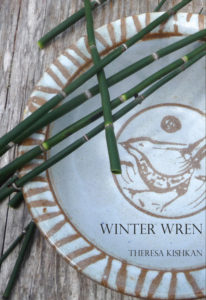 I’d been reading Theresa Kishkan’s novella for a while, the first release from her imprint, Fish Gotta Swim Editions, whose books are designed by the talented Anik See (and oh, this little book is so lovely). And I thought I’d found an error. The book takes place in 1974, and there is a reference to the protagonist being born in 1915, and I thought, “No, wait.” A typo, I figured. She’d been born in 1945. And I still don’t know why I was so insistent on the error, that Kishkan’s character could not have possibly been 59 years old, except for the fact that I rarely encounter a woman in fiction who is 59 years old. And if I do, she is peripheral, or her identity is wrapped up in being somebody’s wife or mother.
Of course, I’ve met old women in literature, characters at the end of their lives, unravelling—Hagar Shipley. And there is no shortage of women in their twenties, thirties, forties, but there seems a paucity of women characters in their fifties. In general, I mean, and perhaps these books are out there and I’m just not reading them. But I’m not reading them, which is why the idea of a 59 year old woman still exploring, growing and transforming seemed remarkable to me. And then it became not remarkable at all, and I became aware that what was remarkable was this literary gap.
Winter Wren is the story of a woman, an artist, who returns from decades in Paris and the end of a love affair to Canada after the death of her mother, and makes a place for herself in an isolated cabin on Vancouver Island. She becomes preoccupied by the view from her window, and with the man who’d lived in her home before she bought it and who she visits in a home for seniors. He too is preoccupied by the view, and wishes she’d paint it for him.
Bring me the view at dusk.
Kishkan’s protagonist, Grace, is a character in one of her earlier novels, The Age of Water Lilies—Kishkan writes intriguingly of her novella’s genesis here. This book is a beautiful meditation of transformation and of place, and the line I loved best was, “Every morning I awake and am filled with a kind of quiet joy to realize where I am.”
August 30, 2016
Mister Nightingale, by Paul Bowdring
 In my friend Mark Sampson’s review of Paul Bowering’s last novel, the award-winning The Stranger’s Gallery in The Fiddlehead, he wrote, “Bowdring’s prose bursts with such clarity and assuredness that you trust his voice to take you anywhere it wants…” I know this because this excerpt from Mark’s review appears inside the ARC for Bowering’s latest novel, Mister Nightingale, and when I read that line, I thought, “Exactly.” Because while the notion of Bowdring’s novel as a “novelist’s novel” appeals to me—I love his send-up of literary culture, of small press politics, of comradeship and competition between writers, and all of that insider baseball—Mister Nightingale isn’t the kind of book I can manage to get through. And not just because it’s written by a man (she writes, unabashedly wearing her bias on her sleeve), because it’s about a man whose own literary bedrock is so definitively male. It’s all Kafka and his frozen heart, and James Joyce, and Proust, and all those people I’ve never read and never will because so many other people read them already that I don’t have to. Because I don’t trust any writer who doesn’t have a single literary foremother, or at least ten of them, and Bowdring’s James Nightingale never references one.
And yet, there was something about the narrative. While in most books, the lack of foremothers would be off-putting, I was willing to forgive it of Mister Nightingale. Because of what Mark wrote about the clarity and assuredness of Bowdring’s prose that I trusted enough to follow. Because (and I am not kidding, this is usually a deal breaker for me): in the entire book, there is not a single blowjob (and this is another reason why I tend to avoid books by men. Ubiquitous blowjobs. They go on for paragraphs and paragraphs. It’s really quite unbearable). And because there was this strange and uncanny echo in the novel of Carol Shields’ Unless, and I’m not saying this was anymore than me making weird connections, but they were vivid ones. James Nightingale, like Reta Winters, a semi-successful novelist, belying the ordinary lives and concerns behind the writer’s persona. James’ estranged wife is called Alicia, who plays viola in an orchestra, although in Reta Winters’ fictional novel, her heroine Alicia is engaged to a man who plays trombone in an orchestra, and so the lines aren’t exactly parallel, but still, one reminds me of the other. Mister Nightingale raises the question of unlived lives, as does Unless and also Shields’ The Stone Diaries, James considering the experiences of his neighbour who discovers her freedom and possibilities when her husband dies and her children are grown, and he also considers his own lives, the ones he might have lived, had he made other choices. Both characters also deal with the demands of elderly parents, and the peculiar, tangled nature of relationships with daughters on the cusp of womanhood. In many ways, these books are spiritual siblings. I think they’d get along.
Mister Nightingale begins with James’ return to his native Newfoundland after 30 years away. He’s even missed his own mother’s funeral, but now they’re offering him an honorary degree, and a local press is reissuing his first book. Plus his marriage has ended in Toronto and he doesn’t know what he’s going to do next, so it seems like a good time to return to the scene of the crime. The crime being the small press publisher ripping off James’ friend, the poet, Kevin, who didn’t get paid for sales of his book and who was furious to discover his poetry published in a high school English text and he hadn’t been paid for that either. So naturally, things are going to get more than a bit interesting at James’ book launch (although the date for that event is being postponed over and over again, in absolutely true small press fashion).
But in the meantime, James takes stock of his life, tries to reconnect with his father, encounters ghosts from his past, learns all the ways that Newfoundland has changed and stayed the same in the last three decades, and keeps some tabs on his daughter, who has just started university in St. John’s. He becomes reacquainted with his sister, gets a Newfoundland driver’s licence, partakes in an ill-attended book signing at the local Chapters, and gets drunk on local TV.
All of which is to say that the novel is not terrible plot-driven, but we go there anyway, with pleasure even, for all the reasons recounted above. Mister Nightingale is a smart, funny and absorbing book, and I’m so glad I went along on its journey.






