October 18, 2016
The Party Wall, by Catherine Leroux

It’s always a good sign when the blank pages inside a book become riddled with notes and diagrams, as has been the case with my copy of the Governor-General’s Award/ Giller-nominated The Party Wall, by Catherine Laroux, prize-winner in its original French, translated into English by Lazer Lederhendler (Nikolski!). Not because the stories themselves in the novel are so difficult to figure out—in fact, they read beautifully with luminous prose (“Fall is approaching and the warmth of the South throbs on the horizon like a sack of gold at the foot of a rainbow”)—but because the challenge and the pleasure is discovering how all of it fits together. While the shape of most narratives is a horizontal line (with the inevitable bump for a climax), the shape of The Party Wall is multi-dimensional, arrows pointed in all four directions and connections that hold the whole thing fast.
The Party Wall is several stories, and while one might argue it’s more a story collection than a novel, I have more fun considering it as the latter. These stories could probably all each stand on their own but the whole is much more than the sum of its parts, which come together in the beginning as a series of curiosities: a woman in Bathurst, New Brunswick, discovers she is not the biological mother of the son she gave birth to; a married couple with a cosmic connection (and he actually the Prime Minister of a future, post-apocalyptic Canada) discover they are twins who were long ago given up for adoption; and a brother and sister (a police officer and an Olympic runner) in San Francisco sit by the bedside of their difficult mother who is dying, and each try to come to terms with the fact that they may now never discover the identity of their father. These descriptions might give the impression that these aren’t stories that are steeped in realism, that they belong to a nether or even an ether world, but that’s not the case. There is magic and there is wonder, and while these situations are indeed highly unlikely, look around you and consider what isn’t.
If these stories are rooms in a house, the walls of the house (that connect them and divide them) are a story on another scale, one that takes place over the course of a single morning in Savannah, Georgia, two sisters wandering the rough and familiar edges of their neighbourhood. From details in the larger-canvassed stories, the reader understands premonitions of danger, this offering the book in parts the momentum of a novel—and where the danger is actually found is probably not where the reader expected. Anticipation of narrative links also urge the reader through the book, and the revelations are never cheap or disappointing, instead adding texture to the richness of the narrative.
In addition to the narrative links, the stories are joined by references to unfortunate cats (whose names include Bastard, Wretch and Shabby), a fixation on horizons (“the boundary between the two worlds, and what manages, unbeknownst to scientists and the gods, to travel from one to the other”) and walls that get knocked on, punched in, listened though and lived in. And yes, the splendid writing, twists that bend your mind, and a story that stretches across a continent, across years and lives, and binds them all together.
October 17, 2016
Today Will Be Different, by Maria Semple
 The first time I read Where’d You Go, Bernadette?, by Maria Semple, was the night after Iris was born via c-section, when I was immobile and yet expected to breastfeed my squalling baby off and on throughout the night (and many nights after…). Not exactly the best of times but it turned out to be the best of books, so much so that every time the baby woke, I was excited to pick up the novel again. It made for splendid reading. Bernadette was smart, funny, clever, breezy, dark, light, and I have always been a little sorry it ended. I’ve never completely gotten over this book.
I read Semple’s first novel, This One is Mine, not longer after, hungry for more of the goodness. It was not as good as Bernadette but had the same something. The same understanding that smart books need not be serious, and humour and situations surely born from their author’s experience writing for television. The same slightly neurotic, irresistible (if you’re a certain kind of reader) point of view. Awhile after that, I read Where’d You Go, Bernadette? again, because I wanted to and also because I wanted to see if it was as wonderful as I remembered/if perhaps I’d been influenced by being on drugs in my adoration of it. It was/I wasn’t.
And so I’ve been waiting more than three years to read Maria Semple again, a situation that brings with it enormous expectations, and I am very pleased to say that Today Will Be Different didn’t disappoint. And nor was it like anything I’d expected. I did a Q&A with Marissa Stapley last week at 49thShelf.com, and she noted that readers and critics of commercial fiction need to take notice of when its writers are taking risks with their work, and celebrate those risks. Here is a book that defies categorization, that pushes the limits of fiction and its tools (and how—the novel contains a mini graphic memoir, among other paraphernalia). Structurally, it’s a fascinating book…why is why I was totally annoyed last week when I listened to an interview with Semple and the interviewer refused to talk about the book outside the realms of autobiography.
It’s true that writers like Semple do make it easy for critics to fall into the trap of conflating author and narrator. It’s true too that very often the two are properly conflated. But when we view our fiction (and our fiction by women in particular) through such a narrow lens, we limit ourselves as to what fiction is all about and missing the chance to talk about women as artists and creators instead of giant sacks of feelings and experience (and after all, what then is memoir for?).
The way that Semple mines her experience and the world around her is interesting. There. There’s a start. Also the way she blurs fact and fiction even in her form, by including extra textual documentation and creating cultural reference points in vivid detail. Today We Will Be Different differs remarkably from Bernadette in its first person narration—while Bernadette was an enigma, we know exactly where Eleanor Flood is, and the reader is stuck right inside her head. Which is a little hard to take at times, and why this is the case is a worthwhile question and makes me thing of demonstrable evidence that people prefer the sound of a male voice to a female one. It’s also a matter of Eleanor’s idiosyncrasies, her digressions and preoccupations, and bluntness—she actively maintains a list of subjects she proactively chooses not to care about, diversity among them. Eleanor Flood is not dying for you to like her. And yet like her, you probably will. She even knows you will.
The book begins with the prospect of a new day, a day which (no surprise here) our protagonist becomes determined will represent a turning point away from the rut in which she has found herself stuck. “Today I’ll play a board game with Timby. I’ll initiate sex with Joe. Today I will take pride in my appearance. I’ll shower, get dressed in proper clothes and change into yoga clothes only for yoga, which today I will actually attend.” An ordinary day that might make all the difference, and it does, but not for the reasons that Eleanor imagines it will. Her plans soon go off the rails: her son’s school calls requesting she pick him up as he’s suffering from a fictional stomach bug; her lunch plans (with the friend she’s spent a decade being unable to shake) are not what she bargained for; and when she shows up at her husband’s office to foist their son upon him, it turns out he’s told his staff that he’s on vacation for a week and they’re surprised that Eleanor and Timby aren’t with him. Where is he?
There are writers who sit down and painstakingly plan their books before they start writing, a mess of post-it notes and index cards, and one gets the feeling that Maria Semple is not one of them. The plots of her books resemble those dotted lines on maps in Saturday morning cartoons in which small children navigate space with curious and often dangerous diversions. Which is kind of a funny way to plot a book, but think of the joy you once got in running your finger along that line, and also of the momentum inherent in this kind of narrative, the briskness with which the reader is brought along for the ride. It also turns out that plot isn’t really the point is, but voice is, and Eleanor Flood’s is the kind of voice that’s hard to get out of your head.
While parts of the narrative seem too brisk, a careful reader will discern clues hearkening to a deeper story, a complicated one of family and Eleanor’s sister, who is only alluded to briefly and mysterious in the novel’s first section. Why the elusiveness? Follow the urgent dotted line, and you will discover the answer, and while the novel ends in a story line that is as ridiculous as the end of Bernadette, you will just be so devastated that it’s over.
October 16, 2016
Looking for a room.

A few weeks ago, I went looking for a room. The whole thing was a bit like a dream; you know, the ones when you’re walking through a place that’s kind of your house and kind of not. Except this wasn’t at all my house. It was Emmanuel College, the building at Victoria College in which the EJ Pratt Library was temporarily located during its renovation in 2000/2001. I worked at the library throughout my undergraduate years, which included the renovation, a period during which the student workers really weren’t very busy. I used to spend hours and hours on Saturday afternoons at a desk in a room where a bunch of computer terminals had been brought in. I recall watching the sun go down at the end of day outside the west-facing window.
I wanted to find that room. The west-facing window was a clue, but I wasn’t sure about the rest of it. When I walked into Emmanuel College a few weeks ago, I was completely disoriented. Where I thought I’d find the room, I found instead a corridor, and there was a stairwell up to the second floor, but I didn’t remember it. I had to pass through the Emmanuel College Library proper (notable for being where the video for “Head Over Heels” by Tears for Fears was filmed), and I have no recollection of the library being en-route, but so it goes. And then I emerged from the library, and there it was. I think. I have no memory of a fireplace, but perhaps the fireplace was less remarkable against the computer terminals (where this creepy man used to come and look at porn and the printers still had continuous stationery).
There was a desk on the righthand side just inside the door, and that’s where I used to sit, with a computer of my own with access to the internet. Which was remarkable. In previous years, student assistants had only had access to the library catalogue and the circulation system, and I used to get a whole lot of class reading done. But less so once the World Wide Web was at my fingertips. I don’t remember what sites I used to visit, or what my online routines were at all. (The very first time I went online was in a class at high school, and my teacher told me to click on a button called “What’s Cool.”) But somehow I found my way to a livejournal belonging to a girl I’d gone to high school with, and I loved the way her livejournal was a window onto her mind, its eclecticism, its mundane details and pop song lyrics and fervent pleas, and idle records of idyl days, and posts that meant much more than that. I read it and thought, “I want to do that too.” And so one Saturday afternoon in October 2000, at my desk just inside the doorway, when I was thoroughly unoccupied and the autumn light might have been much like it was this afternoon, I signed up for an online diary of my own.
From Mitzi Bytes:
“So she started writing the words down in a diary, an online diary, which seemed particularly private since nobody else she knew spent any time on the Internet. The only people online were lonely just like she was, other people who couldn’t sleep at night. It seemed like there was just a handful of them, all networked on the online diary site. This was when she’d never heard of a ‘blog,’ let alone a blook.
She wrote about insomnia, the fish shop, the depressing corner into which she’d painted her life. She signed up for dating websites, and began to write about that too, the triumphs and the horrors of attempting to begin again. When she finally had sex with a man who wasn’t her gay ex-husband, her online friends had showered her with jubilation. This was the post that had indicated that perhaps her online diary had some resonance with the wider world. A bunch of popular blogs had linked to her post, which she’d called ‘Notes on Finally Sleeping with a Heterosexual Male,’ and the resulting traffic had crashed the server of the online diary site.”
Obviously, there is a lot I don’t have in common with the protagonist of my forthcoming novel (not least of which: I have never had sex with a ventriloquist; in my online diary years, I wasn’t having sex with anybody, which isn’t very story-worthy, and so I was unlikely to crash a server) but what we do share is the amazing connections that came from putting our ideas out into the world, ideas that were obviously intended for an audience, never meant to be as solitary as the term “online diary” suggested (…although who really intends even their analogue diary to be unread anyway. Otherwise, what is the point?).
When I started blogging (although I didn’t call it that then) I was young and impressionable, and I learned so much about the world and life and culture and experience from the people who were giving me windows into their own universes. Blogging is “a very public way of working shit out for myself,” as Emily Wight mentions in our conversation, and the “shit” I was working out and have still been working out is everything. My blog was thoroughly ridiculous back in 2000, because I was, fixated on boys whose experiences I was completely peripheral to; full of angst and longing for things I couldn’t even articulate, let alone figure out how to achieve; overwhelmed by the goodness of friends who’d stand by me all the days of my life; and swept away by the sentiment of cheesy pop lyrics, the closest thing I knew (I know?) to poetry. My blog is the path I took from there to here.
A blog needs space to grow and room to wander, exactly the way a life does. Room. A room. I’m thinking about Virginia Woolf, of course, but also that room in Emmanuel College where I created my first post, and resisted all good sense and pressed publish.
If I hadn’t been bored and a bit lonely with time on my hands, what ever would have become of me?
October 13, 2016
Cut it out.
 My novel has a little bit of the sex in it. Not much, but a bit. I am still not sure how I feel about this. I continue to know that having published a book in which I document my abortion, everything else after it seems like cotton candy. Sure fictional sex is no big whoop. And yet…
Yesterday I met with the wonderful Noelle, Managing Editor at Harpercollins Canada, and we went through the proofreader’s notes on Mitzi Bytes (which will soon be seen in galley form! So exciting!). Anyway, I am pretty good at being edited, and so the process was going smoothly…until we got to a note in the middle of a sex part. And I couldn’t even look at the page, let alone the words.
“Oh, Sweet Jesus,” I shouted, averting my eyes, “Cut it, add it. Whatever it is. I don’t care.” Noelle started to say something. “Just let’s move on,” I told her. “I don’t want to talk about this. I can’t!”
Which makes me think I’m probably not going to be reading those parts at readings and festivals. You will have to read them alone at home.
October 13, 2016
Commonwealth, by Ann Patchett
 I have never read Bel Canto. I don’t particularly want to read it. Your emphatic declaration of love for that book is unlikely to change my mind, but thank you for trying. I came to my admiration of Ann Patchett through the back door, via her essay collection, This is the Story of a Happy Marriage (which I reviewed in the Globe and Mail a few years back) and her novel State of Wonder, which I loved. The first thing by her I ever read was Truth and Beauty years ago, and it meant a lot to me. I sincerely appreciate her multifacetedness, that one reader’s Ann Patchett is probably not another’s (and then she goes and becomes an indie bookseller on top of it all.)
Her latest novel, unsurprisingly, represents a departure from her previous work, although having read her essay collection, I was able to note the autobiographical connections. The title “Commonwealth,” as in the state of Virginia, whose own title refers to the welfare (wealth) of the people (common) who live there. Some of the book is set in Virginia, although more is set in California, and also Chicago, New York, and Amagansett. Geography offering no hindrance to the connections between six people whose lives become irrevocably connected due to circumstances set off at a christening party when Bert Cousins arrives with gin, and ends up kissing Fix Keating’s wife, the baby (Franny)’s mother, Beverly.
The first scene of this book is remarkably choreographed, truly a dance between characters, in and out of corners, conversations overheard. Momentum is swift and the writing is terrific, and we think we know what we’re being set up for. And then we’re dropped into the second chapter, near present day, Franny with her ailing father, accompanying him to his chemotherapy. So this will be a novel ducking in and out of time, whose story becomes history with the turn of a page, and the events of the first chapter are recalled with decades of perspective. We learn that Beverly left Fix for Albert, but that their own marriage didn’t pan out, and there have been subsequent spouses. We learn that the babies and the unborn babies of the first chapter have come into adulthood, for better or for worse. It’s a different tone entirely.
Chapter 3 is back to the sepia tones, and we see the two families coming together, the shaky alliances and firm divides. The marriage is never on great terms, but for better or for worse, the Keating and Cousins children are bound together but also subject to the rifts between their respective divorced parents. It’s a curious dynamic, and all the parents are too busy dealing with their own tragedies (and philandering) to pay the children the attention they properly require. Things go amok. Pills are ingested, there’s a fatal bee-sting, and a most inexplicable gun.
And then we find Franny in her early twenties, dropped out of law school and working as a cocktail waitress. She hooks up with a famous writer who we learn discovers that her family history is his muse, later writing the story into a novel (his last, a brief interruption to decades of writers’ block) called Commonwealth. Years later the novel becomes a movie that Franny and her sister take their father to at his insistence, and they all end up walking out at the unbearableness of seeing their history (however fictionalized) presented there.
My experience of the novel was initially stilted—I’d just be getting into it, and then I’d be pulled away by a shift in time, character, setting, tone and everything. Around the time Franny was working as a cocktail waitress, I wasn’t sure that the sum of the parts made sense as a whole…but eventually it started to, and soon no one was pulling the strings, it was just all working, the pieces together doing what the best novels do: showing how one thing leads to another, and that there is no better plot in all of literature than the plot of family life.
October 13, 2016
On Blogs and Food Blogs: a Conversation with Emily Wight
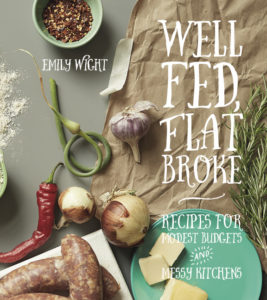
 Emily Wight is author of the cookbook, Well Fed Flat Broke, which is the cookbook that taught me what people are talking about when they talk about reading cookbooks for pleasure. She is also the longtime writer behind the blog of the same name, and I really admire her work and her perspective on blogging.
I’d always wondered if my own philosophy of blogging (that blogging should be easy, fit nicely into your life, never be a chore…) was relevant to food blogging. Emily was kind enough to answer my questions about food blogging, and blogging in general, and what it means to be an old school blogger still at it in 2016.
*****
Dear Emily,
I really admire your blog, your book, and all you do, and it occurs to me that you might the perfect person for something I’ve been wanting to do for a while. I teach a blogging course at UofT and think about blogging a lot, have all kinds of theories about blogs as a radical space, for women in particular. and how blogs have certainly been hijacked by commercial interest. My favourite thing about blogs is there inherent messiness, how they’re works in progress, an exercise in making it up as you go along…
But I also know that this doesn’t quite work for food blogs. A lot of work is required for a food blogger. Whereas I see a blog as a great place to practice the art of imperfection, a food blogger has to get it right or else she’ll be messing up her readers’ dinners. There is also the nature of sponsorship…
Anyway, I would be really interested in reconciling my own ideas about blogging with the realities of food blogging and expanding my understanding of blogging in general. Would you be willing to engage in a back and forth email conversation over a few days to get some of these ideas flowing?
**
 EMILY
EMILY
I’d be happy to help! But also food blogs can be messy and alive, it’s just harder to find them now. I really like Poor Man’s Feast and The Yellow House, but to be honest I’ve really moved away from reading a lot of food bloggers. By the time fall comes, I never want to see another recipe for squash soup as long as I live. I think the “why” behind food blogging has shifted from when I started one million years ago in 2007/08, certainly.
**
KERRY
Okay, so here is my first question. My whole deal is that blogging should be easy, it shouldn’t be a chore. If blogging is hard and taking up too much time, I preach, then you’re doing it wrong. But with food blogging—I suspect and as I’ve been told—there is recipe testing required, you can’t do typos (or else you can end up with a tablespoon of salt when it should have been a teaspoon). It’s a whole different game. Not to mention staging required for photographs… Has this been your experience? Is food blogging inherently hard? Is there a way to fit food blogging sustainably and easily into one’s life?
**
 EMILY
EMILY
I don’t think food blogging is inherently hard—I have a much easier time of it than something like, say, fashion blogging, because I understand food but clothes remain a mystery to me. In most food blogging, food is the creative outlet—it’s a kind of art of its own, and so blogging about food is really just communicating a different form of expression, if that makes sense?
I think that people get satisfaction from different parts of it. I’m not a great photographer, so for me the staging and photographing is an afterthought, because no amount of effort in that regard is going to make my crappy iPhone photos significantly better; I think I’m a decent writer though, so I hope to coast on the quality of the writing and the recipes. For other people who are perhaps better photographers, maybe the writing feels hard.
In terms of accuracy and recipe development, that is a unique challenge but again I’d liken it to its own art form. Like, why would anyone do this if they weren’t either creating or archiving something? For me food blogging made sense—my education is in creative writing, but I am most excited about food, and we have to eat anyway. Food blogging became a way to write every day, or at least fairly often at a time when I might not have known what else to write about.
“Food blogging became a way to write every day, or at least fairly often at a time when I might not have known what else to write about.”
The challenge of sustainability now, I find, has less to do with the form and more to do with my own motivation. There’s a lot of “content” out there. I recognize that this is my own problem—food blogging is very different in 2016 than it was in 2008, and there are so many new voices that it can be hard to wade through and find your people. I won’t read on if I feel like a blogger is writing sponsored content, which is perhaps unfair, but again there is just so much out there now that I get to choose not to be marketed to if I don’t want that. At this stage, I am really looking for writers who make me look at food differently, or who use food as a vehicle for a larger story, whether there’s a recipe at the end or not.
**
 KERRY
KERRY
So interesting. I am also really invested in the idea of blogging as a process, and a never-ending one too. An opportunity to learn and grow. That is why I started blogging about books back in 2007ish. Which is definitely at odds with the way that most bloggers these days are urged to position themselves as experts and gurus. I feel like we don’t get to see any of the process anymore, that the process is regarded as mess, something to be swept into the corners.
Did you have any food blogger “credentials” when you started blogging back in the day? Were they even necessary? You talk about motivation for food blogging—do you think people blogging in 2016 are blogging for blogging’s sake, or are they blogging with the intention of a book deal or some other professional opportunity? And I want to know also—what motivates you to keep blogging after all this time?
**
 EMILY
EMILY
It’s totally a process! That’s why I don’t delete all my terrible, very bad posts with their clunky writing and hideous photos, because I like the idea that you can follow someone back through their process of growth. I remember when I first discovered The Bloggess in maybe 2009, and she was so funny and wonderful, and I had an evening alone (and no children), so I went all the way back through her archives and marveled at how her voice had strengthened and changed as she worked at it. There’s value in the process, and if nothing else it’s reassuring to be able to go back and see how you’ve evolved.
“I don’t delete all my terrible, very bad posts with their clunky writing and hideous photos, because I like the idea that you can follow someone back through their process of growth.”
I think the difference between then and now is really in how we’ve come to view online writing—the idea of “content” creates this sort of urgency to post regularly, to demonstrate value and expertise and keep people coming back. There has always been talk of “building an audience,” but prior to maybe 2011 the message was “make something valuable and people will come.” I don’t think that’s changed, but social media has really altered how that happens—now you don’t just have to make good blog posts, you also have to market them, and you—that was always kind of the case, but there’s so much more “content” out there now, that you have to put in a lot of effort—on a greater number of platforms—to stand out. If you want to do it well now, you have to think of yourself as a “brand” which honestly just feels so ridiculous. I get it, but I don’t want to do it.
“There has always been talk of ‘building an audience,’ but prior to maybe 2011 the message was ‘make something valuable and people will come.’ I don’t think that’s changed, but social media has really altered how that happens.”
Which is not to say that people who are doing it are doing blogging wrong, it’s just that the culture has changed. It does seem like people spring up fully formed overnight, with these beautiful sites and strong voices, but I wonder if part of that is that these are people who are approaching it with more online experience. When I started, I had had a Facebook account for maybe a year and that’s about it; I think now, for a lot of people, the social and visual aspects of blogging come pretty naturally. The technology is better—everyone has an iPhone now and iPhones take pretty good pictures. Getting to where you can be seen as an expert in whatever you’re doing is not such an investment as it used to be. “Anyone can do it” has turned into “anyone can do it well.”
 I didn’t really have much in the way of credentials when I started, short of a writing degree. But is a writing degree any less a credential than professional cooking experience, if the blog’s audience is the home cook? The people who did really well early on had really strong perspectives—people like David Lebovitz, or Luisa Weiss, or Pim Techamuanvivit (who has since quit blogging). They really created the model for what you see a lot of people doing now, and I think created a sense of what you can do if you do well online.
Do people blog just to blog, or do they want something else, like a book deal? I don’t know. I think people sit down and open a WordPress account for the same reason they ever did—a desire to connect, to write, or just to find their people online. But I think there is more of a sense that if this goes well, there are other opportunities in it. People take bloggers more seriously now than they did even a few years ago. You certainly see a lot of blogger cookbooks now, and they are often quite well done (and do very well).
“I think people sit down and open a WordPress account for the same reason they ever did. But I think there is more of a sense that if this goes well, there are other opportunities in it.”
As for me and why I still do it? Well, I certainly do it a lot less than I used to, because now I feel like I only want to write when I have something to say, or a recipe that’s really worth sharing, or to gauge whether what I’m working on is something people want to see more of. With other social media, like Instagram or Facebook, I still feel very connected to my community, so I spend a lot of time on there and other platforms. I treat my site as more of a portfolio—I don’t get paid to write on my blog (I don’t do ads or sponsored posts), but it generates other opportunities. It also allows me to work out my point-of-view a bit, and to figure out what I want to do. I would not have had the opportunity to write the book without the blog; now that I’ve written the book though, the blog is still very important in that it’s a place to dabble and experiment with what I want to do next. It’s a very public way of working shit out for myself. I also get the benefit of feedback—people will make the recipes or comment on the writing, so I know pretty quickly what’s working and what’s not. It’s a hard thing to let go of, especially if you came up in writing workshops and are used to a more collaborative approach to the creative process.
This ended up being a lot of words! In short, I think that blogs are valuable and the evolution and messiness is valuable and we’re in a time of transition, because at this point blogs aren’t going away and also there are always more blogs. But like anything produced en masse, there’s good, meaningful stuff in there and I want to see it, especially if it’s a bit unrefined.
**
 KERRY
KERRY
You are my blogging soul sister! That space to grow and evolve is so essential to successful blogging, I think (and I think a lot of bloggers who head into the gig thinking strategy and imagined outcomes are going to trip up on that). I am curious about your ideas about actually reading blogs. In my course, whenever I ask students what blogs they read, they usually shrug their shoulders and admit, “none!” Which is not to say that nobody reads blogs. I think that lots of people read blogs, but we come to them more laterally. I read food blogs all the time, but usually find them by googling whatever happens to be in my fridge and seeing what recipes result. I used to use a blog reader back in the day, but then Google ended it, and my blog reading was kind of rudderless after that—and I missed blogs. So I actively sought out a blog reader (I use protopage.com) which made reading blogs more of a regular habit. Kind of anachronistic, but I like it old school. I have a small but loyal group of readers who seem to feel just the same (and this is not JUST my mom). Anyway, I am interested in your thoughts on reading blogs and also finding readers. As you said, social media is a huge part of this.
Also, regarding the messiness: do you think it’s just too terrifying for some people to show their mess in public? Is that’s what’s driving the push toward tidy blogs? And by tidy, I mean antibacterial robot blogs? Is the blogger who’s willing to show her process taking risks that might be unwise?
**
 EMILY
EMILY
Ha! I’m glad we’re on the same page, as I often feel like I am a cranky old man about everything and no one understands 😉
Google Reader did kill blog-reading for me, in a lot of ways—remember when you could follow, like, 50 blogs? 100 blogs?! Haha, no. I don’t read a huge number of bloggers, but I have kept up with the ones who tell good stories, or who make me laugh. I love Afroculinaria, and Eating From the Ground Up, and The Pizzle, food-related blogs that offer more than just content. The thing about “content” is it’s stuff meant to fill space. How much of what we’re putting out there is valuable? How much can any one person care about? I know content when I see it, and there’s a real difference between reading something someone put thought and time into and some junk they threw up just to have a post on Tuesdays as per usual, you know? And so, I am reading fewer and fewer blogs. But the ones I am reading, I’m really invested in. Like, I would be genuinely sad if they went away. But you’re right, I don’t think people “read” blogs in the same way that they used to—I agree, I definitely come to blogs more laterally now, and I don’t often click “follow” on the blog when I find someone I like—I find them on Instagram, or on Twitter or Facebook.
I also get to say all that as someone who has been around long enough to not really have to hustle for readers. Do I need more readers? I am sure in terms of marketing books more readers would be valuable, but I am not unhappy with how I am doing, and the amount of traffic moving through the site on a daily basis, even when I don’t post very often. I recognize that the landscape is different now, and I get to be someone with cobwebs and cat hair and it’s, like, my thing. Maybe it’s not that we’re not hustling, we’ve just earned the ability to not have to? Maybe those newbies with their neat presentations and good cameras and shiny websites look at people like us, who have been around a long ass time and don’t feel obligated to bother with Pinterest, with envy?
“Maybe it’s not that we’re not hustling, we’ve just earned the ability to not have to?”
 It might be scarier now to show your mess in public. Mess isn’t marketable, and I think because there are so many blogs out there now, you need to look like you know what you are doing in order to be taken seriously, or at least to be followed by people who don’t care about stuff like messiness and the creative process (which I think is most people). Another aspect of this is that a lot of these blogs are or want to be businesses—and businesses run quite a lot differently than creative projects. I want to say this in a way that doesn’t make me sound like an asshole (because I don’t mean anything offensive by it), but there’s a difference between writers and people who like to write; I think writers, or people who have always written (in the writers-as-artists sense), may value the mess and the show-of-process more than people who like to write but have other ambitions for their blogs. Writers aren’t penalized for having written shitty first drafts (or having evolved through a period of shitty-first-draftyness) because it’s expected, that’s what we do. But bloggers who want to turn blogging into something else, something beyond cookbooks or novels or whatever, maybe they approach it differently, and are more thoughtful about how they present themselves.
Did you see Luvvie Ajayi’s post on having been blogging ten years? She talks a bit about her process, and she had a few points I liked. This one, on evolution: “This blog has evolved with me. And my changed beliefs, my maturity and my growth as a person can be charted through the last ten years. How you start is not going to be how you continue and finish and that is okay. You are human.”
This resonated, because I think this is what’s been so great about blogging. I started out when I was 25 and still really immature in terms of my voice and my world view, and I am happy I can go back even three or four years and see that I have made progress, and that I am maybe a better version of who I was when I started. And maybe that kind of thing won’t matter to most people, but there’s a vulnerability in not being your tidiest, best-branded self and I think that resonates with the kind of readers who will stick with your writing long-term.
Follow Emily Wight on Twitter and Instagram, and stop by to read her blog.
October 7, 2016
Stepping Stones and The Journey
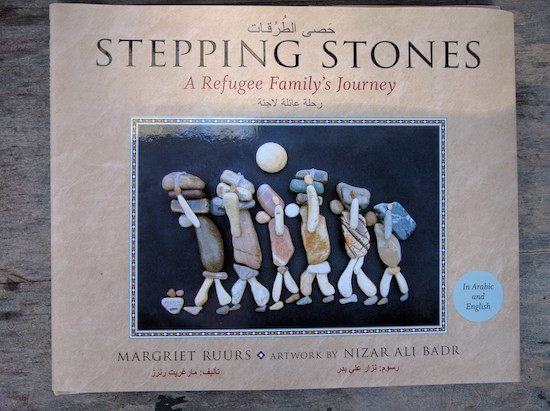
It’s not hyperbole to state that Stepping Stones: A Refugee Family’s Journey, by Margriet Ruurs and Nizam Ali Badhr, is one of the most extraordinary picture books I’ve ever encountered, a book whose incredible origin story is as remarkable as its execution.
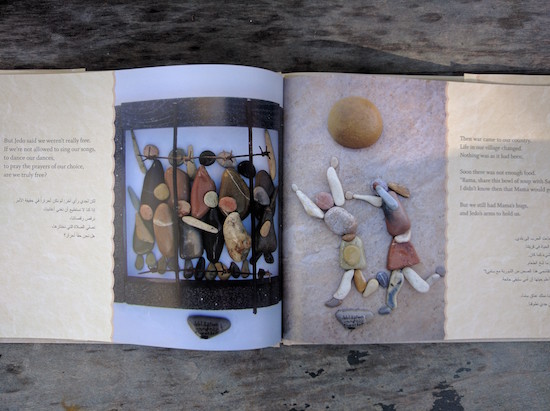
The story begins with Syrian artist Nizar Ali Badr, whose evocative scenes created from stones became popular on his Facebook page. Author Ruurs was inspired by the images and eventually managed to contact Badr, and plans were made for them to create a book together. Ruurs secured a contract with Canada’s Orca Books, who were on board with her mission that proceeds from the project be donated to an organization supporting refugees.
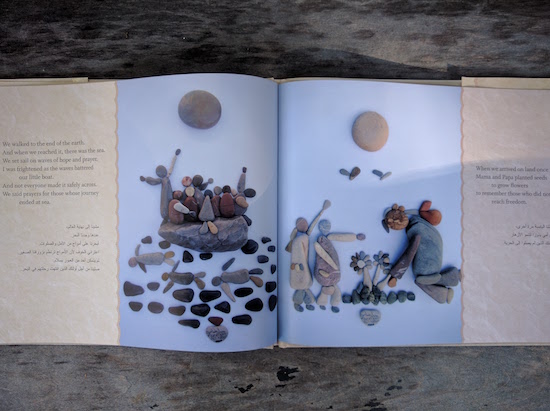
Badr’s illustrations are incredible. I never would have imagined that stones could be so creatively arranged to convey action, emotion and narrative. In her introduction to Stepping Stones, Ruurs tells us that Badr, who lives in Latakia, Syria, cannot afford the glue that would render his pictures permanent—and now his images have been collected in a book that people are going read on the other side of the world.
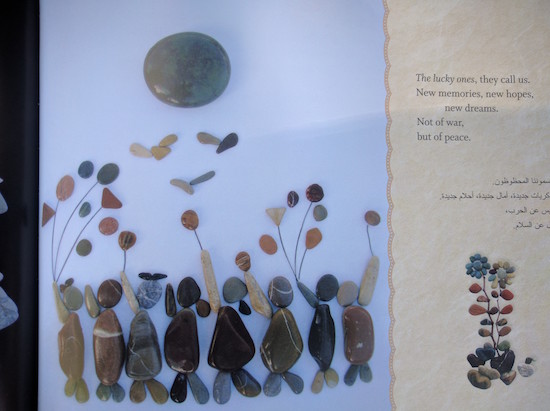
Ruurs’ story is beautifully told, narrated by a young girl whose family is forced to leave the only home she’s ever known, a place of family and friends, memories and familiar scents and sounds. They join, “A river of strangers in search of a place to be free, to live and laugh, to love again. In search of a place where bombs did not fall, where people did not die on their way to market. A river of people in search of peace.” Her text also appears on the page in Arabic, translated by Falah Raheem, making the book accessible to more readers and bring another player into this gorgeous literary transnational collaboration, a book that is very much of this moment and yet timeless at once.
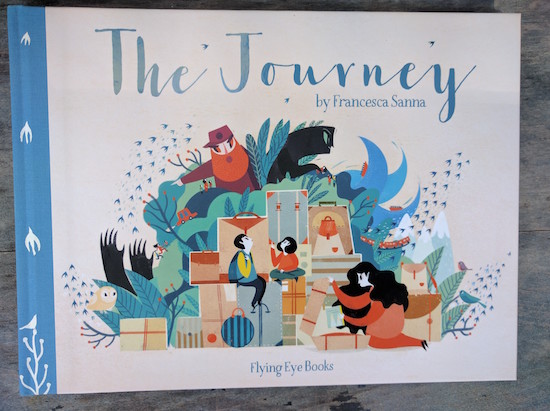
In her book, The Journey, Italian illustrator Francesca Sanna tells a similar story in a different way, a way that in narrative and images recalls fairy tales, Grimms, and an entire canon of stories about people fleeing danger, heroic quests, courage, monsters, danger in the woods, and hope out of the darkness.
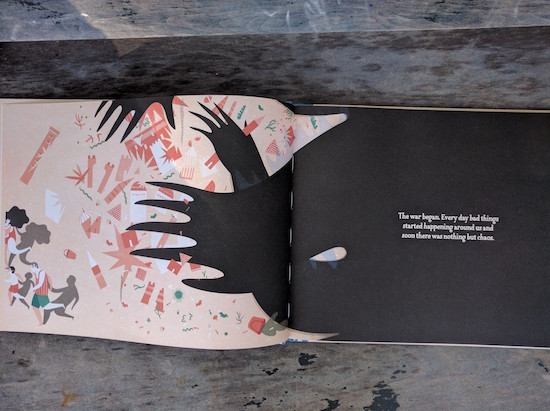
Sanna writes that her story is not meant to represent one particular kind of refugee story, but that her book is a collage of different experiences she learned about through her work at a refugee centre in Italy. The stories themselves become a jumping-off point for a narrative that is not necessarily literal, and neither are Sanna’s illustrations, which are dark and compelling (although my daughter as requested that we not read this book at bedtime…)
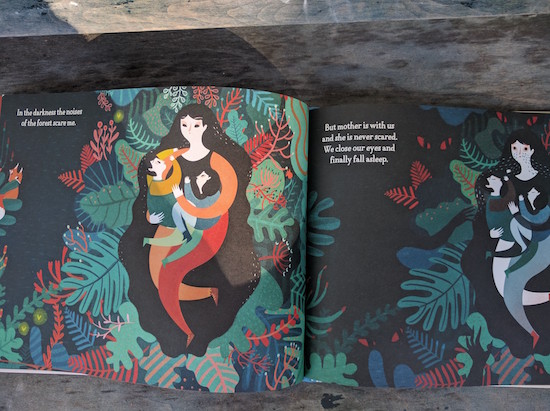
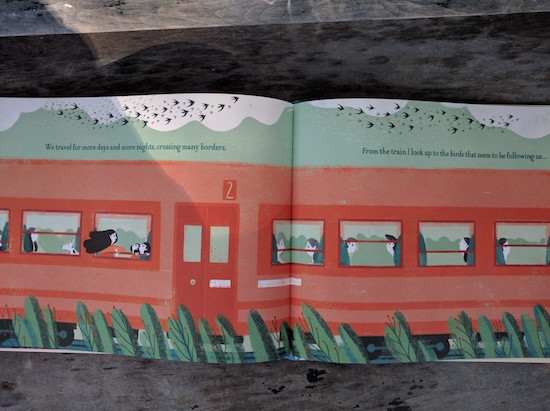
By car, on foot, by sea, and then by train, the family makes their way, encountering threats along the journey and also help from shady characters. The discerning reader’s heart breaks for the mother.
As with Stepping Stones, The Journey ends on a hopeful note, although the journey isn’t over yet: “I hope one day, like these birds, we will find a new home. A home where we can be safe and begin our story again.”
Reading these books, it occurred to me that it’s not just children who require stories like these in order to better understand current events and the world around us. Politicians, and bigots, and other grownups with hardened hearts who’ve forgotten how to be human—these are the readers who need to read these books in order to remember that people are people, some things are universal, and also that books are amazing.
October 6, 2016
Mad Men: Season Five
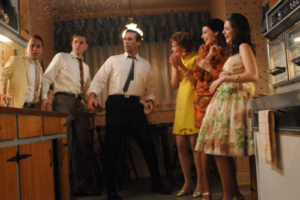
We’re still rewatching Mad Men, now midway through Season 5. From here on in, I’ve only seen these episodes once before, never feeling as compelled to see them again as I did with Seasons 1-3 which, it was true, were working on a very different level. I’ve even stopped taking copious notes as I watch because a) why was I taking notes in the first place b) I’ve started winter knitting projects, and I’ve not yet found way to knit and take notes (although I’m working on it) and c) I’m finding these later seasons don’t require the same puzzling-out that the earlier ones did. Characters’ motivations are clearer, the whole sense of the show is more familiar, and perhaps it’s less textured. These later seasons don’t have the same sense of grand wholeness as the others, as though these pieces are all part of a larger, and deeply intricate project. These later seasons get a bad rap too, the general sense being that things went downhill after Season 3. In a way it’s true, yet the show is still fascinating, and even more importantly (and what we were not anticipating): whenever we finish an episode we find ourselves saying, “Oh, that was was so good.”
It’s true that I was always most invested in Don and Betty as a unit, and remained as such for the rest of the series, and even though they’re both so terrible (for themselves and each other) I cherish their moments of connection after their divorce. How Betty calls Don when she learns she has a lump on her thyroid (although I notice this time that she comes home from the doctor calling for Henry, and it’s only when she can’t find him that she calls Don; she’s actually just looking for somebody to cling to, it’s not personal): “Say what you always say,” she tells him, commanding him to promise her that everything is going to be okay.
Megan Draper never really looked for me, not an actual character as much as a cipher, although this time I’m working with that and thinking that this is part of the point of her. I was always bothered by the way she seemed to be a (poorly-written) character whose personality forms as the show goes on, rather than seeming like a human being with a life behind her. But regarding this less as a problem and more of the general scheme of things has been interesting—this might be the one thing she has in common with her husband, actually, and what about her appeals to him. “Maybe I’ll be a copywriter? Maybe I’ll be an actress?” It’s kind of annoying, but I wonder if Don admires that openness, all her possibility. That they are both inventing themselves as they go—but her with such an open heart, the kind of generosity (to herself and the world) that he’ll never be able to conjure.
Ken Cosgrove has become an excellent man, just the way I remember him. The only decent guy of the lot. Shocking to rewatch Season 1 earlier this year and realize that he was thoroughly terrible. But he evolves, as Harry Crane devolves. Seeing Peggy and Stan together is really wonderful—it’s all inevitable. And I admire her character so much, and Joan too. That they aren’t binary characters—the show is so much more complicated than that. And poor Lane Pryce. There really isn’t more on that I need to say.
Season 5 is interesting, but just a little bit boring as Don struggles to behave, the tension there palpable. It’s weird though, his insistence on making this marriage work, because he doesn’t seem all that happy in it. Megan makes him seem old. Next season, it all goes wrong again, and he starts bonking his neighbour, and I might have to start taking notes again, trying to answer what has always been the question: “What IS Don Draper thinking?”
For now, whatever he’s thinking, I’m pretty sure it’s something grim.
October 4, 2016
Goodbye, Guardian Swim.
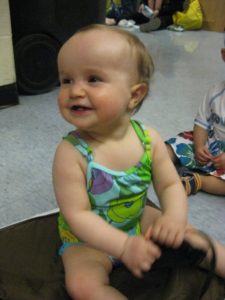 When Harriet was a baby, we had no money but plenty of time, and so instead of enrolling her in swimming lessons as the swishy pool near our house (with salt water and everything!) I signed up for cheap swimming lessons at the city-run pool that was far away and at the top of the only hill in this entire city. It was better than joining a gym, I decided, and only cost $33 dollars, and so began my Guardian Swim years, which is the more inclusive name for the Parent and Tot program I remember from my own childhood.
In the beginning, I was very excited. In the beginning, I find, parents need to strive in order to enact parenthood properly (luckily, many of us outgrow this compulsion) and guardian swim was one way to do so. It was also something to do with my baby that didn’t involve me lying on the carpet being bored out of my mind. It got us out of the house. (The idea that there was a time in my life when I was desperate for excuses to “get out of the house” distresses me now. That sounds awful. I never want to be that person ever ever again.) I am sure I found the first lesson exhilarating. Fortunately, I was never that poor parent whose baby screamed throughout the entire lesson every week and eventually we had to give up going swimming altogether, $33 dollars sadly to waste. Harriet liked the water, I liked having something to do, and so we did it, session after session. I have done “The Fish Wishy” so many times.
Oh, Guardian Swim. Once in a while I signed up for you, and the first class would have this terrific, dynamic teacher with lots of games, songs and ideas, and every time we met that teacher, she or he taught the one class and we never saw them again. Most of the other instructors had a short repertoire, and then would grant the class “free time,” and my baby and I would flounder aimlessly in the pool watching the clock until it was time to go home. There would be plastic toys, and the children would be drawn to them, but once the baby had a toy boat in hand, there wouldn’t be so much to do.
My most favourite part of Guardian Swim was when my husband took the baby into the pool, and I sat poolside reading a book. My least favourite part was when the instructor would give us an obligatory educational session, like how we shouldn’t leave our babies unattended by backyard pools or feed them marbles in case they choked. I also wasn’t big into the times that people pointed out that swim diapers contain faces but not urine, the thing that most of were trying really hard not to think about. There was the sessions with Shaheed, who was the worst teacher ever, and often would forget to come class, never mind that I’d climbed that hill and got my kid ready for it (and got out of the house even—no small feat) and when we got there and he wasn’t, they wouldn’t let us get in the pool. The seventeen-year-old lifeguard would shrug, no idea about my sacrifice—”Nothing I can do,” he’d say.
From Guardian Swim, I learned that I should get dressed before my child does, otherwise she will take her dry-clothed-self and sit right down in a puddle on the change room floor. I learned that she could play with my keys while I got changed, and be sufficiently entertained. She learned how to blow bubbles and how to kick her little legs. I learned not to feed her marbles. Nobody, however, ever learned to swim.
When Harriet was nearly four, she was still in Guardian Swim. I look back upon this with the confusion many parents do when they consider their experiences with their first child. Why were we still doing that? I think part of the problem was that she was terrified of us letting go of her in the water, and clung to me so hard it strangled. She wasn’t comfortable, and neither was I. I was waiting for something to happen, something to happen that would allow us to progress, but that something never arrived. The last time I signed Harriet up for Guardian Swim at the pool at the top of that great big hill, I was very pregnant, and I’d never considered the agony of pushing a stroller with a four-year-old up at that hill in such a condition. It was terrible. Harriet wasn’t learning anything, and there was a six-month-old baby in her class who had better technique than she had. Something was going to have to change.
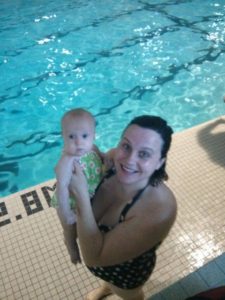 When Iris was born, we were no longer broke. Not only could we afford the salt-water pool, but the convenience seemed worth every penny. Harriet began a swim program that wasn’t geared to infants, and it was Iris’s turn for Guardian Swim. Which I think she was enrolled in three times total. Because neither of us felt like getting in the pool, and it was always cold, and she always had a cold. I was tired of doing the fishy wishy.
We moved to the nearby university pool eventually (spoiled for pool choice, I know) because Harriet needed some help getting caught up and the shallow teaching pool gave her more confidence. The half hours we passed in that pool during Iris’s classes could possibly be scientifically proven to be the longest 30 minutes on record. Even though Iris could actually swim. Like, she was leaping out of our arms and we kept having to catch her before she sunk, and if we’d been daring enough not to bother, she might have floated after all.
By this point, we hated Guardian Swim. It was unfathomably boring. The other children were annoying. The teachers were children. Every week we’d go, and I’d cross my fingers for a pool fouling so we could go home early.
But finally, we have arrived. Last week Harriet began her first swim lesson in the “big pool” upstairs, and she was the first kid in her class to jump in the water (when once upon a time, she was vehemently opposed to such things, and I used to berate her about it, made her practice jumping off the bottom step of our staircase until she cried—not my finest moment as a parent, and it turns out her instructor was right when he suggested we leave her alone and she’d figure it out in time). And Iris started Sea Turtle, the first level post-Guardian Swim, and she was amazing, dunking her head and floating on her back, and these things that she would never have been brave enough to do had I been in the pool alongside her.
And me? I was where I’d always been waiting to be, cheering along poolside, content in the company of an excellent book. So happy with the progress, which is generally where I tend to be in terms of parenting, not looking back in sadness but just so happy to be moving on. Enjoying the ride. “Little girls get a little less little but instead of it feeling sad, it feels exhilarating,” writes Rebecca Woolf on the occasion of her daughter’s eighth birthday, and I love that idea.
Why not embrace the momentum, because it’s not going anywhere—but you are.






