November 1, 2016
Moms who have desks

Moms who have desks is an idea that comes up several times throughout Mitzi Bytes. My character has an office on the third floor of her house, a space she struggles to justify to herself sometimes and to her family—and not just because her most vital occupation (her blog) is a secret to everybody in her life. Her friends have similar desk angst—one has put hers in a closet, but since she’d previously worked in a cubicle without a door, this represents a kind of promotion. If you squint.
The above image is a screenshot from a feature I read a few years ago about organizing your home—if I recall correctly, it quite rightly irritated readers and was subsequently removed from the feature. But it stuck with me, that dismissiveness about women’s work, about a woman’s place in her home, for its derision of household management (which is totally a job) as an occupation worthy of its own tabletop. When my character takes into account her desk—a hulking solid oak object she found on the curb years and years ago and dragged home all by herself, a relic of a life she lived a thousand years ago—she thinks of this feature. “Moms who have desks.” As though this is a sweet affectation.
 I thought of this again the other night as we read Spic-and-Span: Lillian Gilbreth’s Wonder Kitchen, about Gilbreth—psychologist, industrial engineer, efficiency expert, mother of twelve, best-known for the Cheaper By the Dozen book and movies. She also invented the shelves in the door of your fridge and the foot-pedal trash can. Not only a mom who has a desk, but she was a mom who invented a desk. Her Gilbreth Management Desk (pictured left) was unveiled at the Chicago World’s Fair in 1933: “Intended for the kitchen, the desk had a clock and, within easy reach, a radio, telephone, adding machine, typewriter, household files, reference books, schedules, and a series of pull-out charts with tips on organizing and planning household tasks.” (Info from here.)
Intended for the kitchen, yes, but Gilbreth did not underestimate the tasks on a mother’s or any woman’s to-do list.
Ironically, however, I don’t actually have a desk. I mean, I’ve had a few. Once upon a time I had a desk that my husband carried home for me on his bicycle, which is a form of devotion the likes of which have been rarely matched. And in another lifetime, I too worked in a closet, although it had electricity and a window—but no heating, and now that space is crowded with toddler-clothes-intended-for-hand-me-downs and boxes upon boxes of Christmas decorations. And on one hand I could feel put-out by this, by the absence of a room of my own, but I don’t feel the lack. I don’t need a desk exactly, because I’ve chosen to make the world my desk, table-tops the planet over. My kitchen table, my lap as I lie down on my bed or on the couch, or the arm of the couch on a day when I’m required to be upright. The table in the window of the coffee shop I’m sitting in right now on College Street as I wait to go pick up my daughter from Brownies…
What a desk is is permission, I think, to take yourself and your work seriously, no matter what it is you do. It can be actual (solid as oak) or metaphorical. A surface upon which to take stock, to finally begin.
October 31, 2016
Experimental Film, by Gemma Files
 I spent Thanksgiving weekend—as summer turned into fall, the leaves turned into reds and oranges, as everything started to wither and die—reading Gemma Files’ Experimental Film, which was so fitting for the season. I absolutely loved it, and was not the only one to do so—the novel won the Shirley Jackson Award in the summer and the Sunburst Award for Excellence in Canadian Literature of the Fantastic in September. It’s a book about horror movies, and the history of Canadian cinema, and motherhood, and parenting a child with autism, and there are ghosts and it gets creepy, and it gave me bad dreams—which I mean as a testament to the book’s power. I liked it so much, and found it had uncanny connections to Maria Semple’s Today Will Be Different, which I read right after—both protagonists are socially awkward, intellectually brilliant and unmoored in their own lives. In fact, I’d really like to go out for drink with both of them.
I was grateful for the chance to ask some questions about the book to Gemma Files for a feature at 49thShelf. I hope you’ll check it out and enjoy her thoughts on film and literature, the haunting capabilities of both, about how the movie Candyman inspired the book’s structure, the influence of Shirley Jackson, and what it means for literature to be weird.
October 30, 2016
My Year of Tana French

Last year, we had a rough December. I had pneumonia for almost a month, only recovering a couple of days before Christmas, and then Harriet got a stomach bug and Stuart came down with strep throat. It was not the most fun, and people responded with inordinate kindness. And at the tail-end of it all, we came home from visiting friends on New Years Day to find a plastic Waitrose bag hanging from our door. It was from my friend Nathalie (who blogs here). She’d delivered us a container full of soup (soup!) and a pile of books, which were the complete works (so far) of Tana French.
Can I tell you that if a book of anybody else’s entire oeuvre had been delivered to my house, it would have been an imposition. There are probably at least one hundred books around my house that I ought to be reading or at least rereading, and I am empowered enough as a reader that I don’t need any guidance as to what to read next. But I’d wanted to read Tana French for some time, and unlike most mystery writers, her books are rarely available second-hand (which is saying something). It is possible that I would have gone on wanting to read Tana French forever, but not actually done so, had Nathalie not delivered them to my door.
And so my year of Tana French began, with In the Woods, which is the best one, the most devastating, the most brilliant. Which is not to say that she’s not grown and changed with her books, but instead that I had no idea what I was in for with my first Tana French. I wasn’t even prepared to be blown away. Oh, but I was. Not by the mystery so much, though it was compelling enough, but by her first-person narrator, this broken man who doesn’t know he’s broken and I know it long before he does (and that line delivered by his flatmate when we realize that there’s so much he hasn’t told us. When we realize what he’s done…)
Tana French’s books all stand alone and aren’t necessarily a series, but if you read them in order, each one informs the other, a secondary or peripheral character from the previous books becoming the protagonist. The partner of the detective from In the Woods takes the helm in The Likeness, whose premise was kind of implausible and which was unapologetically inspired by Donna Tartt’s The Secret History. I was reading that one before Valentines Day, because I recall walking and reading it all the way to Kensington Market where I went to buy a present for Stuart, this winter having been uncharacteristically warm, because usually reading while walking in February just wouldn’t be possible. (It was wonderfully to be loving a book just that much.)
I read Faithful Place next, while lying on a deckchair in Barbados, in a single day, even. I think this might have been the one I love most, even if it’s because things domestically for Frank Mackey get sorted in a way that was heartwarming, amidst the murder and creepy basements. I read Broken Harbour in May, and this was one that really messed with my head (and I wrote about it here in a blog post called “Tana French is Ruining my Life”, so titled because I couldn’t stop reading at bedtime and wasn’t getting any sleep, plus the book was giving me nightmares). And then brought The Secret Place along on our vacation in August, and didn’t love it as much as the other books and it veered into the supernatural in a way that was a little bit weird (although it also dealt with girls and power and the power of girlhood in a way that was interesting—and tied into other books I read on that vacation, including The Girls, by Emma Cline, and The Story of the Lost Child, by Elena Ferrante). But I was still reading a book by Tana French, and there really isn’t much that’s quite like it.
I’d preordered The Trespasser, French’s first book since 2014, and it seems fitting that my year of Tana French should have a new release by her within it. (I was in Barbados when I learned this new book was forthcoming. Imagine my joy: that there would be another Tana French when the books in the Waitrose bag were done!). And it was everything I’d hoped it would be—a return to tradition of the first four books, a narrator on the edge who doesn’t know how close she is, a strange and tricky murder whose solution is not immediately in sight. I love her plots, her characters, her humour, and that I learn insults like “wankstain” (which shows up in two books). I love her complicated women and men, and their aloneness, and the awkward ways her characters connect with each other. I love her prose, her twists, and her portrayal of Ireland post-boom. Can you tell that I love everything?
For a more erudite appreciation, do read Laura Miller’s recent piece in The New Yorker. And it’s been a good year, but can you believe I have to wait two more of them (at least?) to find out what comes next?
October 28, 2016
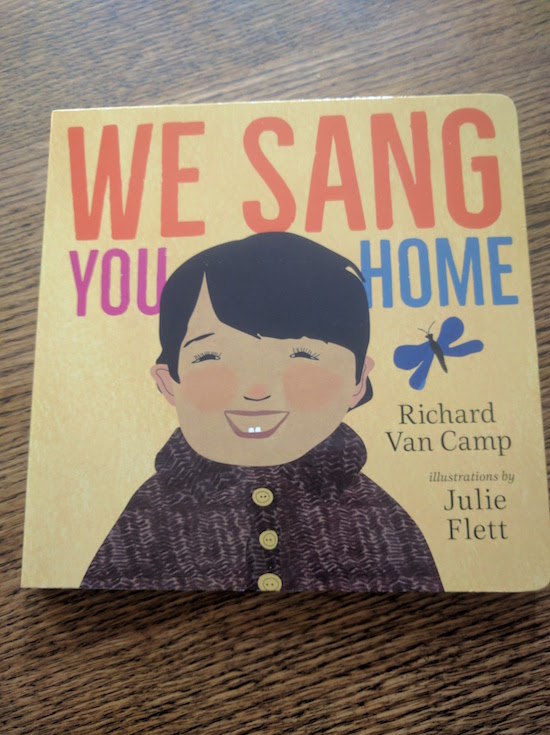
We Sang You Home, by Richard Van Camp and Julie Flett
You might recall that back when Iris was the world’s most disagreeable baby, the only book that held her interest was Little You, by Richard Van Camp and Julie Flett. It was a book that was so lovely I actually made the words into a lullaby, and the illustrations were so delightful that we got lost in them (the hole in the toe of the mother’s tights!), and we would have loved it so much anyway even if we hadn’t bowed down to it in gratitude for its suggestion to us that Iris was actually capable of liking things, and that she had superior literary taste even.
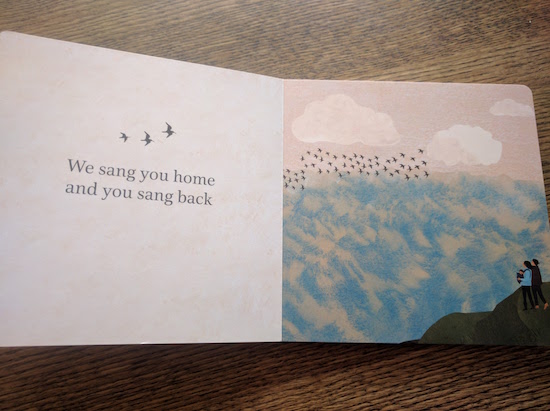
And so naturally, we’ve been excited about Flett and Van Camp teaming up again on another board book, even if my children (gulp) are beyond board books. Even if this is a technically another “Welcome, Baby!” book, and we haven’t welcomed a baby in three-and-a-half years. We are Richard Van Camp/Julie Flett mega-fans, and so we snagged a copy of We Sang You Home as soon as it dropped in our local shop. (We saw it in the window, but it was Sunday, and the store was closed. So we went back first thing the very next day!)
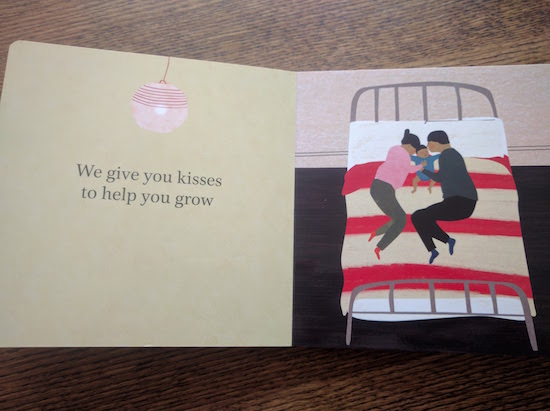
“Thank you for coming to live with us,” is a thing I like to say to my children, because I mean it profoundly, even if I do not entirely understand what I am talking about. (“Where did you live before you were born?” I ask Iris. “That was when I was dead,” she answers.) The chance, the luck, the miracle, of these two extraordinary people being created and born and raised to now is something that stuns me every time I think about it. I feel like a passive agent in the whole scenario too—for whom am I to take credit for orchestrating pure magic? I was just a body along for the ride.
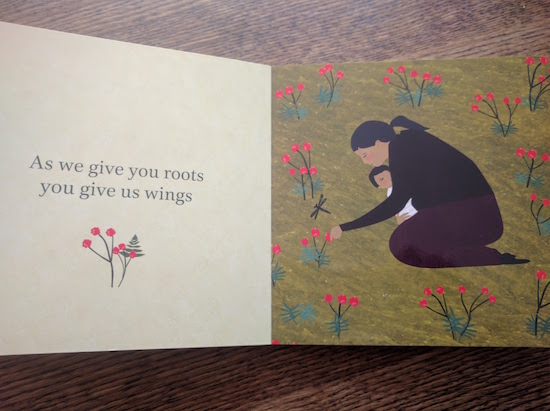
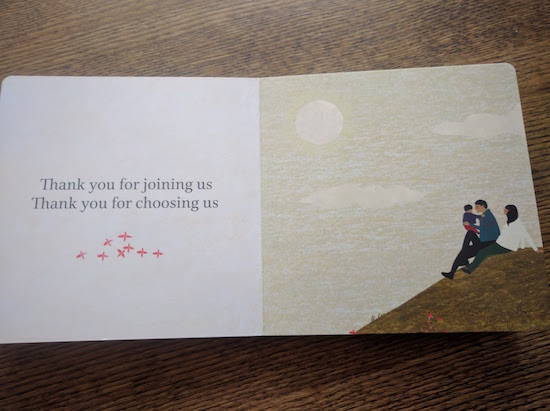
In We Sang You Home, Van Camp gives credit where credit is due, giving thanks to our children with blessing us with their lives, and enriching our worlds with their presence. The best thing about the book is its lack of specificity in both prose and illustrations as to how these babies actually got here—this story is suitable for adoption, same-sex families too. It gets at the point that is always universal—that when a child arrives, a parent is born, and the world is never the same.
October 27, 2016
Without Apology: Writings on Abortion in Canada
 In 1969, abortion was legalized in Canada, but only when the procedure was performed in a hospital and had been approved by a committee of doctors. In response to these restrictions, activists launched the cross-country Abortion Caravan in 1970, Canada’s first national pro-choice protest. Though plenty of road has been travelled since then—the problematic abortion law was struck down in 1988 – the fact that it’s still radical, 45 years later, for a woman to talk about her abortion in public suggests the fight isn’t over yet.
What has changed is the conversation’s tone. While passengers on the Abortion Caravan carried a coffin symbolizing women’s deaths from illegal abortions, contemporary campaigns—such as the viral #ShoutYourAbortion hashtag from 2015 – are more likely to focus on women’s lives….
Thanks to Quill & Quire for the opportunity to review Without Apology: Writings on Abortion in Canada, edited by Shannon Stettner. Read my review in its entirety here.
October 25, 2016
The Little Communist Who Never Smiled, by Lola Lafon

On the surface, Lola Lafon’s novel The Little Communist Who Never Smiled (translated from French by Nick Caistor) is a fictionalization of the life of Nadia Comaneci, but that (of course) is just a cover. What the book is really about is messaged in between the lines (or, quite literally, between the words). The Little Communist… is a book about the Cold War, the politicization of sport and womanhood, about deciphering codes and, fundamentally, this is a novel about punctuation.
 The book begins with Nadia’s performance on the uneven bars at the Montreal Olympics in 1976. (I call her Nadia. Everybody did. I wasn’t born until 1979, but I came into a world where girls were still gymnastics-mad and it occurs to me that gymnasts from that time are the only Olympic athletes I’m familiar with who aren’t from my country. From a very young age, I knew who Nadia Comaneci was.)
Her victory hung on point of punctuation, kind of—a decimal. Her score of 10.0 had never been achieved in gymnastics before and therefore the display screen didn’t have the capacity to show it. Lafon shows the confusion and crisis and judges and administrators realized what had happened and the scoreboard read 1.0, and the implications of this—this was an athlete from whom an entirely different system of success would be designed. “New numbers need to be invented. Or just abandon numbers altogether.”
On page 18, Lafon describes Comaneci: “Her arched back is a comma.” Which is significant because of how conspicuous commas are in the text. Comma splices are scattered throughout the novel, and I had to consider their implication, what they do to sentences. How in English they join unlike ideas in slightly jarring ways that makes the reader think twice, and it made me think about Romania in the 1970s and 1980s, a point in between the Cold War divides of East and West. Later in the book, Lafon shows Comaneci delivering an address in 1984 to announce her retirement from competition, an address that was written for her by the writer who composes all her official speeches: “He writes them out in short lines with commas so that she can pause for breath between them.” But in this address there are no commas. “She had not planned to be silent for so long she is simply searching for the comma, she thought she saw it but there wasn’t one, her words are chosen for her one last time, the comma jumps from one word to the next, like the decimal point: one point nought nought, she raises her eyes to those who have no words…”
The echo of the uneven bars creaking at the Montreal Olympics is “an uneven punctuation for her body as it folds itself around them.” Periods are replaced in between the letters of rival Olga Korbut’s first name in a Man From U.N.C.L.E.-like Cold War allusion (O.L.G.A). In her imagined exchanges with Comaneci, Lafon considers the punctuation used in newspaper coverage about Comaneci, “exclamation marks that compete with the ellipses.” There are references to the story of Nadia being written, rewritten (and indeed they are in Lafon’s imagined exchanges, which cast doubt on everything represented by facts. Truth is nowhere. Everything is suspicious.) and defying translation.
And then there is the period, the decimal point in another form. Full stop. Also menstruation (which I don’t think shares its name with a punctuation mark in the novel’s original French, interestingly, although apparently the French term for menstruation means “rules,” so it’s equally firm), which is hugely significant in this text. The arrival of the period signals the beginning of the end of Comaneci’s career, no matter her coach’s and manager’s efforts to stymy the effects of puberty through training and pharmaceuticals. But in the context of Romanian history, it has wider and more disturbing ramifications regarding forced pregnancy tests women were submitted to to eliminate instances of abortion, the way that not only Nadia had her body regarded as property of the state. And really, this sense of ownership over women’s bodies is a universal thing—anyone else who’s not an Olympic gymnast ever been chastised for not smiling?
And yet Lafon avoids obvious and facile comparisons with East and West with her imagined dialogue with Comaneci, who questions the ways in which women and athletes in the West are necessarily more free. While never minimizing the negative effects of life under the Ceaușescu regime, Lafon complicates notions that here and now is necessarily better than then and there. While Romanian people had nothing during the 1980s, Lafon is reminded in imagined conversations that sometimes nothing is better than insatiable materialist desires. All this so that we’re left with a notion of history and truth that is as elusive as Nadia herself, always just slipping out of one’s grasp.
“You quietly airbrushed your mistakes…could we say that?”
“Yes, exactly. I rewrite everything! But….discreetly.”
Thank you for the International Festival of Authors for inviting me to be a part of your blog tour and giving me the opportunity to read this truly excellent book.
Lola Lafon’s appearances at Toronto’s 2016 International Festival of Authors
(Supported by the Consulate General of France):
Monday October 24 8pm “Interpreting the Past” (Reading/Round Table)
Wednesday October 26 6pm “EUNIC: Writing History Telling Stories” (Reading/Round Table)
October 21, 2016
Hark! An ARC!
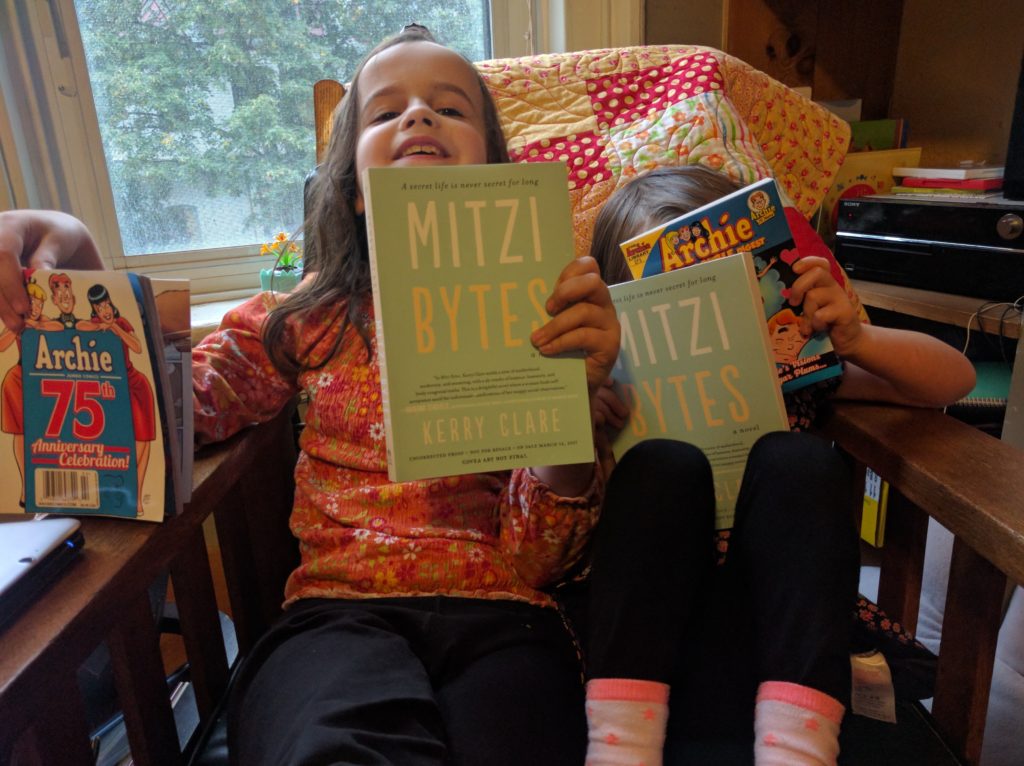
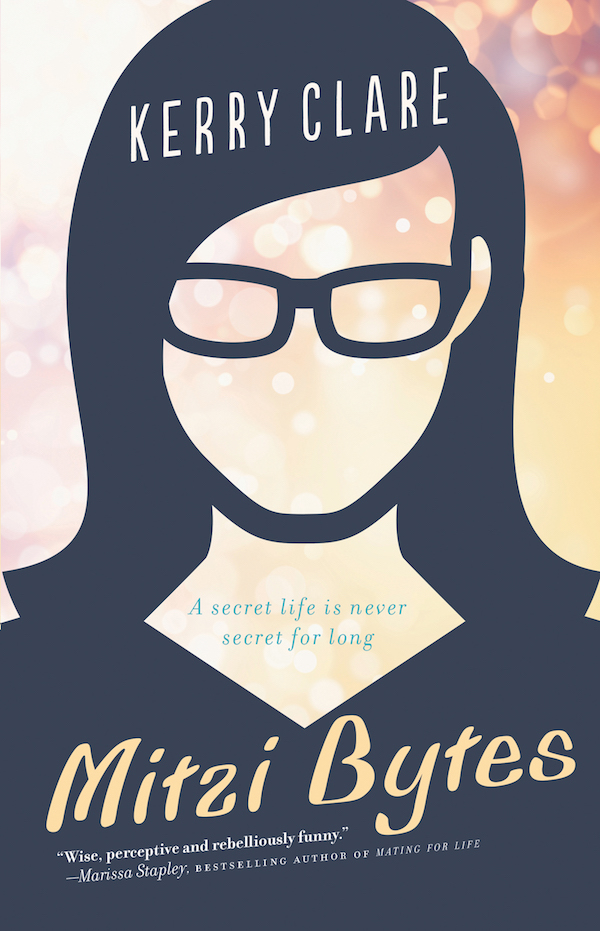
Mitzi Bytes is here! Advanced copies are, at least. There are no French flaps and the cover art is only temporary (although I like it) but it’s a book all the same, and ready to be sent out into the world and hopefully connect with (advance) readers. I am so grateful to May Friedman, Anakana Schofield, and Marissa Stapley, who were kind enough to read the book when it was still a pile of paper, and write such gorgeous blurbs. The photo above is a lie, as the children were mostly annoyed to have to put aside their Archie comics in order to pretend to be excited about Mitzi Bytes. I feel similarly chill about the whole thing. Not underwhelmed, but certainly not over. Just whelmed. But not literally. Perhaps unwhelmed is what I mean? Which is not a bad way to be.
I was just as excited as they were to spy their names on the dedication page, however!
October 21, 2016
The White Cat and the Monk, by Jo Ellen Bogart and Sydney Smith
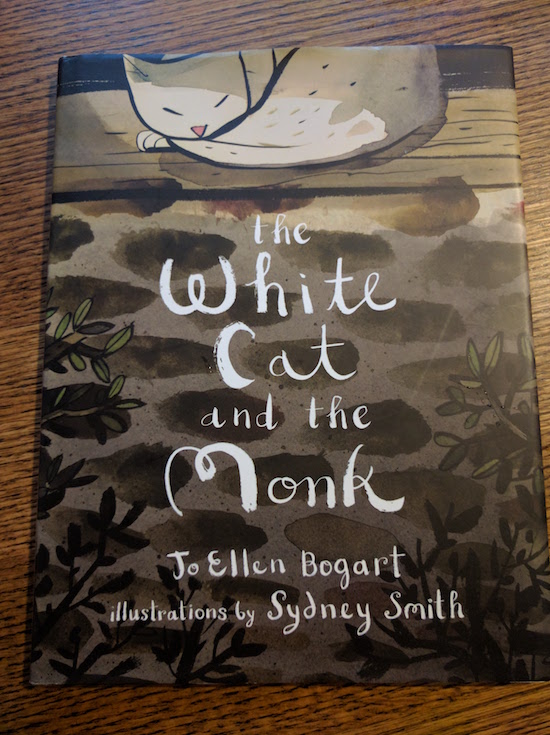
Of the many ways in which picture books are superior to all other literary forms is that it’s implicit that the book is going to be read at least one hundred times. You don’t even have to try, it just happens. “Read this one,” says a little voice as little hands force the volume into yours. Again. There are the books on the shelf that get picked up all the time, and even those which aren’t as regularly selected turn up often as a kind of diversion.
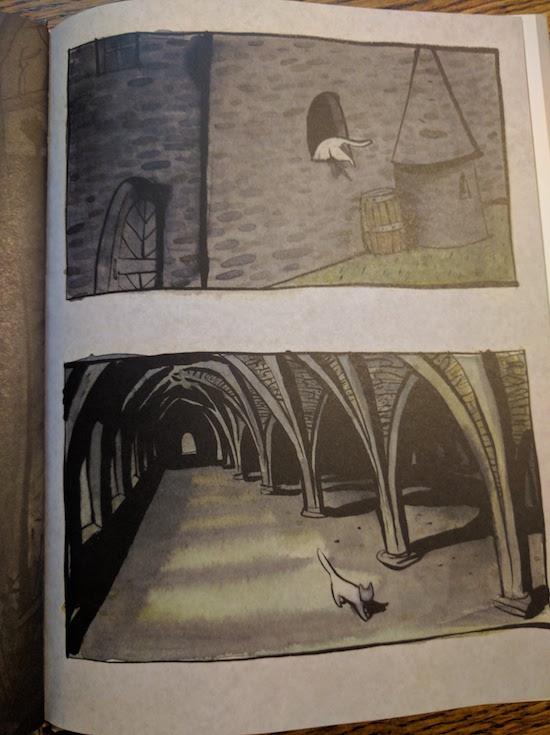
The White Cat and the Monk, by Jo Ellen Bogart, illustrated by Sydney Smith, came out in the spring, and we’ve been finding our way deeper and deeper into it with every read. It’s effect is subtle, at first. It’s a simple story based on a poem written more than 1000 years ago by an Irish monk whose name was never recorded. As Jo Ellen Bogart explains in her Author’s Note, the poem, called “Pangur Ban,” has been translated many times throughout the ages, and the words she’s selected for this incarnation are inspired by a number of these.
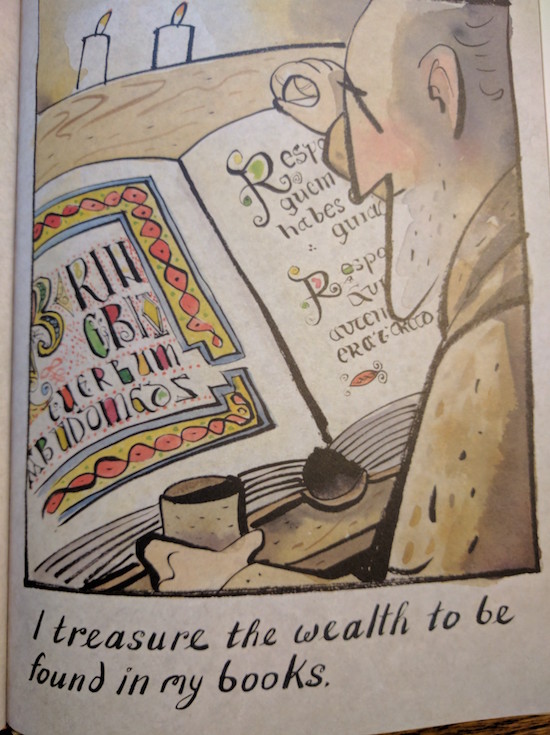
The story is about a monk who spends his days and nights seeking wisdom in the pages of his books, and who identifies with a white cat that has made itself his companion. Quietly, the two together go about their own particular trades, the cat pursuing its mouse and the monk pursuing knowledge.
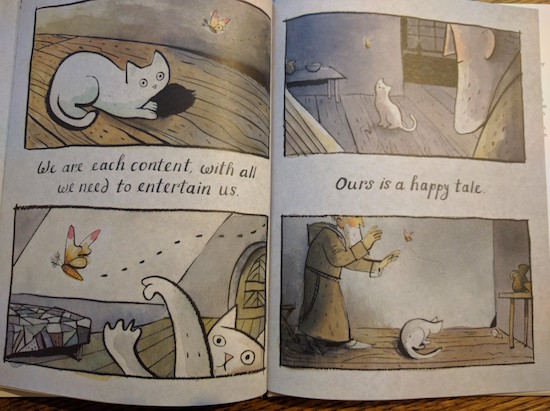
I don’t completely understand the story—that’s why I like reading it so much, getting a better sense of it every time. Is the scholar like a hunter? Is knowledge like prey? And what of the poor mouse? Not such a happy tale for him. It’s a book that raises questions—not surprising for a story based on an anonymous text. And that’s the very point, I think, the reader’s experience analogous with the scholar’s and even the cat’s.
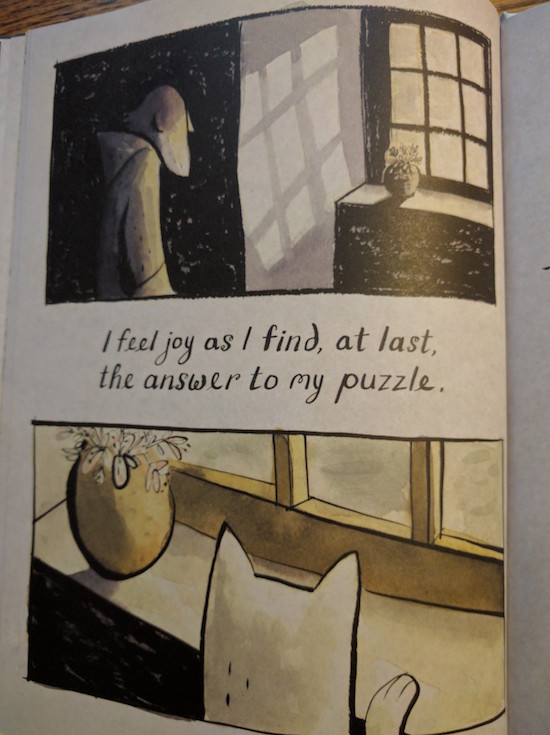
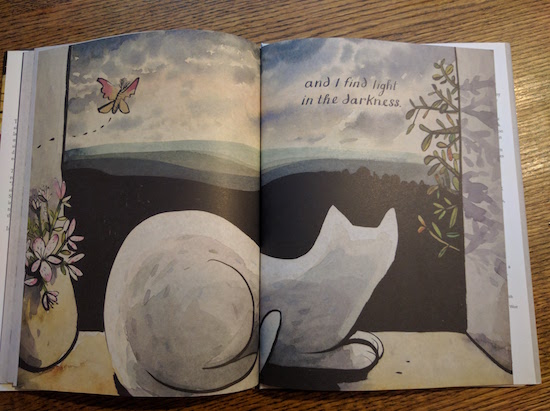
Notions of predator and prey are complicated by an additional layer of meaning offered through Sydney Smith’s gorgeous illustrations with the appearance of a butterfly in the room. The cat swats at it, watching it…and the monk opens the window to set the creature free in the story’s final spread and beautiful last line of text.
And I’m still not sure what the butterfly means, but I trust that in another hundred reads I’ll probably have a good idea.
October 20, 2016
In Praise of Coconut Oil
 “No one has ever asked me how they can get skin like mine.”
But even though they haven’t, I still wrote a post for Plenty about how you can do so…by using coconut oil as a facial moisturizer, including my top five reasons for doing so.
It begins with its amazingly low smoke point, and concludes with the wonders of toast crumbs for exfoliation, and it’s not even entirely tongue-in-(greasy)-cheek.
October 20, 2016
How to Get Over Literary Envy
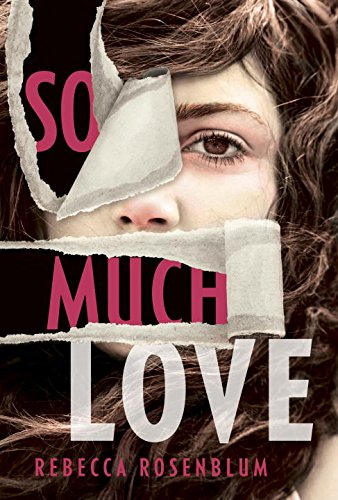 My friend Rebecca Rosenblum’s forthcoming novel, So Much Love, is publishing on the same day as mine is, March 14, 2017. This coincidence is as delightful to me as it is amazing (or even miraculous). Rebecca and I went to graduate school together more than ten years ago, and when I’d read Ann Patchett’s memoir Truth and Beauty later, about friends Ann and Lucy in their post-MFA years when they were “writing to save their lives,” I’d think of Rebecca, who is the most important thing I picked up at school. About the friendships that can form among writers in a workshop, the intimacy of the experience, for better or for worse.
When our program ended, Rebecca and I started meeting weekly and writing together for a few hours after work at coffee shops and food courts, and this lasted about two years. We danced at her wedding. She brought baked goods over when my children were born. We’ve had brunches and dinners and fun dissecting literary feuds. We’ve attended readings and taken road trips to festivals, and we’ve celebrated the books we loved and moaned about books we hated. And it seems entirely perfect that are books are coming out on the same day because we’ve been going down the same road for so long. Except we haven’t been. And that this never really seemed like the case is a credit to the goodness of Rebecca.
I still have such a vivid memory of buying The Journey Prize Stories 19 in 2007 at the old Book City at Yonge and Charles. I was on my way to meet Rebecca for our weekly writing date, and it was so thrilling to consider that my friend was in a book. This book. I had her sign my copy. (A bird shat on my arm that day, which I dared to believe might be a sign that I could be in a book too.) A year later, I was there when she set eyes on her very own book for the very first time, the story story collection, Once, which was an award-winner from birth—we were at the Eden Mills Festival. A few years later, I’d get to interview Rebecca at the launch of her second collection, The Big Dream. And somewhere in between then and now I got the chance to read the manuscript that would eventually evolve into Rebecca’s debut novel, So Much Love. (Full disclosure: I loved it.)
You’d imagine it might be hard, watching your friend publish one book and then another, while your own manuscript went into a drawer forever. At a certain time in my life (before I got on such familiar terms with failure), I would have thought so. I remembering reading somewhere (where?) that Carol Shields had declared she did not suffer from literary envy, and thinking about what I would give to get myself to a place where I could say the same. And it turned out that I did not have to give anything at all. I just had to be friends with Rebecca.
How to Get Over Literary Envy.
- Surround yourself with good people. Good people are generous in their success and make you feel like you can own a bit of it.
- Have a surefire thing. When no one wanted to publish anything I wrote, I still had a blog. It was a thing that was mine that nothing could take away from me. It helped me grow and learn as a writer, gave me an outlet and a platform, and made me feel fulfilled as a creative person.
- Keep on doing what you’re doing, but…
- Grow. Change. Learn. The best antidote to Imposter Syndrome is to get better at doing what you do.
- Paradoxically, success always turns out to be smaller when it happens (and when your friends are successful, you learn this), and yet there is probably still enough to go around.
- Take advantage of the fact that everyone around you is smarter and more successful that you are…by taking notes, listening carefully to their feedback, counting your blessings you have access to these founts of wisdom.
- Don’t take yourself seriously. Take your work seriously, but not all the time.
- Make sure you’re doing what you like, so that even if nobody else likes it, you’re having a good time.
- Cultivate friendships instead of connections.
- Do your best to fulfil yourself in all the ways you actually have control over. Writing is only a part of life. A side-effect of it, even.
I am so grateful to Rebecca for her friendship over the last ten years, and can’t wait for the world to discover So Much Love. You can preorder it now!