October 3, 2016
The Break, by Katherena Vermette
 Katherena Vermette, who won the Governor General’s Award for Poetry in 2012 for her collection North End Love Songs, is demonstrating that winning writing need not be constricted by form—her debut novel, The Break, which has all the suspense and plot of of a thriller while not sacrificing literary richness, is a finalist for this year’s Rogers Writers’ Trust Fiction Prize. It’s a novel whose pieces are disassembled in the beginning, and a most ambitious project—a story told from so many points of view. A woman sees a crime being committed from her window one cold dark night; we see young girls getting ready for a party; another teenager has walked out of her juvenile detention centre; two sisters negotiating rich but complicated adult lives; their mother whose own sister died years before, another Native woman who became a statistic. And then their mother, growing old and frail, at the back of her children and grandchildren’s minds, but a constant. The dead woman too has a voice in this story, and it is her daughter who sees the disturbing scene out her window, blood in the snow that will be covered by morning.
The family tree at the beginning of the book is useful, but the reader soon becomes acquainted with the women of this family, so it won’t be referred to throughout. Momentum is strictly forward as the pieces begin to come together, Vermette deftly moving in and out of time to create a three-dimensional feel to the narrative—we come to feel we know this story from all sides. Four generations of a family, and how tragedy trickles down with all the goodness, the former not negating the latter though. As Vermette has made clear, this is a novel about women and about survival, a story that complements but also takes issue with stories and statistics about First Nations and Metis women as victims before they’re even people proper. But her characters are people here, people with flaws and foibles, strengths and weaknesses, and it’s the strength that endures: “‘It’s okay, my girl. It’s okay.’ Her answer to everything.”
Though that strength too—that will to survive—is a power that Vermette shows can be used for better as well as worse; women indeed contain multitudes both within themselves and amongst each other. The great power of this book is that it shows that.
The Break is a compelling, gripping and wholly necessary novel. I’m glad it’s receiving the praise and attention it deserves.
October 2, 2016
I don’t care about Donald Trump.

I don’t care who Elena Ferrante is. Not one iota. Having read her books, I feel as though she’s given us everything a person might be required to—and more. Which is why I retweeted such a sentiment this morning, only to have a complete stranger respond to the conversation with a (man)admonishment: “lots of things to get angry about this morning and you settled on this…” A complete stranger whose timeline is non-stop Donald Trump. Donald Trump: who I don’t care about even more than I don’t care about Elena Ferrante.
I don’t care about Donald Trump. I don’t care about his stupid hair, or his weak-chinned son, or his parade of wives. I don’t even care about his taxes. There is nothing at all that I could learn about Donald Trump that will confirm anything about him that I don’t know already. I don’t care about his tweets. I don’t care about his Russian ties. I don’t care about his reality TV and his insecurities and his mystique or his appeal. I don’t care about his fucking stupid ball cap. When I never have to see his hideous smirk again, it won’t be a moment too soon.
I don’t care about Donald Trump, and only partly because I don’t live in America and my interest or lack of in its politics has no bearing upon what happens there. I don’t care about Donald Trump, because the same people who pontificate via their Facebook platforms about the shallowness of celebrity culture and the vapidness of teenage girls fixated on selfies are glued to his every move. I don’t care about the debates, which will teach viewers nothing remotely interesting or insightful. I don’t care about Donald Trump, because I’d rather read a novel by Elena Ferrante and also for the same reason I’d rather not read a novel Philip Roth or Martin Amis, or anyone who is determined that the purpose of literature is to “be the axe for the frozen sea within us.”
I am so fed up with maleness, Donald Trump its chief emblem. I am so fed up with nothing being as important as war, except sports, which is a microcosm of the same. I am sick of war rooms and chicanery, and heartless people who proclaim themselves heroic for “making tough decisions.” I am sick of credit being given to contemporary neanderthals for “evolving”—the rest of us did that millennia ago. I am so tired of the sexism, blatant and systemic. For the absolutely shit that women have to go through every day, whether they’re running for office or working in an office. I am tired of valid, heroic protests (a man kneeling during a national anthem, just say) being more controversial than a police officer shooting an innocent person. I am tired of this perception that a life matters more if a person who wore a uniform lived it. The body of a brilliant artist pulled out of a river, and the police officer who racistsplains it all on Facebook. I am tired of Trump and all the other blowhards in pursuit of power (Canadian Conservatives, you people who have no shame and no lows you won’t go to, that would be you) and making all the racist assholes feel pretty comfortable with their points of view in 2016, I am so absolutely tired of the people who are totally loving this train wreck of a presidential election, and feeling morally superior for their attention to it—this is politics, current events, the pursuit of “social justice.” All of you are complicit in making the world a more terrible place.
Naturally the obvious question would be that if I truly did not care about Donald Trump, why indeed have I just written an entire post about not caring about him. A question to which I reply, fervently, as much I don’t care about Donald Trump, I care so very, very much about not caring about him.
So very much that if you need me, I will be reading a giant novel.
Written by a woman.
September 29, 2016
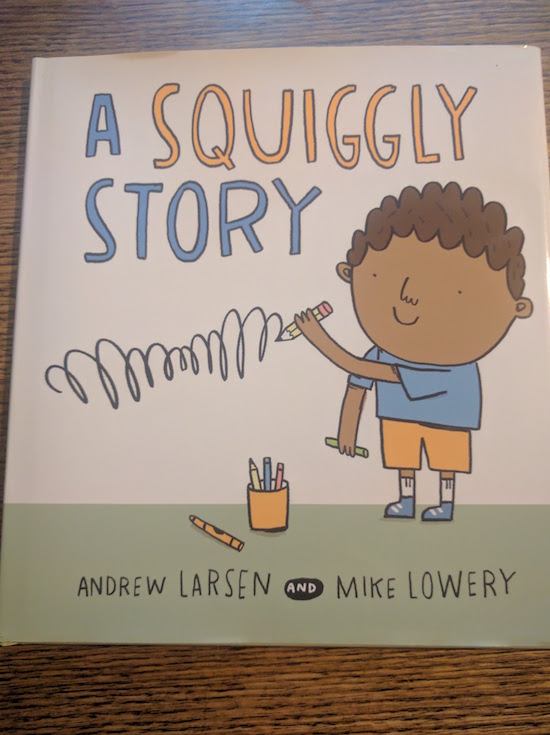
GIVEAWAY! A Squiggly Story, by Andrew Larsen and Mike Lowery
Before my daughter Harriet went to junior kindergarten, she was determined to never be taught anything—by me, at least. I’d read somewhere that a child entering school should be able to write her name, and so that was a benchmark, but Harriet was having none of it. She didn’t even draw pictures. The only thing she ever had to do with paper was taking a pair of scissors and cutting paper into a million tiny pieces, scattering them across our carpet like cheerios.
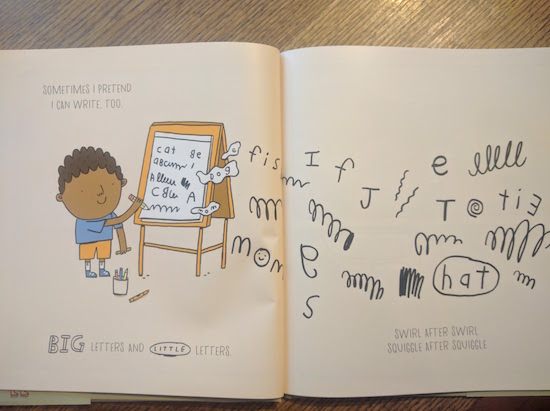
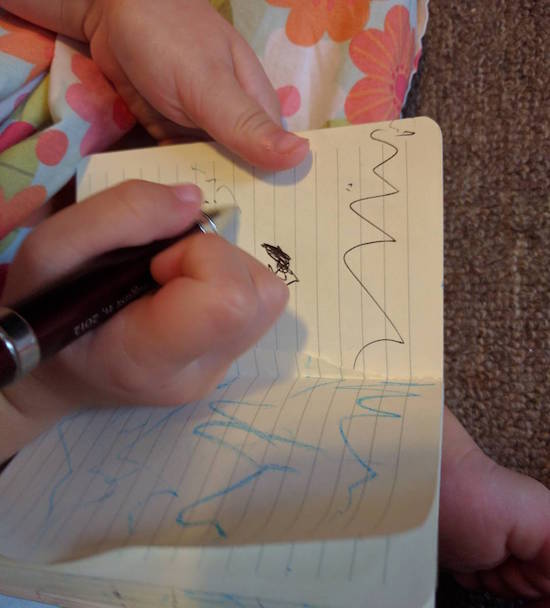
She did, however, have a notebook, and this was the only bit of “writing” she was willing to be known for, filling page after page with curly lines, the closest she’ll ever get to cursive.
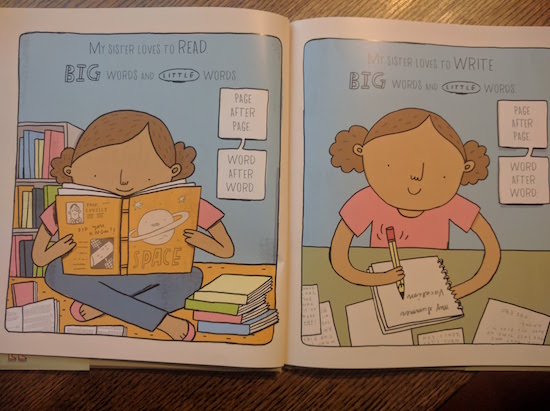
And then she went to school, and it was there the magic happened. Somehow our girl learned to write and to read, and she reads all the time and everywhere, and she writes all the time too (even if her handwriting is atrocious). She makes comics and stories, and she and her friend have written a book at school that they’ve read to kids in the other grade two classes.
And because of Harriet’s example, and because she’s a different person altogether, Iris has a completely different relationship to text and writing than Harriet did at her age. Iris draws amazing pictures, and sits flipping through page after page in novels, and she’s learning her letters—when she sees an “S”, she will shout, “My Daddy has that one,” as if it were some sort of affliction. She knows her classmate’s initials and becomes indignant when a word beginning with A does not actually spell Alma, as it tends to at school.
Most of all though, Iris is partial to her own letter, which is I, and her sister’s H. That the letters fall side-by-side in the alphabet did certainly occur to me when we named Iris, and I also love that an H is an I sideways. They’re often found together in words as well, and Iris is delighted by all of this, finds it intensely meaningful.
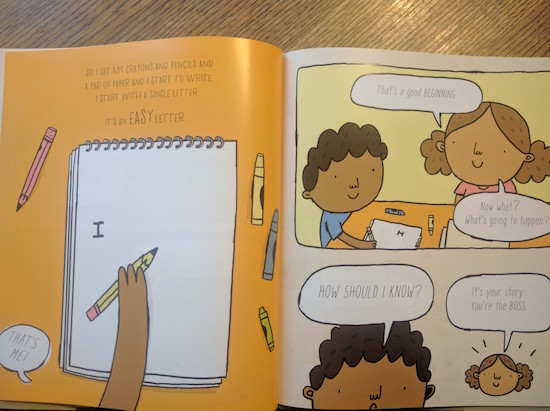
So you can imagine how Iris felt when she saw the above page in Andrew Larsen’s latest picture book, A Squiggly Story, illustrated by Mike Lowery. I is, of course, a letter than is intensely personal to anyone narrating their own experience, but Iris simply took for granted that this was a book that was created just for her.
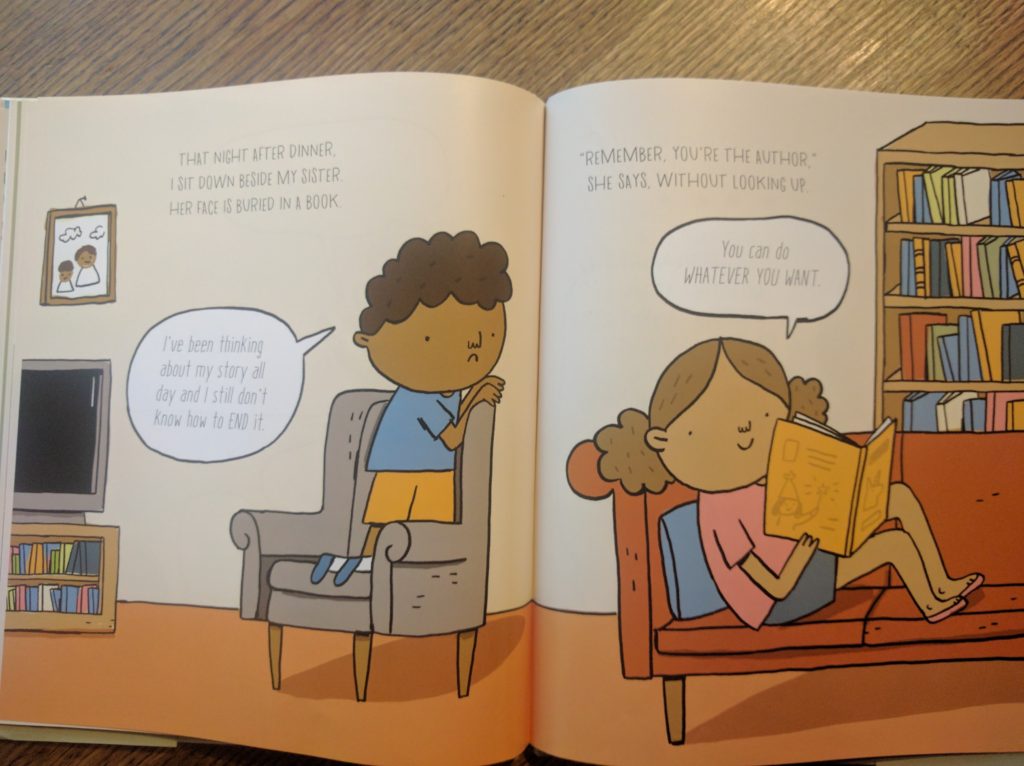
And in a way it was, a book just for her, among many other readers. It’s about a boy who longs to be as deft with words and letters as his older sister, to write a story, and she tells him there’s no reason why he can’t—even if he doesn’t know how to write words yet. “Every story starts with a single word,” she tells him, “and every word starts with a single letter.” This breaking down into smaller pieces concentrated on one step after the other (and another after that) being the best writing advice I know.
So the boy begins his story, a story with I’s and circles and an upside-down V (i.e. a shark fin! This is not a boring story). Empowered by his own creation, the boy takes his story to school and shares it with his classmates, inspiring them to come up with stories of their own and suggestions for his ending. And coming up with one story, of course, makes him think about what kind of story he’s going to imagine next, and the possibilities are endless—a squiggle can be so many different things.
Andrew Larsen is my friend and we’ve had many good discussions about books and writing, and one topic we keep returning to is our distaste with the idea that the outcome of a narrative should necessarily be a protagonist learns a lesson—it’s such a simple minded approach to the role of story in our lives and our experiences. And I love that Andrew’s work reflects this—his are stories that serve to illuminate rather than preach. But a very cool twist is that within his stories I do always find a worthwhile lesson for me, the grown-up reader, to ponder.
“Remember, you’re the author,” the boy’s sister tells him. “You can do whatever you want.”
Fine advice in the writing of a story, but also in the making of a life.
GIVEAWAY: I have an extra copy of A Squiggly Story that you can have a chance to win. Comment on this post and tell me your favourite punctuation mark, and why you love it, and you will be entered in a draw. Canadian residents only. Giveaway closes October 14. October 20.
September 28, 2016
American Housewife, by Helen Ellis
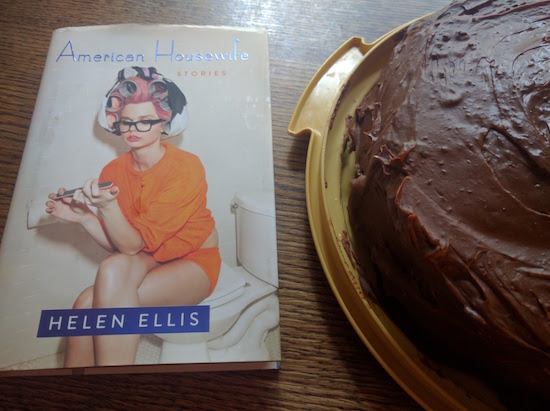
I bought Helen Ellis’s American Housewife after reading about it plenty, and then reading more in Laura Miller’s article on Housewife Fiction (which led me to Diary of a Mad Housewife, by Sue Kaufman, which I loved so much and should surely be brought back into print). I bought it at Ben McNally Books after asking at the counter for a book “with a woman in rollers on the cover, written by someone whose first name is Helen” (because I have become that bookshop patron as my mind begins to fade), and they found it for me. I read it sometime in the summer, but didn’t write about it here, not because it was insubstantial necessarily, but because it was so digestible that I didn’t really need to work through it. Reading this book was like reading a magazine, which I think was meant to be part of its appeal, with the lists scattered throughout between stories and numerous pieces with a didactic bent i.e. “How to be a Grown-Ass Lady” or “How to Be a Patron of the Arts.” There was a surface the reader could skim, is what I mean, though there is more going on if the reader dares to probe deeper.
But there is a limit to the probing (this is not a sexual metaphor, you pervert) because this book is pretty short. It is the most terrific package, a miniature hardcover, cute cover, appealing design on the spine. It is easy to objectify this book and to appreciate it, and yet my book club colleagues who work in publishing were confused about it. People don’t buy short stories, they affirmed, and yes, this is a slight book, but it’s a hardcover, more than 30 dollars. Who was meant to be a audience? Well, me, I thought, although I also know that my singlehanded efforts to support the publishing system have not been seeing the results I’ve been hoping for, so perhaps that wasn’t the most excellent plan.
Anyway, this book is intriguing. It fascinates me that it was borne of a Twitter account (@WhatIDoAllDay), and the resulting snappiness of the book’s contents. It intriguingly plays with the line between autobiography and fiction (in the way that social media in general does) and I’m interested in domesticity as divorced from motherhood, which we don’t see very often. For many women, motherhood offers a direction to one who is otherwise lacking such a thing (for better or for worse) but what do women do if they don’t pursue that option? There is a scathingness to the writing here, and my book club friends wondered just who was being satirized, and if Ellis was reviling her very readers (middle age ladies in book clubs) but I argued that she was implicating herself. This is a book about wanting to write and not writing, or else writing but not being being published (the distinction Ellis describes as the distance between Wimbledon and hammering a tennis ball against the garage door), its about the paralysis of too much choice and women’s roles and living with failure and compromise, and it’s funny, nasty and kind of amazing. We loved its Southern lady/Southern gothic vibe, and the Shirley Jackson darkness, and that John Lithgow appears as a character. I like that Helen Ellis is also a professional poker player, which seems at odds with her southern lady persona, but that is the point of southern lady personas, I think, the surprises that lie beneath an exterior of conventionality. The same could be said of the book. We all had different stories we’d connected with and others not so much, and there was so much to think about, and argue about, and even to agree upon.
And afterwards, we all ate cake.
September 26, 2016
The Dependent, by Danielle Daniel
 I have tremendous admiration for author/illustrator Danielle Daniel, whose picture book, Sometimes I Feel Like a Fox, was one of the best picture books I encountered last year, a finalist for the First Nations Community Reads Awards, and which has recently been nominated for the prestigious Marilyn Baillie Picture Book Award. And so when I learned she’d written a memoir, I know I wanted to read it.
The Dependent is a memoir about her remarkable marriage, a relationship that begins when a headstrong Women’s Studies major meets a handsome guy in the Canadian army, and they embark upon an adventure together that requires plenty of compromise on her part. Daniel doesn’t fit the traditional mould of an army wife, and is continually frustrated by the army’s demands upon her family and also her husband’s willingness to do as the army required in order to further his career. She writes with brutal honesty about her anger and also about her experiences with depression, which begin in this memoir after she experiences a miscarriage. She also alludes to a troubled family background that colours her experience of the present and makes her a jealous and mistrustful partner. Her husband Steve, however, does not have a lot of sympathy for his wife’s point of view—like a good soldier, he doesn’t delve into complicated emotions and focuses on his mission, one thing after another. He is frustrated that his wife does not seem to have ability to work through her unhappiness.
9/11 changes the stakes for members of the military serving around the world, and so too for Danielle does the birth of her son—although Steve leaves home for three months just weeks after the birth. She is relieved when Steve finally receives a position in Canada that keeps him from having to serve overseas, but what she thinks is to be their happy ending turns into another kind of story when Steve is injured in a parachute jump and is left a paraplegic. Suddenly Danielle is no longer married to the army—and in fact the support offered to their family is almost laughable inadequate—but her husband’s disability is something new and just as complicated to navigate. What makes the book so interesting is that Steve rebounds from his injury the same way he does from everything, and the dynamics of their marriage remain unchanged: Steve goes back to school, begins to train as an athlete training for the Paralympics, and becomes a local celebrity. Meanwhile Danielle is lost is the same shadows that had been following her for years, not to mention her husband is altogether dependent on her in so many ways, and she doesn’t know who she is beyond his wife. She is angry with Steve and with the army from what it stole from them, and tired of years of compromise, and Steve is understandably upset that she is wallowing in her pain all the while he’s the one who’s been injured. He doesn’t understand that she’s been a victim too.
Years of simmering tensions come to ahead eventually, and getting to this point makes for a fascinating read. I was impressed how surprising the dynamics were between Steve and Danielle, complicated by the fact that they’re two actually human beings with all the baggage and complexities inherent. While some of the dialogue between them seemed awkward and stilted, containing the same kinds of arguments over and over (which is a marriage problem as well as a narrative one), that would be my one criticism of The Dependent. What blew me away about it, however, was its structure, Daniel’s remarkable deftness with chronology, which makes me think of her art, collage, layers and textures. The Dependent is not told in chronological order, but instead weaves in and out of time (because the idea of time as a line is a point the narrative itself serves to refute. We carry all this stuff with us). The playing with time and story, the giving and withholding of detail, is stunningly accomplished, which is only underlined by the book’s incredible, miraculous and beautiful ending, which is also its beginning, a fantastic, complicated and beautiful love story, and isn’t that always the way…
September 25, 2016
My Literary History, via the Victoria College Book Sale
I must have gone to the Victoria College Book Sale when I was student there (and when I worked at the Victoria College Library, which the book sale supports) but I don’t really remember it. My appetite for books then was more theoretical than practiced, and I didn’t yet have tastes of my own. When pressed, I would have told you that I admired Margaret Atwood, but looking back, I don’t think I had any idea what she was up to in her work. I was still reading the books I thought I was supposed to be reading back then, buying battered paperbacks with familiar names—Thomas Hardy, DH Lawrence. They were always men. It makes total sense now that I didn’t have very much fun reading these books, or even remember them. I recall reading The Years, by Virginia Woolf in my undergraduate years, and finding it all very difficult to decipher. I remember reading it again in the months before I went to graduate school, and being able to make sense of it, and being oh so relieved—perhaps I was finally getting smarter.
It was in the years I was out of school that I finally figured out who I was as a reader. Living in England helped, with its omnipresent literary culture, but after that I lived in Japan, and that helped too. To go from being overwhelmed by print culture to being functionally illiterate was amazing, and having so few books available to me—we read whatever we could get our hands on. I don’t know that there has ever been a more important bookshop for me ever than Wantage Books in Kobe, where I first found Margaret Drabble’s The Radiant Way, and also Carol Shields Various Miracles. It occurs to me that as a reader and I writer, I was actually born there.
I returned to Toronto in 2005, to attend graduate school at the University of Toronto, and I returned also to my job at the EJ Pratt Library. We were so poor then, as I attended school, and Stuart waiting for his permanent residency, without which he was unable to work. When I went to the Victoria College Book Sale in 2005, I remember knowing I probably shouldn’t. We didn’t have the money for it. And me being who I am, and books being what they are, I ended up spending $14 (—this was the half-price Monday, I think) which was a terrific indulgence and one I appreciated so much. I wrote about it here, and reading that list now, these are all books that meant a great deal to me—Penelope Lively and Hilary Mantel (pre-Wolf Hall!). Over the next few years, I would buy everything from Margaret Drabble’s back catalogue at the Victoria College book sale, which fundamentally has been my gateway to major (mostly British) women writers. Laurie Colwin too, and Muriel Spark, Jane Gardam, Anita Brookner and Doris Lessing
2006 was the year I bought Interpreter of Maladies, by Jhumpa Lahiri, which my friend Kim handed to me saying, “You’ve got to read this,” wholly unaware that the blurb on the back by Amy Tan said precisely that this was the type of books that drives one to do such things. I was no longer poor by 2007, so bought about 20 books. In 2008, I purchased an actual tower—with Penelopes Fitzgerald, Lively and Farmer.
By 2009, I realized I’d bought all the books available at Half Price Monday and would have to up the stakes a bit. It was also the first year I went with a baby and the year I bought my first Barbara Pym—Excellent Women. In 2010, I left my baby at home, and went determined to buy books I really wanted to read and not ones that would simply gather dust on the shelf—that was also the year I bought Bronwen Wallace’s story collection, which has never been dusty.
2011 was the most fantastic year—Rachel Cusk, Isabel Huggan (who I hadn’t even read yet!), Lynn Coady, Caroline Adderson, Ali Smith, and more. I missed the Vic Book Sale in 2012—we were in Alberta for my sister’s wedding. It’s possible I missed it again in 2013, with a small baby in my life and an awareness that more books was the last thing I needed. I was perhaps still trying to get through the books I’d purchased two years before. But my small baby grew, and in 2014, she screamed the entire time I was browsing, which solved the problem of too many books (and not because I cut my browsing short, but just because the screaming baby made it hard to concentrate)—that was the year I bought just two books!
Last year I got to go child-free, a few hours stolen while Harriet and Iris were at school—that was when I got a box of Narnia and Penelope Fitzgerald’s The Blue Flower (which I would turn out to love, against all my expectations, but in accordance with everyone else’s).
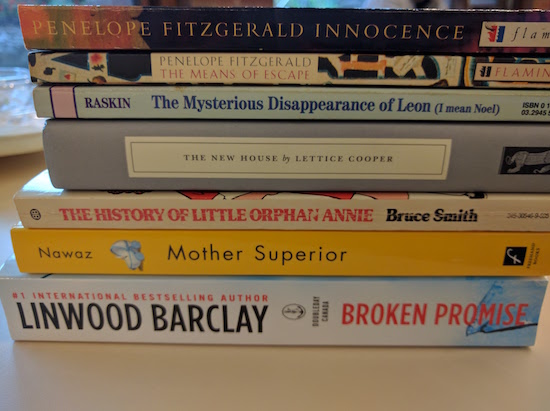
And now this year, which is the whole point of this post. Believe it or not, I did not actually intend to write my autobiography via my history of the Victoria College Book Sale, but that seems to be just what I’ve done. And this year was a very good haul. Penelope Fitzgerald seems to be the one author left whose books I was discover via the book sale—I got Innocence and The Means of Escape. The Mysterious Case of Leon, by Ellen Raskin, whose The Westing Game is so beloved by me and I reread it in December when I was sick. This novel is meant to be quite different, but it’s full of her characteristic illustrations (she wrote wacky picture books during the ‘sixties, and did you know she designed the original cover of A Wrinkle In Time?) and I think I’ll like it.
I got The New House, by Lettice Cooper, because a Persephone Book for $5 is a deal not to be missed, though I know nothing about Lettice, except that Jilly Cooper married her nephew and wrote the intro to this edition. The History of Little Orphan Annie, by Bruce Smith, was a STEAL for $1, and perhaps a book that had been waiting its whole life to get to me, and this is why I love book sales, the serendipity. Mother Superior is the first book by the excellent Saleema Nawaz, and I wanted to buy this book when I visited her in Montreal this spring, but it wasn’t on the shelf, so I was glad to get this copy. And finally, Broken Promise, by Linwood Barclay, because the number of amazing writers and readers who testify to his greatness are legion. I think this one will be fun.
The Victoria College Book Sale seems as much apart of my autumn as the leaves changing colour, or the kids heading back to school. A pleasure in recent years is encountering friends there without even having made plans to do so. This year, we followed up our book browsing by heading out for lunch together, and admiring all new acquisitions, revelling in the goodness of books.
September 23, 2016
Buddy and Earl and the Great Big Baby
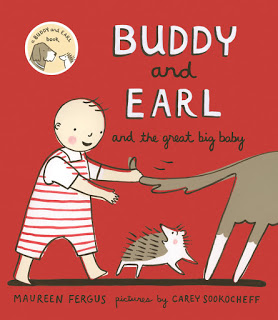
Today for #PictureBookFriday, I’m relinquishing book review duties to Harriet, who has started a blog to explore her fascination with hedgehogs and whose latest post is a review of Buddy and Earl and the Great Big Baby, by Maureen Fergus and Carey Sookocheff, which is the funniest Buddy and Earl book yet (and that is saying something). We love this series, and not just because it features an adorable hedgehogs (although that helps).
September 21, 2016
Book Catch-Up
 Heroes of the Frontier, by Dave Eggers: I stopped reading Dave Eggers at some point (after What is the What, I think, which I loved, although I am not sure I still would…) and I’m thinking that was probably the right idea. I bought his latest novel because I’d heard intriguing things about it, and while I’m glad I read it and liked lots of things about it—there are good bits and he writes children so brilliantly, in particular the younger child who reminded me of my own feral creature who also likes to scream disrespectful things at inanimate objects—but it was too long and rudderless. Actually reminded me a bit of Vendela Vida’s Let the Northern Lights Erase Your Name, which I loved years ago, and also the movie, Away We Go, which Vida and Eggers wrote together. The ending was so good, so I closed the book satisfied, and there were plenty of points throughout where I gasped or laughed, but I was put off my the narrative’s rudderlessness. Why are we floundering, I kept wondering. Which is perhaps a point about nationhood and existentially as well, but for a near-400-page book gets a bit annoying. Thinking about A Heartbreaking Work of Staggering Genius with its footnotes and that novel he wrote after (in my copy the text started on the cover and ran right through to the back cover) and his tendency to have the narrative swell to fill all available space, literally and otherwise, and I am not sure that it’s an altogether good thing. But Dave Eggers gotta be Dave Eggers. I don’t know. He’s interesting. But also not—although he is always more interesting than any arguments disparaging his work and character. There is nothing more boring than hating Dave Eggers. I do think the novel is worth picking up for the depiction of its children, which is remarkable. Not everybody will be able to get through it though….
 A Great Reckoning, by Louise Penny: I do think that Chief Inspector Gamache has been feeling a bit aimless since his retirement in How the Light Gets In about three years back. But in her latest novel, Penny gives him a task and a half: he’s charged with leading the police academy and rooting out its forces of corruption. It’s a novel that has resonance and relevance in light of constant stories about police brutality and #BlackLivesMatter, and it also returns us to Three Pines (don’t worry—Gamache and his wife still have their home there, although they also have a small apartment at the academy) where residents have found a mysterious map hidden on a wall, a map on which Three Pines appears and perhaps the last one upon which it ever did. What does the map symbolized? And yes, who is behind the murder that takes place at the Police Academy soon after Gamache’s arrival, a murder in which he is a suspect? The answers to both questions become intertwined, and connected to a long-ago tragedy from the Chief Inspector’s past which becomes clear at the novel’s devastatingly lovely conclusion.
 Don’t I Know You, by Marni Jackson: I have this idea that my mother spent the years before I came into the world singing “Hey Jude” in downtown pubs in grand singalongs and running around Europe with an accordion playing “Those Were the Days, My Friends”, by Mary Hopkin. By virtue of my parents being baby boomers, I was born nostalgic for a world I never knew—I remember listening to “Carey” by Joni Mitchell when I was fifteen and anticipating a time when I’d have gotten used to clean white linens instead of scrambling down in the street. To be honest, things never worked out so well for me textile wise, but these all remain my cultural touchstones, never mind they happened long before my time. I’ve always wanted to go down to the Mermaid Cafe, which is a huge part of the appeal of Marni Jackson’s fiction debut, whose unique premise is that each story in this linked collection hinges on a fictional encounter with a celebrity, celebrity itself being a kind of fiction—the Brangelina breakup notwithstanding because that shit is real. Anyway, the premise is neat but not the point and eventually becomes secondary to the stories themselves, which are beautifully crafted, full of surprising turns of phrase and plot, and take us through the life of Rose McEwan from age 17 (when she enrols in a writing workshop taught by John Updike) to 67 (when she embarks on a canoe trip accompanied by Leonard Cohen, Karl Ove Knausgaard and Taylor Swift). In between, Van Morrison drives a TTC bus into the mystic, Adam Drive shovels her snow, Gwyneth Paltrow gives her a facial, and Joni Mitchell gives her the lowdown on the perils of free love. This is one book you can certainly call an original, and it’s one that has been staying on my mind.
September 20, 2016
Review: Are You An Echo?
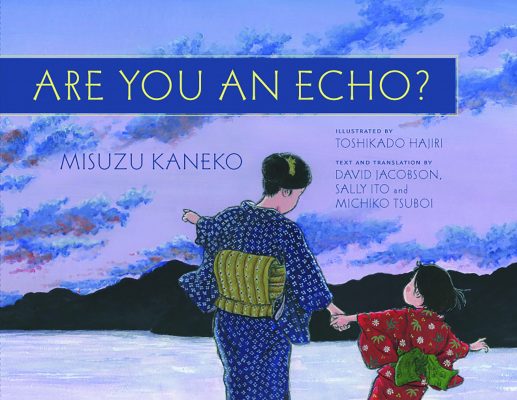
Japan was my home for a while more than a decade ago, and it’s a place I’ll always be grateful to for its generosity, goodness, and what living there taught me about being a person in the world. And so I was especially pleased by the opportunity to review Are You An Echo?, a new book that’s part poetry collection, part biography, and a remarkable collaboration between many different people. It translates Misuzu Kaneko’s poetry into English for the first time, the poems complemented by her difficult life story, and also by the lost-and-found story of these poems themselves, which were “rediscovered” by the Japanese public when the poem “Are You An Echo?” was aired in public service messages on television after the 2011 earthquake and tsunami.
From my review:
…it seems fitting that Are You an Echo?, a book that brings Kaneko’s work and life story to English readers, is also an exercise in connection. The effort is a unique collaboration between American writer and translator David Jacobson, Canadian translator Sally Ito, Japanese translator Michiko Tsuboi (who studied at the University of Alberta), and Japanese illustrator Toshikado Hajiri. Editor and translators’ notes explain the fascinating creative process involved in this genre-bending mash-up, including on-the-ground research in Japan.
September 19, 2016
Swimming
Emboldened by the fact of my children being enrolled in school between the hours of 9 and 3, and inspired by blog Swimming Holes We Have Known (which had me craving blue waters all summer long), I joined the university swimming pool last week, which is conveniently located minutes from my house and the playschool. For a half hour every day, I’ve been swimming lengths in the medium-slow lane, usually just after writing my daily 1000 words of my novel (which hit 71,000 words last week) and so I’m usually mediating on problems of character as I swim (and also pondering what Mad Men has taught me about storytelling). The last time I swam regularly was when I was pregnant with Harriet, which I wrote about here, and so the whole experience in terms of senses and psyche is tied up with the feelings of physical well-being I felt during that time, and also something womb-like, which is not original or such a stretch, but still. It’s the only kind of exercise that I don’t hate—that I love, even (though we’re only one week in, but still there’s something to this).






