August 27, 2020
Island Days

I didn’t move to Toronto until I was 19 years old, but there are parts of the city I’ve known all my life. My grandparents lived at Dundas and Greenwood, where my dad had grown up, and so I knew the park and the pool, the side street where we’d park with its NO BALL PLAYING signs. I know Simpsons, where we’d go to visit Santa at Christmas. The Skydome for baseball games, and the Exhibition Stadium before it. I knew Kew Gardens and the Beaches, and then as I got older, Queen Street became part of my personal geography too, my friends and I being driven downtown on the weekends to buy vintage jeans at the Black Market, buy chocolate chip cookies at the Second Cup on John Street, and peer in the windows at Much Music.
The Toronto Islands have always been a part of that geography though. It was an important place for my grandparents, and they took me there—I remember the extravagance of the ride-all-day wristband they bought me for the Centreville Amusement Park, which cost an entire $13. Another time we met our grandparents there after travelling to the islands in our boat, which we’d launched at Scarborough Bluffs, I think. It only happened once, as far as I can recall, but boating around the Toronto Island Lagoons was one of the most memorable experiences of my young life.
In university, I didn’t have much to do with the islands (apart from the obligatory boat cruise during frosh week) until my fourth year when I got a bike. Heading to the Hanlan’s Point nude beach that summer with two friends who were willing to indulge me, an experience that changed the way I see myself and my body forever. Another time that summer I ran away to the Island all by myself and nobody knew where I was, and there I sat on the beach with a copy of A Room of One’s Own, which I still have, and written on the inside cover is my name, and underneath in parentheses, “who is happy,” with the date, August 4 2001.
So many things about the island have stayed the same, apart from the cost of the wristband, and the way the beaches have shrunk due to erosion and encroaching water levels. Sometimes, loving the island brings profound sadness, at the inevitability of the land slipping away, of climate change and ever-change. But somethings seems eternal too about the place, its draw, being herded onto its iconic ferries.
Stuart and I went to the island on his first visit to to Toronto in 2003, and we got terrifically sunburned. It was the place we brought visitors to once we’d moved to the city ourselves. I celebrated my birthday on Ward’s Island in 2006 or 2007—friends waited in line for hours at the ferry docks because I didn’t have a cellphone then so they couldn’t call to cancel. We used to ride our bikes there, even though the uphill journey home at the end of an island day is the most exhausting trip in the world. We celebrated our three year wedding anniversary on the island in 2008, taking the ferry across after work on a Wednesday night, the most amazing indulgence.
And then we had a baby, and the island became a different kind of place. We stopped riding bikes, spent a lot more time lying under shady trees. We had another baby and the children grew, and Centre Island became important again. The wristband is not $13 anymore, but the amusement park remains cute and charming, not too much. We never buy the wristband, however, because I never want to stay for more than an hour or so.
Because there is so much else to explore! It was two years ago that we walked from Centre Island to Hanlan’s and I took my kids to the nude beach by accident—so many penises. They’re still traumatized. It was good swimming through, and I’ve also made them walk all the way across to Ward’s, where the beach is my favourite. We’ve had ice cream at the Island Cafe and dinners on the patio at the Rectory Cafe, and so many picnics on the green lawn just south of the ferry docks. (The best days involve picnics AND dinner on the patio. The objective of an island day is to stretch it out as long as possible…)
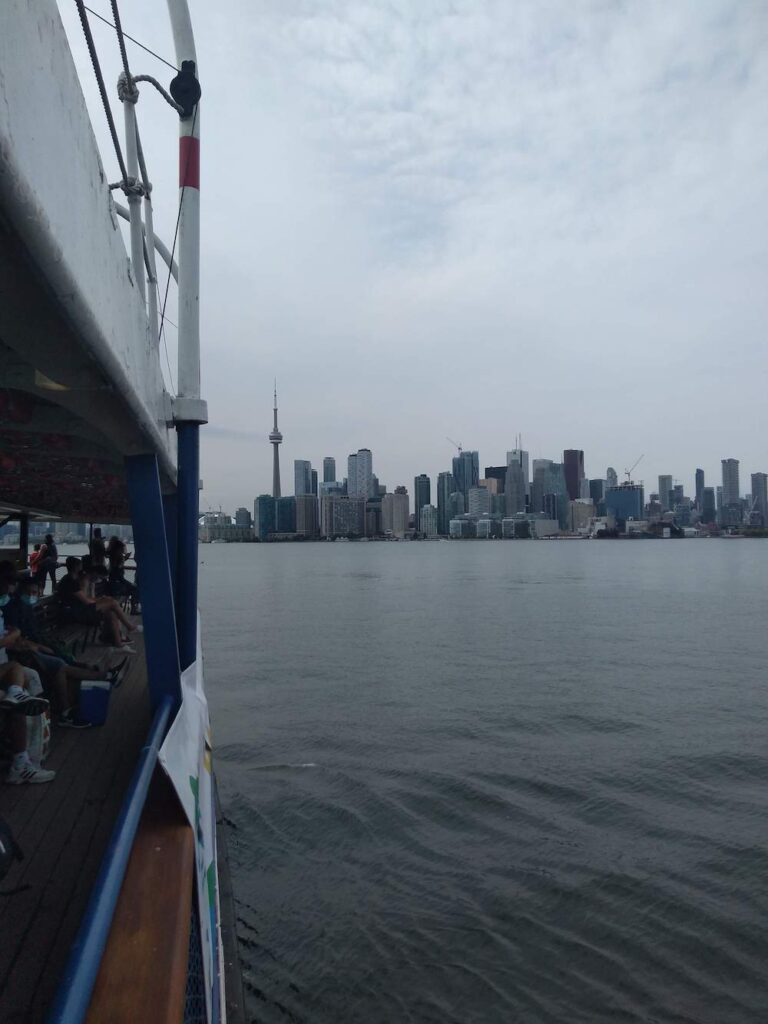
Yesterday we travelled to the island again, late August such a long time to wait for the first island trip of the summer, but it’s been a weird summer. A day spent on Ward’s Island with friends, a perfect spot on a not-so-crowded beach, and the water was beautiful, late-August warm, so clear and clean. The swimming was amazing, and the kids played, I read my book, we devoured fresh peaches, and everything was wonderful. The kind of perfect day only the island can make, and we felt so lucky to have it, and so grateful for everything as we made the familiar journey home.
August 26, 2020
Still Summer: Books on the Radio
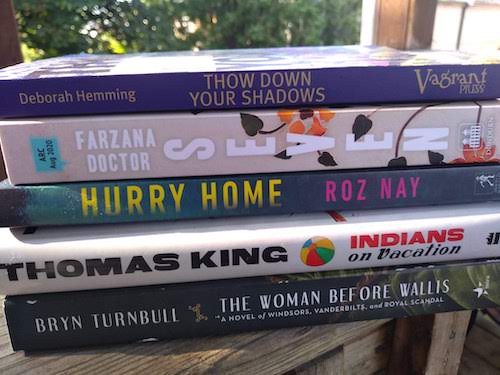
Listen again to my books picks on CBC Ontario Morning! I come in at 33.00.
August 25, 2020
Gleanings
- Some mornings, I use Virginia Woolf’s diaries as a form of divination.
- When you love things, and get passionate about something, you are doing good things for your brain, and good things for your resilience bank account, I imagine.
- Full disclosure, I make the “more kindness” goal every year and it’s one goal I know for sure I improve upon as time goes on.
- I like linear, predictable processes.
- One of the best wisdoms I’ve received is to, “say yes when you mean yes, and no when you mean no.”
- My park really does offer one pretty vignette after another, everywhere one looks! Everything was lush and green. Vibrant and flourishing.
- I think I live in a magical place.
- Potato chips used to be a spontaneous, grab-a-bag-at-the-corner-bodega thing in our household; now with grocery delivery they are more of a staple so I can be ready for spontaneous firepit nights.
- It’s a very challenging time for so many, and I count myself lucky that my tricky bits are not too hard to navigate.
Do you like reading good things online and want to make sure you don’t miss a “Gleanings” post? Then sign up to receive “Gleanings” delivered to your inbox each week(ish). And if you’ve read something excellent that you think we ought to check out, share the link in a comment below.
August 24, 2020
20 K
There are people who get off on pushing limits, on the intensity of winning, overcoming. I am not one of those people, which is part of the reason my children could not ride bicycles for years. The other part of the reason why my children could not ride bicycles for years was that they were really bad at it, and we were even worse at trying to teach them. We tried everything, but once one knew how to do it, the other one was struggling, and finally what it took in the end was a pandemic, for the world to be brought to a halt and my husband to be so frustrated by our situation that he taught our youngest to ride in an afternoon and had everyone’s bikes tuned up and ready to go in a space of a week.
And so we ride bikes now, out for ice cream, to the Korean grocery store, to Dufferin Grove Park. So when my cousin called me out of the blue yesterday and suggested we meet at Humber Bay Shores, way out in the west end, I decided we would ride bikes to get there. According to Google Maps, it was fifteen minutes quicker than transit.
But, dear reader, Google Maps LIED. As we made our way down Shaw Street to King, it occurred to me that a return trip in the other direction was going to be hard work (the problem when your entire city is built on a subtle slope). And then when we got to King and realized that not only were there no bike lanes, but that idiots roared along in their stupid cars like the street was a racetrack, we joined our children on the sidewalk. And as Liberty Village turned into Parkdale, the sun grew hotter, and it was around Dufferin Avenue that somebody started to cry.
But by then it was too late to turn back, and there was still so far to go. Why is there no shade in Parkdale? Why had we decided to make this journey on the hottest day of the year? Would our children ever forgive us as they furiously pedalled on their tiny single speed bikes that they’ve both outgrown already? How were we ever going to get home again, I wondered, as we persisted, the lake getting closer. We pointed it out at our first glimpse of it, but the children were too tired to care.
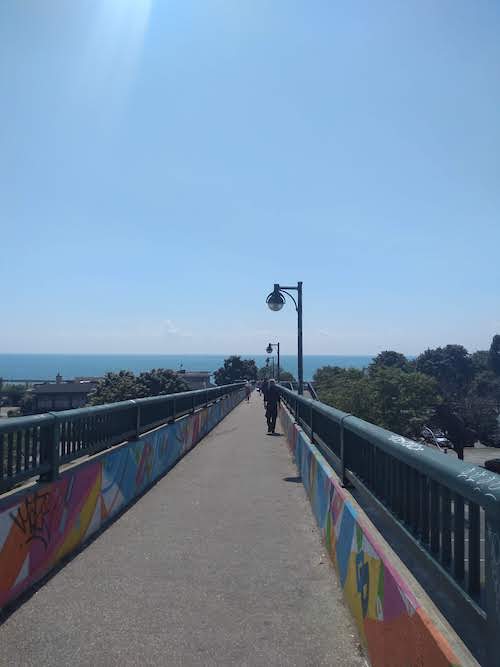
There is a ramp on the other side of the Roncesvalles Pedestrian Bridge, and Iris sailed down it on her bike and ran right into a wall. I chased after her, flinging my own bike to the ground impeding traffic, and feeling like I was going to throw up once I had reached her, because I was already tired, and it was so very hot. (Cheers to the kind man at the Palais Royale who offered to refill our water bottles…)
On the other side of the bridge, we at least got to ride on the waterfront trail, and the Lakeshore was closed to traffic, so there was relief in that. But even from Sunnyside to Humber Bay Shores was so far, and as we approached the slope of the Humber Foot Bridge, we all felt ready to fall to pieces. Maybe we were just going to live at Humber Bay Shores forever, I decided, collapsed in a heap on the concrete.
Fortunately, we had come to Humber Bay Shores to see my cousin and her family, a cousin who has been one of my dearest friends forever, and once we’d recovered our breath and stopped sweating, we spent a delightful two hours with them, and no one ever would have suggested that the journey wasn’t worth it.
But how to get home?
I decided we would cycle home along the Martin Goodman Trail on the lakefront, taking our time (it took 3 hours), stopping often to stick our feet in wading pools, to collapse under shady trees, and eventually even to order takeout from a sushi place which we ate in the Toronto Music Garden. I bought my children orange crush, a staple of my childhood but a curious artifact in theirs, and they were so excited. They definitely earned it. And then after sushi, we cycled just a little bit further, to the streetcar stop that would take us and our bikes right up Spadina Avenue, depositing us at the end of our street.
Which was kind of cheating, but even still, we cycled 20 kilometres, and it was terrible and awful and fun and amazing, and we were so proud of ourselves, and we never, ever want to do it again.
August 21, 2020
Hamnet and Judith, by Maggie O’Farrell
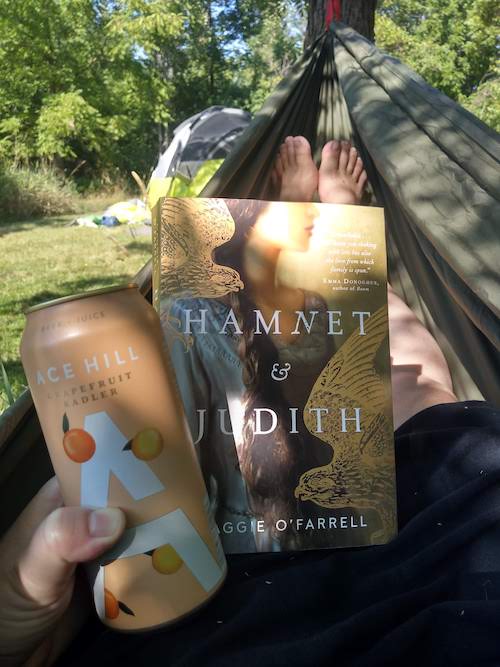
For YEARS, I have had Maggie O’Farrell confused with the author Catherine O’Flynn, and also I once read another Maggie O’Farrell book (Instructions for a Heatwave) but forgot about it completely, so I wasn’t exactly primed to pick up her latest, Hamnet and Judith, especially since it’s set in the sixteenth century and is about Shakespeare. No thank you.
And yet?
Then I kept reading reviews about it, and I can’t recall exactly what swayed me, but it was something about the universality of the fiction, and the glowingness of all the raves. And so I bought the book when we were at Lighthouse Books last month, and I loved it so completely, reading it a few weeks later when we were camping at Bronte Creek.
Which was two weeks ago now, and this week has got away from me. It is 5:31 pm on a Friday as I write this and I have to go make diner, but first, I want to put down on the record that this is perhaps the finest book you’ll read this year. Oh, the writing! The sentences! The scene in the apple store, those pieces of fruit bop-bop-bopping on the shelves to a rhythm. The whole world so magnificently conjured, and yes, it was the universality. It doesn’t matter that this was Shakespeare’s family (in fact the bard himself is not even named), or the century where the story is set—there was an immediacy to the narrative that I so rarely experience in historical fiction. Perhaps because the story is written in the present tense, but it works, the people, the scenes, so alive, so achingly, complicatedly real. And yes, the heartache, for this is the story of a child who dies, and the family who must suffer this incalculable loss, and this universal. The unfathomability. The fear as well, for this is a story of plague, and it seemed especially resonant as I read it in the summer of 2020. And the chapter about how the plague arrived in Warwickshire, fleas, and beads, and ship cats, the way that one thing leads to another, how everything is connected.
A truly magical, and stunning read.
August 19, 2020
Gleanings
- It has taken me more than 40 years, but the singular achievement of my life may be that if I am attacked by a serial killer on a deserted Lovers Lane, I almost certainly will have had dessert.
- But the problem with a system in which crumbling infrastructure is held up by good tape and great staff is that it has no room to give. It’s already at breaking point.
- last year’s monarch recovery is a beautiful example of what people will do with clear instructions and when motivated by something they love.
- My faith is essential, it is fundamental to my equanimity and COVID-19 has changed nothing in that regard.
- The chapter ‘The History of Molecatching’ might be my favourite except that all the others are my favourite too.
- We have many of her tablecloths, each more beautiful than the last, and I understand something of how she tried to keep the lines of family communication open between England and Canada in the days before easy telephone calls and emails.
- This is not a fancy thing, and I am not trying to convince you that it is novel.
- every now and then a freight or a passenger train goes by on the tracks above the community garden. And it is good.
- I trust that when I make choices that are authentic to me, only good things will result.
- I’m extremely reluctant to give anyone advice about anything of late, but I can tell you a few things that are working for me, what’s getting me through these uncertain days.
- This blog is like a corkboard on which to post thoughts, observations, whatever is front-of-mind right now. It acts as a public journal, an I WAS HERE scrawl on the wall.
- Also, I needed an excuse to share this recipe for compost muffins, so named because you can toss just about anything into them
- So I don’t announce to strangers, “yes, my work is excellent, wouldn’t you agree?” but I don’t say, “it’s worthless, burn it,” though the culture sort of urges me to do the latter and my heart a little of both, depending on the day.
- Suddenly, wooden benches and window sills, the Chestnut Tree in my neighbour’s garden, all looked different. Everything came into focus. “
- Once you invert it out of the baking pan, you end up with the flan on top and the cake underneath. I’ve read that this is because the cake, as it rises in the oven, becomes lighter than the flan layer, so the flan sinks and I, a non-scientist, based on little more than liking the sound of it, have concluded that it makes total sense.
- One reason I relished Cher Ami and Major Whittlesey so much is that the novel could easily have been a disaster.
- How to revise your novel: part 1
August 19, 2020
Cover Reveal
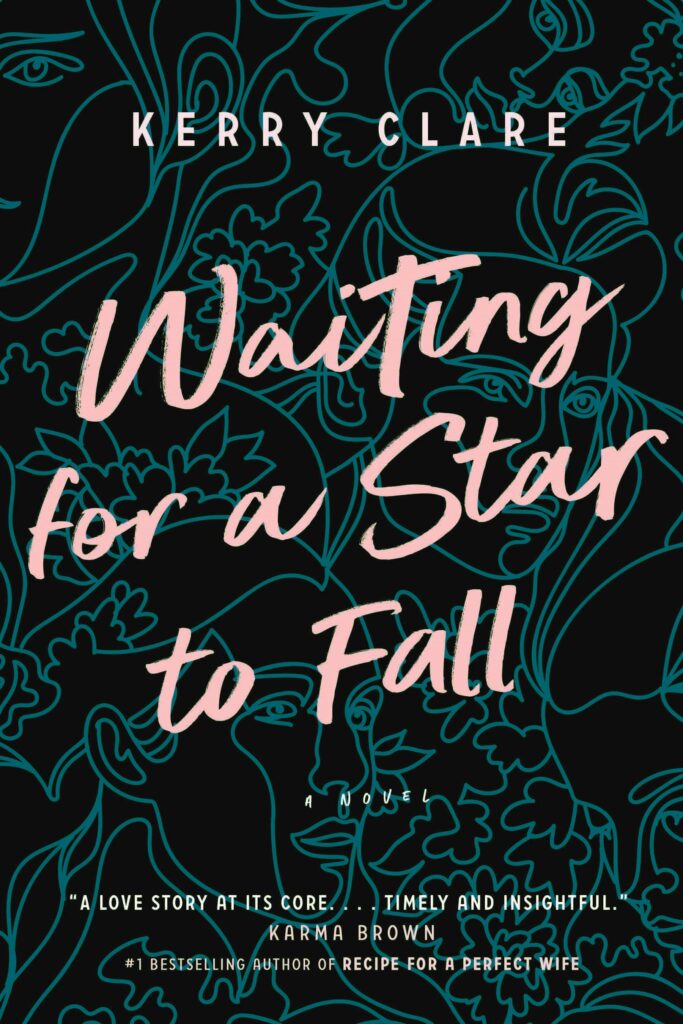
So pleased to share the beautiful cover for my novel Waiting for a Star to Fall, coming on October 27. The designer is Terri Nimmo and she’s done the most incredible job. The book is now available for pre-order as a paperback, ebook or audiobook. I hope you love it.
August 17, 2020
Pandemic Things I Love

- the sound of neighbours’ voices and laughter drifting over the backyard fences as they sit outside on summer evenings
- my children kicking the soccer ball outside
- people taking up space in the street—walking, cycling, playing ball, protesting, etc. etc.
- supporting small and local businesses
- books delivered to my porch
- the occasion of bin night
- local indie bookstores putting their stock online
- the advent of 3pm cake break
- takeout from a local restaurant at least once a week
- a reclaiming of public space—park benches have never been more precious
- thanking people who move to give me room on the sidewalk
- rainbows in windows
- learning to be patient
- ice cream every day
- encouraging billboards (there is one on highway 401 near Oshawa that says, “This is hard and you are doing great.” It makes me cry.)
- picnics in the park
- it turned us into a family of cyclists
- and into seasoned explorers of alleyways
- it has forced us to re-imagine the way we live our lives, and made visible the forces of poverty and systemic racism so that those of us with privilege can’t ignore it any more.
August 13, 2020
Summer Reading Highlights
Queenie, by Candice Carty Williams

Describing this as a Black Bridget Jones Diary really was to undersell it—no disrespect to Bridget, who I also love. But this is more like Bridget Jones Diary if Bridget was trying to place articles about police murdering Black people. The same bad dates, complicated friendships, career frustrations, but this novel is underlined by a psychological heft that I didn’t see coming and which is powerful. Parts literally brought me to tears, others made me cringe in horror (or recognition). I loved it.
*

Little Secrets, by Jennifer Hillier
This is the second novel I’ve read by Hillier, who has made a name writing dark thrillers, and it’s the first one I feel comfortable recommending in general because no one’s body gets chopped up into tiny pieces. (Yay!) It begins with every parent’s worst nightmare—a child goes missing. But Hillier sets the action a year later when the child’s mother, with nothing left to lose, discovers that her husband is having an affair and decides to seek revenge. If reading about children in peril is too much for you, I promise that this is a different kind of book, twisty and absorbing. I loved it.
*

The Last High, by Daniel Kalla
Another plot-driven highlight is the latest from Daniel Kalla, a Vancouver ER doctor whose work I became more interested in after reading his essay in The Toronto Star about how the pandemic could lead us to greater enlightenment. The novel is set against the opioid crisis, and manages to capture a reader’s attention with a riveting plot, but also tell the real-life story of forces perpetuating devastating drug deaths across the country.
*

Sex and Vanity, by Kevin Kwan
I never read Crazy Rich Asians (I know!) but was intrigued by Kwan’s latest, which re-imagines EM Forster’s A Room With a View. A bit trashy, unabashedly silly, and a lot of fun, I really liked this one, which managed real emotional depth, memorable characters, and a few stunning narrative surprises.
*
Grown-Ups, by Marian Keyes

And I’d never read Marian Keyes either! Why did I wait so long? I was warned that Grown-Ups is NOT her best—it does involve a character who has a head injury that makes her blurt out the truth in a most unsociable manner, which plot-wise is not exactly GENIUS. But the rest of the story (narrative, characters) is so excellently constructed that she pulled it off with aplomb. If you like comedies featuring a whole bunch of family drama, then this one won’t disappoint. And now I want to read everything else she’s ever written .
August 12, 2020
I Went to a Bookstore!
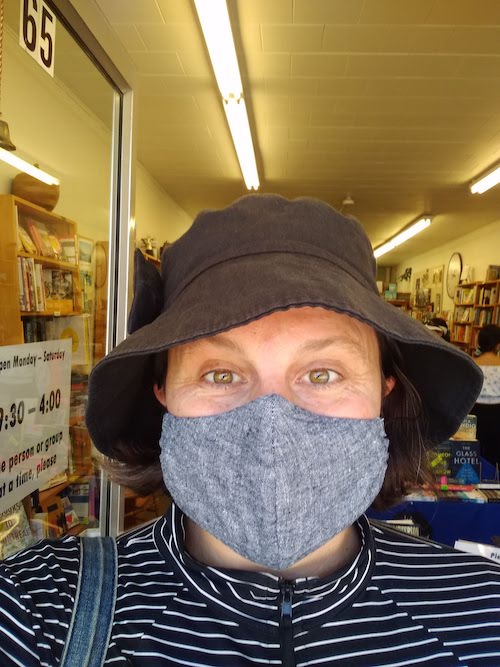
My last bookshop visit was March 8, a stop in at The Nautical Mind, the marine-themed bookshop on Toronto’s Harbourfront. Not that this experience was the end of me buying books, of course. By the end of that week, I’d already placed my first online order with a local bookshop to have a couple of books delivered to my door, and this would continue throughout the spring—I got books from Ben McNally, Book City, Queen Books, Ella Minnow Books, Flying Books, and probably others. One great thing about having absolutely nothing else to spend money on through April and May was that I could fulfill all my book-buying dreams and then some, which really did raise my spirits and help tide me over while the libraries were closed.
Most of the shops doing curbside pick-ups were just a little bit too far out of my way for me to take advantage of this, but I did finally get to partake in July when I ordered a stack from Little Island Comics. A recent development in my life is that I now have a bike, with a basket, and riding home with that basket full of books was exhilarating.
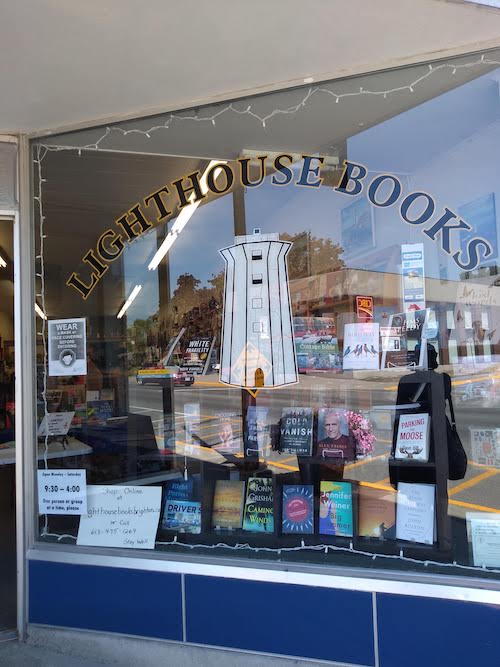
But not quite as exhilarating as my annual trip to Lighthouse Books a few weeks later, a pilgrimage we making on our camping trip to Presqu’ile Provincial Park and one I never take for granted even during the best of times. It wasn’t so long ago that we weren’t even sure Ontario campgrounds were going to open this year, so everything that weekend seemed especially precious. Lighthouse Books had only opened up for customers a week before, and so the timing was great.
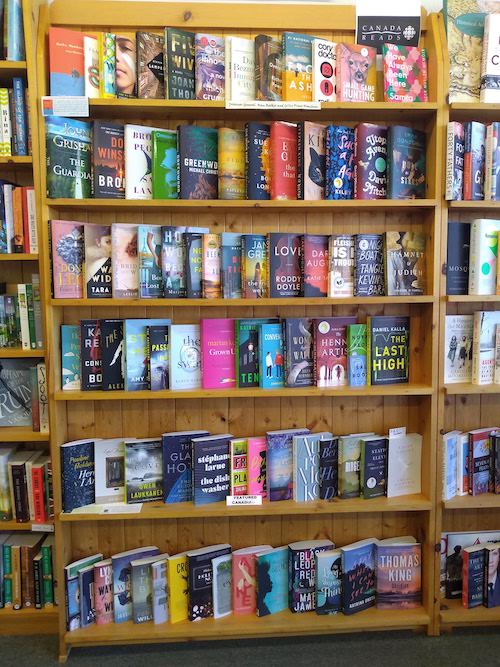
While many of the Covid measures in place right now put a damper on fun, one I don’t hate entirely is the rule that whatever you touch in a bookstore, you must necessarily buy. Okay, then! Lighthouse Books had the most appealing table set up by the door, and in no time I had my mitts on an Attica Locke book I’d been meaning to read for years. By this point, shop owner Kathryn had already greeted me by name, which is remarkable when you consider that my face was covered in a mask AND I only visit once a year, but this is part of the reason that Kathryn is so good at owning a bookstore. The other part of the reason is the marvellous curation of her shelves—doesn’t the photo above make your heart swoon?
I ended up getting that copy of Hamnet and Judith, by Maggie O’Farrell you can see on the right-hand side of the middle shelf—and oh, it blew my mind, that book, plus books for my kids to read. One of my greatest parenting accomplishments is that I’ve somehow convinced my children that sitting around with a book is integral to the camping experience, mostly likely because it really is. And then I got sign a copy of Mitzi Bytes (and no, I don’t love this bookstore just because they always have a copy of my novel in stock, but it helps), and talk to Kathryn for a few minutes…before it was time to go, because my family was waiting for me outside, and also because there were other book buyers who were lined up at the door.
PS I love that a bookshop visit has never not been remarkable.






