June 27, 2010
Unsad Lemon Cake
 This is a slice of the lemon chocolate cake I baked after reading The Particular Sadness of Lemon Cake last week. I think I may have a new compulsion to bake every fictional cake that I encounter, or maybe it’s just any fictional cake I encounter as written by Aimee Bender, who writes about food and eating in such a concrete, tangible way, rendering the ordinary extraordinary. Whose description simultaneously blows your mind and has you going, “Yeah, I know exactly what you mean…” Anyway, the cake was good, and devoid of sadness. I wonder what kind of fictional cake I’ll encounter next?
June 25, 2010
A Spotlight on Atlantic Canada Reads
So yes, I’m rereading Lisa Moore’s February, and loving it as much as I loved it the first time, even though I was delirious back then. All of this very timely, because February is currently in the running for Atlantic Canada Reads, a brilliant initiative by Chad Pelley of (another brilliant initiative) Salty Ink (“a spotlight on Atlantic Canada writers”). Check out the other books up for Atlantic Canada Reads, and read their defenses, and vote for the book you think should take the prize.
June 24, 2010
Goodness turnips!
 I have a vivid memory of the day my mother bought me a copy of Pollyanna on a visit to The World’s Biggest Bookstore when I was about eight years old. (This was back when TWBB was my favourite place in the universe.) I must have read the book a few times because many parts of it have stayed with me, but what I remember the most is the afterword to my edition, which was written by the great Lois Lowry. What I remember is one phrase in particular, one that applies to most of the books I like best; I think of it today because I’m currently rereading February by Lisa Moore.
The phrase is, “Goodness triumphs; I like that.” Except that I didn’t know the word “triumphs” when I was eight years old, and I read it as “turnips”. I read the whole phrase as a kind of exclaimation similar to “Goodness gracious” or “Merciful heavens”, but with a root vegetable twist.
“Goodness turnips; I like that.”
And all these years later, I still do.
June 24, 2010
Pssst… today is my birthday
 Pssst…. today is my birthday. Which has made clear how far a body can come in a year. Because last year was my thirtieth birthday, and it was terrible. I had a four week old baby who had screamed all night the night before, my husband was so busy picking up the pieces of me that he didn’t have much time to orchestrate birthday celebrations, and my computer had just crashed taking with it five years of everything on that precious hard-drive.
The evening was better– Stuart went shopping on his lunch break and came home with some wonderful presents, including a beautiful sundress to cloak the postpartum frump. My sister and best friend were here for a bbq dinner, and Harriet bestowed me with two wonderful gifts– about twenty minutes during which she was awake and not crying (and this was so exciting! We all just gathered around to watch her be), and then she fell asleep and we ate our dinner without Harriet-juggling for the first time since her birth. I also drank beer. But still, it wasn’t the best day.
Today however, my thirty-first, in spite of earthquakes and tornadoes the day before, has been so far without calamity. I got croissants and jam in bed, and wonderful presents (including the beautiful Changing My Mind by Zadie Smith, and Sarah Harmer’s new CD which is a wonderful birthday morning soundtrack). Opened a lovely stack of cards for me this morning, a few of which were delightfully bookish. I’m going to drop over to my friend Bronwyn’s for a cup of tea this afternoon, and we’re having Thai take-out and a Dairy Queen Treatza Pizza for dinner tonight (and did you know they’ve been discontinued in the US? I never realized before just how fortunate I am to be Canadian).
Anyway, Harriet been occupied unpacking my new Body Shop satsuma gift pack, but I’ve just noticed teethmarks in the soapbar. I will turn my attention back to her then (and note that she’s now crying because I won’t give it back to her for another bite). So we will go and play, and she’ll get up to all her new tricks– showing me her belly button, pretending to talk on the phone, offering a cup of tea to Miffy, showing me my bellybutton, sucking on my nose, and a good old game of plush-ball catch.
June 23, 2010
An important tradition of English writers
“But the novels also belong to an important tradition of English writers, mostly women – Elizabeth Bowen and Elizabeth Taylor and Rumer Godden and Penelope Fitzgerald among them – whose subject is the old world of class and empire, and the systems of education and intricate cultural codes that supported it. Sharing that world’s know-how, vigilant over its precise local expertise, these writers nonetheless never quite belong with both feet inside it, or quite participate in its whole power; they survey it from a position sanely detached, defined by irony. They find that freedom perhaps because they’re Anglo-Irish, or Anglo-Indian, or penniless, or from the north (a significant marker for Gardam), perhaps simply because they’re women. They relish the framework that the codes give (‘life with the lid on’, in Bowen’s phrase), and do justice to the best that these embodied, but never forget the inequity, or the costs of forcing life into rigid forms.” –from “Thank God for Betty” by Tessa Hadley, LRB Vol. 32 No. 5 · 11 March 2010
June 22, 2010
Important Artifacts 2
I’ve been thinking more about “thingness” as narrative since reading Carin’s comment on my last post (and it was her review that brought me to read Important Artifacts and Personal Property… by the way). She remarked that the hipster aspect of Lenore Doolan and Harold Morris’ life together was probably to emphasize its emptiness, that it all looked very slick but was without substance. That a couple can’t build a life together on vintage bathing suits alone. And so Shapton’s text was to be a counter-narrative to the thingness then, making clear what was going on beneath surface? I’m not totally convinced, but it’s an interesting idea to consider.
What I am convinced of, however, and what the book makes clear, is that these glimpses we’re given into other people’s lives (whether by auction catalogues, lit windows or Facebook data) is often so deceiving. Partly because what we glimpse is so contrived, (which is Shapton’s entire point), particularly since social media is such a performance. Because I’m all too aware of the view of my window from the sidewalk, because I’ve actually spent my whole life cultivating such a view, but you’re never really going to know what happens when I pull the blinds down, are you?
Motherhood is the best example of this, particularly its presentation via social media. I was devastated last year when my daughter was born, and I found my feelings in the days afterwards so far from the obligatory “Kerry is totally and utterly blissed out and in love with her gorgeous new daughter” status update. Everybody writes statuses like that, and I absolutely couldn’t, and at that point I didn’t know how many moms were just more capable of lying than I was (or of being “blissed out in love” in addition to having a pretty terrible time, but the terrible time itself they never cared to mention). All all of us have a “just given birth, baby on the chest” photo somewhere in our Facebook stash, but it so doesn’t begin to tell my story. We let it stand in for the story, because it’s more comfortable that way, but that doesn’t even begin to stand in for the real thing.
Of course, it’s not supposed to. Online anywhere is not the best place for private life anyway, and there is something to be said for keeping some things to yourself. But I must say that I was fooled by the Facebook motherhood narrative. The blissed out love, the dreamy photos, the quiet baby asleep in a bouncy chair– it did not convey the effort it took to get that baby to sleep. The effort it took to get that mom out of her pyjamas. I felt so incredibly inadequate for not being able to put myself back together as easily as my FB friends had, for being thoroughly miserable when I should have been blissed out in love. I had been expecting blissed out love because I’d perused so many of the pictures. And how could a picture lie?
But they do. They don’t just withhold– they totally lie.
There is no longer such thing as a candid shot, if there even ever was.
June 21, 2010
Harriet gardening
 You probably shouldn’t let your baby dig in soil with a spoon. Because while spoons are good digging implements, they’re also good for delivering items to the mouth, and though Harriet’s spoon/mouth coordination is not always right on track, it certainly was the time she ate a giant spoonful of soil… So it was kind of a milestone, times two if eating dirt is also a milestone. Is it?
June 20, 2010
The Particular Sadness of Lemon Cake by Aimee Bender
 The Particular Sadness of Lemon Cake begins with Rose Edelstein, aged eight, helping herself to a bite of cake and becoming overwhemed by an awareness of her mother’s profound sadness. This awareness is devastating, and has enormous implications: that her mother is human, that life is complicated, that Rose is powerless to control the world around her. Childhood naivete ends at this point, when Rose realizes that she can taste people’s feelings in the food they create– her mother’s sadness makes family dinners unbearable, she eats a friend’s sandwhich and is “envious… that this lightness was where she came from”, and so the vending machines at school supply her with sustenence, the relief of their bland and innocuous factory flavour.
Aimee Bender is known for her short stories, and this seems like the perfect premise for one of these. The novel reading like an extended short story itself– the perfection of the details, the minute observation, the sense of play and whimsy, the genre-bending, the fantastic. And yet this is decidedly a novel too, with great expansiveness, development, and enormous weight. Cake-like, airy and solid.
There is so much that Bender gets absolutely right. Her narrative voice is a stellar achievement, Rose reminiscent of Ramona Quimby as the book begins, and yet undercut by a darker tone that takes over as the book proceeds. Bender manages a perfect balance of wide-eyed child and wry observer (see “[Dad] always seemed like a guest to me. ‘Welcome home,’ I said.” vs. “he loved her the way a bird-watcher’s heart leaps when he hears the call of the roseate spoonbill, a fluffy pink wader calling its lilting coo-coo from the mangroves”.) The story is perfectly timeless, flying on its own steam, freed from the cumbrousness of period. It has the tone and appeal of a YA novel– elements of A Wrinkle in Time in addition to Ramona. And yet, YA this is not– the sadness is heavy, the emotions complicated and awful, and too much for even Rose to understand.
With amazing acuity, Bender shows Rose’s reaction to her burden of empathy– how she eats an entire slice of the cake in an effort to convince herself that everything is fine, that she made up her feelings, but Rose only feels her mother’s sadness more, and how she tries to console her mother but doesn’t know what she wants or needs, and how Rose tries to explain that she can taste a hollow in her mother’s cake but can’t explain it well enough, and how after so much explaining, she eventually keeps it to herself.
Rose’s ability to taste feelings actually becomes secondary as the novel progresses, fading to the background– this is a novel with most of its two feet in reality. Understatement makes Rose’s affliction almost plausible, and we’re not meant to consider it too much anyway, but the story continues to be about her family’s dynamics, and how Rose deals with knowledge of her mother’s sadness as her older brother begins to retreat into his own world. It’s also about food, taste and eating, and where our food comes from, how little most of us actually consider this. And it’s about childhood, and things better unlearned, and a yearning to return to a simpler place that has been tainted by what is known now.
And so onto the bandwagon I jump, late for the party as always. Go Aimee Bender, whose novel is perfectly unlike anything else, and also perfectly perfect.
June 19, 2010
Important artifacts
 I just finished reading Important Artifacts and Personal Property from the Collection of Lenore Doolan and Harold Morris, Including Books, Street Fashion, and Jewelry by Leanne Shapton, the devourable if gimmicky story in the form of auction catalogue. And thought I do think it must have been exhausting for Doolan and Morris to be so insufferably hip at all times (did these people never buy anything at The Gap? did they ever tire of the kitchsy salt-and-pepper shakers and vintage everythings?), I loved the book a lot, though in the same way I like peering through strangers’ windows, looking through people’s bookshelves, and perusing Facebook albums of people I’ve never met.
If Shapton’s intention is to tell a story through physical objects, however, it’s worth remarking upon that she doesn’t succeed. Sure, the story is told, but it’s words as usual that do the job– lists stuck into paperbacks, exchanges scrawled on theatre programs, letters unsent and otherwise, emails, and postcards. In essence, Important Artifacts is an epistolary novel, the artifacts themselves serving as espistle storage devices.
Without the epistles, the objects lack in resonance (though they do add a postmodern layer of veracity to the narrative in the same way the family pictures in The Stone Diaries turned that book into something much fuller than a novel). The objects don’t tell the whole story though, just as a view through a window doesn’t, or a bookshelf, or any infinite number of Facebook albums– but why are these things so compelling all the same?
I wonder if– outside of fictional realms– such fragments come closer to a kind of truth than anything else can? And I wonder how much of the pleasure lies in making the connections by ourselves.
June 18, 2010
Our Wooden Anniversary
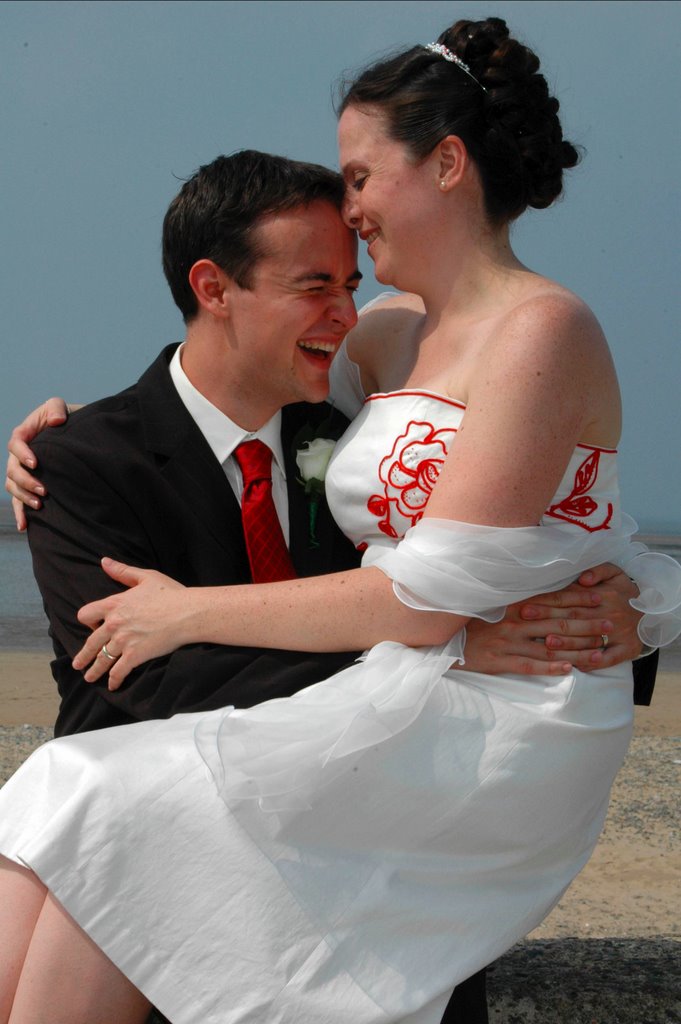 Five years ago, Stuart and I got married in the Northwest of England following a fourteen month sojourn in Japan, and two weeks after our wedding, we moved to Canada. Our wedding was the wedding of my dreams for many reasons, not least of which were the blazing sunshine and the friends and family all around us. But most of all, it was the wedding of my dreams because I married Stuart, who I like better than perhaps anyone, whose company I’ve never grown tired of, who I’m so lucky to begin every day with, who was always very understanding when I shouted terrible things when the baby was new and life was terrible, who doesn’t protest when I decide to bake a pie late at night and even does the washing-up, who goes out on pomegranate errands to satisfy my whims, who is my favourite co-pilot, who is funny even when I’m not overtired (but particularly hilarious when I am), who goes to work so I don’t have to, who gets up in the morning with the baby and lets me sleep in, and who last month left work early in order to buy me a new bathing suit because mine had disappeared a half hour before swimming lessons started and the alternative was me going swimming in my underwear. He really is the best ever, the foundation of all my happiness, and my respect for him gets bigger all the time.






