June 15, 2010
On "There, you see?" criticism
I do hope that the ridiculous parts of of Andre Alexis’ essay The Long Decline don’t undermine his valid points about Canadian literary criticism. I note in particular the statement about the critic who “…takes sentences or paragraphs that he considers examples of brilliant writing and then does the written equivalent of pointing and saying, “There, you see?”
Though just as often, the critic does the same thing with what he purports to be bad writing, supposing the evidence speaks for itself. The problem is, however, that the evidence rarely does. Mostly because there is no such thing as “brilliant writing”, or if there is, it’s only because it’s the writing one happens to like. (And if the evidence spoke for itself, really, what would be the need for critics?)
I want a critic to convince me, the way Steven Beattie did in his essay “Fuck Books“. Or perhaps what I mean is that I want a critic to make his case, because although I don’t agree with Beattie’s general assessment of Canadian Literature, the specific points within his essay are laid out and evidenced so clearly. He argues that Rebecca Rosenblum’s story “Fruit Factory” is “a far more effective – and affecting – portrait of blue-collar experience than anything in In the Skin of a Lion” and uses an excerpt. Instead of just pointing to that excerpt with a “There, you see?”, however, he goes on:
“Notice the way Rosenblum employs sparseness and repetition to capture the combined monotony and pressure of a labourer’s days… Rosenblum’s story is steeped in the rhythms of modern urban reality; the drumming beat of her sentences reflects her character’s lived experience. This is writing that sizzles and snaps, largely because it appears almost completely unadorned. In today’s CanLit, that in itself counts as an innovation.”
To be honest, “writing that sizzles and snaps” means precisely nothing, and it’s the kind of statement many critics use instead of “There, you see?” But with Beattie’s exceptionally close reading of the story and his concrete examples, I completely understand what he’s talking about. The work is almost revivified by his treatment of it.
Whereas, “There, you see?” criticism is dead on arrival, lazy, arrogant, a certain way to write one’s self into obsolesence, and I see this stuff all the time. So I do think Alexis makes a good point. Whether he makes his point well, however, is another matter…
June 14, 2010
Author Interviews @ Pickle Me This: Sheree Fitch
 A few months ago, The Afterword ran their Canada Also Reads, and I noticed a novel by Sheree Fitch on the longlist. At that point, I knew Sheree Fitch from the much-adored board book Kisses Kisses Baby-O(which, incidentally, was provided to all newborns in Nova Scotia in 2008 as part of a program called Read to Me) and I was intrigued to read a novel by its author. So I read Kiss the Joy as it Flies over a couple of days last winter, which brought me such pleasure. And seriously, pleasure in January is an elusive creature, and so I decided email Fitch and thank her for a glimpse of it. Her response was very kind, and this email interview grew out of our conversation.
Sheree Fitch is amazing– here’s proof. Though I have read her picture book Peek A Little Boo every day for the past six months, I am not remotely tired of it. Her poetry collection for adults In This House There Are Many Women is sad, wise and funny. Her first novel for adults Kiss the Joy as it Flies, I decided, was “Fannie Flagg meets Miriam Toews”. When I bought Sleeping Dragons All Around for Harriet, it was really a gift for me. Fitch has also written novels for young adults, and the latest, Pluto’s Ghost, is out in September.
I: I just started re-reading Kiss the Joy as It Flies this morning, and joy indeed. In order to write a novel, did your poetry have to be tamed into prose? What was that process like?
SF: A good question. Short answer would be yes. But… not that simple.
I’ve been writing ( seriously) since the age of 20. In the beginning, I was writing short stories. I wanted to be Alice Munro. I took a short story and play-writing and poetry course– I was interested in all and any kind of writing. As things turned out, my first published work was a short story for children. I was inspired every day by my own and so I started writing “for” them. I decided I would learn everything I possibly could about the art and craft of writing for children and I soon found myself gravitating towards nonsense– word play and the oral tradition combined. I was hooked — mostly by the pure joy in playing with language the genre allowed. So I kept exploring other genres and this included adult poetry –much more sober content, free-verse– but still I had a sense of working in an oral tradition. “Utterature” I called it in my master’s thesis.
After a little over a decade of mostly focusing on verse and poetry, going to prose meant the orality was gone– and I really did not like that! I knew if I was ever to go back to prose that language would still be paramount and voice would become very important– either voice of character or voice of narrator.
The Gravesavers –my novel for early teens took me, yes it did, eight years of working on and off. And this is where I tamed the poet and rhymster long enough to do things like develop character and learn and manage narrative arc. I think work in radio and drama and some film helped too in terms of sense of story etc.
But I am painfully slow. The book that comes out this year took five years. Senior teens and up but again, language and word sparks and how it sounds in the reading. Cadence– all things I still work with. Vital. It is challenging because I am pretty sure I hear words the way many people hear musical notes. Say MUD. Say Zamboni. Every word is a poem if you want it to be. So Kiss the Joy… was me intentionally writing a novel and finding a storytelling voice for adult work that word-played in ways that I hoped was fresh and would lend to a great out-loud reading.
cling clang the way words bang
slip slide and boomerang around
the alphabet’s surround sound
and me —a wannabe composer
a writer who is Clown.
I have a fave line in the novel, but you will have to ask…
I: So I’ll ask?
SF: The line is on page 263, second paragraph. “Mercy rose, washed, ate, brushed, flossed, flushed, dressed, scrunched, lip-glossed,  smacked, smiled, dabbed, patted, changed, fluffed, fed the cat, and left.” A line like in a kids book and all alliteratively tongue twisty– but the storyteller of Mercy, that omnipotent narrator was playful. Next time , who knows?
I: Is there any sense to nonsense? (“Cervix, ovaries, clitoris, uterus, vagina, Saskatchewan. She giggled, remembering the silliness from childhood.”) If nonsense is useful, is it something specific to childhood? Why are adults so drawn to sobriety?
SF: Oh– this is a huge conversation we could have. Think of the fool in Shakespeare. Think of the concept of holy fool, the not knowing, wise person. In a world that makes no sense to me, making nonsense has always made sense to me.
So yes, I actually, honestly, think nonsense is an art form in which profound truths can be revealed. Not always. Sometimes. A kind of tricksterism.
If you read The Clown at the Foot of the Ladder by Henry Miller, or Henrich Boll’s The Clown, they are two books that explore this in different ways. Look at one line punch line zingers…in Dorothy Parker.. pow pow.
These clown books I just mentioned are not funny but illustrate my fascination with the sad/ happy contradictions inherent in life, like the sunshower Mercy Beth finds so strange. She herself is some kind of an admirable frustrating lovable buffoon to me.
I am doing an essay for publication based on a convocation speech I just gave called “Lessons I Keep On Learning” and will explain “play” and nonsense a bit more. (I love to ruminate…..a Mercy wannabe.)
I think I admire comedic genius most. (more…)
June 14, 2010
I am having an affair
 …with this yardsale-purchased breadbox. We have decided to move in together.
June 13, 2010
Wolf Hall by Hilary Mantel
 Everything I knew about Henry VIII before Wolf Hall, I learned from Herman’s Hermits. And I’d planned to keep it that way, because I really can’t stomach historical fiction. Even when it’s written by Hilary Mantel, who I’ve read through suburban black comedies, ghost stories, memoirs and literary fiction (my two favourites of hers have been Eight Months of Ghazzah Street, A Change of Climate, and An Experiment in Love).
But then Wolf Hall won the Booker Prize, and it was nominated for the Orange Prize. And something else happened, though I don’t remember what Steph read it at Crooked House and included an excerpt as part of her babies in literature series, but it all led to me purchasing Wolf Hall when we were in England last fall. The book sat on my shelf for months and months, however, until I decided to tackle (most of) the Orange list, and so last Friday, I finally cracked the great tome (650 pages) open.
Once in a while I tried to remember why exactly I so disliked historical fiction, particularly since I never actually read any of it, but reading Wolf Hall did make my feelings quite clear to me. That the genre necessitates 650 page books, for one thing. In non-historical fiction, wouldn’t an editor do something about a book in which all of the major male characters are called Thomas or Henry? And a pace that goes so quickly, too quickly, and then you find yourself having to refer back to earlier passages, but how is one to find these in a 650 page book??
But, Wolf Hall was readable. It was. I was mainly reading it so I could finally say I actually had, but I found myself enjoying it too. It’s not an easy book, with so many characters and such a dense plot, and Mantel’s prose is not always immediately accessible (and yes, the pronouns were a struggle, but there’s a reason for it. “He” is usually always Thomas Cromwell, to show that Cromwell was everywhere.) But the story, about Cromwell’s rise and rise from lowly blacksmiths’ son to chief advisor to the King of England was fascinating, and Mantel has made Cromwell a complex, sympathetic and wonderfully-difficult character.
I didn’t really understand how fascinating this novel was, however, until I reread its review from the London Review of Books (which I’d read when it was published, but got nothing out of having not yet read the book, of course). The review explains that Mantel’s real genius is rendering a three-dimensional character of Cromwell, about whom little is known, and allowing his mystery to remain fundamental to him. And that nothing within her novel is without significance, in fact more often than not, peripheral characters and details would go on to be instrumental in historical events to follow, though this significance is only hinted at in the novel (and then glossed over entirely by readers such as myself for whom Henry VIII had merely been married to the widow next door, and she’d been married seven times before…). Even the novel’s title Wolf Hall refers to a place only barely mentioned in the story, and the suggestion of a visit there comes in the very last paragraph (and here, according to the LRB review, would begin “the undoing of Anne Bolelyn”).
I recently read that Mantel is at work on a sequel to Wolf Hall, and now I’m quite stunned to find that I’ll not be able to help but to read it. Because the whole 650 pages here was merely in anticipation of what comes next, and what comes next is the rise of Jane Seymour, who was a lowly lady-in-waiting in this book, and the downfall of the Bolelyns, and even (though a few years beyond this) Elizabeth I (who here is just an ugly red-headed baby). To discover that Spanish Mary (in Wolf Hall, petulant, teenaged, and put-out by having just been made a retroactive bastard) becomes Queen herself somewhere down the line– seriously, these are the most tantalizing spoilers ever.
You couldn’t make this stuff up.
June 12, 2010
Fiction on the way
I don’t read much on public transit anymore, because I’m usually carrying my daughter in the Baby Trekker and entertaining her by making faces at our reflection in the windows. But today I had a trip with two subway legs, then the streetcar, and by the end I’d had enough, lamenting that there is no Poetry on the Way these days, because I really was craving a little reading break. When I got on the subway to go home, however, I was pleased to board a car full of book ads, and one of these was a book excerpt. It was wonderful! I don’t care that it was an excerpt from Sophie Kinsella’s Twenties Girl, which is certainly not a book after my heart, but it won it a bit today anyway. As I stood there hugging a pole, going through enough text to give me a taste of a story. It was the only remotely entertaining subway ad I’d encountered all day (and I’d encountered more than a few!). A wonderful idea, and I think more marketers should do this…
June 12, 2010
Vicious Circle Reads: Shadow Tag by Louise Erdrich
 I said I’d never join a book club, mostly because I get offended by book club questions in the back of paperbacks. Or rather, I get really disturbed by the idea of somebody finishing a book, and not being able to think of any questions on their own. Which isn’t snobbery on my part– surely, the most unschooled reader would come away with the most questions anyway? And that would be a fine thing, but to finish a book and come up with nothing? What’s the point of reading, let alone clubbing to talk about it?
When I finish a book, I usually come away with a mess of questions, and this was why I decided to finally join a book club. I also decided to join because they asked me, and “they” was a group of people/readers I really respect (and would enjoy sitting around drinking wine with). Also because “they” were going to ask other such people, and the whole group seemed like a worthwhile one to take my questions to. To check my reader responses, to clear up what I didn’t get, it fill me in on what I’d glossed over, to provide some fine enlightenment, new perspectives, and expand my readerly horizons.
The Vicious Circle had our first official meeting this week, to discuss Louise Erdrich’s novel Shadow Tag. Someone asked me beforehand if I liked the book, and I told him that I wasn’t sure yet– perhaps the best kind of book to be under discussion. I enjoyed reading it enough, admired the writing, was appropriatly disturbed by scenes of harsh brutality, but the novel’s slightness also left me perplexed. I was unsure of its wider context. Shadow Tag is the latest novel by Erdrich, who I’ve never read before. The novel has autobiographical over/undertones, as evidenced by this rave review, and the fact that the lead character is mirrored by a character called Louise.
The lead character is Irene, who begins to keep a second diary (“the blue notebook”) when she discovers that her husband Gil has been reading her original diary (“the red notebook”, and I couldn’t help but think of Doris Lessing too, but not enough to come to any conclusion). She begins to manipulate Gil with the first diary, pushing his boundaries, and the boundaries of their relationship. Gil is a painter who has come to fame with degrading images of Irene in the context of native-American history, and she is essential to his artist persona and to his art. Irene’s entire identity is wrapped up in being Gil’s muse, so she has a lot riding on their relationship as well, in addition to the fact that Gil swore he’d use her alcoholism to take the children from her if she ever left him. Which is also to say that their children are in the middle of this, and being damaged in the cross-fire.
A twist at the end of the novel reveals a mysterious narrator and brought forth many questions about everything I’d read already. How reliable was Irene’s other diary if she was lying in the first? How reliable was the third-person perspective? Could any of the novel’s weakness in plot or character be written down to being a deliberate part of the structure? I’d enjoyed the writing, the childrens’ perspective as witness to marital breakdown was heartbreaking, and I’d also enjoyed reading about native experience where the nativeness itself was not the point.
The Vicious Circle’s concensus seemed to be that I was reading into the book too much with my questions, applying layers of complexity that weren’t there. Everyone agreed that the prose was wonderful, but the characters were unlikeable, unrealized, and some readers just couldn’t bring themselves to care enough. That perhaps Erdrich’s own experience was the key to the novel– that she is writing to make sense of what happened to her, instead of creating a fully realized fictional world, but that didn’t necessarily make for a better book. That some of the dynamics of Gil and Irene’s relationship were perfectly depicted, and the scene in the therapist’s office was hilarious. That Stoney was definitely a bad name to give a child, and pot-smoking children were not convincing. That Erdrich has such a strong reputation as a novelist and story writer that perhaps the book had gotten a lighter treatment in reviews?
This conversation went on for ages, and it was wonderful. And though our response to Erdrich’s book was not overwhelmingly positive, there was enough substance for us to work with and many important discussion topics with bearing on literature in general. I came away liking the book less than I had going in, but gladder than ever that I’d read it. What a book club.
(For other Vicious Circlers’ responses, check out Bronwyn’s vlog [a vlog!] and Julie’s review).
June 11, 2010
Words that Harriet can respond to
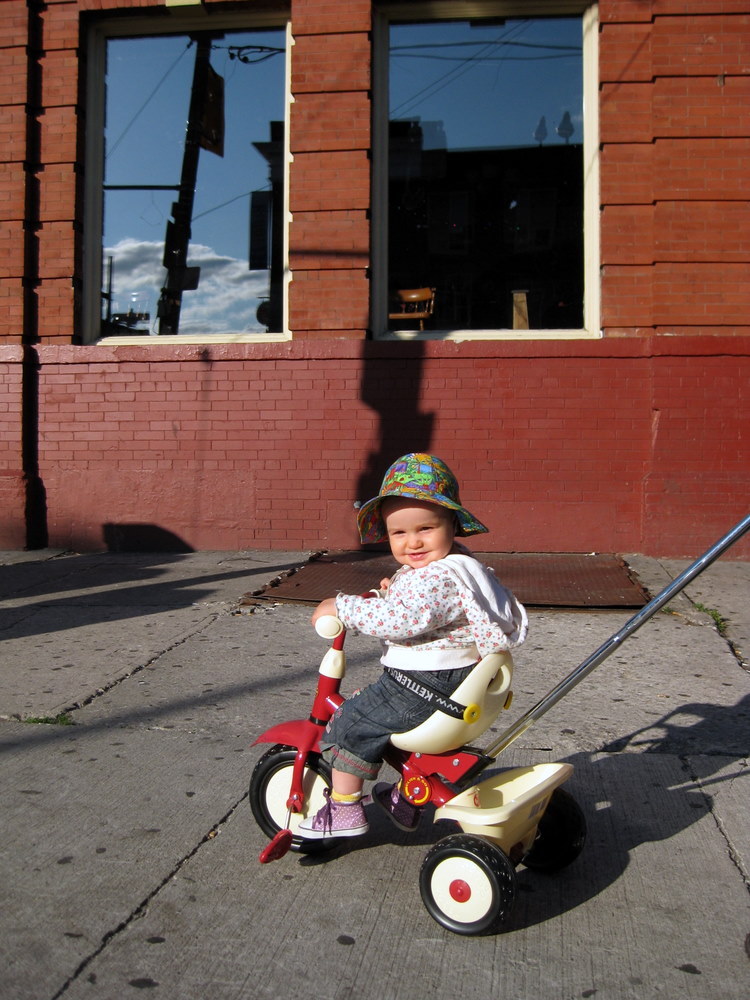 1) Teacup
2) Miffy
3) Book (which is always whatever book I am reading, not any of her own)
4) Tea Party
5) Eeyore
6) Nose
7) Harriet
8) Mommy and Daddy
9) Hat
10) Monkey
11) Blocks
12) Big Dog and Little Dog
13) Elephant
14) Hairbrush
15) Please
16) Bellybutton
June 10, 2010
Hot Summer Books!
Okay, these are called hot only because I’m looking forward to reading them this summer, but that’s hot enough, right?
 The Lovers by Vendela Vida: Truthfully, I know nothing about this book except that it’s Vida’s new one, but her last novel Let the Northern Lights Erase Your Name was so stunning, surprising, and subtly brutal that I’ve been hungry for its follow-up ever since.
Far to Go by Alison Pick: I read an excerpt in The New Quarterly a few issues ago, and have been looking foward to it ever since. I read Pick’s first novel The Sweet Edge last summer, she’s a poet as well, and this story is something completely different, set in Czechoslovakia in 1939 and based on the experiences of her family. (I can’t find a link, but it’s published by Anansi).
 The News Where You Are by Catherine O’Flynn: I read her novel What Was Lost last summer, and am looking forward to this follow-up. Though British old-lady novelists are my favourite, I’ve got a thing for the young ones too.
I’d Know You Anywhere by Laura Lippman: Once again, I know nothing about this except that it’s Laura Lippman’s latest stand-alone, and we do love Laura Lippman here at Pickle Me This. Sadly, my life is no longer as such that I can curl up in a Muskoka chair with a beer, and give my weekend over to it, but I’ll make do and no doubt be enthralled.
June 9, 2010
On The Orange Prize

So pleased that The Lacuna took The Orange Prize.
I gave up talking about The Orange Prize a few years ago, because the conversation was always annoying (“No one puts Baby in the ghetto”), but this year having read 3.5 of the six books on the shortlist, I felt somewhat invested in the whole thing. I also felt as though the shortlist itself was an excellent example of how the prize is doing exactly what it should be doing: celebrating the very best in women’s fiction.
Because this shortlist is living proof of two things: first, that “women’s literary fiction” is often distinct from literary fiction in general, either because it reads as such (and it can, and it does! and is often wonderful for it), or because it’s come into the world via a woman’s hand and is therefore received differently than literary fiction in general. Sometimes both these things are true, sometimes one is, and sometimes neither, which brings me to my next point:
That women’s literary fiction contains multitudes! Of course, each book on the shortlist actully shows the incredible range of excellent books written by anybody these days, gender notwithstanding, but that these are written by women is just another reason to celebrate them. Oh, and yes please, ho hum, a men’s literary award would indeed be sexist and the Orange Prize isn’t, because a) of the million reasons why being a man and being a woman are not immediately parallel experiences, b) the world is a bit more complicated that these stupid lobs of logic back and forth over the net, c) there already is a men’s literary award and it’s called the canon, thank you very much.
Anyway, this is the boring conversation I vowed that I’d avoid, so I’ll just say that I adored Attica Locke’s novel Black Water Rising, but its inclusion on the shortlist was a bit curious because the novel was so unabashedly commerical fiction. But it was such a good book, so ultimately realized in what it had set out to be, and I think it was included on the shortlist to show that women are writing some of the most unlikely women’s fiction these days. Similar with Hilary Mantel’s Wolf Hall, which I’m slowly working my way through. I historically hate historical fiction, without shame, which might be more than a bit discriminatory on my part, because though Wolf Hall‘s heft is dragging me down a bit, it’s a pretty fascinating read. It’s all politics and executions, and even the women portrayed within it are as far from women’s fictiony as women can get. And with The Lacuna too– yet another book with a man at its centre. I adored this book, had previously decided not to pick it up because of bad reviews, then it was shortlisted and I decided to give it a try. And it was amazing– I want to shake the people who didn’t like it and tell them they read it wrong, but that wouldn’t be polite. Anyway, The Lacuna only had about three women in it, and it took on most of the twentieth century, and that’s what women’s fiction is doing now, amazing stuff. As is Lorrie Moore’s The Gate at the Stairs, which does tackle more feminine topics, but with dazzling techical mastery of language, because it’s Lorrie Moore, after all. (And oh my, all these four books were so wonderful, I really will have to read the other two.)
The one problem here, however, is that now I’ve caught myself saying, “Look at women’s fiction, everybody! Doesn’t even read like a woman wrote it!” Which is not what I mean exactly, because there are certain books that only a woman could ever hae written, and their womenishness is the best thing about them. I think women write the best books going. BUT the Orange Prize gets knocked around so often for institutionalizing/ghetto-ising women’s fiction as ala grim, drunken-father-beating, rape in a hayloft, botched abortion, killed in a car-crash whilst getting thee to a nunnery THE END that I am pleased to see the shortlist doing anything but.
And I am pleased to see that the best of women’s fiction is amongst the best of ficton period.