July 7, 2010
Vicious Circle Reads: We Have Always Lived in the Castle by Shirley Jackson
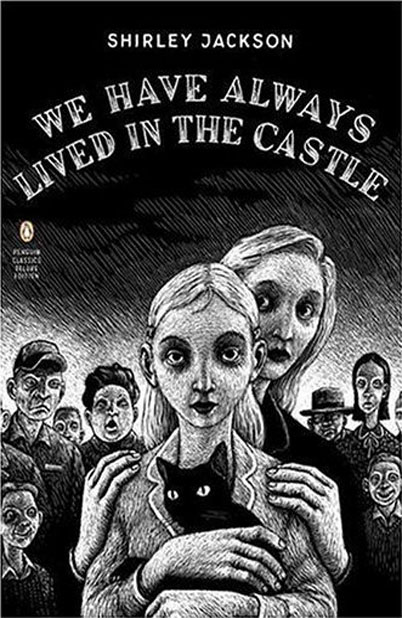 Amazing, amazing. The Vicious Circle assembled again last night to read Shirley Jackson’s We Have Always Lived in the Castle. The place was Patricia‘s back deck, a perfect place for a hot summer night, and conversation was accompanied by a delicious spread, and the coldest beer. There were berries, but Patricia didn’t put sugar on top, or poison, and the keylime pie tarts weren’t fatal either…
Everybody loved this book, which made the conversation a bit harder to come by than at the last meeting. Though this is a book that conveys itself so subtly that we were glad to have extra minds on hand to fill us in on the bits we’d missed– that Merricat was 18, that the novel was a flashback. Jackson is a writer who explains nothing, her story’s beginning and end wide open to interpretation (and some of the middle too).
We remarked upon the book’s unique placement– gothic, but not Southern-Gothic (for once. New England Gothic? Is this even a thing? Because I wouldn’t mind reading more of it). Asked when the story took place. we responded with 19th century, 1920s, 1950s and 1970s. Any time after the telephone was invented, I guess, though of course the Blackwoods didn’t have one. How the book was nearly fifty years old, but not remotely dated, and now everybody wants to read more Shirley Jackson.
Why was Constance so docile, and so afraid of the world? One of us wanted to strangle Uncle Julian with his shawl. Charles was horrible, and we weren’t sure why Constance didn’t see through him. Was it her one moment of resistance to Merricat’s power? What was up with their dynamic anyway– they were husband and wife, mother and daughter, and sisters? How were they going to get through winter without a roof?
The scene after the fire was terrifying. Interesting how Jackson shifts stereotypes so the village men are the vicious gossips here, and the women are kind behind their backs. We thought that Jonas was one of the best fictional cats ever. We though Merricat was an extraordinary character, escaping every grasp and yet so perfectly captured. We remarked upon the framing of the text– how odd that Jackson situates the book six years after what most would consider the meat of the story (ie the murder of all the Blackwoods except three via arsenic in the sugarbowl). Preservation as a metaphor for Constance and Merricat’s life– yes yes yes!!!
By this point, it was so dark we were in shadows, but it was sort of fitting. When the lights came on, the mood was killed, but it was time to go anyway. An amazing evening had by all. Until next time…
July 5, 2010
Reading like a pirate
Harriet has learned to point, so now she’s the master of her index finger, and this afternoon she mastered it directly into my left eye. Which means that I’m just now back from the walk-in clinic, after four hours of being last in the queue because everyone else was hemorrhaging. It was the longest uninterrupted stretch of reading I’ve had for as long as I can remember, even better than the two hours I spent waiting for a passport last summer. Someone reading a Nora Roberts novel kept trying to talk to me, but I was hardly going to waste such a precious opportunity on small talk, particularly not with someone reading a Nora Roberts novel. No wonder she was distracted, but I wasn’t, which was wonderful. To read for hours, without stopping, without the compulsion to check my email, lacking the means to do so. Seated in a comfortable chair just made for ophthalmology, never minding the fluorescent lights, or that I periodically had to cover up one eye and read my book like a pirate. I read the second half of Katha Pollitt’s book, and reread (for the fifth time) the first third of Slouching Towards Bethlehem. I was actually disappointed when the doctor finally arrived, but not so much when he told me that I was fine. Just a tiny scrape on my cornea, and nothing a little over-the-counter wouldn’t fix, and then it was out of the air-conditioning and and into the heat, and onto the subway to read my way home.
July 4, 2010
Pie in the sunshine
 Will you tolerate another picture of a pie in the sunshine? This time a cherry pie (my first! Hulling is tedious, but the pie is delicious) in stars because I don’t have a maple leaf cutter. Purchased with cherries from our farmer’s market, which supplied much of the deliciousness we partook in this weekend. We had a wonderful Canada Day in the sunshine, with friends for dinner, and then spent the rest of the weekend soaking up the city. We went to Trinity Bellwoods Park on Saturday, and I’d forgotten about wading pools, which meant that Harriet had to go swimming in her clothes. She was all right with this, however, and also got in lots of swinging, and sliding, and crawling in the grass. A similar day was had today at Christie Pits, where we also watched an old-time baseball game, went swimming in the city pool (not just wading, and we were equipped with suits and towels), and then played afterwards underneath shady trees. The parks in this city are better than any backyard you could dream of. It was a whole weekend as good as the pie.
The one problem with all this goodness, however, is Harriet’s “separation anxiety”. Quite a difference from last year at this time when Harriet didn’t like anything, she now doesn’t want to leave anything she encounters– she cries when we take her out of the swing, when we take her out of the pool, when she has to get off her bike, when her dad leaves the house in the morning, when the UPS guy leaves the house after having me sign here, when she has to put her ball down, when anybody (including complete strangers) is playing with a ball and she can’t have it, when we get to the last page of Over in the Meadow, and heaven forbid I take my keys out of her mouth, and suggest she not eat my credit card. She’s also taken to pointing at things she wants and screaming in a way that shatters eardrums. I now understand why sign language might have been useful (but still, not I how might have implemented it into life).
 She does take things hard, does Harriet. She has never ever left a playground and not had eyes streaming with tears… Though she really is a happy kid, recovering quickly from her traumas. At left is a photo of us taken last week by Star reporter Vinnie Talotta, which is pretty much our Hats most of the time.
Anyway, I am very busy lately working toward an upcoming deadline, and I’ve also gotten involved in a reading project (which I’ll tell you about when the time comes) that involves me having to read 20+ books in the next two months. This means my library books are way backlogged, and some even due back without having been touched, and my summer rereading project has totally stalled. I should be able to step up some in the days ahead, however, and I look forward to reading Katha Pollitt’s Learning to Drive, rereading Joan Didion, and writing up a post about our next meeting of The Vicious Circle and this month’s book, Shirley Jackson’s We Have Always Lived in the Castle. And updating you about my ongoing obsession with bananas, of course. You’ve probably been waiting for that.
July 4, 2010
I'd Know You Anywhere by Laura Lippman
 Laura Lippman’s I’d Know You Anywhere was the first of my hot summer books, and the perfect book for a sunny long weekend. It’s mainly told from the point of view of Eliza Benedict, an unassuming wife and mother currently preoccupied with adjusting to life in Maryland after six years living in London, and also with her daughter’s initial forays into teenaged awfullness.
The last thing on Eliza’s mind is Walter Bowman, from what she’s come to refer to (though she rarely refers to it) as “the summer I was fifteen”. That summer, after she stumbled upon him burying a body, Bowman kidnapped Eliza, and kept her prisoner for thirty-nine days, and then he let her go, to be the only one of his victims w ho’d live to tell.
Years later, Eliza appears unscathed on the surface, having managed a fulfilling life for herself, married to a man she loves, and as a devoted mother to her children. (Eliza’s academic background is in children’s literature; she claims, “Everything I know about parenting, I learned from Ramona Quimby”). Though she never feels completely secure, insisting that the windows stay locked even in the heat of summer, but there are indeed long periods of time during which she doesn’t think of Walter Bowman and that summer. So she is really rather rattled to hear from him again.
Bowman had been sentenced to death for the murder of another girl he’d picked up when he was with Eliza, but due to technicalities has been waiting on Death Row ever since. When he contacts Eliza, he is hoping to manipulate her into assisting him with one more appeal, the same way he’d managed to manipulate her into complying with his wishes during that summer long ago. Of course, Eliza initially resists his advances, but he has promised to reveal information about his other victims, and she also hopes that by meeting him, she might finally understand why he let her go.
In addition to Eliza’s point of view, the novel comes from the perspective of Walter, and from that of Trudy Tackett, mother of one of his victims. Trudy’s reason for living is to finally witness Walter’s executive, and her sections of the novel are the most compelling of the trio– Lippman nails the might of her fury and the hole that is her grief. Walter himself is less believable, though perhaps being inside his head is just discomforting. Eliza also is hard to pin down– she’s meant to be somewhat unknowable, even to herself, and far more impressionable than impressing, but sometimes she reads as though Lippman wasn’t altogether sure who she was either.
I’d Know You Anywhere is not as successful as Lippman’s previous stand-alone novels (Life Sentences and What the Dead Know), its structure as fragmented as Eliza’s character. By its second half, however, the book picks up steam, becomes more cohesive, and by the time Eliza’s facing Walter down in his cell, the whole thing is worth the ride. Lippman’s writing is so smart, the prose bursting with the stuff of the world, with facts and ideas, and her characters usually jump off the page– Eliza’s overbearing sister Vonnie, her eccentric but loving parents, her daughter and her son.
The book is devourable, suspense mounting as the plot whips along, and really, summer days were really made for books like this.
June 30, 2010
Serious print overload
 Honestly, today was an amazing In The Post day. I received the latest issue of Canadian Notes & Queries, whose cover is gorgeous (as you can see) and embossed (which maybe you can’t). It gets even better in-covers, with an interior re-design by Seth. It’s “The Short Story Issue”, which means I can’t wait to read it to pieces. I’m looking forward to everything, and a new story by Rebecca Rosenblum in particular.
In another envelope, I received some textual treats from my friend Alyssa (and I get to call her my friend, because I met her once in real life about ten years ago, and we didn’t become online friends until some years after that). Not only did she send a card with a photo of her beautiful son, but she sent me three little books from The Regional Assembly of Text in Vancouver: “Crust Test”, “Things They Loved” and “Encounters with Jesus”. Love it love it love it.
Seriously, this is print overload.
Further, I’ve been magazining it up like a madwoman lately. The day after my post on magazines a few weeks back, I received LRB, Chatelaine, and an subscription offer from The New Yorker in the mail, which I thought was sort of funny. The Chatelaine was even worse than the last one, incidentally. My biggest problem with it was the passages they’d highlighted so I didn’t have to go to the bother of reading the articles, and I was insulted by the idea that had I ten minutes to spare, I’d spend it spray-painting a hideous piece of crap. I don’t like how everything is so rigidly compartmentalized, and how the backyard depicted for relaxing in had a motor boat in the background.
But maybe it was because I was reading Wolf Hall, which really did call for diversions, that I began motoring through my backlog of periodicals. I read one LRB after another, and revelled in the fascinatingness. I can’t remember much of what got me so excited at the time, but the point was that it left me super-stimulated and inspired (and maybe I was just getting used to sleeping normally again). Perusing the archives, however, I remember that I loved this scathing review of the new translation of The Second Sex; Andrew O’Hagan on the moon; a review of a book called Incest and Influence: The Private Life of Bourgeois England; Will Self’s “On the Common”; review of Ian McEwen’s Solar; and then Andrew O’Hagan again.
I also read the latest issue of Room, which was the best one I’d read yet (even though I thought I wouldn’t like it, because I thought it was all about sports. It wasn’t. But even when it was, it was good).
The best thing about all this being that now my periodical backlog is not so backlogged. I’ve got three LRBS to be read, the Lists issue of The New Quarterly, and then the just-arrived CNQ. There is a distinct possibility that I might get caught up, for the first time in over a year.
And it is a bad thing that I reserve breastfeeding for reading magazines, which is part of the reason I haven’t really thought much about weaning?
June 29, 2010
Good news about bedtime reading
Though I’m not sure I qualify as a “busy parent”*, I am excited that Harriet and I appear (with a picture!) in this lovely piece by Andrea Gordon in The Toronto Star about bedtime reading. The article was written in response to a recent study showing that 88% of parents with kids under twelve read regularly to their children at bedtime. Which is good news, in addition to the news that all of us knew already– that bedtime reading is one of parenthood’s great pleasures.
*I am not being self-deprecating. Most of this morning has been spent either in a slanket or lying on the floor.
June 28, 2010
Big Brothers
“Inside the bus, he sat several rows ahead of me and I settled behind a girl singing a pop ballad into her collar. Kids around snapped bubble gum and yelled out jokes, but Joseph held himself still, like everything was pelting him. My big brother. What I could see of his profile was classic: straight nose, high cheekbones, black lashes, light-brown waves of hair. Mom once called him handsome, which had startled me, because he could not be handsome, and yet when I looked at his face I could see how each feature was nicely shaped.” — from Aimee Bender’s The Particular Sadness of Lemon Cake
And it occurs to me that everything I know about big brothers I know from fiction, because I never had a big brother myself. But I want one, because of Rose’s brother Joseph, and Sally J. Freedman’s brother Douglas, and Elaine Risley’s brother Stephen in Cat’s Eye, and Madeleine’s brother Mike in The Way the Crow Flies. Gawky boys in ill-fitting sweaters who collect things and understand physics. Who are not quite of the world as their sisters are, always just out of reach, whose attention is coveted, elusive. Their protection a kind of talisman. These mysterious boys with pimples and secret girlfriends, twelve-years old and there’s nobody wiser in the world.
June 28, 2010
How a mother-centered approach to breastfeeding saved my breastfeeding life
 The politics of motherhood are a bit like dealing with those people who live in really awful towns who like to tell you about how much they hate your city. That they could never live there, because it’s claustrophobic, soulless, and so expensive. And you just have to sit there and take it, because you’re not allowed to utter the truth you’re convinced that both of you know– that living in their awful town has turned that person’s mind to gelatin, and that if you had to live there, you’d probably blow your brains out.
Or rather, it is acceptable to write an editorial titled “I formula fed– so what?” attempting to liberate women from the “shame” of formula feeding by evoking saggy boobs and breastfeeding horror stories, but an similar editorial so unabashedly pro-breastfeeding would be considered impolite. Because it would make other mothers feel guilty. And apparently alleviating mothers’ guilt is the structure around which the modern discourse of motherhood is framed.
The problem with this structure, however, is that is devalues some really thoughtful choices. Breastfeeding is only one example of this kind of discourse, but it’s the most pervasive one. The problem with this structure is that it makes everybody defensive, then we all decamp to our various corners to argue about just who can scream the loudest. You either breastfeed, or you are selfish. You’re either free of the shackles of motherhood, or you’re a doormat whose nipples knock against her knees.
The point of all this being that I’ve come to understand why some women become so evangelical about breastfeeding, because I’ve seen how they’re driven to it by a society that supports breastfeeding mothers in name only. A society that seeks to undermine the value of breastfeeding or at least fails to celebrate it, because we don’t want people to feel bad. But I’ve also come to understand that breastfeeding evangelists are really irritating, unless they’re preaching to the choir. And I can’t help but think that there has to be a middle ground.
Actually, I know there is a middle-ground, because I found it once, and it’s the only reason I managed to breastfeed at all. One of the many things I didn’t know before I had a baby (though I was warned; I just didn’t listen) was that breastfeeding is really hard. On the second night of my daughter’s life, I fed her all night long. Watching that clock tick through hours until the sun came up was one of the most agonizing experiences of my life, and in spite of all my effort, she lost 11% of her body weight in her first four days. We didn’t receive terrific support while we were in the hospital– we had a “good latch”, which apparently implied that all was well, and so no one took any notice of the problems we were having. (Most problems with breastfeeding are blamed on bad latches. If a bad latch can’t be diagnosed, then nothing can.)
Eventually, we had to supplement with formula, which I didn’t care about because it meant that I could go to sleep. I was just waiting for someone to tell me to quit breastfeeding, because then I’d have permission to do so (and I’m a textbook case, here, by the way, which is why no one should give a woman permission to quit breastfeeding, in my opinion, but then this is troubling too, no?). The baby was finally gaining weight, but her hunger was insatiable. I would feed her for two hours and she would still be sucking and crying when she was done. It was a growth spurt, I was told, or she was cluster feeding, but neither of these things were supposed to last as long as they did. By two weeks, I was out of my mind and couldn’t take it anymore.
We went to a breastfeeding consultant at a different hospital, one picked by chance from a list of resources, and this woman saved my breastfeeding life. The thing about her, however, is that she did everything wrong from a “lactivist” perspective. The first thing she did was promise me that we’d try to get the baby to feed less at night. I remember her saying to me, “You can go all day, but not all night”, and so much of my agony melted away with that acknowledgement that the awfulness was not to be simply withstood. The second thing she did was weigh the baby, then have me feed the baby (with that excellent latch), and then weigh the baby again to see how much milk she’d taken. In fifteen minutes, the consultant determined, the baby was getting plenty of milk. The baby doesn’t need to be feeding for two hours at a time, she told me. She wasn’t feeding, but simply soothing. These marathon sessions were not only driving me out of my mind, but they weren’t even necessary (which, having a baby who’d lost 11% body weight, I’d be loathe to determine on my own).
I also found out that the baby was constantly sucking and fussing not because she was hungry, but because she had terrible tummy cramps which my constant feedings (and formula supplements) were doing nothing to help. Equipped with the knowledge that she was eating just fine, I started cutting her feedings off and finding other ways to soothe her. We were able to quit formula supplements altogether. Breastfeeding finally became manageable, and I could imagine doing it for some period of time. 13 months later, we’re not even ready to quit.
My problems are nothing compared to what other women go through. I’ve had friends who’ve suffered through unbelievable pain while breastfeeding, receiving no support from breastfeeding consultants because to acknowledge the pain would be to acknowledge that breastfeeding really sucks, undermining the cause. But breastfeeding does suck, in the early days. The early days can extend to about six endless weeks though, and beyond, and it’s no wonder that so many women opt out altogether, and that the women who don’t become so fierce about what they’ve struggled through and what they’ve accomplished. Deservedly so.
I can’t help but wonder though if a more mother-centric approach to breastfeeding would ease the hostilities. If it would put everybody on the same side if we acknowledged that breastfeeding was truly awful, so that those of us who made it could have sympathy for those who didn’t. (And maybe those who never found it awful could just thank their lucky stars.) If those who were tempted to pack it in could receive the kind of support I did, the lately-unfashionable support that dares to take the mother’s well-being into consideration, sometimes even before the baby’s (as long as baby is thriving, of course. And maybe sometimes if baby isn’t. What baby is going to thrive if a lunatic is its mother?). If breastfeeding got a little more flexible, more mothers could keep on with it, and maybe we could ease up on the whole all or nothing “nipple confusion!” “formula is deadly!” etc. paranoia that makes things even less easy.
Imagine if we all decamped from our camps to discover we’re in the same boat? Or imagine if the whole breastfeeding thing became so de-polemicized that I didn’t need to mix my metaphors anymore?
June 28, 2010
Hers is still the second sex
‘It may be that today’s woman writer doesn’t have much to do with the concept of “women’s writing”. Feminism as a cultural and political crisis is seen to have passed. Marriage, motherhood and domesticity are regarded as so many choices, about which there is a limited entitlement to complain. If a woman feels suffocated and grounded and bewildered by her womanhood, she feels these things alone, as an individual: there is currently no public unity among women, because since the peak of feminism the task of woman has been to assimilate herself with man. She is, therefore, occluded, scattered, disguised. Were a woman writer to address her sex, she would not know who or what she was addressing. Superficially this situation resembles equality, except that it occurs within the domination of “masculine values”. What today’s woman has gained in personal freedom she has lost in political caste. Hers is still the second sex, but she has earned the right to dissociate herself from it.’ –Rachel Cusk, “Shakespeare’s Daughters”
June 28, 2010
I love pruning
“I love pruning. If gardening is unsuccessful, I’m going to be a hairdresser.” –overheard through my open window, from one of the two wonderful women working in the garden down below






