October 14, 2015
Basic Black With Pearls, by Helen Weinzweig, and Nightwatching, by Méira Cook
 Helen Weinsweig’s “lost feminist classic” Basic Black With Pearls was winner of the Toronto Book Award in 1981, and has been reissued as part of House of Anansi Press’s A List series on the occasion of Weinzweig’s centenary. It’s part of the city’s canon of books about unhinged women and sub-urban ennui, along with Phyllis Brett Young’s The Torontonians and Atwood’s The Edible Woman, although Weinsweig’s novel is far stranger. Its protagonist, Shirley Kaszenbowski, apparently travels the world on false passports, moving from city to city upon the signal of her dubious lover, the mysterious Coenraad, who communicates to her via her codes inside back-issues of National Geographic. This arrangement is disturbed when she finds herself called back to Toronto, the city she grew up in and has fled from. So that when she arrives and begins to navigate the streets in search of her lover (who can take on many forms), the world around her becomes textured with story and significance, more than enough to trip on. Wearing the black dress and pearls that, she believes, permit her an aura of respectability, Shirley partakes in the city before her and also the city of her memory, a city that has vanished. The line between reality and Shirley’s delusions is just as blurry—the point of view reminded me of Our Woman from Anakana Schofield’s Malarky—making for a discombobulating but compelling reading experience.
**
 Méira Cook has followed up her award-winning first novel, The House on Sugarbush Road (which was one of my favourite books of 2013) with Nightwatching, also set in South Africa, but this time in the Orange Free State during the 1970s. Though place and time play a more subtle force in this story, which zooms in so close on its characters almost so as to render the backdrop irrelevant. Taking place during one hot summer during which the days seem to stretch forever, and their hours too, the narrative conveys time’s slowness and its intensity, the whole world in slow motion. Motherless Ruthie Blackburn is on the cusp of puberty, her body erupting like a series of volcanoes, and so too her emotions, and yet still she cannot attract the attention of her distant father. So she takes out her rage on Miriam, the Blackburn’s maid and Ruthie’s caregiver, all the while Miriam is consumed by other concerns—her son the political radical, her wayward daughter, the babies that the other maids bring for her to hold on Saturdays before they grow too big and are sent away from their mothers to be raised by extended family. It’s an awkward and tragic status-quo, so that Ruthie has far too much freedom to roam streets, particularly at night, peering into houses and imagining the worlds inside.
Curiously for a novel, Nightwatching has a short story’s pacing, immediacy and vivid focus. The plot approaches its tragic end with a sense of inevitability, and in the end it’s not the plot that’s stirring as much as the prose, which creates the novel’s atmosphere and casts a spell that lingers. With the rhythms of its long complicated sentences: “But it was no use, she’d lost the knack, and the sound of the other woman’s name, for once, rang hollow, did not reassure, was not a talisman or a comfort or a cure.” Or, “…and he made his mind a blank, still as a lake with no thoughts to skip across its surface…” And, “Sip shook his head hard as he’d trained himself to do and the past broke up into tiny pieces, the bright colourful mosaics of incredulity and dispassion.”
October 12, 2015
My grandmother’s china
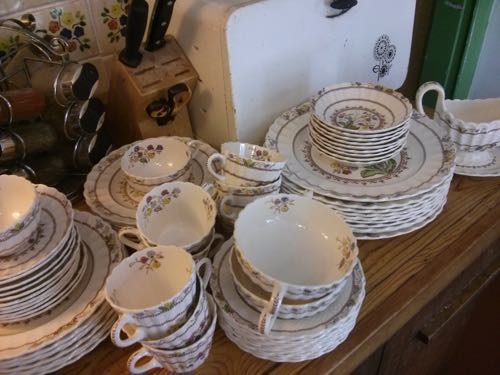
“I have your grandmother’s china for you,” her mother said. “She took good care of it.”
I highlighted this line from a story in Kelli Deeth’s The Other Side of Youth when I read it, the china emblematic of all the ways in which the lives of women my age have failed to progress in the manner that previous generations might have foreseen. All these boxes of china wrapped up in paper and boxed up in basements, and it means nothing now. I grew up in a house with a china cabinet, is what I mean, and it is very unlikely that I will ever have such an item myself, let alone a place to stand it.
Which is not to say that the domestic has no hold, that we don’t give any value to stuff. My Pyrex fixation certainly speaks to that (and I realize now that since the photo in the link was taken, I’ve acquired a set of turquoise Cinderella bowls, and also put a halt on all non-essential Pyrex acquisitions to keep things from getting too out of control). But what I don’t need is a massive collection of dishes and cups to be hauled out on special occasions, just the same way that I don’t need a parlour for afternoon callers. What I like about Pyrex is its usefulness, and then it occurs to me that there is a similar way around the grandmother’s china as well—what if I actually used it?

I have no recollection of ever seeing this china before—I didn’t pay attention to things like plates as a child, particularly if they were patterned with wildflowers. It is also possible that my grandmother didn’t set the table quite so formally when I was coming to visit. Although I do know my own mother’s wedding china intimately. I have no wedding china, but I have a vast collection of cracked and chipped dinner plates that it’s starting to seem shameful to feed my children from, and so I asked my mother if perhaps I could take a look at my grandmother’s china. If we could use them for everyday. Would that be more or less troubling, I wondered, than the plates remaining boxed up until the end of days, or else given away to a consignment store (where I would have totally bought them if I’d happened upon them)?
And so we took them, and now they’re here, unpacked in the kitchen. Some of them need cleaning—the gravy boat is still stained from some dinner more than a decade ago. But for the most part, the plates and cups are in excellent condition. Plates of various sizes, 10 of one, 8 of another, 11 side plates, 11 saucers and 9 tea cups. I wonder what they started with? Only 2 soup bowls—what happened to the rest of them? Or was soup more an intimate course, something best suited to a couple?

Predictably, I’m now a bit obsessed with my grandmother’s china. Who knew? Spode China in the cowslip pattern with a chelsea wicker design. There turns out to be a busy online marketplace for fervid Spode collectors, and now I’m lusting after Spode eggcups and a teapot. I also admire the buttercup pattern (seen here). The former curator of the Spode Museum Trust blogs about all things Spode here (and this is why I love blogs so: there is almost nothing under the sun that has not been blogged about yet). Spode was founded by Josiah Spode in 1770 in Stoke-On-Trent—Josiah Spode was almost an exact contemporary of another pottery-maker called Josiah but instead of a Spode he was a Wedgewood.

We spent this morning at the museum, which re-enlivened my delight in the thingness of things, and it occurs to me how much of my boredom with and dismissal of my grandmother’s things has to do with the idea that this is baggage, something to be carried and put somewhere. (My grandmother never ever put her china in the dishwasher, my mother tells me. We don’t have a dishwasher, so we will quite easily be able to continue in the same tradition.) But with the idea that these things could be used rather than put up on a shelf to be dusted—it changes everything. The best part about things in museums is what they tell us about ordinary life, and so it seems fitting that my grandmother’s china should become part of our ordinary life as well.
Which ensures, I suppose, that each piece will be eventually get broken and never be passed down to anybody, leaving nothing for us to be known by, our ordinary life an enigma to those who come after us, should they even care to wonder. A paradox—the Pompeii exhibit is case in point; does it matter if your frescoes are preserved if you’re dead? But I wonder if it isn’t better to simply live in the moment after all. From a person’s point of view, I mean, if not from that of an archivist.
October 11, 2015
Always thankful…
 But at this moment in particular, I’m thankful for good health, pumpkin soup, sunny days, music to dance to, tea in the pot, too many pies, hometowns and home towns, time, walks, pumpkin festivals where they shoot pumpkins out of cannons, the turkeys who give their lives and also the gourds, those precious moments when the children play together, for harvest, last precious weeks of the farmer’s market, my daughters’ teachers, Crowded House, going to bed early, hoodies, pancakes, groceries, holiday Mondays, for a Canada we recognize, for uppity women, vandals and pot-stirrers all of whom keep it interesting, for the literal pot-stirrers for the gravy, for my children’s incessant chatter, Tabatha Southey, for the people who write the books and the people who sell them, for autumn leaves (the un-ironed ones) and how the sun shines through them, for my mom and my dad and my sister, summer memories, that Taylor Swift songs are so easy to play on my guitar, for my Dyson, for all the kindness, for cheese and beer and wine and ice cream, for precious friendships, Friendsgiving, for Motown music, chestnuts, husbands, lingering baths, and every mortifying thing I’ve ever done that I can no longer remember.
Happy Thanksgiving!
October 9, 2015
Written and Drawn by Henrietta, A Toon Book by Liniers
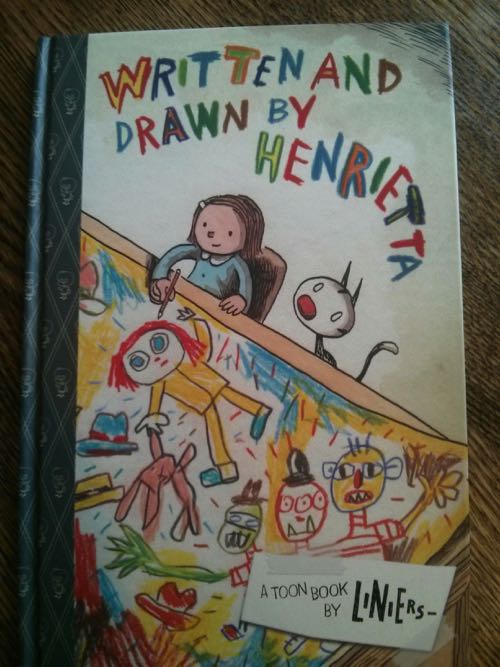 We are in love, besotted, absolutely gaga. I first heard tell of Henrietta—a small brilliant and bookish girl who appears in the Macanudo comics by Argentine artist Liniers—when “Henrietta’s Reading Adventures” appeared in The New Yorker. Then Dan Wagstaff informed me that a Henrietta book was forthcoming from TOON Books, which we’re huge fans of. And that book is Written and Drawn by Henrietta, fun, inspiring and amazingly terrific. We read it together over dinner last night, and just now I had to go retrieve it from Harriet’s bed.

Written and Drawn by Henrietta is a story about the pleasures and frustrations of the creative process. Young readers will be inspired by Henrietta’s creation to make an attempt at their own literary masterpiece (and won’t be intimidated either, with Liniers’ rudimentary-looking Henrietta-style). They will also benefit from practical advice Henrietta offers along the way:

Creating art is not without its challenges and pitfalls, and Henrietta contemplates these as well.

But the narrative is driven primarily by her wonder and her excitement at the story she is creating (“I’m drawing really fast because I want to see what happens next…”) and the reader will be inspired to begin her own creation on Henrietta’s coattails.

…Or at least I’d like to meet the kid who wasn’t.
October 8, 2015
Really Fun DIY Autumn Craft
 A few trees on our street have gone all autumnal, and while the world is not yet awash in golden and orange, the few trees that have turned already have got us in an autumn spirit. Iris had fun playing peek-a-boo with some of them on her way home from school today, and we’re glad she was not picked up by the Ministry of Flagrant Racism and Canadian Values for daring to hide her face no matter how patriotic her covering.
(Halloween is coming. If our government is still in office then, what are they going to do?)
And so we were inspired to partake in an autumn craft this evening for our weekly Fun Night, which is a dinner-hour activity that allows us to hang out and play together for a little while, instead of the rush-rush-rushing that is our regular weeknight routine. I’ve included step-by-step instructions below so you can play along too!
- See a link to a DIY Autumn Leaf Bunting tutorial posted on Facebook, and because you have a thing for bunting, actually consider doing it. Even though you hate doing crafts. The site it’s from is called The Artful Parent, but you’re more of an abstract artful parent, if you’re remotely artful, which you’re not.
- Gather leaves on the walk home from school. Feel smug and sanctimonious, anticipating the excellent time you’re going to be spending with your family and anticipate the reactions you’ll receive when you post your DIY Bunting on Facebook. Contemplate making strands upon strands of the stuff, and bringing them to Thanksgiving gatherings all weekend long so that people will admire your creativity and quirky bunting ways.
- Feel extra wonderful because you even let your kids pick up leaves that were kind of gross and had spots on them. Because it’s about them, really. And my, what a terrific childhood you’re providing them with…
- Buy store-brand wax paper at the grocery store.
- And now it’s time! You’ve already made cranberry brie chicken pizza for dinner that made the children cry (although this was before they tried it; they conceded it was delicious in the end) and so you’re on a roll.
- Press the leaves between two pieces of wax paper. The child who is still upset about the pizza gets upset again because she wants matching colours for each piece of bunting, but you want to mix it up like a rainbow. You’re really fucking insistent about this.
- (Read through the instructions for the bunting at The Artful Parent and realize that the Artful Parent actually made HER DIY autumn bunting while her child was at school.)
- Your husband pulls out the iron. Your children have never seen one. They marvel at this shiny and new piece of technology.
- He begins to iron. It should take a few minutes, the instructions say, for something to happen. Nothing happens. So he turns up the temperature. He starts to iron like no one has ever ironed before. Eventually you realize he is about to iron a hole right through your kitchen table. The leaves are burnt to a crisp. The wax still hasn’t melted. The leaves aren’t pretty anymore.
- This is the point when you storm off and start googling “Why won’t my wax paper melt?” This doesn’t actually seem to be something that happens to many people. You get sucked into a hole of websites about weird ways to preserve leaves and really stupid things that people do with them. You wonder what the point of anything is. You are suffering from bunting grief. It’s terrible.
- This is the least fun Fun Night on record.
- Back in the kitchen, however, your husband has saved the day. He’s poured out glue and everybody’s slapping the non-burnt leaves onto paper. “But what’s the point of this?” you ask him. “What’s the point of bunting?” is his retort, which is blasphemous, but still. And gluing leaves onto paper looks like of fun, so you join in.
- The night is saved by your husband’s excellent improvisational skills. And red wine.

October 7, 2015
No wonder the children grew peaky
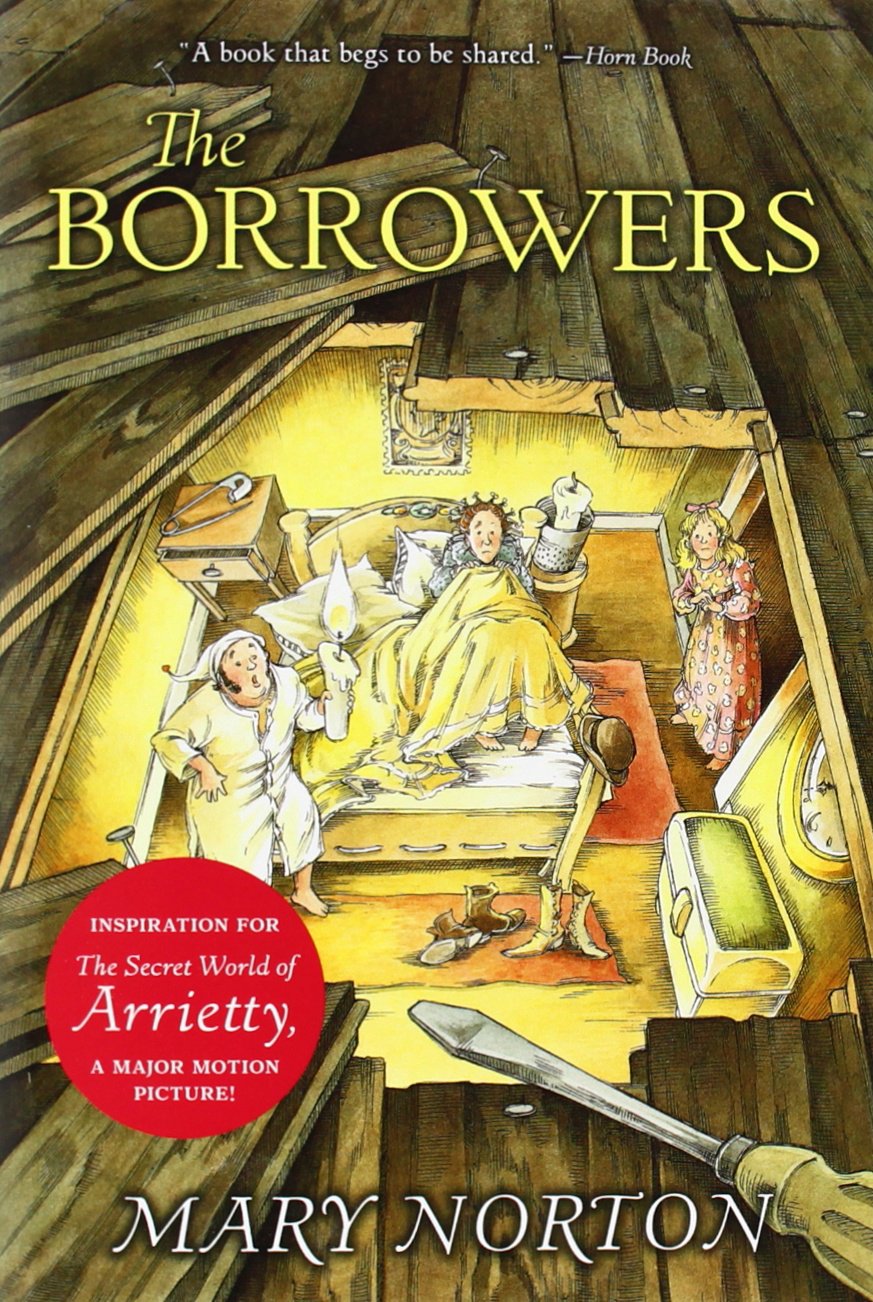 “So he didn’t have your advantages,” went on Homily breathlessly, “and just because the Harpsichords lived in the drawing room—they moved in there, in 1837, to a hole in the wainscot just behind where the harpsichord used to stand, if ever there was one, which I doubt—and were really a family called Linen-Press or some such name and changed it to Harpsichord—”
“What did they live on,” asked Arietty, “in the drawing room?”
“Afternoon tea,” said Homily, “nothing but afternoon tea. No wonder the children grew up peaky. Of course in the old days it was better—muffins and crumpets and such, and good rich cakes and jams and jellies, And there was an old Harpsichord who could remember sillabub of an evening. But they had to do their borrowings in such a rush, poor things. On wet days, when the human beings sat all afternoon in the drawing room, the tea would be brought in and taken away again without a chance of the Harpsichords getting near it—and on fine days it might be taken out into the garden. Lupy has told me that, sometimes, there were days and days when they lived on crumbs and water out of the flower vases. So you can’t be too hard on them; their only comfort, poor things, was to show off a bit and wear evening dress and talk like ladies and gentlemen…” —Mary Norton, The Borrowers
(We’re reading this right now and I’m loving it so much. I don’t know that I’ve ever read it before. When I was a child, I was into the American knockoff, The Littles, but I had no taste, and Mary Norton is so clever, funny and bright. I also like our copy because the cover is by Marla Frazee, who is one of my favourites. And sort of related, we recently finished reading The Lion the Witch and the Wardrobe, which went over very well, except that Iris now walks around saying apropos of nothing, “Aslan die?” and I don’t think she knows what die means, or even Aslan for that matter. But Harriet is quite enchanted and now we’re going to read the whole series, and tonight we were reading a new book called Written and Drawn by Henrietta, by TOON Books, and there was a Narnia reference, and I haven’t seen Harriet that excited since she found out she had a wobbly tooth.)
October 7, 2015
Rereading Anne’s House of Dreams
 I’ve been reading the Anne books as long as I’ve known how to read, though my preferences among them are a bit curious as Anne aficionados go. Anne’s House of Dreams was always my favourite, followed by Anne of Ingleside, because I found her children incredibly amusing. Rainbow Valley I could take or leave, but of course I loved Rilla of Ingleside, which seemed a proper grown-up book. Anne of Ingleside didn’t particularly, however, but it did permit glimpses inside Anne’s marriage, which I was fascinated by. (“They sleep in different bedrooms,” I said to my mother one summer day at the locks at the Rosedale Canal. We were with family friends. “So how did they manage to make babies?” I was told we’d talk about it later.) Anne of Ingleside is the one book of all my Anne book whose binding has completely come apart, which isn’t that surprising considering it was a crappy Seal paperback (and oh, good gracious, the typos! The typos!), although the others are holding up okay. It is possible that I have never reread Anne of Avonlea or Anne of the Island. Grown-up Anne was always more interesting to me than her youthful counterpart, although I’ve reread Anne of Green Gables twice in the last ten years and it’s only deepened my appreciation for its goodness and depth.
And so last week I turned again to House of Dreams, because we’re reading it for our book club. And I was a bit surprised to find that reading it was nothing but a pleasure, and it was rich with humour and surprises. And both, in the case of the regular references to suicide by Miss Cornelia Bryant: “Doctor Dave hadn’t much tact, to be sure—he was always talking of ropes in houses where someone had hanged himself.” There’s a lot of dark humour in the book, and darkness full stop in regards to poverty and status of women in the village families. Anne and Gilbert’s home stands in contrast to to the world around them, just like Captain Jim’s light house.
And yes, Captain Jim, the one bit I was just not as taken by. He was a bit like an idiot savant and I kept wondering about his sexlessness. I wondered a lot about sex in general, actually, and have a better understanding of why fan fiction was invented because I would actually like to read Anne and Gilbert porn—wouldn’t you? Anyway, I was relieved when LM dialled it back whenever I fear that he was about to launch into a sea yarn. There is no book I’d ever want to read less than Captain Jim’s life book, and while I didn’t feel relief, exactly, when he crosses the bar, I wasn’t worry to see the last of him.
The book I do want to read is this one though, about Anne and Gilbert’s first year of marriage. About Anne’s longing for motherhood, which is a subtle but persistent force throughout the book (and even violently so on the part of her friend, Leslie Moore). It goes unspoken, but it’s remarkable that in having a child, Anne would meet a blood relative for the very first time, which even in a world lousy with kindred spirits has to mean something. At the beginning of the book she witnesses Diana holding her own daughter:
“cuddling Small Anne Cordelia with the inimitable gesture of motherhood which always sent through Anne’s heart, filled with sweet unuttered dreams and hopes, a thrill that was half pure pleasure and half a strange ethereal pain.”
The beginning of the book is wonderful, a homecoming to Avonlea, Anne and Gilbert’s wedding the first Green Gables has ever seen. The prose is still so familiar to me from when I read it years and years ago, and I can anticipate each next line as I encounter it: the bit about the bird that sang during the ceremony. Marilla is stiff and deadpan, and Mrs. Rachel Lynde is still every bit herself, and we’re acquainted with characters from previous books (although not Windy Poplars, which was published after House of Dreams, although it takes place before, making it seem as though her friends from Summerside did not making the guest list).
They move to Four Winds Harbour, near the village of Glen St. Mary. There they meet the neuter seafaring Captain Jim, and Miss Cornelia Bryant in her ostentatious wraps and declarations of, “Isn’t it just like a man?” And Leslie Moore, whose name I always found so euphonic, and quite fitting that her husband was called Dick. Indeed. Tragic Leslie, who hates Anne for her fortune as much as she admires her as a friend, and Montgomery’s acknowledgement of that complexity in female relationships is really quite profound. I also rejoiced at the birth of Bertie Shakespeare Drew, who would come to be an important character in the following book.
I always found the romance between Anne and Gilbert most endearing, and I imagine that my greatest attraction reading the book when I was young was imagining that somebody might love me as much as Gilbert loves Anne. This is also why, while I am lucky that somebody loves me much indeed today. I often admonish him for not voicing his interior monologue using phrases like, “I can hardly believe that you are mine.” (My husband believes I am his too much entirely. Poor man.) It is possible that Gilbert Blythe gave me an entirely unrealistic standard of courtly love.
I don’t recall being disappointed by the Anne in Anne’s House of Dreams, though I can certainly see why one would be and I really liked Sarah Emsley’s post about Anne’s dismissal of her writing talents in the novel. Kate Sutherland (who, lucky us, is in our book club!) address this too in a post a few years ago, suggesting that Anne had not let herself down so much as readers had misidentified her as a writer. She had had other goals for herself, although yes, it would have been nice if literature proper in the novel wasn’t so gendered. And while Anne does go the route of plucky childhood heroines and settles down into conventionality ala Laura Ingalls, Dorothy Ellen Palmer made a great point on Facebook about the importance of seeing Anne as an adopted child whose spiritedness may have been a way to deal with trauma, loss and insecurity, and that the trajectory of this character to a happy and stable adult, wife and mother, is incredibly remarkable. (See also: Alison Kinney’s essay, “The Uses of Orphans.”)
What has always been most striking to me about the book is Mongomery’s depiction of the stillbirth of Anne’s first baby, this indefatigable character overcome by heartbreak, and her pain is so real. The experience was close to its author’s heart, giving an extra layer of poignance to the narrative, as well as authenticity. Striking too is Marilla’s fear at the loss of her own daughter, and her relief when Anne’s life is saved. Her inability to articulate her emotions too: “‘Time will help you,” said Marilla, who was racked with sympathy but could never learn to express it in other than age-worn formulas.” And Leslie Moore who dares to say, “I envy Anne… and I’d envy her even if she had died! She was a mother for one beautiful day. I’d gladly give my life for that!” Which is neither kind nor wise but something beyond either. Anne’s anger as well at the idea her daughter was in “a better place.” And when she’s told that one day it will hurt less and she replies, “The thought that it may stop hurting sometimes hurts me worse than all else.”
Although the novel’s most heartbreaking part of all takes place when we learn in chapter 35 that Gilbert Blythe is an ardent Conservative—but of course, and so was Matthew, we remember. But then after 18 years, the Tories lose to a sweeping majority by the Grits, which does to show that anything can happen. Captain Jim himself redeemed by the fact that he wasn’t a Conservative himself—though he dies. Hopefully not a comeuppance, but I do hope that somehow Montgomery’s narrative is some kind of political forecast. More accurate than some polls, I am sure. It doesn’t have to be the Liberals necessarily, but please, in two weeks, let us be able to say, paraphrasing Captain Jim, “After nearly ten years of Tory mismanagement, this down-trodden country is going to have a chance at last.”
October 6, 2015
Canadian books for high school readers

This summer, I got one of the coolest gigs I’ve ever had, the opportunity to write a list of suggested Canadian fiction titles with which high school English teachers can freshen up their syllabus. As I write in the piece, I was inspired by Natalee Caple’s “Why I Teach Brand New CanLit,” which was about university classes, but her points were just as relevant for high school teachers as well. And it was no challenge to come up with the 25 titles I ultimately included in the list—I do suspect that teachers are actually spoiled for choice in this context, should they choose to be.
My list appears at Education Forum, which is the magazine of the Ontario Secondary School Teacher’s Federation. You can read it here.
October 4, 2015
Ledger of the Open Hand, by Leslie Vrydenhoek

“Great civilizations aren’t remembered for their tax policies.” —Marsha Lederman, The Globe and Mail.
I thought of Ledger of the Open Hand, by Leslie Vryenhoek, when I read the quote above, from a story about the failure of politicians in our federal election to grapple with issues deeper than budgets and surpluses, to talk about anything except money. Because Vryenhoek’s novel is about a character just like these uninspired (and uninspiring) politicians, Meriel-Claire Elgin who sees the world in terms of debits and credits, who conflates value with values, and the novel is also about how limited is such a worldview.
Though it’s an easy trap to fall into, this obsession with fiscal responsibility and thinking of thrift as a moral virtue. Raised in a small prairie town by parents of modest means, Meriel-Claire is determined to prove herself responsible as she begins university in the city, working in the summers and part-time to supplement her parents financial support. Though she quickly sees her experience in contrast with that of her sophisticated roommate, Daneen, who takes her family’s wealth for granted. Their respective financial situations seem to demarcate their places in the world, Meriel-Claire decides, imagining herself as the hard-working ant while her grasshopper friend devotes herself to shallow and frivolous concerns. Unconsciously seeing the fable analogy to its end, Meriel-Claire envisions a day when there will be justice, when her hard-work and prudence will be rewarded and Daneen will meet her inevitable downfall.
But of course, life is not this simple, structured like a ledger sheet (which, cleverly, is suggested in the novel’s cover image), and neither is the novel. Interestingly, the story of the ant and the grasshopper has alternate versions in which it’s the grasshopper who is actually the virtuous one, and The Ledger of the Open Hand (like life itself) permits plenty of space for such ambiguity. The novel is broad in its scope, taking place over three decades, and showing the changes in the life of Meriel-Claire (and in her family’s) as she moves from her twenties to her forties. And because all of this is presented from Meriel-Claire’s point of view, everything is about money—she starts off as a bookkeeper and eventually becomes a debt counsellor; with colleagues and family, she gains a fierce (and justified) reputation as a tightwad. Though Meriel-Claire doesn’t see it quite that way herself, and Vryenhoek gives us real sympathy for her situation and how she got there, and the truth is that so much about being in the world is about money after all. It’s just simpler for people like Daneen who don’t have to worry about it. Of course it’s easy not to think about money all the time when you have no need to.
Written in short chapters that whisk the reader through the years, we follow Meriel-Claire through her first jobs, home-ownership, through failed investments and unexpected windfalls. We see her parents sell their business and begin to enjoy their retirement, and live a life that seems at odds with Meriel-Claire’s memories of her modest upbringing. Their distance from their daughter is augmented by tragedy in their lives, tragedy that none of them is really ever able to account for. And looking on through all of this is Daneen, who grows close to the family and eventually becomes a successful author whose stories seem a bit too familiar to Meriel-Claire, raising issues of just how much borrowing is permitted in matters of story as well as money, and also of how adept is anybody at seeing a reflection of her own self?
While all too present on the political stump, issues of finance are curiously absent from so much of literature, whose bills seems to get paid almost by magic (unless it’s a book about the farm and foreclosure). Vryenhoek manages to weave a deep and engaging novel out of money matters, though she makes it about more than that. While at times Meriel-Claire is a bit robotic in her approach to the world and Daneen can verge on caricature, Mariel-Claire’s parents are rich, complex and fascinating characters, and the connections between all these people over the decades yield surprising insights and remarkable depth, culminating in a really wonderful story. Vryenhoak’s prose is bright and accessible, the novel fast-paced and compelling, and there is a startling originality to all of it.
October 1, 2015
Mr. Postmouse’s Rounds by Marianne Dubuc

We are a little bit crazy for Marianne Dubuc in our house, which is interesting because she does something very different with every book she writes, but what all her books have in common are elements of whimsy, unabashed absurdity, rewards for those who are attentive to detail, and an all-engaging strangeness. And in Mr. Postmouse’s Rounds, she has written a book about the mail, and so naturally I am totally obsessed. As are my kids, because, well, look right there on the cover: there is a rabbit pooing. Sitting on the toilet reading, no less. And this glimpse into the rabbits’ hidden world is what’s so entrancing about this book, exploring these animal abodes that Dubuc has dreamed up: the bear’s house has honey on tap from a hive on the roof; the snake’s long skinny house is outfitted with heat lamps; the squirrel’s got a clothesline and sleeps in a hammock; the mole house has a kettle on the stove.
It’s the kind of book a kid can read with her finger, tracing along the Postmouse’s route and in and out of the houses he delivers to. While the illustration style is very different, we love it for the same reasons I loved Jill Barclay’s Brambly Hedge books when I was little, tiny worlds magnified, access into hidden corners, such incredible attention to detail. And yes, it’s funny. There’s the poo (and the flies’ house is actually a giant piece of much poo, much to everybody’s delight). And there are abandoned shoes, mitts and candy wrappers littering the animals’ neighbourhood, and just what’s going on in each of these dwellings? Each house containing a story of its own, so that you can read Mr. Postmouse’s Rounds over and over again and—which I know from experience—the young reader will continue to keep exploring its pages long after the reading is done.