November 3, 2015
Rumi and the Red Handbag, by Shawna Lemay
 I am not a handbag person per se, but as a fervent believer in the secret (and sacred) lives of things, I’ve been really looking forward to Shawna Lemay’s novel, Rumi and the Red Handbag. And also as a fan of Lemay’s blog, Calm Things, and something that I found really wonderful about the book was how clear it was for those of us in the know that Lemay’s blogging is a huge part of her process. This is a book about handbags (among other things) by someone whose long-time blog was called “Capacious Hold-All,” after all, which is from Virginia Woolf’s diary, her description of what she wanted her diary to be. And so it seems that handbags are literary objects right from the novel’s departure—how could a reader ever have doubted?
Rumi and the Red Handbag is a slim, heartbreaking and perfect read, rich with gorgeous prose, and depth and texture. Infused with allusions, explicit and otherwise, it’s a hushed and quiet celebration of women and their lives and their words and the secrets they carry. There is the Woolf, of course, and references to Clarice Lispector, who I’ve never read, but now I have to, and Charlotte Bronte, Jane Austen, Sylvia Plath. Plus vintage Harlequins—this is a book that permits great reverence to women’s stories and women’s spaces.
Our narrator is Shaya, on the run from academia and her unfinished thesis about the secrets of women writers. She takes a job at a consignment shop where she spends one long Edmonton winter in thrall to her young colleague, Ingrid-Simone, whose haphazard education consists of snippets and quotations and lines gleaned from library books that have a tendency to fall off the shelf right into her hands as she meanders her way through the stacks. She’s preoccupied by questions of the soul, by ideas in general. She floats around spouting lines in a manner that is one hand a bit simple and precious, but then she is young and it reminded me of the way my friends and I used to try to pin the down the world with bits and pieces once upon a time. I certainly remember that impulse, and Lemay captures it so well: “For Ingrid-Simone, the idea of hoarding thoughts, holding so many threads of ideas like cupped water as you knelt, knees grinding into finest gravel, thirsty by a mountain stream, did not terrify or oppress her instead exhilarated her.”
When things get a little too ethereal, Lemay balances it out by startling moments of revelation taking place under fluorescent lights at the Shoppers Drug Mart cosmetics counter, and also at Wal Mart. For while this is a novel concerned with questions of the soul, those questions are connected to the material world, in particular with the things that come and go from the shop where Shaya and Ingrid-Simone spend their days. Purses in particular are Ingrid-Simone’s things, and inspired by Shaya’s literary passions, she begins creating miniature purses inspired by writers and books: the first is a tiny capacious hold-all ala Virginia Woolf, authentic right down to a miniature pencil which inspires the writer’s walk in “Street Haunting.”
And so each woman inspires the other, and they learns from each other, and Ingrid-Simone reignites Shaya’s desire to start writing again, jotting words and ideas on post-it notes, “threads of ideas” (and there again we have connections to clothes and to textiles), like the way her friend thinks. Though all the pieces together still do not solve the inherent mystery of Ingrid-Simone—what secrets is she fleeing from? What is her connection to a curious red handbag? And there are other mysteries too—what about the goings-on of the shop’s proprietor, and also how can customers become so consumed by their own lives that they fail to acknowledge the humanity of service staff? A question that wears down on both Ingrid-Simone and Shaya as the long winter goes on.
With spring, however, comes revelations, and departures, and a journey that ends at the Museum of Bags and Purses in Amsterdam, a place Ingrid-Simone had long dreamed of making a pilgrimage to. A place that underlines her philosophy that there is a connection between a woman’s handbag and her soul. It’s a place for secrets, yes, and essential things, and for her stories. Especially for her stories.
For what is a handbag anyway but a place to keep a book?
November 1, 2015
The Future is Dark

“The future is dark, which is the best thing the future can be, I think…” —Virginia Woolf
Something has turned, not just the calendar, making the world around us distinctly November. The leaves on our big tree have gone suddenly from green to yellow, and are starting to fall. The clock has gone back, and the evening comes sooner. And yet the temperature is mild tonight. We walked up to the ice rink to meet our friends and go skating, and our hats and mitts were overkill. The sky was curiously mottled, dark clouds, setting sun and blue.
 We were looking forward to skating—our second time out this season. And our second time out skating as a foursome. Last weekend, we drove out to the west end and hooked Stuart up with his first pair of ice skates ever, and traded in Harriet’s last year pair for a bigger model. When Harriet and I first bought skates last Christmas, it seemed a dubious experiment—would we actually undermine our reputations as terrible Canadians and partake in a winter sport? But it turned out that we loved it, and Stuart looked on longingly. This year, Stuart is in on the fun, and Iris too on bob skates. Though we are particularly excited because we’ve been spent the last week tracking the postal progress of her brand new deluxe bob skates with straps that won’t fall off (we hope!) and they’re due to arrive any day now. And we’re even looking forward to skating proper on the outdoor rinks once they’re open because Stuart and I each bought a pair of snow pants, my first pair in many years. I actually think that they might change my life, and certainly will make walking the children to school at -40 degrees celsius much more bearable, not to mention outdoor play during playschool co-op shifts, and even the prospect of tobogganing. Last year we went tobogganing once, and my jeans got wet, and I was so cold, I could have cried.
 But all that was a long way off as we walked up Brunswick Avenue tonight, enjoying the strange light and the post-Halloween quiet. Stepping over smashed pumpkins, and being in the perfect place between warmth and chill. Arriving at the ice rink to find our friends there, everyone a bit disappointed. The Sunday night public skate schedule was from the summer, apparently. In autumn, the public skate is on Saturday. And it took me far too long to process that it wasn’t actually Saturday. Okay then. But it seemed that the entire park beside the rink was ablaze for some kind of festival, pumpkins lining its perimeter. Children were climbing ladders into up into trees and swinging from ropes in a manner that suggested that nobody had thought about safety permits or wavers. Someone else had set up straw-bales and an old mattress, and the children were taking turns flinging themselves upon it. The adjoining playground, whose climbing structure is a pirate ship, was absolutely full of children, taking in the festival, perhaps, as well as the perfect autumn night. (All this is so lovely—it has rained for the last three Halloweens, I think.)
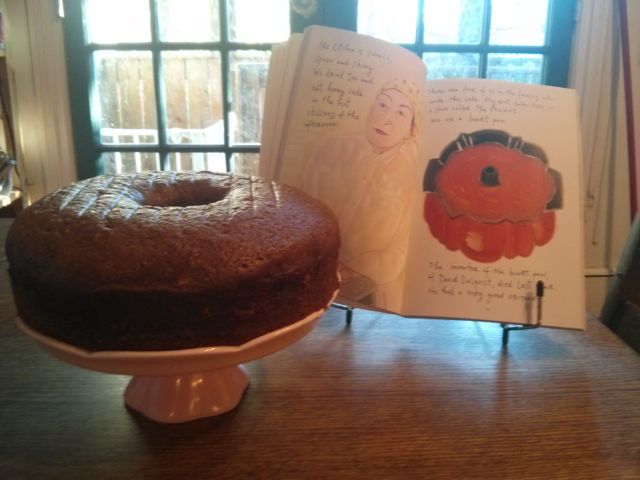 So we stood in the playground with our friends while our kids played, and it was perfect. And I was thinking about Rebecca Solnit’s essay, Woolf’s Darkness, which we’re reading tomorrow night in my blogging course. The line, which is also the epigraph to my novel, “To me, the grounds for hope are simply that we don’t know what will happen next…” I’ve been thinking about nighttime walks, and street haunting, and one thing leading to another. How exactly one year ago, when I was also about to be discussing Woolf’s Darkness with my blogging course (and yes, one might ask me the question: how have you managed to find a way to be paid for doing all the best things ever? To which I would reply: I have absolutely no idea…) and I wrote this post, one of my favourites ever: “On Uncertainty, Mistakes and Accidental Cake“, which might just be my philosophy of the world. Tonight another example: often, not ending up where you were intending to go turns out to be startlingly right.
 We walked home again and it was dark outside. “I don’t like the dark,” said Harriet, who always claims that she can’t see at night, never mind the streetlights. I pointed out that what I liked best about walking in the dark was everybody’s lit windows, and how we could see the worlds inside. We decided to make a quick visit down to our own neighbourhood’s annual pumpkin festival before heading home for dinner: baked butternut squash risotto was waiting in a cast-iron pot on the stove. Although we were less excited about the pumpkin festival as we’d been in years previous, as our own pumpkin hadn’t been picked up to be part of it. We remain fuzzy on how which pumpkins get to be in the festival. I thought it was democratic, but ours keeps not getting picked up. Then we wondered if it was just that it sucked, but I don’t think that’s actually a barrier to entry. Anyway, just to demonstrate that we just didn’t care about any of this, okay, FINE!, we’d hacked our pumpkin to bits this afternoon with an intention to roasting it and making it into something to eat. As we walked home from the pumpkin festival, I was anticipating a rich pumpkin pudding—the perfect end to an excellent, albeit meandering evening.
 Oh, but reader, my pumpkin pudding was vile. Demonstrating that not all winding roads eventually lead to cake or such deliciousness. Sometimes one’s culinary accidents are scraped into the bin, and the problem isn’t solely that you forgot to add sugar (I know! What was I thinking?). But also that carving pumpkins are just fundamentally not meant to be eaten by creatures more discerning than raccoons. Which would be the point at which wiser women might give up, but oh no, that would be too easy. The grounds for hope are simply that we don’t know what will happen next, remember? So I’ve roasted the pumpkin, and now I’m going to turn it into soup. And if that doesn’t work, I’ll chuck the whole thing into the garbage and officially go to bed.
October 30, 2015
Missing Nimama, by Melanie Florence and François Thisdale

It’s not my usual practice here to write about a picture book that I haven’t read with my children, but Missing Nimama, by Melanie Florence and François Thisdale, is not your usual picture book. And I didn’t read it with my children not because they don’t know about Canada’s Missing and Murdered Indigenous Girls and Women—indeed, my 6 year old does know about this terrible part of our country’s colonial legacy, a legacy that’s lasted right up to this exact second—but because she told me she didn’t want to read a story that was sad. And neither did I, truthfully, to have to give voice to this story’s achingly, awful, beautiful words: the words of a mother who has been lost to her daughter but watches over her still, and the words of a daughter who has to grow up without the mother who loves her oh so much.

Stories of children who’ve lost their mothers are perhaps the most unbearable thing I can contemplate. So I don’t, usually. But in the case of Missing Nimama, I was compelled to read on, spurred on by Thisdale’s gorgeous dreamlike illustrations (which are similar in effect to his work in the acclaimed The Stamp Collector). I was also drawn by the story, written by Cree writer and journalist Florence. Her young character, Kateri, is raised by her loving maternal grandmother, who tells her that her mother is lost:
‘”If she’s lost, let’s just go and find her.”
Nohkom smooths my hair, soft and dark
as a raven’s wing.
Parts it. Braids it. Ties it with a red ribbon,
My mother’s favourite colour.
“She’s one of the lost women, kamamakos.”
She calls me “little butterfly.” Just like my nimama did.
Before she got lost.’
And then we hear nimama’s voice: “Taken. Taken from my home. Taken from my family. Taken from my daughter. My kamamakos. My beautiful little butterfly. I fought so hard to get back to you, Kateri. I wish I could tell you that. And when I couldn’t fight anymore, I closed my eyes. And saw your beautiful face.”

We see Kateri growing up, thriving under the loving care of her grandmother, and under the proud watchful eye of her mother. We see her grappling with her loss and grief, learning about her culture and traditions, growing up and finding her way in the world. And the heartbreaking sadness of the story is balanced by Kateri’s success in her life—the stability she finds as she grows older, gets married, has a child of her own. A stability that is against the odds, perhaps, and I think about Missing and Murdered Indigenous Women in connection with the history of Residential Schools and how many social problems in First Nations communities are results from over a century of cultural genocide. Not to mention the much more direct instances of government-sanctioned violence against Indigenous women in Canada.
I think of all these children who’ve lost their moms.
I don’t think that children like mine are necessarily who this picture book is meant for, not right at this moment in time, perhaps. For the far too many children for whom this story is close to home, however, I can’t imagine how powerful it would be to see one’s own experience reflected in a story like this, Kateri’s own story an inspiring example of the path a life can take, even one that begins with incalculable loss and trauma. (Which is not to say that this isn’t an important story for anyone—it’s such a visually compelling book that I’d like to keep it around, have my children leaf through, and become familiar with. We will definitely read it together. We’ll just have to ease our way into it…)

But then, someone might ask, why is it a picture book after all? Surely a book with such subject matter should be geared toward older readers? Should be a chapter book, at least? To which I respond that picture books have nothing to do with age. That grief and trauma don’t have a minimum age requirement either, sadly. That picture books allow this story to be accessible to all kinds of readers (and, remarkably, like all books from Clockwise Press, this one is printed in a “dyslexia-friendly” typeface). And most of all, that this story works because it’s a picture book, because of the marriage of words and stories, and how the respective voices of mother and daughter can exist together, even if apart, on the page.
Missing Nimama is a mourning song, but also a call to action. Near the end of the story, Kateri attends a public vigil for missing and murder aboriginal women: “Stolen sisters. I hold my own sign. My own lost loved one.” And the book’s final page contains quotations by family members of murdered women, from the UN Report which dictates that “Canada must take measures to establish a National Public Inquiry into cases of missing and murdered Aboriginal women and girls.” And our soon to be ex-Prime Minister’s infamous shameful view on the subject: “It isn’t really high on our radar, to be honest.”

The numbers are important, inarguable. “A total of 1181 Indigenous women and girls have been murdered or went missing between 1980 and 2012.”
But it’s going to be stories—like that this one—that make the difference if we’re to give all of our daughters a chance to live in a better world.
October 28, 2015
Another Margaret, by Janice MacDonald
 I really loved this piece about campus novels and academic mysteries that Janice MacDonald wrote for 49thShelf back in September—referencing Dorothy Sayers’ Gaudy Night, of course. So I’ve been looking forward to her latest novel, Another Margaret, her sixth book in the Randy Craig series set in Edmonton, Alberta. Which is also the first book in the series, a reworked version of an out-of-print 1993 book called The Next Margaret, MacDonald’s first to feature Miranda Craig, a hapless perennial academic with a penchant for sleuthing.
On the occasion of her 20th reunion—grad school at the University of Alberta, and her pal Denise has roped her into being part of the organizational committee—Randy’s mind drifts back to her MA studies and her fraught relationship with her thesis advisor. She’d gone back to school as a mature student to study up-and-coming but little known Canadian novelist Margaret Ahlers—yes, another Margaret, along with Laurence and Atwood—on whom her advisor, Dr. Hilary Quinn, had written critical works. But Dr. Quinn turns out to be oddly unforthcoming on the subject of Ahlers, and it is not long after announced that Ahlers herself has died. And whatever her connection to Dr. Quinn, it now seems complicated in a way that Randy is determined to get to the bottom of.
But the course of an academic detective story never did run smooth, and suddenly somebody else is dead—was it murder?—and Randy has got her fingers on a floppy disk that seems to contain a another novel by Ahlers. But the novel turns out to be a detective novel. A “brilliantly subversive detective novel,” but still: had Canada’s Great Literary Hope upped and gone genre? And if she was murdered, was that why?
“All that territory staked on the next Margaret Laurence, or Margaret Atwood, and she turns out to be the next Margaret Millar!”
MacDonald does a terrific job capturing the seasons of the academic year: the heightened expectations of autumn, and then come April, everybody is crying. The send-up of academia is fun and smart, and also important in what Randy’s work as a sessional instructor has to tell us about the precarious nature of academic work at the moment. I also enjoyed the novel’s glimpses into Canadian literary culture, including a funny bit when Randy starts a fake book blog to get an advanced copy of yet another new Ahlers novel that comes out right before the reunion—a novel that Randy knows could not have possibly been written by Ahlers herself.
 The prose style was clunky in places, and some of the leaps of logic (both taken by Randy and required by her reader) were a bit absurd, and then once there’s the stabbing with the plastic picnic knife—well? Well, that’s how you know that the whole project is done in the spirit of fun, not taking itself too seriously, but executed well enough that admirers of academic mysteries can come along for the ride. And I really glad I did. Another Margaret was a lot of fun, and a great introduction to the Randy Craig series. I’ve been been feeling unwell this week and the weather has been autumnal in the not-so-golden sense, and so this has been the perfect kind of story to curl up in.
October 27, 2015
On Rereading: CNQ 93
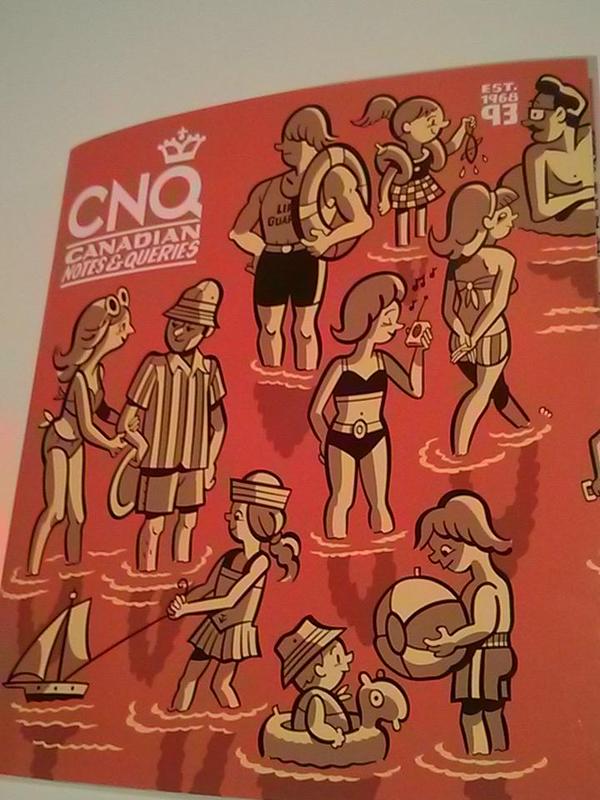 While I wish it were otherwise, the truth is that it’s rare for a magazine to arrive on my doorstep and for me to have devoured the entire thing in a day or two. But then a magazine like Canadian Notes & Queries 93 is a rare thing. Guest-edited by Kim Jernigan, beloved former long-time editor of The New Quarterly, the issue’s focus is on rereading, inspired by the 2005 anthology, Rereadings, edited by Anne Fadiman. And basically once Anne Fadiman turns up on page 7 of your magazine (in Jernigan’s intro: “On Rereading, its Pleasures and Perils”), I’m totally hooked.
(I reference Fadiman in my own essay about rereading Fear of Flying; come to think of it, my most recently published essay is about rereading too. It seems that I am the target audience for this issue of CNQ.)
Do you know Anne Fadiman? Oh, but you have to. Her essay collections Ex Libris and At Large and At Small are two of the best books I have ever read. Loving Anne Fadiman’s work is a bit like being in the world’s best secret society, except none of it’s a secret and we want everyone to join.
Anyway, an entire magazine inspired by Anne Fadiman. Think of it. In fact, go out an buy it. To read Caroline Adderson on rereading (and rewriting) her first novel, A History of Forgetting. It’s about missteps, failure, cringeworthy moments, and on what remains: “First this book tortured me, now it’s humbled me.” And Carrie Snyder on reading The Prime of Miss Jean Brodie, which has changed and not changed both in what it has to tell her about being a writer: “It is the book I aspire to write…” And then Anne Marie Todkill on rereading Mrs. Dalloway. Kathy Friedman on Jane Urqhart’s Changing Heaven, which fails to measure up. (A funny aside: recently I spent an evening laughing hysterically with old friends about how strange we all were when we met nearly 20 years ago. One of us had a Jane Urquhart poster on the wall, my friend Kate remembers. This idea now seems absurd: that Urquhart had such cultural currency. I couldn’t believe it. And then not a half hour later, I was looking through an old scrapbook into which I’d etched a quotation from something by Urquhart, from The Whirlpool, maybe. I even now remember that I once wrote a poem inspired by her book, The Underpainter. All of this feels impossible now. Who knew she was such a touchstone?). And then Susan Olding on The Golden Notebook, weaving her read and her reread into a terrific story of learning lessons again and again, about fragmentation and discovery. The ways in which our readings and rereadings can go oh so wrong.
Plus there are three poems by Robyn Sarah, from her collection, My Shoes are Killing Me, which has been nominated for the Governor Generals Prize for Poetry. The kind of poems you read and that have to read aloud to whoever is sitting on the couch beside you. And a story, “Multicoloured Lights,” by Jess Taylor, from her short story collection, Pauls. And book reviews by Emily Donaldson and JC Sutcliffe. It really doesn’t get any better. (There is also work by men in the issue, although those are the ones that I skimmed…)
So go buy it. That’s all. I think it’s available on newsstands now, so go and delight in its goodness, in the worlds these pieces open and reopen, and how the best thing about literature is that we’re never ever though.
October 26, 2015
Good things to know
 Okay, I know it’s not even Halloween, but have you heard about the 2015 Short Story Advent Calendar? It’s better then chocolate (apparently?), 24 stories for readers to open every day leading up until Christmas. Contributors include Pasha Malla, Jess Walter, Heather O’Neill, Richard Van Camp, and Zsuzsi Gartner, and bunch of others whose identities are staying secret (but a few of whom emailed me on the down-low to let know they were involved, leading me to order my calendar. Trust me: you’re going to want to get in on this). Kudos to Michael Hingston and Natalie Olsen for taking the initiative and making it happen.
And the reason we’re talking about it now is that the calendar is available as a one-time, limited edition print run. By which I mean: Get it while you can.
Oh, and another thing? Remember the panel I took part in at Quill & Quire about whether we’re living in a golden age of Canadian picture books? It’s now online and you can read our discussion here.
October 23, 2015
The Ghosts Go Spooking, by Chrissy Bozik and Patricia Storms


This week our family has been having fun with The Ghosts Go Spooking, a new picture book written by Chrissy Bozik and illustrated by my friend, Patricia Storms. Sung to the tune of The Ants Go Marching, the story traces the antics as a group of friendly ghosts make the most of Halloween night on their way to a costume party at a haunted house. A nice touch is that the ghosts themselves are costumed—as a clown, a witch, a cowboy. As as they go, one-by-one, two-by-two, etc., one of them (a different one every time—the scary one, the silly one, the wiggly one) stops and does a variety of things—knockings on a door, does a jive, does some tricks.
The story is more fun than scary, which is a good thing with our crowd, and my kids like the mischief the ghosts get up to, their amusing extra-textual dialogue in the illustrations: “Better than a rabbit,” exclaims the Bunny-hopping ghost when “the clever one” conjures bats from his hat. Momentum builds as the ghosts eventually end up spooking ten-by-ten, arriving at their party to find a horn-playing werewolf and a vampire on the double-bass, spooky rock-and-rolling against an enormous yellow moon. No doubt this is a party that will go one well into the night.
Boo boo boo…
October 20, 2015
There’s all this goodness and decency and common sense on the ground
 “At present, here in what is still sometimes called our Calvinist civilization, the controversies of liberalism and conservatism come down, as always, to economics. How exclusive is our claim to what we earn, own, inherit?Are the poor among us injured by the difficulties of their lives, or are the better among them braced and stimulated by the pinch of want? Is Edwards undermining morality when he says “it is better to give to several that are not objects of charity, than to send away empty one that is”? Would we be better friends of traditional values, therefore better Christians, if we exploited the coercive potential of need on the one hand and help on the other?…” —Marilynne Robinson, “Open the Hand Wide: Moses and the Origins of American Liberalism.”
It’s been fascinating to be reading Marilynne Robinson’s essay collection, When I Was A Child I Read Books, during the last few days. I bought this book at the Victoria College Book Sale at the urging of my friend Kate, though I was wary of it—the religion, the erudition. But then I read President Obama’s interview with Robinson and realized I needed to explore Robinson’s ideas further, particularly as my own country has been standing at a major crossroads. Obama and Robinson’s discussion about “the sinister other,” about democracy, about faith and religion—it all seemed so relevant. I wanted a deeper understanding of where we might be going, and yes, I also wanted that feeling that you get, that whatever else is wrong with the world, at least Marilynne Robinson is in it.
Thankfully, Canadians made a choice against hatred and divisiveness yesterday, and I am so relived that glad that this awful era has ended. Though I know it’s not quite as simple as that—it is indeed a terrifically good time to be non-partisan, but I know many of my friends were pretty devastated to see the NDP garner such enormous losses. There terribleness of the last ten years has only underlined that we have centuries of colonial tragedy to reconcile with. I know that the new Liberal government will have to be held to account on their election promises. And it’s interesting to read the “Open the Hand Wide…” essay from Robinson, on the etymological and political origins of “liberal.”
 Interesting too to think of Leslie Vryenhoek’s novel, The Ledger of the Open Hand, which I really enjoyed just a few weeks and whose review I began with Marsha Lederman’s line, “Great civilizations aren’t remembered for their tax policies.” This has also been a book that resonates, and is concerned with the same theological issues that Robinson raises in her essay. It’s all very circular.
And of course it is. Lines from When I Was a Child… have been sticking with me, no matter that the book is indeed a demanding read, requiring patience and concentration. But oh, the rewards. “Imagination and Community” concludes with “The great truth that is too often forgotten is that it is in the nature of people to do good to one another.” I firmly believe this. Monday’s result is a testament to that—a rejection of a vision of the world entrenched in othering, hatred and greed.
So yes, it’s all very circular. Tonight I was reading the latest post at Calm Things, the blog by Shawna Lemay (whose novel arrived in the mail today!). The post is entitled “three small kindnesses.” It seemed in keeping with everything I’ve been thinking about. Lemay writes, “So I’ve been thinking this week about goodness, kindness, compassion, decency.” And naturally, she comes back to the Obama interview with Marilynne Robinson. Obama saying: “And the thing I’ve been struggling with throughout my political career is how do you close the gap. There’s all this goodness and decency and common sense on the ground, and somehow it gets translated into rigid, dogmatic, often mean-spirited politics.”
Sometimes—it’s heartening to see—goodness and decency prevail.
October 18, 2015
Night Moves, by Richard Van Camp
 Richard Van Camp’s short story collection Night Moves is a book about transgressions. And for me even reading it was something of a transgression—I don’t read many male writers and Van Camp’s stories are so very male, stories with grit and violence, so much aggression. More than once I wondered if this book was really for me, but something compelled me to keep going. Part of it that these stories weren’t all so male after all, or at least that the question of gender isn’t a straightforward one—the first story, “bornagirl,” is about a trans woman violently assaulted by the young narrator who fears her difference as much as he’s drawn to it. Gender is fluid in many stories throughout the book. And so too are notions of natural and supernatural, the line sometimes blurred entirely to rich and evocative ends, otherworldly creatures living amidst the solidity of the physical world. And stories of otherworldliness living comfortably beside others altogether steeped in realism—”I Double Dogrib Dare You” about a man infatuated by a woman he calls The Holy Woman, a woman said to be half-spirit; followed by “Blood Rides the Wind” about a young man who rides into town intent on revenge for his cousin’s sexual abuse at the hands of a school principal, but who finds his plans challenged by a different kind of blood tie and a promise for the future. “Because of What I Did” is another story of revenge, against a man who’s part of a network behind the disappearance of women across the country—an allusion to the more than a thousand Indigenous women who’ve been murdered or gone missing in Canada in recent decades, to little or no notice until recently. And the very sexy but miraculously restrained “If Only Tonight,” speaking of transgressions, is about a married couple and an old friend, true confessions, no inhibitions and boundaries falling away altogether…as a David Gray winds down on the stereo (of course!).
Van Camp is a prolific writer and storyteller, a Dogrib (Tlicho) Dene from Fort Smith, Northwest Territories. We know him best in our house from his children’s books (Little You; What’s the Most Beautiful Thing You Know About Horses?), and it’s another transgression, I suppose, that his work so readily moves between audiences and genres. The stories in Night Moves extend the narratives of characters from his previous works, including the novel The Lesser Blessed and his most recent collection, Godless But Loyal to Heaven. (This review by Lauren Scott does a great job of putting Night Moves in the wider context of Van Camp’s work.)
I’m inclined to criticize a certain roughness I encountered editorially—typos and a few mistakes—in my copy of the book (which I think was an ARC). Although there is something about such roughness in keeping with the entire project—this is a book far more about its edges than its polish. It’s a rough book. And yet the “something compelling” I found about it all along, I think, is the way that it’s all the same infused with the power of hopefulness. Like its characters at pivotal moments, standing at the crossroads, the reader is driven to turn a corner, turn the page.*
(*Which is another Bob Seger reference I made totally by accident…)
October 17, 2015
Happy Birthday, Lillian H. Smith, and The Story Project

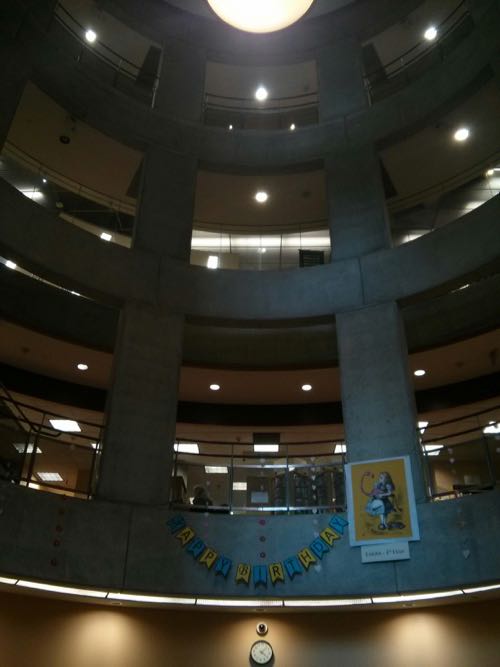 Today was the Lillian H. Smith Library’s 20th birthday party, and we rushed down to College Street after Iris’s nap to catch the end of it. The library has been a special part of our family for the last five years—I wrote about it first in 2011 as part of my “Wild Libraries I Have Known” series, and it also came up in my post about Joan Bodger and Mad Men. It’s truly an extraordinary place—we were there for the Crayon Creators event just a few weeks ago, and last summer completely by mistake we stumbled upon an amazing African drumming workshop because that’s the kind of thing that just happens at the Lillian H. Smith Library.
So we wanted to share in the celebration, and yes, we were told there would be cake. And there was! Plus spring rolls and cups of tea (ala Alice!—“Illustrating Alice” is the exhibit currently on at the Osborne Collection of Early Children’s Books). We were glad to see our beloved Joanne, children’s librarian extraordinaire. There were crafts and face-painting. And the gorgeous bookish birthday table…

Even better? Today was also the launch of the Lillian H. Smith Library Story Project, imagined and brought to reality by the amazing Christina Wong, a library page. Over the summer she collected stories from people with connections to the library, and put them all together on the site. I was happy to share stories about how the library has been so important to my experiences as a mother and our family life in the city: you can listen to it here. (Interestingly, it’s the first time that listening to my voice has not made me want to die… I’m really pleased with how our interview turned out.)
So far I’ve also listened to Andrew Larsen on the role the library has played in his development as a children’s author, and Ken Setterington on the story of Joan Bodger and her husband’s ashes. Looking forward to listening to the rest.
And I’m so happy to have been a part of this project, which celebrates one of my favourite places in the world.






