July 26, 2016
Five Roses, by Alice Zorn
 I loved Alice Zorn’s Five Roses, a novel that’s a love letter to Montreal, its neighbourhoods, and to the magic and serendipity of city life that is inevitably born from the fact of so many characters living in close proximity. It’s a bit of a mess, it is, city life, what with different cultures, and types of people, and old traditions and new traditions, and money and poverty, home and commercial enterprise, and history and the moment, which is now, and impossible to capture anyway…because the only thing that ever stands still in the city is the force of change. Zorn’s novel, however, manages to convey all this and not be a mess, disparate narratives woven together in a way that sparks magic but is left just untidy enough to still ring true.
To still be authentic. This is the kind of thing that matters not only in a novel, but also in the city, and when Fara and her husband embark to buy their first home, authenticity is what they’re seeking. Something real and solid, not a poorly constructed condo where walls are thin and the rain gets in. Unfortunately, the kind of thing they have in mind lies far outside their price range…except for a house in the Pointe St.-Charles neighbourhood of Montreal. It’s a working class neighbourhood, although most of the industry is gone. The signs are still there though, quite literally in the case of the iconic Farine Five Roses sign, from where Zorn’s novel gets its name. The first time Fara walks through the neighbourhood, she hears the sound of old men playing horseshoes, not a sound one hears very often anymore. The houses in Pointe St. Charles are only just starting to be unaffordable, the neighbourhood becoming gentrified. The biker gangs are history. Many of the houses still have their original features, woodwork, which is another way of saying that the people who live there have never had the privilege of moving up in the world, even via renovation. There is poverty, local residents being classed out of their neighbourhood by newcomers like Fara and her husband…although the only reason they were able to afford the house they got is because the son of the previous resident committed suicide. A story like that is bound to bring down the value.
Five Roses is very much about real estate, about owning a house, which is also to say that it’s about making a home. Fara herself is not put off by her new home’s unsavoury history, or at least she imagines she won’t be. She doesn’t find suicide shocking, her sister having killed herself years before. But it turns out that her new home awakens fears and anxieties Fara had thought she would have put away by now. She cannot help but feel the uncanny presence of something in her house…although that presence will prove less otherworldly than she’s imagining. Her next-door neighbour, Maddy, could have filled her in, because she’s seen who’s been watching the place from her view on her back patio. But she keeps her mouth shut. Maddy, who’s lived in her home in Pointe-St Charles ever since the place was a hippie commune, and she’s got her own sad story about the baby she lost decades ago. Which brings us to the final point of this trinity, Rose, a strange young woman adjusting to the city after an isolated childhood in a cabin with her mother in a small town up north. Rose works in the same hospital as Fara, and her roommate is a work colleague of Maddy at a bakery at the Atwater Market, just across the river from Pointe St. Charles (and oh, the food references in this novel are wonderful and hunger-inducing). Which are the kind of connections that happen in a city, how one life brushes up against another. The subtle, often known and yet profound ways in which we touch each other and change each other’s lives. It is in the nature of the city that story happens—and a testament to Zorn’s talent that in her book she makes it all seem to happen so naturally.
The stories don’t all intersect in the ways one might expect, which makes this character-driven novel more gripping than you might think of about a book without a whole lot of plot. Both Maddy and Fara begin come to terms with their painful histories, and begin to settle the ghosts in their respective homes—both literally and figuratively. And the younger Rose begins the process of making her own place in the city, finding a place to make art in a converted industrial building, and falling in love for the first time with a man who squats in an abandon factory who is perhaps even more of a misfit than she is. It’s not perfect, but it’s all possible, possibility being the most valuable thing that a city can offer.
Well, that, of course, and also the wonders of a terrific baguette.
July 25, 2016
Christa Couture and #TheMWord on the radio
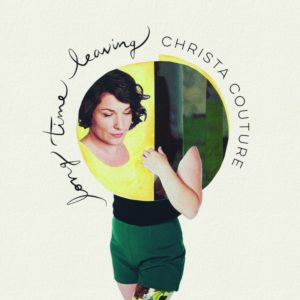 Singer, songwriter, storyteller, cyborg, halfbreed (and then some) Christa Couture was on CBC Unreserved last night, which is the show I generally spend Sunday evenings washing the dishes to. Christa, who is a wonderful musician—her latest album, Long Time Leaving, is terrific—was talking about music, her Indigenous identity, and also about motherhood and what it means to mother after loss. She gave a kind and generous shout-out to The M Word and read a little bit from her essay, which so many reviewers over the years have cited as a highlight of the collection. I remain ever so glad that she was part of the book.
July 24, 2016
Summer Summer
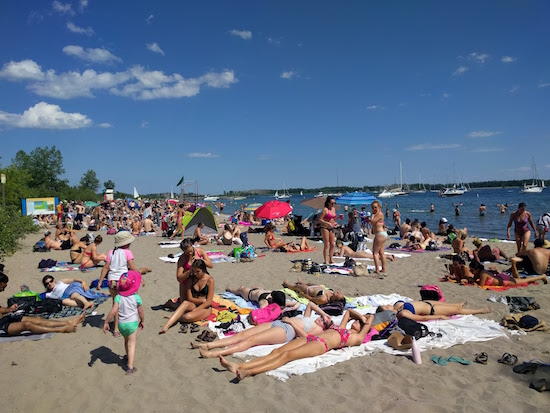
Greetings from Toronto Riviera (i.e. on Ward’s Island), where we spent all day yesterday—it was as glorious as it appears to be. I’m looking forward to spending the next two weeks not running my children back and forth to camps, and instead taking things slow and easy together (and yes, installing them in front of movies each day for a time so I can get my 1000 words written—this is good for all of us). We’ve got camping and cottages coming up and lots of excellent summer things, and I’ve been doing lots and lots of reading and I’m looking forward to sharing some more great books with you.
July 22, 2016
New books by Julia Donaldson and Emily Gravett
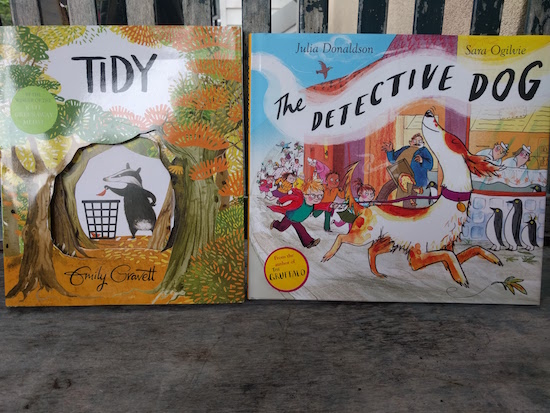
How exactly does a person follow up a success like The Gruffalo? For some authors, the pressure would be paralyzing, but not so for Julia Donaldson, who has published more books than I’ve had hot dinners. (I actually suspect Julia Donaldson has never ever been paralyzed. I once saw her live [I am THAT cool] and she incorporates a whole musical thing into her act but [and here’s the rub]: she can’t actually sing. Not on key, at least. And she doesn’t care and sings anyway, and the children loved her and so did I and it all was wonderful.)
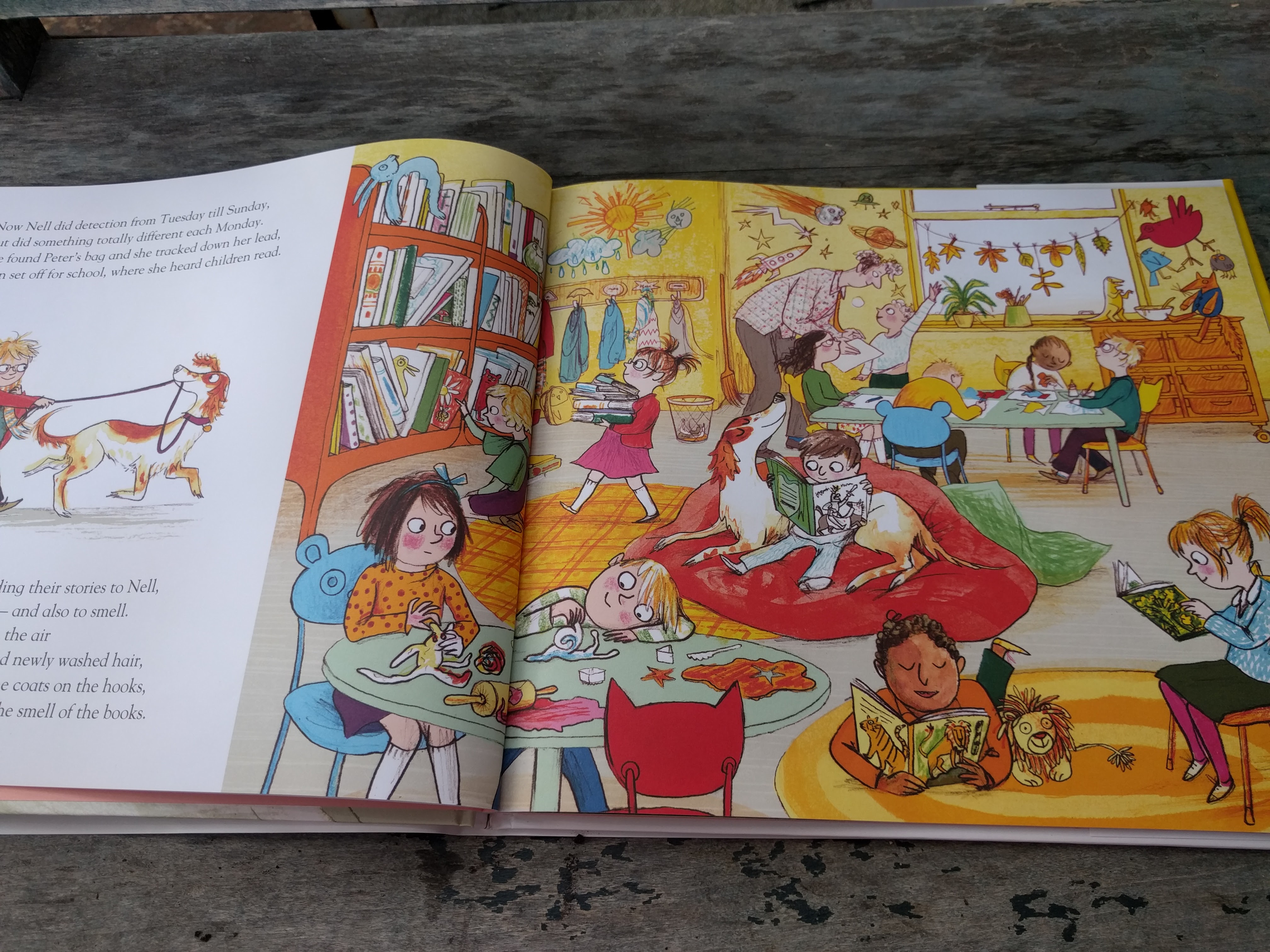
Donaldson has worked with different illustrators to dramatically different effect, and certainly some of her books are more compelling than others (although maybe you’ve got to hear them set to music), but still, she’s got a formula. You know what you’re getting. Rhyming couplets, a bit of drama, and something heartwarming at the end. Sometimes a little light on plot and a rhyme that gets a teeny bit awkward, but it’s all in how you read it. It’s in the rhythm. She knows what she’s doing and she does it very well.
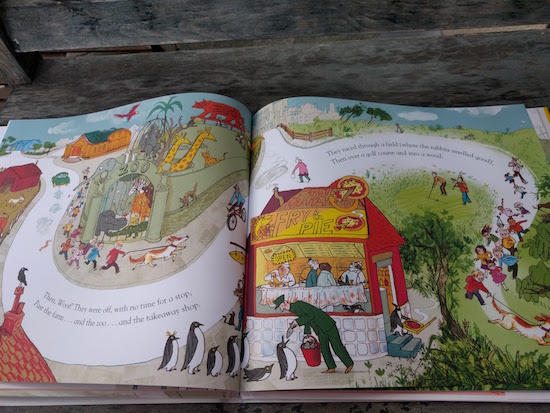
The narrative of her latest, The Detective Dog, starts off as a bit of a stretch. Detective Dog Nell, with her famous sniffer, solves crimes six days a week (“Who did the poo on the new gravel path?/How did the spider get into the bath?), and on the other day goes to school with her owner, Peter, and has the children in his class read to her (although reading dogs are a thing—did you know that?) Nell likes visiting the school, where “the best smell of all was the smell of the books.
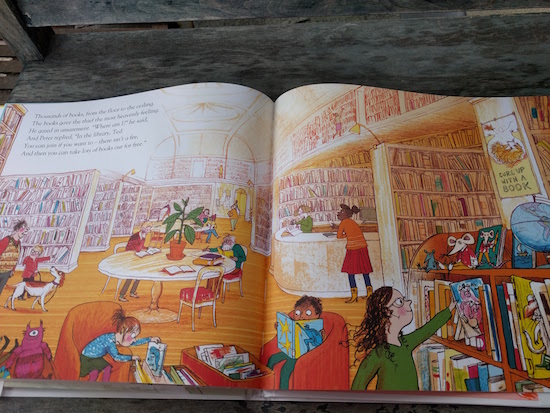
Having a Detective Dog moonlight as a Reading Therapy Pup comes in handy, however, one day when Nell and the children arrive at school to find all the books in the classroom have been stolen. Immediately Nell is on the case and traces the thief across town to a shed where the thief (who, naturally, is called Ted) confesses that he just wanted to read them, and he was only borrowing the books. Which reminds everybody of a place where everybody can go to borrow books, no thievery necessary, which is, of course, the library, and this fun but crowded book culminates quite nicely in a celebration of public libraries, which bring literacy to everyone. And who’d argue with that?
In my mind, Julia Donaldson and Emily Gravett are two of a kind, rhyming coupleteers who arrived in my life around the same time, with the birth of my first daughter. (They have one book together, actually: Cave Baby). I think I first encountered Gravett with the wonderful Monkey and Me, which I like so much that we have it out of the library as I write this. And also Orange Pear Apple Bear and Wolf Won’t Bite and The Rabbit Problem, and so many more. An illustrator with a keen sense of book design, Gravett is ambitious and pushes her own limits and also those of the book itself. Case in point, in her latest book, Tidy, the info on the copyright page is being sucked up into a vacuum. Oh, and the dust jacket has images on both the front and back, both of which are different from the image on the book itself—there is so much richness here, attention to detail, treasures to discover for readers who bother to look close enough.
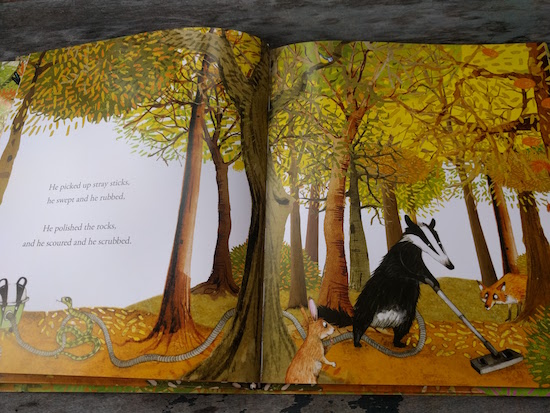
Tidy is the story of a clean-freak badger who likes to keep the forest tidy, much to the chagrin of his friends. “He picked up stray sticks, he swept and he rubbed. He polished the rocks and he scoured and scrubbed.” And when the autumn leaves fell, well, he got busy, bagging every one of them.
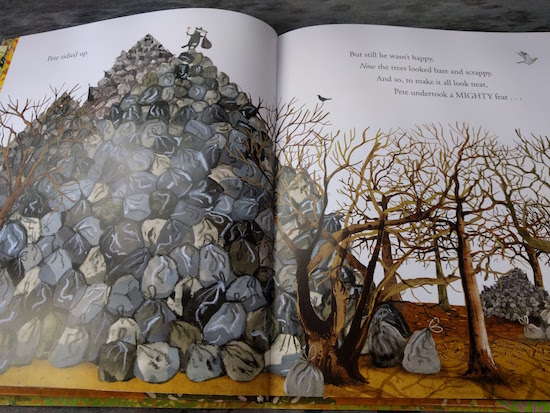
This is one of those stories about one thing leading to another with unintended consequences, cute with an environmental bent. He decides to clean up the scrappy trees by pulling them out of the ground, but then without trees the ground gets muddy, and so he covers everything in concrete, which is totally neat and totally fine…except there is nothing for him to eat and he’s mistakenly blocked up the door to his burrow.
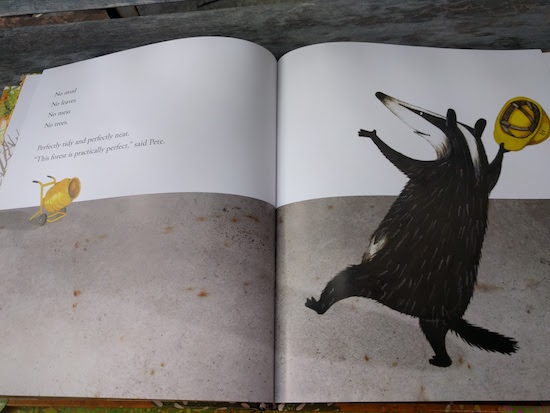
A happy ending is delivered with the help of a jackhammer, which breaks up the concrete, and the badger gets those trees planted again, and he tries to learn his lesson, to tame his over-tidy ways, and he is mostly successful—the story ends with a bunch of ants throwing all of his cleaning supplies into a bin marked “Keep Your Forest Clean.”
As ever, the lesson is: with Emily Gravett and Julia Donaldson you pretty much just can’t go wrong.
July 21, 2016
The Dancehall Years, by Joan Haggerty
 Joan Haggerty’s The Dancehall Years is a perfect summer book, rich and sweeping, the kind of book you’d like to give a week to, on a dock perhaps, or a comfortable deck chair beside the water. It begins in 1939 on Bowen Island, which is home to a fancy hotel whose custom comes courtesy of the steamship lines, and whose grounds are meticulously maintained by Shinsuke Yoshito, the Japanese gardener. His son is Takumi, the lifeguard, who is romantically involved with Isabelle, the youngest Gallagher daughter, much to the consternation of her father. The Gallaghers have a summer rental on Bowen Island, and make use of the hotel facilities, the dancehall. All this action observed by Isabelle’s niece, Gwen, who is the novel’s heart, six years old when the novel opens, her point of view gloriously unfiltered.
Of course, everything is going to change. The summer of 1939 would be the last one before the outbreak of war in Europe, everything changing even further after the Pearl Harbour attack in 1941. Japanese-Canadians along the coast would be taken to internment camps, their properties confiscated by authorities. Not to mention the end of the steamship lines, and cultural changes that would make Bowen Island a very different place by the time the 1960s roll around, when Gwen is a young mother, having left an unhappy marriage and trying to make a life for herself and her two daughters, all the while trying to reconcile unanswered questions from her family’s history.
Like, where did the Yoshitos go? What happened to Takumi? Not to mention Isabelle, once Gwen’s gay young aunt who is now semi-estranged from the family, taking care of her husband who’d come back damaged from the war. There had been a child, we know, although Gwen doesn’t, and was she given up for adoption, or did she die, as Isabelle had been told she did, a heartache she carries with her down through the decades. There are also questions about Gwen’s parents own marriage, her mother’s unhappiness, the question of her family’s inheritance and where it came from, and what do we do with all this history, this stuff we carry down with us, this freight.
Joan Haggerty is an extraordinary writer, her prose Woolfian in its stream of consciousness, its immediacy. This is a saga sweeping four decades written in the present tense. And it’s true that when we talk about summer books, we sometimes mean that they’re a bit light in substance, but this is a different kind of summer book. It’s not difficult, and it’s got its own kind of lightness (strung together by summers as it is), but it’s not a “beach read.” Which isn’t to say it would be wonderful to read it at a beach, but still, it’s not the kind of novel that would blow away in the breeze.
And it’s so good. Two decades in the making. Haggerty is in her seventies, and her last book was The Invitation in 1994, which was nominated for a Governor General’s Award. The Dancehall Years is published by the small but mighty Mother Tongue Publishing, based on Salt Spring Island, BC, and I’m disappointed it’s not available in-store at large Canadian book retailers because it would make a perfect addition to a summer books display—that cover is so perfect. But fear not, determined reader, for you can track this fine novel down, via an online bookseller or direct from the publisher.
And I really do urge to you to do so, for your own sake. For perfect summer book reasons.
Prepare to be swept away.
July 20, 2016
Everything happened in those five years after my abortion.
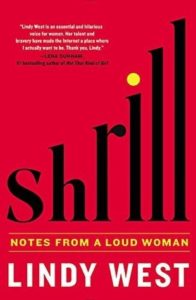 “Everything happened in those five years after my abortion. I became myself. Not by chance, or because an abortion is some kind of mysterious, empowering feminist bloode-magick rite of passage (as many, many—too many for a movement ostensibly comprising grown-ups—anti-choices have accused me of being), but simply because it was time. A whole bunch of changes—set into motion years, even decades, back—all came together at once, like the tumblers in a lock clicking into place: my body, my work, my voice, my confidence, my power, my determination to demand a life as potent, vibrant, public, and complex as any man’s. My abortion wasn’t intrinsically significant, but it was my first big grown-up decision—the first time I asserted unequivocally, “I know the life that I want and this isn’t it”; the moment I stopped being a passenger in my own body and grabbed the rudder.” —Lindy West, Shrill (which I am loving. Particularly the part at the end of this essay, “When Life Gives You Lemons”, when she writes about how if it weren’t for “zealous high school youth groupers and repulsive, birth-obsessed pastors” she would never think of her abortion at all.)
July 19, 2016
All the time you need

The above colouring sheet has been staring at me from the fridge for the last month or so, as I absently read its words while washing the dishes. I actually coloured it yesterday, just to prove its point, I think. That indeed, we have all the time we need. Which has been my mantra as I’ve sailed through the summer so far, a season which is somehow both endless and fleeting. The children home from school and the days are long. But my hours to myself for my work are far fewer, and I’ve once again decided to embark on a marathon sprint toward completing a draft of a new novel. There are not enough hours to read in. And not enough weekends either, for ferry rides to the island, and road trips, and camping trips, and sunny afternoons lying under trees in the park. And isn’t parenthood and life entire a little bit like this summer paradox? Isn’t everything? Endless and fleeting, so much, and also never enough,
And yet…
You have all the time you need.
Which is true. And it’s also true that you need all the time you have. And also that, admittedly, you only have the time you have, so time is precious. But it’s also everywhere. I remember Carol Shields wrote something like this somewhere: “Tempus doesn’t fugit.” Which is a difficult line to ponder considering that Shields died far too soon from cancer, but I’m not sure that fact changes anything at all.
 The colouring sheet is by Teva Harrison, whose Joyful Living Colouring Book is forthcoming from House of Anansi in November. She is also the author of In Between Days, a graphic novel published this spring. I read it at the beginning of May, and have wanted to write about it here, but wasn’t sure how to. I’ve followed Harrison on Twitter for years, and in the hundreds and thousands of people I’ve encountered there, she’s always made an impression. I’ve been inspired by her sense of wonder at the universe, and by the deep love she shares with her husband, and by the richness of her everyday life. It’s the kind of thing I turn to the internet for. Which made the news that she’d been diagnosed with metastatic breast cancer all the more incongruous when I read about it one winter day in the newspaper in late 2014.
While Harrison writes about the depression she suffered from in the wake of her diagnosis, by the time I learned of it, she’d actually just climbed a mountain. Which is kind of a metaphor for her experience, and in the year and a bit since then she hasn’t stopped climbing and going. She’s created two books; been overwhelmingly generous with her experiences in both of these and also on social media; she’s gone to great lengths to bring attention to metastatic breast cancer and to educate people about this disease, its incurability, and what it’s like to live with cancer. She’s also given talks and addresses about her story, one of them I listened to online last December. It was there that I first heard the line, “You have all the time you need.”
She spoke about her changing relationship with time since being diagnosed with cancer—about the endlessness of hours spent watching TV in her depression, about art and all of the things that she’d never made time for before she got sick, about the busy-ness of her professional life pre-diagnosis, and about how she intends to spend the time she has left (which she has ever intention of being years and years). That kaleidoscopic nature of time, fleeting and endless. You have all the time you need. To fill, of course, not to wait for—this is key. All the time you need is right now. (And even if you don’t have all the time you need, that proverbial bus in the street coming to mind, doesn’t it make the most sense to live like you do?)
While I value Harrison’s work so much for her willingness to share what it is to live with cancer—how this broadens our understanding of the human experience and helps us be better friends to other people who live with disease—cancer is only part of what her story is. As her memoir shows, her life has always been a little bit remarkable, from her childhood growing up in Oregon with hippie parents, to the incredible story of how she met her husband while stuck in Toronto after 9/11. Remarkableness seems to be a genetic trait, she shows us, as she traces the stories of the women in her family, “what everyone has done to find peace and a place in this world.” She writes about her aunts, her niece, about her socialist lawyer great-grandfather, about her grandmother who was a Stanford economist. Whose legacy is so much more than cancer and reminds Harrison that she herself is “so much more than my cancer too.”
She writes about the facts of life with cancer, the surreal bits and the terrible ones. About the practical facts of early menopause, brought on by her treatment. She writes about the hope implicit in living with disease, and about fears, anxiety, silver linings and wishes. About “the excruciating act of scaling back [her] dreams.” She writes about her husband: “I hold onto him for dear life, both of which are all I ever wanted, anyhow.”
“When I was a kid, summer stretched out forever,” she writes in “The Mermaid Pool.” “Two months away from school felt like an eternity. Absolutely anything could happen.” She used to swim and swim, and had a dream of staying overnight in the pool (which was actually an oversized horse trough), convinced that she could be a mermaid by morning. And her dream would actually come true, she tells us, albeit not by her original method, but instead, she and a friend would walk in the famous Coney Island Mermaid Parade, which was not quite as glamorous as it sounds but still, “it was something else, floating down that Coney Island street, nothing but a pretty, pretty mermaid for a few hours.
“Dreams come true, if we’ll only make them.”
Yes, and we have all the time we need.
July 17, 2016
Chihuly at the ROM
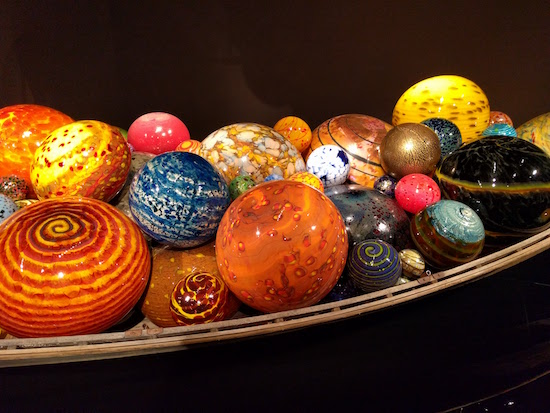
The summer is flying by, as summers do. I spent last week in my hometown of Peterborough visiting my parents, which was lovely, hot and fun. And now back in the city, we went to the ROM yesterday to see the Chihuly exhibit.
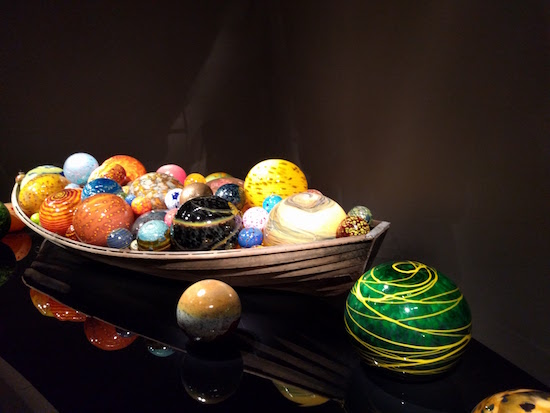
I’d never heard of Dale Chihuly before the ROM magazine arrived awhile back with images of his work, although it occurs to me now that he’d been the artist behind the golden tree I’d photographed in Montreal a few weeks ago. And that perhaps encountering Chihuly’s work out in the world is most striking way to experience it, but the ROM exhibit itself was pretty stirring.
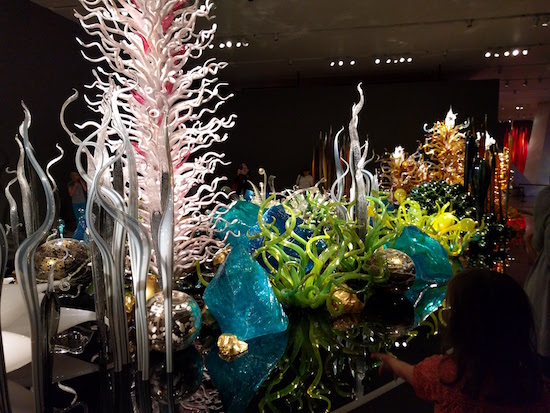
My favourite thing about the exhibit was that it’s the rare thing that all four of us—whose ages range from 3 to 37—could appreciate on the same level. The same things I loved about it and was struck by were what struck the children too, and we were all of us in awe of the colours, the light. The spectacle.

And like nearly everybody else, my favourite part of it was the Persian Ceiling, under which we laid down and just looked, and there was so much to see, and how the light from the ceiling transformed the world all around us.

July 15, 2016
Who Broke The Teapot?, by Bill Slavin
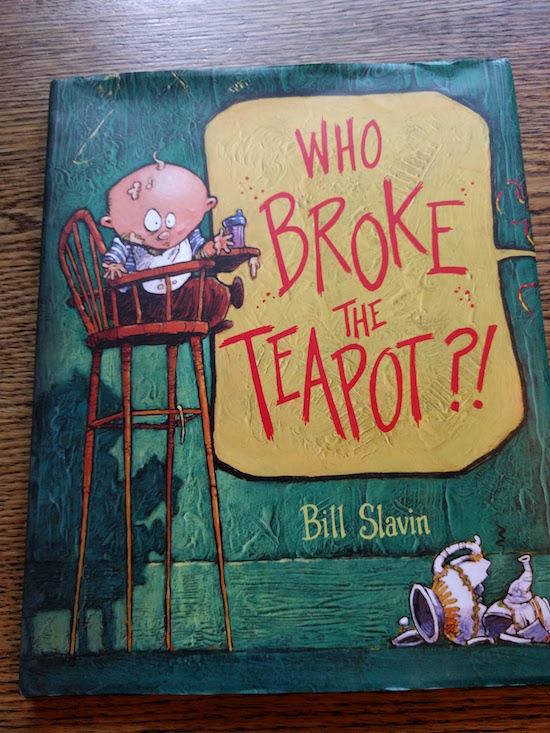
To those who might wonder how a broken teapot could sustain narrative enough to fill an entire book, I will raise the matter of my polka-dotted teapot which got smashed last year on Christmas Day and had me sulking right up until New Years. And so when I heard about Bill Slavin’s new picture book, Who Broke the Teapot?, I did wonder if the plot had been stolen from my life.
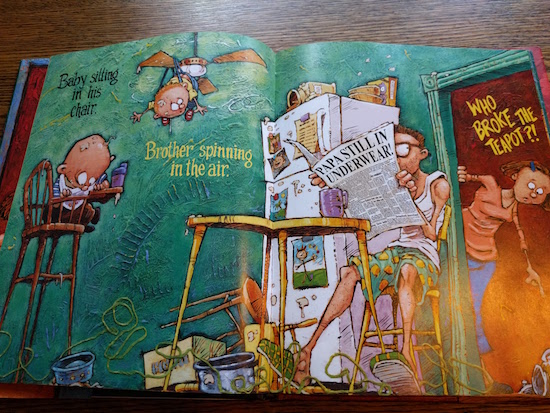
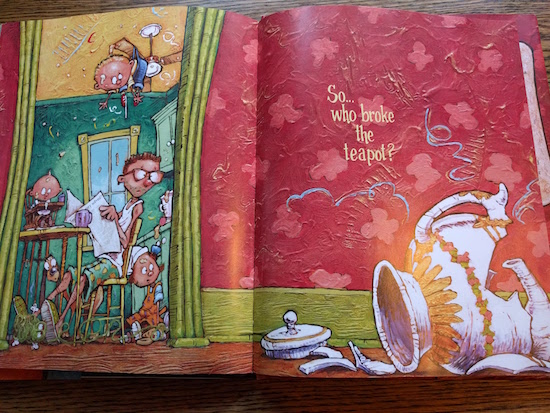
Mother’s beloved teapot is toppled and smashed, and it’s not immediately clear who committed the crime. In our house it was Papa who did it, and he was actually wearing pants, but still, he ‘fessed up right away. Circumstances in Slavin’s book, however, are far more mysterious. The teapot is smashed and the house is in chaos, and what actually happened is hard to discern. And so the set-up of the story is picture book whodunnit. It’s up to the reader to put the pieces together and discover what actually occurred.
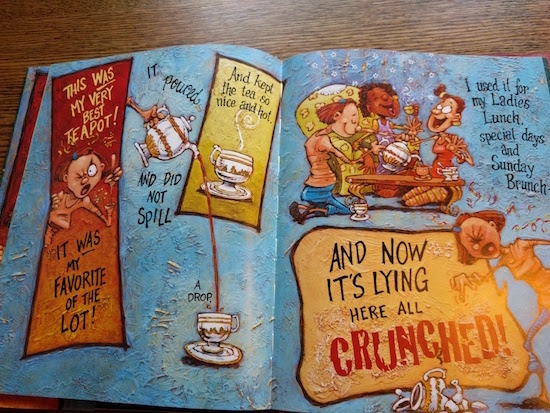
And my sympathies were indeed with the mother, even in her unattractive irateness. I’ve been there, so I totally get it, but even if you haven’t, you can understand what it would feel like to lose your very favourite teapot, your favourite of the lot. Which poured but did not spill a drop. And certainly, such teapots are rare and precious objects, the sort you encounter a handful of times in the span of a life. To find one in pieces on the floor would be devastating.
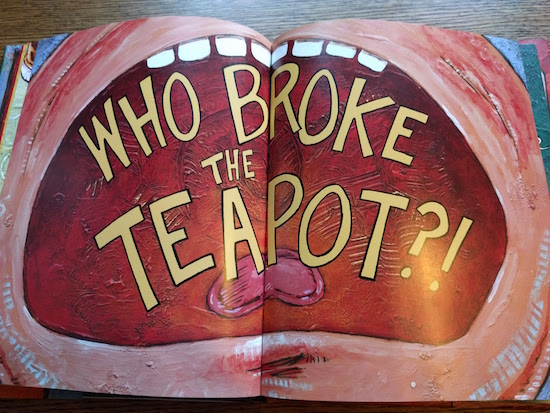
Of course, I like the book because it is basically a memoir about my life, and I identify with the protagonist, and it is hugely affirming to see my experiences represented in literature. But is that enough to sustain narrative enough to fill an entire book? Is it possible to love this book if you are not a 37 year old teapot enthusiast who weathered a similar tragedy just mere months ago?
And the answer is: YES. My children love this book, and not just because it mentions underwear (although they do love that part—as well as the part where the baby says, “Babadoo.”) Three-year-old Iris can now recite the book in its entirety, and it’s only lived in our house for a week, so it’s safe to say it’s made an impression. The rhyming text is fun and playful, the illustrations are full of action and detail, and the surprise ending is spot-on. And also just a tiny bit ambiguous, which means you get to go back to the beginning and read it again.
July 13, 2016
To Sarah Brick, with gratitude

I’m having a ridiculous amount of fun going through the copy-edits for Mitzi Bytes, which came back to me last week. The feedback is incredible, so insightful, detailed, and nobody has ever read this book so well or carefully before. Sometimes it’s a little mortifying to have it all laid out, just how much you’ve got wrong—but then the gratitude that there’s someone who’s catching all that. But for me there is also the pleasure of reading the book all over again, and reading it at this point in the editorial process, which is the closest I’ll ever come to reading it as a reader instead of its writer. And doing so is reminding me of where it all came from, the little seeds that were planted.
In the years between my daughters’ births, I wrote 40,000 words of a novel, which I don’t think I ever finished. It was a novel about a family in a moment of crisis, each chapter from a different family member. One chapter was “If Life Gave Me Lemons,” which was the only bit that was ever published, and that chapter was very different and disconnected from the rest of the book. Mostly. Except for the part where my character comments that she’s been leaving anonymous mean-spirited emails on her cousin’s mommyblog. That cousin was a sister in the story’s central family, and an unhappy new mother. She was kind of autobiographical, which made the comment that “she was too mean-spirited to be sympathetic” a little insulting when it came back accompanying a rejection I’d received upon sending a chapter to a literary magazine. The novel itself was lacking focus, which is part of the reason I never finished it. Skimming through it the other day, I realized it wasn’t altogether terrible—but then I would appreciate it if we bothered to ask a bit more than that from our books.
The idea of the anonymous blog commenter stayed with me though, even after the novel was abandoned. I thought about it a lot, and this idea morphed into the premise for Mitzi Bytes: forthright blogger begins to question her project and fear for her sanity once she discovers a reader with nefarious intentions. My protagonist, Sarah Lundy, doesn’t share so many qualities with the character she was born from, although they do share a name. I didn’t realize this until I was looking through the old story the other night. It turns out that I am really a bit crap a naming characters, which I am trying to get better at. Reading Duana Taha’s book made me realize that a character with an interesting name inherently has something interesting about her because hers is the name she lives with, and so in the project I am currently working on, I have made an effort to name my characters with more originality. I.e. not call them all Sarah, I mean, although I didn’t even name Sarah from Mitzi Bytes—my daughter Harriet did. This was back when she also named everything Sarah, and in fact had a whole fleet of imaginary dogs called just that. So that’s just how bad my character naming is.
I like that they share a name though, Sarah Lundy and Sarah Brick from the old book. Even accidentally. And I am grateful too to Sarah Brick and her overt unsympatheticness and her hastily sketched, poorly drawn lines, and the failed literary project that she was a part of. Because Sarah Brick proof that nothing is ever really a waste of time. That even if work doesn’t get us to the finish line, it can also be useful in getting us to the place where we can finally begin.






