August 23, 2016
The Best Kind of People, by Zoe Whittall
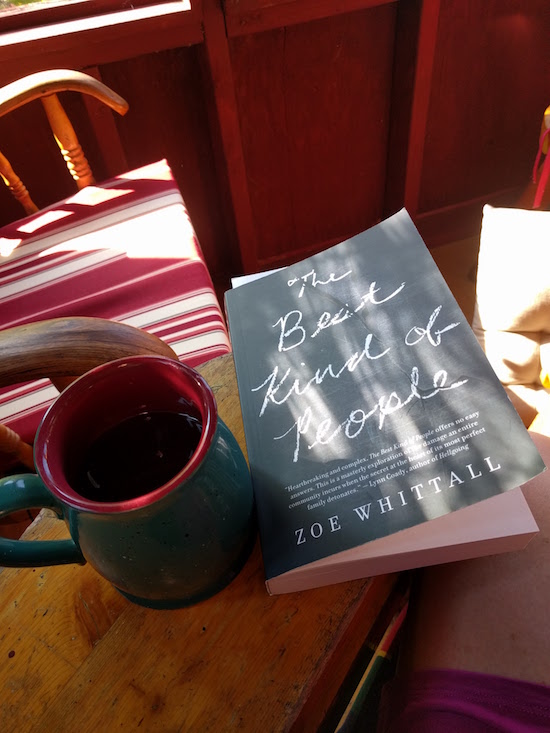
While Zoe Whittall has made a career of writing about misfits and outlaws (which is part of the title of an anthology she edited in the early 2000’s), she turns the tables in her latest novel by writing about a family of unremarkable (were it not for their resolute upstandingness) middle class people who suddenly become misfits and outlaws in their very own lives. The book is The Best Kind of People, which I read on my summer vacation and handed directly to my husband when he asked me what book he should read next. And the family is the Woodburys, the patriarch of whom shocks his wife and children and entire community when he’s accused of sexual assaulting girls at the high school where he teaches.
“How could a person do such a thing?” is the kind of question that tends to be raised after the fact, although Whittall is more interested in another question with wider ramifications, which is, “How can the people around that person, the people who love that person, who did it make sense of their lives and the world once he has?” Joan Woodbury tries to make sense of her past and her future—what was her marriage all of these years, and who is she going to become outside of the relationship that has so long defined her? She deals with threats and violence against her home and family, hears the whispers and the rumours, and knows that many people implicate her along with her husband, because as his wife, how could she not have known?
Her daughter carries many of the same burdens with her at school, and is forced to reconcile her own burgeoning sexuality with her father’s egregious crimes, not to mention falls in with a group of Men’s Rights Activists who try to use her and her father as a pawn for their cause. And when the Woodbury’s son returns home from his life in New York to take care of his family and support his father, he’s forced to confront his own difficult past as a gay boy coming of age in a small conservative town.
Similar to Joan Thomas’s novel, The Opening Sky, The Best Kind of People ponders how the politics and morality of well-meaning, liberal-minded people are tested when they find themselves in situations they never expected. In Whittall’s book, the result is a complicated range of emotions and reactions, and while she puts her characters through test after test, the result every time in believable, entirely (and sometimes unbearably) human. There is so much nuance here, but the book is also devourable, utterly gripping, unfolding with the pace of a thriller and also that hard to put down, as the case unfolds day by day and then week by week, right up until the trial.
While the entire book is fantastic, Whittall gets full points for her spectacular ending, however, which turns the story inside out and disturbingly rips us away from the singular perspectives of characters to reflect the wider culture of rape and sexual violence against whose context the entire novel has been taking place. Which is to say that this is not just a story about a family.
And then the final sentence, which will haunt you long after you’ve finally finished reading, quiet, subtle, devastating and terrible, just like the injustice that is Justice, which isn’t anything like justice at all.
August 22, 2016
Finite
For a few weeks, I was wondering if this summer would be endless, or at least why it couldn’t be. We had a stellar run of days at the beach and road trips and memorable ice cream cones and stargazing. We’ve had a spectacular mix of GO-GO-GO and also lying around on the grass doing nothing. This summer has hung in a marvellous balance, just enough of everything we ever wanted. The children haven’t been complaining about boredom, or Harriet walking around delivering deep heaving the deep sighs which have always been her summer speciality (and a sign for me that we need to get her back to school). It has been a very good summer, the kind of summer you get when your baby is finally three and the world and the days open up their (figurative) arms so wide—I remember the same feeling during the summer of 2012 when Harriet was three, but it was only temporary as by the end of that summer I was pregnant. By the end of this summer I will not be pregnant (and in fact I will never be pregnant ever again—a fact that, I was telling Stuart the other day, makes me as giddy as the prospect of having a baby once did) but all the same, it starts winding down quite naturally. Summer was never meant to be endless, and if it was, I suppose we would tire of it. Summer winding down now with a fairly ordinary couple of weeks in the city. Harriet is in daycamp at the museum, but only for the afternoons, which means that we don’t need to bother getting out of bed until we feel like it, let alone getting dressed. Each day they’ve watched a movie while I’ve settled down to write my 1000 words. So it’s a fairly undemanding routine, but it’s still a routine, getting us set for back to school in just a few weeks time. I’ll be returning here too to let you know about wonderful books I’ve been reading—the new Louise Penny, and Zoe Whittall’s new novel, and I am reading Mister Nightingale, by Paul Bowdring, now, and it’s wonderful. Anyway, returning to real life The key to transitions like this, I think, is to like your real life, so that a return to it comes with its own rewards. Plus there is the prospect of autumn. Also, I’m semi-down with a stomach bug that has left me stuck on broth and popsicles, and when it’s all done (soon, I hope!), feeling generally well health-wise will seem like a ridiculous pleasure.
August 17, 2016
Abortion Baskin Robbins

In her essay, “When Life Gives Your Lemons,” Lindy West notes that she’d rarely think about her abortion anymore if she wasn’t driven to speak out against “zealous high school youth groupers and repulsive, birth-obsessed pastors” who win ownership of the abortion conversation by default—possibly because most other people acknowledge that abortion (and pregnancy and life in general) is messy, nuanced, intensely personal and not very well or cleverly served when batted around like a rhetorical badminton birdie. I identified with a lot of West’s essay, but not this one bit. Because the truth is that I think about my abortion all the time. It’s a matter of geography, and I can’t even help it, Abortion Baskin Robbins being case in point.
It’s a juxtaposition that amuses me, abortion with an ice cream shop. Some might be uncomfortable with the idea, but it’s the word “abortion” spoken aloud that usually troubles people, not necessarily the ice cream. Some might thing I’m being flippant, and the truth is that I actually am, and I’m still a bit high on the liberation I feel at finally being able to say that word, abortion, over and over. Even in an ice cream shop. (Can you imagine how it feels to have the point on which your adult life has hinged be an event that is meant to be literally unspeakable? Can you imagine how empowered you feel when it isn’t anymore?)
But it’s not all flippancy and irreverence—there is meaning there. This spring and summer, Abortion Baskin Robbins is where we’ve turned up as a family after my children’s Thursday night soccer games in a school playground a few blocks north. The fact is that while the last fourteen years taken me to amazing places, geographically speaking I haven’t left the neighbourhood. The sidewalks I travel in my daily life are the same ones I took when I was people I don’t even remember now, including a girl who was once so sad and relieved to obtain an abortion during the summer of 2002. So that my children’s post-soccer ice cream joint is the same place I went to with my friend immediately after my abortion all those years ago. My children order ice cream cones that turn their lips blue, and I can’t help think about the connections between my abortion and my life as a mother, which are everything. The foundations I’ve built my life upon. (Is it any wonder that I’m grateful for the freedom to design my own fate?)
It was a long time ago, distinctly not fun, and I was pretty drugged, and so it’s so surprise that I don’t remember a lot of it well. I’ve probably got some of the details wrong, and lost most of them altogether, and I cannot actually recall what it was to be the first-person protagonist of any of these events, but there are fragments to rise to the surface. The trip for ice cream for one, the advent of Abortion Baskin Robbins (although it wouldn’t be properly named for more than a decade—but what it means to be able to name these things, these pivotal landmarks in our lives). I don’t remember what I bought there, if it was a cone or a sundae or an ice cream cake. If it offered any satiation, or if it helped me feel better. I remember that my friend was with me, the friend who must have taken a day off work and travelled with me on the subway and the bus. (What an incredibly thing to do for someone—I am sure I was not sufficiently appreciative. How could I have been?) And then we went back to her house and I think we had a stack of movies, and I recall that I’d required they all be empowering feminist films. I wanted battle armour. A bunch of other friends came over and we ate indulgent snacks and watched the movies—I think that one was The Legend of Billie Jean. I was completely, unequivocally supported, and even though in my experience of accidental pregnancy I’d felt isolated and impossibly alone, after the termination I had a circle around me. It is possible that it never even occurred to me that I wouldn’t.
(“Abortion is women’s work, I guess,” writes Heidi Julavits in The Folded Clock.)
All this is on my mind because I’m reading a collection of writing about abortion, and realizing that my experience of support was not something to be taken for granted. That it makes all the difference in the world for a woman coming out the other side pretty unscathed, and not having to carry around a terrible secret shame for the rest of her days. It’s the reason why I’m able to link a medical procedure to ice cream instead of trauma. It’s why I’m able to say the word out loud now. It’s the reason I was able to get on with my life and steer it in a directly of goodness and fulfillment. I cannot even fathom what it would have been to have to go through all that alone, or ashamed. I don’t want to begin to speculate on what would have happened to me.
Update: 20 minutes after posting this, I ran into anti-abortion protestors on the street. I had five minutes to pick up my kid at daycamp, but had to stop. Again, I cannot imagine what it would be like to endure such unnecessary nonsense, to have to defend my life choices to a twenty-something twit who wouldn’t know an ovary if it punched him in the face, if I didn’t have an Abortion Baskin Robbins in my history. These people have no idea what they’re messing with. (Why do you magnify your images so much, I ask him. Because we want people to see them, he said. Doesn’t it mean something quite significant, I told him, that otherwise you’re grossly inflating the situation [quite literally] they can’t?)
August 5, 2016
Summer Break
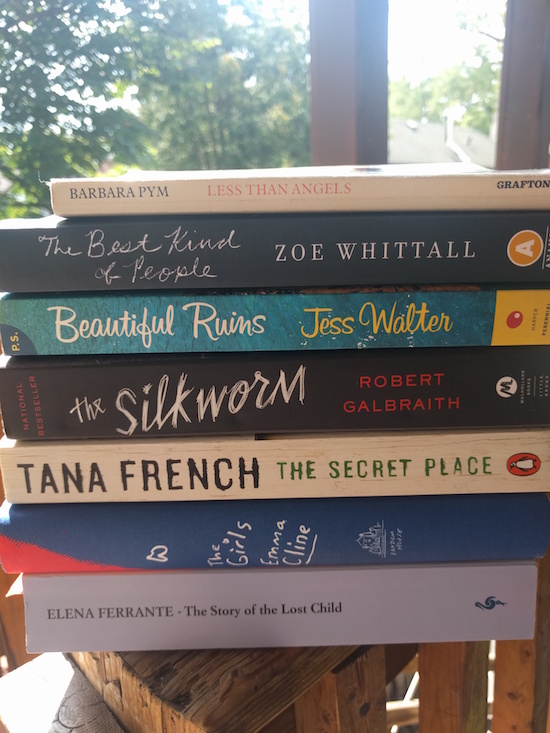
One of my favourite bits of blogging advice is that bloggers should take breaks—it’s good for the blogging soul (sole!) and also underlines to the reader that the person behind this blog is a human. And now with this post, I put my advice into practice. We’re heading offline and into the wilds tomorrow, and I can’t wait. Particularly since I’m bringing this beautiful stack of novels with me. We’ll be back to the city in a week, but my blogging break might last a week longer…but no promises on this one. If all goes well I will presumably be too bursting with good things to tell you.
August 3, 2016
Summer Reads on the Radio

I was so pleased to be on CBC Ontario Morning today talking about great summer reads, and sharing the books that so delightful occupied my July. If you missed the show, you can listen again online at 33.15 minutes—I hope you do and take me up on some of these suggestions. This is a fine, fine stack of books.
August 2, 2016
Destination Bookshop: Lighthouse Books in Brighton, Ontario
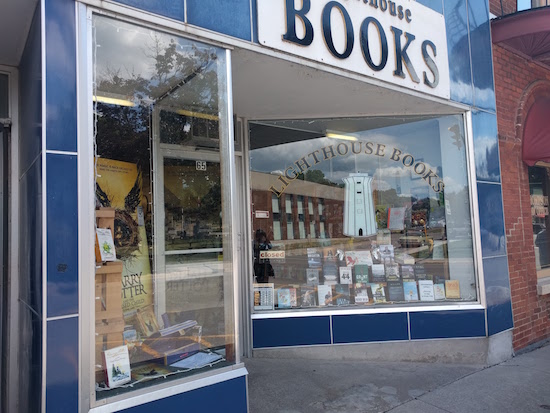
Yesterday we rolled out of Presqu’ile Provincial Park after three feral days in wilderness, dirt-laden, mosquito-bitten, sick of marshmallows and stinking of outhouse. We decided to stop in the nearby town of Brighton, Ontario, for some ice cream and a sweet hit of air-conditioning, and I promise you that what I absolutely was not expecting as we walked along the main street was to find a bookshop. Nobody believed me when I told them that either, but I swear it’s true. And the bookshop was just closing, the owner flipping around the sign when she saw us walking by—it was a Holiday Monday and they’d stayed open from 10-2. And then they proceeded to stay open just a little while longer while Stuart picked up the new Harry Potter and while he was paying for it, the children discovered tiny hedgehog stuffed toys and as Harriet is a hedgehog maniac, we had to have one, and while all that was transpiring, it was dawning on me that this was a truly exceptional bookstore—incredible selection, a wonderful spotlight on Canadian titles, lovely displays, and a friendly, knowledgeable owner—so it was clear that I would have to get a book as well.
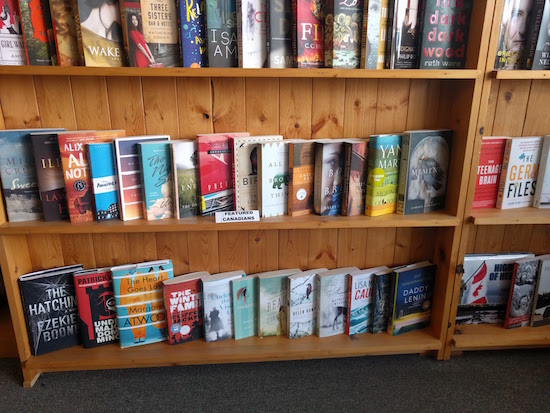
I mean, check out these books—so so good. And then Harriet told the owner how she’s been obsessed with hedgehogs ever since Anakana Schofield came to visit and brought her a toy one, and the owner said, “Well, at least she didn’t bring you Martin John,” and we got to talking about how great that book is and also about how one has to be careful who one recommends it to. And then she told us how much she liked Neil Gaiman’s The View From the Cheap Seats, and now I’m sort of sorry I didn’t buy that book, but I’m not sorry that the one I did get was Carol Shields’ Startle and Illuminate.
Lighthouse Books is totally worth the drive to Brighton, which is a pretty little town just two hours east of Toronto (and worth stopping in at on the way to Prince Edward County too). Presqu’ile is minutes away with its gorgeous beaches and hiking trails, and downtown Brighton features great stops for tea and coffee, lunches and ice cream. Both times we’ve been, we’ve had ice cream at Mrs. B’s Country Candy, where they make their own gelato.
The bookstore, which is owned by Kathryn and Dan Corbett, is open from Tuesday to Saturday, 930-530. You can find out more about them on their Facebook page.
August 1, 2016
Getaway
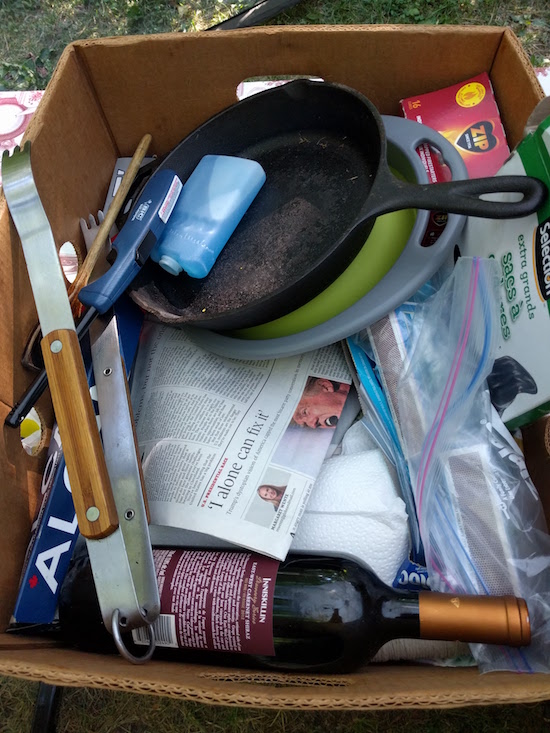
It was such a relief to get away this weekend, to leave the world behind by actually venturing deeper into it. Like many people, I’ve found the last two months incredibly upsetting, and while instances of violence and carnage are inevitable in this global atmosphere of decisive, angry and hateful political rhetoric, that it all makes sense doesn’t make the awfulness any easier to process. I have particularly found the “breaking” nature of violent events unfolding difficult to deal with—clicking on Twitter hashtags to find out what unthinkable thing has been thought of now and then having to filter tweets by racists, nitwits, and conspiracy theorists. Putting the pieces together in the absence of real information and analysis. It’s hurting my brain. A few nights I was served very well by turning off social media altogether after 6pm—whatever horrible thing unfolds tonight, I told myself, I will read about it in the newspaper in the morning.
But this weekend we got away altogether, three days of camping and no WiFi and it was so relaxing and freeing. To consider too that this moment, this place, this quiet solitude with my people is just as real, and important, and vital for me to pay attention to, to witness, as anything else that’s happening in the world. To just be in the world to, immersed in nature. The trees, the bugs, the birds, the dirt, the wide sandy beach, and that huge huge sky.
I read the two-day-old paper this morning before the campfire and considered how much I like receiving news this way. How much good it does me. (I loved Marsha Lederman’s column, “In a World Gone Mad, The Arts Matter More Than Ever.”) And the only other thing I read this weekend (except for an ARC of the new Louise Penny novel, which is her very best yet since the exceptional How the Light Gets In!!!) was headlines from a newspaper from last August, which I found in the bottom of our box of camping stuff, saved for starting fires. Articles about Mike Duffy, when Steven Harper was Prime Minister. It read as though it were from another world, and it was. Not necessarily a more innocent one either, although Jo Cox was still an obscure MP and Donald Trump a fringe candidate. But Rob Ford was alive and Chris Alexander a cabinet minister, so it goes to show that you never can tell.
I took comfort from packing up pieces of Saturday’s paper with my matches and collapsible bowl, and imagining what we might make of it in another year’s time. When we’re back in nature whose very nature is a constant, even though it isn’t really—we walked through a marshland today, and learned how sediment sweeping from the lake will one day render it solid ground. Everything is always changing, and very often in ways that we’ve never imagined. The universe has still not lost its capacity to surprise us. Always, always, there is grounds for hope, as well as humour and heart and faith in goodness.
July 29, 2016
Camping, by Nancy Hundal and Brian Deines
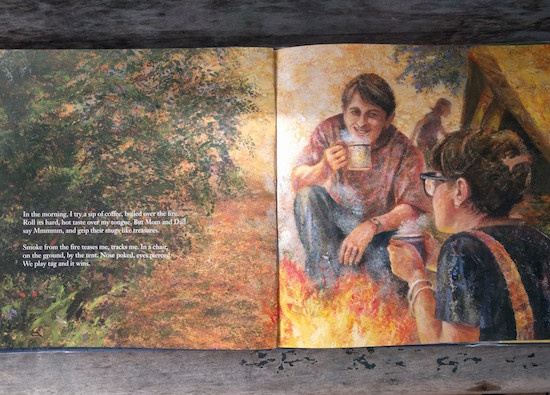
Iris picked this book from a display at Lillian H. Smith Library yesterday, Camping, by Nancy Hundal and Brian Deines, published in 2002. It’s about a family in which nobody is really excited about the prospect of camping, but money is tight and camping is cheap, and throughout the story, they all discover a love of camping. Their experience differs from ours because a) I don’t find camping all that cheap (every year I think we have all the equipment we could possibly need, and then there’s always something more) and b) we are all of us in every family very excited about the prospect of camping. This book has helped us be even more so. (I love the page with the spread of stars the best. The night sky is definitely one of my favourite parts of camping. That, and reading ARC’s of new Louise Penny novels, which seems to be a tradition for me.)
This particular page is the one I love the best though, because indeed there is something about morning campfires and camping coffee and tea. And for sure, we grip our mugs like they’re treasures. Aren’t they though?
July 28, 2016
Against Christmas in July
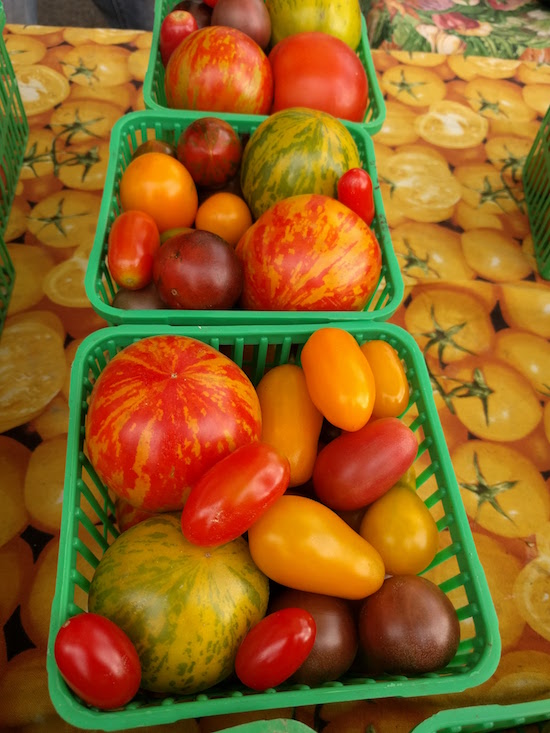
I took this photo at the farmers’ market. Yesterday.
“I think maybe I should quit trying to teach people about blogging,” I said to my husband yesterday. “I think I’m no longer qualified.” Instead of qualified, I’m become a curmudgeon, ruing change and despairing at the form. And what had brought all this on was a theme in my various social media feeds this week, bloggers being invited to attend holiday season previews for various companies and brands. In the magazine world this is certainly a thing, I understand, because magazine people are perpetually living six months in the future. But with blogs, surely with blogs, surely it would be different. The very point of blogs being their immediacy, what they tell us about life as it is being lived, about the moment. Right now.
Right now where I sit, temperatures are in the high twenties. Birds are chirping. I’m listening to cicadas buzzing. It is definitively not Christmas.
I am fully aware of the fact that I am something of a blogging luddite. I’ve made futile attempts to monetize my blog, but my heart isn’t in it. I can’t think of a way of monetizing my blog that wouldn’t compromise my practice. The point of my blog is that I like doing it, and that is reward enough for me. The point of my blog has never been to “work with brands” because I think that’s weird, but then I think a lot of things are weird that plenty of perfectly respectable reasonable people find totally normal (like shopping at Costco) so my own priorities might just be a bit skewed. But they are what they are, and the point of my blog is that they reflect this, that I write posts like this to make sense of the things in the world that flummox me, and a handful of dedicated readers continue to keep reading.
The very best thing about blogs, of course, as I tell people every time I teach a course or workshop, is that they can be anything. The elasticity of the form and capacity for evolution is why they still matter after 20 years, and so for me to declare that anybody is doing blogging wrong is totally stupid. (Especially when those bloggers probably receive far more traffic than I do, and hopefully get compensated for their labours beyond pastries consumed at industry events or shoe samples.) But I do wonder if the blogger mightn’t take heed and consider the nature of her project, what she’s getting out of it exactly, when she’s blogging about holly wreaths with the humidex in the high forties. Who is she serving exactly?
But then what do I know. I can’t even bear advance copies of new books. Summer books arriving in March, and I don’t want to read them then. Being an industry insider is all fine and well, but I want to be a reader. I want to read the books when everyone else does, to share in online enthusiasms, to write about the book while it’s fresh in my mind. For me, this is the very point of my blog, and of blogging.
Not tinsel. Not now.
Not when there’s so much to say about summer sun.






