October 22, 2019
Reading All Day
The Turning the Page on Cancer Read-a-thon took place the very same day as the Waterfront Marathon here in Toronto, which got disproportionate media attention, really, considering that some slackers had completed their race in a couple of hours, but I was reading all day.
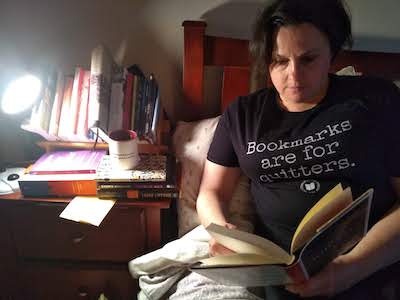
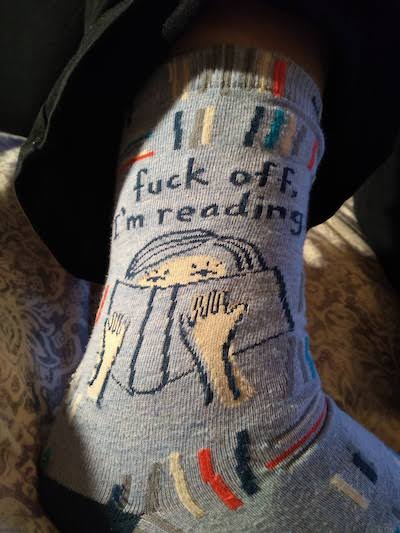
The event kicked off at 8:00, and I was so excited that I woke up before my alarm, taking a quick shower and donning my read-a-thon gear, which was track pants, my “Bookmarks are for quitters” t-shirt and “Fuck Off, I’m Reading Socks.”
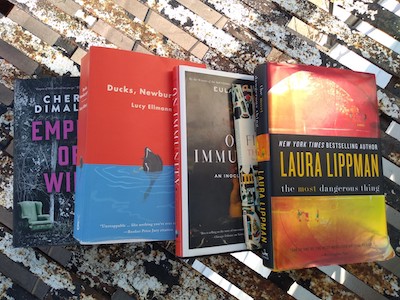
I started off with a reread of Eula Biss’s On Immunity, which the Mom Rage Podcast will be discussing as a book club pick next week. (I read the book for the first time in 2015, and loved it. So happy to revisit it.) Reading with a pen in hand, which I never seem to do anymore, though I keep resolving to. But the read-a-thon was all about immersion, and I’d already marked up the volume the first time around, so there were underlines and notes in the margins. I look forward to writing a bit more about the book soon.
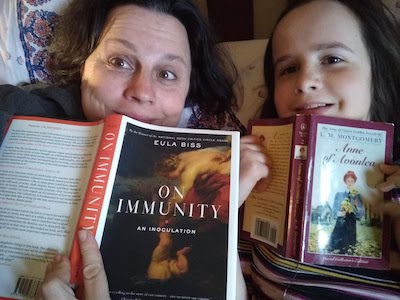
We’d envisioned buying my children whistles so that they could dance around the house cheering me like good coaches, and the idea of whistles appealed to them a lot of noise reasons, but then we remembered our resolution to avoid plastic crap (and also noise reasons) so the whistles would be metaphorical. Everyone in my family was terrifically supportive of my endeavour, which was basically lying in bed all day disguised as altruism. Stuart made waffles, and brought me tea, and Iris and Harriet both joined me for a while so I wasn’t reading all alone. (And yes, I loved that Harriet was so happy reading Anne of Avonlea.) Later, I would be delivered the most terrific grilled cheese sandwich.
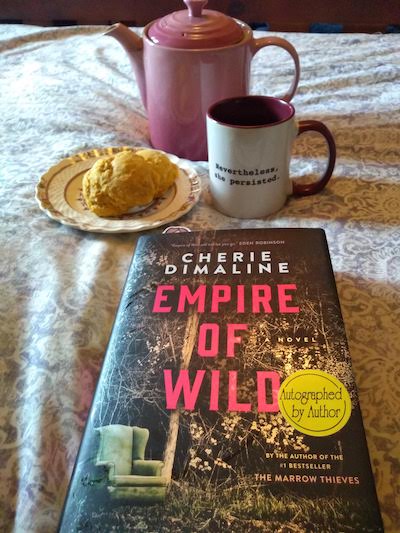
True confession? 8 hours weren’t long enough. Around 11am, it occurred to me that I could keep going all day, which surprised precisely no one. Too much reading begets more reading, really, because my brain is tuned to focus and concentration. There was also a prize for most pages read, and I was really hoping for a solid chance at winning it. When I finished reading On Immunity, I read 25 pages of Ducks, Newburyport, and then moved on to my second book of day, Cherie Dimaline’s latest Empire of Wild, and if you’re ever doing a read-a-thon, I’d recommend a book like this. I LOVED IT. Unputdownable. Funny, suspenseful and rich, and yes, it would be a difficult task to follow up her incredibly successful novel The Marrow Thieves, but she’s done it properly here. (I am surprised it didn’t show up on awards lists this fall. With a handful of exceptions, the awards lists have forgotten a lot of the year’s true literary standouts.)
Sunday was a beautiful day, so I spent part of the afternoon outside in my dilapidated hammock, which has only just survived the season and will probably be thrown into the garbage soon, because when I lie in it, my entire weight is being supported by a couple of stitches. But they both held me safe for one more float, as I drank more tea and was enraptured by Empire of Wild. And then there was just an hour left to go. (No! My stamina knows no limits. Who knew that time could past so fast?)
So I read a story by Penelope Fitzgerald, and then 25 more pages of Ducks, Newburyport, and had enough time left to fit in 31 pages of Laura Lippman’s 2011 novel The Most Dangerous Thing, and then it was 3pm. 8 hours were up. Why must we ever stop reading? Why? Why???
Well, because my husband had been taking care of our children all day, and I’d promised to make dinner because he’d done breakfast and lunch, and it really was such a beautiful day that I ought to venture out in before I end up with bedsores. But in the meantime, I’d raised more than $1500.00, with a ton of donations rolling in that morning. (Thank you!!) Cumulatively, the Turning the Page on Cancer campaign raised nearly $22,000.

My #todaysteacup for the read-a-thon was my “Nevertheless, She Persisted” mug, not because I would need to persist through 8 straight hours of reading (turned out to be no chore, guys), but because this is what women happens to women who are diagnosed with metastatic breast cancer, the disease whose research we were fundraising for. There is no cure for metastatic breast cancer, but women diagnosed can go on to live and even thrive for years. The embodiment of nevertheless, she persistedship, with with more research these women can be better supported and live longer, and there will be a whole lot less to “nevertheless” about.
Thanks to everybody who supported me, to the other champions I was reading along with (including my pal Melanie), and to the amazing Samantha Mitchell, who made the whole thing happen. It was so much fun.
October 21, 2019
Gleanings
- Is “A Bargain for Frances” the best book ever written about childhood friendships?
- Why I Had to Rewrite the Ending of My Middle-Grade Book After Charlottesville
- My feet are my locomotive. I walk, a lot.
- I am not going to reproduce or respond to an email that yelled at me, and not in a humorous way, for not blogging often enough.
- Of course, I do believe it, but it’s good to sit with these things or, as the case may be, to blog about these things.
- Still, it was kind of luxurious to spend three days just reading.
- One of the pleasures of being an author is knowing that your characters are out there living their own lives, separate from you, totally out of your control.
Do you like reading good things online and want to make sure you don’t miss a “Gleanings” post? Then sign up to receive “Gleanings” delivered to your inbox each week(ish). And if you’ve read something excellent that you think we ought to check out, share the link in a comment below.
October 17, 2019
Daughters of Silence, by Rebecca Fisseha
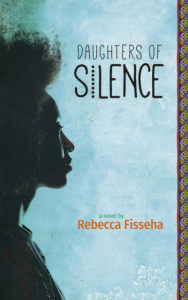
Rebecca Fisseha’s novel Daughters of Silence is dazzling, partly because it’s particularly well crafted, but also in the sense that it messes up your vision a bit, that you’re not quite sure what you’re seeing at first. Because the book is a puzzle, a mystery unfolding, and also a circle. I’m so grateful that I had the chance to read it twice, because it’s one of those marvels, a novel that get better and richer with every encounter.
The first time I read it was in the spring in manuscript form after I’d received a message from its editor, who was once my editor, Bethany Gibson, asking if I’d consider blurbing the book. And Gibson’s passion for the novel as so apparent in her message that I agreed without hesitation. I read the novel, and I liked it, the ending in particular. I wrote, “Featuring gorgeous prose and a most compellingly prickly narrator, Fisseha’s debut novel is a puzzle, a page-turner, and a triumph.”
But then I reread the book two weeks ago in anticipation of my conversation with Fisseha at her book launch last weekend, and I wanted to go back to my blurb if only to underline it emphatically at least a million times.
Fisseha comes at her story with a singular, distinctive style, and a character who’s not here to make friends. No, instead Dessie is working to uncover the truth in her own history, the history of her family, truths she’s spent decades unable to face, hiding abuse and trauma in which the people who loved her were partly complicit, and the reader is simply along for the journey, following Dessie as she makes impulsive leaps and takes her own road. Unable to hide from her past anymore, because she’s stuck back in Addis Ababa, her birthplace, after her plane is one of thousands grounded all over the world after the eruption of an Icelandic volcano. Disturbances in the atmosphere, you know, but where the planes can’t fly, Dessie herself manages to discover some clarity, some answers, especially about the experiences of her mother who has recently died and has been buried in Toronto, not back in Ethiopia as had been what was expected.
In her essay for LitHub “on #MeToo in Ethiopia and Eritrea,” Fisseha writes powerfully about what happens when women decide to tell the truth about their own lives: “Perhaps because of my own predisposition to doom and gloom, I had interpreted Rukeyser’s line the world would split open as a disaster scenario. But now I realize how flexible that line is….The world could split open like a flower in bloom, like a woman shattering the glass that had separated her from true connection. Like the global event that became multitudes of habesha women finally telling their stories online…”
The real-life connections to Daughters of Silence do serve to underline the power of story in general, and in this story in particular, but let them not undermine the fact of what a fabulous work of fiction this novel is. The style, remember? The dazzle. Let Rebecca Fisseha take you on a journey. You will be glad you did.
October 15, 2019
Cities Work

I understand the circumstances that have resulted in an increasing number of people on our streets, but what I cannot understand is how someone could walk on by someone who is unconscious on the sidewalk and do nothing, which happens all the time. “If that were me lying on the sidewalk, I’d want someone to help,” I tell my children. “If it were you, I would want someone to help.” Today we called an ambulance for the second time in recent months for someone who was in trouble. Because that guy on the sidewalk, he’s our neighbour. We share this city together, and cities work when we take care of each other.
And as ever, I was so grateful for the kindness of first responders who accorded this man his dignity. Firefighters and ambulance arrived and took care of him, as a Falun Dafa Parade came up the street, an amazing marching band. We’d left by then and were across the street watching the parade half a block from where the firetruck and ambulance were blocking the road, and this tension, these intersections, and connections are why I love cities so much. Why I love this city so much.
It’s a miracle that any of it works, but sometimes it does, and it can be beautiful and so absurd, the golden autumn day a glorious backdrop.
By the time the parade had arrived, the emergency vehicles were gone, the man taken to the hospital, which I know is only the beginning of the story and unlikely to be the end of his struggles. But I hope it helped, and I loved the marching band and their music, and I am so grateful to be connected to all of it, to be part of this messed up, gorgeous, incredible world.
October 10, 2019
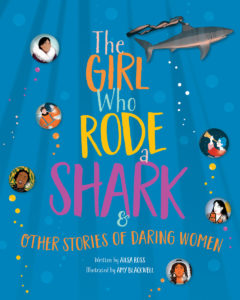
The Girl Who Rode a Shark, by Ailsa Ross and Amy Blackwell
I’m not yet bored of stories of brave and uncommon women, and this is not even a genre that began with Good Night Stories for Rebel Girls. Virginia Woolf published several biographical essay throughout her career—it was from “Lives of the Obscure,” in The Common Reader, that I learned about the Victoria entomologist Eleanor Ormerod, for example, and without Woolf we wouldn’t even know about Shakespeare’s Sister at all. Truth be told, I actually found Good Night Stories... a bit wanting…but that’s because I’d read Rad Women Worldwide before it, and liked it so much better.
But another similar book, The Girl Who Rode a Shark, by Ailsa Ross (who lives in Alberta!) and Amy Blackwell, has managed to live up to my expectations. My favourite bit is the Canadian content—we’re almost at the Roberta Bondar essay. And Indigenous hero Shannon Koostachin is included in “The Activists” chapter.
The women profiled in the book come from places all over the world, include many women of colour, and also women with disabilities. Even better—while many of the profiles are of historical figures, just as many are contemporary, young women who are out there doing brave and groundbreaking things as we’re reading. A few of these figures are familiar, but more are new to us, and their stories are made vivid and compelling through the book’s beautiful artwork and smart and engaging prose.
October 10, 2019
October
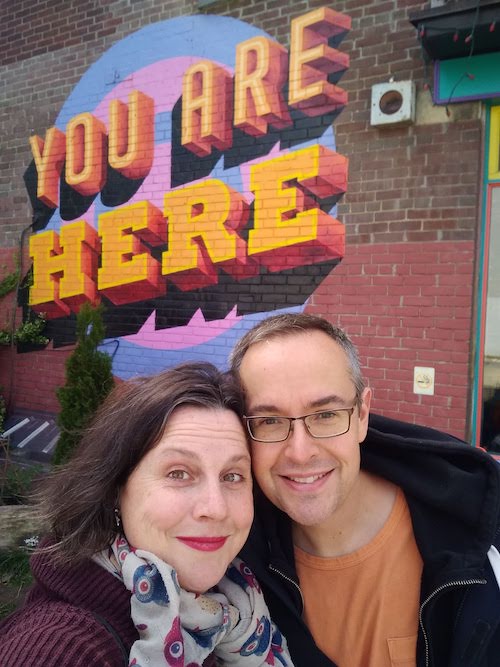
This month marks 19 years since I started blogging, and I’ve also been thinking a lot about where I was here a decade ago, when life was very different, when I was the new parent of a small baby and the universe was made of a million tiny little pieces that would eventually find their way together to make…my life. A life where the children go out of town for the weekend—WHAT? But yes, they went to Girl Guide Camp and Stuart and I were left on our own for 36 hours. So curious to slip back to the life that used to be, when days were wide open, we could walk until our feet hurt, and once the supper dishes were washed, we didn’t have to put anybody to bed. It helped that the day was golden, beautiful. We visited Little India in the east end, where we’d never been before, and then walked along Gerrard all the way from Coxwell to Logan, and it was so interesting and fun, and a great treat to return to that expansive life for a little while, and have my house clean. But oh, the children, with their complications and fascinations, and when they came home, we were glad to have them. Always, we are glad to have them. And lucky. And it occurred to me on Monday, when I was reading Theresa Kishkan’s blog, that I love her blog so much because she’s as mystified and fascinated by this particular thing as I am, the banal and extraordinary fact of the passage of time. How did we get here, far more interesting to me even than where are we going ever was.
October 8, 2019
Watching You Without Me, by Lynn Coady
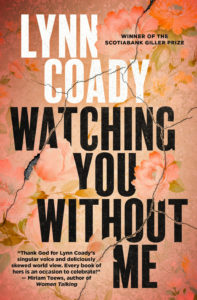
I’ve been a big fan of Lynn Coady for awhile now, since I read Mean Boy back in 2006. I absolutely adored her most recent novel, 2011’s The Antagonist, and I really enjoyed puzzling my way through her Giller Award-winning Hellgoing a couple of years later. Hellgoing, a book that, like the trajectory of Coady’s writing career, is packed with twists and turns, a resistance to the boring, conventional or expected. A resistance that continues right up her latest, Watching You Without Me, a thrilling and engrossing ride of a novel, a most unsettling but utterly captivating read.
Her protagonist is Karen, who returns home to Halifax after the death of mother to take care of things, and to sort out the future of her older sister, Kelli, who is developmentally disabled. The moment both Karen and her mother had been resisting for years, especially after an epic battle they’d had decades before when Karen voiced her refusal to be responsible for Kelli’s care and also blamed her mother for having her identity subsumed into that very thing. But the reality of the situation is more complicated than that, as Karen begins to realize as she becomes reacquainted with her sister and the household, whose demands are made somewhat easier with the curious presence of Trevor, her sister’s care-worker, who, it turned out, had come to play an important role in the family’s life while Karen was away.
But Trevor’s presence is also an uneasy and unsettling one. His familiarity makes Karen uncomfortable, she doesn’t really like him, he has “issues,” as they say, control issues in particular, and a propensity for flying off the handle. But Karen is also desperate, and vulnerable in the wake of her mother’s death, and she allows Trevor to continue to make a place for himself in the household, because he’s kind of a master manipulator, but also she needs all the help she can get.
Karen is a fascinating, solitary figure whose more recent history is glossed over, save her a recent divorce, but her lack of friends and confidantes is conspicuous. An elusive narrator, she sees what she wants to see, and does an effective job of shaping the narrative to her purposes, but there are moments when we see through to the story behind the story, and the story behind that, each of these worthy of novels onto themselves, so many questions—the complexity here is wonderful.
Karen’s story reminds me of the narrator of Helen Phillips’ The Need, recently nominated for a National Book Award. Another sinister book about the unrelenting demands of caregiving and how a person might crack underneath them to make some questionable choices. About how one might take whatever relief they’re offered, even if they know it’s a really bad idea, but it’s rather enticing, the opportunity for just a few moments of rest and also the assurance that somebody else, for once, is in control of the chaos.
Claire Tacon’s wonderful 2018 novel, In Search of the Perfect Singing Flamingo, also similarly explores disability and families, and the experience of being the adult sibling of a person with developmental disabilities, although the siblings’ parents are still alive in Tacon’s novel, and the idea of what happens once they’re gone just looms on the novel’s horizon. Coady’s novel, unflinchingly, takes the reader right there, that moment of the realization of so many parents’ fears for their children, but what is to be most feared actually arrives in the form of a saviour. And the unfolding story of just who Trevor is and what his intentions are results in a roller-coaster ride of a read—which is a remarkable feat when the reader considers that these are characters who barely leave the house.
October 7, 2019
Gleanings
- It is telling that this dedication is not to Stein herself, but to her words and sentences – those notoriously obscure, dense, allusive syntactical puzzles that require dedication and persistence to parse and comprehend.
- It’s lovely to choose your life again, even when you think you already appreciate it.
- Having breast cancer and knowing how little funding goes into research for metastatic breast cancer, and how it mostly goes into overhead and pink trinkets, has made me want to hate October.
- When I go into the kitchen and see the pot of hips on the table, I wonder how the summer passed so quickly.
- I am so grateful for this portal, and it’s always a delight when I hear that a post has inspired or moved someone, or just simply made them happy.
- It strikes me that reading Tove Jansson is like stepping through the back of the literary wardrobe into a Narnia-like world of magic and difference.
- The conservation area is located at #902 Ballyduff Road; small problem though, the road ends at eight hundred and ninety something. Beyond that was a very rough (very, very rough) track through the woods….
- Sometimes it’s fun to know next to nothing about a book prior to picking it up.
- Or the fact that I have been reading Tolstoy for decades and still only have the foggiest idea what a samovar is….
- If you are looking for consolation as a reader, you would be well advised to look elsewhere.
- Yet never has a colon done so much heavy lifting.
- I found her book in my building’s laundryroom’s bookshelf.
- If the bullshit-merchants have no shame about repeating themselves, their critics shouldn’t either
- There is a lot of work to be done out there, Readers! Kids need mirrors and windows!
Do you like reading good things online and want to make sure you don’t miss a “Gleanings” post? Then sign up to receive “Gleanings” delivered to your inbox each week(ish). And if you’ve read something excellent that you think we ought to check out, share the link in a comment below.
October 2, 2019
It Began With a Page, by Kyo Maclear and Julie Morstad
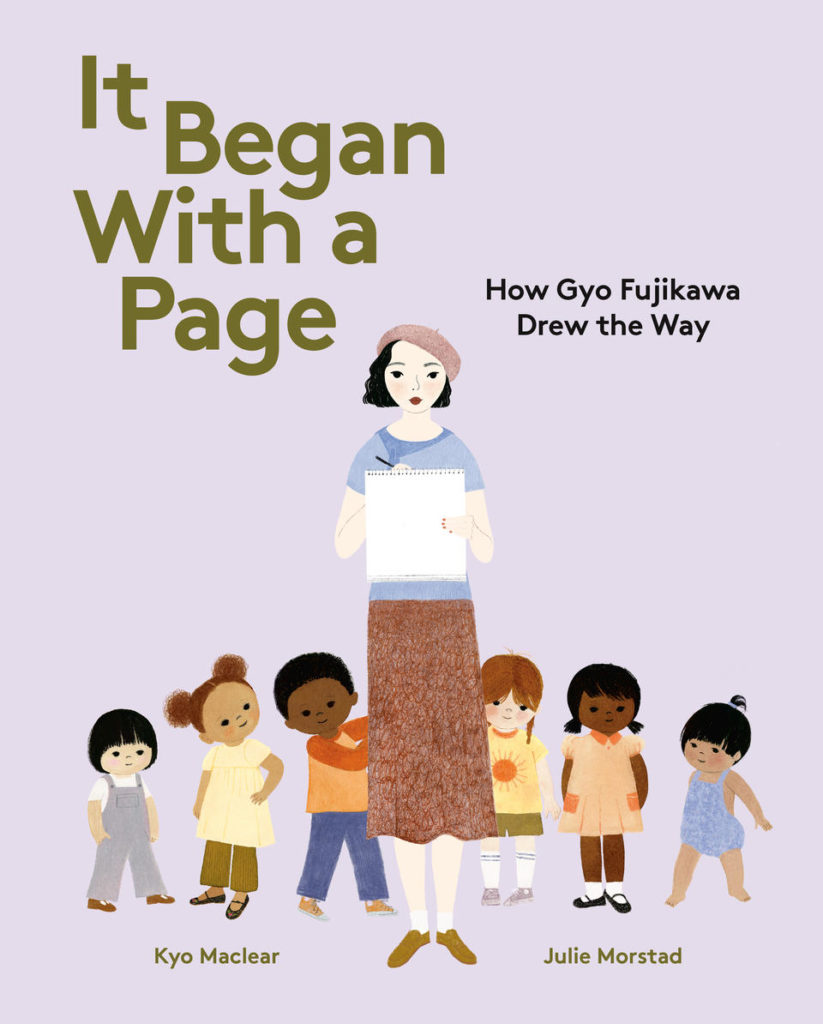
It Began With a Page, the new picture book collaboration by Kyo Maclear and Julie Morstad—who are already known for their picture book biographies(ish) of Julia Child, Elsa Schiaparelli, Anna Pavlova (illustrated by Morstad, written by Laurel Snyder), and Virginia Woolf (written by Maclear, illustrated by Isabelle Arsenault)—has everything. And to have Kyo Maclear, a leading Asian-Canadian author writing about THE pioneering Asian-American children’s author/illustrator, with illustrations by Julie Morstad who does such justice to her source material. Which is, of course, Gyo Fujikawa’s babies, an adorable array of little people from different ethnic backgrounds, all playing together—Fujikawa has clearly been an inspiration to Morstad since the beginning of her career. But what contemporary readers might not appreciate until reading It Began With a Page—which tells Fujikawa’s life story—is that it wasn’t long ago that picture book illustrations of children with different skin colours all playing together was revolutionary, and before that even not condoned.
Which is a convenient metaphor with which to tell a story of a society in which, just say, people from a certain ethnicity have their land and belongings confiscated and are sent to concentration camps. Although Maclear eschews metaphor altogether here, and sticks with the facts: “In early 1942, terrible things were happening. Bombs and gunfire rocked the world. America was at war with Japan. Kyo was shocked to discover that anyone who looked Japanese or had a Japanese name was no suspected of being the enemy… Gyo’s family was sent to a prison camp far, far away from their home.”
But first: “It began with a page, bright and beckoning.” A five-year-old girl with a pencil in her hand. “The dance and glide of a line. How a new colour could change everything: a bright splash of yellow, a sleep stroke of blue.” The girl fills her pages with drawings, and as she grows older, her talent is natured by a supportive teacher who pays for her art lessons Gyo Fujikawa is one of the few girls, let alone Asian-American girls, who goes to college in 1926. She travels to Japan, her ancestral homeland, to learn about the tradition of Japanese brush painting, and after she returns to America gets a temporary job designing books at Walt Disney’s studio in New York. Which means she is far away from her family when the Japanese internment takes place, but the distance only increases her heartbreak at what is happening in her country.
After the war, Fujikawa continues to work as an artist, and Maclear shows her awareness of the dawning civil rights movement. “Still, there was so much that hadn’t changed. At the library and bookshop, it was the same old stories—mothers in aprons and fathers with pipes and a world of only white children.”
But when Fujikawa submits her manuscript featuring “Babies! Chubby cheeked, squat-legged, bouncy-bottomed babies,” the book is rejected. “No to mixing white babies and black babies. It was not done in early 1960s America, a country with laws that separated people by skin colour.”
Fujikawa, however, does not give up on her vision. And eventually, the book is accepted, and is a huge success, the beginning of an incredible career for this illustrator whose drawings would create “a bigger, better world.”
The story includes a timeline of Gyo Fujikawa’s life, and photographs, and a note from Maclear and Morstad to readers about Fujikawa’s legacy (“Gyo as a TRAILBLAZER…and a RULE BREAKER”) was and how her family supported this book (Fujikawa died in 1998), providing access to stories, photos and archival materials.
October 2, 2019
Autumn Reads on the Radio
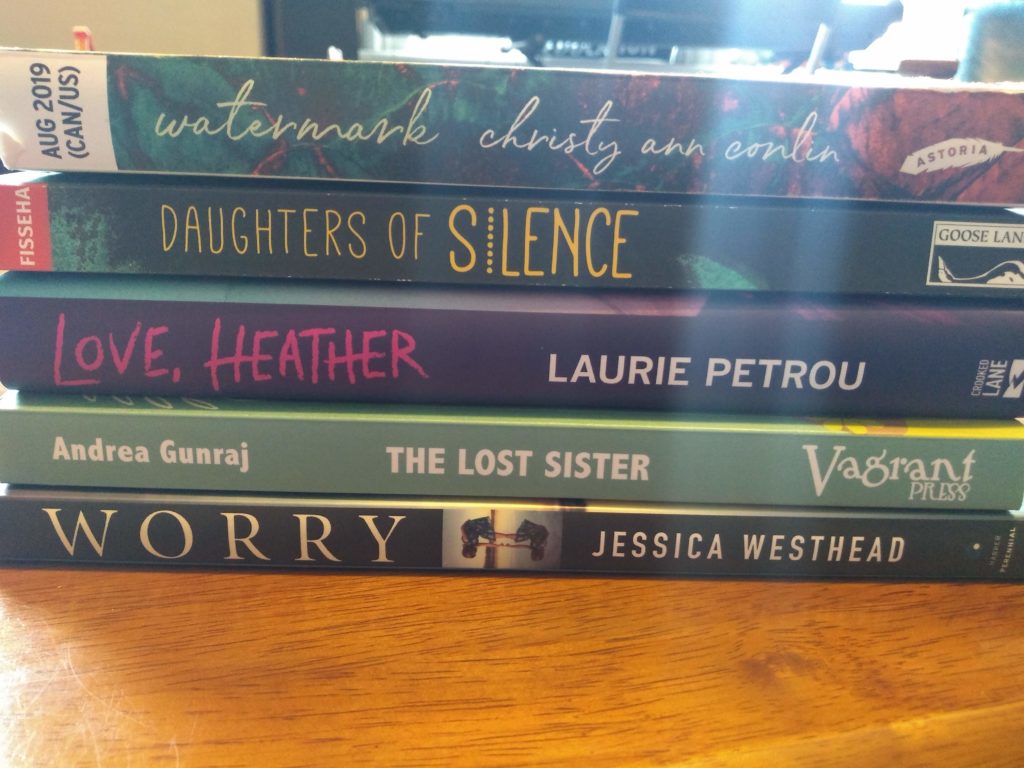
I was on CBC Ontario Morning today talking moody autumn reads that match the weather, but which also feature some glorious golden hues. If you missed it, you can catch my column on the podcast at 33.30.






