June 2, 2013
Reading Barbara Pym on her Centenary
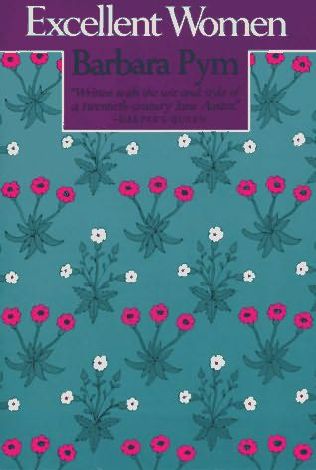 I have nearly all of Barbara Pym’s novels on my shelf, the bulk of which I obtained when a contents sale was held at a house around the corner and I pretty much cleaned out the library. And this is how it is with Barbara Pym novels–it usually takes death for a reader to finally part with them. Though they also turn up at used book sales from time to time (probably after a death as well), which is how I first encountered Excellent Women, perhaps Pym’s best-known novel. I’d heard of Pym from Susan Hill’s Howards End is on the Landing, Maureen Corrigan’s Leave Me Alone, I’m Reading and also from this wonderful piece on the CBC on the Barbara Pym Society, which I joined shortly after becoming a Pym convert. It was Excellent Women that fast turned me into one too, and no wonder, I discovered, over the past few days as I read the book again.
It’s wonderful. I could see how encountering Pym first through some of her other novels might be a less delightful experience, one not truly appreciated until one understands the nature of the Pymmian universe. But Excellent Women, as subtle and small as her other books, is so absolutely funny, its goodness immediately graspable. As ever, the delicious gap because what is written on the page and the reader’s apprehension of the true situation. It’s the story of Mildred Lathbury, spinster daughter of a clergyman whose life changes with the arrival of new neighbours Rocky and Helena Napier, plus a clergyman’s widow who steals the heart of the vicar whom everyone had assumed that Mildred was in love with.
And the lines: “A little grey woman… brewing coffee in the ruins.” The austerity of 1950s’ England is not at the novel’s forefront, but instead a shadow in the background with references to bombed-out buildings, ration books, and bad food. But ordinary life goes on anyway, church services conducted in the half of the church that was not destroyed in the war, which gives the congregation a heightened intimacy.
And the vicar with his plaintive call: “May I come up? I can hear the attractive rattle of tea things. I hope I’m not too late.” Oh, so much tea. “Perhaps there can be too much making cups of tea, I thought, as I watched Miss Statham filling the heavy teapot. We had all had our supper, or were supposed to have had it, and were met together to discuss the arrangements for the Christmas bazaar. Did we really need a cup of tea? I even said as much to Miss Statham and she looked at me with a hurt, almost angry look. ‘Do we need tea?’ she echoed. ‘But Miss Lathbury…’ She sounded puzzled and distressed and I began to realize that my question had struck at something deep and fundamental. It was the kind of question that starts a landslide in the mind.”
There are so many landslides in this tidy book, whose whole world is turned inside out by its final page. Most aren’t the landslides you’d notice and it doesn’t end with a wedding (though a further glimpse of these characters in another Pym novel reveals that one will come about eventually!!!), but more with a change in consciousness, the main character’s heightened awareness of her place in the world. And it’s a funny little world too, quintessentially English, rattling tea things and all. How I adore it, absolutely.
This past week, I also reread A Glass of Blessings, which is more subtle and infused with a touch of melancholy in spite of its delights. So many musings on a furniture storage facility–such a curious book. A bored and idle married woman fancies herself the object of another man’s affections, though he turns out to be gay (which is as expressly stated as you’d imagine for a book published in 1958). Pym is truly the master of the unrequited love narrative.
I do look forward to much Pym rereading this summer. I’ve read most of her books in a pleasurable blur, and welcome the opportunity to think deeper about them. I also look forward to baking a victoria sponge cake this afternoon in celebration of her centenary. It’s either bake a cake or have a baby, and the latter doesn’t appear to be happening yet.
May 26, 2013
Canary by Nancy Jo Cullen
 Not the most succinct review, this one. I read Nancy Jo Cullen’s Canary for enjoyment rather than critical analysis, mostly because I’m 40.5 weeks pregnant, and who wants to analyze critically whilst crawling on the floor (and incidentally, I’m on my knees and elbows as I type this)? But the book left such an impression on me that I have to write about it. I loved these stories of families and volcanic eruptions, hitching rides and kissing cousins. In “Ashes”, a teenaged girl’s family falls apart while she and her dad are out practicing driving (and we meet the girl again decades later in the story “Eddie Truman”, whose links are subtle and touching). A marriage of convenience is the subject of “The 14th Week in Ordinary Time”, in which a gay holy roller takes up with a singer with a past she’s more than happy to escape. “Regina” begins with the line, “I wasn’t in love with the kleptomaniac but he was a good dresser” and it just goes from there. “Valerie’s Bush” is about a Brazilian wax and a rock through a window. “Canary” is one of a few stories about drivers and passengers, this one about an embarrassing mom chauffeuring her teenage son on a date. Another is “Passenger”, about a widower driving a teenage girl across the country as he grapples with the loss of his wife who has gone to a heaven he doesn’t believe in. In “Happy Birthday”, a woman flees her mother’s 83rd birthday party and her asshole of a partner, bolting to freedom. I loved “This Cold War” because I’ve got a thing for 1989. And oh my goodness, “Big Fat Beautiful You”, what a powerful way to finish this collection, connecting past and present, as a middle-aged woman testifies to who her sister was and who she is now: “Caroline is like one of the comets that travel fast enough to enter and leave the solar system with almost no attention. I guess I am the witness who noticed the collision and subsequent disintegration of the marvellous light.” A story like a Bruce Springsteen song, if Springsteen were a woman–I love that. There is humour here, engrossing narrative, and wonderful, wonderful writing.
May 21, 2013
Dance, Gladys, Dance by Cassie Stocks, 2013 Leacock Medal Award-Winner
 In many ways, Cassie Stocks’ Dance Gladys Dance is the kind of book that tends to win the Leacock Medal for Humour (unlike The Sisters Brothers, which took the prize in 2012 and stands out for its gory darkness). It’s a folksy, Sunshine Sketches, Vinyl Cafe kind of book about good people and their weathered porch steps, about the eccentric woman next door who is devoted to her cat. There is a life-affirmingness to the narrative, coupled with biting lines that made me laugh out loud.
In one fundamental way, however, Stocks’ novel stands out from the other winners from over the last 66 years, or at least the other winners save the paltry five (5!) in the crowd which also happened to be books written by women. Last year, I kicked up a fuss when some of the funniest books by women weren’t included in the mix, and I was even more annoyed when the lone male writer on the shortlist ended up taking home the prize. And so this year when Cassie Stocks was awarded the 2013 Medal, I felt I had a responsibility to show my support for the book and its acclaim by buying it and reading it. Not the most arduous gesture either–how hard is it to read a book that’s funny?
It’s not all sunshine in Dance, Gladys, Dance. The novel deals with parental estrangement, prostitution, drug abuse, loneliness, and the undermining of women’s work and women’s art by society at large. Frieda Zweig is fed up with the whole thing and has decided to abandon her artistic dreams altogether. She has come home to Winnipeg with a new goal for herself–to hang up her paintbrushes for once and for all and learn how to live like an ordinary person instead. And though we’re rooting for Frieda right from the start, we’re quite aware that being ordinary is the one thing in the world she’s not capable of.
She answers an ad in the paper for an antique photograph for sale. “Gladys doesn’t dance anymore,” it says. “She needs the room to bake.” Seeing parallels between Gladys’ story and her own, she goes looking for Gladys only to discover there is no Gladys at all, but instead an elderly man with a room to rent. This situation works out quite conveniently for Frieda, and then Gladys starts showing up–it turns out she’s a ghost with a lesson to impart from her own experiences a century before, and there is something she wants from Frieda as well in exchange. In the meantime, the local arts centre is set to be closed and the community must rally around to save it, plus Frieda’s best friend has become a utensil thief. The woman next store is a compulsive crocheter, Frieda’s ex-boyfriend Norman (millionaire heir to a porn dynasty) has come to woo her back, bringing along his mother who’s busy reading everyone’s aura. And what of the homeless girl who builds boxes covered in tampon ads, and the drug addicted screenwriter holed up in a divey hotel who’s a Hollywood smash and doesn’t even know it? And Gladys herself? Does she ever get to dance?
Obviously, there is a whole lot going on here, and it’s often a bit too much, however amusing. The novel’s construction is more haphazard than precise, more elaborate and teetering towers than the firm foundation required to adequately address the subject matter at hand. We skim the surface of these stories, which seem more like sketches, and the people are more caricature than character much of the time. So yes, I’m criticizing a novel that’s just won a prize for humour for not being serious enough, which is a bit rich, of course, but I point it out only because the novel is reaching for depth but doesn’t quite manage to get there and there were times I wished it would.
Other times, however, I was quite content with Gladys as she is–light, smart and feminst, a stand-out in the crowd. Cassie Stocks demonstrates that the funny sisters are doing it for themselves.
May 15, 2013
Basements and Attics, Closets and Cyberspace: Explorations in Canadian Women’s Archives by Morra & Schagerl
 I am one of those readers who has bought into the romanticism of libraries and archives, Barbara Pym heroines and Maud Bailey in Possession. In 2001, I helped to unpack the Woolf Collection at the Pratt Library in its new sub-basement home, and it was one of the most remarkable things I’ve ever done. And even when it’s not romantic, archives are fascinating; one of my favourite books of recent years was Outside the Box by Maria Meindl about legacy of her grandmother’s archive, and unexpected questions: what do you do with a pile of papers covered on dust and cat hair, a colostomy bag stuck to the back? A question that probably wouldn’t faze most archival librarians, as Meindl discovers, and Susan McMaster too in her essay “Rat in the Box: Thoughts on Archiving My Stuff” from Basements and Attics, Closets and Cyberspace: Exploration in Canadian Women’s Archives (Linda M. Morra and Jessica Schagerl, eds). Her essay begins with a literary archivist asking for details, “Mouse turds or rat turds? A few mouse turds are nothing, they can be brushed off…”
The connections between the essays in Basements and Attics, Closets and Cyberspace are broad and strange, as befitting a book of “explorations”. Why “Women’s Archives” in particular? Because it’s a whole different game that requires in some cases a redefinition of what archives are. One can’t go looking in ordinary places for women’s history, because for so long there was no such thing, and different ethical questions are raised about public and personal stories. But what does it mean for the archive to change the definition of archive? What is expanded and what is undermined? The book is a fascinating exploration indeed, and while it’s published by an academic press and makes a fair number of references to Derrida, much of it was accessible to the likes of me, and was a really enjoyable read.
In “Of Mini-Ships and Archives”, Daphne Marlatt writes of language itself as an archive, and asks, “Does writing… inherently contain the possibility of going public?” based on her experiences in archives using personal stories to provide context for larger issues. Cecily Devereau posits eBay as an archive, discussing its advantages and limitations over tradition archives in the quest for “Indian Maiden” lore. “Faster Than a Speeding Thought” by Karis Schearer and Jessica Schagerl was of particular interest to me, examining poet Sina Queyras’ blog Lemon Hound, the blog as archive and ethical implications of this (there is no permanence; who do comments belong to?; can there be such a thing as a paperless archive?) and poses interesting questions about blogs in general: “Although, on the one hand, controlling the means of publication can be a powerful tool for shaping the literary field, on the other hand, it does have its own implications for women’s labour.” In “Archiving the Repertoire of Feminist Cabaret in Canada”, T.L. Cowan attempts to use anecdotes to recreate an event whose ephemera has been entirely lost, and discusses what kind of archive emerges from this exercise. Penn Kemp writes about archives from the point of view of the archivee, as does Sally Clark who discusses her own discomfort with archiving and the question it requires of her: “What are you worth?”
In “Keeping the Archive Door Open: Writing About Florence Carlyle”, Susan Butlin presents some of the unique challenges of researching Canadian women’s history, and the role of her own prejudices in the process (as she discovers the more commercial ventures of the artist Carlyle). Ruth Panofsky and Michael Moir’s “Halted by the Archive: The Impact of Excessive Archival Restrictions on Scholars” tells of Panofsky’s experiences with Adele Wiseman’s archives when Wiseman’s daughter suddenly made her mother’s archives inaccessible to scholars. The limits of traditional archives are further explored in Karina Vernon’s “Invisibility Exhibit: The Limits of Library and Archives Canada’s “Multicultural Mandate”. Katja Thieme uses letters to the Woman’s Page of Grain Grower’s Guide to show how the page function as an archive of rhetoric which underlines our understanding of the Canadian suffrage movement. Vanessa Brown and Benjamin Lefebvre discuss the archive of LM Montgomery and its role in their own work, as well as its inherent gaps and mysteries. Kathleen Venema uses an archive of her own–a collection of letters exchanged between her and her mother decades ago–to create a new archive and explore the limits of her mother’s memory as she becomes more and more afflicted with Alzheimer’s. In “Locking Up Letters”, Julia Creet questions what is she to do with her mother’s letters about her experiences during the Holocaust when the letters are of vast historical import but also recount experiences that her mother spent the rest of her life trying to flee from and hide.
Basements and Attics, Closets and Cyberspace is not a tidy book, but what exploration in an archive (or any one worth exploring) ever would be? Rather than putting away things in boxes, this book throws the boxes open wide, inviting more questions than answers, and demanding a broader point of view.
May 12, 2013
Arguments with the Lake by Tanis Rideout
 …Let’s step now to these gathering places./Name them–our birthright, strung like beads/ on northern shores. Let’s lay claim to the stories/ on this lake, the aquatic murmur of what’s past/ what’s to come.
Oh, it’s become a bit of a pattern, hasn’t it, me falling in love with poetry that give voice to obscure figures from the past. This time it’s Tanis Rideout’s poetry collection Arguments With the Lake, which imagines a friendship/rivalry between Marilyn Bell and Shirley Campbell, two women who as girls were determined to swim across Lake Ontario just two years apart. Bell made it and became a legend, while Campbell disappeared into obscurity after two failures to complete her swim. Rideout imagines the connections which bind these two girls, the force which drew them both to the lake’s edge and made them attempt to be a part of history. As the book’s exquisite cover suggests, there is 1950s’ bathing-beauty glamour going on here with a particular Toronto bent–Sunnyside Beach and the Palais Royale. The poems also examine the darker forces of friendship, of womanhood, of what inevitably follows girldom, stardom. The lake itself is Rideout’s main character though throughout the book, speaking back to each of the girls’ arguments, enduring but ever-changing. From “The Fear of Silence”: “The shoreline changes more than its citizens. The city/ has leeched into the lake. Front Street really was the Front./ Fisherman docked at the market’s doors. It is as though/ we want to live in that water–press into it, fill it up,/ like empty hours filled now with digital detritus”. I loved this book.
May 9, 2013
The Woman Upstairs by Claire Messud
 Claire Messud’s latest novel The Women Upstairs is a book that rubs shoulders with so many others, in fact a veritable library which runs the gamut from Dostoevsky’s Notes from the Underground to Zoe Heller’s 2003 novel Notes on a Scandal. Although the latter novel is not referenced in Messud’s book, but rather by critics who haven’t read The Woman Upstairs yet and see implicit connections between these two novels about spinster schoolteachers with transgressing extracurricular connections, and who seemingly destroy their lonely lives with a subsuming obsession with another woman and her family. In Messud’s book, what is the scandal though? To which I answer that there isn’t one. Messud’s is a dark psychological fiction in which plot is not the point and not much really happens, but I dare you not to be captivated by her narrator’s voice, by this novel which begins in a fury: “How angry am I? You don’t want to know. Nobody wants to know about that.”
The voice belongs to Nora Eldridge, age 37, not incidentally the very same age as Marianne Faithfull’s Lucy Jordan when she realized she’d never ride through Paris in a sports car. And we are not to know until the novel’s conclusion just why she is so angry, assuming it’s mainly due to her dissatisfaction with her place in the world, her own invisibility the result of a life spent pleasing others. She doesn’t get to be “an Underground Woman” or even one of the mad-women in the attic (“they get lots of play, one way or another”), but instead she is “the woman upstairs”, “the quiet woman at the end of the third-floor hallway, whose trash is always tidy, who smiles brightly in the stairwell with a cheerful greeting, and who, from behind closed doors, never makes a sound.”
“Nobody would know me from my own description of myself,” Nora tells us, though it soon becomes clear that her own description of herself is the product of her imaginings, that she has little insight as to how she’s seen by the world, or perhaps she’s making a case for herself in this novel, that she’s taking full advantage of this opportunity to finally make a sound. When a new student arrives in her class, she’s immediately besotted with him, and swept up in the exotic world of his parents, his mother Sirena an Italian artist and his father a Lebanese professor. She admits that she finds their foreignness intriguing, though the reader wonders if its real appeal is that the couple is unable to place her as the outcast she is, and if in their role as outsiders, she’d projecting her own self upon them. And indeed it’s true that Nora does a lot of self-projecting. Metaphors of fun-houses and trick mirrors run throughout the novel, things not being what they seem (Sirena is busy at work creating an installation of Lewis Carroll’s Wonderland), but nothing is more tricky than Nora’s own narration, her fantastically unreliable point of view.
Messud’s novel is also structured as a fun-house, trap-doors and booby-traps springing up if the reader makes the mistake of taking Nora at her word. Which is a difficult mistake to avoid–Nora’s voice is so forceful, persuasive, she perpetually speaks in generalizations and second-person address designed to make us feel comfortable, familiar. “Don’t all women feel the same?” she asks, and you’d be hard-pressed not to respond with a nod, but then, no! There is no such thing as “all women” anyway, and besides, Nora Eldridge is clearly unhinged. On top of being an unreliable trickster of a narrator, she is also blatantly wrong, about so many things, but most notably in her insistence on regarding the world within the limits of gendered binary terms. In this way, the novel recalls Carol Shields’ Unless, another book in which an enraged female narrator stamps her ladylike foot at the systematic repression of womankind, institutionalized sexism which completely exists, but her singular focus upon this obscures a far more complicated reality. Which is not to say that Nora Eldrige’s or Reta Winter’s rage is misplaced, that either should cease their foot-stamping, but just that there is ever and will be ever more to the story.
Nora is threatened by her growing relationship with Sirena, her student’s mother whose thriving career as an artist challenges Nora’s own ideas about the limits placed on women by society. Nora is disappointed by the failure of her own artistic dreams, and Sirena‘s success suggests that this failure could fall more on the individual than on the society around her. But at the same time, Nora is also inspired and empowered by her connection to Sirena, by Sirena‘s attention to her. In their relationship, Nora finds herself as close as she’s ever been to the type of person she’s longed to be and the type of life she’s dreamed of living. Their connection is complicated, power ever-shifting between them, and it’s never entirely clear just who is being played.
The Woman Upstairs also reminded me of Lynn Coady’s The Antagonist, another novel whose foundation is a most remarkable voice, another novel that was sparked by rage and thirst for revenge. In terms of subject matter although not as complex as a fiction, it also had me thinking of The Interestings, which I read recently, another book about friendship, about what happens when different types of people dare to mingle. And even The Great Gatsby–these books in which ordinary people glimpse another, better world and have the nerve to imagine themselves a part of that scene.
But what happens when the scene shatters, when it reveals itself to be a mirror and the character suddenly realizes that she was outside all along? Claire Messud’s Nora’s suggestion is to pick up the pieces and sharpen the shards, though whether she actually will or if this will be just another example of her fruitless longing is just a whole other layer of complexity underlying this formidable book.
May 2, 2013
Everything Rustles by Jane Silcott
 In her book How To Be A Woman, Caitlin Moran talks about “the common attitudinal habit in women that we’re kind of…failing if we’re not a bit neurotic,” and certainly fiction, memoir, film and television abound with women unabashedly celebrating this “success”. But it all gets a bit tiresome, really, this idea that women are never more remarkable than when they’re twenty-three and totally fucked up (or thirty-three, or forty-three, but still totally fucked up). I’ve really got a thing for women who’ve learned a thing or two, particularly a thing beyond how to hit rock-bottom and make a bizarrely lipsticked corpse. Please do see my list of Great Canadian Non-Fiction for an idea of what I’m talking about, essay collections by amazing writers with experiences to recount and distance and maturity enough to reflect on those experiences. I maintain that it’s really possible for a person to grow up, to get a handle on things, to have kept a close enough eye on the world around them that they have something to teach the rest of us.
Though to get a handle on things, of course, is not to have it all figured out, or to ever stop asking questions, to have all the answers. Everything Rustles, Jane Silcott tells us in her book’s introduction, came about by accident. She didn’t know that she was writing a book, but instead, “I was just trying to find out what I thought about things.” She is writing from a threshold, just beyond her child-bearing years but with age not set in yet (though set in, it will–it all begins with that first twist of the knee whilst skiing). In her essay “Threshold”, Silcott writes, “As I head off to exercise class, drinking a glass of soy milk before I go, I think of girdles, cigarettes and gin. Why was I born into this relentlessly earnest time of herbal remedies and yoga classes? Why can’t I take advantage of stimulants and supportive underwear?”
The essays in this collection are diverse in structure and approach, but have in common Silcott’s attention to language, her curiosity, and sense of humour. She writes about what she’s learned and unlearn from aging; about her experiences as clinical teaching associate, model and guide to nurses and doctors learning how to conduct pelvic exams; about love, sex, and marriage, just what attracts two people; about family, about switching her kitchen table from round to rectangular and how it changed mealtimes and their family dynamics. She writes about fears; about her fears of passing her fears to her daughter; about encounters with friends and strangers, and her questions about what these mean. She writes about writing, about using life itself in order to understand how stories work; about losing her parents; about losing friends. I loved “Lanyard”, about her experiences teaching business English: “When I work at places with lanyards, I put on makeup and fuss with my hair.” She writes about letting her children go out into their own lives.
Everything Rustles is a high-literary version of Nora Ephron’s I Feel Bad About My Neck. These are essays that require close attention, which twist and turn away from where you think they’ll go. Not easy reading, but reading that is rich and rewarding. These stories of what Jane Silcott thinks about things deliver a vivid perspective of the world and life itself, and they’re a celebration of strength, wonder and learning.
April 28, 2013
The Best Place on Earth by Ayelet Tsabari
 Can this writer ever write, was my response when I read Ayelet Tsabari’s guest posts at The Afterword last month. And so I sought out her book The Best Place on Earth, a collection of stories about Israelis of Middle Eastern and African descent, only to discover that this wasn’t exactly what the book was “about” at all. Instead the centre of the book is Israel itself.
After she hung up, she turned back to the news online. Ten injured, nobody dead. For a moment, she could see how her country might look to a Canadian. How Jerusalem could be perceived as the worst place to live, raise a family, a dangerous, troubled city, torn between faiths, a hotbed for fanatics and fundamentalists.
In her book, Tsabari provides a whole different impression. That Israel is more than just Jerusalem, first of all, and that its people live in towns, villages, and neighbourhoods with their own distinctions. And that the people themselves come from diverse backgrounds beyond even Mizrahi and Ashkenazi, that Israelis themselves aren’t homogeneous, and their nation is populated by immigrants legal and otherwise striving to better lives for themselves. That Jerusalem and Tel Aviv are cities where people live out their lives in rich detail, where the backdrop is vivid and vibrant, and ordinary life possesses many more dimensions than can be made out on a one minute news clip about the aftermath of an explosion. And even when characters have left Israel behind, its complexities are always tied up in impossible notions of home.
“Lovers in a Dangerous Time” was the song I had running through my head as I read these stories, particularly the line, “One minute you’re waiting for the sky to fall. Next you’re dazzled by the beauty of it all.” In “Tikkun”, a man encounters an old flame and is surprised to find she’s become an Orthodox Jew, that she’s somebody’s respectable wife now. They spend time together at a cafe that is destroyed in a bombing shortly after their departure, imploding for a moment any distance between them. In “The Poets in the Kitchen Window”, a young boy longs for certainty as Iraqi missiles fall near his neighbourhood and his mother lies ill in the hospital, but he finds solace in poetry instead. “Casualties” is a fantastic story about a young woman serving in the army whose personal life and professional life become unravelled as she drowns her troubles in sex and drink.
A Filipino woman working illegally as a caregiver tries to dodge authorities as she contemplates falling in love. A man brings his Canadian girlfriend to meet his long-estranged father near the Dead Sea and discovers that the parameters of their relationship have shifted. A woman arrives in Canada to meet her new grandchild and is presented with the fact that her daughter has decided not to have her son circumcised. In the collection’s title story, an Israeli woman fleeing her marriage arrives in Vancouver to measure herself against her sister’s very different choices and very different life, but the distance between them may not be as wide as it seems.
Tsabari is excellent at atmosphere and representing a very real sense of place. The great writing I noticed in her non-fiction comes through here as well–my favourite passage was a fabulously rendered awkward sex scene in which a girl’s older, more experienced lover attempts cunnilingus as she is seriously preoccupied with other things (“Stop thinking.”). Perhaps it’s my sensibility, but I appreciated the stories about older characters the most, felt that these characters were represented with more depth and complexity, and that these were the stories that pushed the limits of their form, were not just well-rendered realism but were also about story itself.
April 25, 2013
The Interestings by Meg Wolitzer
 “If we had a keen vision and feeling of all ordinary human life, it would be like hearing the grass grow and the squirrel’s heart beat, and we should die of that roar which lies on the other side of silence. As it is, the quickest of us walk about well wadded with stupidity.”–George Eliot, Middlemarch
“And didn’t it always go like that–body parts not quite lining up the way you wanted them to, all of it a little bit off, as if the world itself were an animated sequence of longing and envy and self-hatred and grandiosity and failure and success, a strange and endless cartoon loop that you couldn’t stop watching, because, despite all you knew by now, it was still so interesting.” –Meg Wolitzer, The Interestings
Meg Wolitzer’s The Interestings is so absolutely full of stuff, of the world, loud with that roar which lies on the other side of silence. Within the novel, we find echoes of its literary contemporaries–recent books like The Marriage Plot and Arcadia–and also more distant 19th century relations. And also the kind of stuff that fills up newspapers and magazines, cover-story “issues” like autism, gifted children, grief, depression, marriage, divorce, rape, third-world child labour, unemployment, and motherhood. So that on one hand, I can tell you that this is the story of a group of friends who meet at summer camp and whose ties grow and change during the decades that follow. But it’s also about the history of the last thirty years in New York and America. It’s about what it means to live history, and how characters change with their times. It’s about the democratic and egalitarian nature of youth, when friends could be duped into believing that they all have the same potential, that there is such thing as a level playing field, that it all comes down to talent and drive. Before it’s discovered that talent is mere, that being extraordinary is rare, and that factors such as money, connections, pedigree, physical and mental health, love, children, and luck come to define the path that a lifetime takes, and that those paths can lead in surprising directions.
At the centre of the story is Jules Jacobson, attending camp at Spirit of the Woods on a scholarship, perplexed and thrilled to find herself part of a circle of individuals who define themselves as “interesting”. She’s an outsider among them, yet she’s curiously accepted, which changes the way she sees herself. When the summer ends and she returns home to her family in suburbia, suddenly everything is mere, and the future (and the city) beckons in a way it never had before. She becomes part of the orbit of Ash and Goodman Wolf, brother and sister with inordinate privilege, is embraced into their family with the other “Interestings”: Jonah Bay, son a famous folksinger who squanders his own musical talent; Cathy, the dancer whose body has other plans for her; and Ethan Figman, whose talent for animation will catapult him to superstardom. The story moves through these different characters’ perspectives, and yet Jules remains its focus and we find her years later receiving Ash and Ethan’s annual Christmas newsletter (they eventually become a couple) with its extraordinary reports of their happenings, and being torn between love and hatred for her friends, contentment with her own more quotidian life and pure envy.
The structure of The Interestings is fascinating, the novel weaving back and forth through time without great shifts, effortless for the reader to follow and seemingly effortless for the writer too, though I can’t imagine that this was really the case. And yes, it is so interesting, a book so terrific to be absorbed in and whose end (at page 468) arrives too soon.
April 21, 2013
Cottonopolis by Rachel Lebowitz
 In Cottonopolis, Rachel Lebowitz both imagines and recreates the global trinity that was created by the 19th century cotton industry–in the American South where the cotton was grown by slave labour, in Lancashire England where the cotton was produced in mills with their belching chimneys and inhumane working conditions, and in India whose own textile trade was violently supplanted by the introduction of English imports. Through a series of prose poems and found poems, Lebowitz draws tight the lines between these distant places, their connections to lives lived locally and globally, and the connections between economics, industrialization, and story-telling. She plants seeds of connection between those nineteenth-century factories “[u]ntil the 1980s is a wasteland of old chimneys. Until the clothes are made in China…”. This is not a story as distant in place and time as it might seem.
Many of the poems in Cottonopolis are classified as “Exhibits”, extrapolations of nursery rhymes, historical record, images, maps and items everyday and otherwise. Some echo the voices of those whose lives were made or broken by the cotton trade. The collection’s notes at the end of the book provide context and further explanation for what the poems themselves represent, and they add fascinating weight to this creative work and its stories.
But most remarkably for this book that uses language to build a museum is that the language itself is easily and unabashedly the work’s most remarkable aspect. I love the stories here, the history, but I can’t help but catch my mind on a line like “The trill of the/ robin, the trickle of the rill.” Or my favourite poem in the collection, “Exhibit 33: Muslin Dress” which turns language inside out in order to sew the whole world up into a tidy purse: “Here are the railway lines and there are the shipping/ lines. Here’s the factory line. The line of children in the/ mines. The chimney lines. There is the line: from the/ cotton gin to the Indian.”