September 29, 2013
Projection: Encounters with my Runaway Mother by Priscila Uppal
 A few years ago, I developed a cautious admiration for the literary bolter, those mothers in fiction who had dared to turn convention on its head and flee the children–the narrator’s mother in Nancy Mitford’s The Pursuit of Love was known as “the Bolter”, and my thoughts had been inspired by the mother in What Maisie Knew. In conversation we also came up with Mrs. Brown in The Hours, plus the mother in Vendela Vida’s Let the Northern Lights Erase Your Name. In the latter two books, the psychology of these bolting mothers and our eventual sympathy for them becomes the point on which the novels turn.
How does “the bolter” complicate our ideas about motherhood, I wondered? What if “the bolter” was a maternal archetype, instead of her actions being construed as unnatural? What does it tell us about motherhood and ourselves that we do such construing? And what does understanding the bolter’s psychology help us to better understand about mothers in general?
In Projection: Encounters with my Runaway Mother, Priscila Uppal is pondering the psychology of the bolter in order to understand nothing in general, but instead to better understand her own life. And here is the thing about non-fiction, of course, that it takes out the nuance and raises the stakes (and I still can’t stop thinking about that line from Americanah: “Like life is always fucking subtle.”). You see, my literary bolters of the fictional persuasion were always a but romantic, bobbed hair, cloche hats and long cigarette holders, far too fabulous for the home-front, or else they were running from something, selfless martyrs who flee for their children’s survival. But real life, of course, is rarely so photogenic, or tidy, as Priscila Uppal discovers for herself when she goes to Brazil to find her mother who’d bolted years before.
Projection has recently been shortlisted for the Hilary Weston Writers’ Trust Award for Nonfiction, and rightly so, as it is one of the most extraordinary memoirs I’ve ever encountered. It begins with Uppal–an accomplished poet, novelist and professor, with two experiences as Canadian Poet-in-Residence at the Olympics amongst her remarkable achievements–encountering her mother for the first time in twenty years on the internet. Though Uppal has not been pursuing her mother–it is while googling herself in search of reviews of her novel that she discovers her name listed on her mother’s website, along with a childhood photograph. After years of the past being put far away, Uppal must contend with evidence that her mother’s life continued after her bolting, and moreover that Uppal herself exists as a secondary character in her mother’s life.
She goes to Brazil in search of a story, curious and cautious about what she will find there. Brazil, where her mother had come from and the place to which she returned when her daughter is eight years old. And even Priscila can understand what drove her mother to go: an accident had rendered her father a quadriplegic, altering the trajectory of their family life and making her mother his full-time care-giver. Other details are harder to stomach though–how she cleared out her children’s piggy banks, for example, or that her children were left to care for their father in her absence, contending with a serious lack of essential financial and emotional support.
Uppal’s mother is a film reviewer, and a prolific movie watcher, movies becoming the method by which Uppal frames her narrative. Each chapter is title after a different movie, preceded by a line of dialogue, and the narrative of the film itself becomes integral to how Uppal understands her own narrative. Some of the movie picks are straightforward in their mother-daughter associations–Mommie Dearest, Stella Dallas, Freaky Friday–while others seem more of a stretch, but then Uppal makes the connections seem so natural. So too the lists that pepper her text, top 10 lists of things her mother and she share, or of places she has visited in Brazil on her trip. Her chapters also contain special cuts, montages, and flashbacks in keeping with the film motif. It is a curious construction, but one that works, in particular because these breaks provide moments of relief in a narrative which is full of unbearable tension.
It has become standard to refer to memoirists as “brave”, but I can’t help doing the same for Uppal, with the caveat that “brave” means something totally different here, something substantial. First, Uppal’s bravery in staring down this woman, her mother, who is clearly unhinged and exists in the alternate reality her love of movies provides. Uppal dares to confront her, but also dares to understand her, however unforgivingly. She is also brave to not forgive, or to have her story not adhere to standard narratives, to have a happy ending. She refuses to compromise, but also manages to see her story from all points of view. She is brave to take a story with so much pain and turn it into art that’s so extraordinary.
She writes, “I’m willing to endure [my mother] for a book for all the other children of disastrous, neglectful, and narcissistic parents, who beat themselves up for not being able to alter their gazes, not being able to create the love that would salvage the past, turn into into the turbulent backstory of a triumphant comedy.”
Projection is fascinating, compelling, as beautifully written as it is honest. Honest too that there is artifice at work here, that this book is so consciously art instead of a factual record. And yet there is documentation, note and photographs. A fantastic blurring of art and reality, which is the book’s very point, how we all do this to suit our own purposes, Uppal’s mother escaping to movies in order to justify her own choices.
The literary bolter in Projection must be read to be believed. She is so impossibly divorced from reality (as well as the common rules of social decorum) that if she showed up in fiction, you wouldn’t believe she was true. She exists to underline that mothers are fallible, and more: that some mothers are horrible. That real life is more complicated than a story could ever suppose, but then without story, how would we ever convey that?
September 22, 2013
Oh, My Darling by Shaena Lambert
 While I was pleased that Shaena Lambert’s short story collection Oh, My Darling received a good review in The Globe and Mail recently, I couldn’t help thinking that the reviewer had kind of missed the point. That her stories-as-houses metaphor had failed to consider the construction of the book entire, that here the book itself is a house, well-built and with a strong foundation, which is remarkable for a story collection. I mean, it’s what a story collection should strive for, but many collections really do end up being haphazard piles of all an author’s publishable stories to date (and some of the stories not even that) rather than a proper whole, but Oh, My Darling really is, and a most impressive one at that.
And I love that, that here is a collection where I can tell you about the book, its themes, its shape, rather than just telling you the plots of three or four of the stories I liked best. Oh, My Darling doesn’t actually reference Clementine, which wikipedia has revealed to me is actually a satire (because who would write a song about a drowned girl whose feet were so big she had to wear boxes instead of shoes?) But its preoccupations are just as morbid, and so darkly humorously so at times that I am sure that Lambert knew about the satire. That tireless refrain, powered by blustery, lust-ery, souls laid bare. So much feeling for something seemingly shallow. Sound going nowhere. Just imagine how it would echo in a cavern, in a canyon, excavating for a mile…
The book is framed by two stories about middle-aged women whose lives are about to change with diagnoses of cancer, though this is a straightforward interpretation of two stories that are very different and not straightforward at all. Each experiences a kind of dissatisfaction with her lot, a sense of dread that is shared with characters in most of these stories. The dread is a beneath-the-bones kind of thing, hard to pinpoint, but it is mortality, it is death. (Everything rustles, and it occurs to me that Jane Silcott’s essay collection would be a fine nonfiction companion to this book).
“Welcome home” is the last line of the first story, “Oh, My Darling”, a greeting to the woman whose cancer is going to make her really aware of living in her body for the first time, an awareness that comes with age even without cancer. Bodies are so thoroughly inhabited throughout all these stories, and fitted with parts–never have I encountered so many vaginas in one text. Bodies are bound and unbound, bodies are revealed, mottled middle-aged bodies with wrinkles and scars and unfeeling abdomens whose nerve endings were never repaired after cesarian sections so long ago. Fragile, flawed and precious. Oh, My Darling.
These are stories of women mostly, usually ordinary, middle-class, each with her own particular tragedies, her own emotions and feelings which can seem so profound and yet are part of a larger scheme, un-grand in its scope. She has a yearning for something just out of reach, but only when she is distracted from day-to-day life. There are things to be done, and she does them, unable to articulate the feeling, the fear in her bones–something decidedly bodily. How do we fit into the world, into our lives, mother-daughter relationships which are freighted and fraught, the awkward symmetry of marriage, the stunning pain of loss. Kitchen-sink stuff, yes, but then there is a drag-queen who is the son of Nazi war criminals and walks on his hands, as well as a death by mountain lion, by which I mean that this collection will surprise you.
And I don’t mean that the stories themselves aren’t worth remarking on either. They are gorgeously, effortlessly crafted, and I particularly admired Lambert’s deftness with chronology, her ability to telescope back and forth through time to consider a moment from all angles, as well as the force of her omniscience. How she is able to zero in on a single detail, a moment, and the rest of the story is a sweeping symphony all around it.
September 11, 2013
Some thoughts about Sonali Deraniyagala’s Wave
 I recently read most of a very strange and fascinating novel by Jennifer Quist called Love Letters of the Angels of Death, a novel I had to ultimately quit because it was just a little too strange, mostly because the characters kept saying “dang” instead of swearing properly, and I just couldn’t get past that. But I was disappointed to run into trouble with the book because it really was remarkable in so many ways, and I keep bringing it up in conversations. Talking about this novel which is about a happy marriage, its curious second-person narration that makes so much sense upon the book’s conclusion (which I did read, though I skimmed bits in the middle), about how two people long-time married experience a kind of merger of self.
I thought of this book again this week as I read the stunning memoir Wave by Sonali Deraniyagala, when I encountered this line near the end of the book: “I often think I utter Steve’s words, not mine.” Steve, Deraniyagala’s husband who died in Sri Lanka along with their two sons, her parents and hundreds of thousands of others when the tsunami hit that country’s coast on December 26, 2004.
**
I remember that “tsunami” was once a word I looked up in the dictionary, not long before December 26, 2004. In the years since, while it has also become every headline-writer’s go-t0 metaphor, the event in its enormity has remained something of an abstraction, cemented in history. And yet born of that hugeness, born of so much death and sprawling awful, is Deraniyagala’s slim memoir, so spare and deliberate in its prose.
Wave is the book I thought I couldn’t bear to read, but then such a claim is sort of precious because I always wanted to, a peeking through my fingers as I hid my eyes sort of thing. I listened to Deraniyagala on CBC’s The Sunday Edition last winter one morning as I fried banana pancakes, and found the way she told her story so impressive. She was so articulate, interesting, and I found nothing shameful in being witness to her pain, the way I might have with a woman less in control of her own story.
***
“That Deraniyagala wrote down what happened is understandable. But why would some unconcerned individual, someone who has not been similarly shattered, wish to read this book? Yet read it we must, for it contains solemn and essential truths… In witnessing something far-fetched, something brought out before us from the distant perimeter of human experience, we are in some way fortified for our own inevitable, if lesser, struggles.” –Teju Cole
“Sometimes, usually when the weather is base and the freeways are black with ice and the commute takes too long, you try it on–my death. You take it in–shallow but still very much beneath your skin. It’s a tiny injection of grief and fear. It’s meant to protect us, like an inoculation. You stand in our kitchen as the sky outside gets darker, and you let this contrived, imaginary tragedy immunize you against real sorrow. In your imagination, you marshal the possibility of my death into the small, controlled sphere–one you hope cannot coexist in the same world as a truly dead one. It’s a bit like Halloween–playing dead, acting it out to keep real death away.” –Jennifer Quist, Love Letters of the Angels of Death
***
There are books I’ve read, Joan Didion’s Blue Nights and The Year of Magical Thinking, Calvin Trillin’s About Alice, books I’ve read imagining some sort of usefulness, that they might possibly “fortify me for my own inevitable sorrows”. But they won’t, of course. You can’t read up on this sort of thing, prepare for it. Instead it’s more like what Quist writes about, these vicarious griefs something that we try on, a kind of dare. But then we close the books, put them back on the shelf. Maybe it’s that we imagine they’re fortifying wherein lies the attraction. But they’re just not. They can’t be.
Though perhaps they help us better understand how life is, its shape, to glimpse its darkest corners. There is is usefulness in this, I suppose, deepening our vision of the world around us.
What makes Wave intriguing as compared to other memoirs and what makes it so profound is that instead of Deraniyagala casting herself as central character, she tells the story as filtered through her own perspective, what she sees and feels rather than who she is, or what she has become (though we do get a sense of that). She writes, “And I cringe to be bereft in a way that cannot be imagined, even though I do wonder how impossible this really is.” Her narrative exists to aid us in making that imaginative leap, in bridging the chasm between our experiences. Her self-effacement enhances this.
Though it is also a product of her tragedy–when she loses her family, Deraniyagala loses herself, and hers is the story of a reclaiming of her identity in the face of what has happened to her. So firmly anchored in her own perspective, we are to understand how time slows and spins in the immediate onset of grief, the confusion and the fury. She can’t bear to sleep for fear of waking and having to remember her loss all over again. She can’t bear to remember her family at all, can’t quite believe she ever had them, and it is years before she is able to return to their home in London, to confront what had been taken from her. The house is a museum, and she wants none of it disturbed. The pain of being there is overwhelming, and yet the pain of not having it to return to is worse. “I lost my shelter,” she writes, which seems to stand for everything.
This is the story of how she allows herself to remember her family and her love for them, to feel the pain of their loss because that pain is how she keeps them close to her. “I suspect that I can only stay steady as I traverse this world that’s empty of my family when I admit the reality of them, and me.” It take years for her to get to this point, and the book documents her journey closer and closer to the heart of the matter. And along the way, she brings her family back to life, her sons, her husband, her parents. She paints them each as distinct and striking characters, creating moments of levity that infuse her story with such light. It’s a story as sad as it is happy, what she lost underlined by what she had. Which doesn’t make it any easier that she doesn’t have it any longer, but neither are her loved ones thus entirely gone.
The key to this book, I think, and its usefulness for us, lies in a particular word that occurs at least twice. First, when she returns to her family’s London home and comes upon their back garden in early morning, the sight of a snail making its way across the patio table: “They would be so stirred by this.” Later, she writes about her husband who’d grown up on a council estate in East London, and his first trip to the Natural History Museum when he was six years old. At the sight of a life-sized model of a blue whale: “this was the most stirred he’d ever been.”
To be stirred then, to have our quiet disturbed. Perhaps this is why we should read this, or any book. A gentler version of Kafka’s frozen sea, and I like that. Not fortifying, but instead (and not merely) our reason for being.
September 7, 2013
How the Light Gets In by Louise Penny

There is. Something. Something about the way Louise Penny writes. The style of her writing. The manner in which her sentences. Are formed. If I pay too much attention her prose makes me crazy, and yet I have so completely overcome these reservations that I am now the type who buys her book in hardback the day it comes out, as I did last week with How the Light Gets In. Such a delight for a book to be an occasion, and then to encounter neighbourhood friends who ask if I’ve finished it yet, who implore me to get in touch as soon as I do so we can talk about it. And when I finish the book, I understand why; How the Light Gets In is worthy of an occasion entirely.
Once again, we find ourselves back in Three Pines, the idyllic village in Quebec’s Eastern Townships so isolated that it doesn’t appear on any maps, where cellphone reception disappears, and to which murder is curiously common. They’ve got Chief Inspector Armand Gamache on speed dial there on their ancient rotary phones, a phone from which psychologist turned bookshop owner Myra Landers rings when an expected guest fails to arrive for Christmas holidays. Gamache is just days away from joining his wife for the holidays in Paris with their children, still dealing with desertion by his long-time friend and lieutenant Jean-Guy Beauvoir, and conscious that he’s a marked man by the corrupt forces high up in Quebec’s Surete police force. A trip out to Three Pines promises a reprieve, as the villagers grace him with their characteristic hospitality.
But as ever, the trip will be business, not pleasure. Gamache’s investigations reveal that Myra’s friend has been murdered, found dead in her home in Montreal. Myrna is loathe to reveal her friend’s deepest secret, which is that she was the last of the Oullette Quintuplets, five identical little girls who were once famous the world over. Could her background have something to do with her death?
Meanwhile, Gamache is still trying to unravel the web of corruption at the Surete. The few colleagues who are still loyal to him have come under threat through their investigations of the police department’s computer archives, and Gamache decides that Three Pines is the safest place for them to hide. Their investigations turn into a dramatic game of cyber-cat and mouse, culminating in a fantastic showdown between the forces of good and evil. Gamache has always believed that good will ultimately triumph, but this time will he be proven wrong?
What is the attraction of Louise Penny’s novels, my reservations with her prose still being what they are? I think part of it is the intimacy she creates, between reader and place in her remarkably evoked village of Three Pines. And also the intimacy between the characters themselves, so much between them that doesn’t need to be explained, allowing the novels to progress in ways that are surprising. And finally, the intimacy of her narrative, her shifting points of view which enable us to understand her world from a wide range of perspectives. Which is not to say that her readers know everything. In fact, in this book in particular, the plot is operating on a whole other plane that readers are not even aware of until an incredible twist at the conclusion, and I promise that you never see it coming.
On Penny’s website, she calls How the Light Gets In a culmination of the Gamache books so far, the pay-off. And while it really is a most fitting culmination, one can’t help hoping that it isn’t. As ever, Penny has left her readers wanting more.
August 25, 2013
Mary Pratt: On Blogging, and Preserving Light and Time

MARY PRATT Smears of Jam, Lights of Jelly. 2007. oil on canvas 40.6 x 50.8 cm
It is not a huge leap to look at Mary Pratt’s paintings and have thoughts turn to ideas about the containment and preservation of time. Not least of all because of her paintings of preserves, jams and jellies. Or because she shows that jam jars are containers of not only condiments, but also of light. In the essay “A Woman’s Life” by Sarah Milroy, part of the Mary Pratt book, Pratt recalls early inspiration in her mother’s jars of jelly: “Oh they were gorgeous… she would arrange them along the window-ledge–they were west-facing windows with the light coming through–red currant jelly, highbush cranberry jelly, raspberry jelly, blackberry jelly–all as clear as glass.”
In her work, Pratt also includes more prosaic containers, such as tupperware, and ketchup bottles, as well as preservation agents that capture light with a different kind of beauty–tin foil, saran wrap. Underlining this idea of preservation is that Pratt’s paintings themselves have been painted from photographs, that with a camera Pratt has been able to stop time and preserve a moment in the whirl of domesticity–a supper table that will soon be cleared away, for example. In Sarah Fillmore’s essay “Vanitas”, Pratt notes that “The camera was my instrument of liberation. Now that I no longer had to paint on the run, I would pay each gut reaction its proper homage. I could paint anything that appealed to me… I could use the slide to establish the drawing and concentrate on the light, and the content and the symbolism.”
Whilst reading the Mary Pratt book, which has been created to complement the exhibition of Pratt’s work that will be moving across the country in the coming months, I kept drawing parallels between her work and the womanly art of blogging. This precludes any arguments about amateurism of course, however much some may insist that “blogger” and “amateur” are in fact synonyms. Because Pratt is no amateur, and neither are the bloggers who make art of the form, who craft their posts themselves in order to “pay each gut reaction its proper homage.”
“…it comes from a longing to hold truth in your hands, to feel something of your own existence–a longing to feel alive… The painting of the jelly jar is really about the way that light shines through the glass, the way that light is preserved, like jelly, for all time.” -Sarah Fillmore, “Vanitas”
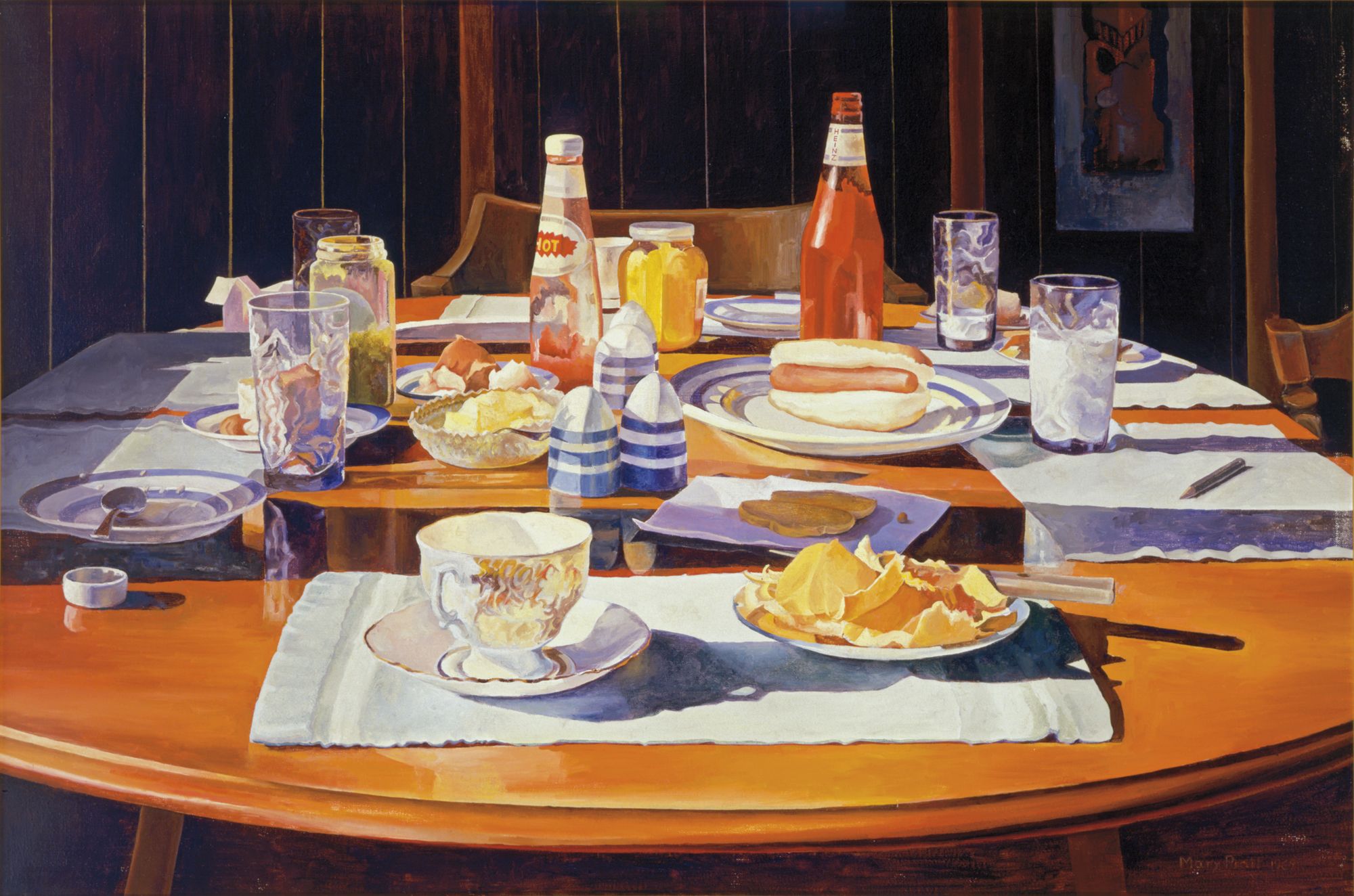
MARY PRATT Supper Table 1969 oil on canvas 61.0 x 91.4 cm
Pratt captures the domestic, the seemingly mundane. And yet behind her rich but also simple and familiar images lie deeper stories. Her painting “Kitchen Table”, the first she created from a photograph in 1969, is at first a quiet scene, a table at once empty and yet crowded with the remains of a meal–a ketchup bottle with its cap off, a hotdog left uneaten, crumbs on a plate, drinking glasses in varying states of emptiness (or fullness, perhaps?). And yet, as Catherine M. Mastin points out in her essay “Base, Place, Location and the Early Paintings”, “Pratt’s postwar-era family table is a site of constant labour, meal after meal–which all fell to Mary, with no foreseeable end.” On a more personal note, Pratt’s “Eggs in an Egg Crate” was the first work she completed after the deaths of her infant twins, a painting whose symbolism wasn’t clear to her until somebody else had pointed it out–that the eggs in the carton were empty.

MARY PRATT Eggs in an Egg Crate, 1975 oil on Masonite 50.8 x 61.0 cm
For all their luminosity and the domestic focus, Pratt’s paintings are also wonderfully subversive. Her eggs are usually broken, is what I mean, the cake half-eaten and cut with a big sharp knife, the bananas in the fruit bowl are just a little too ripe. The meat in her “Roast Beef” is a charred hunk (and Pratt recounts in Milroy’s essay, “I can remember when I first showed it in a gallery [and] I heard a woman say, ‘Well, I guess she can paint, but do you think she can cook?'”). Milroy is correct that “In this day of highly stylized food photography…, Mary Pratt’s work seems ahead of the curve,” and yet Pratt’s food paintings are always just a little “off”–the leftovers from a supper of hotdogs, for example, or the casserole dish in the microwave. This is food that people eat, instead of a lacquered sandwich intended for a magazine cover. Hers is a messy, imperfect domestic scene, and yet there is beauty in these scenes that are captured precisely as they are.

MARY PRATT Split Grilse, 1979 oil on Masonite 56.1 x 64.0 cm
Her images of meat and animal carcasses suggest something basic and bodily about domestic life, a suggestion echoed vaguely in the images of her model “Donna”. “That’s what women do,” Pratt recounts in Milroy’s essay. “They wrap things up, or unwrap them, or cut them open, or chop them, ready for the oven.” Fish are also a recurring image in her work, not surprising considering she’s based in Atlantic Canada, but here is the rarely seen flip-side of maritime life–“Salmon on Saran”, “Trout in a Ziploc Bag” or “Fish Head in Steel Sink”. They don’t write shanties about this kind of sea. And then there is the fire, Pratt’s burning dishcloth on her “Dishcloth on Line” paintings. That same agent used to wipe down the table of dinner-after-dinner is annihilated into a glorious flame which captures the light as intriguingly (and eternally, now that Pratt has preserved the image) as do the far more innocuous jars of jam on the window sill.
Whoever thought the kitchen was a scene of mundanity probably wasn’t looking…
In her essay “Look Here”, Mireille Eagan writes that “Ultimately, [Pratt] asks the viewer to see; she tells us: “Look, here.” Which is what the very best bloggers do too, instead of “Look at me!” using their blogs to implore their readers to, “Look at this!” The result of this being the “sideways autobiography” that Eagan refers to of Pratt’s work. There is no over-arching narrative here, and instead we come to understand the depth of these writers’ lives from the objects, moments and stories they choose to include in their blogs, each individual post its own still-life. Like Pratt, these bloggers are curating their lives, crafting something permanent out of the whirl of the ephemeral. As Eagan writes of Pratt: “Her images reveal a pattern of privacies, of things half-visible, half-said–but articulated, nonetheless. They represent a lifetime of looking closely, an intimation of the buzzing pause before one turns and continues.”

MARY PRATT Between the Dark and the Daylight, 2011 oil on canvas 50.8 x 76.2 cm
Mary Pratt is available from Goose Lane Editions. Read more about this stunning book here.
July 22, 2013
“Like life is always fucking subtle”: Americanah by Chimamanda Ngozi Adichie
 “I’m going to blog about that.”/ “I knew you’d say that.”
I am really excited about the forthcoming anthology Friend. Follow. Text. #storiesFromLivingOnline, which will include short fiction by Canadian authors including Jessica Westhead, Heather Birrell and Alex Leslie, featuring (I suspect…) stories which were some of my favourites from their collection–Westhead’s story that takes place in the comments section of a lifestyle blog; Birrell’s on an online pregnancy forum; Leslie’s comprised of descriptions of Youtube videos featuring a Bieber-like teen-pop sensation. Even Samantha Bernstein’s memoir in emails Here We Are Among the Living is part of this trend of authors using online and social media to change the shape of traditional literary forms, taking advantage of the uniqueness and peculiarity of online communication to contain modernity in their work, to say something new.
At first, Chimamanda Ngozi Adichie wouldn’t be the most obvious candidate to be part of this literary trend. Her previous novel Half of a Yellow Sun (which won the Orange Prize in 2007) was a sweeping epic novel about the Biafran War. She is the writer who brought me to Chinua Achebe. Adichie is Africa. She is history. Her scope is huge, when online communication can seem so ridiculous and small, so much lesser. And yet, it is also very much of this world, and it is the world that Adichie is concerned with. As she stated in a recent interview, “I love books that are social in the way that they engage with the real reality.”
In her new novel Americanah, Adichie’s protagonist is a blogger. Ifemelu is a Nigerian expat in America who has established herself as author of the blog Raceteenth or Various Observations About American Blacks (Those Formerly Known as Negroes) by a Non-American Black. She is able to make a living from her blog through advertising and speaking engagements, and has also been made a fellow of Princeton University. Her blog attracts hundreds of readers everyday with such provocative posts as “A Michelle Obama Shout-Out Plus Hair as Race Metaphor”, “Obama Can Win Only If He Remains the Magic Negro” and “Thoughts on the Special White Friend”. For Adichie’s purposes, however, the blog exists so she can include sharply-worded, strongly opinionated, polarizing ideas in her novel about race in America, ideas which have been flooding social media since George Zimmerman’s acquittal last week of murder in the death of Trayvon Martin. The blog posts–humorous, pointed and passionate–read in tone and language as very authentic, and along with the novel’s references to Facebook, email, and an online forum about natural hair, infuse the novel with a fascinating intertextuality. The blog posts in particular give the novel an edginess that straightforward fiction might be too subtle to provide.
Subtlety was an issue for me as I was reading Americanah though. While it was compelling, the story of Ifemelu and Obinze who begin as a couple in high school and each escape the “choicelessness” of life in Nigeria (for the US and UK respectively) to find their lives taking radically different trajectories, there was a hollowness to the secondary characters these two encountered. “Some of the people we met had nothing, absolutely nothing, but they were so happy,” says Ifemelu’s first American employer of a trip to India. She eventually becomes a friend to Ifemelu but also seems to exist primarily as a mouthpiece for other such asinine pronouncements. Where was the depth in these characters, I was wondering, struggling to make sense of its lack in the context of Adichie’s talent as a novelist. Though could this be part of the novel’s satire, I wondered? And if we’re going to turn the tables, is not portraying characters of a certain race as stereotypical stock characters part of an age-old literary tradition?
There was more though. I love a book so textured that the answer to my criticisms are contained inside its very pages. I reached page 335 to find a tirade by Ifemelu’s boyfriend’s sister who is about to publish her first book, a memoir about growing up black in America. She explains, “My editor reads the manuscript and says, “I understand that race is important but we have to make sure the book transcends race…” And I’m thinking, But why do I have to transcend race? You know, like race is a brew best served mild, tempered with other liquids, otherwise white folk can’t swallow it.” Explaining an anecdote, she says, “So I put it in the book and my editor wants to change it because he says it’s not subtle. Like life is always fucking subtle.”
She continues, “You can’t write a novel about race in this country. If you write about how people are really affected by race, it’ll be too obvious. Black writers who do literary fiction in this country, all three of them… have two choices: they can do precious or they can do pretentious. When you do neither, nobody knows what to do with you. So if you’re going to write about race, you have to make sure it’s so lyrical and subtle that the reader who doesn’t read between the lines won’t even know it’s about race. You know, a Proustian meditation, all watery and fuzzy, that at the end just leaves you feeling watery and fuzzy.”
Blog posts, of course, are the very opposite of lyrical and subtle. Adichie has clearly found a way around the matter.
In some ways, Adichie’s novel bears a resemblance to Zadie Smith’s NW and it’s treatment of race and London, though Adichie shrugs off Smith’s experimental approach, preferring to focus on life as lived as opposed to its voices or the complexities of point of view. The story is the point, and the ideas contained within, instead of its delivery. Ifemelu leaves Obinze when she receives a partial scholarship to an American university, though the two promise to remain connect, to not be apart forever. She arrives in America, however, to discover that the reality of life there is radically different from what she’s seen on The Cosby Show or The Fresh Prince of Bel Air. She must find a job to make ends meet, but she’s not permitted to work legally and has difficulty finding a job under the table as her accent, her appearance, and her lack of American job experience continue to stymy her efforts. She slips into a depression and is just about to hit rock bottom, which would have made this a short book if she’d managed it, when things between to happen for her. In a sense, while Adichie does not portray America or the experience of its immigrants in an easy or flattering light, she does demonstrate that the American Dream is possible, while it is not for Obinze in the UK. Though it must be noted what an exception is Ifemelu–I don’t know if it’s more likely that your average Nigerian immigrant would become a Princeton fellow or a professional blogger. In fact the odds of anyone becoming a professional blogger are unlikely.
 Meanwhile, Obinze’s American dreams are dashed in light of the September 11th terrorists attacks, when the US tighten their visa restrictions and make him ineligible for entry. He receives a temporary visa to England through his mother, a university professor, and when his visa expires, he remains in the country, working under the name and number of another man who’s helping himself to a portion of Obinze’s wages. He gets a job cleaning shit off toilets, and then delivering kitchens, performing the tricky maneuvre of always watching his back while trying to look forward and desperately cobble together a better future. (Here, Adiche’s explores the world of London’s underground job market for illegal migrants, as did John Lanchester in his novel Capital with his Zimbabwean traffic warden.) The ticket is an arranged marriage to a woman with an EU passport, which can be brought about with the right amount of cash (although the last time he tried this, they took off with his money). Plans fail, however, and Obinze is deported, brought home in disgrace only to discover that things are changing in Nigeria, that there is opportunity for a bright young man who is willing to play the system.
Obinze is established as a big man in Nigeria by the time Ifemelu returns after thirteen years in America, and he is by now married with a child. Neither has ever forgotten the other, though the reasons for their estrangement have become unknown or blurry with time. The stakes for their reunion are high, and in a sense Americanah‘s first 426 pages are just a prelude to this point. Because yes, this is a love story, but it’s a love story with an unabashed agenda, rich and compelling. And while Adichie confesses to not being a fan of experimental literature, it can’t be denied that with her third novel, she has broken new literary ground.
July 15, 2013
Bobcat by Rebecca Lee

(My copy has a blue cover, which I found much more appealing than this one.)
I had only read the first story in Rebecca Lee’s short story collection Bobcat before I’d ordered a copy of her novel from the bookstore. Why, I wondered already, had this collection not been more hyped? Not until it was awarded the Danuta Gleed Award a few weeks back did it really come to my attention. But one story was all it took for me to realize that Lee is a writer approaching mastery of her craft. As significant, I think, as the fact that she received an MFA from the Iowa Writers’ Workshop is that she received it 21 years ago. That Lee has had time to grow and develop as a writer so she’s no ingenue, but instead her writing reveals a maturity that is most admirable. Her grasp of these stories was so firm, and her voice so strong that I knew I’d be wanting more of it. I look forward to reading her novel The City is a Rising Tide very soon.
Rebecca Lee’s short stories share the same approach as Sarah Selecky’s, the same intimate first-person narration, close attention to detail that sets these characters as very much of this world (lines like “Lizbet basically knew how to live a happy life, and this was revealed in her trifle–she put in what she loved and left out what she didn’t”)–as well as dinner-party settings and fork on the cover. But on the other side, Lee’s marvelous telescoping endings and ultimate broadness of perspective remind me of the stories in Jhumpa Lahiri’s The Interpreter of Maladies. (I think “Bobcat” may join Lahiri’s “The Fifth and Final Continent” as one of my favourite short stories ever.) These stories were written over two decades and accordingly the collection lacks a certain cohesion, except for (and this is significant) the solidity of Lee’s voice.
“One of the things Strandbakken had been struggling to teach us was that a building ought to express two things simultaneously. The first was permanence, that is, security and well-being, a sense that the building will endure through all sorts of weather and calamity. But it also ought to express an understanding of its mortality, that is, a sense that it is an individual and, as such, vulnerable to its own passing away from this earth. Buildings that don’t manage this second quality cannot properly be called architecture, he insisted. Even the simplest buildings, he said, ought to be productions of the imagination that attempt to describe and define life on earth, which of course is an overwhelming mix of stability and desire, fulfillment and longing, time and eternity.” –from “Fialta”
Lacking a certain cohesion (which in a collection this good is less a criticism than a statement of fact), yes, but there are more than a few points in common. Three of these stories take place in academic settings. These are stories written with an awareness of history and not just a general contemporariness. They are filled with allusions and references to actual places, people, and things. Though “Bobcat” is like this least of all, the first story, about a dinner party and so tightly contained within four walls that the effect is claustrophobic until the story’s incredible ending in which the whole thing explodes. A hostess is acutely aware of the inner lives and workings of her dinner guests, so much so that she’s blind to her own destiny. The people in this story are so vivid and real, and the ending was both incredible and heartbreaking. “The Banks of the Vistula” is a 1980s’ Cold War story (“But this was 1987, the beginning of perestroika, of glasnost and views of Russia were changing. Television showed a country of rain and difficulty and great humility, and Gorbachev was always bowing to sign something or other, his head bearing a mysterious stain shaped like a continent one could almost but not quite identify” [and how I love that “almost but not quite…]) about a university student who plagiarizes a linguistics paper from 1950s’ Soviet propaganda.
“Slatland” is a peculiar story about a strange psychologist and his impact on a young patient who returns to him years later looking for him to translate letters her Romanian fiance is writing to a woman whom she suspects is her fiance’s wife. In “Min”, another Midwestern university student travels to still-British Hong Kong and is enlisted with the job of selecting him a wife, as her friend’s diplomat father is being faced with the morally ambiguous task of deporting Vietnamese refugees. In “World Party”, a female professor during the 1970s’ uses her relationship with her (perhaps autistic?) son to decide the future of a male colleague who has been accused of a sexually inappropriate relationship with a student. And the final story is “Fialta”, in which architecture becomes analogous to story-writing and a group of students enrolled in an elite mentorship program fall in and out of love with one another, learn, come of age and of self, and are each uniquely bound to their teacher for better or worse.
July 7, 2013
The Silent Wife by ASA Harrison
 For me, last weekend belonged to The Silent Wife by A.S.A. Harrison, a perfect summer book if compulsive page-turning in the sunshine happens to be your thing. It’s a book that’s been compared favourably to Gone Girl, though it’s a very different literary creature. It’s not a whodunit, but instead a “Why’d she do it?” It being murder, of course. We learn at the novel’s outset that Jodi will kill Todd, her husband of 20 years, and the rest of the novel illuminates what would bring a seemingly rational woman to such a point.
“Seemingly” is the key word though. Jodi Brett is rational to the point of near-madness, a therapist who prides herself on psychological acuity. It seems that she is as blind to her own self, however, as she imagines she is to her husband indiscretions. Todd is a cheater, and he’s always been, but the stakes are different now. Natasha, the daughter of Todd’s oldest friend, is pregnant, and she informs Jodi that they’re going to be married. Married. Which Jodi and Todd have in fact never been, Jodi adamant that she will not relive the life of her mother, eternally put-upon by a philandering husband. No, she’s always refused to be married, even when Todd asked her, just as she refused to see that her life has assumed the same shape as her mother’s anyway.
The story is told in alternating chapters from each partner’s perspective. Todd is a convincing portrayal of a guy who just can’t help himself, though that Jodi has tolerated his cheating for two decades suggests that she’s less a victim than an enabler. It is hard to have sympathy for either of them, and what compels the reader instead of any sympathy is curiosity as this disastrous relationship heads toward its inevitable end. Curiosity too to unravel the workings of Jodi’s mind, and while Harrison provides an impetus for her behaviour that detracts from the story, it’s still fascinating to see insanity comes in all matter of forms. That is terms of awfulness, Jodi and Todd are in fact a perfect match.
Harrison manages to craft suspense in a story whose outcome is sure from the beginning, though not entirely sure. The conclusion of The Silent Wife is still surprising, ambiguous and clever, the perfect ending to a really good book.
July 1, 2013
The Flame Throwers by Rachel Kushner

“A funny thing about woman and machines: the combination made men curious.”
I do wonder if one day there will be a literary genre distinguished by its treatment of women whose broken dreams are symbolized by their dissatisfaction with their kitchen renovations. I noticed this first in Arlington Park by Rachel Cusk, whose middle-class preoccupations were redeemed by Cusk’s Woolfian narrative, and then recently in Krista Bridge’s The Eliot Girls which was more Picoultian than Woolfian and left me frustrated with narrative in general. And so I turned to Rachel Kushner’s The Flame Throwers next, because it promised to be not Picoultian in the slightest and featured a female protagonist who never went into the kitchen at all.
Though to call her a “protagonist” is not entirely accurate, because Kushner’s narrator is more of an observer, and a cypher than one who the story happens to. We get a sense of her internal monologue, but not of her self–we don’t even know her name. (I am careful not to refer to her as “Reno” [um, for the city, not the abbreviation for “renovation”] though she is referred to as such in the book’s copy. But in an interview, Kushner remarks, “Twice, she’s referred to as Reno, and so reviewers have latched onto this.” And I don’t want Kushner to think that I am a latcher. Never.) This is a novel about motorcycles, motor racing, rubber manufacturing, Fascism and terrorism, which is the kind of novel that generally wouldn’t appeal to me, except that it’s also the book that everybody is talking about and for once I wanted to get in on that action. Plus, it’s a novel about all of these things from the point of view of a female character, and I was curious about that. And so I picked up The Flame Throwers, and perhaps I’ve got a thing for speed and crashes after all because I was hooked by page 21 with the story of a legendary American racer whose parachute failed and had to stop from 522 miles per hour on the salt flats of Utah.
Of course, to call Kushner’s character an “observer” is disingenuous, because while the novel doesn’t happen to her, her voice and perspective are certainly key to its construction. She has more agency than we can really understand. The story begins with Kushner’s character on the salt flats in 1977, riding her Valera motorcycle (which had come from her boyfriend back in New York, Sandro Valera, the estranged heir to the Italian motorcycle/tire manufacturing fortune). Her aim is to race her bike, and also to photograph other races. She is an artist, we learn, who has moved from Reno to New York where she met Sandro. Her racing plans are curtailed by an accident, however, and she, previously the lone wolf, ends up with the Valera racing team by virtue of her motorcycle’s make. She ends up setting a world record for female drivers in the Valera car, the Spirit of Italy, and a scheme is concocted wherein she will travel to Italy on the coattails of her racing fame.
And then the narrative takes us to New York nearly two years before, the girl from Reno arriving in the city to make herself (though we learn a few peculiar details to suggest she’s not entirely formless–she’d been a success as a ski racer years before, and once acted in a McDonalds commercial. She grew up in a household with two motorbike-mad cousins, and an uncle who watched TV in the nude. And even the most mundane detail begins to seem conspicuous because there are so few of them). She tells us, “I thought this was how artists moved to New York, alone, that the city was a mecca of individual points, longings, all merging into one great light-pulsing mesh and you simply found your pulse, your place.” But she fails to, remaining estranged from the city itself, from its art scene. She is young and naive, and through a cast of eccentric characters (“I once went to a house in the Hollywood Hills that was a glass dome on a pole, its elevator shaft. Belonged to a pervert bachelor and he had peepholes everywhere. He was watching me in the toilet. Some guy drugged me without asking first. Angel dust. I was on roller skates which presented a whole extra challenge.”) she meets artist Ronnie Fontaine, and falls in love with his best friend, Sandro Valera. She makes her place on the scene as Sandro’s girl, but overrides him when he resists the idea of her trip to Italy.
In chapters involving Sandro’s father, we learn the sordid details of how he made his fortune and these suggest just why Sandro is so uncomfortable with returning to Italy and why he is determined to remain distanced from his family heritage. When the trip finally happens, it is the disaster he predicted, as Sandro’s mother shows disdain for his American girl, and the whole family is troubled by political uprisings by their factory workers, which were part of a movement sweeping the country in 1977. And finally, our character is faced with the truth about her boyfriend’s intentions toward her, and in an instant she makes a decision that embroils her in Italy’s underground radical social movement.
Kushner’s prose thrums with a Didion-esque rhythm, and her narrative concerns read like a combination of “Good-Bye to All That” and “Slouching Towards Bethlehem”. Her sense of time and place is stunningly evoked, and while details waver in a few places, the overall impression is of remarkable realization. There is a reason everyone is talking about this book, and that’s because it’s a great American novel in the grand tradition but as rendered by a female hand, but then this novel with all its masculine concerns is a treatment of the feminine as well. What is the place of Kushner’s female character in this kind of story? Is she the I or just the eye? Does anybody hear her voice beyond us, the reader? We hear her, but what are the impressions of those who can see her? In a way, she is as invisible as the “China Girl” appearing among the first frames of movie film, ever present but anonymous and glimpsed by almost no one. Is this the extent of possibility for the woman artist? (“You’re not supposed to evoke real life. Just the hermetic world of a smiling woman holding a colour chart.”)
So much of this book’s impact comes from its evasive approach, which is summed up in its final sentence: “Leave, with no answer. Move on to the next question.” And that’s why so many people are talking about this book–because it’s a difficult one from which to draw tidy conclusions.

June 10, 2013
Where’d You Go, Bernadette? by Maria Semple
 Apparently Maria Semple’s novel Where’d You Go, Bernadette? was one of the biggest books of last year, but perhaps I wasn’t paying attention. Someone who was paying attention, however, was Stuart, who took note when I picked this book up in the store and casually remarked, “I’m kind of interested in this one,” and proceeded to buy me the book for Mother’s Day. I saved it for postpartum, because I had a feeling, and oh, what a good feeling it was. Two nights ago, Iris’s all night eating/fussy fits began, and I was so glad to have this book on hand. My mind is fuzzy and there is no way I could write a coherent review, but it’s an endorsement, I think, that on Saturday night when I was up from 12am until 5am feeding the baby, all I could really think of was, “Yes! I get to read more Bernadette!”.
The book comprises a mishmash of forms–letters, emails, newspaper articles, memos and more. It reminded me a bit of A Visit from the Goon Squad combined with a bit of Special Topics in Calamity Physics. It’s heart-felt, satirical, rich with the stuff of the world. Lines in parentheses, like, “This is why you must love life: one day you’re offering up your social security number to the Russian Mafia; two weeks later you’re using the word calve as a verb.” Told from the vantage point of Bee Branch, a wise-beyond-her-years Seattle teen who lives in a decrepit former home for wayward girls atop a hill of blackberries with her father, a Microsoft developer, and her eccentric mother, Bernadette. We learn about Bernadette mainly from the point of view of other parents at Bee’s elite private school, other women bothered by Bernadette’s refusal to conform to their expectations of her. Bernadette is brilliant, agoraphobic, and her daughter adores her. We learn that in a past life, she found fame as an architect of buildings constructed from found-objects, but she stopped creating after a series of tragedies. And now suddenly, on the cusp of a family trip to Antarctica, Bernadette has disappeared. It’s up to Bee to put the pieces of the puzzle together, and find out where her mother has gone.
The perfect book to read in the middle of the night a few days post-partum is not to say the book isn’t really smart and satisfying. How wonderful to get the best of everything.






