January 13, 2026
The Folded Leaf, by William Maxwell

I LOVE William Maxwell, love, love, LOVE William Maxwell, whose novels are the most curious blend of realism and modernism, and who writes about men, love, and longing so very tenderly. For the last few years, I’ve read one of his novels over the winter break, but I think I’ve read his better known books and so my local secondhand bookstores were turning up nothing, and finally I couldn’t take the void and ordered a copy of his 1945 novel The Folded Leaf, a story of male friendship set in the 1920s. (What set me over the edge was the email I received from my friend Julia reading, “OMG KERRY I don’t think you impressed upon me just how brilliant and devastating THEY CAME LIKE SWALLOWS really is. oh how i loved that novel.” [I actually think that receiving such novels is the meaning of life.])
And I liked it so very much. And while I was reading it, I was THRILLED to see a Substack Note from author Brandon Taylor who was reading The Cheateau, which was my first William Maxwell book, and Taylor writes, “This novel is warm, funny, but also probing and wise and profound about surfaces, about illusions, by the yearning for meaning, about the strangeness of travel, about the mystery of human relationships. It is social, historical, but also timeless. I just loved it. LOVED IT. SO MUCH. I CANNOT STOP THINKING ABOUT IT. AMAZING BOOK.” (William Maxwell. He makes us emphatic. We can’t help it.)
He also remarks on Maxwell’s 1980 novel So Long, See You Tomorrow being way overhyped, which was interesting because it was the one novel of his that did not move me at all, but I had assumed that the problem was mine. Maxwell’s work can be a little bit difficult, usually where difficulty might not be expected, a bit strange, uncanny, and tricky to decipher in places—there were threads in The Folded Leaf I had a hard time following. I had assumed I wasn’t reading well with So Long…, but maybe it’s just not his best work. Which is fine, because his best work is so good.
The Folded Leaf is the story of two high school boys who are both misfits in their own way, and who end up being best friends, but neither of them are ever able to articulate just what their connection means to them, or what its parameters are, which means things end up being very messy and complicated as they move through the years, going off to university together, Lymie making all the grades, Spud becoming a boxing star, much to his mother’s chagrin. Where does one boy end and the other begin? The novel’s climax is brutal and devastating.
January 12, 2026
Days of Feasting and Rejoicing, by David Bergen

“It was too dangerous, and fantasy so easily descended into violence and delirium. To act, or not act. Was it that simple? What consequences would she suffer? She looked down at the hands in her lap. Oh, Esther. What will you do?”
Lines are blurred in David Bergen’s novel Days of Feasting and Rejoicing, between truth and fantasy, right and wrong, between a person and another. The novel begins in Bali where two young white women who live in Thailand are travelling, and then one of them ends up dead. The other woman, Esther Maile, flies back to Thailand on the dead woman’s passport, and continues to behave curiously, although the narrative is so firmly fixed in her twisted mind that it’s hard to see what’s really happening. Eventually Police Inspector Net Wantok’s point of view enters the story, and we see him struggling to put together the pieces of the puzzle, which become extra puzzling after the dead girl’s brother flies to Thailand to find out what happened to his sister, and he disappears. Dark, unsettling, and impeccably executed, I was totally riveted by this story, which was so deliciously disturbing.
January 5, 2026
What I Read on my Winter Vacation

Holiday break! This year I only read books by British lady writers whose pub dates span most of the 20th century. It was a pleasure!
The Prime of Miss Jean Brodie, by Muriel Spark: I’ve been reading a lot of Muriel Spark in the last while, and welcomed the opportunity to finally reread The Prime…, which I initially encountered in a first year university English class, and almost all of it went over my head. Muriel Spark’s work is strange, sly, and sneaky, and this slim volume is especially subtle. In all her work, there is also a religious element I don’t fully understand, so I’m always a bit unmoored when I’m reading her, but this time I was grateful to easily have a better understanding of the book. While it’s very much about girlhood, the novel’s scope is very broad and I think I personally had to be older to really understand it. It’s also funny, and brutally devastating in a vicious yet understated way that is easy to gloss over if one is not paying attention—I really wasn’t back then, or just didn’t have the right kind of antennae.
Offshore, by Penelope Fitzgerald: I have a complicated relationship with P. Fitzgerald, whose novels were off-putting upon my first encounters, and in some ways they continue to be so—I don’t read her as easily as I do other English writers. Her perspectives and framings are always just a little “off” from what I’m expecting, and there is a strangeness too that’s a little akin to Spark. But so many people I admire love her AND her books are short enough that they’re easy to reconsider, and so I’ve done so, and read them all, connecting with her through this challenge. I also connected via her wonderful biography, by Hermione Lee, which I loved—her own story is fascinating. Anyway, in December I read the novel Fonseca, by Jessica Francis Kane, a fictional telling of an experience Fitzgerald had in Mexico in 1952, and while I liked it, but didn’t love it (it was strange and a bit obscure in the same way I find Fitzgerald’s work, probably deliberately so), it did put me in the mood to reread some of her work, so I picked Offshore, set in the 1960s, about a motley crew of variously desperate people living on London canal boats—something Fitzgerald knew about, as she’d spent time raising her own children on a canal boat during some of many lean years, a situation which finally ended when the boat sunk and landed at the bottom of the Thames.
The Rector’s Wife, by Joanna Trollope: It was at this point that the themes of my winter reading became clearer—I was going to be reading about rectors, vicars, and curates well into the new year (and Bishops too!). Even Offshore had an interfering Priest, although he didn’t have a lot of impact. Also Joanna Trollope had died earlier in December, and so it was time to finally read this novel which I stole from a rental cottage the summer before last, drawn by its Pym appeal. It was very fun and rich, the story of a middle-aged woman who has delayed her own chances and dreams in order to serve her husband’s interest as a rector in a rural English community. But when he fails to get the promotion he’d been hoping for, she finally takes matters into her own hands, getting a job stocking shelves in a grocery store in order to finance their troubled youngest child’s private schooling—although it’s also more than that, setting off a cascade of events that change everything.
A Game of Hide and Seek, by Elizabeth Taylor: I don’t really have a sense of Elizabeth Taylor (the other one, who did not have violet eyes), but every time I read her, I’m surprised by her talent, and glad that I did. This one is about Harriet, the unremarkable daughter of a suffragette whose quiet life is disturbed when she falls in love with Vesey, the nephew of her mother’s friend, the flame he lights in her heart enduring even after the two are parted (they were barely together) and she finds respectability in marriage to an older man. Which means that when Vesey reappears in her life decades later, she can’t help but act on her feelings and the attraction between them, even at the risk of upsetting everything in her careful life. There’s a lot of humour in this one too (the shop where Harriet works where wages are so low that the employees feel justified spending their workdays taking care of personal needs, like doing their ironing, or waxing their upper lips). Richly textured, and full of such understated feeling, I enjoyed this one a lot.
A Few Green Leaves, by Barbara Pym: The Barbara Pym read odyssey continues, and I loved this one, her final novel, released posthumously. Pym’s novels are either set in London, or in rural villages, this one being the latter, in which a 30-something anthropologist moves into a cottage and becomes swept up in community affairs, and possibly an attraction to the widowed rector who is much occupied by local history. It’s very much about the passage of time, and there are mentions of characters from Pym’s previous novels—the formidable Esther Clovis, in particular—having died. I think this would be a weird, albeit still enjoyable, novel to pick up and start reading out of the blue, but in the context of Pym’s oeuvre, it’s very poignant and lovely.
The Little Girls, by Elizabeth Bowen: Bowen is another writer I sometimes struggle with. I’ve really enjoyed some of her novels, but found others really hard-going, almost as though they were a deliberate running of circles around their points. This one was also a little bit hard to understand, and very odd—it was her second-last novel and perhaps not wholly representative of her body of work. It was fiercely funny in places—an eccentric widow places ads in all national newspapers in order to locate two old friends with whom she’d partaken in a pact during their school days just before WW1, but also there are parts where I’m still not sure what actually happened, the story so thoroughly obfuscated, a little too much going on. It was not my favourite
The Knox Brothers, by Penelope Fitzgerald: The one book in this stack that’s not a novel, but it’s by a novelist, so it counts? I happened upon this secondhand copy of Fitzgerald’s biography of her father and uncles, and wasn’t quite sure how much I’d be interested in these men’s stories, but it turned out to be A LOT. The Knox brothers were the sons of the Bishop of Manchester and the daughter of the Bishop of Lahore, four out of six children, and were remarkable every one. The one who grew to be Penelope Fitzgerald’s father became the editor of Punch Magazine, another was a famous cryptologist in both world wars, the other two both were priests, one of whom ended up converting to Catholicism (and FINALLY this book gave me the context for the Anglo-Catholic questions that come up again and again in Barbara Pym novels where priests are continually “going over to Rome” or being suspected as such). Even more remarkable than their accomplishments and eccentricities, Fitzgerald underlines how her father and his brothers were kind and loving men, feeling people in a time where men of their class were not commonly thought to have such emotional capacity. I loved this one.
Family and Friends, by Anita Brookner: And I loved this one too, though I was wary. Some of Brookner’s novels are incredible dense, opaque, and more cerebral than anything else, but this one (which followed her Booker-winning Hotel Du Lac in 1984) seems to be the exception to the rule. Not cerebral in the slightest, it begins with a family photograph and glosses across the surface of that family’s history across decades as things are ever-changing and nothing ever quite unfolding as expected. Fast, sweeping, and engaging, this turns into a remarkable portrait of seemingly ordinary people, highlighting the less flattering aspects of its characters. Playful and surprising, this one as a pleasure.
Whose Body, by Dorothy L. Sayers: I wasn’t planning on reading Sayers, except then I watched Wake Up, Dead Man, the new “Knives Out” movie, and this novel is referenced (and also Penelope Fitzgerald’s priest uncle Ronnie Knox was also a detective novelist and contemporary of Sayers—they were both members of The Detection Club, along with Agatha Christie, and others). I came to Sayers and Peter Wimsey via Harriet Vane, and was sort of uninterested in reading any of Sayers books in which Vane doesn’t feature (which was most of them) but getting to know Wimsey and his vulnerabilities (he’s suffering from shell shock in the early ’20s; his mother admits it might be too much to ask someone to get over a war in just a year or two) was fascinating. The mystery was satisfying and not too convoluted, although the antisemitism was unpalatable, though at least it was mostly displayed by the novels villains, but still.
The Life of Violet, by Virginia Woolf: This little book is a collection of three short stories written by Woolf when she was still Virginia Stephen, back in 1908. This work had previously been regarded as unimportant, but then a polished draft was discovered, resulting in this publication of these three fables inspired by the life of Woolf’s friend Violet Dickinson. Dreamy, funny, and whimsical, the stories are also remarkable for how they feature elements that would continue to preoccupy Woolf’s creative work—biography, rooms of one’s own, the lives of women—for the rest of her career.
An Unsuitable Attachment, by Barbara Pym: My Pym reread is nearly complete! This was an earlier Pym novel that remained unpublished until after her death, and lacks the (even unplumbed) depth of her later work, but is still very charming, and it was kind of amazing to read back into the past in order to see Esther Clovis resurrected!! This is one of Pym’s urban London parish books, complete with a sojourn to Rome. There is a librarian, a pampered cat, a lugubrious vicar’s wife, chicken in aspic, an anthropologist, and a bedraggled beatnik—what more could a reader want?
Pack of Cards, by Penelope Lively: And I am so THRILLED to be loving this book as much I am, because it’s a pretty big commitment—more than 30 stories by Penelope Lively published in one volume in North America after her Booker win for Moon Tiger in 1987. (It includes the contents of her first two story collections and nine new stories). Fortunately, the stories are wonderful, and I’m gobbling them up—I’m nearly two thirds through now. I don’t think I’ve ever read her short fiction before, but it’s just reminded of what a wonderful writer she is, and now I want to reread the huge stack of her novels that I own, most of which I’ve not read in years.
December 11, 2025
Castaway

“But I don’t know if you can write a book. I don’t know if I can write a book. I don’t know if I can write THIS book… A writing life, I’ve come to believe, is a yearslong process of casting away everything you once believed for sure.”
New nonfiction from Elizabeth McCracken, A LONG GAME: NOTES OF WRITING FICTION. As wonderful to read as any book by Elizabeth McCracken. I loved it so much. The least annoying book on craft you’ll ever encounter. Or maybe it’s just me, and how much I identify when she writes “(The subtext of all my writing is LOVE ME.)”
December 9, 2025
Do Admit: The Mitford Sisters and Me, by Mimi Pond

My own Mitford history began more than 20 years ago when I lived in England and read Mary Lovell’s biography, The Mitford Girls, launching an infatuation that would lead to many more books (the collected letters, the sisters’ own books [but not Diana’s, yikes, a bridge too far], and a pilgrimmage by coach to Chatsworth House once when I was actually quite ill and would end up lying down among the the sheep poo.
The obsession has worn off in recent years—does one need to be young to be dazzled by Mitfords? Perhaps!—but Mimi Pond’s exquisite graphic biography/memoir DO ADMIT: THE MITFORD SISTERS AND ME takes me right back there. To discovering the wonders of their story with all the twists and tragedy; the charm of English aristocratic eccentricity (from a distance, at least); the way they were like The Spice Girls or Little Women in their suggestion of a range of characters available to girls (the rural one! The fascist one!); the compelling nature of their own self-mythology (the nicknames! the lore!); the idea of women with their own agency (for better and for worse!) and suggestion that a woman’s place in history matters.
Pond brings the storied sisters to live in her exuberant illustrations, and weaves their own stories in with her own as a teen growing up in 1960s’ California, ever so far from the storied world of the Mitfords, and the real question is just why they meant so much to her, somebody whose life would never be remotely like theirs. But for Pond, like me, and so many others, it was the promise they offered of the various ways a woman’s life could go, some more sordid than others (Diana spent WWII in the Holloway Prison for Women due to her fascist tendencies, and she wasn’t even the Mitford most primed in that direction!), all of them unfailingly interesting, sometimes inexplicably so.
My favourite thing about Pond’s book has been introducing my daughter to the Mitford sisters through it. “Read this book,” I insisted, forcing it on her, and she was annoyed at first, as she is when I insist anything, and she had a hard time reading the cursive. “I don’t get it,” she kept saying at first. “What’s the point of this? They’re not even interesting. I don’t get it—” And then suddenly she stopped, and became incapable of putting the book down, and that’s exactly what I mean. And now she’s dazzled too.
December 5, 2025
Say Hello to My Little Friend, by Jennine Capó Crucet
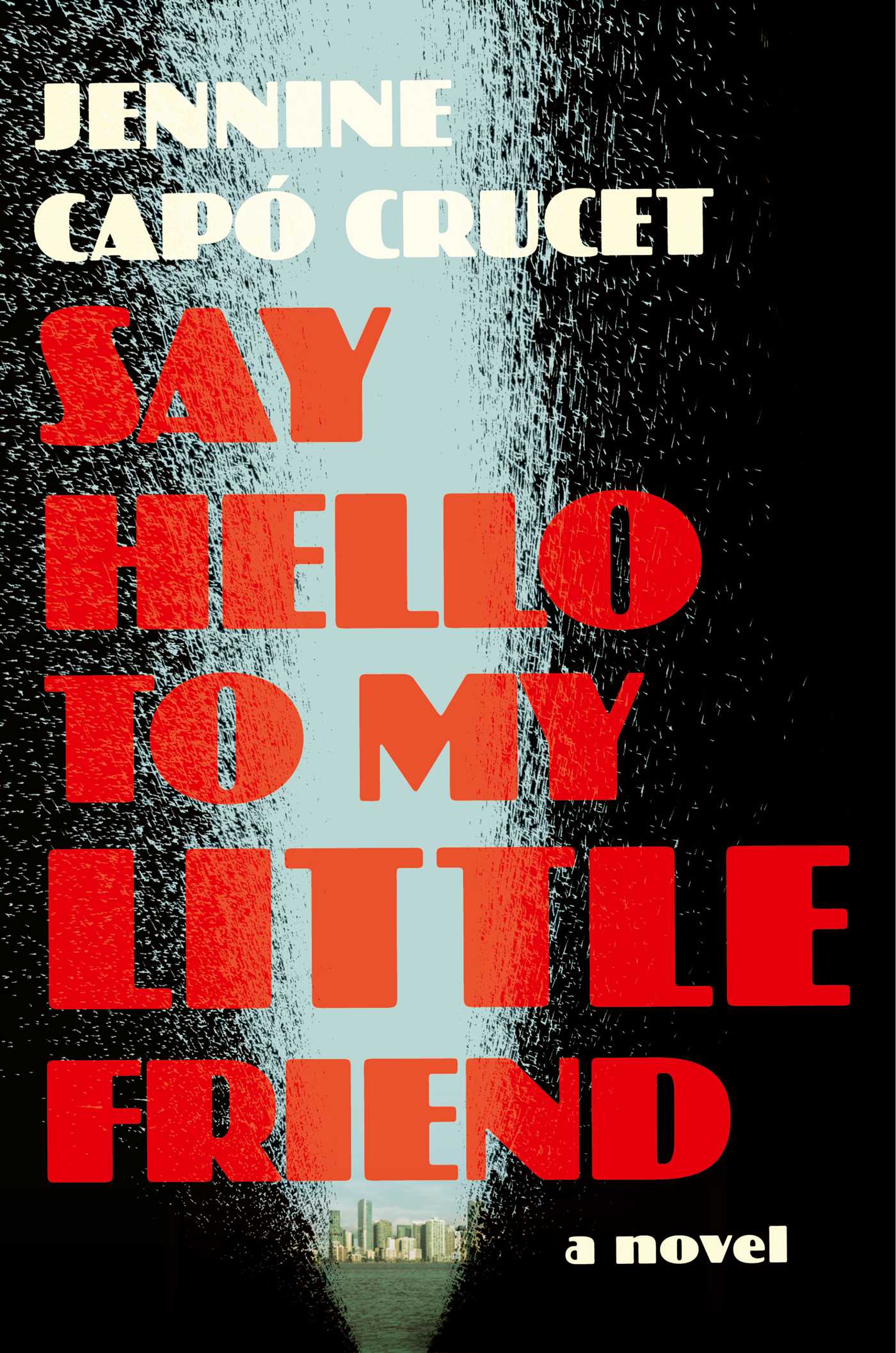
Two very important details about my 2025 are that I developed a baffling obsession with Pitbull (the Miami artrepreneur also known as Mr. 305 AND Mr. Worldwide), a character who continues to delight me in his absurdity and whose collaborator’s contributions are the best part of his tracks, and also I stopped using Google with its built-in AI in favour of Duck Duck Go, an inferior search engine. But maybe Duck Duck is less inferior than I thought, because when I did a search for Pitbull’s recent coffee table-style book (photographs alongside his many aphorisms like, “Life is not a waste of time, and time is not a waste of life”), it delivered me instead the vastly superior literary product, Say Hello to My Little Friend, by award-winning author Jennine Capó Crucet, a novel billed as Moby Dick meets Scarface whose protagonist is a Pitbull impersonator who’s just been served a cease and desist order by the bald man himself.
Having never read Moby Dick or seen Scarface, and merely being obsessed with Pitbull, however, I wasn’t sure how the novel would go over, but wow, it turned out to be the most bananas wonderful book I’ve encountered in a longtime. The story of Cuban-born Miami resident Ismael “Izzy” Rayes who decides to reinvent himself as Tony Montana from Scarface when his Pitbull career comes to an end, the entire premise a statement from the author about the stereotypes and perceptions about her native city, and how these ideas are limits. (Capó Crucet’s Pitbull critique/commentary was one of the most scathing and hilarious parts of the book).
Meanwhile, Izzy develops a curious connection to Lolita, a captive whale in the Miami Seaquarium, who can read his thoughts and who understands him better than anyone, particularly his situation as someone who is far from his native home, separated from his mother, and stuck in his own kind of captivity as to what the possibilities of his life might be.
And together (cerebrally, at least) the two embark on a journey, one that brings Izzy into the orbit of an intense girlfriend who just happens to be his friend’s sister, a whole bunch of iguanas, a criminal mastermind in disguise as a nice and decent guy, and a whole crew who arrived in America on the same raft that delivered Izzy there from Cuba when he was 7 who do not like the questions he’s asking now in an attempt to remember his own past and what happened to his mother.
If it sounds like this novel is a container for everything, I haven’t even told you yet that it’s also a guide to common birds of Miami, and so much more. I read it absolutely dazzled by Capó Crucet’s talent and awed that she’d partly written it out of spite toward the people who thought that Scarface and Pitbull was where ideas about Miami should begin and end, creating a work that’s a thumb on the nose of all that, but also so rich, poignant, and beautiful…
And oh my god, the ending! The ending! (And I’m not even talking about the epilogue that’s in the voice of Pitbull in a pseudo-intellectual vein [“I’ve gotten to see so much of the world because of my music, and yet the more I saw, the more I realized that despite its catchiness, despite the wildly successful branding that calling myself Mr. 305 created for me and my team, it is at its core a falsity. No one person can “be” a place, for one thing.”]
I loved this book so much. Thank you, Duck Duck Go.
December 2, 2025
Simple Creatures, by Robert McGill

My true confession is that wide-ranging short story collections don’t always do it for me, that I like a book to be A Book, complete with common threads and cohesion, but I really liked Robert McGill’s Simple Creatures—a nominee for this year’s Atwood Gibson Writers’ Trust Fiction Prize. Partly because his publisher, Coach House Books, knows a thing or two about how to make A Book (the very fibres of their pages are interesting), and also because it was my introduction to his delightfully ever-so-subtly off-the-wall narrative voice which never fails to be surprising, whether he’s writing from the point of view of a wife watching her 76-year-old philandering husband run races from her wheelchair parked on the sidelines, a PhD candidate writing her thesis on an iconic author whose chronicles of small town Ontario have created their own mythology (and then some), an ASMR Youtuber, or a third person story about an endocrinologist reincarnated as a chimpanzee.
Some of these stories go way back—two of them were published in The Journey Prize Stories in 2003. And while others, no doubt, are of similar vintage, each story in the collection reads as fresh, infused with empathy and curiosity for the human condition, and a warmth and humour that sit in balance. Which is not to suggest that these stories are as simple as the creatures that people them. There’s an uneasiness to their cadence, an uncertainty at their core, and McGill’s willingness to let his characters—and his readers—sit with that is why the collection is so rich and engaging.
November 25, 2025
Small Ceremonies, by Kyle Edwards

As I said a couple of months ago, literary prizes are a scam, AND YET. They’re at their best when they inspire me to read a book I might not have picked up otherwise, in the case of Small Ceremonies, by Kyle Edwards, winner of the 2025 Governor General’s Award for Fiction for English language, and not to be confused with another novel called Small Ceremonies, by a Winnipeg author, Carol Shields’ debut, which isn’t even set in Winnipeg. But in Edwards’ novel, the backdrop is essential, the north end in particular, where friends Clinton Whiteway and Tomahawk “Tommy” Shields are making their way through their final year of high school and playing for the Tigers, their school hockey team, famous for never having won a game, and now the league is trying to push the Tigers out, which makes the prospect of winning more enticing than ever.
The boys have been friends since elementary school, but each one has a different and complicated relationship with the city. Clinton comes from a remote First Nation that his family was forced to leave behind years before after catastrophic flooding destroyed the community, while Tommy grew up in the city and has no experience of rez life, both boys feeling like misfits for different reasons. And the novel follows them and other characters over the course of the school year—Tommy’s sister, a university student; Clinton’s brother, who has just gotten out of jail and back into trouble; Tommy’s mother, adrift in Vancouver’s downtown east side; Clinton’s father, who watches his sons from afar; Clarissa, the intrepid student journalist writing who refuses to stop asking questions about the hockey league’s decision; and Pete Mosienko, who runs the arena, who clears the Tigers’ ice with a shovel and is saving up to finally buy himself an actual Zamboni.
Fierce with humour and heart, this is also a novel that is probably going to break yours, but just let it, and you’ll be glad you did.
November 21, 2025
Future Boy, by Michael J. Fox

I thoroughly enjoyed Michael J. Fox’s new memoir Future Boy: Back to the Future and My Journey Through the Space Time Continuum, written with Nelle Fortenberry. Fox as Alex P. Keaton on Family Ties was my very first crush around the age of 6—the P was an ad lib, the book tells us—and while I didn’t see Back to the Future right away, I became obsessed with it once I finally caught it on VHS, and it’s remained one of my favourite movies ever since, perhaps the beginning of my fascination with time travel stories and a weird relationship with nostalgia that my therapist and I are still working through.
In Future Boy, Fox tells the story of the movie role that launched him to stardom which he nearly didn’t get—he was a last minute replacement for another actor to play Marty McFly, after six weeks of filming had already been completed (although the part was originally written with him in mind!). And in order to fulfill his contract to Family Ties, which rehearsed all day Monday to Thursday, and filmed in front of a studio audience on Fridays, Fox worked on Back to the Future evenings, overnight and on the weekends, all of which made for a schedule that would have been impossible for anybody who wasn’t in their 20s.
But Fox was in his 20s, and he writes about how filming a movie and TV concurrently didn’t really seem any more impossible than the amazing things that were happening to him around that time, when he’d only recently just stopped being a struggling actor eating out of dumpsters. Apparently the Delorean was a bitch to drive and everybody hated it. He writes about being looked down upon by his film colleagues for being a TV actor, and how he challenged the film’s direction by bringing in ad-libbing and making suggestions as he’d become accustomed to doing on Family Ties. Because of his height or lack thereof, they ended up replacing the actor originally cast as Marty’s girlfriend in the film. And he might never have been able to make the movie at all if it weren’t for Meredith Baxter’s pregnancy (she and Michael Gross played his parents on Family Ties, but were only fifteen years older than he was!) which shifted the scheduling of the show.
In the first paragraph of the book, Fox concedes that he understands precisely nothing of Einstein’s theory of relativity or the space-time continuum, but has fun considering the idea that time was played with during the absolutely bonkers scheduling of his life while making the film, and also that time travel may well be a thing, because how else could a 40-year-old movie seem like it was made just yesterday?
November 18, 2025
Sisters of the Jungle, by Keriann McGoogan

In Sisters of the Jungle: The Trailblazing Women Who Shaped the Study of Primates, Keriann McGoogan—herself a scientist whose adventures have included studying howler monkeys in Belize and two years in Madagascar deep into lemurs—considers the question of why so many primatologists are women, especially in comparison with other scientific fields. McGoogan takes the stories of the world’s best known primatologists (I was going to specify female, but I think they’re the best known, full stop)—Jane Goodall, Dian Fossey, and Birute Galdikis—and weaves in others from the scientists who’ve built on their legacies in more recent years, along with her own perspective of experiences in the field, and draws a rich history of the evolution of primatology so that the book becomes (amusingly) a study the study of primates. The anecdotes are fascinating and the prose evocative and absorbing, McGoogan effectively balancing the personal and professional in her subjects’ experiences, all the while understanding how the lines are particularly blurred when one is in the field for months at a time.
She shows that while the women she writes about had to contend with sexism and limited opportunities due to gender, they also benefited from male mentors who took them seriously (Louis Leakey’s complicated legacy notwithstanding). And it is especially refreshing to read about the women whose male partners were supportive of their scientific endeavours, and who’ve been able to achieve some element of equality in their relationships, which has also been McGoogan’s experience.
The readability and engagingness of Sisters of the Jungle might belie just what a huge project it must have been to write—this is the history of a scientific field, a biography of at least six different people, plus memoir, and reportage. You get a lot of book in this one book, and it manages to be fantastic and inspiring from start to finish.






