January 13, 2016
Hotels of America, by Rick Moody
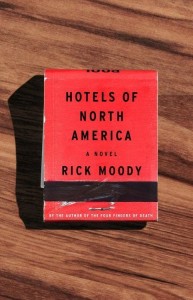 Reviewed by Kerry, Toronto Canada. Rated 3 out of 5 stars I bought a copy of Hotels of North America, by Rick Moody, because I was intrigued by the idea of a novel comprising online hotel reviews. I am not being facetious when I write that online hotel reviews are actually one of my favourite kinds of literature, and I have passed many an hour reading aloud ones written by English people, who tend to be very cranky and have strong feelings about the temperature of toast. And part of the reason I love these reviews so much is because of the narrative one senses beneath those few hundred words, the rage and fury that bubbles to the surface, the idea one gets of what the writer left behind as he embarked on his disappointing getaway. And the narrative, rather than the hotel amenities, is what Moody’s Morse—a prolific and popular reviewer—focuses on, the reviews themselves posted in alphabetical order but referring to hotel visits spread over decades of Morse’s curious and mysterious life (which has lately been particularly peripatetic). Usually the hotel itself merely serves as a platform for Morse launching into an episode from his past, involving his broken marriage, a troubling love affair, his itinerant work as a motivational speaker, the various schemes he’s embarked upon with his current partner, K. Some of these episodes are funny, and more than once I laughed out loud. A few are poignant, and each piece is a thoroughly worthwhile vignette. Cumulatively though, the novel lacked momentum—strange for a novel about travel, although the problem is that Morse never gets anywhere. So that I’d put the book down and not be compelled to pick it up again, though I was happy enough once I had done so. And while I am not sorry I read this book, and I’d recommend it to interested readers on the basis of Moody’s writing, I will probably not read it again. Was this review helpful?
January 10, 2016
Birdie, by Tracey Lindberg

Last week writers Lee Maracle, Drew Hayden Taylor and Tracey Lindberg spoke on CBC’s The Current about the idea of First Nations book club month (responding to Minister of Indigenous and Northern Affairs Carolyn Bennett’s recent proposal) and what the experience is like being an Indigenous writer in Canada. The program was excellent, and the show was stolen by Maracle, who was indomitable, admirably cantankerous, and an excellent articulator of her situation and that of other First Nations women writers.
Maracle explained, “The balance in reading is not there for Indigenous women. 70% of book buyers are women, but 80% of books sold are men’s—it doesn’t matter what colour you are., So I think that’s a problem in Canada. If you just say Indigenous books, I think Tom King, Drew Taylor, Richard van Camp will get on the list [of suggested titles for a book club], and myself and Tracey will be at the bottom or at the middle.” The numbers back up her experience; in 13 years, for example, Canada Reads has never featured a book by a First Nations women writer—though I suspect this is a wrong that will begin to be righted upon the announcement of this year’s shortlist, which may very well include Tracey Lindberg’s Birdie. In fact, I hope it does.
Birdie is an example of what riches Canadian readers are missing when they’re overlooking First Nations women writers—a novel about women’s lives and experiences, the connections between them, and what happens when those connections are broken. (Think about more than 1000 missing or murdered women across this country—what must those absences be doing to families whose ties are already strained by centuries of colonial atrocities?) Though Birdie is most importantly about a particular woman, Bernice Meetoos, nicknamed Birdie, who has turned up in Gibsons, BC, after years of drifting, a pilgrimage to the place where The Beachcombers was filmed. In her bag, she carries decades-old clippings of Pat John, an actor from the show—”a healthy, working Indian man.” She’s preoccupied by thoughts of John, as well as taking guidance from The Frugal Gourmet, whose PBS cooking show is broadcast on the CBC. Things have not been quite right with Birdie, even more so than usual (and she spent four years living on the streets of Edmonton after all). She’s secured a job at a bakery and even has a place to live, a local woman to watch out for her—but then something breaks. She goes to bed, doesn’t eat, scarcely breathes, won’t be roused. And as ever when help and comfort are needed, it is the women who come.
First, Bernice’s cousin, Skinny Freda, the two of them raised like sisters, although the circumstances of Freda’s parentage are scarcely delineated. And then she sends for their Aunt Val, who’s had her own ups and downs, but is a motheraunt to both women as Birdie and Freda are sistercousins to each other (and such compound words abound throughout Birdie, suggesting that English proper is not up to the task of telling this story, just as the novel as we know it is inadequate to contain it, and therefore chronology is disrupted, notions of realism challenged, the whole book infused with elements of First Nations storytelling and mythology—Lindberg should be celebrated for her pushing the limits of what “the novel” can be). From her bed, in a kind of dream state, Bernice relives the traumas she’s endured, chief among them childhood sexual abuse by her uncles, which culminated in a terrible act of violence (justice?) that leaves her estranged from her family, alone. Until the women come.
Also present, if not physically, is Bernice’s mother Maggie, invoked in the novel’s prologue and epilogue, whose own problems make her not wholly responsible to what happened to her daughter. Bernice’s landlady too, while not Native, becomes part of this collective of women watching over Birdie, suggesting the possibility of womanhood as a connection that goes beyond culture; what happened to Birdie is particular to her situation, but there is a universality to women’s experience. There are so many things that every woman understands—and we see from being close to each character in this collective that each woman has her own tragedies that she carries within her,
Surprisingly, Birdie is not a heavy book, even with all the violence and tragedy. It’s as funny as it is sad, and more than that, it’s vibrant—powered by the voice of a woman who seemingly lies unconscious, which is kind of ironic, but there’s a lot going on inside Birdie’s mind, even as she’s got one half-opened eye on The Frugal Gourmet. As a character she’s rich and realized, and Lindberg never makes her a victim of her circumstances, her agency retained even in her lowest moments. Her very act of retreating into her mind, while passive from the outside, is a powerful gesture, and necessary for healing, for the possibility of a future.
January 4, 2016
Holiday Reading Joy

One day back into our routine, and I find I’m happy to be here. It’s been so long, with the sick-filled holidays and my three-plus weeks of pneumonia, and while I was nervous about this return to the real world, I find it much more pleasant and even more relaxing than where we’ve been lately. Although, granted, this is after just one day. Get back to me, perhaps, at the end of the week. But the one thing I do miss about the holiday was the reading—it was wonderful.
I was reading not-new and not-notable books in the weeks before Christmas, and enjoying the experience entirely. But then I picked up Niagara Falls All Over Again by Elizabeth McCracken, and found myself reading notably in spite of myself. It was so terrific. I’d adored McCracken’s short story collection, Thunderstruck, and I spent last Christmas Day sobbing while reading her exquisite memoir, An Exact Replica of a Figment of My Imagination. I read her The Giant’s House last summer, and liked it well enough, but it lacked the immediacy of her other books. And I had been reluctant to finally pick up Niagara Falls… because it was about men, a comedy team who find fame on the vaudeville circuit and in the golden days of Hollywood—nothing about that grabbed me. But the book did. Oh, its pacing, and energy, and to be so sad and so funny, and so completely realized. Truly, one of the best not-new books I read in 2015, and I’m so pleased that I finally did.
After that, I read Cassandra at the Wedding, which I bought at Ben McNally Books right before Christmas. I bought this one on the recommendation of Sarah from Edge of Evening, and was so pleased that I did. As Sarah writes, Dorothy Baker conjures Joan Didion in her setting but is entirely different in tone and approach—more wry than wrought, humour bubbling to the surface even in the darkest moments. It’s a book about twin sisters that seems like a great companion to Libby Crewman’s new novel, Split. About the connection between sisters and what happens when it’s severed, and how one person’s reality can be interpreted by another. Like so many books published by New York Review Books, Baker is doing fascinating things with narrative voice, and I appreciate how hearing from the slightly-deranged Cassandra’s sister Judith turns the whole story on its heel.
Then I read Inside Out, which is an essay by Rebecca Solnit with paintings by Stefan Kurtan. I’d asked for it for Christmas because I love Rebecca Solnit and wish to read everything she’s ever written, and also because it’s an essay on the subject of houses and homes, which I find really interesting. And it was. I loved her thoughts on materials and materialism, and the home as an extension of the female body while the automobile is that of the male (and therefore mobile), which connected to all kinds of things I’ve been thinking about Mad Men as we’re rewatching Season 1. Reading Rebecca Solnit is never not satisfying, and the book is beautiful.
I read Because of the Lockwoods next, by Dorothy Whipple. A Persephone Book, which is never short of extraordinary. I bought it in April when we were in London, because we’d been visiting Lancashire and she’s a Lancashire author and also because she is compared to Barbara Pym, similarly ripe for a revival, says Harriet Evans, but even a better writer. Whipple (whose unfashionable name is perhaps part of the reason she’s so fallen out of favour, writes Evans) is meant to be utterly readable, her novels absorbing. But I was dismayed to discover that they’re also 500 pages long, and you know how I feel about long books. It was one thing to carry such a doorstop across the sea, but then to actually pick it up and read it? Clearly I needed a holiday, a bit of space in which to make the long read happen—but then the book turned out to be everything Evans said. I read the whole thing in 2 days and now want to read everything in print by Dorothy Whipple. The novel was engaging, surprising, rich with complex characters and situations. I really loved it. Was dismayed to read that Virago Books was so thorough anti-Whipple. Thank goodness for Persephone for bring her back in print.
And then finally, I read The Magician’s Book: A Skeptic’s Adventures in Narnia, by Laura Miller, which was a marvellous celebration of reading, of literary criticism, and of the Narnia books and their creator, as well as critiquing the considerable problems with the two latter points. As we’re smack in the middle of reading the Narnia series (all of us for the first time!) in our family, I was glad to learn so much more about them and their context, and there was no shortage of fascinating Narnia and CS Lewis trivia, so that I become as uninteresting as I always do whilst reading excellent non-fiction (avidly sharing details, beginning every sentence with, “Did you know…) We’re reading Prince Caspian now, and I’m loving it all the more for Miller’s book.
November 19, 2015
My review of Split, by Libby Crewman
 My first professional book review was of Libby Crewman’s The Darren Effect in Canadian Notes & Queries in 2008. It was a good book, but a messy one, and I suspect my review probably achieved a similar effect, which sadly was not an aesthetic statement, but was just me figuring out my way. But it also meant that I was looking forward to Crewman’s follow-up, Split, which was published by Goose Lane Editions in September. I read the novel twice as summer turned into fall, and it’s a story that has stayed with me since, in its oddness and perplexities, its curious sideways appeal, but also in the vivid moments that Creelman so stunningly evokes.
A remarkable feature of Split, Libby Creelman’s second novel (after 2008’s The Darren Effect; she is also author of the acclaimed 2000 story collection, Walking in Paradise) is that it isn’t split. Whereas Creelman’s previous book was an impressive tangle of multiple storylines suggesting this short story writer was still finding her way into a different literary milieu, Split—for the most part taut, controlled and smartly plotted—signals Creelman’s arrival proper as a novelist. This new book is an ambitious, assured and most accomplished whole.
This wholeness is doubly (ha!) impressive considering the novel’s movement between two moments in time—2008 on the eve of both Barack Obama’s first election victory and widespread economic meltdown, and during the hot summer of 1975, the year after Nixon’s resignation and just months after the last American troops were removed from Vietnam. The former is the novel’s present day, during which Pilgrim Wheeler returns to her hometown in rural Massachusetts to find her childhood world drastically changed, and must finally reconcile with a tragedy that had wrenched her family apart decades before.
November 15, 2015
Heyday, by Marnie Woodrow
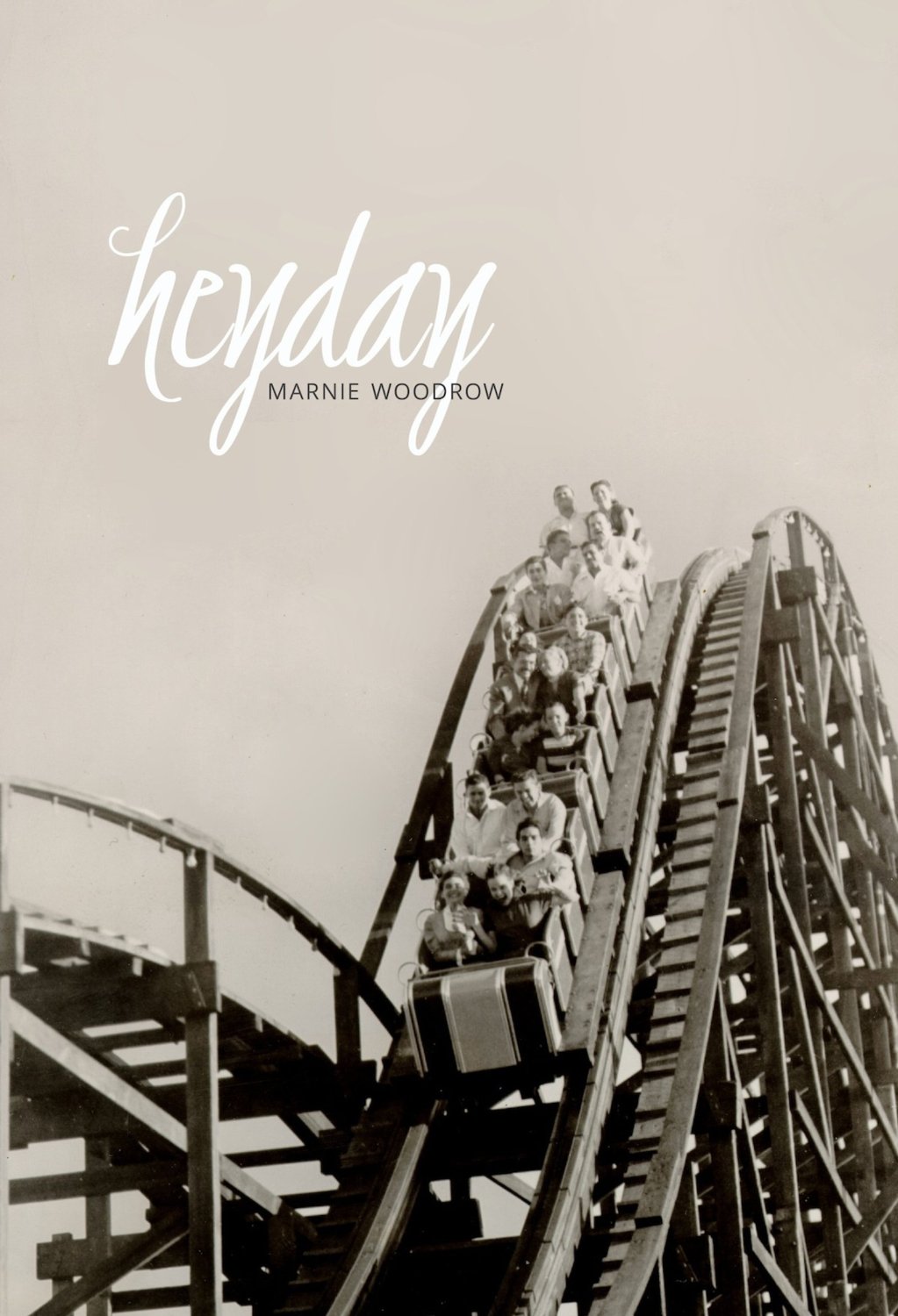 “It had something to do with Mary Pickford. With beauty. With the Figure 8 ride on a hot June day at just the right moment in time.”
Heyday is the first novel by Marnie Woodrow since the acclaimed Spelling Mississippi more than a decade ago. It’s a book that artfully weaves two stories, one in the present day as Joss mourns the loss of her longtime partner, Bianca, to whom she was never fully committed, and the other about two young women, Bette and Freddy, who meet one day on a roller coaster in 1909. And what connects these stories both is the Toronto Islands, peaceful Ward’s Island where Joss lives alone now but in her grief feels smothered by the attentions of the close-knit island community, and Hanlan’s Point on the other side, which in 1909 was a bustling amusement park, called “Canada’s Coney Island,” and where Freddy and Bette encounter each other for the very first time.
Bette is a single-rider, unnerved by the boy who takes the seat beside her as the roller coaster ride begins, and then intrigued as he whips off his hat to reveal a shock of blonde hair—the boy’s a girl after all. And a friendship begins between them, cultivated over a mutual love of swoops and turns, twists and plummets. Although the girls are worlds apart otherwise. Bette is the daughter of upper-class parents, her father an ardent spiritualist, her mother busy with campaigning for woman’s suffrage, and both parents too involved in their own affairs to pay sufficient attention to their youngest daughter who is mourning the recent loss of her beloved grandmother. Their lack of attention means that she’s able to escape from the confines of home during that summer, however, and make her way across the harbour to Hanlans, where she spends her time becoming utterly bewitched by the charismatic Freddy who works as a ticket-taker in the movie theatre. Although Freddy has secrets of her own, running from a dangerous past that is never far behind her. And as affection between the two girls grows—as they make plans for a future together, daring to consider running away together to New York City, to the actual Coney Island—it becomes clear to Freddy that their relationship might be putting Bette’s life in peril. But does she dare risk it? Or must she sacrifice their friendship to ensure her friend does not become snarled up in her own torrid past?
The novel’s historical detail is evocatively realized, and uncompromising in its sense of immediacy and richness of atmosphere. The sections of Heyday (from the respective perspectives of Bette, Freddy, and Joss) flow together naturally, the past and present timeline subtly connecting with small details. Though how the two sections relate beyond geography is not clear until the novel’s end when it becomes clear that one story might just be a figment of the other. But the spell Woodrow casts is so magnificently done that it doesn’t occur to the reader even to mind this.
November 8, 2015
Us, by David Nicholls
 “It’s like a Richard Curtis film,” will be the kind of description that sends half of you running, but (surprise, surprise) I’m in the other camp, and so I was all up for reading David Nicholls’ novel, Us. It’s the story of Douglas, a rather buttoned-up fellow whose wife Connie confesses late one night that after twenty-five years of marriage, perhaps she’s ready to leave him. Although it’s a tentative thing, her declaration, and they’ve already scheduled a summer trip across Europe with their teenage son that she’s determined to go through with. Leaving Douglas, who’s never too sure of himself in the first place, on particularly unsteady ground, and what ensues is continental hijinx and mayhem, bittersweetness and a bit of heartwarming.
The story weaves together the story of their trip with that of their relationship, starting with their first meeting at a dinner party, an unlikely connection between them. Connie is warm, passionate, artistic, while Douglas is an awkward biochemist, but each awakens something in the other, and Douglas finds himself in love for the first time in his life, moreover bowled over that Connie loves him too—he makes her laugh, he calms her storms, and their worlds are so different that each is fascinated with the other. Their relationship progresses, they move in together, buy a flat, and get married, which is straightforward enough, but life itself never is. There are bumps in the road, and there are tragedies, in particular the death of their daughter soon after her birth, an experience that tears them away from themselves, each other, and the entire world, before they’re able to reassemble to the pieces of the universe into something recognizable again, and even though they do, it’s something from which neither of them ever fully recover—Douglas in particular, who we know from his own evasions in the narrative lacks the emotional vocabulary to fully process what has happened to them. Though the experience also cements them like nothing else—no one else knew their baby, or loved her, and they resolve together to never forget her. Even the birth of their son not long after, while something like a balm, doesn’t take the pain away.
As their son grows, though, there becomes a new kind of pain. Life changes and Douglas leaves the job he loves in academia to better provide for his family, working long hours and commutating to a pharmaceutical company. And he begins to find himself displaced within their family home, that his wife and son are connected in a way that excludes him, and that his attempts to be the kind of father he wants to be—and even more, for his son to be the kid of boy he wants him to be—all fizzle, setting off a chain reaction of upset and disappointments. He loses his humour. His son has no respect for him, and doesn’t even like him, and no wonder. And then there is Connie, at four o’clock in the morning: “I think our marriage has run its course, Douglas, and I think I want to leave you.”
On their trip to Europe, Douglas becomes determined to prove to Connie that he is the man she fell in love and to their son that he is worthy of his love and respect. But things go very wrong before they’ve any chance of being right again. And it was some of these bits of the novel (which is 400 pages) at which my attention lagged. The addition of a sex-mad Australian accordion player to this cast was a good one, and the travel setting allowed Douglas to grate on his family’s nerves in a way that was particularly exacting. But it was the interactions between these characters that I loved best, and so Douglas wandering the streets of Amsterdam was always going to be less compelling, no matter who he meets on his wanderings.
Resolutions were also a bit pat as well, although I’d heard the Richard Curtis comparison, so what was I expecting. Curiously though, the novel is spattered with very literary epigrams: Penelope Fitzgerald, Lorrie Moore, Elizabeth Taylor (not that one), Henry James and Isaac Newton. Allusions as scattershot as Douglas’s attempts at harmony, or the travel itinerary that eventually transpired. Suggesting the novel comes with a certain literary heft, which is strange because its narrator isn’t at all the type. Surely this novel isn’t the type either. But then the references are also elsewhere woven into the text itself, and perhaps the project itself is to determine what kind of novel one can write about a man who doesn’t read novels. The inner life of a man who conducts himself as though he has no inner life, the stereotypical Englishman—perhaps a generation late. The kind of man who peruses his son’s social media accounts, and wonders with terror (at least I think it’s with terror): “Good God…how might I have fared in a world where people were free to say what they felt?” How far would the novel have to stretch to accommodate a narrator like that?
While the novel should have been shorter, I can determine that I liked it very much, most particularly for the complexity of its characters. Connie is just as flawed as Douglas is, and while initially they complement each other, it’s easy to see how the years roughen their edges and have them rub up together all wrong. She thwarts him just as much as he thwarts himself, and it’s all so terribly human and wrong. The novel is notable too for its portrayal of marriage—it reminded me of a line from Lorrie Moore’s Bark, that marriage “was like being snowbound with someone’s demented uncle.” But how does one get there? The path is never so straightforward. And David Nicholls has done a remarkable job of showing us the way.
November 3, 2015
Rumi and the Red Handbag, by Shawna Lemay
 I am not a handbag person per se, but as a fervent believer in the secret (and sacred) lives of things, I’ve been really looking forward to Shawna Lemay’s novel, Rumi and the Red Handbag. And also as a fan of Lemay’s blog, Calm Things, and something that I found really wonderful about the book was how clear it was for those of us in the know that Lemay’s blogging is a huge part of her process. This is a book about handbags (among other things) by someone whose long-time blog was called “Capacious Hold-All,” after all, which is from Virginia Woolf’s diary, her description of what she wanted her diary to be. And so it seems that handbags are literary objects right from the novel’s departure—how could a reader ever have doubted?
Rumi and the Red Handbag is a slim, heartbreaking and perfect read, rich with gorgeous prose, and depth and texture. Infused with allusions, explicit and otherwise, it’s a hushed and quiet celebration of women and their lives and their words and the secrets they carry. There is the Woolf, of course, and references to Clarice Lispector, who I’ve never read, but now I have to, and Charlotte Bronte, Jane Austen, Sylvia Plath. Plus vintage Harlequins—this is a book that permits great reverence to women’s stories and women’s spaces.
Our narrator is Shaya, on the run from academia and her unfinished thesis about the secrets of women writers. She takes a job at a consignment shop where she spends one long Edmonton winter in thrall to her young colleague, Ingrid-Simone, whose haphazard education consists of snippets and quotations and lines gleaned from library books that have a tendency to fall off the shelf right into her hands as she meanders her way through the stacks. She’s preoccupied by questions of the soul, by ideas in general. She floats around spouting lines in a manner that is one hand a bit simple and precious, but then she is young and it reminded me of the way my friends and I used to try to pin the down the world with bits and pieces once upon a time. I certainly remember that impulse, and Lemay captures it so well: “For Ingrid-Simone, the idea of hoarding thoughts, holding so many threads of ideas like cupped water as you knelt, knees grinding into finest gravel, thirsty by a mountain stream, did not terrify or oppress her instead exhilarated her.”
When things get a little too ethereal, Lemay balances it out by startling moments of revelation taking place under fluorescent lights at the Shoppers Drug Mart cosmetics counter, and also at Wal Mart. For while this is a novel concerned with questions of the soul, those questions are connected to the material world, in particular with the things that come and go from the shop where Shaya and Ingrid-Simone spend their days. Purses in particular are Ingrid-Simone’s things, and inspired by Shaya’s literary passions, she begins creating miniature purses inspired by writers and books: the first is a tiny capacious hold-all ala Virginia Woolf, authentic right down to a miniature pencil which inspires the writer’s walk in “Street Haunting.”
And so each woman inspires the other, and they learns from each other, and Ingrid-Simone reignites Shaya’s desire to start writing again, jotting words and ideas on post-it notes, “threads of ideas” (and there again we have connections to clothes and to textiles), like the way her friend thinks. Though all the pieces together still do not solve the inherent mystery of Ingrid-Simone—what secrets is she fleeing from? What is her connection to a curious red handbag? And there are other mysteries too—what about the goings-on of the shop’s proprietor, and also how can customers become so consumed by their own lives that they fail to acknowledge the humanity of service staff? A question that wears down on both Ingrid-Simone and Shaya as the long winter goes on.
With spring, however, comes revelations, and departures, and a journey that ends at the Museum of Bags and Purses in Amsterdam, a place Ingrid-Simone had long dreamed of making a pilgrimage to. A place that underlines her philosophy that there is a connection between a woman’s handbag and her soul. It’s a place for secrets, yes, and essential things, and for her stories. Especially for her stories.
For what is a handbag anyway but a place to keep a book?
October 28, 2015
Another Margaret, by Janice MacDonald
 I really loved this piece about campus novels and academic mysteries that Janice MacDonald wrote for 49thShelf back in September—referencing Dorothy Sayers’ Gaudy Night, of course. So I’ve been looking forward to her latest novel, Another Margaret, her sixth book in the Randy Craig series set in Edmonton, Alberta. Which is also the first book in the series, a reworked version of an out-of-print 1993 book called The Next Margaret, MacDonald’s first to feature Miranda Craig, a hapless perennial academic with a penchant for sleuthing.
On the occasion of her 20th reunion—grad school at the University of Alberta, and her pal Denise has roped her into being part of the organizational committee—Randy’s mind drifts back to her MA studies and her fraught relationship with her thesis advisor. She’d gone back to school as a mature student to study up-and-coming but little known Canadian novelist Margaret Ahlers—yes, another Margaret, along with Laurence and Atwood—on whom her advisor, Dr. Hilary Quinn, had written critical works. But Dr. Quinn turns out to be oddly unforthcoming on the subject of Ahlers, and it is not long after announced that Ahlers herself has died. And whatever her connection to Dr. Quinn, it now seems complicated in a way that Randy is determined to get to the bottom of.
But the course of an academic detective story never did run smooth, and suddenly somebody else is dead—was it murder?—and Randy has got her fingers on a floppy disk that seems to contain a another novel by Ahlers. But the novel turns out to be a detective novel. A “brilliantly subversive detective novel,” but still: had Canada’s Great Literary Hope upped and gone genre? And if she was murdered, was that why?
“All that territory staked on the next Margaret Laurence, or Margaret Atwood, and she turns out to be the next Margaret Millar!”
MacDonald does a terrific job capturing the seasons of the academic year: the heightened expectations of autumn, and then come April, everybody is crying. The send-up of academia is fun and smart, and also important in what Randy’s work as a sessional instructor has to tell us about the precarious nature of academic work at the moment. I also enjoyed the novel’s glimpses into Canadian literary culture, including a funny bit when Randy starts a fake book blog to get an advanced copy of yet another new Ahlers novel that comes out right before the reunion—a novel that Randy knows could not have possibly been written by Ahlers herself.
 The prose style was clunky in places, and some of the leaps of logic (both taken by Randy and required by her reader) were a bit absurd, and then once there’s the stabbing with the plastic picnic knife—well? Well, that’s how you know that the whole project is done in the spirit of fun, not taking itself too seriously, but executed well enough that admirers of academic mysteries can come along for the ride. And I really glad I did. Another Margaret was a lot of fun, and a great introduction to the Randy Craig series. I’ve been been feeling unwell this week and the weather has been autumnal in the not-so-golden sense, and so this has been the perfect kind of story to curl up in.
October 18, 2015
Night Moves, by Richard Van Camp
 Richard Van Camp’s short story collection Night Moves is a book about transgressions. And for me even reading it was something of a transgression—I don’t read many male writers and Van Camp’s stories are so very male, stories with grit and violence, so much aggression. More than once I wondered if this book was really for me, but something compelled me to keep going. Part of it that these stories weren’t all so male after all, or at least that the question of gender isn’t a straightforward one—the first story, “bornagirl,” is about a trans woman violently assaulted by the young narrator who fears her difference as much as he’s drawn to it. Gender is fluid in many stories throughout the book. And so too are notions of natural and supernatural, the line sometimes blurred entirely to rich and evocative ends, otherworldly creatures living amidst the solidity of the physical world. And stories of otherworldliness living comfortably beside others altogether steeped in realism—”I Double Dogrib Dare You” about a man infatuated by a woman he calls The Holy Woman, a woman said to be half-spirit; followed by “Blood Rides the Wind” about a young man who rides into town intent on revenge for his cousin’s sexual abuse at the hands of a school principal, but who finds his plans challenged by a different kind of blood tie and a promise for the future. “Because of What I Did” is another story of revenge, against a man who’s part of a network behind the disappearance of women across the country—an allusion to the more than a thousand Indigenous women who’ve been murdered or gone missing in Canada in recent decades, to little or no notice until recently. And the very sexy but miraculously restrained “If Only Tonight,” speaking of transgressions, is about a married couple and an old friend, true confessions, no inhibitions and boundaries falling away altogether…as a David Gray winds down on the stereo (of course!).
Van Camp is a prolific writer and storyteller, a Dogrib (Tlicho) Dene from Fort Smith, Northwest Territories. We know him best in our house from his children’s books (Little You; What’s the Most Beautiful Thing You Know About Horses?), and it’s another transgression, I suppose, that his work so readily moves between audiences and genres. The stories in Night Moves extend the narratives of characters from his previous works, including the novel The Lesser Blessed and his most recent collection, Godless But Loyal to Heaven. (This review by Lauren Scott does a great job of putting Night Moves in the wider context of Van Camp’s work.)
I’m inclined to criticize a certain roughness I encountered editorially—typos and a few mistakes—in my copy of the book (which I think was an ARC). Although there is something about such roughness in keeping with the entire project—this is a book far more about its edges than its polish. It’s a rough book. And yet the “something compelling” I found about it all along, I think, is the way that it’s all the same infused with the power of hopefulness. Like its characters at pivotal moments, standing at the crossroads, the reader is driven to turn a corner, turn the page.*
(*Which is another Bob Seger reference I made totally by accident…)
October 14, 2015
Basic Black With Pearls, by Helen Weinzweig, and Nightwatching, by Méira Cook
 Helen Weinsweig’s “lost feminist classic” Basic Black With Pearls was winner of the Toronto Book Award in 1981, and has been reissued as part of House of Anansi Press’s A List series on the occasion of Weinzweig’s centenary. It’s part of the city’s canon of books about unhinged women and sub-urban ennui, along with Phyllis Brett Young’s The Torontonians and Atwood’s The Edible Woman, although Weinsweig’s novel is far stranger. Its protagonist, Shirley Kaszenbowski, apparently travels the world on false passports, moving from city to city upon the signal of her dubious lover, the mysterious Coenraad, who communicates to her via her codes inside back-issues of National Geographic. This arrangement is disturbed when she finds herself called back to Toronto, the city she grew up in and has fled from. So that when she arrives and begins to navigate the streets in search of her lover (who can take on many forms), the world around her becomes textured with story and significance, more than enough to trip on. Wearing the black dress and pearls that, she believes, permit her an aura of respectability, Shirley partakes in the city before her and also the city of her memory, a city that has vanished. The line between reality and Shirley’s delusions is just as blurry—the point of view reminded me of Our Woman from Anakana Schofield’s Malarky—making for a discombobulating but compelling reading experience.
**
 Méira Cook has followed up her award-winning first novel, The House on Sugarbush Road (which was one of my favourite books of 2013) with Nightwatching, also set in South Africa, but this time in the Orange Free State during the 1970s. Though place and time play a more subtle force in this story, which zooms in so close on its characters almost so as to render the backdrop irrelevant. Taking place during one hot summer during which the days seem to stretch forever, and their hours too, the narrative conveys time’s slowness and its intensity, the whole world in slow motion. Motherless Ruthie Blackburn is on the cusp of puberty, her body erupting like a series of volcanoes, and so too her emotions, and yet still she cannot attract the attention of her distant father. So she takes out her rage on Miriam, the Blackburn’s maid and Ruthie’s caregiver, all the while Miriam is consumed by other concerns—her son the political radical, her wayward daughter, the babies that the other maids bring for her to hold on Saturdays before they grow too big and are sent away from their mothers to be raised by extended family. It’s an awkward and tragic status-quo, so that Ruthie has far too much freedom to roam streets, particularly at night, peering into houses and imagining the worlds inside.
Curiously for a novel, Nightwatching has a short story’s pacing, immediacy and vivid focus. The plot approaches its tragic end with a sense of inevitability, and in the end it’s not the plot that’s stirring as much as the prose, which creates the novel’s atmosphere and casts a spell that lingers. With the rhythms of its long complicated sentences: “But it was no use, she’d lost the knack, and the sound of the other woman’s name, for once, rang hollow, did not reassure, was not a talisman or a comfort or a cure.” Or, “…and he made his mind a blank, still as a lake with no thoughts to skip across its surface…” And, “Sip shook his head hard as he’d trained himself to do and the past broke up into tiny pieces, the bright colourful mosaics of incredulity and dispassion.”






