March 27, 2017
Barrelling Forward, by Eva Crocker
 I can’t help it, I need to read a short story collection like a novel. By “like a novel” I mean “like a book,” compelled to keep turning the pages. While I admire those who can dip in and out of a collection, read a story at a time, I’ve come to accept that in general, I’m never going to be that guy. If we’re speaking in terms of appetites and birds, when it comes to books I’m a raven. Which means I appreciate a short story collection like Eva Crocker’s debut, Barrelling Forward, whose momentum is suggested by its title.
The first story is “Dealing With Infestation” about a young teacher whose apartment is freezing and infested with something that’s left him itchy with a rash, when he embarks upon an ill-advised foray with his gym-teacher colleague. In “Auditioning,” a set of teenage twins are trying to get gigs acting in commercials, and one must resort to desperate measures to register her distaste with the whole exercise. In “Full-Body Experience,” an exercise instructor tries to get over the death of her sorta-boyfriend in a car accident. “Serving” is from the perspective of a father (middle-age man who works as a server in a family restaurant) and his teenage son, about the father’s innocent (?) relationship with a co-worker, and his colonoscopy. Work and family similarly intertwine in “All Set Up,” about a young father who waffles between contentment with his domestic situation and yearning for more. In “The Landlord,” a young waitress pushes the line about how far she’d go in order to avoid being evicted from her apartment. “Lucky Ones” is a tale of lottery tickets and Sherry, who’s taking care of her boyfriend’s baby while he works the night shift.
Eva Crocker’s stories of work and family life are reflective of modern realities, but underlined by more traditional notions of breadwinning and family structure, her characters are getting stuck in the gaps between these, sometimes perilously. All of these characters are gambling something, still hoping their ship will come in, which keeps the stories buoyant instead of bleak. And while not all the stories are equally successful, and this will be the kind of book that will frustrate you if you’re the type who disdains short stories for ending too soon, it’s a debut that positively sparkles with talent. Here’s hoping Crocker’s career achieves similar momentum as well.
March 23, 2017
The Mother of All Questions, by Rebecca Solnit
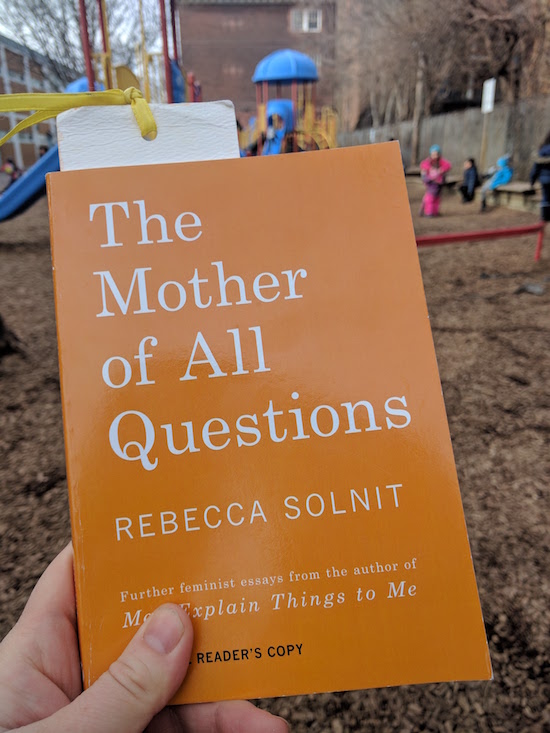
“There is no good answer to how to be a woman; the art may instead lie in how we refuse the question.” —Rebecca Solnit, The Mother of All Questions
Do you remember where you were when you discovered Rebecca Solnit? I do—I was listening to The Sunday Edition on CBC and she was talking about her book, The Faraway Nearby, a book that had a line of prose running throughout the bottom of every page. I read The Faraway Nearby, and fell in love with it, writing this effusive response. This was in 2013. In 2013, we still didn’t know that the world would fall apart and that I’d come to rely on Rebecca Solnit so much to put the pieces back together.
Solnit started particularly steeping in the zeitgeist with her 2012 essay “Men Explain Things to Me,” which lead to the term “mansplaining” although she’s far too elegant a writer to have invented it. The essay was part of a collection of the same name on feminism that was published in 2014, which was the same year that many of the essays in her latest, The Mother of All Questions, were written. “I’ve been waiting all my life forget what 2014 has brought,” her essay, “An Insurrectionary Year” begins, about that “watershed year” in which conversations about rape and sexual violence started changing. It seems like a long time ago now.
There is a Rebecca Solnit book for every moment—and sometimes for two of them. Her collection of essays Hope in the Dark was first published 2004 in light of George Bush’s re-election and the American invasion in Iraq in spite of global demonstrations for peace the likes of which had never been seen before. After the 2016 US election, the book was reprinted and I read it with such gratitude—it gave me comfort. I was reading it as we marched on January 21, and it made me feel buoyant for the first time in months. It indeed brought me hope, and perspective. There have been hard times before, activism is always a process, it’s always too soon to go home, and that you never know what effects your actions will achieve. There are grounds for hope. It’s a reason to bother.
The Mother of All Questions is another book about feminism, although it reads less triumphantly than such a book might have a short time ago. Before the patriarchy saw fit to elect an incompetent sexual predator to its highest office, because the alternative was a smart and qualified woman who rubbed a lot of people the wrong way. They sure showed her though, and all of us, where we’re at in terms of gender politics and equality. It is true that with the elections all my illusions about feminism and progress went kaput, and I’ve been functioning in a state of perpetual heartbreak ever since then. To think I’ve been raising my daughters to have a voice and to take for granted that their ideas and input would be valued by the world—what was I even thinking?
The ideas Solnit takes on here involve silences: “Being unable to tell your story is a living death and sometimes a literal one.” She writes about the people who weren’t permitted to speak, and the tales that weren’t allowed to be told. She writes about the men who are silenced by patriarchal forces, from being themselves, telling their own stories. She writes about rape, consent, domestic violence. She writes about the silence that occurs because no one is listening. About new and difficult conversations that have started to happen in the last twenty years or so, attempts to reconcile the unreconcilable (and the backlash). Most of these essays have appeared elsewhere and I’ve read a few of them, but it does me good to read them here assembled all together. There are many ways that I process the world, but reading Rebecca Solnit is a very important one of them. It’s true, I don’t read for her interrogation. I read her for comfort. Wanting comfort is not such a terrible thing.
However. “All your faves are problematic,” somebody tweeted last week, possibly in response to Chimamanda Ngozi Adichie’s comments about transwomen. And it’s true, and Adichie’s comments were ignorant and she’s not the spokesperson for every single living thing, but I’m not sure there is anybody who isn’t problematic. Remember the year we had to keep quiet about our admiration for presidential candidate Hillary Clinton because she too had failed to be perfect? And I went along with that. It was a silence. To admit one’s lack of socialist principles, and her Iraq war vote. She was the establishment, and there was Wall Street. She wasn’t even cool. Similarly, I had go to keep my excitement about Caitlin Moran’s new book on the downlow because she was racist and ignorant in a tweet in 2011. Which was problematic. But everybody is problematic. (It also seems that there is nothing more problematic than a woman being popular. Or in particular being popular with other woman. If too many women like you, then you’ve suddenly lost all your cred.)
I think we need to give women the space to be problematic though. I think we have let our feminist heroes cause trouble, and be wrong, and not even to atone if they don’t want to. We need to let people complicate things. We need to let others rail against it. That’s how progress happens. That’s how truth emerges. Uncertainty is okay, containers are porous. And I keep returning to the quote I started this essay with, “There is no good answer to how to be a woman; the art may instead lie in how we refuse the question.” Rebecca Solnit keeps refusing it admirably.
March 19, 2017
So Much Love, by Rebecca Rosenblum
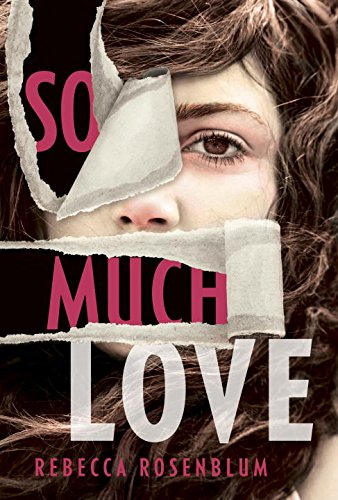 My friend Rebecca Rosenblum’s third book and debut novel So Much Love launched on the same day my book did last week, although I’d picked up a copy (from Indigo’s “New and Hot Fiction” table) two days before. I’d read it years ago in manuscript form and really liked it, and it was to my great joy to discover as I read the book last week that everything I remember loving about the first version—lines and scenes and settings—were still there, but that all the pieces of the story had been pulled together into a beautiful package that reads as seamless. It’s an incredible book, about the disappearance of a young woman and the devastation her absence leaves, and we also hear from the woman as well, and from a poet who’d been murdered in an act of domestic violence years before in a story with strange parallels to the central story. But not so many parallels—maybe vague connections are a better descriptor. Because to say there were parallels suggests that two characters’ stories might be alike, or that the the people who populate the novel are anything like types, because they’re not. And that’s so remarkable. The specificity with which the novel’s characters are evoked, every single one of them. I am awed by how Rebecca manages to imagine a 50-year-old male college professor reflecting on decades of marriage, a single mother desperate at her grown daughter’s absence, a kidnapper, a waitress, a poet, a builder. Each of them so stunningly realized—it’s magic. Sometimes the characters are so singular that it makes me wonder why—Catherine Reindeer, mature student, married young, works as a waitress, taking just one class a semester because she’s determined to avoid student debt. Which comes full circle, because, why? Because that’s who she is. These people are alive, and their city has its specific geography, and they all have their histories, and not all of it is delineated, but it’s there. We know it’s there. The whole novel was so enveloping, which is what hooked me, even though this is not a novel you’d call “deftly plotted” or “chockfull of suspense.” Which is not to say it’s boring or slow, but it more cerebral. It’s a novel whose atmosphere the reader steeps in rather than races through, and I loved that. Even though it wasn’t always easy—Rebecca avoids sensationalizing violence and only alludes to the worst bits, but it’s all very emotional wrought. There is so much sadness…and yet. And the title then, the so much love. Which is, of course, the whole point.
I loved this book. It’s an incredible achievement. I’m so proud of my friend.
March 1, 2017
May Cause Love, by Kassi Underwood
 I never had what Kassi Underwood terms as a “post-abortion meltdown”, which is the sentence I initially planned to open this review with, but then upon pondering I started to recall things I’d long ago forgotten. Such as that in the months after my abortion, I started working with a colleague whose girlfriend was pregnant, accidentally, and they were making a go of it together, and everything about their arrangement made me feel incredibly lonely. I would become unnecessarily preoccupied with the details of their lives. I feared that if I’d perhaps squandered my one chance to have a family. I remember a conversation with my best friend about reconciling feminist principles with my sadness about my situation, and then I remember waking up on the first day of what would have been the last month of my pregnancy and crying hysterically without even knowing why, as though my body knew before my mind did that something had been lost. But I also know that I felt much better after that. And later that year I would get the woman symbol tattooed upon my ankle, as a way to remember without having to actually remember, and it must have worked because all this seems far away and vastly unimportant now. When I look at the tattoo on my ankle, I don’t even remember that my abortion was a reason for it. “My abortion is the foundation of feminism,” is the thing I always say now, and it’s all conflated. My feminism is also a foundation of me. So you see, it’s with me always, even these if days I barely recognize it.
(The interesting thing about the preceding paragraph is that not once do I affirm that in spite of my sadness, my abortion was still the right decision. When I wrote the paragraph, it never occurred to me to do so. And now after, I’ve gone back and tried to insert the sentence, but there is nowhere it fits properly. I’d only be writing it anyway to give assurance to you, my reader, but so now I’m going to do a radical thing and not even bother with that. Inspired by Kassi Underwood’s example, I am going to present my abortion as a thing that happened in my life that is ordinary enough and extraordinary enough to exist outside—and between, above and beyond—the simplified bounds of morality.)
So no, I didn’t have a “post-abortion meltdown” per-se, but then I don’t have Kassi Underwood’s remarkable flair for the dramatic. As a writer, a narrator, and a literary character, she comes across as a person who does nothing halfway, which might explain how she ended up with an alcohol addiction, but then it also explains how she turned her post-abortion story into a spiritual journey, what I’ve been calling the Eat Pray Love of abortion memoirs, the recently-released May Cause Love.
It was a book that made me really uncomfortable in places, which is saying something, because I talk about abortion all the time. But I’ve never talked about how the way that Underwood does, confronting uncomfortable truths about the experience, daring to consider its spiritual aspects. And so this was a book that expanded my mind. She begins her story in childhood, growing up in Kentucky with strong ideas about family and motherhood and the kind of woman she wants to be. It all goes a bit wrong (the love of her life is serving overseas, she’s in her first year at college and gets knocked up by a junkie) and she gets pregnant. The decision to have an abortion isn’t an agonizing one (and I am willing to entertain the notion that it only ever really is on television) but then it’s getting over it that’s the hard part. Acknowledging her sadness at not feeling ready to have her baby at that time, and then having to deal with the same guy having a baby with someone else just a couple of years later—her realization that she could have made a different choice. Getting over her abortion is also complicated though because it’s the urge to make good of her second chance that got her sober, that drove Underwood to make something of herself—who would she be without that drive? The questions she has and the ideas she grapples with aren’t the ones you ever read about in news coverage so fixed on the polarity of the abortion debate, but they’re so much more interesting, and kind, and useful.
The memoir chronicles her experiences learning about the spirituality of abortions, including taking part in a Japanese ritual for mourning abortions, to a Catholic post-abortion retreat (which is kind of horrifying, but Underwood’s lack of judgement is admirable [ps I now have this fantasy of telling pro-lifers that I’m not judging them, the same way they like to tell me that, and just seeing what they make of that]), a witchy Jewish circle of wild women helping her release her burden, meeting with an abortion grief specialist, and taking a five-day vow of silence in an isolated cabin in Vermont. She yearns to make peace with her decision, to find her way forward in her life, and to reconcile the seemingly contradictory experiences of her abortion—that the experience of pregnancy meant something to her, that her baby was a baby, that if she hadn’t had an abortion her ex-‘s daughter wouldn’t be alive today, and that somehow her abortion had been an act of love.
May Cause Love is a strange book, not just in terms of subject matter, but in structure and tone. As a narrator, Underwood is tricky, breezy, rendered unsteady sometimes in present tense instead of steeped in context and explanation. She’s also completely audacious, in the most incredible way—imagine not only not apologizing for owning your own soul, but demanding to be transported to a higher plane. It was so refreshing and illuminating to read about abortion in these terms, and while the storyline about the boy she spends years hung up was much less compelling to me than everything else, sometimes that’s the way that life goes. And life itself is full of surprises, just like this remarkable book.
February 26, 2017
Son of a Trickster, by Eden Robinson
 I went to see Eden Robinson at the Toronto Reference Library at the beginning of the month where she was in conversation with Miriam Toews. It was a perfect pairing, these two understated, seriously brilliant and totally hilarious writers together, and many of their sentences would trail off into hysterical laughter. The effect of all this being that when I finally picked up Son of a Trickster, its voice in my head was Toews’ cool easy cadence. This is not a complaint. Like Toews does, Robinson’s work is an uncanny breezily brutal, absurd humour juxtaposed with weighted tragedy, and there doesn’t actually appear to be anything of a juxtaposition at all.
I loved Son of a Trickster, the first novel in ten years by Haisla/Heiltsuk Robinson. (“Her two previous novels…were written before she discovered she was gluten-intolerant and tend to be quite grim,” so goes her cheeky author bio.) At her TPL event, Robinson explained that this is a novel born of the 2008 financial meltdown, a problem that didn’t affect Canada so extensively, except for in small pockets we don’t hear about a lot, such as Robinson’s hometown of Kitimat, BC, where 535 workers lost their jobs when the pulp and paper mill closed in 2010. It’s in the aftermath of this that we find her main character Jared, sixteen-years-old and doing his best to keep things afloat. He makes money baking pot cookies and selling them to his classmates, but then he turns that money over to his father’s landlord so he won’t be made homeless as he struggles with addiction. Which Jared’s mother can know nothing about, because she’s terrifying (when she discovered a former boyfriend beating up Jared, she attacked the guy with a nail gun, fastening him to the floor) and if she finds out Jared is supporting the father who abandoned them, he might have (justifiable) reason to fear for his life.
The novel begins when Jared was small, when his parents were still together and in love, and it would be his father’s job loss at which point the whole arrangement falls apart. Although all was not always idyllic—his maternal grandmother had never liked Jared, as we learn in the novel’s first sentence. “‘Trickster,'” she tells him. “‘You still smell like lightning.'” As Toews herself pointed out at the event with Robinson, the title of the novel suggests it’s not exactly a spoiler to say that Jared’s grandmother might be onto something. And this book, the first of a trilogy (yay!), is the story of Jared’s journey to realizing exactly what that is. As he continues to hold his family afloat, suddenly the things he’s known to be true are revealed as fictions, and stories themselves take on a disturbing realism. About two thirds of the way through Son of a Trickster, a reader will feel herself stuck inside a Stephen King novel, which I mean in the very best way possible.
I loved it. The dialogue was so sharp and real, easing back and forth like a squash game at which everyone’s stoned, but never ever missing its mark. The characters are heartbreakingly realized, with soft spots and sharp edges, fuck-ups, and triumphs. I’d read reviews that the plot was uneven, but I didn’t experience it that way. While the book didn’t exactly fly by, I didn’t want it to. When I got to the end, I wanted there to be more, and thankfully there is more.
Next book, please.
February 13, 2017
Lillian Boxfish Take a Walk, by Kathleen Rooney
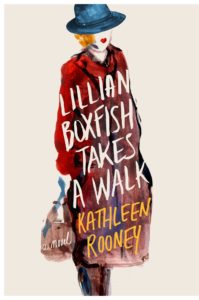 The book everybody’s talking about this season, in my circles at least, is Lillian Boxfish Takes a Walk, by Kathleen Rooney, which I first saw described as Mad Men meets Mrs. Dalloway, or, in other words, as a love letter written directly to my heart. Mad Men because Lillian Boxfish worked in advertising, albeit thirty years before Peggy and Joan, writing copy for R.H. Macy, and she achieved some fame as the highest paid ad woman in America, as well as for her books of Dorothy Parker-esque light verse which sold well in their time. And Mrs. Dalloway because of how the novel is framed in a similar fashion, around a single evening, the last night of 1984 as Lillian Boxfish—old as the century [or actually a year older than that, if you want to get really specific, although she doesn’t]—walks around the New York City she’s seen change around her over the decades. Places on her walk prompting flashbacks to the fascinating story of her career, her marriage, her fame, and various downfalls. In some ways, this is a very easy book, definitely a breezy book, but that to use that point as a dismissal would be to ignore the richness of its language. This is the first book I’ve read in a while which had me pulling the dictionary off the shelf to look up new words, and that makes perfect sense, not just in that Rooney herself is a poet whose attention to language is unsurprising, but so too is her character, Lillian Boxfish (inspired by real-life figure Margaret Fishback). Which reminds me of what Joan Didion wrote about her time working at Vogue where, she writes:
“…I learned a kind of ease with words…a way of regarding words not as mirrors of my own inadequacy but as tools, toys, weapons to be deployed strategically on a page. In a caption of, say, eight lines, each line to run no more or less than twenty-seven characters, not only every word but every letter counted.”
Looking back at her life, Rooney has Lillian Boxfish contemplating the way the public’s relationship to words have changed, the way that the ads she wrote in the 1930s assumed a level of cleverness and awareness of language that contemporary advertising no longer seems to aspire to. Where she finds that same sense of fun and play with language, she remarks, is in the rap music she hears on the streets of New York, a city that’s so much grittier and dangerous than the city she arrived at in her youth. And yet all of it still draws her in, the sounds, the sights, the people all stirring her curiosity. She strikes up conversations and always asks a person’s name, and they get talking, and the moral of every single one of their stories is that people are people, regardless of time or place. Lillian Boxfish sees the humanity, the beauty, in all of it. And so we get to too.
February 5, 2017
Birds Art Life, by Kyo Maclear
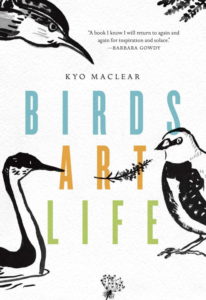 “…what he really taught me was that the best teachers are not up on a guru throne, doling out shiny answers. They are there in the much beside you: stepping forward, falling down, muddling through, deepening and enlivening the questions.” —Kyo Maclear
In her book, Mommyblogs and the Changing Face of Motherhood, my friend May Friedman refers to the value of “critical uncertainty in practice,” as opposed to “the generalizing trap of expert discourse.” Indeed the best blogs, and life itself, are all about “stepping forward, falling down, muddling through, deepening and enlivening the questions.” And while Kyo Maclear’s new memoir, Birds Art Life, is no blog—its prose is polished perfect; by design, the book is an object most exquisite—it has a bloggish spirit, with its wide vistas, room to wander, and the miraculous and serendipitous way that one thing seems to lead to another.
It’s not a book about birding, or even discovering birding—it’s a book that’s far more vicarious, and stranger than that. Here is a book about a year Maclear spent hanging out with a birder, figuring out what makes him tick. Developing a passion for birds in the process, but that’s not the point of this memoir. Yes, there are birds, but it’s also about family, and history, about caregiving, marriage, waiting, reading. About darkness, and prisons, and action in dangerous times. It’s about cities and nature, about the hearts of things and also their edges.
“Life and death. Survival and extinction. The common and the rare. The robust and the disappearing. I had come to see that birding was about holding opposites in tension. It elicited a twoness of feeling—both reassuring and dispiriting—especially in a city where so little landscape had survived modernity’s onslaught. In that twoness was a mongrel space between hope and despair.” —Kyo Maclear
I’ve loved Kyo Maclean’s work since reading her first novel, The Letter Opener, in 2008. In 2012, she released her second novel Stray Love along with the picture book, Virginia Wolf, and created a list at 49thShelf of Picture Books for Grown-Ups, and what I love about Birds Art Life is that she’s now herself created such a thing. First, because the book is illustrated with photographs of birds by her birding friend, Jack Breakfast, and also with Maclear’s own line-drawings, which add whimsical charm to the pages in a the fashion of Maira Kalman. And second, because of how the stories in this memoir contain echoes of her picture books, works that are so rich in thoughtfulness and wisdom—and now grown-up readers get to read it all too.
But it’s a particular kind of wisdom. I feel as thought Maclear herself would feel uneasy with being declared as wise, but it’s the kind of wisdom she’s talking about in the excerpt I quoted at the beginning of this post. The kind of wisdom that comes from falling down, from enlivening questions, rather than supposing there are even answers.
The year Maclear captures in her memoir is a dark one, although it comes with requisite moments of light. But she’s been caring for her father during a period of illness; she’s still negotiating her relationship with her mother; she worries about her younger son and identifies with his anxiety; close to the end of the year, two close friends of their family are imprisoned in Egypt and news of their fate is held in fear and uncertainty. And as I read this book yesterday, I was thinking that this is precisely the very book I need to be reading right now, not to escape from the things outside my door that make me afraid these but instead to “enliven the questions.” A book that—like so much that I’m reading these days, like so many books that are saving my life—helps me negotiate that space between hope and despair.
Leaning towards the hope, even.
January 30, 2017
Among the Ruins, by Ausma Zehanat Khan
 What an absolutely crazy, awful and perfect week to be reading Ausma Zehanat Khan’s third novel in her series about Detectives Esa Khattak and Rachel Getty, Among the Ruins, which is published on February 14. Khan’s first book, The Unquiet Dead, won an Arthur Ellis Award, and I read her second novel last summer. In her latest, Khattak is on leave from his job with Canada’s Community Policing Department and has stolen away to Iran on his Pakistani visa, an escape from his troubles at home and a chance to reconnect with his cultural heritage. He has visions of taking in gorgeous sites and and eating delicious food, but any expectations of a holiday are disappeared when he realizes he’s being followed. Turns out a Canadian-Iranian filmmaker, Zahra Sobhani, has been murdered at a notorious prison and Khattak is quietly urged by the Canadian government, on behalf of a shadowy middlewoman, to find out what happened to her. Zahra Sobhani’s work had focussed on Iran’s Green Movement, which contested the results of the 2009 elections after a surge of populism and demands for democratic reform. The regime came down hard on these dissidents, but Zahra Sobhani would have thought her Canadian citizenship might have protected her—so why didn’t it? Khattak considers this question and becomes involved with a group of young people who’d been involved in the Green Movement, this line of narrative providing a powerful perspective on what it’s like to fight for freedom under an oppressive regime. Meanwhile, Khattak’s also receiving mysterious letters from someone who seems to be a political prisoner, and there are aspects of Zahra Sobhani’s death that refuse to make sense. Back home in Toronto, his partner Rachel Getty is perusing her own investigation involving crown jewels and an archivist at the Royal Ontario Museum, stolen jewels and a smuggling operation on the Caspian Sea.
It’s a mystery whose plot(s) take the shape of something created by a spirograph, which makes it all a little bit difficult to follow at times. This along with devastating sections of the narrative from a character being tortured and raped in prison mean that this isn’t a mystery you’d ever call “cosy,” but then I don’t know that a work of detective fiction has ever been more urgent and relevant than this one. Khan is a gorgeous writer, her sentences shining, and she so vividly evokes an Iran of striking contradictions, of beauty and ugliness, of progress and backwardness, of people who are repressed but who also own themselves in the most courageous, remarkable ways. With a PhD in International Human Rights Law, Khan writes from a remarkable foundation and knowledge of the implications of the stories she tells, and this underlines these stories with so much power.
Most powerful of all though: for readers to enter the mind of a Muslim-Canadian character. Not such a leap, really, but it certainly informed my perspective as I heard the news last night of a shooting at a mosque in Quebec City. Thinking of Esa Khattak: “He’d been cautious since he’d chosen the police as a career. Careful and measured consideration was the only way he knew how to answer the assumption of Muslim rage… Whether he enjoyed living his life on these terms when he could have been at ease, expressing the different sides of himself, the things that have enriched him, enriched, he believed, the fabric of his nation, was a separate question.”
January 16, 2017
Take Us To Your Chief, by Drew Hayden Taylor
 I absolutely loved Take Us To Your Chief, by Drew Hayden Taylor, which was just as fun as its cover promised, and meaningful in a way I should have expected. Because while there is indeed something incongruous about First Nations’ science fiction, it’s only because I’ve never read any, not because it doesn’t make total sense. Is there a cultural group more familiar with notions of alien contact and invasion, for example, as in “A Culturally Inappropriate Armageddon,” in which broadcasters at a community radio station inadvertently summon attention from extraterrestrial beings? In “I Am…Am I,” scientists manage to create artificial intelligence, and the being (who is fed encyclopedias of knowledge) is drawn to notions of First Nations culture for its notions that all things, in fact, have souls, because the alternative is too hard to bear. In “Lost in Space,” an astronaut contemplates being Native in orbit: “What happens when you aren’t able to run your fingers through the sand along the river? Or walk barefoot in the grass? Or feel the summer breeze blowing through your hair?”
In “Dreams of Doom,” an Ojibway journalist learns that dream catchers are a government conspiracy, actually devices to spy on and control First Nations people and keep them in line: “You will notice that since Oka and Ipperwash, other than a few flare-ups here and there, things have been relatively quiet.” In “Mr Gizmo,” a suicidal teenage point is given a wake-up call by a toy robot, in keeping with his culture’s understanding that all things are imbued with a soul (including, awkwardly, your toilet). The narrator of “Petropaths” is a man whose troubled grandson learns to travel through time via ancient codes in petroglyphs. In “Superdisappointed,” the shockingly common conditions of housings on a First Nations reserve (houses with mould, substandard drinking water) causes a chemical effect that renders one man an actual superhero. And finally, in the title story, three reticent Objbway men are taken as ambassadors from Earth when aliens arrive on the planet.
I’ve cited nearly every story in the collection here because they were all of them hits, no misses. I read this book exclaiming at how fun it was, and appreciating the way in which Taylor plays with sci-fi tropes, and that each story pursues such a different line. And yet this collection is not merely an exercise in whimsy either—Taylor’s stories are fervent arguments as to the continuing tragedy of colonialism, which seems to be a solid through-line from the past and right into the future. Familiar ideas then, to those who’ve been paying attention, but the point is that too few are paying attention and maybe more might be with this fresh and utterly engaging context.
January 8, 2017
How I Spent my Christmas Vacation

It was three Christmases ago that I spent my holiday immersed in Hermione Lee’s brilliant biography of Penelope Fitzgerald, one of those perfect reading experiences you never quite get over. In homage to that, I had a vision of devoting my holiday this year to biographies too, because biographies require wide windows of time and focus and I can’t always accommodate such things in my ordinary life. But on holiday, I can, so I was all set to read Robert Kanigel’s biography of Jane Jacobs, Eyes on the Street, which I bought back in October, and also Ruth Franklin’s Shirley Jackson biography, A Rather Haunted Life, which I’d had an inkling would be under the Christmas tree. Ross King’s Mad Enchantment: Claude Monet, and the Painting of the Water Lilies, had not been part of the plan, but then we went to see the Mystical Landscapes exhibit at the AGO on Christmas Eve, and I have to tell you that I only had the vaguest sense of Monet and his water lilies beforehand, but the whole exhibit was a little bit life-changing. And Ross King’s biography has the most gorgeous design ever, the title fonts inside were gorgeous, and Chapter One was called “The Tiger and Hedgehog”. So I kind of had to, right?
It all turned out so wonderful, each life story captivating and connected in curious ways. Even more oddly, I’d gone offline for the week after Christmas (hence all the time for reading) and we were doing the Globe and Mail holiday crossword at the same time, and I kept coming across answers in the book I was reading—Hammurabi’s Code was something Jane Jacobs studied in her continuing ed courses, and then I got a synonym for “crafty” from translation somewhere in the Monet book, and also knew that Rodin was the sculptor from another clue. As always, the way that books speak to each other is always strange. What to say then about these three? That they’re all about three brilliant people who weren’t conventionally attractive, and it’s funny how the latter point is spoken in such lovable terms with Monet but with the women it’s an altogether different matter. Each character lives through a world war, Monet quite directly with World War One in France (and it’s fabulous to read about his insistence in his painting being included as “war work,” not just for reasons of nationalism, but also because it would ensure he received extra rations of petrol and cigarettes), and both Jane Jacobs and Shirley Jackson (via her husband) would come under suspicion of the McCarthyites. Jane Jacobs was shaped by coming of age during the Great Depression and Jackson by marrying a Jewish man with a terrifying awareness of the genocide being wreaked upon European Jews at the very same time, an awareness that would continue to haunt her.
I’ve spent most of my life with a blithe sense of living outside of history—I was ten in 1989 and everything after that was supposed to be easy, and not even 2001 and everything after would deter that sense until very recently. And what I really appreciated from these three biographies was what it showed about ordinary lives through vast historical backdrops, mainly that it goes on, and also that society’s pendulum swings. World War One, and Monet is painting and art still matters (and even matters more) and Jane Jacobs in the 1960s, which was not quite the utopia I’d figured it as, all Summer of Love and civil rights. No, I hadn’t been thinking about the fight before it was won, that before the win it was all fighting. And like right now, it was a time of a divided America, a country at war, racial tensions, riots in the streets, so much injustice. Ours is not a brand new story, is what I am saying, and these three books offer remarkable context to the world we’re living in at this very moment.
This from Jane Jacobs: “I resented that I had to stop and devote myself to fighting what was basically an absurdity that had been foisted upon me and my neighbours.”
Another point that links these figures is that all lived vital, creative lives while firmly ensconced in a domestic scene, surrounded by children—although Monet, of course, is the only one whose stepchild basically devoted herself to subservience in order to facilitate his creative life well into old age; Jane Jacobs’ grown son, on the other hand, would decide to start a business importing bicycles from China but the bikes arrived disassembled and his parents were recruited to assemble 30 of them from directions written in Chinese. Not that his mother wasn’t happy to do so, but still. It’s funny to read about Robert Kanigel’s (whose previous biographical subjects have all been male) fascination with Jacobs being a wife and mother—that she did all she did, and made dinner too—not that her status as mother wouldn’t be used to dismiss her work, the ideas of a woman who was just a mother, oh no! Which reminds me of Shirley Jackson filling out a form at the hospital before she gave birth to her third child, when she wrote “writer” under “occupation” and the nurse changed it to “housewife.” But yes, for Jackson and Jacobs both, their domestic lives fuelled their creative work.
Interestingly, both Jacobs and Jackson lived in Greenwich Village too and frequented Washington Square Park, but a decade apart. I don’t think they ever hung out. And never with Monet—at least not until this blog post, of course.






