August 6, 2025
Born, by Heather Birrell
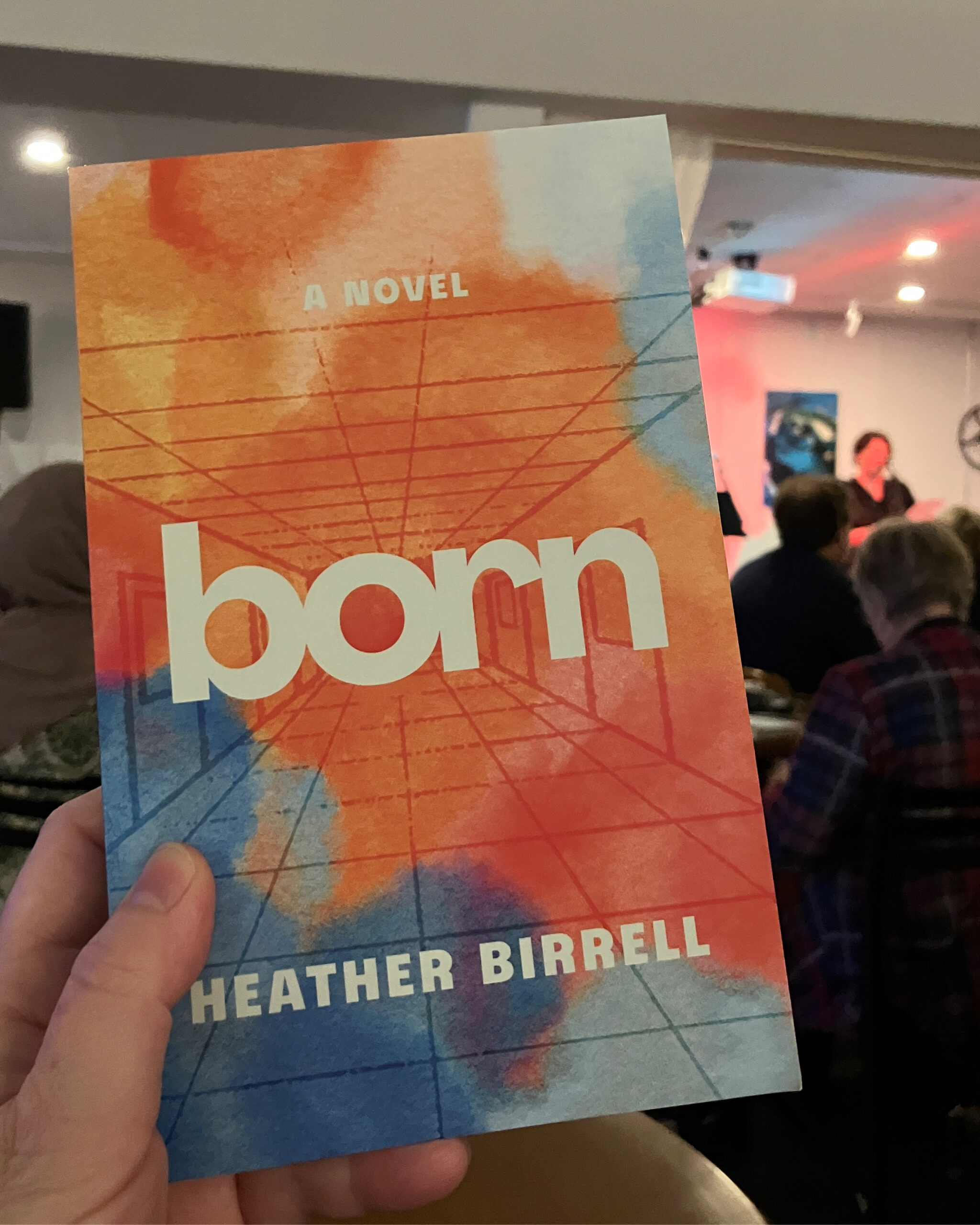
My propulsive reading recommendation for the summer of 2025 is Heather Birrell’s novel BORN, which grabbed me from the start and did not let go until its incredible perfect ending and even then not entirely. Gorgeous, compelling, fraught with tension, chasing shadows, full of light. Dazzlingly literary and unputdownable at once, this story of a high school English teacher who goes into labour during a lockdown is a polyphonic ode to caregiving, community, and public schools. It’s a fast paced read that will stay with you long after the final pages (which made me cry, they was so beautiful). Buy it! READ IT! (Or borrow it from your local library!)
August 5, 2025
The Road to Tender Hearts, by Annie Hartnett
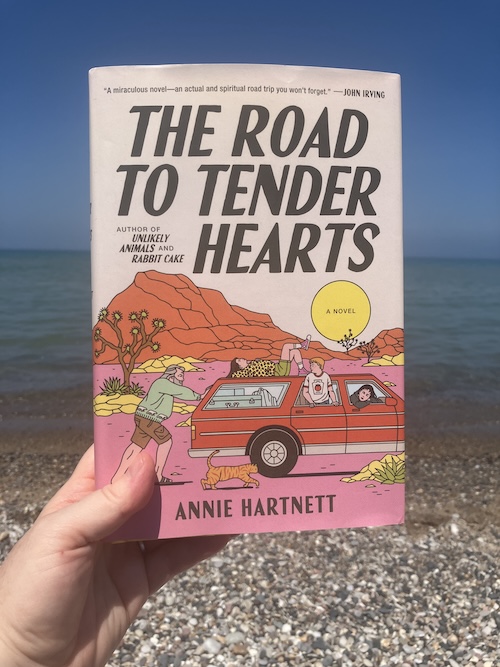
In the acknowledgements for THE ROAD TO TENDER HEARTS, Annie Hartnett explains that her novel was born of a challenge she set for herself around 2021: could she take all her fears and anxieties (especially about death), and her worries about not being a good enough parent or capable enough person, and turn all of these things into a novel that was FUNNY? And reader, she did, she really did, this explanation going a long way toward making sense of this totally bonkers novel that manages to be not remotely off-putting even though it’s about grief after loss of a child, childhood sexual abuse, children who are orphaned in a murder suicide, and one tragic death after another as the narrative goes on, taking its reader on a road trip from the armpit of Massachusetts down to Texas, and then to Arizona where lottery winner and prototypical well-meaning but disappointing dad PJ Halliday hopes to be reunited with Michelle Cobb, the love of his life, whose husband’s obituary has only just appeared in the local paper.
The only complication is that he’s just been saddled with the care of his grand-niece and nephew after their parents’ tragic deaths, and PJ doesn’t have a great track record for care, really. His eldest daughter drowned in a cranberry bog on her prom night 15 years before, and his youngest, Sophie, barely speaks to him now, plus he’s spent the last decade and a half drinking away his pain. And okay, I lied, that’s not the only complication, in fact, everything is a complication for PJ at the moment, in particular that his ex-wife is about to depart on a trip to Alaska and PJ won’t be able to have breakfast every morning at her house anymore. Or that PJ doesn’t have a car anymore after his DUIs. Or Pancakes, the cat, which comes along on the journey and seems to have an instinct for when somebody is about to die…
How does Harnett get away with writing a comic novel about ALL THAT? By acknowledging the best and worst parts of people, by telling the truth, by demonstrating that LOVE means telling the truth, even when the truth is that the people we love or loved are profoundly flawed or terrible.
If you’re up for a sombre book about grief, leave this one alone, but if you’re in the mood for a story that will explode your ideas about what must be treated with seriousness and reverence in fiction, then THE ROAD TO TENDER HEARTS will likely be one of your favourite books of the summer too. Thanks to Stephanie at Betty’s Bookshelf in St. Mary’s, ON, for the recommendation.
July 31, 2025
Dark Like Under, by Alice Chadwick
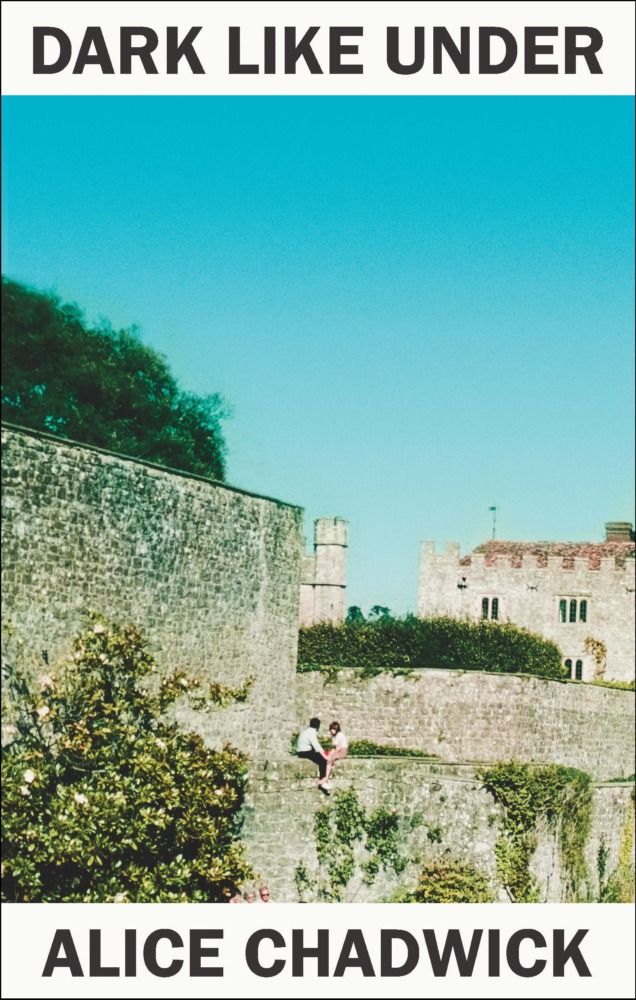
The story begins so late at night that it might already be tomorrow, Robin and Jonah taking chances, walking on a weir, taking chances too in being together at all—Jonah is Robin’s best friend Tin’s sometime boyfriend. They’re pushing their luck. Something terrible is going to happen, it is clear, and just what that something terrible is comes into focus at an assembly at school the next day when the reviled head announces that a well-liked teacher, Mr. Adennes, whom Robin and Jonah had met on their meanderings the night before, is dead. And everything after that seems to ricochet, the narrative full of traps and holes, shifting between the perspectives of students and teachers moving forward through the day, their understanding of the tragedy seen through the lenses of their own experiences, informed by their own traumas and heartaches, grudges and preoccupations. Tin providing as much as a centre to this tale as anything, because she’s the kind of person who draws people to her (for better or for worse), who makes “hot, empty days sparkle like broken glass,” and their teacher’s death reaches back to something terrible that happened to her years before, the image of broken glass enduring throughout the text, shiny, sharp and dangerous.
Alice Chadwick’s DARK LIKE UNDER, set in the 1980s admist the community of a grammar school in northern England, is slow, character-driven, intensely engaging at the sentence level, and disorienting as the story moves between characters, deep into their minds, their pasts, into their homes, class distinctions usually unspoken, but ever-defining. It’s a deep dive into a dark sea, and beautifully spellbinding.
July 29, 2025
Summer Goodness
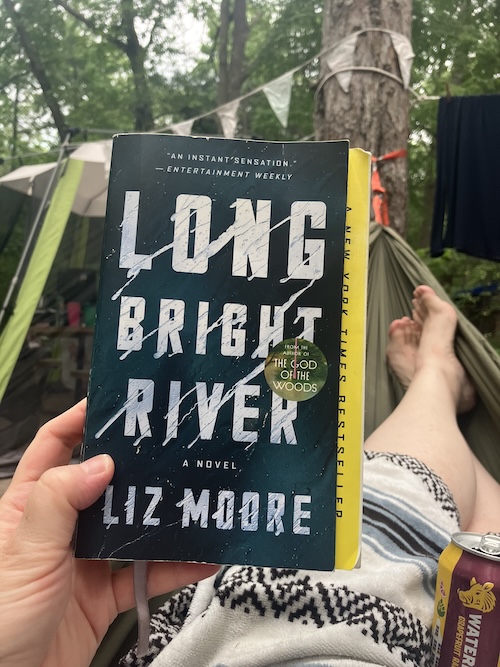
Last weekend we went away again, and I brought along Liz Moore’s 2020 novel LONG BRIGHT RIVER on a camping trip out of nostalgia for the weekend I spent last summer utterly absorbed in Moore’s GOD OF THE WOODS at the same park, and it was no surprise just how much it delivered because my husband and teen had already read the book before me and both of them loved it. And I did too (I’ve heard it said that it might be better than GOD OF THE WOODS, which I think is true, although GOD… subverted my expectations in the most interesting ways and this novel was a little more conventional). It’s the story of Mickey a police officer in Philadelphia’s gritty Kensington neighbourhood who lives in fear of one day coming upon the body of her sister, Kacey, a longtime addict, on one of her patrols, and for whom the line between her professional and personal lives become blurred when it appears that a serial killer is targeting vulnerable women in the neighbourhood. It’s a gripping mystery with all kinds of twists, but also a searing indictment of police corruption and incredible human cost of current drug crises, including opioid addiction and drug poisonings.
July 25, 2025
Second Life, by Amanda Hess

I remember how, when I became pregnant with my first child in 2008, the internet was an oracle. Google searches: signs of pregnancy, how to tell if i’m pregnant, am i pregnant. I had no trouble getting pregnant at all, and yet still found my way onto forums where I learned acronyms like TTC, DH, and people talked about “baby dust.” (Not long after, a friend had a miscarriage, and found her way onto forums where people who weren’t very good at spelling talked about their angles.) And then once my pregnancy was confirmed, I’d signed up for Baby Centre updates, through which I received weekly emails with news about my baby’s development, all of this supplemented by regular google searches about what pregnancy symptoms I should be experiencing week by week, because everything about my pregnancy in the first half of it (when not being mediated by machines like the dopplar or by ultrasound scans) was incredibly hard to believe in.
Fast forward a decade and a bit, and this lunacy has increased exponentially, and now it’s wrapped up in capitalism in a way it wasn’t yet when I was cruising Baby Centre and didn’t yet have a smart phone, so there were still no apps. “First I had learned to track my periods, then my pregnancy, and now I was tracking my kids from a surveillance camera perched above their beds,” writes New York Times reporter Amanda Hess in her memoir reportage hybrid, Second Life: Having a Child in the Digital Age, which is less a parenting book than a book that probes the way we parent as mediated by technology, and it’s absolutely blown up since I was in the thick of it, for example I had no idea that Dr. Harvey Karp (of THE HAPPIEST BABY ON THE BLOCK fame, whom we named Dr. Douchebag at our house because we had the unhappiest baby in the universe) had invented a robot crib that performs his 5 S’s for you. Or that you can buy special socks that track your baby’s vital signs, preying on every anxious parent’s worst tendencies. And then there’s all the screening available in utero, and Hess’s experience of this is complicated by her own child’s prenatal diagnosis, and experiences with disability, prompting her to become curious about the free birthing movement and also the “medical mama” online phenomenon as a counterpoint, and the way that millennial parents deal with their children’s behaviour with scripts from online influencers like Big Little Feelings. All of it fascinating, and Hess is reflective enough to see parts of herself and her experience in the different kinds of parenting she explores in her work, even the absurd parts—though she draws the line at the chiropractor who advises her that her son’s disability was caused by her own experiences of “self-devaluation” during pregnancy, whose entire approach is born from an antisemitic conspiracy theory, slamming the door closed on that particularly rabbit hole entirely.
I kept talking about this book to my husband, whose phone was listening, and then suddenly I started getting ads for the very period tracking app discussed in the book, though I hadn’t mentioned it by name at all. The brave new world out there for pregnant people and parents is a wild one, and a book like this goes a long toward generating some vital and necessary critical thinking regarding just what this technology is all about it, and what it’s doing to us and the way we see the world—and each other.
July 23, 2025
Last Week’s Summer Reads
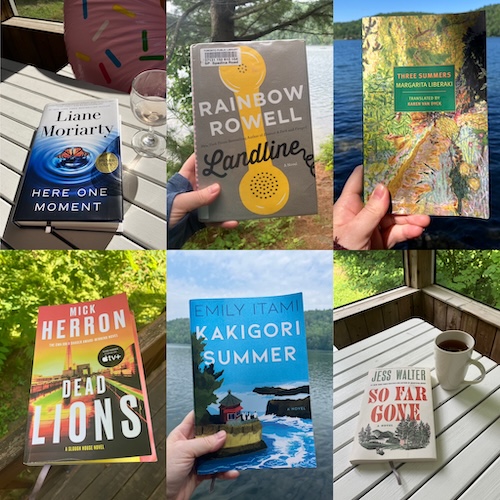
Once again, summer reads stacked up like a dream, this time on last week’s trip to the Lanaudiere region of Quebec, where we fell in love with the cleanest lake, shared a lawn with a fat groundhog, went swimming every day, and had fires almost every evening in the company of wonderful friends, the very best time. And the books were just as book, eclectic, fun, sparkling and magical.
I began with Jess Walter’s SO FAR GONE, which I picked up at Spark Books in Perth en-route (actually on the recommendation of David Worsley from Words Worth Books in Waterloo). I read and adored Walter’s BEAUTIFUL RUINS on a summer holiday years ago, and this very different kind of story proved just as rich and satisfying. It’s about a man who has retreated to a secluded property in Washington State after his long career in journalism fizzled out with the industry and after he punched his conspiracy nut son-in-law in the face during Thanksgiving in 2016. And then all these years, there are two children on his doorstep whom he fails to recognize as his grandchildren, and SO FAR GONE is the story of his wobbly redemption as he is forced to return to to the world and save his grandkids from the dangerous militia their dad has become embroiled with. Funny, thoughtful, twisty, and absorbing, this one is definitely a highlight of the summer.
Next up I read KAKIGORI SUMMER, by Emily Itami (who is Japanese, but writes in English, and whose text engages with Japanese kanji in the most interesting way), which I bought at Words Worth in Waterloo the week before, and which is going to be a highlight of the year. I’d previously read Itami’s novel FAULT LINES, and liked it very much, but this one is even better, the story of three Japanese sisters (their mother is dead, their father is barely known to them, living with a new family in his native England) whose lives are far apart but who come together again when the youngest—a pop star—becomes embroiled in a national scandal. Together, along with the middle sister’s young son, they all return to their childhood home, and the company of their prickly great grandmother, and are forced to make sense of their history, the possibilities for their future, all the promises of a beautiful, imperfect world, and the fragility of life itself.
I read Mick Herron’s DEAD LIONS after that, the second book in the SLOW HORSES series. I’ve not seen the TV show, but am enjoying the books a lot, and my husband who is two books ahead of me claims that the series continues to be great. It’s a spy thriller that subverts expectations at every turn, such a fresh take on a familiar genre, so that it continues to be cozy and surprising at once, and also so prescient—this one’s about the Russian threat lying dormant after the fall of the USSR and just waiting to spring up again.
And then I read THREE SUMMERS, by Margarita Liberaki, a recommendation with Teri Vlassopoulos via Julia Zarankin, an English translation of a Greek classic published in 1946, another book about three sisters coming of age in a bucolic idyll that feels worlds away from where Greece actually was at the time of publication. Dreamlike, steeped in heat and atmosphere, the story is strange and surprising, secrets and hidden strengths and weaknesses revealed, the story itself ever changing amidst a world where so much stays the same.
Next up was LANDLINES, by Rainbow Rowell, which came out in 2014 and I recall readers feeling let down by, and so I didn’t have any expectations. I fell in love with Rowell’s work when I finally read ATTACHMENTS, and then ELEANOR & PARK, and her most recent books, SLOW DANCE (which I loved SO MUCH). Perhaps fans of her super-hit FAN GIRL weren’t as interesting in LANDLINES, a time-bending story about a long marriage, and motherhood, the middle-agedness of it all, but that’s what SLOW DANCE is all about, and it’s right up my street. I loved it, and now keep listening to “Leather and Lace” and not even ironically.
And then finally, HERE ONE MOMENT, by Liane Moriarty, whose books I LOVE, but I didn’t rush after this one when it came out because the premise was so odd (it’s about a plane full of people to whom a mysterious passenger delivers each of their precise dates and causes of death) and PREMISEY. I didn’t love Moriarty’s novel NINE PERFECT STRANGERS, and while I appreciate her urge to spread her creative wings and not simply rewrite BIG LITTLE LIES over and over, I felt her latest might be more of the same. But it really surprised me, and I enjoyed it so much, especially Moriarty’s beautiful talent for investing difficult characters with the most human and sympathetic edges. The story had me GRIPPED, but I had to put it down unfinished on our last night away, and throughout the six hour drive home, I was so looking forward to finally getting to the end, the most delicious anticipation.
July 11, 2025
On the Calculation of Volume 1, by Solvej Balle
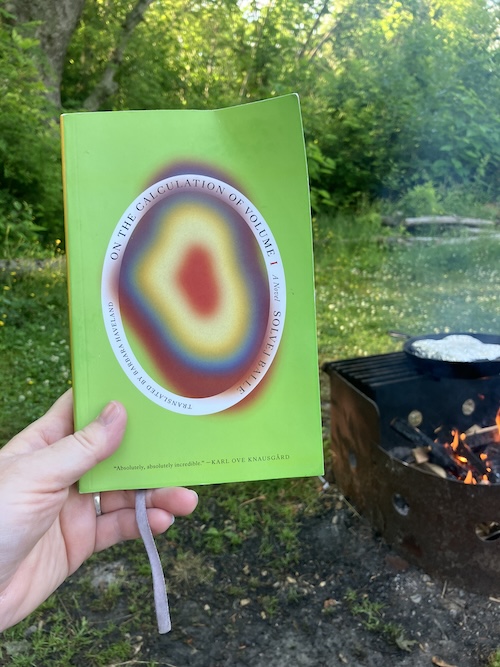
I will only mention Bill Murray this once, and not even name his film’s title that’s become iconic enough to eclipse the film itself, standing in for a narrative approach so overdone that it might be hard to imagine it could be made interesting. And then along comes Danish writer Solvej Balle with a request for us to hold her beer after she, according to a blurb on the back of her novel from LE FIGARO , “went into exile on an island for more than twenty years” and returned with ON THE CALCULATION OF VOLUME, whose first two volumes have been translated into English by Barbara J. Haveland, the first of which I read on a camping trip the weekend before last.
The premise is this. Tara Selter, antiquarian bookseller, has just spent the last 121 days awakening every morning to another November 18 (alas, without Sonny and Cher). It all started on a business trip to Paris, unfathomably strange. Eventually she makes her way back to the home in Northern France that she shares with her husband, Thomas, who is also her business partner, and when we find her, she is hiding out in her spare room because she eventually tired of having to explain to Thomas day after day what she was doing at home instead of Paris, where she’s supposed to be.
This is a quiet narrative, as confined as Tara is within a single day, a limited geography (though apparently the world expands in subsequent volumes). She comes to know all the patterns, when she’ll hear birdsong, when her husband returns home, what the weather will be, everything always the same, although there are strange deviations—sometimes things she acquires one day travels with her into her next day, and other days these acquisitions disappear. Trying to figure out some kind of pattern or logic beneath what’s happening to her becomes a major preoccupations in the her first 50 days or so, but eventually her energy in that direction peters out.
Tara’s loneliness permeates the text, the relief of finding her beloved Thomas eventually ceasing to satisfy her because she realizes how fundamentally she’s alienated from him, even when they are fortunate enough to be together. She realizes that she’s embarked upon a journey that he cannot be part of, no matter how much he wants to be, no matter how much they love each other—which reminds me of what couples experience when one is undergoing a serious illness or even dying, the impossibility of true togetherness, the meagreness of the togetherness they have.
I happen to be rereading Frankenstein right now, and recognize a similar tone in the two novel’s first-person addresses, Tara too a kind of monster, outside the ordinary, people responding to her situation with confusion and disbelief. She spends the novel similarly skulking in the margins (she refers to herself as a ghost), peering in lit windows, set apart from the ordinariness of human experience which she so longs for.
The Calculation of Volume tells an extraordinary story, but what its narrator goes through will be familiar to many readers, underlining the story’s poignancy. This very specific, unlikely tale brings with it a certain universality. Tara tells us, “It seems so odd to me now how one can be so unsettled by the improbable. When we know that our entire existence is founded on freak occurrences and improbable coincidences. That we wouldn’t be here at all if it weren’t for these curious twists of fate. That there are human beings on what we call our planet, that we can move around on a rotating sphere in a vast universe full of inconceivably large bodies comprised of elements so small that the mind simple cannot comprehend how small and how many there are… Anyone would think that this knowledge would equip us in some small way to face the improbable. But the opposite appears to be the case…”
July 9, 2025
Winter (of Strout) in July
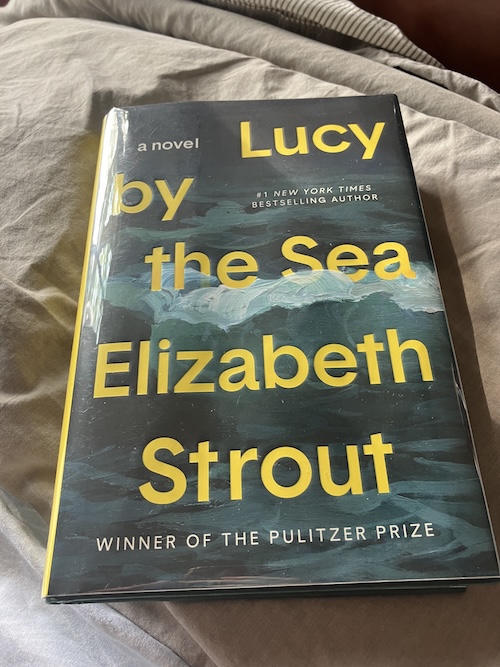
In so many ways, Lucy by the Sea was where it all began for me, the #WinterofStrout. Albeit in 2023, when I finally read it after avoiding Lucy Barton for a long time. I’d read My Name is Lucy Barton when it first came out, and I did not like it. But by the time Elizabeth Strout’s third book about Lucy Barton, Lucy by the Sea, was published, I was willing to give them all another chance, so I reread the first book, read the second (Oh, William!), and finally LBTS, which is where all the pieces began to come together.
During my #WinterofStrout, I’ve been reading all of Strout’s books in chronological order, beginning with her lesser known first two novels, Amy and Isabel, and Abide With Me, which I loved so much. And then Olive Kitteridge, and The Burgess Boys, which I’d read before after the first time I reread Lucy by the Sea, because by then I was in love with Bob Burgess. And it was kind of amazing to meet him again upon rereading Lucy by the Sea, to recall meeting him for the first first time in this book, and how I know him so much better know having read so many other Strout novels in which Bob appears—including Tell Me Everything, which came out last fall, and which Lucy by the Sea is like a bridge to. It was also nice to be rereading Lucy by the Sea as my husband is reading The Burgess Boys, both of us side-by-side in bed reading about Bob. I love the intimacy inherent in that.
The part about rereading Lucy by the Sea that was less delightful was how, when I first read the novel in 2023, and the parts about rising political polarization and tensions in American society reaching a boiling point (the novel is set in in 2020 and 2021, the January 6 insurrection unfolding on its pages) it would have made me think, “Ooof, we dodged a bullet there.” Biden was elected in 2020, and I really supposed the chaos was behind us, that people might actually begin to settle down, that William’s observations about the simmering rage of American people resulting from a very human kind of cruelty and also inequality might have been overblown instead of prescient.
I did appreciate how much less viscerally I experienced the 2020 parts about Covid than when I read it in 2023, that so much of that seems far away from where we are now (which is FINE!).
There is so much that’s wild about this book—that it’s the first time I met Charlene Bibber and Kathryn Caskey too. The torture and sadness of Lucy’s love for her daughters, and all the ways she’s failed them, and all the things that they need from each other that none of them are able to give. The way I’m now fascinated with Margaret, Bob’s wife, the Unitarian minister, who Lucy doesn’t really like, and neither did Bob’s sister-in-law, Helen, and she doesn’t come out great in Tell Me Everything, really. I want to read HER story now. How there’s a part in this novel where Lucy quotes a novel she once read, and while she didn’t cite the novel, I recognized it as a line from Olive, Again (“‘I think our job—maybe even our duty—is to…bear the burden of the mystery with as much grace as we can.”) Imagine the audacity of putting your words from one book in the mouth of a character in another? Imagine how I’d read that line the first time, back when I’d not yet read Olive, Again, and just skimmed right over it like it was no big thing? (And what ELSE did I miss, even this time?)
My #WinterofStrout, stretching all the way to SUMMER, has been such a wonderful, powerful reading experience, lending shape and cohesion to my reading life. I will likely be rereading Tell Me Everything sometime this summer (I read it twice last fall), to see how it reads differently having read all of Strout’s novels now, and no doubt I will find new treasures (and oddities) to discover inside it.
July 7, 2025
This Way Up, by Cathrin Bradbury
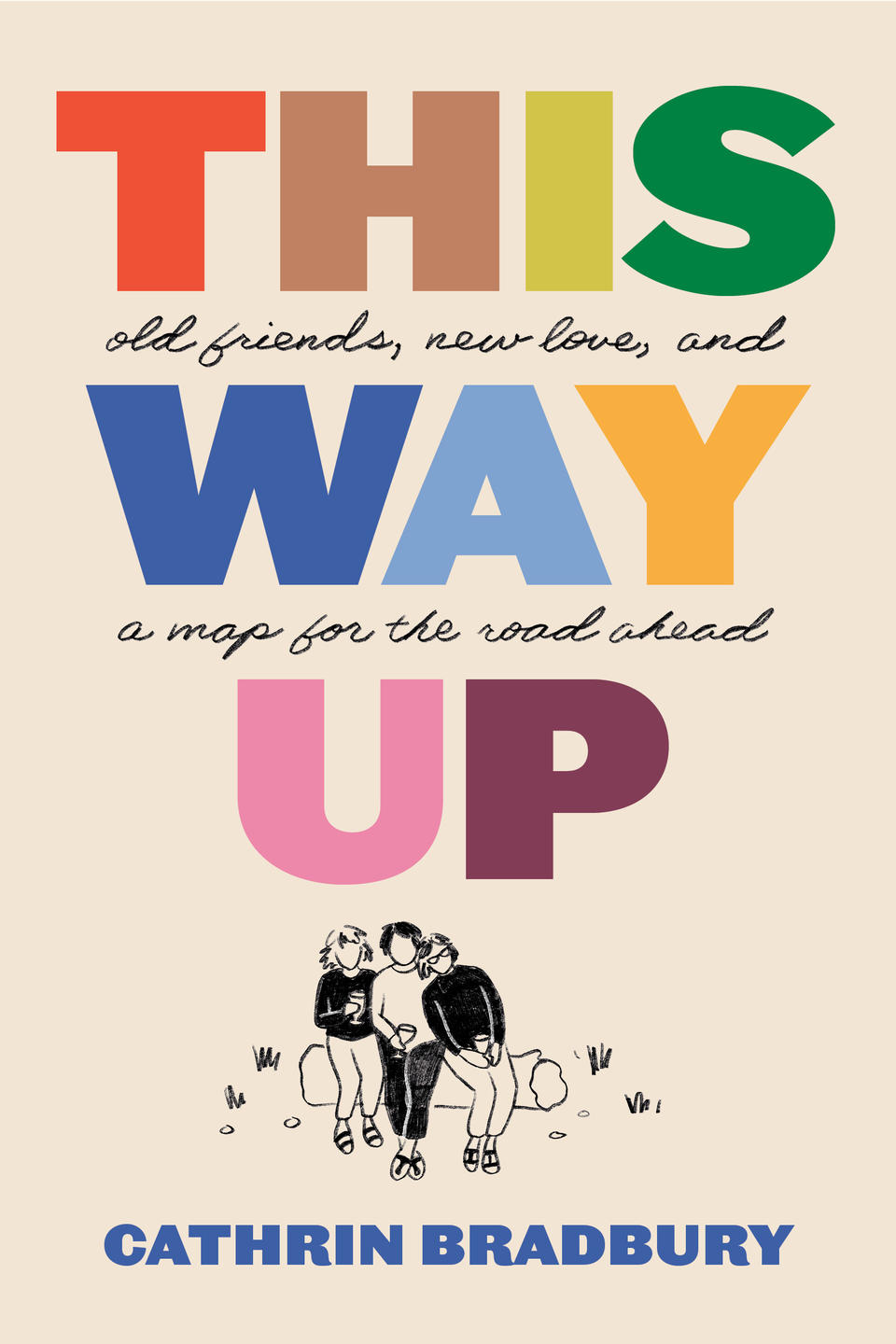
Cathrin Bradbury’s memoir This Way Up is an exercise in reorientation, in way-finding. Think about title, the label placed on boxes in transit, a simple instruction to show where the bottom goes. Although the title of the book is also a joke—at age 68, her doctor hands her a drawing labelled “Aging Changes,” and it turns out everything (“muscle mass, blood flow”) is in decline. “The very few times the arrows pointed up were for body fat and bone breaks. The small fibrillations of panic I had studying the diagram, the merest skips in my heart, were right there under myocardial irritability: ‘UP^'”
“I was going to need a map,” the book begins, with Bradbury on the cusp of her fourth quarter, and changes in the mix. Her marriage has ended, she’s retired from a career in journalism, her children are grown, and yet none of this indicates the end of her story. And it seems there exists no instruction manual for finding one’s way forward at this pivotal time of life, a moment at which she’s finding new love, discovering a new vocation as a writer, and reconsidering the stories she told herself about her history. And so, unable to procure a map for the future, she finds one that takes her into the past instead, a map of the setting from her earliest memories, St. Catharines, Ontario, consulting her trusty siblings to make sense of where she came from, who she’s been.
This Way Up is a delightful, hilarious, and richly crafted story of getting one’s bearings when everything seems upside down. It’s a terrifically candid story of mothering adult children (Bradbury’s daughter’s constant refrain of “Oh my god, Mom…” made her one of my favourite characters in the book), of sustaining longtime friendship, the twists and turns (and pokes) of sibling relationships, and the physical and emotional realities of aging. It’s also beautifully bookish, full of literary allusions, and a wonderful nonfiction companion to Elizabeth Strout’s Lucy By the Sea.
I loved this book, speeding through it in just two sittings. The structure and form are fascinating. On the surface, the reading is direct and straightforward, easy and breezy, but there are such depths, threads beautifully woven into the narrative, appearing and reappearing, so precise and impactful—nothing easy about it at all, except the way it’s such a gorgeous pleasure to read.
July 2, 2025
A Dark Death, by Alice Fitzpatrick
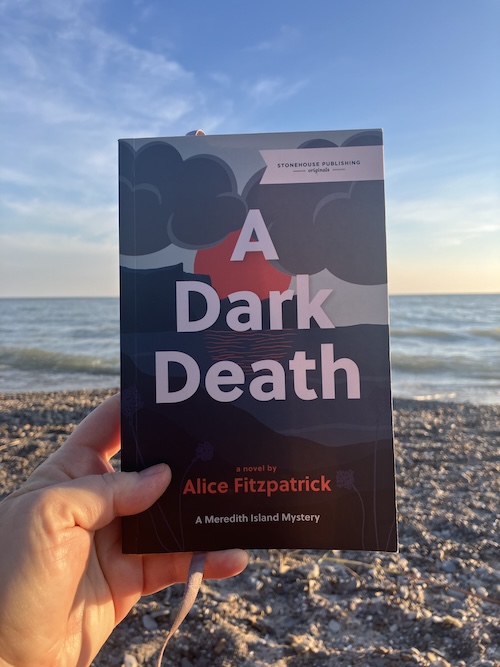
I was lucky to be born in Canada, and doubly lucky to also be able to also choose Canada when I moved (back) here with my immigrant spouse exactly 20 years and two days ago. My feelings about Canada Day and nationalism are always complicated (which I think they should be), and they’re additionally complicated this year with Canada’s sovereignty under threat. The world is so weird and interesting, and nations are made-up stories, but also so is everything.
This past long weekend (which stretched four days long) kicked off summer for us with a beautiful weekend camping in one of our favourite places on the shores of Lake Erie. And I was thrilled to delighting in a Canadian novel on the beach, Alice Fitzpatrick’s A DARK DEATH, the second book in her Meredith Island Mystery series (I haven’t read the first, jumped right into this one, and it was fine!). Meredith Island is a small and homey Welsh island where retired teacher Kate Galway (who solved her aunt’s murder the summer before) is hoping to finish her novel, but there is too much happening for that even before the first body turns up. A group of archaeology students is unearthing supposed evidence of a Roman temple, and a conman posing as a psychic is stirring up trouble among her neighbours, and then all hope of tranquility is lost when a body turns up amidst the dig site. Once again, the local constabulary is going to require Kate’s assistance, although they’re calling it meddling. And what about the minister who has locked herself inside the church and seems to have lost her faith? Or the shopkeeper who has fallen under suspicion for the murder, even though Kate knows that surely he hasn’t done it.
The narrative moves between multiple perspectives, Kate sharing the story with her neighbours, with the young police detective who is one of Kate’s former students, her artist friend who is looking to seduce the detective, the Professor leading the dig, his errant students, with the Minister, and her doctor husband. The result is a satisfying (and amusing) picture of a community with Three Pines vibes, each character with his or her own struggles and temptations, and a fun and absorbing mystery to follow, and this series might be joining my own personal list of must-reads.
It’s also one of 49thShelf’s July Summer Reading picks, if you feel like doing some Canadian reading yourself. And even better—each and every title on the list is up for giveaway!






