February 18, 2010
The Parabolist by Nicholas Ruddock
 I’ve determined that the Toronto of Nicholas Ruddock’s The Parabolist must exist in an alternative universe: one which is just compressed enough to accommodate the a walk from one end to another without remarking on the distance, and also one in which everybody is passionate about poetry. Though the time is 1975, and maybe things were different then, but I still think that most randomly assorted groups of Torontonians would always have been hard pressed to answer “Who are your Canadian poets?” with a list extending to eleven.
But of course, Ruddock’s group is not such a random assortment– they’re a group of medical students taking a required English lit course which, due to a series of odd and oddly connected events, is now being taught by a Mexican poet called Roberto Moreno. Moreno is part of a movement back home in Mexico called “parabolism”, which no one seems able to properly understand or define, but this doesn’t matter. Moreno’s passion for poetry is contagious, and soon everybody is writing it, reading it, and shoplifting it.
The novel is structured around a cadaver, dissected piece by piece as the academic term progresses. Medical student Jasper Glass is working on the body with his lab partner, Valerie Anderson, who Jasper is in love with, but loses to Roberto Moreno. Roberto is staying in Toronto with his Aunt and Uncle, who live next door to Jasper’s parents. Jasper’s father sits at home all day watching squirrels on the neighbours’ roof, paralyzed by an inability to finish his definitive book on contemporary French idioms. Jasper’s brother John has flunked out of every course except embryology. And then there’s the feminist poet who begins a literary magazine with Valerie, and the teenage prostitute, and Jasper’s married lover, and the Crisco, and an insane resident in psychiatry at 999 Queen who goes by the name of Krank.
The many strands of the story are off-putting at first, and I was particularly bothered by the novel’s lack of chapters (and quotation marks!) that made going back to sort out the pieces particularly difficult. I was confused by the novel’s hybridity as well– by its violence, its humour, its literary references, its realism, its fancy. Was it a crime novel, medical drama, sex romp– how was I to read it? (I was also deterred by what really might be too much penis, and one character who claimed that he’d be able to put his through concrete). The Parabolist has an epigraph by Roberto Bolano, and I wondered if this was another book whose meaning would elude me due to my complete ignorance of South American literature.
Eventually though, I got it. This book is a mammoth undertaking for a first novel, and though it shows some strain, it follows through on delivery. I got also that Ruddock is writing with a sense of humour at all times– though sometimes this makes his characters border on caricature (and his treatment of poets and poetics less effective than he might intend it). And I also began to see within the novel’s structure Ruddock’s roots as a short story writer– how every detail is there for a reason, how his characters are performers commanding the narrative (and taking it off on tangents too), how the universe is full of people winding in and out of one another’s lives. Which is rare in a novel, but it became quite compelling once I got used to it.
So that all reservations aside, I was hooked throughout most of the book. And not even to find out who did it, because Ruddock tells us straightaway, but I was hooked on the clever humour, and the connections. Like Sweetness at the Bottom of the Pie, so much of the appeal is referential– how Ruddock casts Toronto in the central role, the CanLit send-ups, and campus humour (as well as campus literary life humour, familiar to many of us).
And yes, the plot had me too– to find out how Ruddock was going to tie such disparate strands together finally. Which would inevitably be just a little too pat, like something out of a book, but we’ll forgive him for it, because what a book it is.
February 14, 2010
Valentines Day Recommendation: A different kind of love story
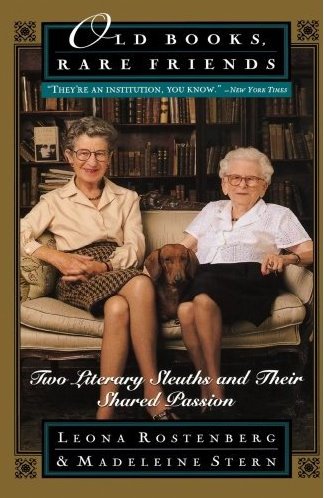 Old Friends, Rare Books is doubly a love story. About first, an incredible lifelong relationship. One which, the authors note, has been inferred to be sexual, but they say otherwise. That there had been men in their lives, and plenty of other friends, but in no one else did these women begin to find the sense of being so perfectly matched that they’d encountered in each other. Truly– as their joint autobiography attests to– Madeleine Stern and Leona Rostenberg speak in the very same voice, and mostly they’ve been talking about books since their meeting in New York at the beginning of the 1930s. And in recounting their adventures ever since then, the peculiarities of their relationship actually become quite unremarkable, or perhaps only as unremarkable as any extraordinary, enduring absolute partnership could be.
Stern’s work as a biographer brought much acclaim throughout her career– in particularly, her groundbreaking work on Louisa May Alcott. (And with a book on bookish connections, it’s worth noting that I only read Old Books, Rare Friends after seeing it referenced in Harriet Reisman’s new Alcott biography, which I only read because I’d read Little Women in the Fall, and I only did that because I’d found a battered copy in a curbside box two years ago and it had been sitting on my shelf forlorn ever since then). Rostenberg had completed a PhD dissertation on early printers and publishing, but it was unfairly rejected– a wrong that thirty years ago was righted with the granting her degree in 1972. In the meantime, she’d opened up her own business as a rare book dealer, Stern joining her a few years later, and their book recounts their adventures exploring bookshops throughout the world in search of precious volumes, which did have a knack of turning up rather serendipitously. Their sleuthing/detection skills were also put to use in their discovery of Louisa May Alcott’s vast body of salacious short fiction, published in 19th century periodicals under a pseudonym. This find would cast Alcott’s reputation as a kindly writer of children’s fiction into a new light.
All of which are part of this book’s other compelling love story– Stern and Rostenberg’s lifelong affair with books. An enthusiasm made contagious through such vivid and engaging prose. Truthfully, sixteenth century ephemera isn’t my cuppa tea, but I started to wish it was. Their adventures in literary sleuthing were like Possession but in real life! Their extraordinary lives were such a grand adventure, the stuff of a book lover’s dream.
I am so grateful for the literary luck that put me in touch with this marvelous volume. Love love love.
Happy Valentines Day.
February 11, 2010
Can-Reads-Indies #3: Wild Geese by Martha Ostenso
 I wasn’t the only reader for whom the highlight of Canada Reads 2009 was Michel Tremblay’s The Fat Woman Next Door is Pregnant, which was a book that we all should have read, that we were all better for having read, but I would never have picked it up otherwise. Sometimes the prospect of looking to the past for books we should have read is a bit like contemplating getting into Joyce Carol Oates– where do we start, and how would we ever be able to stop?
So it’s nice to get a bit of guidance, and I feel the very same about Martha Ostenso’s Wild Geese, which I’d never even heard of until I encountered NCL obsessive Melanie Owen online. In its day (1925), Wild Geese was a bestseller, was even made into a film, and heralded a new direction in Canadian fiction (though I’m not sure who followed in that direction– Sinclair Ross? Hugh MacLennan? See, with this early stuff, my knowledge is very sketchy. I read Ernest Buckler once. Anyway…)
Wild Geese takes place in a rural community in northern Manitoba. Schoolteacher Lind Archer arrives to board with the Gare family, and quickly realizes that something is amiss– somehow Caleb Gare has got his wife and children stuck under his thumb, and they’re terrified of defying him. He works them like animals on the farm, keeps them isolated from the community, wields his power with brute force, and he takes care to bully and blackmail his neighbours on the side. Caleb has met his match in daughter Judith, however, powerful in spirit and body (she reminded me so much of Jo March), who is desperate to get away from her tyrannical father and is inspired by Lind to finally do so.
“Powerful” is overused as an adjective to describe a book, and I wish I could coin a new way to describe exactly what Wild Geese does to its readers. The book was engrossing in way I’ve not very often experienced– closest comparison is my Andrew Pyper nightmares. Usually I read at a distance from novels, keeping the literary world and my own sensibly divided, but parts of Wild Geese crept into my consciousness. I read the chapter where Lind comes home in the dark and keeps making out creepy shadows and shapes behind her and around her, and I read this in the middle of a sunny afternoon, but I was freaked out. Similar, the conclusion– I absolutely couldn’t take it anymore and had to skip to the final pages to prevent a heart attack.
I also had such strong feelings about Caleb’s wife, Amelia Gare. Caleb had married her aware that she’d previously had a child out of wedlock, and he uses this knowledge to control her throughout their marriage. The control, however, comes from Amelia’s fear that Caleb would tell her son of his background (which he had been blissfully unaware of, told he was well-born, by the priests who’d raised him). Amelia’s feelings for this son are so strong that she is willing to sacrifice her other children for him, the spirited Judith in particular, and this absolutely enraged me as I read. Perhaps more than Caleb did himself.
Caleb Gare is a fascinating character, soft-spoken in the creepiest way possible. At first, I thought he was simplistic, his purposes far too blatent– Ostenso has him rubbing his hands together whilst surveying his land, wondering, “what the occasion would be, if it came to that, which would finally force him to play his trump card, as he liked to call it… He firmly believed that knowledge of Amelia’s shame would keep the children indefinitely to the land…”
But when I saw him interacting with members of the community with similar schemes and tricks, manipulating and blackmailing, this behaviour with his family began to seem very consistent. Caleb Gare is a completely unsympathetic character, and I am not sure this equals a lack of complexity in his moral make-up. We are tuned these days to see such characters as poorly drawn, but I’m not sure now. Ostenso has Caleb Gare making sense: everything he did was for his own gain– he worked his family hard so that he wouldn’t have to work as hard himself or pay anyone else to do so, he worked his neighbours to get his hands on their land and therefore expand his own power. He delighted in this power too, perhaps his only source of joy, save for his land, and there is a vital relationship between the two.
In addition to his sheer meanness, we are supposed to see Caleb Gare’s connection to his land as part of the motivation for his behaviour, but this is a given, not wholly explored. Which I’ve found in a lot of books, actually. It’s taken for granted that land can make a man do certain things, but I’m often left wondering exactly why. Ostenso does show that Gare (through using his family as slaves) is able to reap a bounty from the harsh northern lands in a way his neighbours are unable to do– that his domination extends even to the crops he commands. But I would have liked to know more about why Caleb feels the way he does about his land. It could be, however, that we don’t know how he feels the feels and thinks very little beyond his conniving. That Caleb is absolutely spiritually bankrupt, and this does seem to be the case.
Ostenso’s treatment of the landscape itself is vivid, of the inhabitants, and elements of Norse mythology informing their lives lends to the spooky treatment. The depiction of the land is also remarkable for the way in which the delicate, lovely and elegant Lind Archer’s contrast with it. Her presence as a foreign object in this strange brutal place is the catalyst for all that transpires, and also gives us a perspective on the Gares from without, which is most illuminating. Her relationship with Mark Jordan, another recently transplant (who is Amelia Gare’s illeg. son! This is not a spoiler, however, as we’re told from the outset) provides also provides necessary relief from the brutality of all other human relations.
In short, unlike much Canadian prairie fiction, Wild Geese didn’t make me want to kill myself.
From about midway in, I was rapt by this book, but there is one big reason why it won’t be top of my list of Canada Reads: Independently picks. Primarily, the way in which the prose of Wild Geese manages to sometimes reads like an undergraduate essay on Wild Geese. Such as when Lind Archer says, “That’s what’s wrong with the Gares. They all have a monstrously exaggerated conception of their duty to the land– or rather to Caleb, who is nothing but a symbol of the land.” There is something particularly ubsubtle about the book’s structures, particularly when compared to the complexity of a book like Century.
Still though, it’s a riveting read, pushes its language and imagery in challenging directions, is unafraid to shy away from uncomfortable or even horrifying situations, and tackles female sexuality in a beautiful way. (Yes– Canadian fiction in which the woman gets to be the horse, for once.) If this book is underread, it should be no longer.
Canada Reads I
ndependently Rankings:
1) Hair Hat by Carrie Snyder
2) Century by Ray Smith
3) Wild Geese by Martha Ostenso
January 25, 2010
Can-Reads-Indies #2: Hair Hat by Carrie Snyder
 Well-executed books of linked short stories such as Century or Hair Hat have the rare power of making the novel look mere. Mere as in only linear, one-dimensional, and narrowly focussed, which is nothing like life or like the world. Whereas the shape of a book of linked stories is like the world, or rather, like the world if it had edges– polyhedronal. Multitudinous sides, perspectives, but only glimpses of these. And so perhaps the novel has the advantage of providing the reader with more satisfaction in its illusion of wholeness, but for the reader who is seeking something a little more true, linked short stories are as close as it gets in fiction.
The stories in Carrie Snyder’s Hair Hat are linked by a man whose hair is cut into the shape of a hat. A creepy cut to ponder, and even someone standing immediately before Hair Hat Man declares the style only “plausible”. Of course, I had to google it, and this guy seems to be the most famous Hair Hat Man on the internet. Carrie Snyder’s Hair Hat Man, however, looks a little different. In fact, he looks a little different to everyone who encounters him, older or younger, shabby or less so, weary or sinister, friend or foe.
“Yellow Cherries” is told from the perspective of a young girl staying with her Aunt, Uncle and cousins while her mother is having a baby. A later story, “Comfort”, is the Aunt’s perspective of the same events, but the events subtly different, calling into question notions of memory, narrative authority and underlines the gulf between what adults and children understand about one another. “Tumbleweed” and “Third Dog” are both stories of motherhood, the first about a mother taking her children on a disasterous beach outing on the day her husband has (perhaps?) left them, and the second a grandmother taking her grandson for a walk one summer day, pondering her daughter’s unhappiness as she relieves her of her maternal duties for a small time. A most vivid moment is the daughter upon their return home, (the narrative is in second person, spoken from granddaughter to grandson): “Give me the baby!” said your mother, running to the back door to greet us. “
It doesn’t take much: the urgent nature of her exclaimation, that she is running, that it’s the backdoor. Snyder uses her materials with such deftness that she almost makes prose look easy, and indeed Hair Hat is a breezy read. But each word, every sentence is weighted, to be considered. Such a wide range of characters, but Snyder is deliberate in showing the different ways that each one speaks.
The narrator of “Harrassment”, for example, who speaks like he’s spouting off, and then we realize he’s erupting. He’s one of several characters who are loners, for whom the Hair Hat Man is a point of connection. Queenie, the obese doughnut shop employee in “Queenie, My Heart” who has just lost her father is another, and on her second encounter with the man, on the subway, the beginnings of a romance are sparked. In subsequent stories, we view this odd pairing from afar, but there is something heartening about their relationship. We’ve only been watching Hair Hat Man from the periphery, observing him as an oddity, but we’re beginning to connect with him too, and he’s somebody we care about.
As the book progresses, we move back and forth in time to get closer to the Hair Hat Man’s story. When we finally encounter him directly, he is so familiar that the hair is plausible, and perhaps the least remarkable thing about him. But still, this is only an extended glimpse. This story “Missing” is from the perspective of his long-lost daughter’s own daughter now grown, given up for adoption and now returned to find him, Hair Hat Man, her grandfather. “I should have brought along a camera. I should have asked a passerby to take a photograph of the three of us. Next time, I thought. But next time is so rare. It’s a hummingbird in the rose bushes: blink and its possibility is gone.”
Not so much for a book, however, for like Century, Hair Hat is a book that begs for rereading. Unlike Century, it is also a book that I would have found my way to, even if not for Patricia Storms’ recommendation. Carrie Snyder’s book with its distinctive cover had been turning up before me increasinly often of late– at the library, at the Eden Mills Festival in September at The New Quarterly booth where I entered a draw to win it but didn’t win. Carrie Snyder had stories published in the most recent TNQ as well, and I was excited to read more of her work once I’d finished reading them.
All right, this ranking thing is terrible when all of the books in question are wonderful. Like choosing between your children, it is, when none of them have colic and they sleep for twelve hours every night. I am going to have to rank Hair Hat over Century, however, because for being less ambitious in its vision, Hair Hat realizes that vision with more success. Or perhaps that I’ll have to read Century thirty-five more times before I get my head around it finally, or that no matter how many times I read it, I never will. For all my derision of readers “seeking the illusion of wholeness”, perhaps I want a bit of it myself, and Hair Hat offers. But this doesn’t mean, I promise, that I love Century any less.
Canada Reads Independently Rankings:
1) Hair Hat by Carrie Snyder
2) Century by Ray Smith
January 23, 2010
The Sweetness at the Bottom of the Pie by Alan Bradley
 In Alan Bradley’s novel The Sweetness at the Bottom of the Pie, our heroine, eleven year-old Flavia de Luce opines that, “Heaven must be a place where the library is open twenty-four hours a day, seven days a week.” So that it occurs to me that heaven must also be a narrator like Flavia de Luce, who is perfectly precocious in all the right places and suitably limited in others. The latter point being particularly important, because Flavia is the first fictional detective I’ve ever encountered who solved the crimes slower than I did. Not that she’s stupid, oh no, not Our Lady of the Periodic Table of Elements, but hers is a refreshing perspective when her youth shows through.
And yes, in this, she’s much like Harriet the Spy. Or rather, Flavia is a tribute to Harriet, though I wonder how consciously? At first glance, the connections could be coincidental. Flavia is sleuthy, and keeps a notebook, and that she’s charged with the spirit of her late Mother, who was called Harriet. This last point I doubt Alan Bradley means for us to interpret as Flavia being of Harriet (M. Welch) born, mostly because I don’t think male readers identify with Harriet that strongly. (And this, by the way, I’d love to be wrong about).
But I encounter the following paragraph: “I was me. I was Flavia. And I loved myself, even if no one else did.” And I can’t help but think that Bradley was channeling his inner-Fitzhugh after all.
Flavia lives Buckshaw, a grand home outside the English village of Bishop’s Lacey. Her eccentric father scarcely pays her attention, her older sisters torture her mercilessly, the entire household lives under a shroud of sadness from her mother’s death, but Flavia contents herself mixing poisonous concoctions in her chemistry lab at the top of the house. When a dead bird lands on the doorstep, however, with a postage stamp stuck through its beak, and then then a body turns up in the cucumber bed in the garden, Flavia is aware that life is about to get interesting for the very first time. And when her father is arrested with murder, she becomes all the more determined to solve the crime herself and clear his name.
Bradley writes Flavia tongue-in-cheek, his novel a send-up of detective fiction, but he manages to create a rather intriguing mystery all the same. Involving philately, libraries, English reticence, postmistresses– a whole host of infinitely nerdy pleasures. A whimsical book, Bradley writes gorgeous turns of phrase to match– my favourite was when Flavia steps into her dead mother’s long-undisturbed bedroom and feels as though she were “an umbrella remembering what it feels like to pop open in the rain.”
The Sweetness in the Bottom of the Pie is a book built on a the back of other books, on the back of a whole literary tradition, and its charm lies in its references to a world already much beloved. The connections it draws and its own twisty plot make for a deliciously readable delight.
January 18, 2010
Kiss the Joy as it Flies by Sheree Fitch
 Two and half days of my last week were spent in the absolute bliss of reading Sheree Fitch’s first novel Kiss the Joy as it Flies (shortlisted for the 2009 Stephen Leacock Medal for Humour). I’d previously only read Fitch’s wonderful children’s book Kisses Kisses Baby-O!, but love it so much that when I discovered Fitch had written a novel for adult readers, I had to read it. Though I began reading with a degree of uncertainty: the story of Mercy Beth Fanjoy, who receives a troubling medical prognosis and decides to stage a clear-out of her messy life in the time she has left. This sort of formula could go either way, and very quickly in, I was pleased to find Fitch had gone in the right one, with sprightly prose and a narrative packing a punch. The novel is wonderfully original, although if pressed, I’d have to call it as Fannie Flagg meets Miriam Toews.
In Kiss the Joy as it Flies, it’s not so much plot that accelerates as the language itself operating on sheer gumption, and the spirit of Mercy Fanjoy picking up speed as she comes into her own. Though things happen– people die, hopes are dashed, love is born, battles are fought, illusions are shattered, triumphs are won, and lessons learned. The stuff of life with a wacky cast of characters who are constructed as types– religious zealot mother, loyal friend, hippie daughter, enigmatic dead father, sex god– but each of them excellently crafted with the most remarkable ability to surprise you.
Mercy Fanjoy is wholly embodied by Fitch’s prose. The fact of the disease that lurks inside her, and her buxomness, and her sexuality, and when she expresses milk from her engorged breasts into the bathtub during a flashback in which she remembers her teenaged, single-mothered, basement-apartmented self. Two decades on, Mercy has come a long way– she’s reconciled with her difficult mother, earned a university degree, she pens her own column in the Odell Observer, has raised her daughter, bought her own house, teaches a creative writing course, and has maintained a lifelong relationship with her best friend Lulu. She still holds a grudge against horrible Teeny Gaudet (who has since gone onto fame as bestselling author of the “Burt the Burping Bear” series of children’s books), but you can’t win them all.
Over the week she seeks to put her life in order, Mercy finds herself becoming unhinged, and emerging from a rut she’s been stuck in too long. In the end, just about everybody in her life surprises her, but she manages to shock them right back, tenfold. And while it’s raw, we’ll get our hearts warmed, and Fitch also pulls of a satire so slick, we can’t help laughing, and I suppose that this is what she means by “the sheer mad joy of all of it.”
January 15, 2010
Can-Reads-Indies #1: Century by Ray Smith
 Its sombre cover coupled with my misunderstanding that Ray Smith had eschewed story for higher principles would have kept me from Century: A Novel, were it not for Dan Wells’ recommendation. I thought this was a book that wasn’t for me, not only in a “not my cup of tea” sense, but that it was meant for a more erudite kind of reader for whom the act of reading is not meant to be a pleasure cruise (“Sweet Thames, run softly till I end my song… Wallala leialala“).
So it is my surprise to find I love this book, that it contains everything I look for as a reader, including that most unfashionable self-contained universe. That Smith may have eschewed traditional narrative structure, but he has done so only to compress a 500+ page novel into his first 98 pages, to represent the disintegration and disorder present in the universe the book contains, to have Century be what it’s meant to represent. And that his writing possesses a sympathy for and understanding of women that I found surprising, and striking, and even (dare I suppose in a book such as this?) somewhat heartening.
Heinrich Himmler didn’t shock me. Perhaps I’m just being defiant in my reactions, but Jane Seymour, the young woman in 197o’s Montreal who receives his ghostly visitations in her bed, the nightmares in which he touches her naked body (but oh, I was struck by the details– “the buttons on the cuffs of his sleeve caught on the sheet when he reached under to touch…”)– there is context for her, precedent. Of course, her friends suppose that she has undergone a trauma, perhaps she has been raped, which has led to the visions, which leads to her suicide. And that may be so, but the whole thing is the extreme end, I think, of how ordinary girls become obsessed with Nazism, which manifests in more usual terms with an Anne Frank fascination and YA books about the Holocaust. As a kind of dangerous experiment in empathy, though of course the Holocaust is so sanitized in such literature, but there is a thin line there, and I just think that Jane Seymour has crossed it for one reason, or for many.
But now I’m off on a kind of tangent. Kenniston Thorson, protagonist of the latter half of Century (and perhaps Jane Seymour’s grandfather) goes off on something similar, its conclusions more succinct than mine, but this result, he is told, “comes not from your mind wandering, but rather from your mind turning its subject round and round as a sculptor considers his piece”. Which is a good way to describe a reading and/or consideration of Century for two reasons: one, because it has so many angles, perspectives that I don’t think it could be taken in all at one time, as one thing; and two, because in reading Century, the reader does become sculptor, a book so fragmented requiring its reader to engage by putting the pieces together, thus coming to recreate it in their own way (so I am very sure that your Century will be altogether different from mine).
“The truth is to be found in the way many different things fit together in relation to one another. In a sense, because the relationship, not the parts, has the truth, the whole is greater than the sum of its parts.” Though Century is doubly complicated in that its parts are so much apart, and yet this makes the relationships between them all the more remarkable. Between the first four stories in the book’s first half “Family”, which in various ways tell of Jane Seymour’s family. The first story about the troubled Jane from the perspective of a male acquaintance who sees her problems as emblematic of women in general during these difficult times, the second story of Jane’s brother and his reunion with his wife following a period of estrangement, the third of Jane’s father after the death of his wife and at the end of a long career in African development and international diplomacy as he ponders what he has made of himself, and fourth about Jane’s mother some years earlier and we learn that her husband truly didn’t know her at all (and that though he suspects he didn’t know her, he has no idea just how much).
The second half of the book “Continental” is in two parts, from the perspective of American Kenniston Thorson, in Paris 1892, and Germany in 1923. Written as a period piece meant to be Jamesian (and where all the women talk like women in TS Eliot poems, sometimes deliberately word-for-word), the pace is different here, story less the point. And though the concerns of Kenniston and other characters intriguingly overlap with those from “Family”, I chose to see this part of the novel as a key to the first half. That is, in Kenniston Thorson’s conversations and deliberations about art, music, history and even French Onion Soup, we achieve an understanding of what Smith is accomplishing in “Family”, of how we might put its fragments together and regard them (or how we might choose not to and why).
But being a reader who seeks story, who traces plot, I did note the connection between Kenniston Thorson and Gwen Seymour, and I seized to that in order to steady myself. And though the plot was moving backward here, it didn’t matter, for we look back at history in just this way. To see that Ray Smith has encapsulated a century (and not just “a” century, but “the” century) in a scant 165 pages, in the story of a family, of a marriage, of just one single woman.
And that woman doesn’t even exist, “there never was a Jane Seymour.” And as a reader who seeks story, who traces plot, this kind of trick didn’t deter me one bit, because I am also a reader who tries with reading to make sense of the world, and such blurred metafictional lines are the best way to do so: “These encounters enable me to hold the phantasm and the reality in my mind at the same time; this is much more interesting than either one alone.”
Century‘s is a pessimistic vision, “a world that bears too much truth”. A world in which the weight of being a woman leads to suicide, where imaginary gardens are not enough to shore against one’s ruins, where politics are an unchanging morass, and rapists are ordinary men, where “if man is only appetite: then all is barbarism…” And yet
.
Always “and yet”, because there is art at all made of it. Because at the beginning of the novel (which is close to the end in a sense, which is “now”), we find men and women finally not in opposition and that there is empathy; and because of the last line of the second story (which just might be the end, this is a novel in fragments after all and we can do with them what we may): “and they lived fairly happily for quite a while afterwards.” Which is really the best we can hope for in this life.
And is Century a novel? I vote yes, because its truth indeed lies in how its pieces relate to one another. Because I read the Gwen story “Serenissima” on its own once upon a time, and it seemed to “just be another piece of improbable pornography”, but it the context of the rest of the book, I knew everything about her and she broke my heart.
Anyway, it occurs to me that this response to Century has done it no favours. That its biggest problem is that no one is ever going to to say, “Hey, read this” with a snappy one-sentence reason why. That it raises questions without answers, and begins an engagement that is unceasing, and it’s more like someone handing you pieces of a puzzle than recommending you a book. Except you get to rearrange the pieces over and over again, which is infinitely more interesting, but frustrating too.
It will be hard to compare this book to others, because its level of engagement is on its own kind of plane. I’m not sure whether this will be points for or against it when it comes time to rank it against the other books. Apples to oranges perhaps (though both are delicious). So I’m glad I read it first, and I’m glad I read it at all, and I do hope I’m passing something on of its spirit, and others are inspired to read it too.
Canada Reads Independently Rankings:
1) Century by Ray Smith
January 11, 2010
Louisa May Alcott: The Woman Behind Little Women by Harriet Reisen
 I was confused every time I came across the name “Louisa” in Harriet Reisen’s biography Louisa May Alcott: The Woman Behind Little Woman. Louisa? Who was this “Louisa”? For I was reading about Jo, wild, topsey-turvey, irrepressible Jo March, of course. Jo, whose identity was claimed by Alcott unabashedly, because her fiction was an amalgam of her own experiences and dreams of better things. That Louisa May Alcott had to tone reality down a bit to make Jo’s story believable, however, means that her biography is bound to be devourable. And in the most capable hands of Harriet Reisen (who writes like a novelist), the book most certainly is.
Admittedly, as Alcott’s biographer, Reisen did have certain advantages. Louisa May Alcott left quite a paper trail, of journals and scribblings, and an enormous volume of work produced over a very prodigious career. She annotated her own journals over time. Her parents, siblings and many associates all kept journals throughout their lives. She was associated with characters such as Thoreou and Emerson who themselves are objects of great interest. And Reisen is following in the footsteps of other Alcott biographers whose literary sleuthing resulted in the uncovering of Alcott’s pulp fiction and thrillers that were published under the pseudonym of A.M. Barnard.
Reisen’s other advantage was that Louisa May Alcott was absolutely fascinating. The daughter of famed Transcendentalist Bronson Alcott (who Reisen contends made his greatest fame on the back of his novelist daughter’s reputation), a peer of Thoreau and Emerson, Louisa grew up in a family guided by his eccentric whims. These whims make a storied tale, though their result was that the Alcotts were frequently destitute, desperate, much in debt, so that the four daughters had to work for a living from a very young age, constrasting them much from their mother’s socially prominent Boston family.
Work, which became the name of one of Alcott’s autobiographical novels, is one of the most interesting themes of her life. Seeking independence from and support for her family, she work as an invalid’s companion, as a teacher, a governess, as a seamstress– “Needlework offered one great advantage over teaching: ‘Sewing won’t make my fortune, but I can plan my stories while I work, and then scribble ’em down on Sundays.'” She served a nurse in the American Civil War, which was the subject of her book Hospital Sketches. And yes, she wrote, exhaustingly– children’s stories, fairy tales, thrillers and lurid tales, novels and sketches, and short stories– earning enough to support herself, which Reisen notes was as rare for a writer then as it is today.
Of course, Louisa was not exactly Jo. Reisen reports of fans that flocked to her house and were disappointed “(sometimes to the point of tears) to find an old curmudgeon instead of spunky Jo”. Alcott was subject to extreme moods, periods of ill health, and the positive outlook so prized by the Marches was more easily aspired to than attained. Her own childhood experiences had been mined of their most extreme hardship before appearing in Little Women, she’d given Jo a different type of father, the March family’s was a much more just kind of world.
But Jo she was, nonetheless, just as her older sister Anna signed fan letters as “Meg”– noting that she lacked Meg’s good looks, but Louisa had decided that “someone had to the beauty”. Louisa may have even referred to herself as “Jo” in her journals, or else her first biographer had made the error whilst transcribing the journals, which is emblematic of how the fact and fiction began to further blur.
Which means that Reisen had some literary sleuthing of her own to perform, and she did turn up long-lost transcripts of interviews Alcott’s neice Lulu (who was one of the last living people to have known the author). Having such an enormous number of resources at her disposal must certainly have been an advantage, but to pick and choose and then join them so seamlessly would have been no mean feat, and Reisen proves herself up to the task. To have brought Alcott to life, in such vivid Jo-ishness is a remarkable achievement, a credit to the subject, and the whole book is absolute marvelous and inspiring to read.
January 5, 2010
L.M. Montgomery and The Blythes are Quoted
My Quill & Quire review of Jane Urquhart’s Extraordinary Canadians: LM Montgomery and Montgomery’s The Blythes are Quoted (edited by Benjamin Lefebvre) is now posted online. I enjoyed both of these books immensely, and found The Blythes are Quoted fascinating to consider as a example of Montgomery’s work in progress, though perhaps not a typical one as this book has something of a peculiar genesis. And the Urquhart biography is wonderful– as enlightening as Mary Rubio’s but in an accessible package for a more casual read. There is so much about Montgomery her readers don’t know, and how much richer is her writing once they do.
Anyway, my review is here.
January 5, 2010
Burmese Lessons by Karen Connelly
 As I received this book for Christmas and read it over a couple of days of bookish holiday bliss, my brain is far too mushy in regards to it for a formal review, but I don’t want to miss my chance to let you know how wonderful it is. I read Karen Connelly’s novel The Lizard Cage in 2007, it’s stayed with me ever since, and it made a Burma a place that’s important in my mind. I certainly thought of Teza as I read news coverage of the Saffron Revolution later that year (which was not really a revolution in the end, but for a while it was the promise of something). Connelly’s novel was formidable in and of itself, but that a Canadian woman had managed to so well articulate the story of a male Burmese political prisoner was quite remarkable.
Connelly’s new book Burmese Lessons is partly the story of how she came to write The Lizard Cage. I say “partly”, because Burmese Lessons is “about” many things, strands of experience from that time in Connelly’s life, plaited together in a gorgeous construction. The book is subtitled “A Love Story”, and much of it is the story of Connelly’s love affair with Maung, a Burmese dissident guerrilla fighter. But theirs is not the only “love story”, strictly speaking. In the book, Connelly writes of her effusive love for the whole world, this one country in particular, and every corner of it, and its language and its people, and its beauty, and she seeks an understanding of its ugliness too. Her passion resonates throughout the text, whether she is describing the people she sees, the food she eats, those she conflicts with, the politics of Burma, the situation on the Thai-Burmese border, or sex with Maung (and there is much of the last one). Burmese Lessons is very much a story of the body, of sex, of violence she witnesses inflicted upon Burmese protesters, of the sick children she sees who are dying of malaria, of her own experience with malaria, of living in the jungle and not having a bowel movement for days and days and days. Connelly holds nothing back here, and her passion is clear with every line.
As well as a novelist, Connelly is a poet and a non-fiction writer, and her prose demonstrates such deftness. After more than a decade dealing with Burmese politics, she also knows her stuff, and holds nothing back either regarding the brutality of the Burmese junta, the realities of life in the Burmese refugee camps in Thailand, and the violence that human beings enact toward one another. This is not an easy book by any means, but its various strands are entwined so as to counter heavy with light, to enlighten and enliven, to make reading the whole thing in a day or two a serious delight.
If you haven’t read The Lizard Cage, you really should. And then when you’re finished with that, read this to find out everything else, what Connelly couldn’t hope to contain in her other book. Which is to say that Burmese Lessons is a serving of leftovers of a sort, but it would have been a sin to have them go to waste.






