January 30, 2011
By Love Possessed by Lorna Goodison
 Full disclosure would necessitate me revealing that Lorna Goodison was once my teacher, but I’d be telling you this less to note the otherwise non-existent relationship between Lorna Goodison and I than to have you know that Lorna Goodison was once my teacher, and she was wonderful. And though she is best-known as a poet, her new book By Love Possessed is strange and beautiful, collected stories written over more than two decades, and I had the gorgeous benefit of hearing Goodison’s own voice in my head the entire time that I was reading it.
Voice is integral to the entire collection, whole passages consisting of disembodied dialogue, which breaks a cardinal rule of creative writing, except that the talk is as such that you can imagine exactly who’s saying what, and what they’re doing as they do. Each story also delivered in its own particular tone, dialect as a distinguisher of class and character (but not necessarily “Character”). The story is in the telling as much as in the stories themselves. The range of voices is immense, unsurprisingly for a collection written over such an extended period whose stories would first appear in many different places, and the range of stories is as well. But Goodison manages the effect of the whole to be harmony instead of cacophony, music set against the backdrop of her native Jamaica.
These are not stories written by someone with that rather ubiquitous label, “Master of the form”. I will bring forth no comparisons to Alice Munro or Mavis Gallant; Goodison has less mastered the short story form than put her own peculiar spin on it, rendering the collection full of surprises. Such as where she is going in a story like “The Helpweight”, two old flames meeting years later and speaking lines from a play, but the lines don’t mean what we think they do, though we get the gist of it a few stories into the collection, Goodison’s male characters often being charming cads capable of talking their way into and out of anything. Their women are long-suffering, worked to the bone. A sense of nostalgia imbues the entire collection, characters looking back over the years to mine how much they’ve lost (or how much they’ve found).
“The Helpweights” takes a woman to her breaking point, when the man who long ago broke her heart returns to Jamaica with his Irish wife. In “Jamaica Hope”, it is explained that “Jamaican man married because them tired” , and Alphanso becomes tired enough to finally say yes to Lilla. “Bella Makes Life” begins with the striking image of a woman who’s dressed like a checker cab, returning to her husband and children after working in New Yorker, and her husband finding her more and more changed every time. “By Love Possessed” is the Pushcart Prize-winning story of a mismatched couple, the woman of whom becomes victim of her own pride:
“She would have forgiven him for breaking her precious things; she would like to have been able to tell the story of how bad her man was and about the day he broke everything in her china cabinet and boxed her down the steps. But he was gone, so what was the point.”
The dialogue in “House Colour” is biting and ends on a perfect note. Love goes wrong in “Angelita and Golden Days” as “Slack Goes Cultural”. From “For My Comrades Wearing Three-Piece Suits”, delivered by a man in prison burdened by principles everybody else managed to shake off long ago, we go to “Mi Amiga Gran”, from the perspective of a teenage girl whose mother in America is always late sending money, and how the girl is not quite alone in the world yet. “I Came Through” wears its melodies on its sleeve, a retrospective via interview with a woman looking back at her long career as a singer, her troubled personal life, her betrayals, and her underlying strength.
The collection is long and could stand to have been pared down a bit, and yet, I understand why it wasn’t, each story adding something unique to the whole. These are stories so absolutely invested with story that you might not even realize they were written by a poet, except, of course, for the language and the music it makes.
January 19, 2011
Canada Reads Indies 2: Be Good by Stacey May Fowles
 I’ve developed an aversion for any book described as “gritty”, mainly because “gritty” has lately been synonymous with “badly written stories about troubled girls who exchange blow jobs for heroin”. As though addressing sex, drugs and self-harming is merit enough that the writing itself doesn’t have to be good, the book doesn’t have to be interesting. This whole approach also failing to address the reason why so many fictional girls are exchanging blow jobs for heroin, because, frankly, this is troubling, but I digress.
So I was relieved to find that Stacey May Fowles’ first novel Be Good had more going for it than sheer grittiness. The book is about two friends who struggle with their feelings for one another, and end up on opposite sides of the country in unsatisfying relationships. Hannah has just left Montreal to follow her boyfriend Finn to Vancouver, while Morgan has been traveling Europe on the dime of her older lover Mr. Templeton. The novel comprises a series of flashbacks and snapshots which culminate to the story from a variety of perspectives– Hannah’s, Morgan’s, her roommate Estella’s, Finn’s and Mr. Templeton’s, as well as that of disembodied narrative voice that seems to be curating the collection.
The propensity towards falsehood and self-delusion (the latter never as effective as the former) on the part of Hannah and Morgan, as well as the fragmented nature of the narrative, ensures that “what really happened” is never clear, nor does it need to be, and that it’s what characters think happened which is more important (and always fluid). Ambiguity, embellishment, storytelling and outright lies are narrative methods as valid as truth, and perhaps even more valid for their unwillingness to adhere to the limits that truth imposes.
Hannah and Morgan are trying on various to guises to discover what’s at their core, chasing after different fantasies of the kind of women they might actually be. They pose drinking on fire escapes, imagining the world throwing them admiring glances, enacting magazine shoots, an impression of unreality. They dress up in costumes, imagine that the self is composed of details like grape bubblicious, see themselves from the outside and work that image down to the smallest detail. They see their friends as accessories, every new scene a set-up, that the world can be so deftly manipulated, that the people are so plastic.
Be Good is a coming of age story, the turning point occurring with Hannah’s line, “Perhaps the issue is not what people see in me but rather what I see in them.” Which is a revelation from a woman of any age, really. To step out of gaze and take stock of where you are. Though of course the conclusion is not so simple– it’s never clear whether each of the separate perspectives are actually different narrators, as there is a sameness to the voices. And though Hannah is the wordsmith of the two, Morgan is a famous fabricator, and so it’s possible that the whole book was hatched in the head of either of them, imagining the self as seen through the eyes of others. This last point being what makes Fowles’ book more interesting than other grit-lit– with all that ambiguity, this story is solipsistic with a twist.
Which is in constrast with Thomas King’s Truth and Bright Water, whose narrator is entirely self-effacing, but the two books share much else in common. Both are coming of age stories in with the protagonist’s relationship to the story isn’t always clear, in which he or she knows more or less than he/she lets on. Both books play with ideas of superficial poses, the natives playing up their culture on Indian Days not so far removed from the girls on the fire escape. Both books also have an ambiguous relationship to truth and fact, and choose to overlook these items in favour of a good story. Truth and Bright Water is also quite gritty, also with lesbians, suicide, sex, drink, drugs and destruction, and both skim a facile narrative surface belying darker stories underneath.
It’s just that in King’s book, however, we know that the darker stories are certainly true, and no longer are these poses anymore. His story wedded to a long, long history, whereas Fowles’ book and their characters seem to exist outside of time. King’s subtext more substantial too, unsurprisingly as insubstantiality is Fowles’ preoccupation here, but if we’re comparing books (which we are), King’s comes out the richer. If we weren’t comparing books, however, these two would stand side-by-side, drawing fascinating connections from one another.
Canada Reads Independently Rankings:
1) Truth and Bright Water by Thomas King
2) Be Good by Stacey May Fowles
January 18, 2011
The Torontonians by Phyllis Brett Young (and Betty Draper)
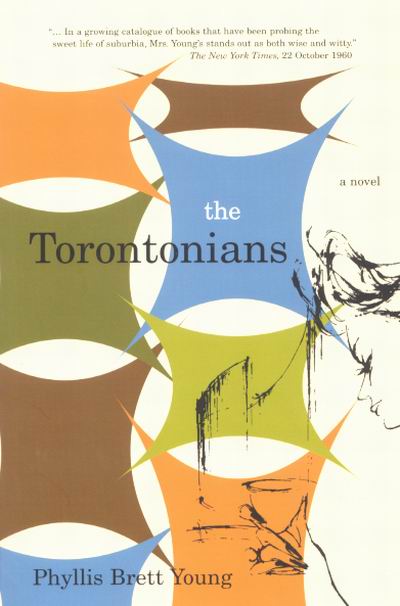 Phyllis Brett Young’s 1960book The Torontonians is not necessarily to be read as a stunning example of the novel form. The satire and irony have been rendered most unsubtle in the years since its first publication, so that The Torontonians reads more like Cyra McFadden’s The Serial than a remarkable work of literature. Remarkable, however, The Torontonians most certainly is when it is read for its feminist content and Toronto setting. It’s a fun read too, and in places very funny.
Published three years before Betty Friedan’s book, The Torontonians is The Feminine Mystique put to fiction, except that Young makes clear what most modern readers of The Feminine Mystique miss: the new woman problem is not so much with the domestic sphere itself, but rather with what consumerism has done to it. Women have never had it so good, except that their labour has been alienated from production via labour saving devices, which don’t actually save labour but just create more jobs to do. And then they’re expected to be fulfilled by the material goods that decorate their houses, and adorn their yards, and when they fail to be, nobody can imagine what could possibly have gone wrong. In its critique of consumer society, Young’s novel anticipates Atwood’s The Edible Woman.
The Torontonians also employs that setting so familiar from Atwood: the city of Toronto. London’s creeping here too, as Karen Whitney’s home on the city’s outskirts overnight becomes the centre of suburban Rowanwood (which was modelled on Leaside). One of the most enduring images of the novel is the Whitney’s buckweed lawn, which they’re forced to spend a summer painstakingly installing because they can’t afford to lay down sod but also realize their neighbours are running out of patience with their uncultivated grass. Rowanwood is the kind of neighbourhood in which a house with just one bathroom is frowned upon for dragging down the market value of the others.
In her novel, Young paints a picture of Toronto in the midst of transition, juxtaposing the suburbs against downtown where Karen had grown up in the Annex neighbourhood. She writes of a Toronto elite (“the Masseys and the masses”) who were all familiar through family connections, and attended the same private schools. But the city, howeer constant in its hum, is always changing. With some of her scenes set against pre-CN Tower aerial views, she shows that no one ever steps into the same city twice.
Young’s novel is a historical document, and deliberately so, as as the book’s introduction makes clear. She thought it was important that  writers document the way people lived then, and so we get a story in which doctor and patient both smoke during an examination at the Medical Arts Building at Bloor and St. George. We read about a city in which the subway was new, New Canadians were usually Hungarian, downtown high rise apartments were novel (and an exotic dream for the bored housewives of Rowanwood). There is the Peyton Place-ish suburban sex too, and a very funny line about who’d do what in Loblaws, but Young shows restraint here. By the end of the book it is quite clear that her people are not caricatures, and the narrative rises above plot cliches.
(The Torontonians is also very, very Betty Draper, and is the first Mad Men-ish book of a few I will be reading in the next while. The others are The Collected Works of John Cheever, and Rona Jaffe’s The Best of Everything. Any other suggestions?)
January 12, 2011
Bound to Last: 30 Writers on Their Most Cherished Book ed. Sean Manning
 For two days this week, I was swept up in the pleasure of Bound to Last: 30 Writers on Their Most Cherished Book, which is edited by Sean Manning. A celebration of the book as object, of general bookishness which is a catch-all term including, “the tactile sensation of turning a page, the sight of my bookmark inching closer to the finish, then finally closing the book, hearing the whomp… the sense of accomplishment that brings” (from Manning’s introduction). I was certainly this book’s idea reader, but I loved it for more reasons than that I was simply predestined to do so.
This anthology was made by its diversity. The effect of this, however, was that it always took a few paragraphs to settle into each essay, each one so distinct from whatever had come before. These jarring entrances aside, it was always a pleasure to discover something new– writers male and female, old and young, an ex-solider and an ex-mobster, and even two essays in translation (yes, yes, yes! In particular because these are from China and Iran, and books as objects in these places have their own kind of stories to tell). Each essayist approaching their subject matter different, where the book itself had come from, how they brought their essay around to its point. Some of these were books lost to time or history, or books still cherished; books that had been read to death or books never read at all. Many essays begin with a portrait of the essayist as a young reader, perusing her parents’ bookshelves, and the books come to delineate family relationships, broken or otherwise. For some writers, the book in question is the only one they’ve ever kept, or else it’s just one in a vast library that fills entire houses (or two, in the case of Francine Prose).
I hadn’t heard of most of the 30 contributors to this anthology, and I knew of about as many of the books they’d brought, and yet this did not diminish my reading experience one bit. The essays were that good, and the subject matter so universal that it all resonated with me, familiar or otherwise. Some of the more notable contributors included Ray Bradbury, of course (whose piece, truthfully, was one of the weaker in the bunch), Francine Prose, Joyce Maynard, Elissa Schappell, Karen Green (who is the widow of David Foster Wallace, which I wouldn’t mention, except that it’s what her essay is about), and Karen Joy Fowler (who wrote the Jane Austen Book Club).
I loved Francine Prose’s “Andersen’s Fairy Tales”, which is about tracking down a disappeared book from childhood, about “the real book” as opposed to its impostors (which are available for sale on the internet, of course). Joyce Maynard’s “The Bible” tells her father’s story via a book she never read and doesn’t have now. And oh, I could go on and on about Julia Glass’s “Roar and More”, which is decades long– the first book she ever asked her parents to buy because she saw it read on Captain Kangaroo, and it so stayed with her that she wrote it into her own novel, and her quest for permission to quote the material introduces her to the book’s author, but only for a fleeting moment. Glorious, Anne Fadiman-esque, which is the highest compliment to be bestowed to this sort of thing.
And yes, “The Portable Dorothy Parker” by J. Courtney Sullivan, about all the girls just like her who show up in New York wanting to write like Dorothy Parker but have a different kind of life. And oh my, Rabih Alameddine and “The Carpet Baggers”, which was a novel he had in his childhood home in Lebanon– the book is lost when the house is destroyed by war, but he connects with it a few more times in a brilliant case of book fatedness. Finally, Jonathan Miles’ “Ship of Fools”, which had belonged to the mother he did everything to break away from, and then she was lost to him for good through Alzheimer’s Disease.
Books as objects are never just about the books, of course, and so this anthology encompasses the whole wide world. My only criticism of it would be the essays that plead their cases too hard against e-books and e-readers– such defensiveness is unnecessary, because the essays make the point without even trying. A book is a book, and there’s nothing else quite like it.
January 10, 2011
Canada Reads Indies 1: Truth and Bright Water by Thomas King
 The basic narrative of Thomas King’s Truth and Bright Water was more straightforward than I’d been expecting– Truth and Bright Water are, respectively, an American town and a Canadian Indian reservation, side-by-side at the bottom of Alberta. The story takes place in the summer days leading up to the “Indian Days” celebration in Bright Water (which attracts German and Japanese Indian-enthusiasts in particular), from the perspective of a young boy called Tecumseh. His closest companions are his cousin Lum, and his boxer-dog Soldier, the three of them roaming the area with its peculiar topography as familiar as the blue sky that surges from the mountains– mountain and prairie alike, the coulee, naturally occurring stone pillars rising from the river, the incomplete bridge between the two communities, the old church high on the hill about Truth.
One night out on the coulee, Lum and Tecumseh witness a strange woman throwing something in the river, and she appears to throw herself in after it. Closer investigation by the boys turns up a clean white human skull where they’d seen her jump in, but there is no sign of the woman, or the truck she arrived in either. The scene is troubling to both boys in different ways– a recent tragedy has claimed Lum’s mother, and he begins to conflate what happened to her and the woman they saw. Tecumseh is aware that something is not right with Lum, and disturbed by the skull also, but he is unable to articulate his concerns, and his parents are too consumed by their own affairs to notice that anything is wrong.
His parents’ affairs could possibly have something to do with the return of Monroe Swimmer (Famous Indian Artist) to Bright Water. Monroe, who has purchased the church on the hill but has shown himself to no one, has some kind of connection to Tecumseh’s mother. Tecumseh’s parents are separated, and his father continually embarks upon schemes to win back his wife which are about as sensible as his business ventures. Tecumseh’s looking for business ventures of his own, and ends up with a job with the elusive Monroe, who has begun painting the old church to blend in with the landscape.
Of course, the story is not entirely straightforward– there is a ghost, for example, though Tecumseh is not aware that she’s a ghost. In fact, Tecumseh is not aware of many things, which requires the reader to question on any straightforwardness the novel might suggest. But on a straightforward level, the novel still works, unlike, say, King’s Green Grass Running Water, which really requires a decoder ring to be properly understood. It’s only half the story, of course, but it’s still worth noting that this is a proper tale of a boy and his dog.
The novel is straightforward, however, the same way that Tecumseh’s mother’s quilt is straightforward. Woven into its fabric are hooks, feathers and other unusual objects. The shapes of the quilt tell its stories, but the stories aren’t quite what they seem. Tecumseh struggles to decipher the quilt as he does the whole world around him– none of his questions are ever answered; his parents keep disappearing; the bruises on Lum’s body are clearly inflicted by his father, but nobody does anything about them; and what about the woman having her hair cut in his mother’s salon who is convinced that Marilyn Monroe was an Indian?
The whole book could be explained away by allegory, and when I read it in graduate school, that is probably what I did. The symbiotic relationship of Truth and Bright Water showing that recent political borders are arbitrary, and that even Indian/non-Indian comes with a similar lack of distinctions– the Indians play up their stereotypical culture for the tourists, but their “Indianness” is far from King’s sole preoccupation with these characters. Or does glossing over such distinctions make matters worse? Famous Indian Artist Monroe Swimmer is painting out the church from the prairie landscape, obliterating the past (after years of working in museums and painting Indians back into the picture in the landscapes he “restored”): “Seeing that it has gone is one thing. Finding it now that it has disappeared is something else.” After all, that history can be so swept away is really just an illusion. Really, nothing is straightforward at all, and such subtle complexity is the novel’s great strength.
Truth and Bright Water is not without its weaknesses, however. Tecumseh’s limited point of view leaves too many gaps to make the novel as satisfying as I would have liked it to be, or perhaps the trouble is too many plots to be brought together effectively. Though the gaps have their purpose, and the too many plots is analogous to crazy shape of Tecumseh’s mother’s quilt, and that’s how life is. The subtlety of the novel also works against it– one could finish it and think they’d read a middling story about a boy and his dog. Though I enjoyed the story and found the ending particularly sad, its overall effect upon me was a bit underwhelming.
I’m glad I read it though, sort of a cheat of a reread, as I barely remember reading it in the first place. Truth and Bright Water requires attention and close reading that I didn’t apply to it before, so I’m grateful for the opportunity this time around. A very good book that gives the rest of the line-up quite a lot to live up to.
Canada Reads Independently Rankings:
1) Truth and Bright Water by Thomas King
January 5, 2011
Started Early, Took My Dog by Kate Atkinson
 Confession: I’m not especially crazy about Jackson Brodie, the sometime-PI of Kate Atkinson‘s exceptional crime novels. I mean, I’ve got nothing against the guy either, but that I’ll automatically read any book he appears in has far less to do with the man than his creator. Kate Atkinson is one of the best contemporary novelists in the English language, I only turned to crime (fiction) when she started writing it, and her crime fiction is as good as anything she ever wrote, including my favourite of her novels, the award-winning Behind the Scene at the Museum. The latest in her Jackson Brodie series, Started Early, Took My Dog, definitely doesn’t disappoint.
The novels in the Brodie series definitely stand alone, though first-time readers will find themselves wading through some treacherous back story. Jackson Brodie is the link between the books, not so much as the solver of the crimes in question, but as a magnet for incident, and co-incident. Stories have always happened around him, beginning with the murder of sister in childhood, which becomes his most formative experience.
In Started Early, Took My Dog, Jackson is living even further than usual on the fringes of the law, still recovering from the fraudster wife who stole his money, still pining for Louise Monroe up in Scotland, still connected to Julia who knows him better than anyone, and striving to be a good father to his children in spite of everything else that has happened.
But of course, his story remains on this novel’s periphery. At its centre is Tracy Waterhouse, a retired police officer who, in a moment of weakness, ends up with a child that isn’t her own, and then suddenly finds herself pursued by a variety of unsavoury characters. One of these characters is Jackson Brodie, who’s trying to track down the origins of Hope McMaster, a woman who’d been adopted thirty-five years before whose story is vaguely connected to Tracy’s through a social worker’s file. As in all of Atkinson’s novels, the past and the present are impossibly intertwined. Who was Hope McMaster? Who is the child in Tracy’s care? What are the Leeds police force still trying to hide after all these years? And who is the strange man who appears to be on Jackson’s trail?
I find reading Kate Atkinson to be a most intoxicating experience– her immersion in her characters’ thoughts, and how she does twists and turns like nobody’s business, and just when I think I’ve got it figured out, she twists it around again. She works coincidence in this way that makes me marvel at the world– not relying on it as a plot device as bad writers do, but instead coincidence is her entire preoccupation, her books are an examination of it. Her books are funny, smart, never saccharine. And they are dark, unflinching in their assertion that the world is a dangerous place to be a woman, the stories violent, gruesome at times, highlighting injustice, but then Atkinson’s narratives culminate in their own kind of justice– goodness triumphs.
So Jackson Brodie lives to fight yet another day, but even more importantly, Kate Atkinson lives to write another book, and how fortunate are we for that.
December 22, 2010
Our Spoons Came From Woolworths by Barbara Comyns
 I read Barbara Comyns’ book Our Spoons Came From Woolworths strictly for fun, with no intention of blogging about it, but then once it was finished I desperately required somebody to talk about it with. And you will do! I first saw reference to the book at the DoveGreyReader blog, where she didn’t mention the book at all, but it was included in a stack of books about eccentric middlebrow families. The title was memorable. And then Stephany Aulenback at Crooked House included some excerpts as part of her (Having) Babies in Literature Series. I also really liked the pink in the cover, then picked up a copy at the Vic Book Sale in September whose spine had never even been cracked. (For those of you who share my aversion to dogs in books, do note that the cover photo is slightly misleading. There is a dog, but he is actually a fox, and only comes in at the end.)
The book’s copyright page states, “The only things that are true in this story are the wedding and Chapters 10, 11 and 12 and the poverty”. Chapter 9 begins, “This book does not seem to be growing very large although I have got to Chapter Nine. I think this is partly because there isn’t any conversation. I could just fill pages like this: “I am sure it is true,” said Phyllida./ “I cannot agree with you,” answered Norman”… That is the kind of stuff that appears in real people’s books.” Chapter 38 is entitled “The Last Chapter”, and begins, “This is the end of my book, but not the end of my story, which will go on until I die…”
All of which is to say that this novel is a delightful blend of fiction and memoir, made up in a whimsical form whose lightness very nearly belies the rawness of its subject matter. Sophia marries Charles at the age of 21 in 1930s’ London, and they set up house together. (This was when poor people lived on Primrose Hill). Charles is devoted to his painting (and his mother thinks he is a genius) and therefore has an aversion to earning a living, so Sophia supports them both with commercial art work and posing for painters. When she eventually becomes pregnant, Charles (along with his family) blames her for ensnaring him into the mess of domesticity, but Sophia is determined to make their situation work. The chapter of her birth (which is the aforementioned Chapter 10, btw) is brutally awful, but delivered in the matter-of-fact chirpiness that runs through the entire story, whether Sophia is dealing with her botched abortion, her infidelity, her husband’s inattention, their poverty, and the eventual death of her daughter. Oddly enough, this isn’t a depressing story at all, because Sophia never fails to be optimistic, to take notice of the rare happy times, because the entire story is delivered in retrospect, so the self-pity and sadness is glossed over.
What we get then is an unconventionally-structured narrative about unconventionally-structured lives, a fast-paced read from the perspective of a unique and captivating narrator. Hooray for Virago Modern Classics, which brings women’s stories back into print (though from examining their catalogue, I see that ought to go about bringing this one back into print again). Definitely, everything the cover would have you expecting (except the dogs).
December 12, 2010
Imagining Toronto by Amy Lavender Harris
 Amy Lavender Harris’ Imagining Toronto is one of the best books I’ve read this year, blowing my mind with its gorgeous prose, fascinating facts, stunning narrative, and sheer readability– I was absolutely lost inside it. Which is fitting for a book whose author/narrator implores her reader to: “descend until we lose our bearings, until the landscape merges with the base of the bridge, and the sounds of trains, traffic and the river grow almost indistinguishable from one another. We have reached the city at the centre of the map: let us begin.”
Though its bibliography is 24 pages long, Imagining Toronto is no catalogue, or dry academic treatise, but instead it is a story, and the story is a city (and the city is a story, but we could go on like this forever). Harris has not merely written a book about Toronto, but she has written the city itself, from the depths of its ravines to the tip of the CN Tower, 1815 feet up in the sky. Her raw materials are the city’s fictions, and the city is rendered by these poems and stories in glorious concreteness.
Though it was fascinating to realize the volume of literature that has been written about Toronto, to encounter books I’m familiar with (The Robber Bride, Moody Food), books I need to reread urgently (Headhunter), and books I simply must read now (What We All Long For, The Torontonians etc.), the greatest delight of Imagining Toronto was what these fictions had to tell me about the city itself. About its geography– the true location of Cabbagetown, for example. About the infamous Ward slum (finally razed with New City Hall) which Harris intriguingly refers to not as the city’s “other”, but as its shadow. And about the migration of its residents westward toward Kensington Market, and then eventually out to the suburbs. About multiculturalism, which Harris shows through various works is our “creation myth”, suggesting more productive ways to understand our neighbours and negotiate this space we all share. She writes about situations in which fact and fictions fail to gel, in particular with the portrayal of Toronto’s homeless populations in works such as Carol Shields’ Unless and Girls Fall Down by Maggie Helwig, and the virtual silence in our stories from characters who’d reflect the reality of homeless people’s lives.
Harris is utterly in command of her material, her footnotes populated with engaging asides. She leads her readers on a tour across Toronto’s varied topography, through its neighbours, and along its “desire lines” (“despite their lyrical nomenclature, we owe these cartographies of desire not to poets, but to transportation engineers […who] used the term to refer to the informal footpaths worn by pedestrians deviating from paved pathways…”). She writes about “Desire’s Dark Side”, and highlights that missing children are prominent in the city’s history and in its stories– Shoeshine Boy and Barbara Gowdy’s Helpless among others. We are taken to the Toronto Islands (the number of which, I was surprised to learn, is anybody’s guess), and not only learn of the stories the islands have told, but the story of the islands themselves, and of the artists and writers who’ve lived there. In “City Limits”, Harris highlights another disparity between fact and fiction– “The Myth of the Monocultural Suburb.” And what it means that so many places once at the limits of the city have now been absorbed into the city proper.
Just as you have to walk a city to gets its sense, so too do you have to actually read this book to understand its comprehensiveness. References are current to August 2010, and include recent books such as Alissa York’s Fauna. (And though the works within Imagining Toronto seem an exhaustive list, Harris includes an ever more complete Toronto Library on her website.) One gets the impression that this is the kind of book an author could have gone on writing forever (Volume II, anyone??), but reading it is a similar experience. With every page, we discover a new dimension of the city to explore, another book to add to our list to-be-read, and when we reach the conclusion, we realize we’ve been transported somewhere new.
Or perhaps we’ve been here all along, but we’ve only just starting noticing, and imagining. And then we realize that noticing and imagining are so often the very same thing.
UPDATE: See Harris’ piece from The Toronto Star this weekend, Best kids’ books based in the GTA.
December 5, 2010
The New Yorker Stories by Ann Beattie
 When I started reading Ann Beattie’s The New Yorker Stories last week, I was concerned I was doing it wrong. I’d never read any of Beattie’s stories before, and this collection of more than 40 stories written over 30 years might have been too much of a good thing. Surely, a collection like this meant to be savoured, dipped in and out of, but as I’m a little short on leisure these days, an overdose was my only option. And after the fact, I’m actually grateful, because these stories are small worlds constructed of tiny gestures, but the cumulative effect was to hit me with a wallop.
Beattie’s stories are very much fixed in their time, cars with make and year, characters listening to Sony Walkmans, a reference in a 1979 story to “a stereo as big as a computer”, a lot of pre-electric Bob Dylan and Mick Jagger playing on stereos, no matter the decade. This element of detail, however, gives the early stories the effect of a bad orange cover design. It wasn’t so much that the stories themselves were dated as were their backdrops, which made the collection difficult to settle into. But one or all of the following things happened: the stories got better, the sets got more modern, and I began to get a real sense of what Beattie’s work is all about (and this final effect is the very best thing, albeit an exhausting thing, about reading more than 40 short stories in a row).
Reading 40 stories in a row also revealed connections between them, providing the sense of what Beattie is all about. Revealing also that she only knows about seven men’s names, which are mostly Richard, that every dog is called Sam, and that dogs in general are a preoccupation. As are marriages gone sour (and there is no marriage that hasn’t), multiple husbands (though not all at once), children of divorce, deadbeats, misfits, and all the lonely people (who are sometimes justifiably so). At least three times, a character without use of a limb tries and fails to use that limb anyway, and is surprised by their failure. Betrayal, deception, sinister trespasses, and the kind of people who’ll break your heart over and over again.
There is a range to how these stories are constructed, many focused on the personal and the immediate, but the later stories in particular taking on a wider scope. In “The Cinderella Waltz”, a woman watches as her ex-husband breaks his boyfriend’s heart as he once did hers (and he’s breaking her daughter’s at the same time)’; in “Girl Talk”, a woman about to give birth confronts the reality of her lover’s family (and of her lover, and her whole life); in “In the White Night”, a couple still grieving the long-ago death of their child enact the inexplicable adjustments a complicated life demands of us: “Such odd things happened. Very few days were like the ones before”.
I thought of Grace Paley’s work as I made my way through this collection, the way her preoccupations became definite, the way her characters all eventually became thrice-married alter-egos of their author. The way that Beattie’s stories were the kind that Paley’s Faith’s father wouldn’t have understood, wondering why she didn’t just write beginnings, middles and endings. Beattie similarly ponders connections to aging parents, and plays also with the metafictional element in her story “Find and Replace”, in which her narrator (who is a writer called Ann) confesses that all her fiction comes from reality:
“‘People don’t recognize themselves. And, in case they might, you just program the computer to replace one name with another. So, in the final version, every time the word Mom comes up, it’s replaced with Aunt Begonia or something.'”
One phrase at the end of “Summer People” goes far to sum up what Ann Beattie’s stories are all about, and how a restive reader might encounter them: “For a second, he wanted them all to be transformed into characters in one of those novels she had read all summer. That way, the uncertainty would end.” But the uncertainly doesn’t in these stories, and novels these stories aren’t nor do they attempt to be. Here is story for the sake of story, for the sake of truth uncertainty provides. Another line from “Find and Replace” is an extension of this idea, and the very essence of the short story, of their perfection:
“You can’t help understanding. First, because it is the truth, and second, because everyone knows the way things change. They always do, even in a very short time.”
November 29, 2010
The Sentimentalists by Johanna Skibsrud
 The 2010 Gillers picked a book out of the blue for me, pushed me to pay it closer attention than I might have otherwise, and the payoff was enormous. This is literary awards at their very, very best (and also makes clear that “what sells” is self-fulfilling prophecy, marketing types take note). I was lucky enough to get my mitts on a Gaspereau Press edition of Johanna Skibsrud’s The Sentimentalists, which meant that my book was a book of a book, hand stitched, thick paper, a dust jacket for a paperback. Such care; for me this is “what sells” and I bought it.
I pushed through the story in a way I might not have had the book not been so celebrated. There was a lack of precision in the language, a distance between the reader and the story, and I kept putting the book down and not rushing to pick it up again. But I think this was as the book was intended to be read, a long slow journey without a destination in mind. Because when we arrive at the end of the book, at our destinations, the answers are still not all apparent. By which I mean that if you’re reading to find out what happens next, you’re probably going to find this book disappointing.
An intimacy creeps into the story though, between these people and I, as two fighting sisters drive their ailing father across the country. Sisters are at each others’ throats, banding together only to rally against their father who keeps lighting up cigarettes and forgetting to open the window– the family dynamics are set in motion, and they tell us who these people are and where they’ve come from; we are there. That the sisters have constructed their lives out of pieces, and now they’re older, they’re both discovering that lives are pieces after all. When the narrator discovers her partner with another woman, she goes to be with her father where he’s living with Henry, a family friend. It was at Henry’s where she and her sister spent their childhood summers, on the banks of a lake that had flooded where a town used to be, and being there is to have an awareness of the drowned town, ever-present whether it can be seen or not.
Which serves as a metaphor for the story of her father, who is called Napoleon Haskell, and his relationship to Henry, whose son Owen served with Napoleon in Vietnam. During the summer the narrator spends with her father and Henry, she constructs the story of her father’s past, what happened to Owen, and what had happened to Napoleon to fracture the rest of his life into just pieces of pieces.
Throughout the story, Napoleon is hard at work on crossword puzzles, and these puzzles are an indication as to the novel’s construction. Blanks are filled in from clues, with their correctness not always assured, but the puzzle takes on its own shape anyway. The puzzles pieces include Skibsrud’s prose, sentences with their many, many clauses, as well as allusions to poetry and film, and concludes with a transcript from Napoleon’s testimony of what he witnessed during his time as a soldier. The transcript provides many of the answers the rest of the story had been withholding, and creates an altogether satisfying conclusion to the novel, which doesn’t provide all the answers, but the effect is very much of a whole.
The Sentimentalists is sentimental, unabashedly so, but perhaps if you don’t like sentimental, find a book with another title. Because I liked this book, which portrays the humanness of men at war, particularly during this time when we’re all being brainwashed to believe that “soldier” and “hero” are synonyms. I like what it says about history and story– that the former can never been captured, and the latter has wings of its own. I like the tender gruffness of its men, that love and poetry are what remains, that some things may be irreparable but that doesn’t mean they’re truly broken.






