October 18, 2010
The Journey Prize Stories 22
 In the Canadian literary circles I tune into, everybody bitches about everything. It’s sort of a standard rule. Which makes it notable, I think, that I’ve never heard anybody complain about the dearth of a thriving literary magazine culture in this country. That I’ve never heard a writer tell me that they’d had it with Canadian lit. mags, and now they’re sending everything to some address in New York City or London. That L.A. is where the bucks are. Though no one ever says that here is where the bucks are either, but the bucks are not the point. Though they should be. Why aren’t they? And probably we could all start bitching about that.
We take these magazines for granted, however. These little outfits all over the country, often driven by volunteers, undersubscribed but over submitted to. Whose funding was cut by the Federal Government a while back, remember? These magazines that have provided stellar platforms from which our best writers have launched their careers. Magazines that readers like me have fallen in love with, and thrill to see in my mail box about four times a year.
Of course, I go on about small magazines all the time. I also spend a lot of time celebrating the short story, and the fantastic work being created in the genre by new Canadians writers. And I realize that this all can be a bit overwhelming– what magazine to read? What writers? What stories? How to get a feel for any of this? So I am very happy to answer all these questions with The Journey Prize Stories 22.
Each year, Canadian literary magazines submit their best short fiction for The Journey Prize, which was founded in 1988 when writer James Michener donated the Canadian royalties of his novel Journey. This year’s judges were Pasha Malla, Joan Thomas and Alissa York, and they culled the list down to 12 stories which appear here. The collection was a pleasure to read, an exciting sampling of the diverse forces at work in Canadian short fiction, and an example of the amazing talent being spotted and fostered by our smaller magazines.
The three stories selected for the shortlist were all deserving– Krista Foss’ “The Longitude of Okay” is a gripping story of a school shooting incident and its aftermath, fiercely plotted, and sparsely drawn with perfect detail. Devon Code’s “Uncle Oscar” is told from the perspective of a young boy who is privy to disorder all around him, and orders that disorder in his own way. That young boy’s perspective never falters. And finally, Lynne Katsukake’s “Mating” takes place in Japan, where a husband is reluctantly supporting his wife in a an effort to find a wife for their son, and the narrative is a subtle meditation on family, love and parenthood.
For me, other standouts in the bunch were Laura Boudreau’s “The Dead Dad Game”, which is also a young person’s perspective on a broken world, and that world is realized with such humour, poignancy and quirky charm. Ben Lof’s “When In the Field With Her at His Back” is a disorienting story with all of itself encapsulated within its very first sentence, and yet it manages to be surprising. I loved Andrew McDonald’s “Eat Fist”, in which a young Ukrainian-Canadian math prodigy’s language lessons from a female weight lifter blossoms into her very first love affair. Eliza Robertson’s “Ship’s Log” is the story of a young boy who’s digging a hole to China, perhaps to escape from a home where everything has gone awry, and the gaps in this playful narrative are particularly devastating to great effect. Mike Spry’s “Five Pounds Short With Apologies to Nelsen Algren” begins, “No one ever tells you not to fuck the monkey…” and goes from there, and never falls over its feet with its furious pace.
As I read this collection, I tried to think of a way to link the stories, to find a way to talk about them all together in a review, but they each read so differently, and I never figured out how. But now I see that the small magazine thing was the underlining factor all along anyway– incredible stuff is happening here. And if you want to add your support to a really thriving culture, The Journey Prize Stories is a good place to start.
October 11, 2010
Room by Emma Donoghue
 I am one of the legion of readers who initially found the premise of Emma Donoghue’s Room off-putting. Not because it was horrifying, a woman kidnapped and kept in an impenetrable cell ala Fritzl, who bears a son and has to protect and care for him within such a perilous universe. No, I thought it would be boring, two people, four walls, and the perspective of a five year-old to boot. Until other readers started reading it, and I’d never heard anyone short of raving about it, and I was promised I wouldn’t be sorry. I wasn’t. Room was gripping, fascinating and lovely, and I am awfully glad I changed my mind.
Like We Need to Talk About Kevin, however, it is a book that’s rarely separated from the issues it confronts. Yes, Room posits fascinating questions about motherhood and childhood, but I think extensive focus on these ideas undermines Room‘s literary merit. Because Emma Donoghue has created, with Jack, a point of view that never falters, that remains true. A point of view whose truth is unexpected and surprising, uncomfortable and horrifying. Through Jack’s eyes, the world is truly seen anew, and not just for Jack, but for the reader too. His unquestioning understanding that Room is the entire universe, inhabited also by Bed, Floor, and Eggsnake, and then his mother reveals that there is a world Outside, and now Jack’s faith in the order of things is shattered.
Jack and Ma’s escape from Room is terrifying, and I had to keep from skipping ahead to see that everything would turn out fine (and even when I knew that it would, I had to skip ahead again. To double check). This is plot, this is the stuff, purely unputdownable. Though the whole book has that effect– perhaps it’s the deceptive simplicity of the prose that makes one think there would be no harm in reading just a little bit more, and then they realize they’ve been reading for hours.
It’s true that the plot-drive relents in the book’s final half, but I was so fascinated by Jack’s perspective of the world Outside that I continued to be as gripped as ever. To Jack, Room was a kind of sanctuary, and now freedom in the world outside is full of threats– dogs, and rain, and UV rays, and social constraints that make no sense. It’s a strange dichotomy, amplified by Donoghue’s decision to make Jack’s extended family in the outside world well-meaning and essentially good. And yet even so, relations are impossible to navigate.
So to the issues… The overwhelming sense one gets from Jack’s existence in Room is how well taken care of he is, in spite of. How savvy his mother has been at keeping him safe, making him smart, about exeeding their own circumstantial limitations. She is a hero, is Ma, and Jack is immune to ill because of her love for him. And then when he gets out into the world, there are problems Ma had never considered. “I thought he’d be all right,” Ma says at one point, surprised at how much the force of her love and protection hasn’t compensated for everything– Jack doesn’t know how to climb stairs, how to make small talk, how to play, he is a afraid that the wind might knock him over. He has to wear a face mask for fear of exposure to germs that he’s never encountered in his life.
All of which says fascinating things to me– ultimately that a mother’s love (or a parent’s love) only goes so far, and a child needs more than four walls can give. And yet at the same time, Room gives a fascinating portrayal of how much a parent constructs a child’s universe, the weight of such responsibility.
Room was criticized elsewhere for failing to take on the politics of breastfeeding, of extended breastfeeding in particular. Jack is still breastfed when he and Ma are freed, and Aimee Bender wonders why Donoghue doesn’t use “breast-feeding as an effective symbol for that initial, primal bond between mother and child, a bond that has to evolve over time.” To which I’d answer that Donoghue’s narrator doesn’t think in terms of symbols, moreover that the extended breastfeeding was probably a purely practical matter anyway– a way for Ma to ensure that her son’s meagre diet is well-supplemented. And that their breastfeeding relationship ultimately ends the way most breastfeeding relationships do– quietly, without ceremony. I admire Donoghue’s matter-of-factness in regards to it.
All that notwithstanding, though, I do worry that critical emphasis on the Room‘s portrayal of the mother/child bond will be further off-putting for other readers, the male ones in particular. Because I think Room is a book up anybody’s alley, and Jack’s perspective would be illuminating for anyone. Though beyond the stunning literary achievement of his perspective (which is no small thing, of course), I wonder if ultimately this is not a book of enormous depth; unlike We Need to Talk About Kevin, for example, Room would not be a very different book the second time around. However, let this point not undermine its considerable force as we encounter it the first time through.
October 1, 2010
Two best books I’ve read this year: Mammoth and Light Lifting
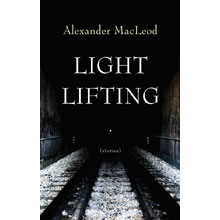 Alexander MacLeod’s short story collection Light Lifting never wavers, one solid story after another, and the effect is devastating, gripping, overwhelming. I could hardly believe that the book was this good, and so when I discovered that a friend was reading it at the same time that I was, I got in touch right right away for confirmation. Her take: “This guy is the real thing.”
Short stories whose absolutely evoked universes reminded me of Alice Munro in their expansiveness, whose subtly horrifying endings were a bit Flannery O’Connor. Stories so engaged with the stuff of this world, the living and the doing– laying brick driveways, changing an explosive diaper in a disgusting truck stop bathroom, learning to swim, cycling in the snow, crossing the finish line in a track competition, searching for lice, outrunning a train. So vivid that it’s hard to believe it’s fiction, which is why I had trouble remaining composed at the end of the story “Light Lifting”.
These are stories that hinge on a single moment, when one thing turns into another, and yet these single moments are so emblematic of larger stories that each of these stories is a lifetime, is a novel, and utterly satisfying from beginning to end. MacLeod also manages to bridge the literary gender divide, which I found remarkable– how he writes like a woman, and how he writes like a man, and how such distinctions cease to matter with incredible work like this. I am full of awe, amazement, will be foisting this collection on everyone I know, and not a single one of them will be the least bit sorry. They’ll all feel as lucky as I do to have experienced this incredible collection.
(See Light Lifting on the Giller longlist.)
**
Larissa Andrusyshyn’s debut collection of poetry Mammoth is a study in paradox– how death brings the knowlege of what  finally endures; the entire universe made containable by the neat equations of its basest parts; that it is poetry unleashing the magic implicit in algebra, taxonomy, molecular biology, zoology. “Snakes are not made from scratch”, Andrusushyn demonstrates on the basis of its useless hip bone, and so neither are these poems, which have been created from the stuff of life, from the world. The story of the mammoth carcass from which a genome is harvested becomes conflated with another extinction, that of the narrator’s father, and as the scientist diligently searches for what endures, so too does the poet.
Poems such as “Portrait of the Liver at the Open Mic” use humour to break the body down to its parts, show how these parts both function and decay, and to examine the language we use to understand these processes. “Diagram of Flightless Bird” and “Vestigial” connect these parts of ourselves to what came before us, and posit that we carry all history and the universe within ourselves– that we are not made from scratch either. The mammoth and the father return near the end of the book, the poetry asserting that we do not bury our dead after all. That we are a sum of our parts, of now and all that came before us.
Andrusyshyn’s book is understated and stunning, slim and expansive, hilarious and sad. Thoroughly engaged with a sense of wonder (“Voyageur”) and a sense of play (“The Mammoth Goes to School”). I had such fun reading (and rereading) this collection, and I know I’ll return to it again and discover something new. It’s a book that manages to not only be transporting, but also to deliver us home.
September 24, 2010
The Dead Politician's Society by Robin Spano
 Somewhere along the line these last few years (and I suspect that Kate Atkinson could very well have something to do with it), I discovered, with great surprise, that I have an affinity for murder mysteries. Crimes novels/detective fiction (and isn’t there a difference between the two? I can never keep it straight, but look forward to PD James’ Talking About Detective Fiction for a little clarification) are the only kind of “genre” that has ever won me over, and I think it’s because these are novels that wear themselves on their sleeves. The same mechanics are present as in any novel, but their workings are much less subtle, and I think that when we revel in detective fiction that we are revelling in the novel in general.
Robin Spano’s first novel Dead Politician Society comes from the less literary end of the spectrum, but kept me up at night in anticipation of discovering who did it, as all good detective fiction should. Her novel’s chief delight is its campus setting, the University of Toronto in particular, and the story is enlivened by the actual streets its characters walk along, familiar views outside their windows, and detailed (but not obtrusive) geography.
Undercover policewoman Clare Vengel is on her first case, sent to infiltrate a secret society of idealistic political science students, and find out who’s killing off local politicians one after another. The story is told from Clare’s point of view, and that of others including students in the society, their charismatic professor, a newspaper obituarist who aspires to better things, and the dead mayor’s ex-wife who wonders if her girlfriend could be behind the crimes.
The novel comes with its problems, chiefly that while the bulk of the novel races by with deft (and fun!) plotting, it stumbles at its beginning and end. The former is perhaps from difficulty of establishing so many different points of view (which might have worked better had each chapter been more extensive? They were often so brief and chopped up the reading). The latter is particularly troubling, however, as a mystery’s reveal is its main draw, but this was one was something of an anti-climax– Spano’s set-up had me geared up for more.
That said, the novel was great fun, refreshingly irreverent, and unputdownable for the most part. Robin Spano has created some memorable characters, Clare Vengel in particular, who– with her wisecracking, motorcycling, chain smoking shamelessness– had an interesting challenge fitting in on campus. Dead Politician’s Society is an amusing social satire, and also perhaps a timely read with municipal politics due to get a lot more heated and ridiculous in the weeks ahead.
September 20, 2010
The Sky is Falling by Caroline Adderson
 Caroline Adderson’s wonderful The Sky is Falling will not be outsmarted. The novel, in which Doris Lessing’s The Good Terrorist meets the short stories of Chekhov, is narrated by Jane Z., who opens the paper one morning to find a face she hasn’t seen in twenty years. The face belongs to Sonia, once Jane’s roommate, once a friend and possibly something more than that, and also a co-member of a movement campaigning for nuclear disarmament in the early 1980s. Sonia has just been freed from prison, after serving a twenty year sentence for a crime that will be the novel’s climax. The narrative flips back and forth between 1984 and 2004, as Jane explains what happened to her and her friends, and how her past connects with the very different life she lives now.
This is a novel deftly composed of fragments and allusions, whose construction is remarkably assured for this, and yet there are these moments throughout where something slips– a certain detail, an incongruency, we know one thing and then we’re told another–, and these moments take us outside the story for a moment. Poor editing, we can chalk it up to, and avid readers are encountering this kind of thing more and more these days.
And then. And then.
As I said already, Caroline Adderson’s novel will not be outsmarted, there are no slips. How Pascal was said to be a friend of Dieter’s, but Dieter doesn’t even appear to know him, and it’s not Adderson who’s slipped up here, but Jane, and her remarkably limited, unfiltered perspective. Or rather, a perspective that’s filtered solely through a lens of Chekhov stories and the Russian language she’s studying in her second year at UBC, and the stories are more real to her than her life is. She’s more of an agent in these stories, which she manipulates in her essays to suit her own political purposes, than she is in her own life where she is always on the periphery. She reads her life rather than lives it, and her readings are very often wrong.
Jane is the daughter of a Polish immigrant, she’s a foreigner in Vancouver where she has come from Edmonton for university. After a year of living three buses away from the campus with her eccentric aunt, she wins a spot in a shared house because she’s viewed as unthreatening enough to not steal somebody’s boyfriend. Here, she meets Sonia and the other housemates, all of whom have their own reasons for political action (and Adderson should be commended for her treatment of this ensemble cast). For Sonia, it’s a genuine desire to save the world (or perhaps to be the saver of the world, more particularly), and Adderson does a fine job of illustrating the heightened state of Cold War politics in 1984, with Star Wars, the Doomsday Clock, a rubber Ronald Reagan mask hanging by its eye-hole from a nail in the wall, and the Korean airliner that had been shot down by the Soviets the autumn before. To the insular group feeding off one another, all these were signs that the end was nigh, and to Jane, even more insulated within that insular group, it seemed her eyes were opening to reality for the very first time.
Twenty years away from all that, Jane is able to understand her own naivete– not necessarily that the end wasn’t nigh, but that she had a chance of changing any of it. She is just as powerless now as mother to a teenage boy who she fears is slipping away from her– it’s not his big leather boots she minds, or the piercings in his face, or his sullen friends, but that he’s becoming a stranger to her. Though Jane’s sympathy for teenagedom is admirable– Adderson has depicted the trappings of adolescence in a realistic way that would make Tabatha Southy proud. When Jane’s son finally seems interested in his mother, it’s only in her own surprising past, and Jane questions the ethics of using the allure of her past mistakes to connect with her son again. To what ends will he end up using her story?
The Sky is Falling is a great, smart and engaging novel that will appeal to Chekhov lovers, and make Chekhov seem appealing to the unconverted. Adderson’s allusions do not burden the story, but they serve to illustrate Jane’s lack of worldliness, and invest the whole novel with rich under-layers of meaning. The past and present strands of the story come together in a marvelously clever ending that both promises a brighter future, and also acknowledges that the thing about the future is that it’s always just escaping one’s grasp.
September 16, 2010
Sandra Beck by John Lavery
 I could say that I’ve never before read a book like Sandra Beck by John Lavery, but then I would be lying, if only because I once read the book Elizabeth Costello by J.M. Coetzee. These two books are only alike in the strangest ways, both being oddly fragmented novels that aren’t quite novels. Both being about a woman who is never entirely present, who is never ever seen from the same perspective twice. Both novels even end with similarly strange conclusions at customs desks, though Sandra Beck in general, I think, is a less perplexing shade of weird.
It is true, however, that I’ve never read prose quite like John Lavery’s. His sentences are acrobats, flinging from trapezes with no sign of a net. His narrative goes backwards and forwards, overlapping and backing up again on itself. His writing manages to be gritty, ribald, and really beautiful, though it’s also challenging and takes a while to get a sense of the way it flows. The book eventually establishes a momentum, even dipping in and out of time as it does, but then just when you think you know what it’s doing, you realize you know nothing at all. Sandra Beck is the kind of book you could read thirteen times in a row, and it would be a different novel every time.
The book’s first section is from the perspective of Josee, daughter of Sandra Beck, who is everything to her daughter, and also at the same time, never enough. Who manages to be at the periphery of Josee’s life, but also at its centre. Sandra Beck walks with crutches, is perpetually busy as manager of the Montreal Symphony Orchestra, is married to Montreal police chief Paul-Francois Basterache, and though Josee refers to her mother as “my happiness”, she also makes her daughter miserable. Josee is in the midst of adolescence, has the voice of a child but is conducting a bizarre affair with a clarinetist’s birth-mark. Witnessing her mother from a distance at the section’s climax, Josee has the revelation that she has never known Sandra Beck at all.
The second section takes some years after the first, as Josee is now grown-up and self-sufficient, allegedy teaching theatre to children in Bogota. Almost 200 pages of a drive from Lennoxville to Montreal, the reader is an invisble passenger in the backseat of Paul-Francois’ LeSabre, and he’s addressing us directly. P-F, so I’ve been told, has appeared before as a character in Lavery’s short stories, and I can see how the writer can’t quite get enough the guy. He’s the police-chief, and a television personality (on the local crime show C’est le loi/It’s the Law, an ardent husband, impatient father, and a wonderful meandering storyteller who does not fear contradiction, the complicated nature of life. He is bilingual, and so duality is his thing. P-F makes the journey fly by, recounting his relationship with the elusive Sandra Beck. The difference in their mother tongues standing in for the differences between any two people, and that inevitable failure to communicate exactly what one means. “When you love someone, you often understand perfectly what they’re going to say before they say it. It’s when they say it that you find yourself struggling to grasp what they’re attempting to tell you.”
I’ll admit that it took me a long time to understand where the story was going, and that even once I was swept up in the momentum of P-F’s story, I sometimes still had a hard time trying to grasp what he was telling me. That I found Josee’s section a bit tedious at times. But when I got to the end of the story (and it hit me with a brutal wallop), there was no doubt that I’d just experienced something quite extraordinary. And yes, this is a novel that begs to be encountered for a second time, to bring the pieces all together, but even disassembled, this puzzle is oh so worth the read.
September 12, 2010
Freedom by Jonathan Franzen
 I suspect that if I’d ever read the Russians, I’d have a good understanding as to why Jonathan Franzen’s novel Freedom had to end up being so bloated. It would make sense of why a novel one might describe as bloated has received glowing reviews across the board, which had raised my expectations so much that the bloat came as a bit of a disappointment. But for me, the Russian illiterate, the bloat was just bloat, but alas, there was still a lot to love about this novel.
Freedom is the story of the Berglund family, who are introduced in the novel’s first section through a cacophony of hearsay and neighbourhood gossip. We see the family from without– Patty, pushing her stroller up and down the street before the neighbourhood was even fashionable, her well-meaning husband Walter, their growing family of son Joey and daughter Jessica. Patty is unflappable, never says a bad word about anyone, won’t tolerate gossip about her neighbour Carol, single-mother of daughter Connie, until Connie starts sleeping with Joey, and Patty just snaps. They could never prove it, of course, but somebody slashed the tires on Carol’s boyfriend’s car, and that somebody was probably Patty, and then Joey ends up moving in with Carol and Connie, too many bottles start showing up in the Berglund’s recycling bin, and eventually the Berglunds move away to Washington, Joey becomes a Republican, and somehow the conservationist Walter ends up embroiled in a scandal involving his relationship to coal companies.
The rest of the novel gets close to the Berglunds, and shows us how they got from there to here. The various sections are told from the point of view of Patty (who has written her autobiography in third person), Walter, Joey, and Walter’s best friend, musician Richard Katz, who has always complicated the relationship between Walter and Patty. Like Franzen’s previous novel The Corrections, Freedom is an unflinching depiction of contemporary family life, of its peculiar dynamics, and– like Lionel Shriver’s recent So Much For All That, which I thought was a finer specimen of a novel– the book also is a statement about American society in general. This point gets hammered home through various treatments of the concept of freedom– to define ourselves apart from our families, freedom to defend our country after September 11, 2001, how the term is hijacked by the left and right, freedom as an export, freedom to be you and me, and then these diatribes about environmentalism and overpopulation, and soon I really wasn’t sure of the point being hammered home as much as I was just sure of the hammer.
The characters didn’t convince me. The Patty Berglund we saw from the outside was an intriguing character in all her quirky ordinariness, but her autobiographical section didn’t feel authentic. Moreover her character didn’t either– others described her amazing laugh, which was nothing more than “Ha ha ha” on the page; she was a woman who’d made little of herself, but I was never sure why everyone was so sure of how smart she actually was, down deep; I didn’t get the dynamics of the marriage either. It was all very confusing and eventually I just didn’t really care who did what or why, because no one needs to make life that hard. Life is hard enough all on its lonesome. And I guess I felt that way about everyone populating this book, this family.
Patty only became vivid to me again in the novel’s final section, which is the mirror image of the opening, once again, the Berglunds from the outside. Part of the relief was that the characters had finally quit doing idiotic things, but they all somehow just seemed much less like nonentities from the outside. I cared about them from the outside, they clicked with the world from the outside, they all just made a bit more sense than from that scrambled place inside their heads. Part of this was also that Franzen was allowing the story to tell itself, rather than painstakingly laying it out for us, piece by piece, and piece by piece by piece.
It’s a smart trick though, framing a novel with bits that are so wonderful, that when you finish the book, you put it down and say, “What a brilliant book. What a perfect ending”, even though about two hundred pages before, you’d wanted to leave the whole thing on the bus. Such framing makes the slog seem worthwhile, especially since the slog itself was rife with good writing, intriguing set-ups, humour, and good questions about our assumptions of every day life. So I’m glad I read Freedom, I definitely am, but I also am terribly relieved that I’m not reading it anymore.
September 1, 2010
On having read The Slap
 “One of the striking things about so-called literary fiction is that it tends to be not morally simplistic,” says Jonathan Franzen in his recent Globe & Mail interview, which means that Christos Tsiolkas’ The Slap might be about as literary as they get. Though I’m not so sure that lack of moral simplicity is that simple. What kind of fiction does a book get to be when everyone in it is totally awful?
But let’s go back to the beginning. I heard Christos Tsiolkas on a rerun of Writers and Company, and liked the sound of The Slap: a story that takes place at a suburban barbeque in Melbourne Australia, where a man slaps somebody else’s misbehaving child. The novel explores the ripples effects of that action, and also deals with the cultural climate of that country: the sons of Greek immigrant communities, their wives whose families come from India, the blonde-haired, blue-eyed “Australians”, the aboriginees (and in this case he’s converted to Islam, and changed his name to Bilal).
I saw The Slap in a bookstore when I was on vacation, so I scooped it up, and arrived home to find that the book had been long-listed for the Booker Prize, and was being called “unbelievably misogynistic”. I read it anyway, because it had appealed to me, but also as a kind of experiment in reading something I wouldn’t normally read.
Tsiolkas defends his book by saying that a book isn’t misogynistic just because its characters are. Which I agree with entirely, but I think the book is misogynistic if the hatred of women it expresses is so unrelenting, so pervasive that when you get to the end of the book and consider an underlying message, that message is probably, “Mothers are the source of all the world’s problems”. Nothing in the book refutes this. Motherhood, so says every narrative strand in this enormous book, makes women “selfish, uninterested, unmoved by the world”. (Women without children do receive a get out of jail free card).
The women in The Slap are all intelligent, interesting people, but each of them is complicit in her own degradation. Each of them is slim and beautiful, married to brutish men who like to have sex with prostitutes. They also treat their wives like prostitutes when they have sex with them, and pretend their wives are the prostitutes. That their wives are also the mothers of their children inspires a bit of tenderness, but it’s usually fleeting. The word “cunt” gets thrown around a lot. These men hate their wives, and they hate their lives, but mostly they hate their wives. Seethingly. Every single one of them.
Also, everybody does drugs. Everybody. It’s kind of boring actually, pill popping as a plot device. Is this really suburban reality? Do I not see that kind of thing in my own life because I live downtown.
So why did I like this book? Because it’s a soap opera. Because Tsiolkas is a master of plotting, and I raced through this 500 page book to see what would happen next. Because, although I didn’t like the answers, the novel posed provocative questions about motherhood and feminism. Because the novel is divided into sections, each from the point of view of a different person who’d been at the barbeque where the slap was slapped, and so we’re taken farther and farther into the future each time from a different perspective. The story becomes so layered, and multi-dimensional. Because each section adds pieces that fill out the past, sometimes to completely horrifying ends. Because where do we put our sympathy– disturbing to consider. Who do we cheer for in a crowd like this? What does it mean that we too want to see the kid get slapped? Want to slap him? Because the ending was totally wonderful. Because each character was so vivid, and how get to know them from within and without. Because the novel was unabashedly of right now. Because it was unabashedly everything.
Though I think it could have been more abashed. Seriously, I’m not an idiot. I know that Huckleberry Finn isn’t racist, is what I mean, because anti-racism is its underlying tenet, but all I took away from The Slap was that women are everything that’s wrong with men, which is everything that’s world with the world. That men hate women, blame them for their ills and justifiably so. And there was nothing in the book that refuted this. What am I supposed to make of that?
In the Guardian piece, Tsiolkas responds to such criticism: “I would call them lazy readers. I think they are confusing the writer with the character. I think there’s a laziness now in how we read. We read for confirmation of who we are, rather than for a challenge of who we are.” Which I get at some level, and he’s managed that challenge very effectively, but I don’t think my reaction is purely personal. Or maybe I just don’t think I really need to be challenged about who I am as a person who is not a worthless piece of shit based upon my gender.
August 30, 2010
The Beauty of Humanity Movement by Camilla Gibb

Camilla Gibb doesn’t reinvent the novel in her latest The Beauty of Humanity Movement, but she challenges the limits of what a book can hold. Her book is packed full with the expansiveness of its story, its vividness of place, of history, its multiple points of view, and voices, and languages, and cultures, and art. Depicting humanity at its ugliest, and most beautiful, all very tidily in under 300 pages of gorgeous prose, The Beauty of Humanity Movement was absolutely a pleasure to read.
The book takes place in Hanoi, “the Vietnamese heart”, the city from which was born pho: “a combination of the rice noodles that predominated after a thousand years of Chinese occupation and the taste for beef the Vietnamese acquired under the French”. In the city, Old Man Hung’s pho is famous, its mere aroma bringing men to their knees. He’d had a shop years ago, but lost it when everything was nationalized, and these days couldn’t afford the rents or the bribe money that would be required to even secure a lease.
Pho’s shop had been a gathering place for radicals in the 1950s, when the Vietnamese people were rising up to overthrow their French oppressors. The artists and poets who’d met there had been part of The Beauty of Humanity Movement, which envisioned a glorious kind of socialism, and not one that merely replicated the tyranny that had come before it. Of course, this kind of vision is the sort that gets men in trouble, and eventually the authorities clamped down on their expression. Their leader, the poet Dao, was sent away to an appropriately-ominous-sounding “re-education camp”, and he is never heard from again.
Two generations later, Dao’s grandson is a young man with endless potential, in comparison with his parents who’d toiled for years in a ping-pong ball factory. Tu had become a math teacher, and then realized that loving math and teaching math are not synonymous experiences. He’d left his profession to give tours of Hanoi to Americans, and to pursue happiness in both the material and ideal senses. Though he is not so forward-looking– he reveres Hung, his family patriarch, who took over the role after Dao was lost, and kept the poet’s memory alive for his descendants. And so Tu continues to visit Hung, who lives in a shack and serves his pho from a ramshackle cart, and who belongs to a older Vietnam that is quickly disappearing.
Gibb’s narrative spins all these strands around a character called Maggie, Vietnam-born but American-raised. An art dealer and curator, she has come to Vietnam to find a trace of her father, an artist, who may have been part of Dao’s movement. Everybody she speaks to tells her she should talk to Hung, but when she finally finds him, it seems the old man’s memory is beginning to fail. He and Maggie work together to possibly recover some pieces of the abundance that was lost.
Though The Beauty of Humanity Movement is her fourth novel, in many ways it represents a sophomore effort for Gibb, an attempt to follow the “break-out success” of 2005’s Sweetness in the Belly. Both novels are enriched by Gibb’s background as an anthropologist, and manage to contain the stuff of culture but get bogged down by it– Gibb spins the stuff into story. And though this new book does not quite mesmerize in the way that Sweetness… did, that’s a lot to ask of any book, and so I’ll settle for just being glad that Camilla Gibb has written another wonderful novel.
August 21, 2010
Alone With You by Marisa Silver
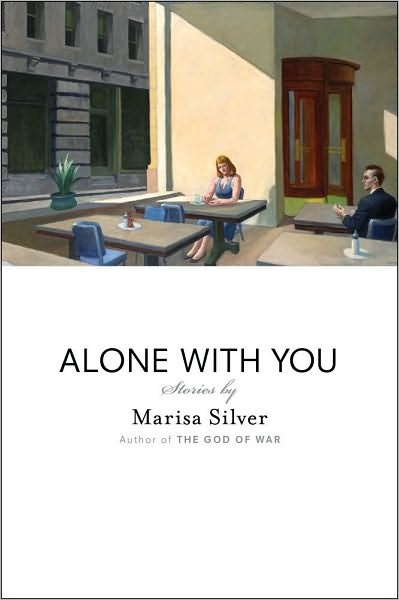 The very best pieces in Marisa Silver’s Alone With You are each expansive enough, containing more story than most novels do, so that the volume isn’t really slim; it only looks that way. Silver’s work has appeared in The New Yorker, she’s a winner of the O. Henry Prize, and has been much acclaimed for her novel The God of War. (It’s worth noting also that the New York Times review of this book is sets a benchmark for reviews we all should aspire to, and also that I don’t very many American short story collections, but now I digress…)
From the story “Night Train to Frankfurt”: “The fact of being was sometimes an unbearable mess and what was hoped for in life was so rarely reached. The shortfall between those two things was so much more fumbling and base than anything Helen had ever imagined.” And that shortfall, with all its fumbling, marks the development of most of these stories. They open up wide in the way that Alice Munro’s do, a decade passing in a paragraph break, and the narrative manages to never miss a beat.
In “Pond”, the mother of a disabled adult child confront her daughter’s pregnancy, her husband hovering in the background of the narrative only to be brought to the foreground at the story’s conclusion, as he’s forced to confront what his relationship with his glorious grandson implies about his feelings for his imperfect daughter. In “Three Girls”, the penultimate moment in a single night telescopes a young girl into the future and a vision of her older sister: “In that moment, Connie had the idea that she wouldn’t know Jean when they were older, that when Jean left the family, she would leave Connie too, because Connie would remind her of things she didn’t want to remember.”
Helen, from “Night Train to Frankfurt” accompanies her mother on a last-ditch attempt to cure her cancer, and their whole relationship, with all its ambivalence and love, is encapsulated in that train compartment. “The Visitor” tells of Candy, a nurse in a Veteran’s Hospital, whose patient has lost his legs and one arm: “It was sad. Of course it was sad. But she didn’t feel sad. Sad was what people said they were in the face of tragedies as serious as suicide bombings or as minor as a lost earring. It as a word that people used to tidy up and put the problem out of sight.”
Marisa Silver, however, does not do tidiness or sentimentality. Her stories are sad, yes, but they contain everything (and unfaithful men in particular), and something is glorious in all their messiness, in the deliberate perfection of their tangle.






