January 16, 2013
On Elizabeth Mitchell, Blue Clouds, and storybook discovery…
 I discovered Elizabeth Mitchell a few months into Harriet’s life, and her music has been our family’s soundtrack ever since, the serenity of her voice making me a better mother and a happier person, her songs providing us all with a solid grounding in folk music, and their stories becoming the basis of so many of our own. And this year was a very good year to be an Elizabeth Mitchell fan–her album Little Seed came out in July and had the honour of not only being the soundtrack to our summer roadtrips (along with Carly Rae Jepsen), but was also nominated for a Grammy, and then Blue Clouds came out in October, and we managed to save it until Christmas, but we’ve been listening steadily ever since.
Blue Clouds is brilliant: a new version of “Froggie Went a Courtin'” that is Harriet’s favourite song on the album; my favourite track is her cover of Van Morrison’s “Everyone”; covers of David Bowie’s “Kooks”, Jimi Hendrix’ “May This Be Love”, Bill Withers’ “I Wish You Well”, “Blue Sky” by the Allman Brothers. We love new songs “Rollin’ Baby”, “Hop Up My Ladies”. And we love the song “Arm in Arm”, based on the verse by Remy Charlip: “Two octopuses got married and walked down the aisle, arm in arm in arm in arm in arm in arm in arm…”
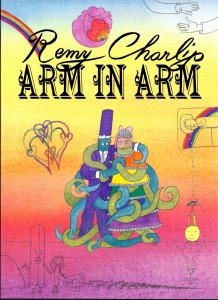 I’d never heard of Remy Charlip before Blue Clouds, but his artwork graces the album and its liner notes, and a letter inside by Brian Selznick introduces him further: “If you don’t own any of Remy’s books, you owe it to yourself to find as many as you can.” Which is the kind of guidance I’m always happy to take, and so we’ve been borrowing Remy Charlip books from the library like gangbusters over the last couple of weeks. And we didn’t quite know what to do with them at first: they weren’t stories to be read as much as books to be used, to be engaged with. It turned out that only the first line of the “Arm in Arm” song was Charlip’s, the line all the text on a single page, and the whole Arm in Arm book is made up of similar wordplay, riddles, play and whimsy. Harriet is in love with Mother Mother I Feel Sick Call For the Doctor Quick Quick Quick, and also the cowboy story Little Old Big Beard and Big Young Little Beard. We brought home Thirteen from the library yesterday, and it blew our minds! So many stories in a single book, a book you’ll read over and over and never the same way twice.
I absolutely love art that takes you somewhere, and artists who collaborate. Getting to know Remy Charlip via Elizabeth Mitchell has been like getting to know a friend, and so when I discovered tonight via internet search that he’d died in August, both Stuart and I were oddly saddened. His work is so much the definition of life that it seems impossible that his own could be over, but then the books live on, and how they do, over and over and never the same way twice.
January 15, 2013
More on bad/good reads, and almost-didn't reads: Olive Kitteridge
 I had some thoughts about Olive Kitteridge before I read it. I don’t know if I’d noticed that it had won the 2009 Pulitzer Prize for Fiction, but I’d noticed the endorsement by Oprah on the over, which in my mind is a different thing entirely. My anti-Oprah bias is part of the reason that I’d never picked the book up even though it’s been sitting on my shelf for ages. Also, it was the sort of book like A Complicated Kindness whose blanket popularity had left me uninterested–the boring cover didn’t help either. I’d remembered that the popularity wasn’t so blanket and those who didn’t love it absolutely hated it. I could never remember who of Olive or Elizabeth was the title or the author either, “Strout” seeming as unlikely as “Olive Kitteridge” from certain angles. But I’ve been making serious progress through my to-be-read shelf, to the S’s even (because indeed, Strout Olive’s author was) and so it was finally time.
I must confess an enormous affinity for the “novel in stories”, though I confess it quietly because lovers of the novel are so often disappointed and/or frustrated by this strange hybrid form, and calling attention to it as a form at all makes short-story lovers furious in its undermining of the greatness of stories on their own, or side-by-side but unconnected. But then haven’t you read A Visit from the Goon Squad? The Juliet Stories? Lives of Girls and Women? The Elizabeth Stories? Then surely you get the point that the form is really something onto itself?
Carrie Snyder is quite illuminating on the “novel in stories” form: “The definition on the back of my book may be a marketing tactic, but it’s also accurate. I did structure each chapter as a story that could stand on its own. I did so very deliberately. I did it because I’m comfortable with the form. I did it because I like the gaps and leaps that stories permit. I like the cleanness of the form, the circularity, the interior singular coherence.
But just because each chapter works individually as a short story doesn’t alter the fact that the larger book is its own whole universe. It’s meant to be read from beginning to end, not piece by piece. It needs all of its parts to be complete. It unfolds chronologically. Its overarching plot-line tracks the development and changes of the same characters. It has themes that are woven throughout. It has peaks and valleys. Does all of this make it a novel? Probably. Sure. Why not?”
Olive Kitteridge is probably less novel than stories, and unlike Juliet its pieces had been written/published separately over a large span of time, but I still admire the sense of wholeness that comes from such a many-sided shape. The slight discrepancies in point of view, the inconsistency that brings the book its verisimilitude. Because people change over time, and they change depending on who is doing the watching, and a novel in stories shows all of that. A character from near and far, within and without and I love that.
Olive Kitteridge is a “good-read”, the kind that Kyo Maclear would like to stretch her muscles and read less of. But I do believe that Strout’s book in all of its lyrical realism can do everything that Maclear’s “bad-reads” recommends. However quietly and without intention to improve its reader, Olive Kitteridge shows that “life as dynamic and unsettling, full of moments of absurdity and disorientation, at times startling and unreal.” Just as rare and remarkable as the successfully-realized fictional invented universe is the fictional universe that looks exactly like the one I know. I’m still not done being disturbed, startled, and awed by the sight of life itself.
January 13, 2013
Is speculative fiction my "can't read"?
 In June, I wrote this:
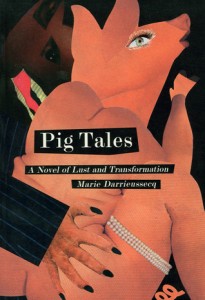
“Against Domesticated Fiction, or The Need for Re-Enchantment” was an essay by Patricia Robertson in Canadian Notes & Queries 84, in which Robertson decried contemporary writers in general for their failure to imagine the world beyond the individual, and the failure of contemporary writing to be anything but tedious. Hers was an inspiring argument, even stirring, and yet… I’m not yet tired of the kind of novel she’s maligning. Domesticated fiction remains what I most want to read, and I’m not nearly finished with it yet. And I don’t even have a good argument as to why this should be the case, except that I think that with the reader taking an imaginative leap, domesticated fiction can do as well as the fantastic, or any other kind of literature, to “incorporate some of the wildness, the strangeness, the mystery of the world around us.” To show that we are indeed “participants in a vast web of being.”**
Last week, Kyo Maclear published a fantastic essay at 49thShelf shelf about embracing “the bad read”, celebrating the kind of fiction that doesn’t go down easy. She wrote, “Yes, bring on the bad reads. Bring on those lousy good-for-nothing novels that embrace novelty, possibility, and surprise. Let’s hear it for god-awful fiction that believes anything can happen—that captures the weird, the awkward, the complicated, the downright bizarre…you know, the really real…in all its ghastly glory.”
Her argument was not dissimilar from Robertson’s, but Maclear came at it from a different point of view that made me less defensive. First, because she does that brilliant thing that critics never do wherein she celebrates one thing without necessarily denigrating another. And also because her point of view is similar to mine, as a reader and writer of “lyrical realism.” Her rallying call stirred my heart, and every part of my brain registered how completely right she was. How could I feel any other way, considering how often I am frustrated by readers’ refusal to be challenged by fiction? And yet, I could only be stirred so far. I don’t know who or what could ever compel me to pick up a porcine allegory, let alone an erotic one. (I’m still too afraid to read Tamara Faith Berger’s Maidenhead, for heaven’s sakes.) I want to be challenged, but I don’t want to be that challenged.
And isn’t that what we all find ourselves saying? When we throw up our arms and plead, “I’m 21 weeks pregnant with a small child and I only get the tiniest blocks of time to read in every day. Kindly leave me to read what I like. No sex pigs, please.” So yes, part of it is that I’m perpetually tired, as perpetually tired as every single human being on this planet is, but another part is that I cannot bring myself to be interested in a story unless human beings on this planet are what it’s addressing. Not just with books either–I can’t watch animated films unless its characters are people. I just don’t care. And I just don’t care about books depicting other worlds either, or other versions of this one. I liked A Wrinkle In Time, but only when they were at home, for example. The only part I liked in The Princess Bride is when Fred Savage is reading with his grandfather.
So now I’m doing that thing, denigrating an entire genre, but I’m not actually. I’m just clarifying the enormous gulf that lies between me and the kind of “bad reads”, anything’s-possible book that Maclear recommends. Perhaps if I weren’t too tired, I might do well to pick up some books from Leah Bobet’s Speculative Fiction Titles for Literary Readers list. Maybe what I’m suffering is not so attitudinal as a lack of a bridge? Why am I so afraid to take a leap?
But it’s not fear altogether. I’m not scared of speculative fiction necessarily (though the sex pigs, yes, sound terrifying) but I just don’t quite see the need for it. I’m still not finished with this world yet, and I don’t know that fiction is either. And while it’s a stunning achievement to construct a new universe, I think that any fiction writer does that whenever she sits down to write. I think that realism is perfectly capable of “embrac[ing] novelty, possibility, and surprise”. That last year, books by Anakana Schofield did this, and Zadie Smith, and Lauren Groff (though yes, she’s a genre blurrer at heart), and Annette Lapointe did this. Even Carrie Snyder’s book And these are the books I will challenge myself to read, though they don’t go down as easy as, say, A Large Harmonium by Sue Sorensen (which is so so so wonderful. Have I told you that lately?). For me, these books aren’t necessarily “good-reads” and they have passages and sections I have to read over and over to understand and appreciate what’s going on. Maybe one woman’s good-read is another’s bad-read, and speculative fiction is my “can’t read”? And really, what is reading for? And for whose sake? Do we have to save the world with book we pick up? And why ever wouldn’t we want to? And who’d ever have the time?
As ever, I’ve got no answers, but I look forward to more circular arguments and frustrations in a forthcoming post on Olive Kitteridge, naturally.
**Interestingly, there are responses to Robertson’s piece in the latest issue of CNQ. I haven’t read them yet, but look forward to doing so.
January 10, 2013
Short fiction joy, news, and reviews.
 We received the most enormous pile of packages on Tuesday, including a magazine each for Harriet and I. Mine was Canadian Notes and Queries, featuring a new short story by Caroline Adderson, and Harriet’s was Chirp, with a fabulous short story by Sara O’Leary (!!), and I loved that both of us were experiencing the joy and goodness of short fiction in fine Canadian magazines, and that Harriet gets to appreciate this fine thing from the age of 3. What a lucky girl.
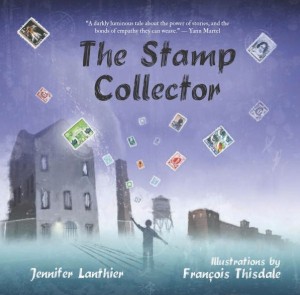
In other news, I was quoted in this excellent piece by Anne Chudobiak in the Montreal Gazette about the CWILA count and lack of female reviewers in Canadian journals and newspapers. And my review of The Stamp Collector by Jennifer Lanthier and Francois Thisdale is now up at Quill & Quire.
January 9, 2013
Time, Growth and Change: Books for the New Year
 This is my latest cross-post for Bunch Family!
We were reading Chicken Soup With Rice by Maurice Sendak on New Year’s Eve because, with all Sendak’s usual mischief and fun, I love how it gives the reader a sense of the span of the year, which is not an easy concept to grasp when one is three-years-old. The book is mostly nonsense, but with verse that has steeped into our family vernacular: where else would Harriet have learned about “old Bombay,” a place she references at least daily in her imaginary play; we’re all fond of exclaiming, “Whoopy once/whoopy twice!” at odd moments; and shouting, “I told you once/I told you twice/ all seasons of the year are nice!”, which is actually true, if you think about it. As a primer of all things monthly, the book is hardly scientific–your child will come away assured that September is indeed the period in which he’ll ride a crocodile down the chicken soupy Nile. But he’ll know what the months are called, which is something, and you will have enjoyed having read this jolly little book to him.
 With Chicken Soup and the New Year, I started thinking about other book about time, growth, and change, about the cyclical nature of a year and a life, and Paulette Bourgeois’ Big Sarah’s Little Boots came to mind, illustrated by Brenda Clark. It’s the story of a little girl who loves her rubber boots, which seem to deliver her extraordinary puddle-jumping powers. But one day when she puts her boots on, they no longer fit, and none of Sarah’s attempts to stretch them are successful. Reluctantly, but stoically, she comes to accept that she is growing up and that there is as much to be gained as is left behind with every step forward she takes.
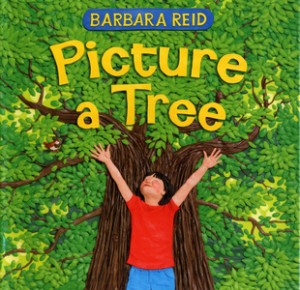 Barbara Reid’s Picture a Tree is always the book I pull out at bedtime when time has got away from us, not only because it’s short, but because it also manages to not remotely be lacking in depth. I am as nearly astounded at the overwhelming bounty of Reid’s creation as I am at nature’s– the fact that she has sculpted every single leaf in the book out of plasticine. And there are so many leaves, as Reid explores the various roles that trees play our life. My favourite spread shows trees as “A tunnel” (century-old branches stretching over a city street that looks like mine) “or an ocean” (a view of the city from a highrise balcony, the trees creating a sea of green). Reid moves through the seasons of the year, eloquently expressing the complicated idea that with every tree, “You may see the end of one thing, or the start of something new.”
 Andrew Larsen shows something similar in his latest book, Bye Bye Butterflies, which is illustrated by Jacqueline Hudon-Verelli. On a grand scale, it’s the story of a boy beginning to grow up and make his way into the world, the experience encapsulated in a class project at his school in which caterpillars are raised into butterflies. “Our friends will be with us for just a few days…” the teacher tells the students. When the butterflies are grown and ready to be released, the story tells us, “The children felt a little happy and a little sad all at once.” With great sympathy and nuance, Andrew Larsen is demonstrating that these are the mixed emotions that a full life comprises.
 Some of my favourite books to read with my daughter are those that I remember reading as a child, the very books that belonged to me, an experience that connects me to my own history, to the reader and child I used be. This connection is made quite literal in Sara O’Leary’s When I Was Small, illustrated by Julie Morstad. It’s the third book by the duo, about a small boy called Henry whose mother and father view parenthood as an imaginative springboard (and really, isn’t it though?). In this book, Henry wants to hear stories about when his mother was small, and she indulges him with tales of when she so small she went swimming in the birdbath, could feast on a single raspberry, slept in a mittten and used a thimble to build sandcastles. Conventional concepts of space, time and generation are collapsed as she tells her son that when she was small, what she longed for most was a small boy of her own. She wanted a small boy to tell stories to, she explains, “because in stories we can be small together.”
 Barbara Cooney’s Miss Rumphius is one of those books I loved when I was small, a book I’ve had kicking around my shelves since long before I had anybody small to call my own. In Miss Rumphius, Cooney evocatively illustrates the span of a lifetime, and also of history, art, literature and geography, and she shows the rich possibilities for what a single life can hold. Most importantly, the kernal of the story is as much a challenge as inspiration: “You must do something to make the world more beautiful.” The book ends on a note of possibility: ‘”All right,” I say. But I do not know yet what that can be.’
 I love picture books that show the passage of time, the largeness of history and our relative smallness (but our place nonetheless) in the scheme. And of course, I also love house books, so Emma and Paul Rogers’ Our House, which is illustrated by Priscilla Lamont, was inevitably going to be a delight. The book is made up of four pretty ordinary domestic stories taking place in 1780, 1840, 1910, and 1990, each showing subtle changes in the house and surrounding area, and also the lifestyles of its changing inhabitants. The final story shows an awareness of the people who’d lived in the house before, as the family, whilst searching for an errant pet mouse, finds bits of history under floorboards and in backs of cupboards. (“We shed as we pick up, like travellers who must carry everything in their arms, and what we let fall will be picked up by those left behind.”– Tom Stoppard, Arcadia.) There is no supernatural element at work here, but the connection between the child in the first story and the child at the end reminded me of my favourite time-out-of-time childhood novels like Tom’s Midnight Garden, Charlotte Sometimes, and A Handful of Time.
 Life Story by Virginia Lee Burton is perhaps the most ambitious picture book project I have ever encountered, the history of the universe as beginning with the birth of the sun. With her usual attention to technical detail (Burton was the daughter of an artist and an engineer, and in all her books, it shows), Burton’s story moves through the ages, the development of the earth and the plants and animals that inhabit it. In terms of time and place, her story because more and more focussed until her final page and a direct address to her reader: “And now it is your Life Story and it is you who plays the leading role. The stage is set, the time is now, and the place is wherever you are. Each passing second is a new link in the endless chain of Time. The drama of Life is a continuous story–ever new, ever changing, and ever wondrous to behold.”
January 9, 2013
Baby With a Heartbeat
There are so many things I’ve forgotten to worry about this time around: dwarfism, hermaphroditism, whether my baby would be born entirely covered with one big hairy mole like someone I saw once on Jerry Springer. My pregnancy was confirmed in September with the faintest double line on a home test (albeit the fifth test I’d taken that week. My un-neurotic behaviour only ever extends so far. But I’d known I was pregnant, even if the four negative tests had been oblivious). And after that, I didn’t even get a blood test. I made very few pregnancy-related google queries. One the odd day that I felt well, I didn’t panic and start to think that something was wrong. I was having the rare experience of living life as a normal person does, and it was a really, really nice way to be.
This was entirely different from my previous pregnancy, which tied me up in such knots that my midwife had worried about my blood pressure. Having never had a baby before, I’d found it impossible to believe it was possible, that my body would know how to perform this miraculous thing. It made me crazy to know that that here I was with this enormous responsibility, the creation of a person, and no control over the process. The no control thing was the worst of it, and it seemed really irresponsible to me. This time though, it was easy to accept it, to understand that being pregnant is fundamentally a passive exercise. Part of my ease with this was because it was easier to accept passivity, and with work, a small child and a first-trimester to contend with, any shortcut is welcome. The other part, I think, was because I already am a mother, and spend a large number of my waking (and sometimes non-waking) hours doing “mothering things”. I didn’t feel the need I’d felt before to enact pregnancy (worry about soft cheese and abdominal twinges) in order to stake a claim on motherhood. I had my claim. I also know that this baby is never going to be so easy to take care of as during its time in the womb–let’s enjoy the silence while we can.
(Note: As I say, my un-neurotic behaviour only extends so far. Don’t think that I haven’t supposed that my complacency will inevitably result in calamity. That just when I start to take security for granted, the whole thing will fall to pieces. That I will publish this post, and then find out tomorrow that baby forgot to grow internal organs. But I haven’t supposed so much. I can pack up these thoughts away in a box, which is really something significant.)
When I was pregnant with Harriet, I didn’t know her name or sex, or anything about her, but I spent a lot of time imagining. I wrote her letters, played her music, read her stories every night. I understood that bonding with this tiny being was a really important process, so I worked at this. From fetal kicks, we determined that she loved Motown, we read her Teddy Jam’s Night Cars on repeat so that apparently she’d recognize it, she knew my voice, she knew her daddy’s. Life the soft cheese aversion and anxiety, I think what I was really doing was staking a claim on motherhood. But then she was born, and she was a total stranger. I’d never imagined her face, she didn’t seem to like Motown at all, she was more amphibian than human. It occurred to me that my “bonding” had been 100% projection. The disparity between who she was and the baby I’d imagined (who, to be fair, was at least six months old) made those early days all the more difficult to navigate.
Which is probably part of the reason I’ve not really started using our new baby’s name or proper pronoun, though I’m aware of both. I tell myself that this baby hears more stories in utero than Harriet ever did, because I read stories to Harriet all day long (and most are of far superior quality to the children’s literature I had access to four years ago. Indeed, motherhood has opened up whole literary worlds). Perhaps the strongest bond that I feel to my new baby as a person is that this is Harriet’s sibling, which is a wondrous thing for me to behold. Any sibling of Harriet is someone I’d really like to meet, even if I have no idea what its favourite song is. Yet.
Baby has been kicking away all along as I’ve been sitting here writing this, and I don’t mean to convey that this feeling doesn’t fill me with overwhelming joy. But it’s more a harbinger than a direct message. The sight of tiny feet on my ultrasound two weeks ago, the galloping heartbeat at my last pre-natal appointment. When I went in for my first ultrasound at 11 weeks, and the technician who was blessed with people-skills said to me as soon as she’d started, confirming: “Baby with a heartbeat.” The first outside indication of fetal life since that faint double line six weeks before. That phrase was a kind of music, a song I have such faith in, and I love to play it over and over again inside my mind.
January 8, 2013
Stymied already
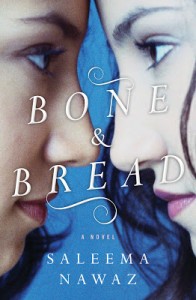 It’s stymied already, my one reading goal this year to read more outside the CanLit bubble. I’ve spent the last while putting together the 49thShelf Spring Books Preview, and there is so much to look forward to. The whole list is more than a little coloured by my bias anyway, but in particular, I am excited for Marita Dachsel’s Glossolalia, Belinda’s Rings by Corinna Chong (because who can resist a book with a squid on its cover?), Helen Humphreys’ Nocturne, Bone and Bread by the excellent Saleema Nawaz, Claire Wilkshire’s Maxine, Every Happy Family by Dede Crane, Nancy Jo Cullen’s Canary, Studio St. Ex. by Ania Szado, Tish Cohen’s The Search Angel, and new Chevy Stevens!
January 6, 2013
Whitetail Shooting Gallery by Annette Lapointe
 Imagine Alissa York’s Fauna but in rural Saskatchewan and with all the sentimentality stripped away. Imagine lots of sex, kissing cousins, a gunshot to the face, and a set of teeth that get kicked in over and over again. Imagine a family farmhouse, country roads, the kind of place you might want to move to raise your kids if you don’t look too closely. The hockey player, the pastor’s daughter, how he’s giving blow jobs to his teammates, and she’s having sex with her best friend. All those things that go on down in teenage caves in the basement, the kinds of people who live in holes in the ground, poring over pornography, vampire novels, Flowers in the Attic, scarcely coming up for light.
Oh, and horse books. “It’s those damn fillies again. They’re everywhere. That particular shade of sun-drenched blond hair spontaneously generates short fiction for girls when nobody’s looking.” And in a sense, this is a horse book, but not in the way you think. Jen is big, not at all graceful as she scrambles up on her horse’s back. The book begins with gunfire, buckshot in her horse’s neck, and Jen’s own body is full of holes. The shooter was her cousin Jason, the circumstances behind the incident quite unclear, and clarity never really comes, the plot circling around the mystery over and over, as two decades pass.
“Clarity never really comes.” I think this sentence is important, actually, as Whitetail Shooting Gallery baffled me thoughtout, disturbed and troubled me, but it also intrigued me, continually surprised me, never stopped me wondering what would happen next. It’s an anti-pastoral, a complicated portrayal of rural life. It’s the story of Jen and Jason, two cousins whose relationship was always strangely tangled or predatory, who drift apart in their teenage years. Jason is troubled by his shattered family, and while Jen’s family remains strong, her parents don’t really know her. She struggles to reconcile her feelings, her yearnings, her body, with expectations of womanhood. (Significantly, at the arena where Jen teaches figure-skating and Jason plays hockey, the girls’ change room is labelled “Visitors”). She runs around with a pack of wild girls, girls with fleshy bodies, hair, nails and teeths. They’re all a bit feral, and they long for lairs, the kind boys get:
“If Jenn were a boy, she’d have claimed the family basement for her cave. It would be her birthright, She’d have crawled underground and lined her cement cave with clothes and animal hair, and she’d plot how to capture her chosen other-person, how to drag them down into the dark and chew on them.”
The narrative follows Jen and Jascon through their teens, twenties and into their thirties, and demonstrates how each is shaped by their early years, by the peculiarities of the land that bore them, what is possible to be overcome and what isn’t. Both continue to have their closest relationships with animals, Jason with the ferrets and lizards he keeps as pets, and Jen ending up working in a zoo. The line between humans and their fellow-creatures remains ever-blurred, which is one of the most interesting parts of the novel, of so many.
Annette Lapointe’s literary reputation was established with Stolen, which was nominated for the Scotiabank Giller Prize in 2006. And here in her second book, she’s turning Can-Lit on its head, challenging not only her readers’ sensibilities, but also ideas about what a novel should be. And the latter seems to be a requirement for the kind of book that I like best.
January 3, 2013
Our Favourite Kids' Books Lately
 Lumpito by Monica Kulling: The evening Lumpito arrived in our lives, Harriet wanted to read it over and over. She’s a sucker for dog books, and Lump became beloved right away. In vivid illustrations by Dean Griffiths, we discover how a little dachshund finds his way into the heart (and home!) of Pablo Picasso. Neither Picasso nor his art are really the focal point of book, but I love that through Lumpito, Picasso becomes a point of reference and part of Harriet’s world.
 This is Not My Hat by Jon Klassen: I’m not telling you anything you don’t already know–Jon Klassen is amazing. We were so excited for his new book, which is beautiful and just as subtly sinister as I Want My Hat Back. Harriet loves it, and enjoys it every time she imagines she’s outsmarted the story again.
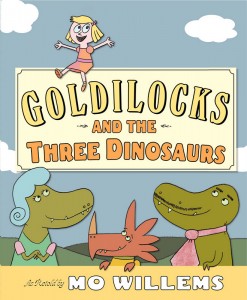 Goldilocks and the 3 Dinosaurs by Mo Willems: Once again, Willems is no undiscovered gem, but we love everything he does. And for our girl who is especially partial to dinos, we thought this one would be perfect. The book is geared for someone a bit older than three, and much of the humour is lost on Harriet, but we love it, and she gets off on the silliness. It’s the Three Bears turned inside out with a useful moral: if you find yourself in the wrong story, get out.
 A Good Trade by Alma Fullerton: In gorgeous illustrations by Karen Patkau, readers follow Kato, a small boy on his morning route to get water for his family in his small village in Uganda. We notice the vivid colours of his clothing and his friends’, the community spirit, and in the background are soldiers on guard, the fact that the children are shoeless. When an aid truck rolls into the village, Kato is intrigued by what’s inside, and imagines what he might give the aid worker in exchange.
 The Stone Hatchlings by Sarah Tsiang: We loved this one, a follow-up to Tsiang’s A Flock of Shoes. Abby is back, and she’s found two little eggs. They’re just stones, says her mother, but then we already know that Abby’s mother is often full of nonsense. In Abby’s vivid imagination (and with a great deal of care), the stones hatch into beautiful birds that become her companions. And when it’s time for the game to finally end, Abby’s ready when it does. (I interviewed Sarah Tsiang about the book last fall.)
 LMNO Peas by Keith Baker: Not just another alphabet book (plus, it urges on Harriet when peas are on her plate. “Look,” I say. “They’re peas and they’re unique!”). This book is a triumph of design, written in jaunty verse and I love that this alphabet is astronauts, explorers, gigglers, investigators, outlaws, readers, voters vets and volunteers. Also that it has introduced, “Can you dig it?” into Harriet’s vernacular, and at one teaching point (“Kings”) features Elvis. We all love this one.
 This Moose Belongs to Me by Oliver Jeffers: Jeffers is another underground kidlit sensation that only I have ever heard of or loved (ha). His new book is a bit of a departure visually, employing the collage technique he’s used in other books but this time using backdrops from old fashioned landscape paintings. It’s a funny little story about a boy who thinks he owns a moose, but the moose is most determined to own itself (and is partial to anyone giving away apples).
January 2, 2013
My Christmas with Caitlin Moran
 It is never Christmas properly for me unless I get to spend most of the day curled up on my mother’s sofa reading a book. This year’s book was Caitlin Moran’s Moranthology, which I received in hardback from my sister-in-law, which was only fair because I turned her onto How to Be a Woman last year. It’s a collection of Moran’s columns from the Times from over the years, interviews with characters from Paul McCartney to Lady Gaga, synopses of episodes of Sherlock and Downtown Abbey, celebrity gossip notes, and columns of wider social significance–on poverty, feminism, activism, and more. Moranthology is clearly more a collection of newspaper columns than a book proper, but for those of us who have fallen in love with Caitlin Moran, it makes a fabulous read.
The other book I got for Christmas was Astray by Emma Donoghue, from Stuart who was determined to buy me a book I hadn’t asked for, a surprise book. He went through my 2012 Books Read list, examined my shelves (to-be-read and otherwise), and had my Book City account checked to ensure I hadn’t bought the book and hidden it. As Harriet ended up telling me what all my other presents were (a cast-iron enamel pot and a tea towel), the book turned up to be my only surprise at all, and it was a lovely one.
I have also just realized that ten years ago, I never would have imagined that receiving a cast-iron enamel pot and a tea towel for Christmas would thrill me as it did, but it did! Though mostly because the tea towel is of the Barbara Pym variety. My husband is wonderful man indeed. And I guess a decade is a long time to change in.






