January 30, 2013
On yarn, yarns and Extra Yarn
 I’ve been knitting a baby blanket this last while, its colour yellow as selected by Harriet for whom yellowness is a sacred thing. And perhaps it was my current knitting project that got me thinking about the CanLit/Knitting Connection recently, about knitting in books and knitting about books. Then I thought about it more yesterday when we took out Extra Yarn by Mac Barnett and Jon Klassen from the library. What a spectacular book, about a little girl whose magical yarn stash never seems to run-0ut (and I know a lot of knitters, actually, with a similar affliction). I don’t know that Jon Klassen has ever gone wrong, and we loved this story with its splashes of colour, amusing prose, and sinister archduke (plus, SPOILERS, happy ending). Of course, you probably know all about this book already, especially since it was selected as a Caldecott Honour Book on Monday. Which was a particularly good day for Jon Klassen who also won the Caldecott Medal proper for the wonderful This is Not My Hat. I imagine this exciting news has changed Klassen’s whole life a little bit, but it’s changed mine too, because now I get to say that my website features an interview with a Caldecott winner.
January 29, 2013
Welcome to our new arrival!
 Life has changed forever in our home since the delivery of our newest household member on Saturday morning. Labour was a breeze, performed by two strong men who apparently carry appliances up rickety staircases and install them in attics all the time. And thereafter we fell upon gazing at it, unable to get over the beauty, the shine, the rocket-ship-ness. It plays music when its cycle is completed. Our previous washing machine was so old that when we asked our landlord to replace it, she reminisced that she’d used it to wash her kids’ diapers, and her kids are now in high school. Our old washer was Shirley Jackson eccentric, and it had a dial, but the label had worn off so we could never tell what the setting was, and there only seemed to be one setting anyway which mainly involved the washing machine dancing across the floor, and leaving the clothes inside not only not clean, but usually ripped. And don’t get me wrong–it was better than nothing. And certainly better, being close at hand, than the washing machines at the laundromat on Harbord Street which I’d frequented before we moved here, having to queue, and then remove other people’s manky underpants before using the machine for myself. But now this is a brand new washing machine, and it’s never known any manky pants but my own. When the clothes come out, they’re so clean you can feel it, and they’re nearly dry from the spin. And only a few months down the line, when I’m up to my ears in cloth diapers, will my love for this machine fully blossom. I’m almost excited about it. Almost.
January 28, 2013
The Ontario Table Cookbook
 I’ve had my eye on The Ontario Table by Lynn Ogryzlo for awhile now. It was shortlisted for the 2012 Taste Canada Awards, and has been part of a pretty display at my local butchers with a Le Creuset dutch oven and a tea towel. And even though it isn’t an alphabet book, it seemed the closest thing around to a local version of Foodshed: An Edible Alberta Alphabet. A few weeks back, the weather felt like absolutely spring and brought to mind miraculous things like fresh produce, and the gorgeous pictures in this book reflected the world exactly, so I sprung and bought it, and we’ve been eating rather deliciously ever since.
Animal Vegetable Miracle by Barbara Kingsolver changed our lives when we read it in 2007, and its effects linger on. At the time, we were broke but had a huge and beautiful garden, learning so much about how food grows, and we also started attending our local farmer’s market to spend what pennies we could manage. 6 years later, we no longer have a backyard to put a garden in, but we’re not broke either, and so we buy most of our food at our local farmer’s market in the summer, buy local food whenever it can be had at the grocery store (whose selection of Ontario garlic lately has been so exciting to behold), and have an organic food box delivered weekly which is composed of local food more often than not. We eat meat once or twice a week, and only buy from local butchers with ties to small local farms. We also eat organic as much as possible, not due to any dubious health claims but because we’ve determined that organic food tastes better and when you’re teaching a little person to enjoy vegetables, things like flavour are really important.
The Ontario Table is many things. First, it is an ode to local food cultures and to the tremendous diversity of food that is produced in Ontario. It is a travel guide to Ontario’s agricultural regions that makes one want to jump in the car for a Huron County road-trip immediately. It is also profiles farms and farmers from across the province, a glimpse of the people behind the food we eat. But most importantly, it is a cookbook and it’s been blowing our minds. We knew things were good when its recipe for beet chips was the first I’d ever made successfully. And then that weekend we had the cranberry beef stew and were pretty much converted. Oh, but the farmer’s pie, with sweet potato and mince chock full of vegetables, and Harriet loved it as much as did. Last night we had the pesto chicken stir fry, and it lived up to all our expectations. We’ve decided that with a meal from The Ontario Table, it might be impossible to go wrong.
The book is beautiful with stunning photography, and it’s as pleasurable to browse through as it is to eat from. From what I can tell, it’s also self-published, however, and sometimes a lack of polish shows–the index has the wrong pagination (but consistently, so you figure out where’s what), recipes could use more detail, and stronger editing (when exactly was my red pepper supposed to be added to last night’s stir-fry). I give these criticisms for the sake of full-disclosure, so you know what you’re getting exactly when I implore you, local food aficionados, to buy this book anyway. And I absolutely can’t wait for summer when it, and everything, will come into bloom.
January 27, 2013
We visit the Intergalactic Travel Authority to meet Gabby
 We ventured westward today for our first visit to the Intergalactic Travel Authority, an out-of-this-world cafe at Bloor and Dufferin. The cafe was inspired by the 826 storefronts in America , which run literacy programs for young people. Apart from the usual coffee and baked goods, customers at the Intergalactic Travel Authority can also purchase black holes in cans, robots and monsters, plus BOOKS, the proceeds from which fund the cafe’s literacy programs.
 Which take place through the cafe’s magical spaceship doors…
And we got to walk through those amazing sliding doors today because we were there for the launch of Joyce Grant‘s picture book Gabby, illustrated by Jan Dolby. (Joyce, a longtime literacy advocate, contributed a wonderful post to 49th Shelf this week for Family Literacy Day with tips for raising a reader.)
 Gabby is a fabulous book about a funny little girl who must deal with the consequences when she drops her book on the floor and all its letters fall out upon impact. When she starts picking up the letters now scattered all around her room, she is amazed to discover that the letters, when assembled in a precise manner, start taking on a life of their own. With the C, A and a T, Gabby makes a cat, but then it needs feeding, and trouble starts brewing when the next letters she picks up happen to spell “bird”.
 It’s a perfect book for Harriet, who is just beginning to understand how letters get together to make words. (Her partiality to the letter H, however, means that she’s not really bothered by the other 25 in the alphabet. Perhaps this book will help her get over that?) How letters with their individual sounds each have their own particular powers. Older readers will delight in guessing which words Gabby’s errant letters spell, as attested to by these kids’ reaction when Joyce was reading to us. The illustrations by Dolby are bright and fun, and subsequent readings reveal all kinds of hidden surprises.
 Though we in our family have a tendency to like any place where the cake is particularly abundant, we had an especially wonderful time today at the Gabby book launch. We were happy to pick up a copy of the book and have it signed by author and illustrator (who kindly noted with her autograph that H is indeed for Harriet!). And a book launch at such an extraordinary venue? It isn’t every day when you get the privilege of walking through a pair of sliding spaceship doors.
Isn’t reading wonderful?


January 23, 2013
Mini Reviews: Crusoe's Daughter & Stupid Boys Are Good to Relax With
 Jane Gardam always catches me off-guard, one of those authors who operates without real precedent and so whenever I pick up one of her books, it’s never what I’m expecting. I read Old Filth about two years ago, and found it incredibly bizarre–so traditional its Englishness and its subject matter, but its treatment was a bit like a fun-house mirror. I’ve made more sense of what Gardam is up to since reading this wonderful essay on Crusoe’s Daughter, which posits that Gardam “has, more successfully than most novelists, navigated the narrow stream between the stingy shores of modernism and the grand cliffs of the nineteenth century novel.”
I bought Crusoe’s Daughter (though was disappointed not to receive this edition, whose cover I adore) after Martin Levin noted it as one of his top reads of 2012. I wish to better understand Gardam and her work because it intrigues me so, and also because her admirers tend to be really brilliant readers. It’s the story of Polly Flint, the daughter of a sailor who is sent to live in a yellow house by the sea with two eccentric aunts. The first passage in the book I underlined was a description of a view of trees from a train carriage: “The light showing through them made them look like loops of knitting pulled off the needles.” Oh, can Jane Gardam ever write. And then the line appears again, inconspicuously, closer to the end of the book. There is real method in the construction of this book, which reads as old-fashioned from a distance. Crusoe’s Daughter is actually a novel about novels, or one in particular. In her isolation in that strange house beside the sea, Polly finds escape and company in Robinson Crusoe, whose character’s own isolation she identifies with: “He didn’t go mad. He was brave. He was wonderful. He was like women have to be almost always, on an island. Stuck. Imprisoned. The only way to survive is to say it’s God’s will.”
There was so much going on in this book that I didn’t wholly understand or appreciate, and I’ve never read Robinson Crusoe which probably means I missed even more than I’m aware of. But I was still captivated by the oddness of Gardam’s narrative, by the oddness of Polly herself (who does go mad but only for a little while. She eventually finds salvation teaching Robinson Crusoe and English Literature at a boy’s school). I’m not wholly converted to Jane Gardam yet, but this novel was as such that I’m not going to stop reading her until she finally takes.
**
 I don’t know that I’ve ever been as stupid than the year I was twenty-one, when I came across Susan Swan’s Stupid Boys Are Good to Relax With while shelving books at the university library. I was drawn to the title immediately, of course, as stupid boys were a habit of mine at the time, not just because I was stupid myself (though this was part of the reason) but also because I hadn’t realized I could do any better. Perhaps I thought the title might justify so many of my life choices at the time? But I was so stupid the year I was twenty-one that I didn’t even know how to read a short story collection. I think I was too young to appreciate what Swan was up, and I don’t think I got very far with the book at all.
The best thing about re-encountering a book is that it can be a testament to how far one has come. I would love for this momentum to continue, for my intelligence to be increased by the time I am 45 to the same extent it has improved in the last 12 years. Though that might just a peculiarity of one’s twenties; is there any other learning curve so great? Yes, my taste in men has come a long, long way, but I am also such a better reader now.
Stupid Boys Are Good to Relax With is remarkable for being a book published in 1996 with a laptop computer on its back-cover, with a whole section of the book called “Cyber Tales”, written as a conversation on the internet. In 1996, I wasn’t as stupid as I was when I was 21, but I don’t think I’d ever used the internet. How amazingly forward thinking was Stupid Boys…, which walks a very fine line of being very much of its time but not being dated. I was trying to explain the difference between the two, and I think it comes down to Swan having been aware of the use of technology in her work, and intending it to mean something other than just “modern” (which it most definitely wouldn’t be just a few short years along).
Stupid Boys… is a collection of stories about the way women construct their lives and identities of men undeserving of such an honour (and who are often even unaware they’re so being honoured). Using traditionally structured stories (including some narrated by the famous Mary Beatrice Bradford), and more unconventional tales peopled by characters from classical literature and pop-culture, Swan writes about the compromises women make, and the pleasure and pain of such choices. It’s also a surprisingly remarkable complement to Caitlin Moran’s How to Be a Woman, which is the book I read immediately afterwards.
January 23, 2013
Do you know how to be a woman now?
 ‘”No–I’m talking about the common attitudinal habit in women that we’re kind of…failing if we’re not a bit neurotic. That we’re somehow boorish, complacent, and unfeminine if we’re content.
The way women feel that they are not so much well-meaning human beings doing the best they can but, instead, an endless list of problems (fat, hairy, unfashionable, spotty, smelly, tired, unsexy, and with a dodgy pelvic floor, to boot) to be solved. And that, with the application of a great deal of time and money–I mean a great deal of itme and money. Have you seen how much laser hair removal is?–we might, one day, 20 years into the future, finally be able to put our feet up and say, “For nine minutes today, I almost nailed it.”
Before, of course, starting up the whole grim, remorseless, thankless schedule the next day, all over again.
So if I was asked, “Do you know how to be a woman now?” my answer would be, “Kind of yes, really, to be honest.” ‘
–Caitlin Moran, How To Be A Woman
January 22, 2013
The opposite of this scattered post would be an empty space.
 1) A friend emailed recently as she was doing a clear-out and wondered if I wanted any of her books on babies and birthing–Jessica Mitford’s The American Way of Birth, Sheila Kitzinger, Alison Gopnik’s The Philosophical Baby. And it was such a pleasure to tell her no. I’d read these books already. I remember poring over Gopnik’s book when Harriet was six weeks old, desperate for some kind of understanding of this creature who’d arrived in my life. I remember the hours spent on internet forums trying to work out a pattern in the pieces of brand new life as a mother. I remember a lot of talking about talking about motherhood, the desperation of these conversations. How important they were for me to have at the time, but how there came a time eventually when I didn’t need them anymore. I have this fantasy that when our new baby arrives in the spring and my life becomes all-baby again that literature might be my one escape from the haze. That I might spend my summer reading about everything except babies, even if it has to be done in the middle of the night while the rest of the world (except the baby) is sleeping. But I’ve never had a second child before. I do not know if my fantasy will come true.
2) Motherhood still interests me, but on a broader level than the whole strollers on the bus brouhaha and whether breast is really best. The conversations I appreciate most about motherhood are those that don’t usually appear on the pages of glossy magazines, which rise above the Mommy Wars to broaden notions of what motherhood is and can be, and the ways in which different women’s lives are affected by various experience of maternity, and the elusiveness of “choice” (which is so often another fantasy, no?). Anyway, I’ve got more to say on the topic and the most exciting news ever forthcoming in the weeks ahead. Stay tuned.
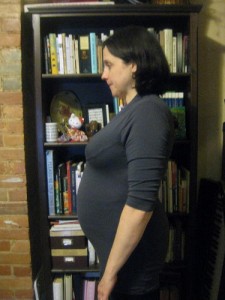
3) We took a picture of my baby bump! How positively first-pregancy of us! It is not altogether flattering, as I’ve no make-up on, lighting is poor and I’ve had a cold for three days and it shows. But this is me at 22.5 weeks pregnant, which is kind of remarkable. I know many people find pregnancy pictures obnoxious, but as someone who has spent most of my life feeling fat and the last three years in particular trying to hide an unfortunate abdomen post c-section (3 years later, it is no excuse, I know, but still…) it is awfully refreshing to embrace and celebrate the shape I’m in. And it’s a remarkable thing, however ordinary, to have happen to one’s body, to change so much in such a short time, different every day.
4) I keep vague tabs in my mind of how my blog content is divvied up, the grown-up things, the kid things, the women things. I always have this notion that I’m doing terribly well when a string of posts doesn’t reference children or motherhood at all, and yet I don’t fully believe this either. My blog has always been a reflection of life as it is, and small children (and the books they read) have been a huge part of my life for some time now. I could pretend otherwise, but then I’d be left with not much to write about. Anyway, all of which is to say that I’m feeling self-conscious and babyish posting about pregnancy and belly-shots, but then here is where I’m at right now. The opposite of this scattered post would be an empty space.
January 20, 2013
Some Great Idea by Edward Keenan
 For the sake of full disclosure, I’ll inform you that I actually appear as a character in Edward Keenan’s new book Some Great Idea: Good Neighbourhoods, Crazy Politics and the Invention of Toronto. Keenan, a Senior Editor at The Grid, writes in his book about how the Rob Ford spectacle has galvinized a whole segment of the population to take an interest in city politics, of this effect on his own career: “…before, my regular readership consisted largely of insiders at city hall, and political activists. Since Ford was elected, tens of thousands of readers click through online to soak up anything I write about the mayor.” And that’s me, one of tens of thousands. (I’m the one waving.) I didn’t even vote in the 2006 municipal election, the only election I’ve ever sat out since I came of age, but I remember being busy that day, not seeing the point. That election result seemed inevitable, but since Rob Ford took office in October 2010, nothing is inevitable anymore. It suddenly seems worth paying attention to what’s going on around us.
I think I’d be compelled to pick up any book whose author acknowledges that his thinking about Toronto has been influenced by Amy Lavender Harris’s Imagining Toronto. Amy has since become a dear friend, but we’d only met in passing when I fell in love with her book back in 2010, marvelling at how markedly she demonstrates that a city is constructed of stories as much as concrete and steel. Keenan takes this as the premise for his book, whose opening line is, “I have this notion that cities are just a collection of stories we tell ourselves about ourselves.” Near to the end of the book, he writes, “The answers, then, are in the process, just as the themes and lessons of any story lie not in its conclusion but in the unfolding of the plot.” So there you have it: plot. This is not some dry polemic. There is movement here; we get somewhere. Which is exactly what you would expect from a book with a subway on its cover.
Some Great Idea is the history of Toronto since amalgamation in 1998, the story of mayors Lastman, Miller and Ford. Though Keenan emphasizes that Toronto has always resisted being defined by its leadership, so the story goes beyond these three figures. Which isn’t to say that the city hasn’t been marked by personalities, and Keenan selects William Lyon Mackenzie, RC Harris (who was apparently very different from the figure Ondaatje portrayed him as), and Jane Jacobs as three individuals who resisted convention, rebelled against the system and helped to shape the city we live in today.
It’s also the story of Keenan’s own engagement with civic life, in the last ten years in particular (and in this way, Some Great Idea is a nice companion to Samantha Bernstein’s memoir Here We Are Among the Living which documents this same period in Toronto). He’s been in a privileged place, telling urban stories at a time when an awareness of urbanism had taken hold of the city like never before: this was the birth of Trampoline Hall, Spacing magazine, Richard Florida, the Dufferin Grove Park pizza oven, and Keenan ties these factors all together as the story of this place. It’s his place, where he lived in an industrial loft with the woman who is now his wife, where his children were born, where he and his wife became homeowners. It’s a story too that is more complicated than the personas of the men in power suggest–there was a great deal of progressiveness in the city under Mel Lastman thanks to figures on council like Jack Layton; David Miller’s legacy was far more positive than most of us remember; Rob Ford’s “leadership” has engaged Torontonians like nothing before.
Keenan shows that Toronto too is a much larger place than the downtown core highlighted in most civic discussions. He gives the example of Woburn, a neighbourhood within this supposed “city of neighbourhoods”. Except that Woburn isn’t a neighbourhood at all, but it’s the name given to the area where Keenan spent his teen years, near Markham and Lawrence in Scarborough. He has it stand for the inner-suburbs in general. It’s an area that grew up entirely differently than the downtown neighbourhoods, with different interests and priorities, whose populations no longer live the lifestyles the area was so rigidly planned for. You have to understand a neighbourhood like this, its strengths and weaknesses, in order to understand how Rob Ford was elected into office, to understand why someone who lives in that part of the city might see themselves as as taxpayer before citizen, if they even define as citizen at all.
The book’s title is taken from a quotation by Benjamin Disraeli: “A great city whose image dwells in the memory of man, is the type of some great idea.” The peculiarity of this diction, the vagueness of “some” great idea unspecified points to the book’s one weakness, a kind of muddled conception of itself and its purpose. I longed for Keenan to grasp his narrative with more confidence, for less journalistic objectivity. It wasn’t always clear where the story was going, but then Keenan himself was the one who wrote that unfolding not conclusion is the very point. And I will take it.
Because I learned so much about Toronto from this book, its history and its present. Keenan posits diversity as the city’s great strength, and goes on to define a city’s “diversity” as being about so much more than the ethnic backgrounds of its people. He closes with his theory of a city as something ever in the process of being born–“Inventing Toronto”, then, in addition to imagining it. The city as a story each of us is telling every time we stroll, cycle or drive down one of its streets.
Other Toronto links:
-My review of Rosemary Aubert’s Firebrand, “Loving the mayor is a bit like that.”
January 20, 2013
A bad year to be a woman with a reproductive system.
I want to take a few moments to delineate the many ways in which 2012 was a spectacularly depressing year to be a pregnant woman. We’re only a few weeks into 2013 so it’s still too soon to say, but so far I haven’t had to listen to that jangly Rick Santorum song with the lyrics, “We’ll have justice for the unborn/Factories back on our shores…” one single time, and that is progress. Neither have I noted once that a panel of old men (too many of whom with more children than fingers on one hand) have been provided a international platform from which to debate just how much American women’s access to contraception should be curtailed.
And speaking of “debate”, so far in 2013 I have not once had to endure the insult of 91 members of Parliament (including the Status of Women Minister) voting for a say as to the contents of my uterus. I was five-weeks pregnant at the time, and I was absolutely horrified, as well as confused as to why I had not been brought in to provide expert consultation. Surely some expertise might have been necessary. Did you know that there are actually 233 members of Parliament who have not a single uterus among them? The input of a living, thinking pregnant woman into this conversation might have provided some much-needed perspective.
So far, 2013 has been an improvement. It’s been at least a few weeks since a group of Ontario MPPs (not a uterus among them either, note) staged a press-conference supporting a move to stop public-funding of abortion in this province. And while I am sure that several women worldwide actually have died this year because they’ve lacked access to abortion and other maternal health procedures, there has not been a story with the level of tragedy of Savita Halappanavar‘s, who died in Ireland after miscarrying at 17 weeks pregnant when a fading fetal heartbeat was privileged over an actual human life.
2012 was a bad year to be a woman with a reproductive system. I’m talking Handmaid’s Tale territory. When I got pregnant, it was immediately apparent to me that my body had become a national concern, that my womb was now somebody’s territory for staging a shouty “debate”. A woman who was pregnant in 2012 owned herself just a little less, and it was total madness. I really can’t believe we put up with it. My resolution for 2013 is that we not do that anymore.