January 22, 2014
Kathryn Kuitenbrouwer’s All the Broken Things
 There is a mention of bunting on page 59 of Kathryn Kuitenbrouwer’s All the Broken Things, which Kathryn has claimed (maybe even in all seriousness) that she included in the book just for me, and from this point you should infer two things which are related: first, that I am situated too close to Kathryn Kuitenbrouwer to offer up a proper review, and second, that I am among those who are fortunate enough to call Kathryn a friend. Kathryn is smart, blunt, hilarious, a bit terrifying in her brilliance, and blessed/burdened with a huge and generous spirit. My admiration of her as a person and as a writer stretches oh, so long, and I am so pleased that her new novel All the Broken Things has garnered rave reviews in The Toronto Star and the National Post.
While I am pleased, however, I am troubled that the reviews have neglected to mention how weird is All the Broken Things. You might be inclined to think it’s just another romp about a boy and his bear, Blueberries for Sal in the Junction, except with a horrible disfigured toddler who is a victim of Agent Orange (and that Sal in the Blueberries book was actually a girl). Laura Eggertson writes in the Star, ” Bo and Bear deserve to become fixtures in the pantheon of Canadian characters who live in our imaginations,” by which I picture the two of them and Anne of Green Gables bounding down The White Way of Delight.
My pictures aside, live on in imaginations these characters do. I finished reading the book the other day and have not quite discovered what I think of it yet. “I think it’s a novel meant to be deeply considered rather than summed up in a sentence or two,” is what I wrote on Sunday in an email to a friend. The novel is a peculiar shape, not quite what I am used to. I found it to be a page-turner, difficult to put down. It’s a novel that moves through time and space almost as quickly as I moved through its chapters, and I have this theory that its plotted more as an epic tale than a novel. (The myth of Orpheus is referred to in the novel, in the form of the Sir Orfeo story, and it’s intriguingly unclear exactly what maps onto what.) While Bo’s journey is certainly inward, it is demonstrated by his outward journey, from plot to plot, place to place, quests, and battles, dragons slain. Characters are not delved into deeply, which is not to say that these characters are not interesting (Bo’s teacher, his mother in particular, Soldier Man in High Park) but that their own journeys remain unclear to us, their mysteries suggested but not brought into light. There is a shallowness to the narrative which is intrinsic to its shape and to what Kuitenbrouwer is attempting (and succeeding at) in her project, which is breadth instead. This book about bear wrestling, Vietnamese boat people, CNE freak shows, and the production and effects of Agent Orange. You know?
Anyway, this is what I love, a book that provokes a more complicated response that either this is good or this is bad. I mean, this is good, of course, but even more importantly, this is interesting. And if I ever get to the bottom of what I think of All the Broken Things, I will be profoundly disappointed to be done.
Check out the book trailer for All the Broken Things by Carol Nguyen. It is also interesting, and absolutely stunning.
January 20, 2014
Consolations & Translations
 People have been so kind in response to my sadness over the closing of my beloved local bookstore. Anyone who thought I was being melodramatic and ridiculous has kept that information to himself. This is a loss that has been experienced by many avid readers in the last few years, and I really appreciated their sympathy and understanding. I am operating with an optimistic spirit, that Bloor Street won’t be bookshop-less for long. And in the meantime, venturing further afield for my book-buying pleasures will a) possibly save me thousands of dollars and b) allow me to not take for granted such things. I am hoping that good things are ahead also for the Book City employees too, and that each will find a place where his/her skills and expertise are valued.
And in the meantime, I went shopping. In a few weeks, the shelves will be bare and all will be depressing, but there is still plenty to choose from so I allowed myself a rare pleasure for a bookish sort like me who always knows exactly what she’s looking for. Last week, I bought the new Jane Gardam novel, The Ice Cream Store by Dennis Lee, and this wonderful book of maps for kids. Buying discounted books at the going-out-of-business store made me feel like a vulture, but I was assured that I’d earned the right to do so without compunction by having tried my darndest to spend as much money there as possible this past while. So I went back today and got Pitch Black by Renata Adler (because they didn’t have Speedboat, and I am intrigued by Renata Adler), and Molly Ringwald’s book because Molly Ringwald wrote a book and it’s even meant to be good, and 30% off is a good excuse to find out if that’s true. Then two more books by Rebecca Solnit, because I want to read everything she ever wrote.
And finally, because reading books in translation was my New Year’s reading resolution, I bought two books to get me started: For Sure by France Daigle (French-Canadian) and Swimming to Elba by Silvia Avallone (Italy). I’ve been inspired to do so after reading the Penelope Fitzgerald bio and realizing how limited is my perspective on the novel with such a focus on Englishness. It’s like only ever looking at a shape from just one side. So I am going to challenge myself and my sensibilities, first as a reader, but also as a writer. I’ve made a renewed commitment to writing fiction this past while (which has led to an acceptance letter the other week! Hooray. I’ll have a story forthcoming in The New Quarterly this spring or summer), and I want to write stories that seek to do things that are new. I think translations will show me what other possibilities there are.
And I am particularly excited about another book in translation, Sanaaq by Mitiarjuk Nappaaluk, which was stupendously reviewed by Keavy Martin in the Globe and Mail this weekend. It was such an inspiring, incisive piece which dares to challenge readers: “Yet rather than attempting to draw large (and largely inaccurate) conclusions about Inuit culture, southern readers might instead try to enjoy this humbling state of non-understanding.” I am willing to take her up on this, and I’m looking forward to it.
January 19, 2014
The M Word is coming.
 I’m not sure when I last touched base here about The M Word: Conversations About Motherhood, which is forthcoming from Goose Lane Editions in April. I suspect that the last time I did, the book had a different title, was still more a manuscript than an actual book. But a lot has changed since them, and you will notice that this book even has a cover, thanks to the talents of Goose Lane’s Julie Scriver. (It is to our great joy that the cover image includes a baby with a soother. Soothers are sacred objects in our household. If we had a family coat of arms, a soother would be in it.) The essays themselves have been strengthened with the deft editorial hand of Bethany Gibson, which whom it has been a privilege and pleasure to work with. Publisher Susanne Alexander and everyone at Goose Lane (including the wonderful Colleen Kitts-Goguen) has made an enormous investment in this project, which I am so grateful for and amazed by. To think that just two years ago, this book was just an idea sparked by a discussion with my friend Amy Lavender Harris, and how far we’ve all come since then. An ARC of the book arrived in my mailbox at the end of November, and what solid proof of this book’s realness. Terrifying and oh, so exciting.
And of course, the best thing about my book being an anthology is that it’s not my book after all, but rather our book. I can tell you that this book is wonderful and important, and not be conceited, because I’m not talking about me, but us. Excellent essays by Heather Birrell, Julie Booker, Diana Fitzgerald Bryden, Myrl Coulter, Christa Couture, Nancy Jo Cullen, Marita Dachsel, Nicole Dixon, Ariel Gordon, Amy Lavender Harris, Fiona Tinwei Lam, Deanna McFadden, Maria Meindl, Saleema Nawaz, Susan Olding, Alison Pick, Heidi Reimer, Kerry Ryan, Carrie Snyder, Patricia Storms, Sarah Yi-Mei Tsiang, Priscila Uppal, Julia Zarankin and Michele Landsberg. And me. My essay is important because no wonder what tender thing each of the other writers is laying bare, she is not writing about the time she had an abortion, and so at least there is that.
As I wrote here recently, for it had just occurred to me, the literary non-fiction anthology is a revolutionary act. Though in my mind it has also had an element of ephemerality about it. It’s the literary equivalent of, “hey kids, let’s put on a show!” and it’s very much of its time instead of for all time. Except that maybe, perhaps, it’s more than that. Which I’ve been thinking about the last few days as I’ve been rereading Dropped Threads: What We Aren’t Told by Carol Shields and Marjorie Anderson. That book has come to serve as a reference point—it was so popular, a Carol Shields project, so ubiquitous—that I think some of us have forgotten what a powerful, incredible collection of essays it actually is. I think that so much about womanhood much be discovered over and over again, and that’s why these anthologies are important, these stories set down and together. Women making our own histories where there before has been centuries of silence.
This week I was thrilled and grateful to see The M Word included in the Quill & Quire 2014 Spring Preview. It’s nice to know there are other people looking forward to our book. And if you happen to fall in this company, I’d ask you to pre-order the book from your local bookstore. Perhaps also think of including it in your book club’s schedule this year? It’s an engaging book that will definitely incite discussion, one that will probably continue even after the wine is drunk.
January 17, 2014
Meeting the Tormentors in Safeway by Alexandra Oliver
 Poetry can be perplexing, but it’s got nothing on the poets. Many a time I’ve tried to make sense of who likes who, what and why, going straight to the source and asking poets themselves who’ve confessed they’re just as confused by the whole thing as I am. I’ve tried flowcharts, diagrams, and spreadsheets, and have managed to uncover no pattern except that having me really love your collection is generally an indication that it’s not poetry proper. I have even tried to be more discerning as a result: last year I read Personals by Ian Williams, and while I really liked certain poems, I thought, Nope. This isn’t cutting it. And then the next day it was nominated for the Griffin Prize, so there you go. But then a few weeks ago, hell must have frozen over (along with everything else, I suppose) because critic Michael Lista (whose book I liked, granted) went and picked Alexander Oliver’s Meeting the Tormentors in Safeway as one of his books of the year. A book that I’ve been reading and enjoying considerably!
Here’s how I came to this book (and be forewarned: I’m going to start talking about Book City again). I went to the Biblioasis launch in October and hear Alexandra Oliver read from her book, which is the best advertisement for this book. She was amazing. Though I didn’t actually buy the book until about a month or so ago when people were talking about it on Twitter, and the nature of my excellent life is that I can be reminded about a book on Twitter and then march straight out to purchase it at the bookstore around the corner (where of course it is on the shelf. They saw me coming a mile away). And I’ve been dipping in and out of the book ever since, intrigued and delighted.
These are poems that are deceptively simple; they rhyme. Sometimes I think that Alexandra Oliver is making fun of me, but I don’t hold this against her. These are poems about familiar situations–encountering other mothers in the park and discussing stroller models, angsty troubled romance. Proud poems about trouble—one called “Curriculum Vitae” contains the lines, “The hive of hell was crowded with my bees/ the sea of ill acquainted with my oar”. Dark, sinister, sardonic and hilarious. A poem about a camera user’s manual, and yes, the title poem, about recounting an old bully years later. “It’s been so long. They say. Amen.”
http://www.youtube.com/watch?v=jIllNmv1TAs
January 17, 2014
The Morning After: What Do We Do Now?

Harriet trick-or-treating at Book City on Halloween
I don’t want to go to Book City since the news. I feel like if I stay home, I can pretend that none of this is happening, but of course it makes no difference and my heart is broken. (And in a way this loss has been drawn out–I’ve been missing Book City’s second floor for years. Who ever would have imagined that the early to mid ’10s of our century would prove a golden age? It was full of war and dreadfulness. Would have been shocked to think we’d look back at all fondly.) Anyway, I am not doing a great job of moving on here, which is the point of this post, but let us do so.
Here is what I am going to do. I will suck it up and shop at Book City for as long as I have the privilege to do so. (I have a yearning for Penelope Fitzgerald’s The Bookshop now. Wonder if they have it in stock? I wonder if they can still order books that aren’t in stock. Hmmm.) And I am going to frequent the other great bookshops in our area–Little Island Comics has great kids books, and Parentbooks is actually moving a few blocks closer to our house, and they have a nice selection of children’s books too. Expanding my radius a bit, great books are on sale at the Bob Miller Book Room, the UofT Bookstore, and Good Egg in Kensington Market. (More about our local bookshops here.)
I am going to champion my favourite books and authors by following Carrie Snyder’s advice for how to support good books and good book culture.
I am going to start asking myself more often, “What would Jane Jacobs do?” (This was Jane Jacobs’ local bookshop as well, so the question is more relevant than it might immediately appear.)
And I am going to continue to appeal to someone—someone brave, creative, smart and with some funds—to please fill the gap which will be left by Book City’s closure. The problem I think is that anyone lately with the chutzpah to so such a thing sometimes lacks the savvy and business acumen to pull the whole thing off. There could be a connection i.e. anyone who’d open up a bookshop these days must lack necessary smarts to run a business, but this isn’t always the case. I think that book selling is a bit of an art, and not everyone can do it. You have to have experience and expertise to do it right. I think about a local indie bookshop that shut recently, and how their stock was terrible–never once did they have the books I wanted on their shelves, and when I ordered books, they messed the orders up. How they were lacking the casual friendliness and focus on customer service that Book City has taught me to take for granted.
No more. But yes, there is a hole here. So the last thing I am going to do here is have faith that something excellent is going to come along and fill it.
January 16, 2014
The Saddest News
 A few years ago, I misread a headline that Book City in Bloor West Village was closing as my local Book City closing (Bloor Street in the Annex), and was devastated for a moment. The relief I felt upon realizing my mistake was absolutely epic, but I always suspected that the moment was a glimpse of things to come. I’ve been lucky to this long stay immune to the indie bookshop closure plague, but it seems that my luck is finally up with the announcement today that Book City’s flagship location would indeed be closing, and I cried and cried and cried.
Of course, one could say, the loss of a store is not a real thing. But then it is a real thing, which is the whole point of a proper bookshop. Real things are people, like Jen who phoned me yesterday afternoon to confirm my order for the collected letters of Penelope Fitzgerald. Like John, who has worked there since 1976, and everybody else who takes my special orders, rings through my giant stacks of books, rings through my customer discount without even seeing my card because they know my name. My husband went into Book City shortly after Iris’s birth, and came home with a present from Rachel. I have tweeted that I’m coming in for a particular book, and they’ll have it behind the counter for me by the time I’m at the shop. Such excellent, knowledgable, expert customer service, and all these people are going to be out of a job. I am so sad for each and every one of them.
We used to live in Little Italy, and it wasn’t until we moved nearly six years ago that I realized what I’d been missing all my life: a bookshop just around the corner. It is the ultimate destination. I do all my Christmas shopping there, and if I’ve ever given you a book for any other occasion, that’s where it’s come from. Any time Stuart and I go out on a date, we make a late-night stop in. We took Harriet trick-or-treating there on Halloween. After Harriet was born, it was the first place I ever ventured. During Harriet’s first year when I was bored and alone, I became a regular. The shop staff (Hi, Suzanne!) were some of the brightest spots in my life. Harriet wanders around the shop like she owns it, and I feel like she has grown up there. It makes me so sad that Iris won’t have that experience. I have bought so many books because someone has been smart enough to display it at the counter knowing it was precisely what I wanted/needed. So many bookish discussions at the counter. Running into bookish friends in their natural habitats. On lazy Saturdays when we have to go somewhere, it is generally where we go. I look around my library and see that most of my books have come from there. Memorable visits, like the day Harriet bought Wonder Woman. Pre-ordering Donna Tartt and Zadie Smith, and getting my mitts on those books the day they come out. When we were on austerity measures after Stuart lost his job 3 years ago, and for Mother’s Day my gift was to buy some books and it was such a pleasure. I love that whenever I’ve wanted a poetry book from a small press, I could be reasonably assured of seeing it on the shelf. I was so looking forward to The M Word being on sale there.
It has been an honour to pay full(ish–I had my customer discount after all) price for books in exchange for having an excellent independent book shop in my neighbourhood. I wish that more people could see how much we gain for such a transaction. Books cost money because they are items of value, and I think that in our society’s hunger for deals and discounts, in that we have made everything about dollar signs, we have forgotten what value is. Anyone who has let Chapters/Indigo drive out their local indies will soon be sorry when that whole enterprise shuts down and they’re left with no place to buy books at all. And then there is Amazon, who has seen fit to forfeit profit in order to ruin everybody else, but I promise you that their prices will no longer be so reasonable once they’ve finally achieved their grand monopoly. And how about conditions in their warehouses? Also, real things: Amazon does not qualify.
And I know I have been spoiled, to take for granted that I could walk around the corner and to pick up nearly any book I desired. There are those who will say I need to get with the times, who find my elitism repugnant, who find that Costco serves their book buying needs just fine, thank you very much. But those people must not know that they’re missing. These are not the people I want designing our society. People who have never known how a bookshop really can be the heart of a neighbourhood, and what a hole is left when one disappears. All this is partly sentimental, which I think is what they call it when I despair about the loss of things that make me happy, but it is also practical–where will I buy my books now? I am fortunate to have some excellent specialty bookshops in my neighbourhood still, but no place for new adult books unless I go out of my way. And I guess what I’ve always liked about my life and where we live is that I’ve never had to go out of my way to buy a book. Book-buying has always been right there on the main thoroughfare, along with Sweet Fantasies Ice Cream. In short, life has been complete. I have been so lucky. I am not sure this is a bad thing and think it should be wider-spread, not rare. Can you imagine how much better and smarter the world could be if everybody had such a place around the corner to go?
It is shameful that the Annex will no longer contain a proper bookstore–how far this storied neighbourhood has fallen. And I implore some brave soul with capital to make a new venture, please. I promise to come and spend lots of money.
See also: Jon Paul Fiorentino on the need for fixed book pricing in Canada: “FBP may seem, to some, to be counter intuitive to the free market sensibilities we have in North America, but consider this: The book marketplace is one of the only marketplaces where vendors can return merchandise to their suppliers for a full refund whenever they want. Books are clearly not typical merchandise. They are as much cultural artifacts as they are goods for sale. In fact, books represent the source of our cultural and intellectual reality. So why should they be treated with the same notion of disposability as jeans or candy bars? FBP is good for bookstores because it levels the playing field and eliminates undercutting. It’s good for independent publishers because it allows them to control their print runs, stay in competition with larger houses, and take risks on less popular but innovative and vital authors. It’s good for authors because it secures a level of remuneration with regard to the fixed net price their royalties will be paid out at, and it’s good for consumers because it diversifies the marketplace and gives them more options.”
January 14, 2014
On Seven Months Part 2: I Want My Hat Back
 Things started disappearing a few weeks after Iris was born.
First was our picnic blanket, which is a strange thing to lose. Last seen when the baby was two weeks old, the afternoon we ate cheese and bread on the grass by Robarts Library while the baby slept in the stroller. The outing had been an exercise in normalcy, and one at which we succeeded marvellously. But when it came time for Harriet’s play school picnic a week and a half later, our picnic blanket–actually an king-size sheet with a green leaf print that I’d bought at Walmart for a dollar back when I still bought things at Walmart–was nowhere to be found. We ate our lunch that day on a table cloth. “It will turn up,” was the thing we said, because we always say this and often it’s true. But our picnic blanket never did. We soon replaced it with a waterproof outdoor mat that we bought with a gift certificate our friends had given us when Iris was born. It was an upgrade. The loss of our picnic blanket was mysterious, but not a tragedy.
In November, we lost Iris’s snowsuit. Well, not a snowsuit exactly, but this blue fleece suit with a hood that was perfect for autumn, one that was worn and pilly because Harriet had worn it four years before. Iris had worn it to swimming lessons, but I’d carried her home without it under my coat because she was sleeping and I didn’t want to disturb her. She was warm enough. But we got home to find that the blue suit was nowhere, and though I enquired at the community centre’s Lost and Found a few times over the next week, it didn’t turn up there either. But then the season was changing, we had a real snowsuit waiting. The blue suit had been coming to the end of its life anyway.
You already know how in November, I also lost our passports. Mid-journey in Amsterdam airport, resulting in a missed flight, so much panic, plans for emergency visits to consulates in farflungdom. Passports did turn up, but only after airline staff had unpacked our baggage three times, and then finally we unpacked them once more under the instructions of the immigration police. Perhaps if we’d tried this technique with the first disappearance, we might have found the picnic blanket.
And then somehow I have lost my pink fleece sweater, one that is old and worn, so farewell, I suppose, but it is cold in my house, and moreover, the sweater wasn’t entirely frumpy. I thought maybe it had gotten mixed in with the three garbage bags of stuff we’d assembled to be donated to charity, but searches turned up nothing. This loss has left a sizeable hole in my already meagre wardrobe.
None of this makes any sense. I am meticulously organized. I have known to have fits of anxiety when Harriet’s puzzles are missing a piece and scour the house until we find it. For me, the definition of “laid-back” is when I put away her toy eggs without the full dozen in the plastic carton, and I always feel sort of proud of myself when this happens. I lost my quarter-teaspoon a few years ago, and this was such an odd occurrence that it stands out. I have been mis-measuring my salt ever since. It must have fallen down behind the cupboards.
This is why when the immigration police told me to unpack our bags just one more time, I protested. “Really,” I said. “They couldn’t be there. I never would have put them–” But there they were. How odd not to know one’s own mind, let alone one’s own bag. Since Iris arrived, it is as though the fabric of our daily life has been stretched so thin and enormous things keep falling through the fibres. The metaphor is simply too perfect, and sometimes I suspect I’ve walked into a short story plot. This kind of confusion is what happens when you read far more than you sleep.
On Sunday afternoon, I lost my hat. And then I kind of lost my mind, because I was just so tired of losing things. And it wasn’t like the blanket or the blue suit, things we could get along without, things with which I could follow my dictum that things are just things and not worth getting upset over. Because I love my hat. It is a red felted cloche with a fuchsia flower, a one-of-a-kind that I bought at a craft fair last winter. It cost $45, which is a lot for a hat, but it was a beautiful hat, and it covered my ears. I have a big head, so such hats are hard to come by.
I had been writing this blog post in my head for a few days before the hat actually got lost, and it had begun to seem really disturbing, like my life had taken on the blog post’s trajectory rather than the other way around.
With the loss of the hat, I had officially had enough. I am a fervent unbeliever in Mommy-Brain, which offends me first because it’s this self-perpetuated myth that motherhood makes us stupid, which does us no favours, and also because my brain has never been as sharp as its been since my girls were born, the world suddenly full of brilliant and surprising connections and I really do find the experience of being a mother absolutely inspiring like nothing else I’ve ever experienced. But yes, I am tired. And I keep losing things. I was imagining a place (beneath the floorboards, perhaps?) where all the missing things were gathered. It was the violation of the laws of physics that was my main concern with this troubling string of events, never mind Mommy Brain—how can an object simply disappear?
(We flirted with a hypothesis: Iris was the obvious suspect. Nothing had gone missing before she arrived in our household. What if Iris was a thief?)
Then we found my hat. I couldn’t believe it. The first time I retraced my steps, I’d come up with nothing, as with all the other missing things. It was all part of the same plot, and it was beginning to be infuriating, not to mention boring. But yes, the surprise twist. I present once again at another Lost and Found, and the attendant comes back with precisely what I am looking for held in his very hand. And suddenly it didn’t matter anymore that on the way to the Lost and Found, my purse strap had snapped in two and it was beginning to seem that my whole life was unravelling. Because it wasn’t. I had my hat back, and everything terrible seemed a little less inevitable after that.
We walked home and I didn’t even need my hat. The temperature was above zero, something spring-like in the air, and the sun was out. For the first time in a long time, we held hands without mittens, and our mittens were either tucked safely in our pockets or tied to our coat with string.
January 12, 2014
Tenth of December by George Saunders
 In 2013, for the first time ever, I’d read almost all of the year’s best fiction, at least as determined by the New York Times. Life After Life, Americanah, The Goldfinch, The Flamethrowers–all of these were huge and satisfying reading projects for me this year. (One would note that these are all books by women. I believe their appearance on this list all together is because 2013 really was a banner year for books by women, but also because it was the year in which Pamela Paul [a woman] became editor of the New York Times Book Review, a most fortuitous confluence of events.) The one book on the list I hadn’t read was Tenth of December, a short story collection by George Saunders, and it had been keeping such excellent company on that list that I decided I had to read it too, for my own reading pleasure as well as for the sake of completeness.
When I started to read, I had no idea what I was getting into. We begin, “Three days shy of her fifteenth birthday, Alison Pope paused at the top of the stairs.” And was there ever a better opening sentence, in terms of rhythm, euphony, use of a moment stopped in time? The smallest pause, and the story begins its movement forward, unrelenting. It is a common complaint of the modern short story that within it nothing happens, and herein the work of George Saunders is resolutely an exception. Although as Alison Pope descends the stairs, where we’re going doesn’t get any clearer. “Say the staircase was marble,” and here we are in the realm of the hypothetical. A strange kind of voice, punctuated by physical gestures, “{eyebrows up}”, catchphrases and short bursts of francais (ballet, it is). And then it is clear–aha! Here were are in the head of a teenage girl, Alison Pope, just three days shy of her fifteenth birthday. She’s home alone and here is her interior monologue, and it is full of affectation and she’s imagining herself as the heroine of our story (oh, but isn’t she though). She is faintly ridiculous, but here is the thing–George Saunders loves her. He believes in Alison Pope, in a benignly teasing way. And it is this kind of faith on which the entire collection is constructed.
In a sense, Alison Pope is a type, and so Kyle Boot, her neighbour (over-helicopter-parented neurotic nerd) but they’re both invested with specificity in their oh-so realized voices, and moreover, Saunders permits both of them (and all of his characters) to go beyond type. As Alison is descending her stairs, she is contemplating big questions in her peculiar sunny way: are people good and is life fun? Alison Pope is voting yes, and then comes a knock at her door, the cruel world fighting to get in. Conspiring to rid the sun from the world of Alison Pope, and the only person positioned to save her from such a fate is a most unlikely hero, Kyle Boot. Here is plot; here is a man with a knife. Because there are men with knives–George Saunders knows that. But he also knows that they don’t always win. That shadow doesn’t negate the light.
I tore through these stories in a hurry, leaping from one to another and having to re-find my feet on each landing. We move from skewed domestic tales (Tom Perrotta meets stylistic innovation?): to a convicted murderer partaking in pharmaceutical experiments which ultimately offer him a chance at redemption; a story in form of a pseudo-motivational email from a middle-manager; the diary of a man in some distant future who is disappointed with his life and decides to make his daughter proud by investing in the latest fad–foreign women displayed as lawn ornaments–and thus begins the downward spiral of his life; the amazing, explosive story “Home” (which it occured to me I’d read in the 2011 New Yorker Summer Fiction issue) about a war veteran returned home broken to his imperfect life; and the title story in which a nerdy boy with an overactive imagination (whose mom is my favourite person in the whole book, and the boy’s perception of her is beautiful and heartbreaking) meets in the woods a terminally ill man who is determined to end his life.
Though very different in tone, Saunders’ collection has the same preoccupations as the Giller-winning Hellgoing by Lynn Coady, moral questions in an amoral world. What is good and what is evil? Are there such things as either? How do we know how to be in a world without God? And is it possible to even get the chance to answer these questions when the speed of life’s locked in at status-quo?
I come to Saunders without context, save for the New York Times list, but in reading the book made another CanLit connection–Jessica Westhead and her short story collection And Also Sharks. This one quite similar in tone and approach, funny and broken characters who show their cracks, created in utmost sympathy. Stories which remain solidly on the side of goodness, even as they acknowledge the realities of life itself.
January 11, 2014
On Seven Months
 As it was when Harriet was a baby, seven months has been a turning point. The baby has become vertical. She sits and eats her dinner with us in her chair. She has a sense of humour. I can put her down and she can play by herself, thereby ensuring that dinner gets made. She and Harriet are beginning to play together. We have found equilibrium as a family of four. And yet seven months is turning point in another sense, such as we’ve turned a corner and smashed into a wall. It would be more troubling if we hadn’t been precisely here before, but it’s still exhausting and frustrating. Six nights out of seven, she won’t be put down to sleep in the evenings, and then we take turns sitting on the sofa drinking wine by ourselves while the other is upstairs trying to get her to settle. Because we’ve been here before, we know enough not to turn it into a power struggle, we know that baby needs what she needs, and that “sleep habits” are indeed something a child of 18 months can indeed acquire out of the blue. I always expected that we’d end up here again, but oh, it’s not a fun place, even if you’re only visiting. (She is upstairs, screaming right now, and just spat out her soother and it sailed down the stairs.) We know we know we know, and it could be a million things–she is teething (or just evil?), and on antibiotics since this morning for cellulitis. I spent 4 hours last night at the emergency room having that cellulitis diagnosed, so you can see why I had hopes for having earned a more enjoyable way to spend my time tonight than the screamy baby relay. When I am refreshed enough to be philosophical about the whole thing, I know she is little, in need, that I love her, and these days are fleeting (and it’s the nights that are the trouble; the days themselves are fine, and I’m not even really tired because once I come to bed, she is happy enough to sleep beside me), but more often on these nights, I’m just impatient and angry. There is nothing like a baby to take one to the limits of herself. My own limits, as I learned very early in my mothering days, are closer than I’d like to admit.

January 9, 2014
The Silver Button and Wanderlust
 I have been besotted with Rebecca Solnit ever since reading The Faraway Nearby last fall, so I was very pleased to receive two more of her books for Christmas. I read Wanderlust: A History of Walking first as it was written before the other, and I loved once again being absorbed in a Solnitian world where the connections between books and place are so strong, and where one thing leads to another, just as one step does. (“One foot in front of the other,” is Harriet’s mantra as we embark on the 1.3 km walk to school every morning. It is a long walk if the walker is 4 years old, particular lately through snow and ice. ) And it is because one thing leads to another that one can’t sum up a Rebecca Solnit book properly, and I therefore must resort to ecstatic sharing. I loved learning about how closely the history of English garden design connects to the history of walking, about how the idea of walking being natural takes for granted civilization (i.e. law and order), and the gender politics of walking and (for women) the sexualization of the street—how different is the term “tramp” depending on to whom it is applied.
The first paragraph of Wanderlust:
Where does it start? Muscles tense. One leg a pillar, holding the body upright between the earth and sky. The other a pendulum, swinging from behind. Heel touches down. The whole weight of the body rolls forward onto the ball of the foot. The big toe pushes off, and the delicately balanced weight of the body shifts again. The legs reverse position. It starts with a step and then another step and then another that add up like taps on a drum to a rhythm, the rhythm of walking. The most obvious and the most obscure thing in the world, this walking that wanders so readily into religion, philosophy, landscape, urban policy, anatomy, allegory, and heartbreak.
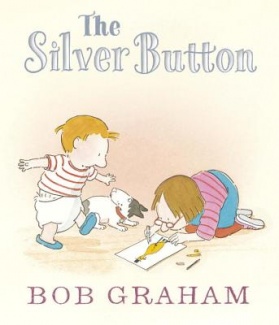 Which reminds me of the exquisite picture book that I bought Harriet/myself for Christmas this year. The Silver Button is a new book by Bob Graham, one of our favourite authors and the force behind the wonderful Oscar’s Half-Birthday. It’s a story that takes place within a single moment, illuminating the connections, the beauty and the perfections of the world. The perspective moves from a space on the floor in a single room to eventually comprise an entire city and beyond toward the global as Jodie puts the finishing touches on her drawing of a duck and her brother Jonathan rises to his feet to take his very first step. “He swayed, he frowned, he tilted forward, and took his first step. He took that step like he was going somewhere….”
These two books are an unlikely but absolutely perfect pair.