January 8, 2014
On Supporting CWILA in 2014
I wrote a short post for the CWILA Blog about why I will be donated to Canadian Women in Literary Arts once again in 2014.
First, because the pies are making a difference. Quite a few people don’t like what they stand for, or don’t like what they’re saying (or something. Truth be told, I don’t really understand, though I’ve tried) but they those pies are changing our publications for the better. The 2013 CWILA numbers reflect a significant change from 2012, writers and editors now working with an awareness of gender representation in what they read, write and publish. And that’s huge. I want to make sure the count continues into the future, is even expanded, and that the “counters” are properly compensated for their work.
Read the whole thing here.
January 7, 2014
My Opinions (and the Anthology as a Revolutionary Act)
When I was 19, I had a notebook that I’d covered with a piece of green corduroy that had previously been part of a pair of my pants. On one page, I wrote a heading with each letter outlined in a different colour Crayola marker, and the heading was “My Opinions”. And below, I tried to capture them all, my perspectives on such things as capital punishment (against), war (totally averse), abortion (well, I guess I respect choice, though I could never go down such a road myself). I don’t remember what I must have been for: universal suffrage, maybe? The abolition of acid rain? Sex, probably, but only hopefully. I think this was around the time I used to say things like, “I’m not a feminist, I’m a humanist,” so really, my opinions were likely best not held in a permanent record. It is not a total loss that I don’t have that green notebook anymore.
(I do remember that on the page following my summary of opinions, there was a recipe for mocha cake.)
I thought about this today as I read a really interesting New Yorker profile of novelist Jennifer Weiner. It was a respectful, considered piece that managed to make some space for nuance, to highlight how smart Weiner is and what important ideas she conveys about how fiction by women is perceived by readers and reviewers. And yet it also shows the trouble with Jennifer Weiner, which is her conflation of literary and commercial fiction, and this inane idea that not joining a rah-rah sisterhood is a feminist betrayal.
I’m been turning my head inside out for years now trying to make sense of Jennifer Weiner and her activism, basically trying to articulate a one sentence burst under the heading “My Opinions”, but the words don’t fit. If I added up all the blog posts I’ve ever written on this subject, I think they would fill up that entire green corduroy notebook, and I still wouldn’t have it figured out.
While I find the whole thing infinitely frustrating though, I am starting to realize that the turning my head inside-out might be the very point, instead of a pithy line I could deliver with a bullet. That these figures or ideas that rattle us or make us uneasy are doing a service, serving a purpose. “But when we paraded through the catcalls of men and when we chained ourselves to lampposts to try to get our equality– dear child, we didn’t foresee those female writers,” said Dorothy Parker, and sometimes (often?) the very worst parts of the feminism are the other feminists, but maybe why this is why feminism is excellent (and also why it will never become a totalitarian regime). We keep each other in check, we rub one another the wrong way, we ruffle feathers, we don’t sing kumbaya.
Here’s an opinion: the non-fiction literary anthology is a revolutionary act. This is apropos of something, and I mean it. The literary anthology, second-tier non-fiction. The kind of book that couldn’t win a prize if it tried (because it isn’t eligible). There is no cohesion, but this is the very point. The complexity of many voices, all of them singing a different tune. Not cacophony, which is noise, but heteroglossia instead. Resolving nothing, but reflecting reality. Sometimes as close to solidarity as we’re ever going to get.
January 6, 2014
Book Haul/Book Stamp
 We really did have the nicest December, mostly because the weather was always terrible we just kept cancelling our plans and staying home. We visited the art gallery on Christmas Eve, which might have to become a tradition because the place was empty and we had an excellent time. We also pulled off a string of going out for lunch three days in a row, which is how we roll and how we love it. In terms of book haul, we received some wonderful children’s books for Christmas that I expect to be writing about here in the weeks ahead. And my own book stack was pretty impressive, as the photo makes clear (and check out my new Cath Kidston mug. Guaranteed to make winter days brighter). The Genesis book is from the photography exhibit that we loved and went to see over and over. So nice to have a bit of it to live with us forever. And two Rebecca Solnits–I just finished reading Wanderlust yesterday. She is so so wonderful.
And speaking of wonderful, my husband made a dream come true this Christmas by giving me my very own book stamp: “From the Library of Kerry Clare”. It’s a beautiful stamp, and the ink goes on so smoothly that the stamp looks like it’s printed. It has been suggested to me that because I have a book stamp now that maybe I might start lending out my books, but no, of course not. Let’s not be totally ridiculous.

(What bookish gifts did you receive this year?)
January 5, 2014
Penelope Fitzgerald and the Holiday Read
 After we’d gone book-shopping on our recent trip to England, I sat down to read that weekend’s Guardian Books with its books of the year round-up, and found reader after reader citing Penelope Fitzgerald: A Life by Hermione Lee. Now, my relationship with Penelope Fitzgerald is complicated. She’s an English author called Penelope, which is usually all it takes, but I find her books difficult, inexplicable. There is something there but it’s just beyond my range as a reader. In short, I’m not one of those who “gets” Penelope Fitzgerald. But in my failure to grasp her work, she fascinates me. (If more difficult writers wrote short books, this might be something I experienced more often.) I also love a good biography, and so after reading so many recommendations for the book, I was awfully sorry to find myself stranded on the Fylde Coast with nary a bookshop for miles and miles.
The airport bookshop, I decided, would be my salvation, so I was awfully sorry to discover that the WH Smith in Manchester Airport Terminal 3 barely had books at all, let alone this one. (My expectations were high: it was at the Manchester Airport WH Smith that I bought my first Elizabeth Bowen novel in 2009. I don’t know if this was a different terminal, or if all the airport bookshops have been economic downturned.) We returned home to Canada without the book, and I requested it for Christmas, then was informed that it would be for sale in Canada until after the holidays. So ever it was not to be.
Until just before Christmas, a friend who knew none of this managed to get her hands on a copy and wrapped it up just for me. Penelope Fitzgerald was mine! I started to read it on Christmas Eve, and this fantastic book became the centre of my holiday.
What a life! Daughter of a prominent family, from a world that is never to return after WW2. Her father edited Punch, her stepmother was Mary Shepherd, who illustrated Mary Poppins, who was the daughter of the illustrator of Winnie the Pooh. Her mother was at Oxford with Dorothy Sayers and Rose Macaulay. Even the incidental intersections: the house her parents were meant to rent when Fitzgerald was 2 was inhabited by Katherine Mansfield and John Middleton Murray.
Fitzgerald finishes at Oxford and writes book and theatre reviews for Punch, scripts for the BBC. She marries Desmond Fitzgerald, her “Irish soldier”–one of many men in the book who are also shattered by their experiences of war. The embark on a career as literary bohemians, editing a literary magazine together and having three children who add to the disarray of their household. (In the background: miscarriages, at least one stillbirth. Fitzgerald becomes a larger than life character by her biographer’s hand, but still remains elusive.)
Several rented houses are fled from suddenly. The literary magazine folds. Desmond Fitzgerald gets into trouble. Penelope begins supporting her family by teaching, after a stint working part-time in a Suffolk bookshop. She moves them all back to London, where they really cannot afford to live, so she secures them lodgings on a leaky barge which becomes their home from 2 years. (The Penelope Fitzgerald books I’ve read are Offshore [which won the Booker Prize in 1979], The Bookshop and Human Voices, all of which are illuminated by these insights into her biography.)
The barge sinks… Which is a major challenge to Fitzgerald as a biographical subject, so much of her archive winding up at the bottom of the Thames. There is much hardship as she struggles to secure housing for her family, eventually ending up in a council flat in South London where she is happy enough to be settled. And here begins her literary career, publishing her first book at age 60. She writes a biography of her father and his brothers and poet Charlotte Mew before turning to fiction. And it is from this point on that she’s an overnight success. Etc. etc.
What a book! It makes me want to go back and reread the Fitzgerald novels I’ve encountered, to see if finally I can grasp them with such knowledge of their context. It makes me want to read everything she ever wrote, in particular her penultimate novel The Blue Flower, said by many to be a masterpiece. To understand her as un-English makes it all so much clearer, to think of her work in the context of Beckett’s. Her complexity as a person, as a character–impossible and infinitely loveable. Unabashed and brilliant. When she died, I cried. I have to get my hands on her collected letters, because I just want more more more of her.
December 30, 2013
In With the New
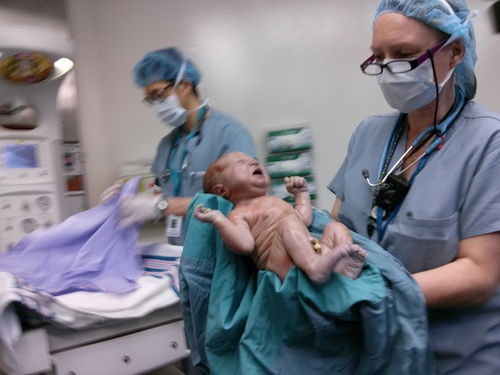
If this is a year in pictures, 2013 only needs this one for me. Not just my favourite image of the year but perhaps my favourite image of all time, my baby brand new, sticky, shrieking and naked, yanked out into the world one day shy of 42 weeks in utero. The image I never got to see when Harriet was born, and a sign that this might be our chance to right what went wrong the first time we had a baby. Not the birth I’d envisioned, cold and sterile, my body split in two, and we were so disappointed. (It is true that whenever anyone has had a baby since, I have cried because Iris’s birth was another c-section.) And yet, this image for me was a glimpse of possibility, that this could be another story. Iris’s birth was a new beginning in so many senses–of her life, course, and of our family as four. But it was also for me a rebirth of myself, that self that had been so shattered when I became a mother for the first time. The second time, however, has been like coming full circle, a journey to somewhere familiar and brand new.
This year has reassured me even with its challenges. I used to worry that I was only a happy person because circumstantially I’ve been extremely blessed, and while I am blessed and I also think I have a chemical disposition for happiness (another blessing, though after about eight more weeks of winter, I will be telling a different story), I managed moments of happiness too in times of stress and enormous fear. I think of a week in March whilst we were awaiting biopsy results, and how we spent the week so gloriously, but then the sun was shining and I’d decided to believe in the odds in my favour (and so they were). But still. I may be braver than I think. I am also grateful that my worst fears were averted. Further, I have learned a lot about things going wrong and how these things don’t necessarily signal, quite literally, the end of the world.
“Over time, I’ve come to understand that when Jamal says that a situation is normal, he means that there are flaws in the cloth and flies in the ointment, that one must anticipate problems and accept them as a part of life. Whereas I’ve always thought that things are normal until they go wrong, Jamal’s version of reality is causing me to readjust my expectations for fault-free existence and to regard the world in a more open fashion.”–Isabel Huggan, “Leaning to Wait, from Belonging
I stood on the cusp of 2013 with a great deal of uncertainty–I was partaking in a freelance writing project that would be quite intense and something I’d never done before, and I knew there would be a newborn baby in my life again, which seemed a horrifying proposition. But I’ve met both these challenges quite impressively, and it is funny that what caused me real problems during the past year was that cystic tumour growing up on my thyroid when it had never even occurred to me that I had a thyroid. It seems you never do know, which is a promise as much as something to fear.
The world has smiled on us a lot this year. First, with the birth of our strong, healthy baby; with our brilliant summer as Stuart had 12 weeks on parental leave; with Stuart being promoted to a new job that makes him so very happy upon his return to work; with a book contract for The M Word, which I am so very proud to have my name attached to; with Harriet who manages to be as wonderful as she is annoying (and that’s huge). I like people who are 4 years old. I am lucky to have Stuart in general, who delivers my tea in the morning. I am grateful for him, and to our families for their love and support. I am also grateful for our new queen-sized bed, which means that Iris sleeping with me every night (and sometimes the “sleep” is elusive) is not nearly as bad as it sounds.
I started writing when Iris was just a few weeks old, my mind and imagination anxious to be exercised. I hadn’t written short fiction for so long–the previous year had been spent on The M Word, year before that on a novel forever unfinished that has served its purpose but I’m done with it. But since then, I’ve been busy, and I do hope that some of that productivity turns into publishing credits in the year ahead. I’ve sent out submissions, which is the part of the battle I have any control over. That and working hard on my pieces of course. I’ve been focussing on revising and getting feedback, both of which I’d shrugged off for too long, out of fear, I think, and habit (too much blogging). I am proud of my book reviews this year, my Ann Patchett review in The Globe, of Hellgoing in Canadian Notes and Queries, and Alex Ohlin’s two books at the Rusty Toque. I am also happy to be reviewing kids books for Quill & Quire. I continue to be so grateful for the opportunity to promote great Canadian books through my job at 49thShelf–come March, I’ll have been working on the site for 3 years.
My New Years resolutions (in addition to writing and revising and submitting) is to not to any of the annoying things I complain about authors doing once I’ve got a book in the world myself. I’ll be writing more about this in a few weeks time. Will be interesting and educational to see it all unfold from the other side of the page.
My reading resolution of 2013 was to read more non-Canadian books, which is kind of a weird resolution but I was stuck in a CanLit bubble and it was making me crazy. So I am pleased that I read outside of that bubble (and that I’ve read 4/5 of the best fiction of the year according to the New York Times). There is not reading what everyone else is reading but also reading totally out of the loop, and I feel that in 2013, a balance was struck. (I just finished reading another top-rated book of 2013, A Constellation of Vital Phenomena by Anthony Marra, which was so wonderful. I am so glad I didn’t let it pass me by.) For 2014, I would like to put a focus on reading books in translation, because really “the novel” is so much richer than I’ve glimpsed by English language focus.
This year I’ve read 92 books or thereabouts, which is far fewer than I’ve read it years and years. But I’ve also read more long, long books than I have in recent years and taken my time and enjoyed them. I also know that I’ve read about as much as has been humanly possible, save for the problem of my possible addiction to twitter (which I’m working on) so I am content with the total. Content also because the books I’ve read have been so extraordinary. (I have also abandoned a ton of books in 2013, and I am totally happy with that.)
Over the past few days, we’ve been busily decluttering the corners of our apartment. We’ve made a commitment to stay in this place we love so much as long as it’s comfortable to live here, and so we’re working on that comfort and making space by clearing away all the things we don’t need. And suddenly, our house is bigger, airier, and cleaner than we thought it was–the space! (Certainly, getting the fir tree out of the living room helps a little bit. Also getting rid of that box of plates in the kitchen that hasn’t been opened since the last time we moved.)
Out with the old then and in with the new, and it’s all so refreshing, full of possibilities. Though the greatest thing about the situation, of course, is just how pleased are we to be where we are.
December 27, 2013
Fairy Door

With the aid of a generous benefactress, our fairy door has received an upgrade! Heaven knows, it needed one…
December 23, 2013
Holiday Hiatus
 Last night, I finished knitting Iris’s Christmas stocking, and I am pretty happy with the symmetry of four stockings hanging by the (unworking) fire. I’ve knit these four stockings over the last eight years and hanging this last one underlines the completeness of our family now. I like this.
There has been something very different about this Christmas season. Mostly it was that December 1 represented the end of a very, very busy few months, and so instead of Advent being about the mad rush, it’s been a slow, easy time with lots of space for being together, reflecting on the season, visiting friends, cooking good food, reading books and listening to music. Stuart finished work early last week and we aren’t going anywhere for the holiday, so this time and space continues, which is such an enormous luxury. (Though as we became housebound due to ice storm, there was something of the prison about this luxury. I discovered that I actually have the capacity to be bored.) In order to create even more space, I’m taking a break from here until the new year–if you need me, I will be visiting the art gallery, spending time with family and friends, listening to Darlene Love sing “Please Come Home for Christmas”, eating from our three-tin high tower of biscuits, and reading Hermione Lee’s biography of Penelope Fitzgerald (which I have just begun–it is already astonishing, and I hope broadens my understanding of this writer whose work, to me, stubbornly remains enigmatic). I hope you have an excellent holiday and read many wonderful books. Or even just one that’s incredible.
Thank you for reading here.
December 21, 2013
Love, Nina and Mutton
 During our disastrous English vacation, I did manage to get some excellent holiday reading in, mostly because my mother-in-law’s intensive grandmothering meant that I was on mother-holiday. And it was great.
I discovered Love, Nina: Despatches from Family Life when India Knight tweeted about it, a collection of letters by Nina Stibbe, a young woman from Leicester who moved to London in the 1980s and got a job working as a nanny for books journalist Mary-Kay Wilmers, editor of the London Review of Books. India Knight is the ex of Andrew O’Hagan, who blurbs this book, which is a fine glimpse into literati inner-circles. In the Guardian Best Books of the Year round-up, film director Stephen Frears cited the book, then said, “But I would say that since it’s about my ex‑wife and our children. Letters from their Leicester nanny. Very funny and sharp.” Another review called it “‘Adrian Mole meets Mary Poppins” so you can see why I had to read it.
Imagine a sitcom in which everybody is writer, and Alan Bennett is the too-familiar neighbour. In fact, imagine any book in which Alan Bennett is a character at all, one who has dinner with the family (Wilmers and her two sons) every evening, and critiques Stibbe for her use of tinned fruits and vegetables in her cooking. There is mischief and hijinx, there is this unique community through the eyes of someone outside it blessed with a nice dose of realism (if a bit sweetly naive at times), character development and incredible dialogue. Mary-Kay Wilmers is a most formidable comic creation. These are Stibbe’s letters home to her sister from during her early years in London, and they’re absolutely delightful.
**
 And then I read Mutton by India Knight, her fourth novel about alter-ego Clara Hutt. In this instalment of Clara’s story, an old friend returns from years in America and she’s looking younger and better than ever. What’s her secret? Why yes, it’s extensive plastic surgery (and yoga and she drinks a lot of water). Clara herself isn’t getting any younger and she starts considering drastic measures on her own part. She’d always had these ideas about growing old gracefully, but that was before she started growing old, of course.
The novel is funny, rambling, and I adored every single digression, but then I can’t quite get enough of India Knight and her novels which are basically extensions of her newspaper columns. Instead of plot, we are treated to “what India Knight thinks of everything”, but for some of us that’s absolutely the book we came to read.
December 18, 2013
Six Months in, four years later
“My mother didn’t tell me much about motherhood, it’s true. She said she couldn’t remember. None of you ever cried, she said vaguely, and then added that she might have got that wrong.” –Rachel Cusk, A Life’s Work
If I hadn’t written it down, I don’t think I would remember the blurry despair of Harriet’s early days. And even having written it down, the images are fractured. (Joan Didion: “You see I still have the scenes, but I no longer perceive myself among those present, no longer could even improvise the dialogue.”) For a while I’ve supposed that it was really not so bad, and that my tendency to dwell (through writing in particular) had magnified the difficulty and my impressions of my own unhappiness. I have thought this especially since Iris came along and we’ve been weathering all the usual bumps in the road. (“Oh yes, this is why we never wanted to have another baby,” we remembered the other night when once again Iris refused to go to sleep, which, while we meant it, was delivered cheerfully, as a joke.)
The must wonderful and terrible thing about having a blog are its archives. They are, quoting Didion again, “Paid passage back to the world out there.” Sometimes the passage is treacherous though, embarrassing, agonizing, that one person (myself!) could have been so stupid. But it is ever illuminating, these glimpses that remind one to keep in mind the unreliability of memory, the mutability of self.
I remembering telling someone that it was not until around seven months in to Harriet’s life that I was happy in our day-to-day life. (This is important. I am someone who is accustomed to being happy in my day-to-day life.) As time I went on, I started to doubt that this had really been the case, particularly because of how easy Iris has fitted into my life, how much I’m enjoying these days which are mostly spent with her napping on me while I read and write. Surely, I thought to myself, it couldn’t have gone on that long. There are photographs of us smiling. I have excellent memories of wonderful days.
But then I went back recently to read my archives about Harriet at six months, curiosity occasioned by Iris having just reached this milestone. There is a picture of me halfway up a ladder at a bookshop, and I so vividly remembered that day. Stuart had taken the day off and his company was so welcome, and I remembering feeling so fat, horrible, and tired, none of which I mentioned in the post (and I remember feeling quite surprised in fact when the photo wasn’t terrible). It was shocking to me that this had been six months along–I’d remembered it being so much sooner. But then time moved a whole lot slower then.
And then my post about Harriet at six-months, which was useful because it reminded me of her Baby Self who is now lost to us entirely (who sucked on her toes, loved the chicken puppet and had eaten the shopping list the week before).
This was followed by: ” It’s so hard. And I don’t think it ever gets easy, but it gets easier. And then harder too, of course, in all new ways, but the whole thing is also totally worth it in a way I’m really beginning to understand now. Only beginning to, though, because it’s an understanding I can’t articulate or even make sense of to myself, and it’s more a steady current inside of me than a feeling at all./ She is delightful, and fascinating, and amazing, and I can’t remember a world in which Harriet was not the centre. Which is not to say that sometimes I don’t wish for a different focus for a little while, but it would always comes back to her anyway. It always does. And it will forever, but how could it not?”
Confession: I now have no idea what I was talking about. Partly because the writing isn’t terribly clear or good, but mostly because “I no longer perceive myself among those present” in these scenes. Who was that woman anyway? Certainly nobody I’ve ever been.
Isn’t it funny that we persist in imagining time as a line, one thing after another, a cumulation. When it is something else entirely, and only the “now” is ever-present, the past itself gone with a poof out behind us and salvaged sometimes when made into a story.
December 16, 2013
A World Less Delightful
 “If I had to pick just one thing about the English novel, I don’t think I could, but if pressed to pick five things, one of them would have to be the post. Much in the same way that cell phones are pivotal to contemporary plotting, the British postal system is essential to the 20th century Englist novel. As are teacups, spinsters, knitting, seaside B&Bs, and the vicar, or maybe I’ve just been reading too much Barbara Pym, but the mail is always coming and going– have you noticed that? Someone is always going out to post a letter, or writing a letter that never gets posted, or a posted letter goes unreceived, or remains unopened on the hall table.”
Last week it was announced that Canadians are due to lose door-to-door mail delivery. Four years ago today, I wrote an ode to the post–foundation of not only my daily life, but also the plots of my favourite novels–from which the above paragraph is lifted. You can read the whole thing here and I haven’t changed my mind. With the elimination of postal service, we’re basically conspiring to make the world less delightful and this is not insignificant.
Without delight, what’s the point of anything?






