September 1, 2026
Cottage Reads 2.0
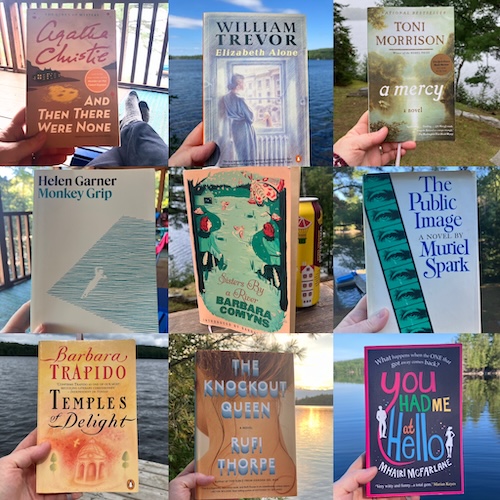
As I was somewhat disappointed in myself for my cottage book stack from July being so conventionally packed with new releases (which is not to say that The Shampoo Effect and Dolly All The Time are not incredible reads I now recommend to everyone—they are both SO GOOD), I decided to return to my own readerly foundation—PURSUE YOUR OWN CURIOUS AVENUES—for our most recent getaway. I love the challenge of putting together a book stack utterly unlike everybody else’s, off-beat and unexpected. A proper cottage book stack, to my mind, should be made up on books obtained in little free libraries, library book sales, or secondhand stores, preferably published in previous centuries. Front lists don’t belong at the lake.
And Then There Were None, by Agatha Christie: This one came from our local Little Free Library, and was notable for being a book that every member of our family read on our week away. (Now that our youngest family member is 13, there are more of these and it’s delightful.) It all began when my eldest daughter, who is a murder mystery aficionado, read it, and was bowled over by the cleverness. She insisted that all of us had to read it so we could talk it with her, and perhaps the best part was everybody trying to predict the story’s outcome as they were reading and those of us who’d read it already replying, “Just keep going.” No one guessed the ending, which is remarkable for a novel wholly spoiled by its title.
A Mercy, by Toni Morrison: I loved this one, which I bought after it was selected as one of the New York Times’ best books of the century. Published in 2008, it’s set in the 1600s around the beginning of the slave trade, and the story of a young Black enslaved woman purchased by a man who’s ambivalent about slavery, and her connection to the wife of the man who buys her. While the story’s beginning is disorienting in its fragments, it actually comes together quite straightforwardly, and Morrison had tricked me into thinking I knew what to expect, which is never the case with any of her novels, steeped in a wonderfully throught-provoking moral ambiguity. What is the line between right and wrong, good and evil? Who gets to draw it. Troubling in the very best way.
Sisters By a River, by Barbara Comyns: A purchase from the Victoria College Booksale! I’ve read two previous novels by Comyns—Our Spoons Came From Woolworths and The Vet’s Daughter—and was curious about this re-release from Virago, her first book, a novel that’s really a collection of autobiographical vignettes from Comyns’ childhood with a father and mother who made Farve and Muv Mitford seem like helicopter parents. It’s a childhood of peril and cruelty, filled with nasty characters, and yet the narrative voice gives the whole thing a certain charm, which is the weirdest magic spell.
Temples of Delight, by Barbara Trapido: Trapido wrote the foreword to Comyns’ novel, so naturally I had to read her next. Barbara Trapido is such a strange writer, strange in a way I did not understand or appreciate when I read her the first time, appreciating something light and easy. And while there is indeed light and ease in Trapido’s work, there is also so much darkness, death, tragedy, dubious morality, and the contemporary English novel does not tend to be her template—I’ve actually already read the sequel to Temples of Delight, which was positively Shakespearean in its approach to theme and character, and this novel is a riff on The Magic Flute (although I cannot tell you how because I don’t know it). But oh, her work is wondrous to behold. I wish Trapido had been more prolific—I am sad that I only have one more of her novels before me. (Another Vic Booksale score!)
You Had Me At Hello, by Mhairi McFarlane: In some ways this one is the outlier of my stack, a contemporary rom-com, but there us something transgressive about how McFarlane pushes at the limits of the genre, making room for more, for deeper and sometimes darker storytelling, and besides this is her very first novel, and so backlist it is. And I loved it. McFarlane is one of my favourite chroniclers of modern life, of women’s friendships, and is oh so very funny, kind of my literary role model. An absolutely delight. (I found this one in my local LFL.)
The Knockout Queen, by Rufi Thorpe: Another more contemporary pick, the book Thorpe published before the smash hit Margo’s Got Money Troubles. It make think about my cottage stack and the common thread of people broken down by their lives and by society, and what happens when those people make the only choices they were ever going to make, which are the worst ones, ones with devastating consequences. (See Morrison!) Who are the freaks and monsters of the world, really? In some ways this is like a bizarro version of The Great Gatsby, set in the suburbs of Los Angeles, also troubling and violent, but utterly captivating and each of its broken messed up characters has incredible heart—but Thorpe pulls no punches either.
The Public Image, by Muriel Spark: This one was different from other Spark novels I’d read, seemingly more straightforward, less concerned with questions of religion and Catholicism that end up going over my heard anyway. But maybe not so straightforward after all because I gather that the protagonist was supposed to be a villain of sorts, a celebrity utterly consumed with her image to the point where she’s an empty shell, but I had real sympathy for her—perhaps the omnipresence of celebrity and fame in our current moment has normalized what’s wrong with her. She’s an actress of middling distinction who has ended up a genuine movie star, but then her less famous husband takes a vicious revenge. I don’t know if this is Spark at her best, but it was a good read anyway. (Another Vic Booksale find—and a North American first edition at that!)
Monkey Grip, by Helen Garner: I bought this one new awhile back, but it’s a reissue so you can’t fault me. A whole bunch of the Australian Garner’s books were republished recently, this one with an introduction by Lauren Groff. It’s set in the 1970s against a counter culture scene build on drugs and communal living, single mom Nora infatuated with the junkie Javo, and struggling to rectify her feelings of attachment to him with her desire to live freely. Her ambivalence is truly interesting, and while I tend to find narratives about people on drugs terrifically boring and parts of this were no exception to that rule, I really appreciated Nora’s story and Garner’s spare and unyielding prose, and how the novel connected to the questions of morality woven so interestingly into all the other novels I was reading.
Elizabeth Alone, by William Trevor: The Irish writer Trevor is most celebrated for his short stories, but the dark humour and rich poignancy of his early novels are my favourite, and this 1973 release was such a pleasure to read. Maybe I love Trevor because he writes women’s stories so beautifully, this one about four patients at a fiction London women’s hospital, the narrative weaving each of their stories and those of so many other characters in their lives, resulting in a tangled web of connections and disconnection, goodness and wickedness aplenty, and also grace. Rich and funny, so emotionally acute, and absolutely cutting.
(Bonus) The Unexpected Guest, by Agatha Christie: The audiobook we finished on the way home from our trip! We had an audiobook DNF on July’s journey, a book that was so long, and tended to send us to sleep, which was a problem if you’re driving a car. For this trip, we banked on a short book, a novel that was actually adapted from one of Christie’s plays. We loved it. And while the conclusion seemed to be settling into an unbearable predictability as we got closer to the end (which is what you get with a short mystery, perhaps, an uncomplicated wrap-up?), Christie swooped in with her plotting genius at the eleventh hour and blew our minds. SO GOOD!






