July 24, 2026
Cottage Reading Recap
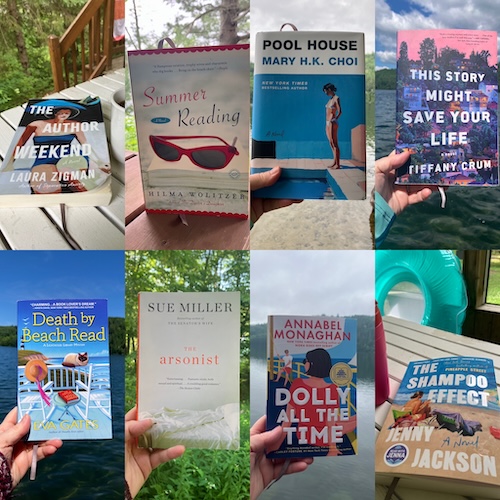
We were the luckiest people in the whole wide world when we ran away to rural Quebec for a week, returning to Toronto only just as the toxic smoke-filled skies were clean and blue again. I have never been more in need of a break, and the relaxation was epic, just so much sleeping, swimming, and reading (and eating! Quebec is delicious…).
My first book was Author Weekend, by Laura Zigman, a comic thrilled about an aging bestseller who will resort to anything to continue in the world of publishing (and I mean anything). It is perhaps a bit too inside baseball for the average reader, but I’m certainly part of the niche group this novel is designed to appeal to. And after a start that slow to get going, it did. It would be better if this novel skewering the reality of the publishing world and what an author has to resort to in order to make it was a stronger book—this one was trying to do too much at once. But it came together in the end and I really enjoyed it (but not as much as Zigman’s Small World, which I loved).
Next was Summer Reading, by Hilma Wolitzer, a used bookstore find I’ve been saving since the winter. I read Wolitzer’s 1980 novel Hearts last year and it was so incredible that now I want to read everything else by her. Summer Reading is the story of three women whose very different social circles overlap during one summer in the Hamptons—a wealthy wife who’s hoping a book club will help to fill part of the void in her life, the young woman from town who works for her during the summer, and the retired academic who’s eking out a living running wealthy women’s book clubs. By the end of the summer, all of these women’s lives will be changed. It was great, and I adored it.
I found Mary H.K. Choi’s Pool House less absorbing, its characters and their story at a remove, but part of that was by design, I think. Set in Los Angeles about a Korean-American actress who’s gone broke so she and her daughter are living in their pool house, the main house rented out to short-term tenants, the daughter working a local fast food joint with the dream of a promotion to management and getting to move away from her mother. When mother’s longtime lover and sitcom husband dies, the actor who played her TV comes to town, and the three of them perform their familial bonds in awkward, earnest, and dysfunctional ways. If I was younger and cooler, I’d likely like this book better, but it’s ending absolutely gets 5 stars from me.
Next up, still on the west coast, Tiffany Crum’s This Story Might Save Your Life, about Benny and Joy, two best friends who run a survival-themed podcast together, and then Joy and her husband suddenly disappear and Benny is left behind to piece together what has happened. Fun and breezy, with Arthur Fonzarelli allusions, I wouldn’t call this deftly plotted, exactly, but I liked reading it a lot.
Back to the east coast now, Nag’s Head, North Carolina. I found Eva Gates’ Death By Beach Read in a Little Free Library en-route to our vacation, and thought it would fit well into my vacation stack. Gates, who writes also under the name Vicki Delany, has written more than 20 cozy mystery novels with bookish themes, and while I wish the bookishness had factored into this one a bit more (there is a book group reading The House of Seven Gables, but not much is made of it) and it was pretty cookie cutter, it was still a good time. Lighthouse Librarian Lucy has moved into her new home with her fiance who is working hard to bring the dilapidated building into good condition, but the effort is set back when Lucy discovers a body in the kitchen and it turns out solving the mystery involves figuring out the true story of a reported haunting in that same house decades before.
I read Jenny Jackson’s The Shampoo Effect after that, set in a fictionalized Ipswich, Massachusetts, when the author is from (and which found its place on the literary map when John Updike moved to town in the 1960s). I liked Jackson’s debut novel, but I loved this follow-up, which manages to be frothy and smart at the very same time, inspired by Updike, perhaps. When a writer comes to town for the summer, she falls in love and becomes connected to her partner’s very tight group of friends (including the on-again-off-again girlfriend who is pregnant with his child). The points of view move between the writer, and three of the women in the friend-group, all of whom are coming secrets. Everything comes to an explosive climax that is resolved in the most perfect, and surprising way imaginable.
Sue Miller’s The Arsonist after that, set in New Hampshire, which barely has a seaside, and this novel is set in a different region altogether, but there are still conflicts between local people and summer people and lakes and ponds for swimming. When Frankie returns from 15 years working in east Africa to the New Hampshire village where her family has always spent their summers, tensions are especially high with an arsonist setting fires to people’s summer homes, the fires getting riskier and more dangerous all the time. Frankie begins an affair with the editor of the local newspaper, grapples with her father’s increasingly obvious dementia, and considers notions of home and belonging. I absolutely HATED this novel because it’s the last time I will ever read a novel by Sue Miller again (until she publishes something new—fingers crossed!). Which is to say that I didn’t hate this novel at all, in fact I love it, and Sue Miller’s books are just so incredibly excellent, a fact that gets undermined by how much they’re also such a pleasure.
And I read those last two novels so quickly that I had time to read one more! Dolly All The Time was the first Annabel Monaghan book I’ve ever read, and I loved it so much. Partly because its romantic lead was called Stewart—there aren’t enough romantic leads called Stewart/Stuart, and Stewart/Stuarts are some of my favourite people in the world. This fake dating story has oh so much heart, and more townie/outside tension, except Stewart Whitfield is not an outsider, exactly. The town of Whitfield (fictional, located next door to Newburyport, MA) is named after him, but he’s not of the place in the way that Dolly Brick is, Dolly who manages multiple gigs, raises her 12 year old son, and has come back to town for the summer to help her father run his fish store. When Stewart and Dolly team up to pose as a couple, he’s hoping to appear emotionally balanced enough to be made CEO of the family company, and Dolly’s looking to finance her father’s new roof, and both of them end with far more than they bargained for, namely LOVE. So funny, so clever, and so fresh, I was thrilled to fall head over heels with this one.






