April 28, 2026
Becalming, by Aga Maksimowska
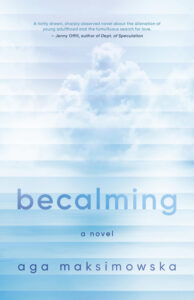
Aga Maksimowka’s Becalming is a novel that complicates dualities in the most fascinating way. The story opens on a sailboat, waves slapping the sides, and Gosia (who otherwise knows a lot) can’t tell a rudder from a tiller, whereas her mother can, at home as the captain, and suddenly Gosia sees there’s another side to her mother, one that she’s never even glimpsed back in Canada. She tells us, “This isn’t Toronto Harbour; this is the Baltic, an arm of the Atlantic, the world’s youngest sea.”
Gosia has returned to Poland with her sister and her mother after living in Canada for decades, painstakingly making a life there, and now—age 30—she works as a teacher, she’s stable in her relationship with Peter. Or maybe too stable? There is something wild and hungry inside Gosia that Peter struggles to accommodate, and Gosia has found herself drawn to a work colleague, the appeal of the forbidden. But stability is appealing too, especially after a childhood where she was left by both her parents—her father for another wife, her mother who immigrated to Canada before Gosia joined her.
The sailboat is important—becalming is motionlessness from a lack of wind, which can sometimes mean relief. The word also is very close to “becoming.” There’s a whole lot going on her, and the depths get even murkier when revelations about Peter’s dying father suggest he wasn’t the perfect man the Gosia liked to suppose he was, the counterpart to her own absent father. And all the counterparts are all messed up anyway—why are her relatives in Poland now doing better than the Canadians in 2007? Is Gosia, drawn to her colleague, more like Peter’s father herself?
In Becalming, Maksimowska weaves a complex and beautiful web of connection and disconnection, then and now, here and there, plot and prose both turning surprisingly, creating a rich and textured portrayal of family, history, and real and messy love.