April 13, 2026
Cleo Dang Would Rather Be Dead, by Mai Nguyen
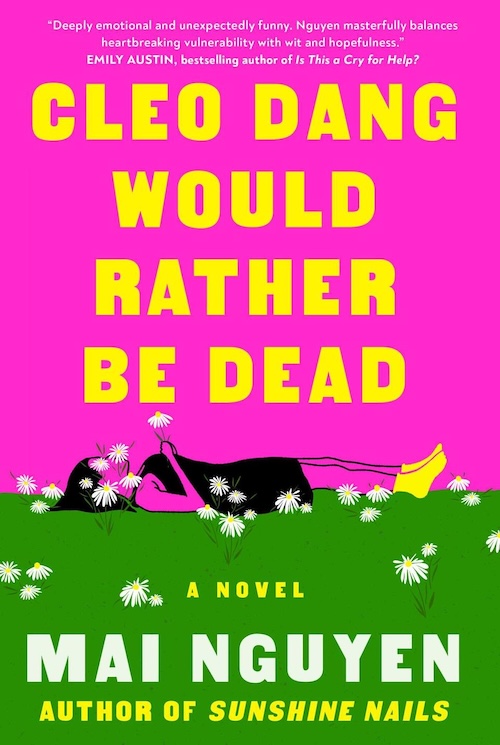
Mai Nguyen’s second novel, Cleo Dang Would Rather Be Dead, is a gift to anybody who’s ever thought, “I can’t imagine”—as well as an invitation to try. A comic novel about the aftermath of infant loss sounds impossible, I know, but also maybe it doesn’t—the absurdity of the situation is actually the perfect set-up, and this fiction born of the author’s own experience of loss and grief is so gorgeously heartfelt and human. And for those readers who don’t have to imagine, because they’ve been there, Cleo’s story is a powerful reminder that they’re not alone.
The story begins with the funeral, a tiny coffin, Cleo paralyzed by grief and amazed that she’s still expected to go through the ritual of a receiving line. Thankfully, her extrovert husband steps in, and Cleo retreats, establishing the dynamic they’ll be stuck in for months to come. To make matters even more complicated and terrible, Cleo’s best friend and neighbour, Paloma, has just given birth on the very same day as Cleo, except that she was able to bring her baby home, and is now going through the motions that the two friends had been expecting to experience together. And Cleo is unable to face up to any of it, overwhelmed by sadness at the loss of her daughter and the vision she’d had for what her life would be.
I’m taking part in a panel with Nguyen at Hamilton’s Grit Lit festival this weekend, which had me thinking about Cleo in connection with Clemence Lathbury, the protagonist of my recent novel, whose own loss and grief are considerably less heavy to hold than Cleo’s, but who similarly dares to blaze her own path through a period of transition, leading everyone who loves her to suspect that she’s gone totally insane. But like Clemence, Cleo stays the course, taking advice here and there, but locating her own compass through grief, grieving on her own timeline, taking on a most curious job to fill the hours in her day and the hole in her life—in Cleo’s case it’s a job as an assistant at a funeral home.
As sad as Cleo’s story is (in addition to being so very funny—in her loss, in her rage at her bad luck, the lady is pulling no punches), Cleo Dang Would Rather Be Dead absolutely overflows with love. Love for her daughter, love for Cleo herself from her husband, her parents, her friends. And love for life itself, eventually, even though for so very long the novel’s title rings true, and Cleo can’t think of a reason to go on, choosing to numb her emotions and consciousness with pills and booze, but a wise friend makes her realize that it doesn’t have to be this way. That the love and grief she carries for her daughter can be a reason to live, instead of why she doesn’t want to, and that a future is indeed possible.
Cleo Dang Would Rather Be Dead is a beautiful, poignant, funny, and life-affirming read.






