September 22, 2025
Bad Indians Book Club, by Patty Krawec
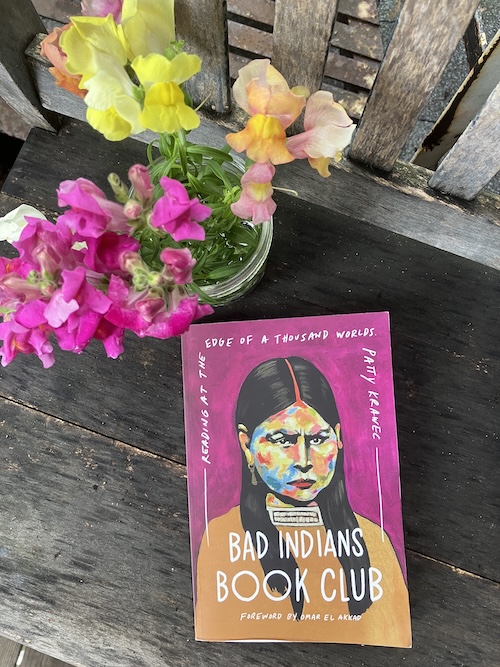
The moment of hideous social backlash which we’re all enduring right now is evidence of how furiously and violently some people cling to white supremacy and the colonial systems upon which this country and so many others were built, which only underlines the subversiveness of a book like Patty Krawec’s Bad Indians Book Club, a book that centres writers whose stories usually are told on the margins. It is a book that was born of a question, and then conversations that turned into a podcast, and as a result, the narrative is rich with connections—between writers, between readers, between books themselves—as Krawec maps a year of reading. “Rather than allowing us to stand on what we think is the stable ground of a singular expert, reading many books draws us into the mashkiig—the swamp—where the ideas in one book layer with the ideas in another.” She goes on to write, “Even if the centre of influence is one that we have come to respect and admire, the borderlands—or places where the influence of that centre extends and then layers with others—brings us to new ways of thinking and to possibly the creation of new centres.”
Krawac, who is an Anishnaabe/Ukrainian writer belonging to the Lac Seul First Nation who grew up in southern Ontario, writes about connecting with her Native family and ancestry in the 1990s, these connections informed by her ideas about Good Indians and Bad Indians, as understood by Hollywood films: “Good Indians: those who rescue white heroes so that they can in turn be saved. And…Bad Indians..: those who refuse to be rescued or to be saved themselves.” And over time, she can to be drawn to the Bad Indians who, she writes, “…offered me a vision of new worlds being born—worlds rooted in differences that bring balance and life , not differences that play out in hierarchies and power.” The first rule of Bad Indians Book Club, according to Krawec? “Always carry a book.”
And thus begins a journey into the wonders of reading, the questions books raise, and the connections we can make between stories—and between each other. Krawec refers to books by Indigenous, Black, and Jewish writers, and those by writers of other usually marginalized communities to construct a network of overlapping concerns and understanding, stories that inform each other, with characters like Nanaboozhoo and Ananzi. She refers to the books and writers from her podcast, and the panellists that presented those works, and supplements these with books that have occurred to her since the original conversations (including works as recent as Leanne Betasamoske Simpson’s Theory of Water, which just came out this spring, and which helped inspire her idea of writing from the mashkiig). As with the stories Krawec writes about, her narrative is more cyclical than linear, more layered than straightforward, as she organizes her Bad Indians reading list into themes—books about beginnings, about history, memoir, nonfiction, horror books, and speculative fiction.
How do we imagine a world that de-centres whiteness and colonialism? With kindness, humour, thoughtfulness, and curiosity (as well as acknowledgement that nobody will ever get it right all the time), Krawec shows the way, her citations an example of gratitude and generosity. I loved the way she cites writers’ racial and cultural identities when she refers them (because these things are central to people’s experience) all the while underlining how these identities can also be points of connection as we learn from and listen to each other instead of rigid lines of division.
As you might expect from a text that’s inspired by mashkiig, Bad Indians Book Club can be a dense read, thick with ideas and meaning, and it doesn’t read up quick, but you won’t want it to. It’s a book to be savoured and experienced, returned to again to let it change you, and for those of us with a bookish bent, reading it is a rich and wondrous pleasure.






