April 11, 2012
Can Any Mother Help Me? by Jenna Bailey
 I think it was an error that led to this beautiful hardback ending up on sale for $1 in the bargain bin at the shop around the corner from my house. Or perhaps it was fate, and this book was always meant to be mine. Jenna Bailey’s Can Any Mother Help Me? is the story of the Cooperative Correspondence Club, born in England in the 1930s when a young woman wrote a letter to the magazine Nursery World:
“Can any mother help me? I live a very lonely life as I have no near neighbours. I cannot afford to buy a wireless. I adore reading, but with no library am very limited with books… I know it is bad to brood and breed hard thoughts and resentments. Can any reader suggest an occupation that will intrigue me and exclude ‘thinking’ and cost nothing!”
Readers wrote back suggesting a collaborative magazine which was organized amongst a membership of around 25. For the next 45 years, the magazine was circulated every month, with each contributor sending her piece to the magazine’s editor. The editor compiled the pieces and bound them within an embroidered cover, and then one-by-one each woman would receive the copy, read it (adding annotations and footnotes where she saw fit) and pass it on to the next woman on the list. Basically, it was an early paper version of a blog, and the CCC’s back-issues are now held with the Mass Observation Archive at the University of Sussex.
Historian Jenna Bailey faced the daunting task of whittling down the CCC into book size. She chose to include those articles which were most remarkable and emblematic of the rest of the collection, in a semi-chronological order. The book’s sections include those on motherhood, WW2, marriage, work and growing old. They show the diversity of voices within the CCC (and the club was careful to keep itself as such, choosing members from different religious backgrounds, political affiliations, and social classes). Though most of the women were educated, and all of those highlighted in Bailey’s book show tremendous writing ability. The articles are provocative, surprisingly contemporary in tone, amusing and moving when required to be. Members wrote about their discontentment with domestic work (and many of them had been forced to leave their jobs upon marriage, as was the custom), trouble with marriages, address adultery and divorce, sex and orgasms, recount anecdotes from everyday life. They wrote with pseudonyms, though Bailey includes biographies of members throughout the book, revealing how many of them did great work in their extra-CCC lives (most remarkably Elaine Morgan, one of the best known proponents of the aquatic ape theory).
The book’s title is a little bit misleading, for the CCC seems to be as much about womanhood as it ever was about motherhood (though it’s true that members were required to have children). To me, the book’s chief appeal is its testament to women’s friendship, its Chloe liked Olivia-ness. Bailey shows that for so many women in the CCC, its other members were the great loves of their lives.
April 9, 2012
Stray Love by Kyo Maclear
 Kyo Maclear’s novels are quiet, muted, about lonely characters at a remove from the world around them. And as you read these novels, you might be underwhelmed, wondering at the quietness, at the slow. They have a depth that works differently than depth does– you don’t necessarily drill down into subtext; the prose here is doing what it’s doing, but the thing is that it keeps going once the story is done. I have been thinking about The Letter Opener for four years now. And similarly, having just finished her latest Stray Love, I’m still going over the story in my mind (to a soundtrack that is Waterloo Sunset).
Maclear’s narrator is Marcel, an artist living in London whose precarious balance is disrupted when an old friend asks him to temporarily care for her eleven-year old daughter, Iris. The girl’s arrival disturbs Marcel’s quiet containment, their burgeoning relationship stirring up memories of his own troubled childhood. In a parallel storyline that becomes the novel’s centre, we learn that Marcel was abandoned by his mother shortly after his birth and raised by Oliver, his adoptive father who was a war correspondent in Africa as the British Empire dissolved in the 1950s and in Asia in the early ’60s. Oliver’s distance wasn’t always geographic either– he’d endured his own trauma, losing his parents in the London Blitz and being raised himself as a “stray” by an adoptive family. Oliver didn’t always manage to be present for Marcel, even when he was. Though not biologically related, both Oliver and Marcel have the same ways of coping, shutting away disturbing memories in suitcases deep in the back of closets though not so far enough away that they’d ever forget what was there.
The story moves from Marcel’s present with Iris (whose circumstances might supposed her character to be analogous to Oliver’s and Marcel’s, but instead she is a departure in a way that begins to change Marcel’s mind about the way his life is going) to the past, to his childhood in London, longing for his mother and waiting for Oliver to come home, and also to the time he spent with Oliver in Saigon in the early ‘sixties lead-up to the Vietnam War. The end of the novel also brings revelations about the more recent past, revelations that re-cast the rest of the book in an entirely different light (and I think that this is where Maclear’s lingering effect comes from).
“There are so many ways of mapping the world,” Marcel notes at one point as he traces his adoptive father’s travels on a map on the wall with push-pins, and then begins to plot points according to his own desires. And in Stray Love, Maclear has shown us another way, how to use fiction to map time and history and place, across continents, historical periods, culture and race.
April 7, 2012
Our morning with Mo Willems

Harriet with her new book.

Patricia Storms & Andrew Larsen!
Today we had the great pleasure of attending the Small Print Toronto event “A Morning with Mo Willems”, which for us was a bit like going to church. Because we love Mo Willems’ books– Elephant & Piggie, the Pigeon, Edwina the Dinosaur, Naked Mole Rat, Leonardo the Terrible Monster, and (my personal favourite) Amanda and Her Alligator.

More friends!
Harriet’s favourite, however, is Knuffle Bunny, which has so seeped into our collective family consciousness that now when we watch movies set in Brooklyn (and aren’t they all these days?), we fall over ourselves pointing out Knuffle Bunny landmarks.So it was particularly exciting that we were able to (surreptitiously) purchase a Knuffle Bunny stuffed toy today that will be a particularly fitting treat tomorrow for Easter.

Mo Willems! The actual Trixie's dad!
We also got a copy of Willems’ new book The Duckling Gets a Cookie, ran into friends, listened wrapt as we were read Mo Willems stories by the man himself– The Duckling and also the new Elephant and Piggie trumpet book. He was almost as good at reading them as I am. He answered questions, made us laugh, and all in all it was a very fine literary Saturday morning.
April 4, 2012
Meg Wolitzer's Rules
“If “The Marriage Plot,” by Jeffrey Eugenides, had been written by a woman yet still had the same title and wedding ring on its cover, would it have received a great deal of serious literary attention? Or would this novel (which I loved) have been relegated to “Women’s Fiction,” that close-quartered lower shelf where books emphasizing relationships and the interior lives of women are often relegated? Certainly “The Marriage Plot,” Eugenides’s first novel since his Pulitzer Prize-winning “Middlesex,” was poised to receive tremendous literary interest regardless of subject matter, but the presence of a female protagonist, the gracefulness, the sometimes nostalgic tone and the relationship-heavy nature of the book only highlight the fact that many first-rate books by women and about women’s lives never find a way to escape “Women’s Fiction” and make the leap onto the upper shelf where certain books, most of them written by men (and, yes, some women — more about them later), are prominently displayed and admired. ”
Yes, yes, and read the rest fromMeg Wolitzer’s “On the Rules of Literary Fiction for Men and Women”.
(My only qualm is when the women who write really terrible [and usually non-literary] fiction read this and jump up and down screaming, “Right on!” As Dorothy Parker said [and what didn’t Dorothy Parker say?], “I’m a feminist, and God knows I’m loyal to my sex, and you must remember that from my very early days, when this city was scarcely safe from buffaloes, I was in the struggle for equal rights for women. But when we paraded through the catcalls of men and when we chained ourselves to lampposts to try to get our equality– dear child, we didn’t foresee those female writers.” Indeed. Hmm.)
April 4, 2012
Knee deep in the hoopla
 According to Heather Mallick, we’re all mad women now (to which some would respond, “Speak for yourself, Heather Mallick”, I’m sure, but not me). And then Erica Jong does something the same but backwards in defending the feminist revolution. In more about feminism, the very wise Rachel Power suggests that Elisabeth Badinter has the wrong targets in her sight. The wonderful Sweet Devilry makes the Gerald Lampert Award shortlist! On Cindy Sherman and women’s work in art. Did you know that Jane Gardam writes for children? I just found out and have ordered a copy of her novel Bilgewater. Roger Sutton responds brilliantly to the “debate” about adults reading YA. “Frogs” from Heather Birrell’s forthcoming collection Mad Hope is now available as a free e-story.
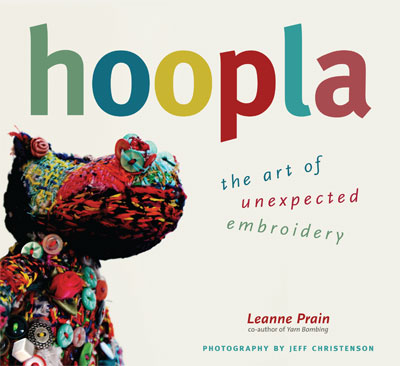
And in “more about my friends” news, I once spent a year sitting across the circle at the library’s Baby Time from a woman I always wanted to get to know, and when I did, I discovered she was wonderful, a book designer, and that she’d designed one of the first books I professionally reviewed. She’s Diane Robertson, and along with Mo Willems and Elizabeth Mitchell, she’s been one of the great finds of my mothering life, and I’m so excited that she’s won a first prize in the 2012 Alcuin Awards for Excellence in Book Design for Hoopla: The Art of Unexpected Embroidery.
Finally, this year I once again served as a judge for the OSSTF Student Achievement Awards, and the very deserving winners are celebrated here in a video that’s guaranteed to make you cry.
April 3, 2012
Our Best Book of the Library Haul: Zoom by Tim Wynne-Jones & Eric Beddows
 The great news is that the library workers have been back to work since Friday, and that we’re off to the library tomorrow to freshen this haul that’s been kicking around for a while. But this haul has been a good one, and it’s sustained us while the library workers had to go and stand up for what’s owed to them. And we have been particularly enamoured of the Zoom trilogy by Tim Wynne-Jones and Eric Beddows (who is also illustrator of Night Cars. It’s possible that I’m genetically predisposed to fall in love with any book his nib has touched).
Zoom is all the elements of the fantastic, but without the dragon and gauntlet cliches. That Zoom is a small white cat is incidental to these stories, in which other worlds are accessed via strange tall stairways and bookcases in a rather curious house. Zoom’s adventures all involve his sea-faring Uncle Roy and a woman called Maria who explains nothing, and it never occurs to Zoom to ask anyway as he travels down an underground Nile to ancient Egypt, or follows a tiny corridor in pursuit of the North Pole.
April 2, 2012
My blogging course begins again.
 It’s true, it’s true! My course The Art and Business of Blogging at UofT’s School of Continuing Studies is offered again starting on April 16th and runs for the next 8 weeks. I’m looking forward to it. Space is still available so register now.
April 1, 2012
Sweet Devilry by Yi-Mei Tsaing
 Sarah Yi-Mei Tsaing is author of the picture book A Flock of Shoes which we’ve adored for ages, and I’ve wanted to read her book of poetry Sweet Devilry ever since I read her poem “How to dress a two year old” (which begins “Practice by stuffing jello into pants./ Angry jello.) As A Flock of Shoes has autobiographical elements (the story’s main character has the same name as Tsaing’s daughter), there is some delightful overlap between it and Sweet Devilry, though they’re directed at different audiences. I love in particular the reference to Abby’s shoes flying high in the sky in the book’s final poem (though there’s no mention as to whether they sent her postcards).
I’ve added Sweet Devilry to my list of essential Motherhood books. The first poem begins, “On the morning of your birth…” and contains the wonderful line, “Learn a good latch, kiddo–/ it pays to hold on/ to someone you love.” And from then on, the book was unputdownable– I read it walking away from the bookstore all the way to the subway, even though my hands were cold. The first section includes poems about ultrasounds, various perspectives of pregnancy tests, poems about two year olds, tantrums and starting daycare.
The next section riffs on other texts, namely government-issued household manuals from the 1920s and well-known fairy tales, to reinvest familiar tropes with narrative. Section 3 is a long poem reworking The Little Mermaid. And finally, Section 4 explores the various corners of contemporary family life, including the joys of home-ownership in a “transitional neighbourhood” (“We find a pair of shat-on men’s underwear/ sitting at the back of our yard,/ casually, as though it’s always been there,/ as if it’s not embarrassed by its own/ telling state”). The rest are poems about loss (in particular of a parent), and how elements of loss and tragedy co-exist with ordinary life, and about the painful fact that love itself is always about letting go.
March 30, 2012
Canadian Titles up the Frank O'Connor Prize
It’s the longest longlist ever, but I was so happy to see 8 9 Canadian books nominated for the Frank O’Connor International Short Story Prize, in particular because I’ve read 5 and them and they were all great and deserve more attention. Check out my reviews for Laura Boudreau’s Suitable Precautions, Daniel Griffin’s Stopping for Strangers, Johanna Skibsrud’s This Will Be Difficult to Explain and Other Stories, and DW Wilson’s Once You Break a Knuckle, as well as my rave for The Big Dream by Rebecca Rosenblum, who I am lucky enough to call my friend. Congratulations to each of these fine writers!
Update: HEY! Lorna Goodison’s By Love Possessed is also on the list. I read that one too. It was great.
March 30, 2012
A Barbara Pym kind of morning
 It’s all been very Pymmian, my experience of membership in the Barbara Pym Society. That I’d join a society whose membership includes attendance at events that I never, ever go to, for one. But the Pymmishness really began with a handwritten letter I received in the post about two years ago from a fellow Pymmite who was rallying Ontario members of the society to get together. The very best thing was that the letter writer’s name seemed familiar, and I realized that she was a writer whose essay I’d noted on this very blog about 3 years previously and we’d even had a brief email correspondence. Anyway, we were back in touch and arranged a Barbara Pym tea at my house later that summer. It was a delightful get-together and we all fell in love immediately, and everything was perfect except that I’d put out a ton of food and everybody had already had lunch before their arrival. Further social awkwardness ensued when afterwards a gift was put in the post for Harriet which never arrived. I didn’t want to say anything because perhaps there hadn’t been a gift after all, but then months later, there was an enquiry as to whether I’d received it, and I felt terrible, because all that time they’d been thinking that I was a type of person who didn’t send thank-you notes! Not to mention that the present had disappeared off the face of the earth. Oh, the perils of the postal system…
Anyway, last weekend, my friend Gloria called me (and it’s true that Barbara Pymmites and my mom are the only people who call me ever) to say that she and Judy were getting together this week, and she wondered if I could come along. At the time, I was facing a week of municipal labour unrest which meant no organized activities for my toddler, so I was very happy to accept. We drove out to the suburbs this morning with a blueberry cake in tow, and arrived only a few minutes late. It turned out that that the long-lost present had been found in the post office a few months ago, and so Harriet finally got to unwrap it– a gingham dress bought much too big so that 18 mos later, it fits perfectly. They also gave her a cowboy hat, which I can’t quite believe she didn’t own already.
The table was spread with just as many lovely things as I’d prepared back in 2010, except that we hadn’t had lunch before. We set to wait for the other guests to arrive… but they never did! Oh, we enjoyed ourselves, cups of tea and delicious cake and Harriet gorging on blue cheese. We enjoyed catching up again after many months, but at the back of our minds, we were concerned about where Judy and her husband had got to. The phone rang once and there was nobody there, which only served to up the urgency. We were all very polite and hid the panic, and poured more cups of tea, for what else can you do?
Finally, it was time for Harriet and I to get back to the city, and just as we were leaving, Judy rang. She and her husband had been caught in traffic all morning and finally decided to pack it in and turn around and go back home. Which was too bad, her waste of a morning and that we’d missed her, but we were all really thinking that our gathering had just narrowly escaped a calamity, worst-case scenarios passing before our eyes. We were all a little giddy as we bid our final good-byes.
So we will do it again soon, with Judy this time, and maybe we’ll all finally get it right but it’s funny how much these social situations are precisely the stuff of Pym, the excellentness of the women in particular, of course– Judy is even a vicar’s wife. That there is a timelessness to Pym’s grasp of human dynamics, their intricacies and awkwardnesses. And it’s unfortunate for those of us who have to live it but so fortunate for those of us who get to read it: these kinds of stories will never go out of style.






