April 25, 2012
Mad Hope is launched
 My friends-writing-extraordinary-books streak continues with Heather Birrell‘s story collection Mad Hope, which is so rich and wonderful. We’re currently working together on an interview that I’m looking forward to sharing with you soon. But in the meantime, I wanted to share photos from Heather’s launch last night at the Dakota Tavern. Her reading was brilliant, followed by an excellent interview with Kathryn Kuitenbrouwer. The room was packed with Heather fans, and it was really a most enjoyable evening. PS You can still get a copy of her story Frogs for free.

April 24, 2012
What We Talk About When We Talk About War by Noah Richler
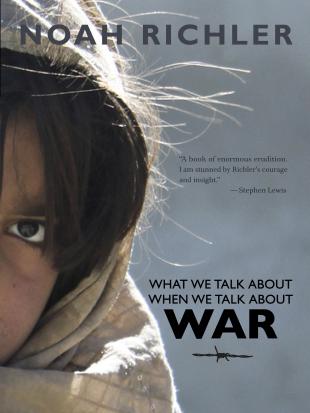 Noah Richler’s new book What We Talk About When We Talk About War comes with a warning label of a blurb with Margaret MacMillan’s “You don’t have to agree with everything Noah Richler says — I don’t — but you must take him seriously.” Which is is the first sign that we’re dealing with a polemic that exists to complicate the idea of polemicism. (It is also helpful a helpful blurb if you’re part of the choir Richler is preaching to– to keep an open mind is the very point.) The second sign that we’re dealing with such a polemic is Richler’s explanation of his book’s title, which comes from the Raymond Carver story whose full sentence is, “It ought to make us feel ashamed when we talk like we know what we’re talking about when we’re talking about love.” And so it should with war, according to Richler, in particular for those who’ve been in charge of our “strategy” in Afghanistan since 2001 and so clearly didn’t.
Most of my impressions of war were formed from the perspectives of my grandfathers who served in the Canadian Navy during World War Two and never had anything to say about war other than that it was awful. There was also the letters long saved that my father’s father had written home to his wife and children during the many years he had to spend away from them. And a story about the body of a dead German, my grandfather’s long lasting impression that inside that man’s wallet there would have been photos of a family much like his own. Which is not to say that my grandfathers did not take pride in their years of service– I spent many a Remembrance Day watching my grandfather march in parade, his medals displayed. I’ve spent more time than you would imagine at the old Naval Club on Hayden Street. But I mostly remember listening to the lists of the ships that were lost in the fighting. I remember being told over and over that the reason they had fought was so that war could be obliterated. Back when I was learning what I know about war, they kept telling us, “Never again.”
Peacekeeping was invented by men who’d learned too much about war, and forgotten by men who’d never known it at all. In the years since my days at the Naval Club, Remembrance Day has been hijacked, the story of “peacekeeping” has been denigrated, and our country has been at war for a decade. And Richler shows that none of this just came about, but was instead the result of a deliberate campaign to shift public thinking, and build up the Canadian military in order to underline the presence of Canada on the international stage. At heart, the shift was rhetorical– we understand ourselves and our lives in terms of stories, and that story has moved in the last ten years from the complex shape of the novel with humanity at its core, to the simplistic epic tale with easy-to-grasp binaries of good and evil.
Richler outlines the circuity of the rhetorical arrangements– the government, think-tanks, the Canadian military has been successful at militarizing the Canadian mind-set by keeping Canadians so at a remove from war itself (which has not been difficult– Afghanistan is far away). That the media has been complicit in the game because war is news, it makes reporters feel useful and excited. That the liberal hippy-dippy platitudes of peacekeeping and love your brother are as empty as the troop-supporting sentiments expressed by ardent war-mongers like Don Cherry or Christie Blatchford (“The time we take to pay dues to war’s brutality… is an ersatz moral act that excuses actually having to do anything more proactive about a subject that is innately horrific.”) That the Afghanistan mission (which only turned into a “mission” once the war itself had become a little bit stale) became less about “war-making” and more about peacekeeping (and school building!) as the conflict wore on, the very approach that “top soldiers” had resisted in the beginning. That the military and government were able to turn instances of public mourning into public relations opportunities. Richler writes, “Ritual works, brilliantly. What chance does dissidence have when monolithic acclamation is the order of the day?”
Our notions of heroics have been hollowed out to exalt those in uniform to extents that are absurd. Women are exempt from this narrative unless they’re requiring rescue, Richler comparing responses to the deaths of photojournalist Tim Hetherington and Calgary Herald reporter Michelle Lang. Our language has been obfuscated, imbued with euphemism– torture is “enhanced interrogation,” a mission is war. The tragic disaster that was the Battle of Vimy Ridge is now a story of glory. People who dare to complicate the dictum of “Support Our Troops” are met with hateful vitriol.
“This is what passes for think-tank work in Canada, which is remarkable but what we have to put up with until others speak up,” writes Richler of a somewhat blathering blog post in which Canadian historian Jack Granatstein once again attempts to lay to rest the myth of the Canadian peacekeeper. In his book, Richler shows how these others have been silenced by rhetoric, and speaks up himself with an erudite text packed with wide-ranging references from Greek myth to modern video games, resisting all accusations of loftiness with a his very constructive final chapter, “What is to be Done?” (and there is plenty).
And while Richler’s message would have been better conveyed in particular to those beyond his choir with a bit more clarity and conciseness (as well as further editing. This text is a mess, though is promised to be cleaned up by next printing), it will be a relief to those of us who feel the same that someone is speaking up finally.
April 22, 2012
The Famous 5
 So many things I love are a part of this photo. Also, we had a really wonderful trip to Ottawa this weekend. Lots of reading on the train, hotel fun, good food, friends, and, speaking of friends, we were the beneficiaries of some amazing hospitality. Long live the Mini-Break!
April 18, 2012
Mini Review: Brief Lives by Anita Brookner
 “There is no charm to Anita Brookner”, I wrote last year when I read her novel Look At Me. Like Barbara Pym with just the lonely bits. The book was slow and depressing, and while I appreciated what was good about it, I didn’t like it. I probably would never have picked up an Anita Brookner novel again except that I found this one in a cardboard box on the curb in January. We had a ridiculously mild winter this year, a cardboard box of free books on the curb in January was an even surer sign than lack of snow that something was askew climatologically speaking. But it was the only such box I’d seen in months so I picked through it, took this one home and I read it over the last couple of days.
And that I read it over a couple of days suggests that pace-wise it was better-going than my last Brookner. Though it features the same kind of self-effacing narrator whose unreliability is never affirmed, only subtly suggested (and how does she do that subtlety? The narrator who ever so subtly is not really so subtle). With all tell and very little show, Brookner tells the story of Fay Langdon, a singer who gives up her career when she marries Owen whose business brings her into contact with the magnificent and obnoxious Julia. Fay asserts continually that she and Julia have little in common beyond their husbands’ relationship, that each exists on the other’s periphery, but the careful reader will discern otherwise.Who is the true victim here, and who is the villainess? What are the limits to Fay’s extraordinary self-denial?
Still not much in the way of charm, even better this was really good. A compelling and enjoyable read.
April 18, 2012
Don't pick the flowers
 “Don’t pick the flowers” is a cardinal rule at our house (along with “Don’t chase the pigeons”). It is so important to me that Harriet learn to engage with and appreciate nature without torturing or destroying it. Not every experience needs to be hands-on. And so what she’s come to understand about the flowers we encounter in our neighbourhood (and gloriously, there are so so many) is that they’re still growing. When she touches them, she has to be gentle. “They’re still growing?” she asks me, looking back over her shoulder, and when I nod, she seems to get it. But we’ve made an exception for the dandelions. Not because they’re lesser flowers, but because they’re a flower of abundance. She seems to get this too. And so we gathered a bouquet on Monday morning on our way home from the library, and it’s been decades since I did this. It’s been decades since I sat at a table with a dandelion centrepiece. I’d forgotten there had even been such centrepieces, but there were so many, and as we picked our flowers, it all came back to me. The “this was why I had a child” moment I didn’t even know that I was waiting for. And the lesson too about exceptions– as important as the lesson about still growing. How important it is for our children to grasp that we live in a bendy and beautiful world.
April 16, 2012
Malarky by Anakana Schofield
 If Hagar Shipley met Stella Gibbons, the end result might be Anakana Schofield’s Malarky, but then again, it probably wouldn’t be, because Malarky refuses to be what you think it is. And moreover, it probably wouldn’t be because the book is meant to be chock-a-block with allusions to James Joyce and Thomas Hardy. Don’t tell anybody, but I still haven’t read Ulysses (and hence the Gibbons instead of the primary sources), but I have read Malarky, and it was brilliant, which I know for certain even with the burden of my literary ignorance. And that I can pronounce a book as wonderful even whilst unable to access its higher planes of greatness is certainly saying something for the book itself, which is mostly, “You’ll like it too.”
Schofield’s heroine, Our Woman, if she can be summed up at all, will be summed up with the explanation she gives for the period of despair she suffered after the birth of her first child: “Then I had a cup of tea and six weeks later, I felt better.” There is so much that goes unspoken of, silences to be filled with the rudiments of life as a farming wife, of motherhood, of friendship with her gang of local women (“…not a day passed when several of them didn’t meet. They were like tight ligaments in each other’s life, contracting, extending and sustaining the muscle of each other, house to house, tongue to ear”).
The bottom falls out, however, when she discovers her son up to unmentionable things with the neighbour’s boy. Our Woman’s stress is compounded by a woman she meets in town who confesses to her that she’s been doing unmentionable things with Our Woman’s husband. In response, Our Woman goes out into the world determined to do a few unmentionable things of her own to learn a thing or two, but the situation becomes more complicated– her son takes off to join the US army and local rumour has it that he did it to get away from her, and also her obsession with what she saw him doing becomes a kind of fascination, a desire to be close to him in an impossible way that suggests local rumours could be true.
But it’s hard to tell. Malarky is very much of the world– the Irish economy, wars in Iraq and Afghanistan, the plight of immigrants, mental illness, grief– and yet, its interiority is impermeable. When Our Woman spies her son shirtless in the barn, she notes, “He must have been freezing, his pale body bleary and quivering, trousers at his ankles.” However perversely, she is ever a mother, urging on a sweater. But she’s not just a comic figure; Schofield evokes Our Women with remarkable sympathy: “Mainly she had wanted to hit him about the head and shout these aren’t the things I have planned for you.” Malarky is a journey beyond the limits of love, an equally sad and hilarious portrait of motherhood.
“Malarky is like nothing else, and what everything should be,” is something I wrote down this weekend. First, because it’s as funny as it’s dark, and also because it dares readers to be brave enough to follow along an unconventional narrative. Though the winding path is only deceptively tricky– Our Woman’s voice is instantly familiar, and the shifting perspectives remain so intimate and immediate that the reader follows. Consenting to be led, of course, which is the magic of Malarky. This is a book that will leave you demanding more of everything else you read.
April 15, 2012
Only in hindsight
 I loved Stephen Marche’s piece “The Persistence of Mad Men”: “Everything in Mad Men is predictable, but only in hindsight.” Marita Dachsel and Carrie Snyder, two women I like and admire, have a conversation about The Juliet Stories, motherhood, and the writing life. Carrie Snyder also turns up at Blog of Green Gables writing about the various stages of reading with her children. I love that Sarah Tsaing is writer-in-residence at Open Book Toronto this month. Sarah is also on the New Generation of Canadian Poets, which has its own page at Amazon. Jonathan Bennett on Kyo Maclear’s Stray Love. Nathalie Foy likes Jo Walton’s Among Others. My friend Erin gave me a Cath Kidson Diamond Jubilee mug (which should go really well with my new bunting, which is due to arrive in the post soon. And how amazing that I get to spend the next couple of weeks anticipating bunting in the post [because is there any greater state of being?]). Blogs that are interesting me lately and challenging notions of the form: Habicurious (“Exploring the intersection of people, their housing and communities”), and Kathryn Kuitenbrouwer’s May I Stare At You?, and Heinonen on writing and reading fiction (in particular, lately, “The Notebook Habit and the Hell of Notebooks“). Richard Florida on “Why Young Americans Are Driving So Much Less Than Their Parents”. And finally, we’re currently building a box city at our house (of cereal boxes, pasta boxes and very much lately of tissue boxes) as inspired by Alfred Holden’s Beaver, whose exhibition Stuart and I went to see years ago.

April 13, 2012
The fourth day she reduced the teabags inside the pot to one
“The fourth day she reduced the teabags inside the pot to one, and he commented the tea had gone very weak, as though it was being controlled by the weather or an outside force. He did not lift the lid of the pot, because he was not accustomed to doing such things for himself.” –from Anakana Schofield’s Malarky
April 12, 2012
So I am required to support stupid women writers now?
I am confused. Meg Wolitzer writes an essay about how “women’s fiction” gets lumped into one big bucket of dross. Essay gets writers talking. Writers begin taking offence to distinctions being made in that big bucket of women’s fiction, dross and all. Apparently we’re supposed to embrace the bucket. “Support Women Writers!” becomes a rallying cry, caveats forbidden. Jennifer Weiner tweets, “Thing that drives me crazy: essays re: women’s lit that begin, “now, I’m not talking about ALL books by women, just the ones I approve of.”” But isn’t the problem in the first place that too many people are talking about ALL books by women like it’s just one thing? Someone else makes a video called “Support Women Writers! (But Not The Stupid Ones)”, and I’m thinking, “Right on! Oh, wait. This is supposed to be sarcastic?”
So I am required to support stupid women writers now? The ones whose stupid books are the reason women writers get such a bad rap in the first place?
I support women writers not out of a knee-jerk sisterhood reaction, but because I know that our literature is richer for the inclusion of female authors and female characters in the canon. I know that our magazines and journals (which, incidentally, are not exactly part of a thriving industry, so perhaps they might heed a bit of advice) will be better when they cease to neglect work by half the population. I support women writers because for reasons related to prejudice and marketing, so many great ones are being passed over by the other half of the population who themselves are losing out on essential reading experiences.
“The difference of value persists,” wrote Virginia Woolf (and also wrote me), but the commercial/literary divide wasn’t the difference we were writing about. This argument keeps getting hijacked over and over again.
UPDATE: A line from this wonderful post about “girls books” and “boys books” is applicable to the women writers issue: “The secret is that it simply has to be a good book.” And while I agree that dividing children’s books by the gender of their intended readers is bad for everybody, it’s complicated because I do acknowledge that there is such thing as a woman’s book in terms of adult fiction: “…it would be a fallacy to pretend that all fiction is universal; worse, to demand universality as a quality standard is to say that drawing-room women are insignificant, that sisters, wives and daughters do not matter… [But] I can’t help but wonder where the onus lies in the failure of women’s writing to achieve universality – what is it that lets us down, the stories or their readers?”
The point is that the gender line (sometimes) exists, but as readers we all have to be fearless and open to challenge enough to keep on crossing it, to teach our children to cross it too. The secret is that it simply has to be a good book.






