March 5, 2020
Polar Vortex, by Shani Mootoo
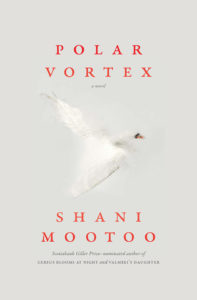
At first glance, this is a novel about a love triangle. Priya, who is married to Alex (a woman), and they live together in quaint and rural Prince Edward County. But something isn’t right, even before we learn that their household is about to be disturbed by a visit from Priya’s old friend, Prakash. Even notwithstanding Priya’s erotic dream about Prakash, which opens the novel. There is a distance that stands between Priya and her wife, and also a strange, uncanny hollowness to Priya’s first-person narration—or maybe it’s not hollow, but instead there’s a kernel of something there (what?!) that the reader is not privy to.
Prakash is a very old friend, a friend that Priya has barely spoken of to Alex, though she has pointed him out in an old photo from university, a photo of the two of them alongside Priya’s first girlfriend, Fiona. And is Alex threatened because he shares a cultural heritage with Priya? They are both diasporic Indians, Prakash from Uganda (where his family was expelled and brought to Canada as refugees) and Priya from Trinidad—though Priya would argue that this isn’t such a remarkable connection. But of course there is more to it, more than even Alex knows, more than Priya is willing to admit to herself or to even remember.
The novel takes place over the course of a day, and the tension in the text can be excruciating—but in the very best way. The kind of excruciating tension that makes a book unputdownable, that causes a reader to yell at a page. Polar Vortex becomes a book about truth and memory, about how little we know each other, and ourselves. Strange, ominous, haunting, it’s a propulsive read and a deliciously unsettling one.
March 4, 2020
My Barbies Always Got Pregnant

Maybe it’s genetic? Because we were listening to our children playing Playmobil the other day, and one little plastic figure or another in their game had gotten knocked up, and my husband said, “It’s just like you!” Because my Barbies always got pregnant, always. I didn’t even really have Barbies, but I played when them at my cousin’s house, and the narrative of our game would inevitably reach the point where I’d stuff a pile of clothing under my Barbie’s voluminous blouse (my cousin’s Barbie fashions were very 1970s and a-line) and suddenly it would be A Very Special Episode. I don’t recall that my Barbie ever had a partner, because who could be bothered with Ken, who underpants were moulded to his body, so it wasn’t like that old Barenaked Ladies Song. I don’t recall either where I got the idea for this Barbie story line—it is possible I was unduly influenced by the movie Look Who’s Talking, but that movie didn’t come out until I was 10, and I think I’d been playing Pregnant Barbies for years before that. And it wasn’t even Barbies—any kind of imagination role-playing game would, for me, inevitably lead to me getting pregnant (with clothes stuffed up under my t-shirt, natch), to the point where people didn’t want to come over and play with me anymore—although it’s possible there were other reasons for that.
Other pop-cultural pregnancies that influenced me: Elyse Keaton’s shark-jumping pregnancy late in the Family Ties series (she goes into labour while wearing a brown velour track suit that I think my cousin’s Barbie had); Elizabeth McGovern’s pregnancy in the movie She’s Having a Baby, with co-star Kevin Bacon, which I never even saw, but I was obsessed with the trailer and where she said, “I stopped taking the pill”; when Martha Plimpton gets pregnant in the movie Parenthood (and perhaps that entire movie); and the Molly Ringwald vehicle For Keeps, which I am not sure I ever saw either, but I sure did read the back of the VHS tape at my corner store. And yes, Look Who’s Talking, and maybe the source of all of this is that I figured if I got pregnant, at least I’d end up with John Travolta in the end. (And Kenickie and Rizzo in Grease. Even though that was just a false alarm.)
I also spent my childhood reading newspaper articles I didn’t properly understand about stories like Baby M, and Chantal Daigle.
Anyway, it occurred to me—as I listened to my children following my imaginative footsteps, as I was going through copy edits for my brand new novel that is forthcoming in October—that my Barbies never actually quit getting pregnant, and that I just started writing their stories down in stories instead. Because my fictional characters always get pregnant too. Or they don’t—I’m currently writing a short story about a man whose wife, an online influencer, decides to monetize her infertility. In 2014, I edited an anthology of essays all about the experience of getting pregnant, or not getting pregnant, because these are the big turning points in a person’s life. A year ago I wrote about how I do love me a good fictional abortion (which is not to say that the nonfictional ones aren’t worth having, obviously) but I think I can take a step back from that and consider that it’s pregnancy in general (desired or not, realized or not) that most intrigues me from a narrative point of view. It’s why, to be frank, books about men don’t interest me that much, because men’s lives don’t offer the same possibilities, the same questions and potential for transmogrification. The hero quest? Yawn. Instead, the possibility of having your entire life railroaded (by a pregnancy or the failure to have one), not being architect of your own fortunes, so much left to chance, hope, luck. It’s in all the fairy tales, some of our oldest stories, Sleeping Beauty and Rapunzel, even the old woman who lived in a shoe.
March 4, 2020
March Books on the Radio
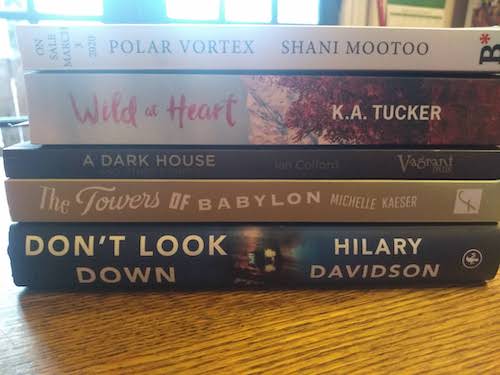
So happy to talk GREAT BOOKS on the radio this morning with the lovely Wei Chen, who even reads the books I recommend. If you missed it live, you can listen again on the podcast. I come in at 35.00.
March 2, 2020
Gleanings
- I like to think of myself, in some ways, as an artist of the everyday.
- “Let it rest” can mean giving the piece an hour, if that’s the deadline. For an essay, a week or a month is better.
- Some moments call for flowers, or a lasagna.
- This is what blogging is about, that we can see each other even when we feel invisible, that through time and space and memory and algorithms, we see each other. We hear each other. That in the quiet, we are briefly together.
- First steps and leap years
- I’ve been keeping a “book” since 2011.
- A long time ago my husband built a hang glider.
- Due to the luck of the draw I was one of the last to be called, and the jury was selected before I was asked to return to court.
- So I’ve developed a kind of short hand for interpreting dating profiles to save me from spending a precious evening suffering through a bad date instead of chocolate-dipping a whole box of strawberries and eating them by myself.
- When people suggest feminism has somehow been a failure, I like to hark back to the world I was born into, the world that made my mother so full of suppressed fury…
Do you like reading good things online and want to make sure you don’t miss a “Gleanings” post? Then sign up to receive “Gleanings” delivered to your inbox each week(ish). And if you’ve read something excellent that you think we ought to check out, share the link in a comment below.
February 28, 2020
The Bug Girl, by Sophia Spencer
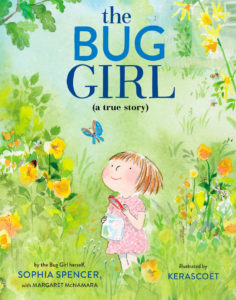
The Bug Girl, by Sophia Spencer, with Margaret McNamara, has a very cool backstory—when a young girl with a passion for insects finds herself bullied by peers, her mother reached out to professional entomologists to offer support for the girl, which went viral. And this is how Sophia Spencer became a debut picture book author at the age of 9, but even knowing none of this, there is a lot to love about The Bug Girl. It’s a book about unabashedly being yourself, about pursuing your own avenues and fascinations, and about defying other people who might hold those fascinations against you. The book is sweet and fun, but also an inspiring call to resist peer pressure, and to understand just how great and wondrous the world is—beyond the limits of one’s own community, and also right down to the smallest creatures on earth.
February 28, 2020
Disfigured, by Amanda Leduc
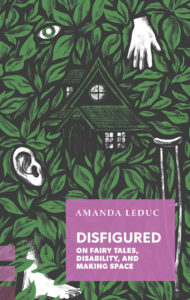
While I was intrigued by the premise of Amanda Leduc’s Disfigured: On Fairy Tales, Disability, and Making Space, I wasn’t anticipating just how interesting I would find the book, as someone who can get through the day (for now, at least) without giving disability a whole lot of thought and who also didn’t grow up with a strong connection to fairy tales, Disneyfied or otherwise. A few years older than Leduc, I was lucky enough to make it out of childhood without ever longing to be Ariel and before the age when Disney started marketing dresses, so that if I’d ever wanted to dress up as a princess, I would have had to design the costume myself— and that is only part of the reason I never did.
But to say that I did not grow up in a culture steeped in the messages and symbolism of fairy tales, steeped in those stories, would be disingenuous, as Leduc makes clear in Disfigured. Because these stories are everywhere, and yes, they’re only stories… but they’re not only stories. And throughout those stories are representations of disability—hands and heads chopped off in Grimms’ tales that magically grow back, and dwarfs, and women without voices, and witches with crutches, hideously disfigured beasts, and changelings, plus fairy godmothers who exist to reverse one’s fortune.
Leduc, who has cerebral palsy, uses her own experiences (and the text includes her own childhood medical records) to tell a story of what it means when happily ever after means learning to live with one’s disability, instead of magically overcoming it—and suggests that what must be overcome is society’s ableism instead. Disfigured is gorgeously written, a fascinating blend of memoir, scholarship and cultural commentary, a quick read that’s also packed with stories about fairy tales and disability, as well as questions and curiosities. It’s the kind of book that illuminates the ordinary and points to possibilities for a better kind of world.
February 26, 2020
I don’t know how to resolve the Wet’suwet’en crisis, and neither do you
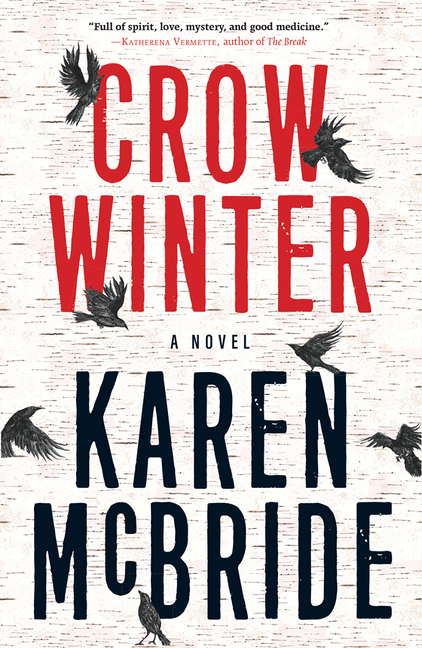
I keep thinking of something Christi_Belcourt tweeted about how impossible big corporations and government make it to resist plans they have every intention of rolling through, which we ought to keep in mind when considering the other First Nations who’ve signed on to the pipeline plan that Hereditary Chiefs of Wet’suwet’en are currently fighting in northern BC. It’s interesting to be reading Karen McBride’s novel Crow Winter as all this is unfolding, the story of a young woman who returms home to Spirit Bear First Nation in Northern Quebec and, with the help of her ancestors and the trickster Nanabush, must stop the development of a mining project on her family’s land. History is not just in the past, but it’s still happening all around us. I vote that every settler with an opinion on what’s happening in Wet’suwet’en just shut up and sit down, and read a novel instead.
February 24, 2020
Gleanings

- I gave him the two pages in which the painting is mentioned in the novel and based on those two pages, he did the painting in three days. It’s not a portrait of a real person. I bought the painting from him. It’s hanging in our den. I never get tired of it.
- Can you even bear to think about putting a half-read chunkster back on the shelf and ‘resting’ it for a few weeks…
- But the other thing about Tyler’s novels is that while her characters may stray, they almost always come home again.
- Never in my wildest dreams did I think I’d use a rolling pin as often as I do.
- What even is real life?
- Dialogue tips from The Port Authority
- …in the end, life is just an ephemeral garden of memories, a paradise we create with missteps, a paradise created as we bring together the broken pieces…
- The Buxton Chronicles is Curtis’s masterwork. It transforms the Elgin settlement into a version of Hannibal, Missouri, where Mark Twain grew up: a setting of idyllic boyhoods, full of pranks and woodsy adventure, in which Curtis examines themes of slavery, race, and class from an unequivocally Black perspective.
- Why High-Achieving Women Pretend Their Lives Are in Shambles
- When I read that Marie Kondo now started an online store, I felt like I’d been had somehow and I haven’t done much de-cluttering since.
- It felt like one of those Escher paintings where you’re climbing stairs to nowhere that never end.
- And the level of homesickness Ginzburg was feeling for her large family comes through strongly as she evokes them all while maintaining a personal privacy.
- Just after we turned out our reading lamps, the coyotes started singing.
Do you like reading good things online and want to make sure you don’t miss a “Gleanings” post? Then sign up to receive “Gleanings” delivered to your inbox each week(ish). And if you’ve read something excellent that you think we ought to check out, share the link in a comment below.
February 21, 2020
Calm
2016 was the year in which I spent a lot of time waking up and not recognizing the world I lived in anymore, which was certainly a privileged position to be in (or emerge from), but that didn’t make it fun. “If somebody’s not safe, then none of us are safe,” was a phrase I heard that stuck with me, as violence and tyranny in faraway places crept closer and closer, as we stumbled through 2017 and I started getting massacre fatigue. I kept thinking about Syria, and all those people who’d been living regular lives up until just a few years ago, and how what separated me from those people’s experiences was mostly nothing.
To be anxious at this moment in time is certainly not to have one’s feelings be unfounded, of course. And while it’s in my nature to compare right now to other difficult periods in history (in the 1960s, everyone supposed they’d all die in a nuclear war, for example, which is the thing I remind my daughter of when she wonders if she’ll have a future because of climate change), that is not the same as saying we don’t have to do anything about what’s going on. And I’ve become especially resistant to people insisting that everything is fine, and that, moreover “there are good people on both sides” in order to justify such a position. Anyone who starts in on The Militant Left, as white nerds in stupid khaki pants take up their tiki torches and parade through the streets of major cities. Certainly, everything is not okay, and the oceans are riddled with plastic and the forests are burning.
But it somehow got to the point where every time a plane flew over my house, I supposed we were all going to die (and guys, we live under a major flight path). I got emergency weather alerts on my phone, and would have heart palpitations. Every time there was a wind gust, I’d be thinking about cyclones, and patio furniture flying off condo balconies and that poor person in the west end who was killed by a flying STAPLES sign during a storm in September 2012. It all became more than a little overwhelming.
And then it stopped, with the end of November. Like that. I wish I could tell you how it happened, but I really don’t know. (This shift did correspond with positive results from one of my various annual cancer-screening medical appointments [#Thisis40], but surely that’s not the reason I’m not afraid of the sound of airplanes anymore?) And there have been a few times since where I’ve sensed the anxiety creeping back, which has itself made me anxious, because I don’t seem to have much control over this thing, but each time the anxiety over the anxiety has proved worse than the anxiety itself, which quickly retreated and was never as enveloping as it had seemed before.
But it’s not gone. It’s there, but at a remove. I can note it, acknowledge it, and choose not to indulge it, as I lie under my covers in bed at night and hear a howling wind outside. I can make a choice to hear the wind and stay calm instead, which did not seem to be an option before.
The night of January 3, I opened my laptop and checked Twitter (I don’t have Twitter on my phone, as a kind of self-preservation) and saw that #WorldWarThree was trending after the US’s targeted killing of an Iranian military official, and instead of scrolling and scrolling in a futile search for reassurance and understanding, I closed my laptop again. In contrast, when the Russian ambassador to Turkey was assassinated in December 2016, similarly leading to hysterical tweets about Franz Ferdinand, World War, and ominous phrases like, “Here we go…,” I couldn’t close my laptop for days. But this time I had enough to perspective to consider that all of us could probably benefit from calming right down.
Similarly a week after the targeted killing, when we received the devastating news that a passenger airplane had been shot down “by accident” outside of Tehran, killing everyone on board. It was news that hit particularly close to home, as 57 Canadians were on board and many more were also en-route to Toronto, and grief hung low just like a fug, but. “I am working at channelling calm as I head into today,” I posted on Instagram that morning. It seemed particularly important for my own mental health, but also on a broader level, because it had been escalating military attacks (the opposite of calm) that had led to the tragedy in the first place.
During the past couple of weeks, our country has been (I’m not going to say GRIPPED BY, because gripped isn’t a calm word, and I also don’t think it’s particularly accurate) following the protests set up along rail lines in solidarity with people fighting against the construction of a pipeline in the Wet’suwet’en First Nation in Northern British Columbia. These rail line protests have blocked the transport of goods and also passenger trains, and yes, its all very complicated, because the Wet’suwet’en people (consistent from what I understand of all groups of people ever) have divided opinions on what exactly should be done about the protests, not to mention the pipeline itself. I really do not have a comprehensive understanding of the matters at stake—though such a lack has not stopped other people from opining—but have appreciated the government response, which some might term as measured. Or calm. Even though Twitter partisans are raging that the Prime Minister doesn’t know anything about power, and the rail companies with record profits are following through with layoffs they were already planning but blaming the blockades so they don’t have to take the heat for their actions, and it’s reminiscent of the immediate aftermath of last month’s plane crash when the very same blowhards were calling on the Prime Minister to declare Revolutionary Guard in Iran a terrorist organization. It’s all just so incredibly stupid, because none of these people know what the answer is anymore than I do. None of it’s simple, and the only way toward an answer is work, which is what’s happening now all around us, and we need to be patient. And calm.
Calm is a superpower. This is a line from Ann Douglas’s latest book which is ostensibly about parenting, but which is really more about community, and connection, building a village, and learning to be better understand and support each other. And while Douglas is indeed speaking about parenting directly when she talks about calm being a superpower (and oh my gosh, is it ever), this advice is just applicable when it spills over into everything.
Perhaps it’s the closest thing we’ve got to an answer to anything right now.
February 20, 2020
A Dark House, and Other Stories, by Ian Colford
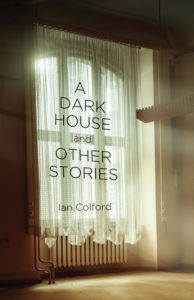
The old year clocked over on January 1, but I wasn’t finished with the books yet. A month ago I published a list at 49thShelf about 2019 books worth checking out before we got lost in a sea of 2020 new releases, and while I already suspected that it might be the least fluffy book list ever posted in the history of the internet, having read one more book from that list—Ian Colford’s A Dark House and Other Stories—I can now totally confirm it.
A Dark House… was terrific. And I’d been hearing rumours of as much; the book got a starred review in Quill & Quire. But one woman’s starred review can be another man’s DNF, so it always feels extra lucky when I like a book as much I’d been led to expect that I would.
A Dark House and Other Stories collects works Colford wrote between 15 and 25 years ago, as he explains in his acknowledgements, but nothing about these stories read like a writer who’s finding his way. The first story makes the reader feel immediately uncomfortable, about a man who has taken his son from his ex-wife. “He’s tall and gaunt and unsure what he’s doing is right, but he’s doing it anyway because what else can a man do when he’s been denied his son through a perversion of justice.” There’s a sense of inevitability here, and a real sense of empathy with somebody who has done wrong—and this pervades the whole collection. And truth be told, we’re living in a moment where a a lot of men are feeling like a perversion of justice has denied them something to which they’re entitled, and stories told from such a point of view tend to wear out my patience real fast…except that Colford writes from such a place of curiosity, grace and humanity that I kept on reading, and I am really glad I did.
The stories are gripping, plot-driven, have nothing slight about them, and decades are conveyed in just a few pages. In “The Comfort of Knowing,” a man decides to get the better of his wayward younger sister, but instead sews disaster. “The Dictator Considers His Regime” is a fascinating story that (I think) is set in mid-century Portugal, about authoritarian systems, freedom, personal responsibility, and the price of speaking truth to power. The main character in “McGowan on the Mount” reflects on a lifetime of family, loss, business, neighbourhood change, and finally can’t avoid taking one more chance on life and love. A college professor whose marriage breaks down projects his own experience onto a homely undergrad in “The Ugly Girl.” In “On the Beach,” a young girl whose mother is struggling is unnerved by her developing friendship with a troubled neighbour. In the title story, an inversion of “The Ugly Girl,” another professor projects her experience onto a student who reminds her of her ex, and reconsiders her life choices. And finally, in “The Music Lover,” a young girl struggles to keep the peace as her family falls apart.
Every story is rich and absorbing, small windows into wider worlds. With wide-ranging approaches to tone, theme, and characterization, what links these stories as a collection is simply that they’re just so good.