May 7, 2020
Writers & Lovers, by Lily King
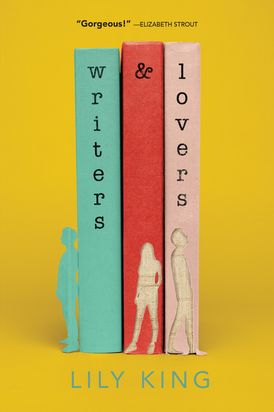
I was a bit wary of Writers & Lovers, by Lily King. I’d read her previous book, Euphoria, and I remember finding it a bit wanting (I am in the minority in this assessment), but then Maria Semple recommended this new novel on Instagram, and Maria Semple is a person I trust. I started reading it though, and thought: this is a novel that I’ve read before. The young woman who can’t get her life together, hold her liquor and whole makes terrible choices (see The Dud Avocado, Bridget Jones Diary) meets Lucky Jim, but for girls (and it’s different for girls) meets the MFA novel (any work of fiction that references Breadloaf, except for Ducks, Newburyport). “I just find it extraordinary that you think you have something to say,” our narrator is told on the second page, by the man who owns the property where Casey rents a potting shed that stinks of mould. She bakes cookies in a toaster oven, and almost everyone she ever knew who was a writer has gotten married and/or gone to law school. Casey is 31.
But I haven’t actually read this book before, unless you count Virginia Woolf’s To the Lighthouse where Lily Briscoe realizes her vision. Is Casey a fool or not to believe that she can make it as a writer, that the struggle is worth it, six whole years on a novel that maybe nobody will ever read? She makes money waiting tables at a restaurant in Harvard Square, she’s up to her eyeballs in debt and regret and heartache, and desperately mourning the death of her mother. An older writer (a widow with two young children) invites her into his orbit, clearly with domestic intentions, and maybe this is the answer to all her problems, but there is also the other guy, the one with whom the spark is undeniable—but right before their first date, he took off across the country on his motorcycle.
I am unaccustomed to reading about a woman who is flawed and who takes her art seriously, and I am unaccustomed to art that treats such a woman seriously, instead of as the butt of a joke. The book begins in familiar territory but then takes its reader to unexpected places, to previously unexplored terrain. How do you know you’re going to make it, until you make it, and it reminded me of reading Ann Patchett’s memoir of her friendship with Lucy Grealy, the two of them starting out in their careers, writing to save their own lives. And there’s a lightness to the tone that is possibly deceptive, that any story that’s such a delight to behold must necessarily be less than profound. That any woman who fails to be a perfect candidate must necessarily fail to triumph.
I loved this book, set in 1997, back you had to look up literary agents in guides at the library, and spend your last dollars mailing out your manuscript to the lot of them. A book that, as I said, begins in familiar territory, the usual tropes—the douchebag writer guy who’ll break your heart, the writer waiting tables, the possibly creepy mentor, the writer friend with whom one is in unspoken competition. But this portrait of the artist as a no-longer-young woman does something different and novel with all of these pieces, which is why the story so comes alive on the page.
May 5, 2020
A Match Made for Murder, by Iona Whishaw
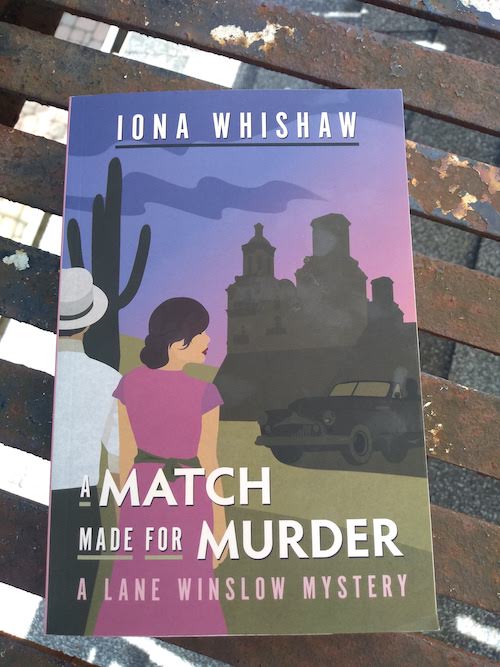
If you’ve ever wondered just how much they have to pay me to love the Lane Winslow mystery series as much as I do…the answer is nothing. And never has there been a series quite so easy to love, a series of books that has done wonders for my reputation as a person with good literary instincts, because everyone I recommend the series to loves them too, and that I get to receive a tiny bit of credit for that is marvellous luck. To have any kind of proximity to Lane Winslow is really a wondrous thing.
It never disappoints, this series, whose seventh installment is A Match Made For Murder, and Iona Whishaw has taken her heroine and her new husband on honeymoon to Tucson, Arizona. But first I’ll catch you up a bit, if you’re new to King’s Cove, the small village outside of Nelson, BC, where Lane Winslow—young, brilliant, beautiful, looking for a quiet life after spending WW2 spying for the British—retires in search of a quieter life, but she’s just got this knack for stumbling over bodies. Which brings her close to the handsome Inspector Darling—although in the first book, he’s arresting her on suspicion of murder. All that’s sorted out now, however, and the wedding has finally happened. On her honeymoon, at least, will Lane finally get the rest and relaxation she’s been seeking for the past two years?
But just while Lane is settled onto a lounge chair by the pool, reading a book (Nine Tailors, by Dorothy Sayers, naturally!), a shot rings out, and it won’t be the last one fired before the book is over. It turns out that Lane and Darling are surrounded by couples with complicated arrangements, mob connections, and possibly murderous intentions. Meanwhile, back in King’s Cove, Ames is left to unravel a curious case involving a dead man whose reputation for interfering with teenage girls goes back at least a decade, and when the woman he fancies turns out to have a connection to him, he struggles to retain his impartiality.
As always with Whishaw’s books, the novel is a delight, charming and funny, cozy and enveloping—by page 7, there are already scones. It’s also a wonderful literary homage to the classics of detective fiction, and I love that Nelson, BC, comes with its very own Baker Street. But coziness is not even the half of it—the series takes on race and racism (in this latest book, Nelson has its first Black police officer and Ames comes to understand that he gets to be regarded as an individual, while his colleague is forever representing an entire race), and misogyny, rape and spousal abuse all factor in this story, which is strongly concerned with the enormous power that men had at the time (and still have now) to control the women in their lives, and also with their sense of entitlement to that control. It’s an idea that is present in both Lane and Darling’s minds as they contemplate how their relationship might be different now that they are married—but then neither of them has ever had much taste for convention.
Lane Winslow, of course, will be keeping her name.
And here is Iona Whishaw reading from her new novel as part of 49thShelfLAUNCHPAD.
May 5, 2020
Gleanings
- We’re adapting. We didn’t want to. I’d rather be swimming…
- At this threshold, in this, our most vulnerable moment yet, can we find in our heart, our soul the empathy, the compassion and the kindness that is needed so badly?
- The pandemic might turn us all into birders.
- Pandemics actually “unfold in slow motion,” he says, and “there’s no event that changes the whole landscape on a dime.” But it feels that way, because of how relentlessly we quest for updates.
- We are living through unusual circumstances, and you are not obligated to do anything extra right now. But if a complete dinner on a single pan appeals, this one is pretty easy, and easy to adapt.
- I kinda want to say, “this week’s cake is…” but it is only Tuesday and there are five of us so half the cake is already gone.
- I’m not yet mourning or grieving the closure of the library. I guess I’m busy looking to the future of libraries.
- walking where no one walks
- From the very beginning, This Ain’t was familiar and it was all Hamilton.
- There, the sum of my sourdough expertise–it’s honestly not very much but has allowed me to cruise through many years of bread-making with much pleasure and little stress.
- I don’t want to leave my characters on the brink — maybe one or two, if they deserve it, but for at least some of them, I want church bells, or trumpets, or the Rocky theme song.
- The clouds have blown on, the sun is shining, it is 18°C and, at long last, it does seem as if we are in the opening stretch of an Ontario springtime in a year when optimism is utterly essential.
- However, if we can exercise our imagination and envision possibilities for the future, if we can live in a better future for even a few minutes in our minds, it is far likelier that we will experience hope and a belief in a better world.
- She gave me my love of reading which I treasure above most things in my life.
- Now I know, I know, you’re really not supposed to pick them but we have to cut ourselves some slack right now and I think the hedgerows can cope.
- I’m not sure they’ll function as vases. Or anything, for that matter. But I plan on glazing and firing them, anyway. We’ve come so far.
- Where on the map’s contours is the place where a woman paused to consider the beauty of the morning?
- She’s too smart and too artful a novelist to have left in anything that didn’t serve her purpose as she understood it, and she’s the kind of writer (meticulous, deliberate) who has earned my trust. That, arguably, shifts the burden to me: if the novel seemed too long to me, what was I missing?
May 4, 2020
Open House, by Jane Christmas

Something that truly shocks me are the number of attractive book covers identical in palette to my hideous bathroom, a bathroom whose hideousness I can blame on the fact that I don’t own a house, have never bought a house. The pink tiles and green blue tub are not something I ever would have chosen, but I have grown comfortable with them (and with the mildewed grouting) because it’s been home for 12 years now, and we live very comfortably here with rent that’s as affordable as my bathroom is ugly. (Which is to say: VERY)
But I have always been fascinated by houses, and how people live inside them, which is why I peruse real estate listings for fun, which is how I discovered my childhood home is currently for sale, and spent Friday morning virtually touring the place as in a dream. Which is why I was also a fan of the British property show Location Location Location when I lived in England, a nation whose sense of house and home is peculiar and fascinating, and felt very proud to rent a terrace house of my own (albeit just a two-up two-down, with nary a bay window), a photo of which hangs in my living room today (naturally with the bins out front). All of which makes me an ideal reader for Open House, Canadian Jane Christmas’s memoir of an extensive renovation on a Victorian terrace in Bristol she purchased with her third husband after their dream of living in a seaside town was scuppered by a variety of factors including SEAGULLS. Throughout the book, she examines her propensity for moving (she has moved 32 times!), her peripatetic childhood (and her many childhood homes in suburban Toronto, her marital homes, the places she lived in gritty 1980s Hamilton as a single mother.
The book has all the appeal of MLS listings, but with stories that don’t need to be guessed at. Instead, with characteristic candour, humour and flair, Christmas strips her life to the studs, and ruminates fascinatingly on notions of home and the places where we make them.
May 1, 2020
Actress, by Anne Enright
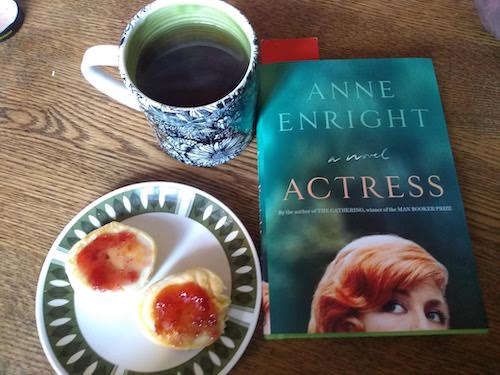
I find Anne Enright difficult, but not in the way I find other writers difficult. Which is so much so that I have absolutely no desire to read them, because life is difficult enough. But the work is usually worth it with Anne Enright, whose books are strange and beguiling, although ordinary at first glance—although I didn’t love her most recent The Green Road so much, a novel that was interesting that never really hung together in the way I wanted it to. For me, Actress was more satisfying, but also strange and disorienting, which isn’t a bad thing for a novel. Uncanny: to be both at home and not at home.
It’s the kind of book that’s just so specific, the kind of book of which you can’t say “it’s the kind of book…” at all otherwise. It’s so specific that’s difficult to fully comprehend that this is fiction, that Enright made the whole thing up, the singularly personality and career of Katherine O’Dell, the Irish theatre legend, her story told by her daughter, Norah, who grew up in her mother’s shadow, but this experience too is singular, as human experiences are. This is no Mommie Dearest, is what I mean. It’s so richly imagined and then filtered through the lens of Norah’s perspective, who’s missing half the details. A story by a daughter of her mother that is not a story of neglect or a litany of grievances, though there are some of these, but no more than with any human being. A different kind of take on mothers and daughters, that one can regard the other as a human being—albeit a complicated and flawed one, one who was eventually admitted to a psychiatric hospital after shooting a producer in the foot (which was less funny than it sounds—the injury caused torture for the rest of his days).
I appreciated this novel more after having read Say Nothing, by Patrick Radden Keefe, which filled in my understanding of The Troubles in Northern Ireland in the 1970s, though this part of the story is peripheral in The Actress. Intentionally so, because there are many things that Norah doesn’t want to know about her mother. But the part that resonated for me as I read this book in April 2020:
A funny thing happens when the world turns, as it turned for us on the night we burned the British embassy down. You wake up the next morning and carry on.
Anne Enright, The Acress
April 30, 2020
Catching Up with THE M WORD
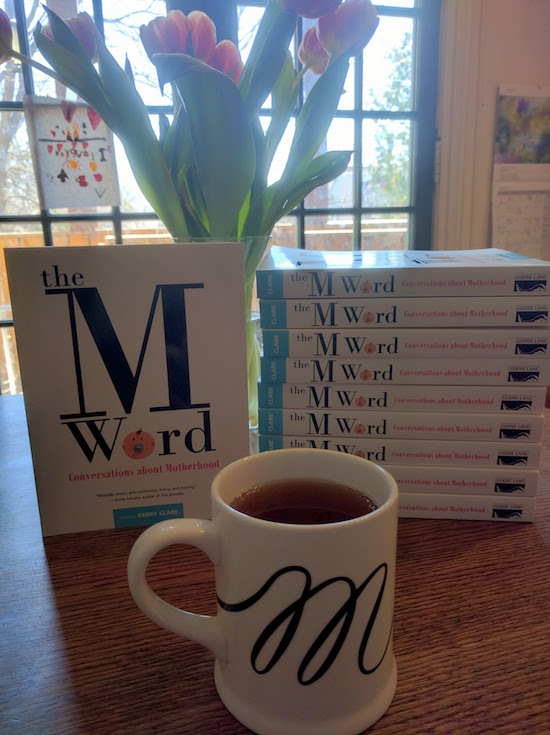
Last week, I was asked to blurb a memoir that’s coming out this September, and I was happy to say yes to this request, though I always have trouble reading books that aren’t actual books yet, and especially when they’re digital, because I’d have to read on my phone, and who wants to do that. But this book. Which I received on Friday and had finished by Monday night. On my stupid phone. Do you know what an endorsement that is?
The book is How to Lose Everything, by Christa Couture, and it’s a story that sparkles and sings. A story for anyone who would like to consider ways to find grace and keep going in the face of a hopeless situation. Amazingly, it’s also a book that was born out of the essay that Christa published six years ago in The M Word: Conversations About Motherhood. What amazing seeds that book has planted!
Which made me consider all the remarkable things that contributors to The M Word have been up to in the years since the book was published. I continue to be bowled over with gratitude to all the women who contributed to our project, and want to celebrate what some of them have been recently been up to literary-wise.
But first, I want to note the death of Priscila Uppal in September 2018. Uppal’s essay was “Footnote to the Poem “Now That All My Friends Are Having Babies: A Thirties Lament,” and it was funny, brutal, honest, and necessary. I am still so honoured that her work was a part of our collection.
- Heather Birrell’s latest book is the poetry collection, Float and Scurry, which has been shortlisted for the 2020 Gerald Lampert Memorial Award
- Christa Couture has just released her fifth album, Safe Harbour. Her memoir How to Lose Everything will be published in September.
- Nancy Jo Cullen’s debut novel The Western Alienation Merit Badge was published in 2019.
- Marita Dachsel’s most recent book is the poetry collection There Are Not Enough Sad Songs
- Ariel Gordon released the essay collection Treed: Walking in Canada’s Urban Forests in 2019. It has been nominated for the Carol Shields Winnipeg Book Award
- Fiona Tinwei Lam’s poetry collection Odes & Laments was published in 2019.
- Maria Meindl’s debut novel The Work was published in 2019.
- Saleema Newaz’s new novel, Songs for the End of the World, was due to be released in August. Due to uncanny connections between her novel—about a coronavirus that sweeps the world in 2020—and our current moment, the book has been released early as an ebook and the print book is coming this summer.
- Patricia Storms’ most recent book is the picture book Moon Wishes, co-written with Guy Storms and illustrated by, Milan Pavlovic published in 2019
- Julia Zarankin’s first book, Field Notes from an Unintentional Birder, is coming in September (and I can hardly wait!)
This is just a smattering of updates from our contributors, all of which have been up to good and interesting things in the years since the book came out. What a pleasure it is to have this connection with each and every one of them.
April 28, 2020
Gleanings
- I have baked enough over the past 40 years to know that one can use less yeast if one is willing to wait
- Even as I keep teaching my students that stories need conflict, I’ve grown perplexed about the ethics of abusing characters to drive a narrative arc.
- I am interested in the value of a mistake. If the character knew how to pronounce that word from the beginning, there wouldn’t be a story.
- Our world is changing drastically, but we don’t know what it will look like, which means there is room for us all to imagine.
- It’s more a matter of learning to live with the debris and planting what is hearty instead of wishing for what we can’t have.
- We first met somewhere on Cape Breton, remember?
- I mean, shouldn’t you stock the stuff you need for what you’ll want to cook and not some arbitrary list from a lady who loves Triscuits?
- I’m always inspired by people who make something out of discards, remnants and broken pieces
- It’s a lot to process, as is said, and it really freaking is. But we can hold it. We can, we do.
- Mondays are for Melancholy
- From the famous first line: “Mrs. Dalloway said she would buy the flowers herself” to the bittersweet ending, it’s a story told like the alighting of a butterfly on different consciousnesses as the narrator’s eye sweeps over London.
- every first draft is a success because by definition, its only job is to exist
- If Cineplex collapses, I honestly don’t know. But gawd, I need to go to a movie.
April 28, 2020
You are allowed.
You are allowed to have unpopular opinions.
You are not obligated to share them.
You can share them if you want, but you will annoy people
and maybe this is the point.
You are allowed to annoy people.
They are allowed to find you annoying when you do.
When you begin a post with “Am I the only one who…”
most of the time you are not.
You are allowed to like unpopular things
and not like popular things
and neither fact is particularly remarkable, really,
but neither is the photograph of my sandwich
that I posted on Instagram.
April 27, 2020
Where I Find the Time To Read: The Global Pandemic Edition

This is the third and perhaps the least fun installment in a series of posts about how I find the time to read. (Part one was about reading with a small baby, and you can read the post-breastfeeding edition here.)
And this post is remarkable because in the beginning of this, I couldn’t read at all. It was terrible, because the world was already upside-down, and then here I was unable to read—and if I’m not a reader, then who even am I?
Finding my way back to reading has been to find my way back into my own head again, and since I managed this, books and reading have provided the most wonderful distraction. Books have proven to be the very best way to measure out these days, and worthwhile not just as an escape, but also for the uncanny connections they’ve managed to make to what we’re going through, underlining the universality of experience even in extraordinary times, and also how amazing books really are.
Here’s how I did it.
- Rereading: In difficult times, there is nothing like returning to a book that’s familiar, a book that’s not going to surprise you. It’s a comfort thing, but it’s also a wonderful experience to be able to read again, to encounter a book you know and then find it changed. Or perhaps you’d forgotten it altogether—last summer I read Big Sky, Kate Atkinson’s first Jackson Brodie novel in almost a decade, and realized that I didn’t recall much of what happened in the first four books in the series. Returning to them since has been absolutely enchanting, and also so surprisingly perfect for this moment in a way I could never have predicted, not could have Atkinson herself as she wrote the novels years ago. That they acknowledge life’s darkness, which is important right now, but they’re also brilliantly funny and an escape in themselves. Getting to read these books again has been such a gift for me.
- Create a reading project: Don’t make this aspirational, but instead make it something you really want to do, an indulgence instead of a chore. If your project, like mine, is about rereading, all the better, because these will be books you already have at home–which is important when you’re locked down under quarantine. I have one more Jackson Brodie book to read, and then I’m going to undertake rereading everything Margaret Drabble ever wrote in chronological order. Thankfully, Margaret Drabble wrote a lot of books, and I have this secret wish that as I read through them, the world outside might become a little less terrible.
- Finally read the books you own that you haven’t read yet: I actually HAVE read all the books on my bookshelves, because the ones I haven’t read yet I keep on a different bookshelf…and some of these have been lingering there for a really long time. Now is the time! Keeping these titles distinct from the rest helps to focus your reading, and seeing the pile diminish can be satisfying. Remember too though that now is the time to acknowledge that some of these books you’re never actually going to read, and therefore you should get rid of them, which is perfectly fine and even freeing.
- Have a book swap with your neighbour: You get something new to read, something just a little off your beaten track, and you also get a little burst of social connection. (Just make sure they’re not just giving you the books that they’ve finally accepted they’re never going to read, because that’s probably not going to end well for you…)
- Acknowledge the reader you are: If your plan is to transform yourself into someone you’re not, then I’m not sure you’re going to be very successful. Life is hard enough right now, and I just don’t think it’s the best time to be adding reading Karl Ove Knausgård to your struggles if you, like me, have never found the prospect very appealing. Instead, pick up only the books you’re really excited about and read like nobody’s watching—because nobody is.
- Don’t be afraid to break up with your book: If the same book has been sitting on your beside since March 11, then it’s possible that the pandemic is not your literary problem. Perhaps that book is not even a bad book, but it’s just not the book you need at this moment, and you should have no compunction about putting it away for awhile. Forever, if need be. Try another one, and even another one, and eventually, something will take. (Here are some recommendations!)
- Order some books from your local indie, or from Indigo if that’s what’s available to you. I’m not saying this is going to get you out of your reading slump, but waiting for things to come in the post MAKES ME SO HAPPY these days and all days, and being happy feels good.
- Set limits for social media: The only social media app on my phone is Instagram, because I find it inspiring, as opposed to Facebook or Twitter which just raises my blood pressure and lead to endless scrolling. I don’t hate these sites, but they suck up my time in unproductive ways, so I am glad they’re not always accessible to me.
- Put your phone away: My best time for reading is from 9-11 once my kids have gone to bed, and I get the most reading done when my phone is out of reach.
- Ask yourself just what you’re seeking from news coverage: I’m not hiding my head in the sand, and it’s important for me to know what’s going on in the world. But during the time when I couldn’t read books and was obsessively scrolling and refreshing news sites, I was desperately looking for answers that nobody had yet. They still don’t. Acknowledging the futility of this was useful to me, and it was heartening to realize that books knew more secrets. These days, I focus my news consumption on print media (it has context and it’s FINITE!) and don’t look at online news after sunset.
- Stop watching so much Netflix. Unless you’re loving it and don’t miss reading at all, but I really do believe that books are a better kind of escape (and they help you sleep better). Rhonda Douglas is running a A 30-Day No Netflix Challenge over at her website as an incentive for writers, and I think it’s a great challenge for readers too. Or what if you set aside one or two evenings a week for reading instead of Tiger King? You probably won’t be sorry you did.
April 23, 2020
Misconduct of the Heart, by Cordelia Strube
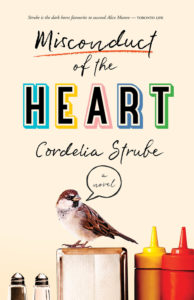
I was nervous about this book, and if you’ve ever read Cordelia Strube you’ll understand. Cordelia Strube whose previous novel was On the Margins of These Pages, There is Heartbreak, or at least it might as well have been. (The book was actually On the Shores of Darkness, There is Light, it was one of my favourite books of 2016, and won the Toronto Book Award.) But my capacity for heartbreak is so currently occupied at the moment by everything, and I can’t take any more. So I went into this warily, is what I’m saying, like the book itself was an unreliable teenage boyfriend. “Here’s my heart, Cordelia Strube,” is what I was thinking. “Be careful, please.”
Misconduct of the Heart is not a feel-good comedy. Narrator Stevie is currently sandwiched between violent assaults by her son who returned from Afghanistan with PTSD and the demands of her aging parents (her mother assaults their personal support worker and her father shits his pants), all the while Stevie herself has trauma that she’s never properly processed or admitted to anyone. She became pregnant with her son after a violent gang rape when she was a teenager, and was never able to show him affection—though her own mother and father weren’t stand-out examples of parenting either, so did anyone ever have a chance?
But they do, which is the point of this book, which is as funny as it’s dark. Populated by the characters who work at Chappy’s, the weathered franchise restaurant in suburban Toronto where Stevie works as kitchen manager, and if you’ve ever worked in a kitchen, you’ll recognize the scene. High stress, as if Stevie needs any more—but then someone drops off a child who might be the daughter of her son, and here Stevie sees the possibility of something. Redemption? Could this troubled world ever give her that much?
This is not a feel-good comedy at all, but oh it’s so richly funny. Funny in the way the world is, absurd, preposterous, sad and hilarious. “You can’t make this stuff up,” kind of funny, which is funny because Strube does, and it’s wonderful. And even feel-good, because there is hope and there is triumph, and the reader is rooting for every single one of these lovable losers to finally win.
It’s a slow build, this book, and first 100 pages are tough—the narrative is a bit disorienting, we’re not sure why we care about any of these people yet, and the story of Stevie’s past and what happened to her son is really brutal. But the reader should persist because once the story picks up, the payoff is huge, such an unrelenting kernel of light and love. There is nobody else who writes like Cordelia Strube, and this is one of my favourite books of the year.






